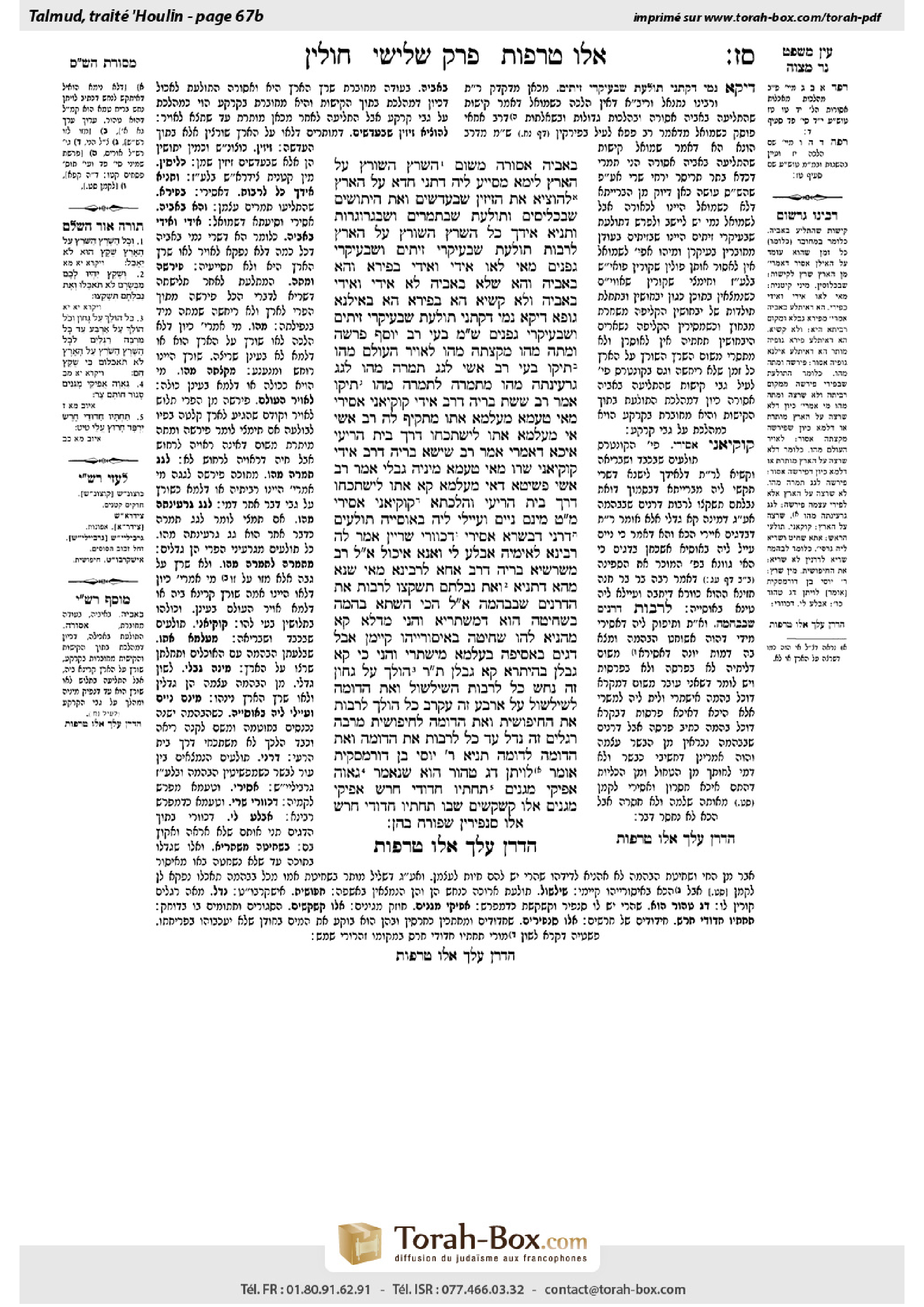
Chullin 67b: Talmud study for Daf Yomi
Study the Talmud for Daf Yomi with scanned pages, Hebrew text, English translations from Sefaria and AI-generated French translations.
Passage selection and English or AI-generated French translation are available where the scan has annotations. Daf Study is independent of Torah-Box and Sefaria.
Browse Chullin · חולין · All tractatesChullin 67b text and translations
This page of Chullin includes the Aramaic text, an English translation and an AI-generated French translation, alongside the scan above.
חולין ס״ז ב · Aramaic and Hebrew text
בְּאִבֶּיהָ אֲסוּרָה מִשּׁוּם ״הַשֶּׁרֶץ הַשֹּׁרֵץ עַל הָאָרֶץ״.
לֵימָא מְסַיַּיע לֵיהּ, דְּתָנֵי חֲדָא: ״עַל הָאָרֶץ״ – לְהוֹצִיא אֶת הַזִּיזִין שֶׁבָּעֲדָשִׁים, וְאֶת הַיַּתּוּשִׁים שֶׁבַּכַּלִּיסִים, וְתוֹלַעַת שֶׁבַּתְּמָרִים וְשֶׁבַּגְּרוֹגְרוֹת. וְתַנְיָא אִידַּךְ: ״כׇּל הַשֶּׁרֶץ הַשֹּׁרֵץ עַל הָאָרֶץ״ – לְרַבּוֹת תּוֹלַעַת שֶׁבְּעִיקָּרֵי זֵיתִים וְשֶׁבְּעִיקָּרֵי גְפָנִים.
מַאי לָאו, אִידֵּי וְאִידֵּי בְּפֵירָא, וְהָא בְּאִבֵּיהּ, וְהָא שֶׁלָּא בְּאִבֵּיהּ?
לָא, אִידִי וְאִידִי בְּאִבֵּיהּ, וְלָא קַשְׁיָא: הָא בְּפֵירָא, הָא בְּאִילָנָא גּוּפֵאּ.
דַּיְקָא נָמֵי, דְּקָתָנֵי ״תּוֹלַעַת שֶׁבְּעִיקָּרֵי זֵיתִים וְשֶׁבְּעִיקָּרֵי גְפָנִים״, שְׁמַע מִינַּהּ.
בָּעֵי רַב יוֹסֵף: פְּרָשָׁהּ וּמֵתָה, מַהוּ? מִקְצָתָהּ, מַהוּ? לַאֲוִיר הָעוֹלָם, מַהוּ? תֵּיקוּ.
בָּעֵי רַב אָשֵׁי: לְגַג תְּמָרָה מַהוּ? לְגַג גַּרְעִינָתָהּ מַהוּ? מִתְּמָרָה לִתְמָרָה מַהוּ? תֵּיקוּ.
אָמַר רַב שֵׁשֶׁת בְּרֵיהּ דְּרַב אִידִי: קוּקְיָאנֵי אֲסִירִי, מַאי טַעְמָא? מֵעָלְמָא אָתוּ.
מַתְקֵיף לַהּ רַב אָשֵׁי: אִי מֵעָלְמָא אָתוּ, לִישְׁתַּכְחוּ דֶּרֶךְ בֵּית הָרֶיעִי.
אִיכָּא דְּאָמְרִי, אָמַר רַב שִׁישָׁא בְּרֵיהּ דְּרַב אִידִי: קוּקְיָאנֵי שְׁרוּ. מַאי טַעְמָא? מִינֵּיהּ גָּבְלִי. אָמַר רַב אָשֵׁי: פְּשִׁיטָא, דְּאִי מֵעָלְמָא קָא אָתוּ – לִישְׁתַּכְחוּ דֶּרֶךְ בֵּית הָרֶיעִי!
וְהִלְכְתָא: קוּקְיָאנֵי אֲסִירִי, מַאי טַעְמָא? מֵינָם נָיֵים וְעָיְילִי לֵיהּ בְּאוּסְיֵיהּ תּוֹלָעִים. דַּרְנֵי דְּבִשְׂרָא – אֲסִירִי, דְּכַוְורֵי – שַׁרְיָין.
אֲמַר לַהּ רָבִינָא לְאִימֵּיהּ: אַבְלַע לִי וַאֲנָא אֵיכוֹל, אֲמַר לֵיהּ רַב מְשַׁרְשְׁיָא בְּרֵיהּ דְּרַב אַחָא לְרָבִינָא: מַאי שְׁנָא מֵהָא דְּתַנְיָא ״וְאֶת נִבְלָתָם תְּשַׁקֵּצוּ״ לְרַבּוֹת אֶת הַדְּרָנִים שֶׁבַּבְּהֵמָה?
אֲמַר לֵיהּ: הָכִי הַשְׁתָּא? בְּהֵמָה בִּשְׁחִיטָה הוּא דְּמִשְׁתַּרְיָא, וְהָנֵי מִדְּלָא קָא מַהְנְיָא לְהוּ שְׁחִיטָה – בְּאִיסּוּרַיְיהוּ קָיְימָן, אֲבָל דָּגִים בַּאֲסִיפָה בְּעָלְמָא מִישְׁתְּרוּ, וְהָנֵי כִּי קָא גָבְלָן – בְּהֶיתֵּרָא קָא גָבְלָן.
תָּנוּ רַבָּנַן: ״הוֹלֵךְ עַל גָּחוֹן״ – זֶה נָחָשׁ, ״כֹּל״ – לְרַבּוֹת הַשִּׁילְשׁוּל וְאֶת הַדּוֹמֶה לְשִׁילְשׁוּל, ״עַל אַרְבַּע״ – זֶה עַקְרָב, ״כֹּל הוֹלֵךְ״ – לְרַבּוֹת אֶת הַחִיפּוּשִׁית וְאֶת הַדּוֹמֶה לְחִיפּוּשִׁית, ״מַרְבֵּה רַגְלַיִם״ – זֶה נָדָל, ״עַד כׇּל״ – לְרַבּוֹת אֶת הַדּוֹמֶה וְאֶת הַדּוֹמֶה לַדּוֹמֶה.
תַּנְיָא, רַבִּי יוֹסֵי בֶּן דּוֹרְמַסְקִית אוֹמֵר: לִוְיָתָן דָּג טָהוֹר הוּא, שֶׁנֶּאֱמַר: ״גַּאֲוָה אֲפִיקֵי מָגִנִּים״, ״תַּחְתָּיו חַדּוּדֵי חֶרֶשׂ״; ״אֲפִיקֵי מָגִנִּים״ – אֵלּוּ קַשְׂקַשִּׂים שֶׁבּוֹ, ״תַּחְתָּיו חַדּוּדֵי חֶרֶשׂ״ – אֵלּוּ סְנַפִּירִין שֶׁפּוֹרֵחַ בָּהֶן.
הֲדַרַן עֲלָךְ אֵלּוּ טְרֵפוֹת.
Chullin 67b · English translation
while attached to the ground is prohibited, due to the prohibition of: “Every swarming thing that swarms upon the earth,” because the cucumber was considered part of the earth when the worms infested it.
The Gemara suggests: Let us say that a comparison of the following two baraitot supports Shmuel’s opinion. As it is taught in one baraita: “Every swarming thing that swarms upon the earth” serves to exclude zizin, a type of insect that is found in lentils, and mosquitoes that are in kelisim, a type of bean, and worms that are in dates and in dried figs. All of these are permitted for consumption because they do not swarm on the earth itself. And it is taught in another baraita that when the verse states: “Every swarming thing that swarms upon the earth,” the word “every” serves to include as non-kosher worms that are in the roots of olive trees and that are in the roots of vines.
What, is it not that both this and that baraita are referring to insects that are found in the fruit, and this, the latter baraita, deems forbidden fruit that is attached to the ground, and that, the former baraita, deems permitted fruit that is not attached to the ground? This would support Shmuel’s statement that worms in a cucumber attached to the ground are forbidden.
The Gemara responds: No, it is possible that both this and that baraita are referring to insects found in vegetation attached to the ground; and the apparent contradiction between the two is not difficult. This, the former baraita, deems permitted insects found in the fruit, and that, the latter baraita, deems forbidden insects found in the tree itself. This interpretation contradicts Shmuel’s statement.
The Gemara notes: The language of the latter baraita is also precise, as it teaches: Worms that are in the roots of olive trees and in the roots of vines, clearly referring to the tree itself rather than the fruit. The Gemara concludes: Learn from it that the second interpretation is correct.
§ From the above discussion, it is clear that worms that grow in produce not attached to the ground, and have never emerged from the produce, do not fall under the prohibition of: “Every swarming thing that swarms upon the earth,” because they have never swarmed on the earth. Rav Yosef raises a dilemma: If a worm emerged from the produce but died before it reached the earth, what is the halakha? Is it considered to have swarmed on the earth simply by having emerged? If only part of it emerged, what is the halakha? If it emerged into the air of the world and flew away without landing, what is the halakha? The Gemara responds to all of the above: The dilemma shall stand unresolved.
Rav Ashi raises a dilemma: If a worm was spawned in a date, and it emerges and climbs onto the roof of the date, i.e., its upper part, what is the halakha? Is this considered the normal manner of growth for the worm, in which case this does not render it forbidden, or is the roof of the date considered a separate entity such that crawling there constitutes swarming on the earth? And if it is considered a separate entity, what is the halakha if the worm climbed onto the roof of the date’s pit? Is this considered the normal manner of growth for the worm? If the worm emerged from a date and entered a date that was attached to it, without being exposed to the air, what then is the halakha? The Gemara responds to all of the above: The dilemma shall stand unresolved.
§ Rav Sheshet, son of Rav Idi, says: Kukeyanei, worms found in the internal organs of animals, e.g., in the lung and liver, are forbidden. What is the reason for this? It is that they came from the outside world, i.e., the animal must have swallowed them along with vegetation, in which case these worms were already included in the prohibition: “Every swarming thing that swarms on the earth is a detestable thing; it shall not be eaten.”
Rav Ashi objects to this: If they came from the outside world, they should be found in the digestive tract as well. Since they are found only in non-digestive organs, they must have originated in the animal and should not be considered creeping animals that swarm on the earth.
Some state the exchange differently: Rav Sheisha, son of Rav Idi, says: Kukeyanei are permitted. What is the reason for this? It is that they originate from inside the animal. Rav Ashi said: This is obvious, as if they came from the outside world, they should be found in the digestive tract.
The Gemara concludes: And the halakha is: Kukeyanei are forbidden. What is the reason for this? It is that the animal sleeps, and worms enter it through its snout. From there they travel to the internal organs without passing through the digestive tract. Worms found in meat between the skin and the flesh are forbidden; those found in fish are permitted.
The Gemara recounts: Ravina said to his mother: Conceal the fish’s worms inside it so I cannot see them, and I will eat the fish. Rav Mesharshiyya, son of Rav Aḥa, said to Ravina: What is different in this case from that which is taught in a baraita, that the verse: “Their carcasses you shall have in detestation” (Leviticus 11:11), serves to include worms that are in animals as forbidden? Why are worms in fish permitted?
Ravina said to him: How can these cases be compared? An animal is rendered permitted for consumption only by slaughter. Before it is slaughtered, it and all its contents are considered part of a living animal and prohibited by the Torah. And since the animal’s slaughter is not effective for these worms, they retain their forbidden status. But fish are rendered permitted by merely gathering them; they are not included in the prohibition against eating a limb from a living animal. And therefore, when these worms originate inside the fish, they originate in a permitted state.
§ The verse states: “Whatever goes upon the belly, and whatever goes upon all fours, or whatever has many feet, even all swarming things that swarm upon the earth, them you shall not eat” (Leviticus 11:42). The Sages taught in a baraita that the phrase “goes upon the belly” is referring to the snake. The preceding word “whatever” serves to include the earthworm and animals similar to an earthworm. The phrase “upon all fours” is referring to the scorpion. The preceding phrase “whatever goes” serves to include the beetle and animals similar to a beetle. The phrase “has many feet” is referring to the centipede. The preceding phrase “or whatever” serves to include animals similar to a centipede and animals similar to those similar to it.
It is taught in a baraita: Rabbi Yosei ben Durmaskit says: The leviathan mentioned in the Bible is a kosher fish, as it is stated: “His armor is his pride” (Job 41:7), and: “Sharpest potsherds are under him” (Job 41:22). The phrase “his armor” is referring to his scales, which protect him like armor. The phrase “sharpest potsherds are under him” is referring to fins with which he swims, which are sharp and project from his underside.
Chullin 67b · Traduction française (IA)
tandis qu'attaché au sol, il est interdit, en raison de l'interdiction de : « Tout ce qui se multiplie sur la terre », car le concombre était considéré comme faisant partie de la terre lorsqu'il était infesté de vers.
La Guemara suggère : disons que la comparaison des deux baraitot suivantes soutient l'opinion de Shmuel. Comme il est enseigné dans une baraïta : « Tout ce qui se multiplie sur la terre » sert à exclure les zizin, un type d'insecte trouvé dans les lentilles, et les moustiques présents dans les kelisim, un type de haricot, ainsi que les vers présents dans les dattes et dans les figues sèches. Tous ces éléments sont permis à la consommation, car ils ne se multiplient pas sur la terre elle-même. Et il est enseigné dans une autre baraïta que lorsque le verset dit : « Tout ce qui se multiplie sur la terre », le mot « tout » sert à inclure les vers non-kosher présents dans les racines des arbres à olives et dans les racines des vignes.
Qu'est-ce que cela ne signifie pas que ces deux baraitot se réfèrent tous deux aux insectes présents dans les fruits, et celle-ci, la dernière baraïta, considère interdit le fruit attaché au sol, et celle-là, la première baraïta, considère permis le fruit non attaché au sol ? Cela soutiendrait l'affirmation de Shmuel selon laquelle les vers dans un concombre attaché au sol sont interdits.
La Guemara répond : Non, il est possible que ces deux baraitot se réfèrent tous deux aux insectes présents dans les végétaux attachés au sol ; et la contradiction apparente entre les deux n'est pas difficile. Cette première baraïta considère permis les insectes présents dans les fruits, et celle-ci, la dernière baraïta, considère interdits les insectes présents dans l'arbre lui-même. Cette interprétation contredit l'affirmation de Shmuel.
La Guemara note : La langue de la dernière baraïta est aussi précise, car elle enseigne : les vers présents dans les racines des arbres à olives et dans les racines des vignes, clairement faisant référence à l'arbre lui-même plutôt que au fruit. La Guemara conclut : apprenez-en que l'interprétation secondaire est correcte.
§ D'après la discussion ci-dessus, il est clair que les vers qui grandissent dans les produits non attachés au sol, et qui n'ont jamais émergé des produits, ne tombent pas sous l'interdiction de : « Tout reptile qui se multiplie sur la terre », car ils n'ont jamais se multiplié sur la terre. Rav Yosef soulève un dilemme : si un vers est sorti du produit mais est mort avant d'atteindre la terre, quelle est la halakha ? Est-ce qu'il est considéré comme ayant se multiplié sur la terre simplement en ayant émergé ? Si seulement une partie d'entre eux est sortie, quelle est la halakha ? Si le vers est sorti dans l'air du monde et s'est envolé sans atterrir, quelle est la halakha ? La Guemara répond à tout cela : ce dilemme restera sans solution.
Rav Ashi soulève un dilemme : si un vers est né dans une date et émerge et monte sur le toit de la date, c'est-à-dire sa partie supérieure, quelle est la halakha ? Est-ce que cela constitue la manière normale de croissance du vers, dans ce cas cela ne le rend pas interdit, ou est-ce que le toit de la date est considéré comme une entité séparée tel que marcher dessus constitue se multiplier sur la terre ? Et si cela est considéré comme une entité séparée, quelle est la halakha si le vers monte sur le toit du puits de la date ? Est-ce que cela constitue la manière normale de croissance du vers ? Si le vers est sorti d'une date et entre dans une date qui était attachée à elle, sans être exposé à l'air, quelle est alors la halakha ? La Guemara répond à tout cela : ce dilemme restera sans solution.
§ Rav Sheshet, fils de Rav Idi, dit : les kukeyanei, les vers présents dans les organes internes des animaux, par exemple dans les poumons et le foie, sont interdits. Quelle est la raison de cela ? C'est que ces vers sont venus du monde extérieur, c'est-à-dire que l'animal doit avoir avalé ces vers avec la végétation, dans ce cas ces vers étaient déjà inclus dans l'interdiction : « Tout reptile qui se multiplie sur la terre est un objet abominable ; il ne doit pas être mangé. »
Rav Ashi s'oppose à cela : si ils sont venus du monde extérieur, ils devraient être trouvés dans le tractus digestif également. Puisque ils sont trouvés uniquement dans les organes non digestifs, ils doivent avoir origine dans l'animal et ne devraient pas être considérés comme des animaux rampants qui se multiplient sur la terre.
Certains exposent différemment : Rav Sheisha, fils de Rav Idi, dit : les kukeyanei sont permis. Quelle est la raison de cela ? C'est que leur origine est à l'intérieur de l'animal. Rav Ashi dit : cela est évident, car si ils sont venus du monde extérieur, ils devraient être trouvés dans le tractus digestif.
La Guemara conclut : et la halakha est : les kukeyanei sont interdits. Quelle est la raison de cela ? C'est que l'animal dort, et les vers entrent dans l'animal par son nez. D'où ils se déplacent vers les organes internes sans passer par le tractus digestif. Les vers présents dans la viande entre la peau et la chair sont interdits ; ceux présents dans les poissons sont permis.
La Guemara rapporte : Ravina dit à sa mère : cache les vers du poisson à l'intérieur de celui-ci afin que je ne les voie pas, et je mangerai le poisson. Rav Mesharshiyya, fils de Rav Aḥa, dit à Ravina : Quelle est la différence dans ce cas par rapport à ce qui est enseigné dans une baraïta, que le verset : « Leur chair vous sera en dégoût » (Lévitique 11:11), sert à inclure les vers présents dans les animaux comme interdits ? Pourquoi les vers présents dans les poissons sont-ils permis ?
Ravina dit à lui : Comment peuvent ces cas être comparés ? Un animal est rendu permis à la consommation seulement par l'abattage. Avant qu'il ne soit abattu, il et toutes ses parties sont considérés comme faisant partie d'un animal vivant et interdits par la Torah. Et puisque l'abattage de l'animal n'est pas efficace pour ces vers, ils conservent leur statut interdit. Mais les poissons sont rendus permis simplement par leur récolte ; ils ne sont pas inclus dans l'interdiction de manger une partie d'un animal vivant. Et par conséquent, lorsque ces vers originent à l'intérieur du poisson, ils originent dans un état permis.
§ La parole dit : « Tout ce qui marche sur le ventre, et tout ce qui marche sur quatre pattes, ou tout ce qui a beaucoup de pieds, même tous les êtres rampants qui rampent sur la terre, vous ne les mangerez pas » (Lévitique 11:42). Les Sages enseignent dans une baraïta que la phrase « marche sur le ventre » fait référence au serpent. Le mot précédent « tout » sert à inclure la limace et les animaux semblables à la limace. La phrase « marche sur quatre pattes » fait référence au scorpion. La phrase précédente « tout qui marche » sert à inclure le scarabée et les animaux semblables au scarabée. La phrase « a beaucoup de pieds » fait référence à la centipède. La phrase précédente « ou tout » sert à inclure les animaux semblables à la centipède et les animaux semblables à ceux semblables à elle.
Il est enseigné dans une baraïta : Rabbi Yosei ben Durmaskit dit : Le léviathan mentionné dans la Bible est un poisson kasher, car il est dit : « Son armure est sa fierté » (Job 41:7), et : « Des fragments de poterie aiguës sont sous lui » (Job 41:22). La phrase « son armure » fait référence à ses écailles, qui le protègent comme une armure. La phrase « des fragments de poterie aiguës sont sous lui » fait référence à ses nageoires avec lesquelles il nage, qui sont aiguës et qui sortent de son ventre.
Traduction française générée par IA à partir de l’édition anglaise de Sefaria. Vérifie toujours un passage avec le texte source.
Text from Sefaria: William Davidson Edition - Vocalized Aramaic (unknown); William Davidson Edition - English (CC BY NC).