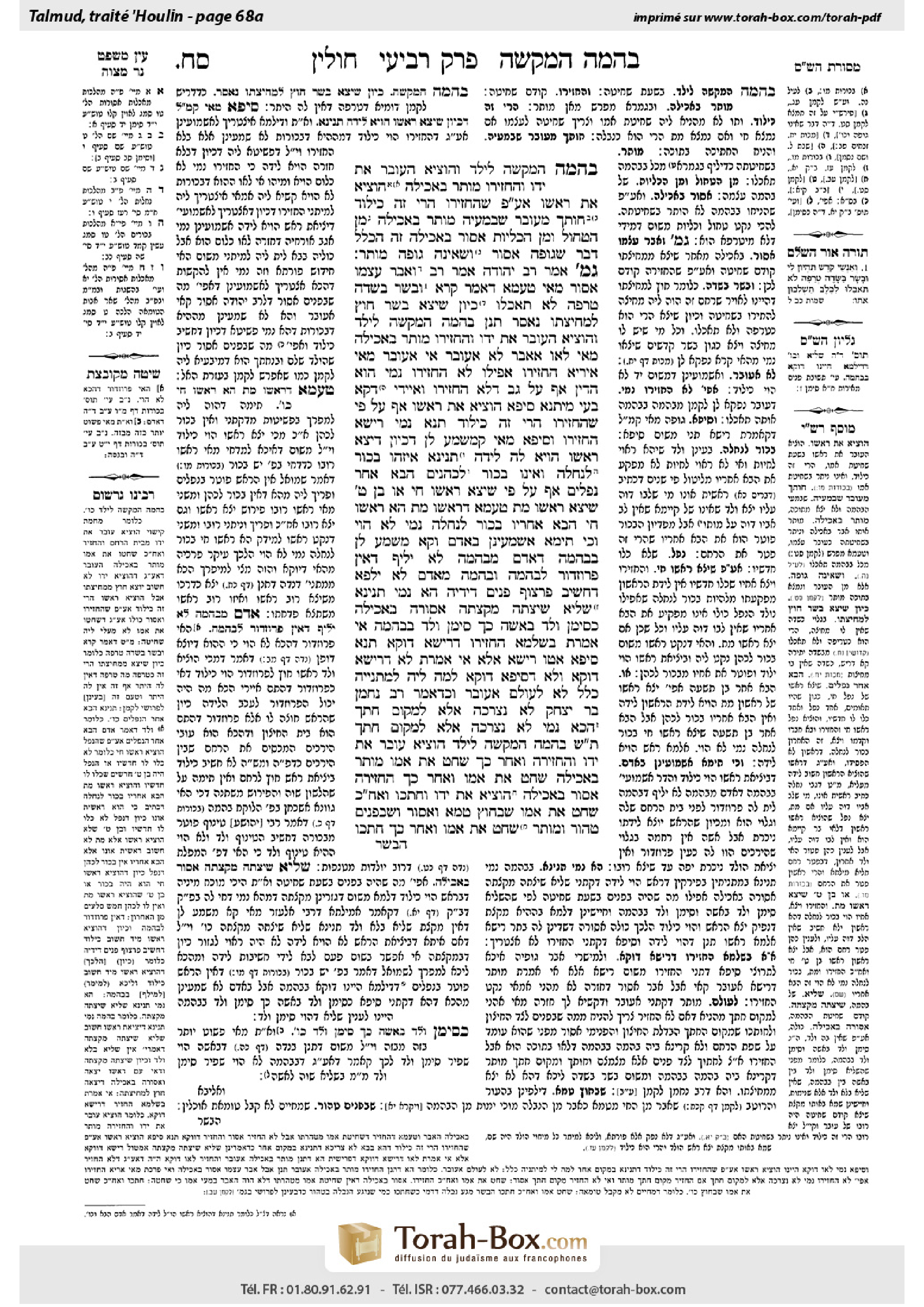
Chullin 68a: Talmud study for Daf Yomi
Study the Talmud for Daf Yomi with scanned pages, Hebrew text, English translations from Sefaria and AI-generated French translations.
Passage selection and English or AI-generated French translation are available where the scan has annotations. Daf Study is independent of Torah-Box and Sefaria.
Browse Chullin · חולין · All tractatesChullin 68a text and translations
This page of Chullin includes the Aramaic text, an English translation and an AI-generated French translation, alongside the scan above.
חולין ס״ח א · Aramaic and Hebrew text
מַתְנִי׳ בְּהֵמָה הַמְקַשָּׁה לֵילֵד, וְהוֹצִיא הָעוּבָּר אֶת יָדוֹ וְהֶחְזִירוֹ – מוּתָּר בַּאֲכִילָה. הוֹצִיא אֶת רֹאשׁוֹ, אַף עַל פִּי שֶׁהֶחְזִירוֹ – הֲרֵי זֶה כְּיָלוּד.
חוֹתֵךְ מֵעוּבָּר שֶׁבְּמֵעֶיהָ – מוּתָּר בַּאֲכִילָה, מִן הַטְּחוֹל וּמִן הַכְּלָיוֹת – אָסוּר בַּאֲכִילָה. זֶה הַכְּלָל: דָּבָר שֶׁגּוּפָהּ – אָסוּר, וְשֶׁאֵינָהּ גּוּפָהּ – מוּתָּר.
גְּמָ׳ אָמַר רַב יְהוּדָה אָמַר רַב: וְאֵבֶר עַצְמוֹ אָסוּר.
מַאי טַעְמָא? דְּאָמַר קְרָא: ״וּבָשָׂר בַּשָּׂדֶה טְרֵפָה לֹא תֹאכֵלוּ״, כֵּיוָן שֶׁיָּצָא בָּשָׂר חוּץ לִמְחִיצָתוֹ – נֶאֱסָר.
תְּנַן: בְּהֵמָה הַמְקַשָּׁה לֵילֵד, וְהוֹצִיא הָעוּבָּר אֶת יָדוֹ וְהֶחְזִירוֹ – מוּתָּר בַּאֲכִילָה. מַאי לָאו אַאֵבֶר? לָא, אַעוּבָּר.
אִי אַעוּבָּר, מַאי אִירְיָא הֶחְזִירוֹ? אֲפִילּוּ לֹא הֶחְזִירוֹ נָמֵי! הוּא הַדִּין אַף עַל גַּב דְּלֹא הֶחְזִירוֹ. וְאַיְּידֵי דְּקָא בָּעֵי מִיתְנֵא סֵיפָא: הוֹצִיא אֶת רֹאשׁוֹ אַף עַל פִּי שֶׁהֶחְזִירוֹ – הֲרֵי זֶה כְּיָלוּד, תְּנָא נָמֵי רֵישָׁא הֶחְזִירוֹ.
וְסֵיפָא, מַאי קָמַשְׁמַע לַן? דְּכֵיוָן דְּיָצָא רֹאשׁוֹ הָוְיָא לַהּ לֵידָה? תְּנֵינָא: אֵיזֶהוּ בְּכוֹר לְנַחֲלָה וְאֵינוֹ בְּכוֹר לְכֹהֲנִים – הַבָּא אַחַר נְפָלִים, אַף עַל פִּי שֶׁיָּצָא רֹאשׁוֹ חַי, אוֹ בֶּן תִּשְׁעָה שֶׁיָּצָא רֹאשׁוֹ מֵת.
טַעְמָא דְּרֹאשׁוֹ מֵת, הָא רֹאשׁוֹ חַי – הַבָּא אַחֲרָיו בְּכוֹר לְנַחֲלָה נָמֵי לָא הָוֵי.
וְכִי תֵּימָא, אַשְׁמְעִינַן בְּאָדָם, וְקָא מַשְׁמַע לַן בִּבְהֵמָה.
דְּאָדָם מִבְּהֵמָה לָא יָלֵיף, דְּאֵין פְּרוֹזְדוֹר לִבְהֵמָה, וּבְהֵמָה מֵאָדָם לָא יָלְפָא, דַּחֲשִׁיב פַּרְצוּף פָּנִים דִּידֵיהּ.
הָא נָמֵי תְּנֵינָא: שִׁלְיָא שֶׁיָּצְתָה מִקְצָתָהּ – אֲסוּרָה בַּאֲכִילָה, כְּסִימָן וָלָד בָּאִשָּׁה כָּךְ סִימָן וָלָד בַּבְּהֵמָה!
אִי אָמְרַתְּ בִּשְׁלָמָא הֶחְזִירוֹ דְּרֵישָׁא דַּוְקָא, תְּנָא סֵיפָא אַטּוּ רֵישָׁא.
אֶלָּא אִי אָמְרַתְּ: לָא דְּרֵישָׁא דַּוְקָא, וְלָא דְּסֵיפָא דַּוְקָא, לְמָה לֵיהּ לְמִתְנְיַיהּ כְּלָל?
לָא, לְעוֹלָם אַעוּבָּר, וְכִדְאָמַר רַב נַחְמָן בַּר יִצְחָק: לֹא נִצְרְכָה אֶלָּא לִמְקוֹם חֲתָךְ. הָכָא נָמֵי, לֹא נִצְרְכָה אֶלָּא לִמְקוֹם חֲתָךְ.
תָּא שְׁמַע: בְּהֵמָה הַמְקַשָּׁה לֵילֵד, הוֹצִיא עוּבָּר אֶת יָדוֹ וְהֶחְזִירָהּ, וְאַחַר כָּךְ שָׁחַט אֶת אִמּוֹ – מוּתָּר בַּאֲכִילָה. שָׁחַט אֶת אִמּוֹ וְאַחַר כָּךְ הֶחְזִירָהּ – אָסוּר בַּאֲכִילָה.
הוֹצִיא אֶת יָדוֹ וַחֲתָכוֹ, וְאַחַר כָּךְ שָׁחַט אֶת אִמּוֹ – שֶׁבַּחוּץ טָמֵא וְאָסוּר, וְשֶׁבִּפְנִים טָהוֹר וּמוּתָּר.
שָׁחַט אֶת אִמּוֹ וְאַחַר כָּךְ חֲתָכוֹ –
Chullin 68a · English translation
MISHNA: When a pregnant kosher animal is slaughtered, the slaughter also renders the consumption of its fetus permitted. Even if an animal was encountering difficulty giving birth and meanwhile the fetus extended its foreleg outside the mother animal’s womb and then brought it back inside, and then the mother animal was slaughtered, the consumption of the fetus is permitted by virtue of the slaughter of the mother animal. But if the fetus extended its head outside the womb, even if it then brought it back inside, the halakhic status of that fetus is like that of a newborn, and the slaughter of the mother animal does not permit the consumption of the fetus. Rather, it requires its own slaughter.
If, prior to slaughtering an animal, one severs pieces from a fetus that is in the womb and leaves those pieces in the womb, their consumption is permitted by virtue of the slaughter of the mother animal. By contrast, if one severs pieces of the spleen or of the kidneys of an animal and then slaughters it, then even if those pieces are left inside the animal their consumption is prohibited, because an organ severed from a living being is not permitted by the subsequent slaughter of the animal. This is the principle: An item that is part of an animal’s body that was severed prior to its slaughter is prohibited even after slaughter, and an item that is not part of its body, i.e., its fetus, is permitted by virtue of its slaughter.
GEMARA: The Gemara qualifies the first ruling of the mishna: Rav Yehuda says that Rav says: But as for the limb itself, i.e., the foreleg, its consumption is prohibited, even though the fetus brought it back inside prior to the slaughter.
What is the reason for this? It is as the verse states: “And flesh, in the field, a tereifa, you shall not eat” (Exodus 22:30). A tereifa is an animal with a wound that will cause it to die within twelve months; its consumption is prohibited even if it is ritually slaughtered. The Gemara interprets the verse as teaching a principle: Once flesh whose permitted status is dependent on being within a certain area, e.g., sacrificial meat within the Temple courtyard, has gone outside of its boundary, i.e., the area in which it is permitted, which the verse describes as being “in the field,” it becomes permanently prohibited, like a tereifa. Likewise, the permitted status of a fetus is dependent on its being within the womb when the mother animal is slaughtered. Accordingly, if any part of the fetus leaves the womb before the slaughter, it is rendered permanently prohibited.
The Gemara raises a difficulty: We learned in the mishna: If an animal was encountering difficulty giving birth and as a result the fetus extended its foreleg outside the mother animal’s body but then brought it back, and then the animal was slaughtered, the consumption of the fetus is permitted by virtue of the slaughter of the mother animal. The Gemara assumes: What, is the mishna not referring to the entire fetus, including the limb, i.e., the foreleg, when it states that its consumption is permitted by the slaughter? This would contradict Rav’s ruling. The Gemara answers: No, the mishna is referring to the rest of the fetus, apart from the foreleg.
The Gemara asks: If the mishna is referring to the rest of the fetus, why state specifically that the fetus brought back its foreleg? Even if it did not bring it back the rest of the fetus would still be permitted. The Gemara answers: The same is true, that the rest of the fetus is permitted, even if it did not bring back its foreleg. But since the tanna of the mishna wants to teach in the latter clause: If the fetus extended its head, even though it brought it back, the halakhic status of that fetus is like that of a newborn and is permitted only through its own slaughter, therefore he also taught in the first clause that the fetus brought back its foreleg, for stylistic reasons, despite the fact that the ruling is not limited to that case.
The Gemara asks: And concerning this latter clause itself, what does it teach us? Does it teach that once the fetus extended its head, that is considered a birth? But we have already learned this in a mishna (Bekhorot 46a): Who is considered a firstborn with regard to inheritance but is not considered a firstborn with regard to the requirement to be redeemed by giving five shekels to the priests? It is a son who came after the miscarriage of an underdeveloped fetus. The mishna adds that the category of stillbirth includes the case of a child who did not reach full term, even if its head emerged alive, or a fully developed, nine-month-old fetus whose head emerged dead.
The Gemara infers from the final clause of the mishna: The reason a son born following the miscarriage is considered a firstborn with regard to inheritance is that the head of the miscarriage emerged only after it was already dead. But if its head had initially emerged alive, even if it then died before being fully delivered, the son born after him would not be considered a firstborn even with regard to inheritance. Apparently, this is because the emergence of the head alive is considered a birth, and therefore any subsequent child cannot be considered the firstborn. Evidently, it is unnecessary for the mishna here to teach this definition of a birth.
And if you would say that the mishna there teaches us the definition of birth with regard to a person, and the mishna here teaches us that the same definition applies to an animal, another problem remains, as the Gemara will presently explain.
Before explaining the problem with this suggestion, the Gemara explains why it is necessary to teach the definition with regard to both people and animals: Because the definition of birth with regard to a person cannot be derived from that of an animal, as an animal does not have a concealed opening [prozdor] to the womb, unlike women, whose thighs conceal the opening to their womb. Consequently, even if the definition were stated with regard to an animal, one might limit it to animals, as that stage is immediately visible; whereas in women it is not. And conversely, the definition of birth with regard to an animal cannot be derived from that of a person, as the form of a person’s face is significant because people are created in the image of God, and their faces bear the mark of their intelligence, which is not true of animals. Consequently, perhaps the emergence of the head alone is considered a birth only with regard to a person.
The Gemara proceeds to explain why the above suggestion is not a solution: With regard to this halakha also, that the emergence of the head of an animal is considered a birth, we have already learned it in a mishna (77a): If part of a placenta emerged from the womb of an animal before it was slaughtered, its consumption is prohibited even after the mother animal is slaughtered. The reason for this is just as the placenta is an indication of the presence of a fetus in a woman, so too, it is an indication of the presence of a fetus in an animal. Consequently, it is possible that the part of the placenta that emerged contained the head of the fetus, and accordingly it would be considered to have been born. The slaughter of the mother animal would therefore not permit it for consumption. Evidently, it is unnecessary for the mishna here to teach the definition of a birth even with regard to an animal.
The Gemara has established that the latter clause does not teach any novelty. Accordingly, it returns to challenging Rav’s ruling: Granted, the mishna is understood if you say that the statement that the fetus brought its foreleg back inside the mother animal, which is mentioned in the first clause of the mishna, is written specifically in order to teach the novelty that the foreleg is permitted if it was brought back before the slaughter, in contrast to Rav’s ruling. If so, then one can claim the mishna taught it in the latter clause due to the first clause, so that they would be parallel stylistically, and no novelty is necessary in the latter clause.
But if you say the first clause is not written specifically and does not teach a novelty, but rather the mishna is referring to the permitted status of the rest of the fetus, which is permitted even if it does not bring back its foreleg, and you also say the latter clause is not written specifically to teach a novelty, since the definition of birth is already taught in a mishna elsewhere, then why does it need to teach the halakha that the foreleg or head were brought back at all? Perforce, the first clause must be referring to the permitted status of the foreleg and limiting it specifically to the case where it was brought back inside. This contradicts Rav’s ruling.
The Gemara responds: No; actually, the mishna is referring to the permitted status of the rest of the fetus, but nevertheless, the statement that the fetus brought back its foreleg does teach a novelty. This is similar to that which Rav Naḥman bar Yitzḥak said, in explanation of a ruling in a baraita cited below, that it is necessary only with regard to the location of a cut limb on the fetus’s body. If the foreleg were to be severed at precisely the point that lay on the boundary between the inside and the outside of the womb, then the location of the cut on the fetus’s body would also be prohibited. Here too, one can explain that the ruling is necessary only with regard to the location of the cut, and it teaches that if the fetus did not bring back its foreleg, then not only is the foreleg prohibited but the location of the cut is also prohibited.
The Gemara suggests: Come and hear a challenge to Rav’s ruling from a baraita: If an animal was encountering difficulty giving birth, and as a result the fetus extended its foreleg outside the mother animal’s body and then brought it back inside and then afterward one slaughtered its mother, its consumption is permitted by virtue of the slaughter of the mother animal. But if one first slaughtered its mother, and only afterward did the fetus return its foreleg back inside, its consumption is prohibited.
If the fetus extended its foreleg outside and one cut it off, and then afterward one slaughtered its mother, then the part of the foreleg that was outside and was cut off is ritually impure and its consumption is prohibited, as it has the status of a limb cut from a living animal, which is forbidden. And the rest of the fetus that was inside is ritually pure and its consumption is permitted by virtue the slaughter of the mother animal.
If one slaughtered its mother and only afterward cut off the foreleg that had been extended outside,
Chullin 68a · Traduction française (IA)
MICHNA : Lorsqu'un animal kasher est enceinte et est tué, la tuée rend également la consommation de son fœtus permise. Même si un animal éprouvait des difficultés à accoucher et que pendant ce temps le fœtus avait étendu son avant-bras en dehors du ventre maternel et l'avait ensuite ramené à l'intérieur, et que l'animal mère était ensuite tué, la consommation du fœtus est permise en vertu de la tuée de l'animal mère. Mais si le fœtus avait étendu sa tête en dehors du ventre, même s'il l'avait ensuite ramenée à l'intérieur, le statut halakhique de ce fœtus est celui d'un nouveau-né, et la tuée de l'animal mère ne permet pas la consommation du fœtus. Plutôt, il exige sa propre tuée.
Si, avant de tuer un animal, on coupe des morceaux d'un fœtus qui est dans le ventre et qu'on laisse ces morceaux dans le ventre, leur consommation est permise en vertu de la tuée de l'animal mère. À l'inverse, si on coupe des morceaux du rein ou des reins d'un animal et qu'on le tue ensuite, même si ces morceaux restent à l'intérieur de l'animal, leur consommation est interdite, car un organe séparé d'un être vivant n'est pas permis en vertu de la tuée ultérieure de l'animal. C'est le principe : Une chose qui faisait partie du corps d'un animal et qui a été séparée avant sa tuée est interdite même après sa tuée, et une chose qui n'appartient pas à son corps, c'est-à-dire son fœtus, est permise en vertu de sa tuée.
GUEMARA : La Guemara précise la première décision de la Michna : Rav Yehuda dit que Rav dit : Mais concernant le membre lui-même, c'est-à-dire l'avant-bras, sa consommation est interdite, même si le fœtus l'avait ramené à l'intérieur avant la tuée.
Quelle est la raison de cela ? C'est comme la Parashah dit : « Et la chair, dans le champ, un tereifa, tu ne mangeras pas » (Exode 22:30). Un tereifa est un animal avec une blessure qui le fera mourir dans les douze mois ; sa consommation est interdite même s'il est tué selon les rites. La Guemara interprète cette Parashah comme enseignant un principe : Une chair dont le statut permis dépend de se trouver dans une certaine zone, par exemple la chair sacrée dans le courtyard du Temple, devient définitivement interdite si elle sort de sa limite, c'est-à-dire la zone dans laquelle elle est permise, que la Parashah décrit comme étant « dans le champ ». De même, le statut permis du fœtus dépend de son être dans le ventre lors de la tuée de l'animal mère. Ainsi, si une partie du fœtus sort du ventre avant la tuée, elle devient définitivement interdite.
La Guemara soulève un problème : Nous avons appris dans la Michna : Si un animal éprouvait des difficultés à accoucher et que par conséquent le fœtus avait étendu son avant-bras en dehors du corps de l'animal mère mais l'avait ensuite ramené à l'intérieur, et que l'animal était ensuite tué, la consommation du fœtus est permise en vertu de la tuée de l'animal mère. La Guemara suppose : Qu'est-ce que la Michna ne fait pas référence à l'ensemble du fœtus, y compris le membre, c'est-à-dire l'avant-bras, lorsqu'elle dit que sa consommation est permise en vertu de la tuée ? Cela contredirait la décision de Rav. La Guemara répond : Non, la Michna fait référence au reste du fœtus, à l'exception de l'avant-bras.
La Guemara demande : Si la Michna fait référence au reste du fœtus, pourquoi préciser spécifiquement que le fœtus a ramené son avant-bras ? Même s'il n'avait pas fait cela, le reste du fœtus serait toujours permis. La Guemara répond : C'est pareil, le reste du fœtus est permis, même s'il n'avait pas ramené son avant-bras. Mais puisque le tanna de la Michna veut enseigner dans la clause ultérieure : Si le fœtus avait étendu sa tête, même s'il l'avait ramenée, le statut halakhique de ce fœtus est celui d'un nouveau-né et est permis uniquement par sa propre tuée, il a aussi enseigné dans la première clause que le fœtus avait ramené son avant-bras, pour des raisons stylistiques, malgré le fait que la décision n'est pas limitée à ce cas.
La Guemara demande : Et concernant cette clause ultérieure elle-même, qu'enseigne-t-elle ? Est-ce qu'elle enseigne que lorsqu'un fœtus étend sa tête, cela est considéré comme un accouchement ? Mais nous avons déjà appris cela dans une Michna (Bekhorot 46a) : Qui est considéré comme un premier-né en ce qui concerne l'héritage mais n'est pas considéré comme un premier-né en ce qui concerne la nécessité de l'acheter en donnant cinq shekels aux prêtres ? C'est un fils qui est né après le décès d'un fœtus sous-développé. La Michna ajoute que la catégorie des mort-nés inclut le cas d'un enfant qui n'a pas atteint le terme, même si sa tête est sortie vivante, ou d'un fœtus bien développé, neuf mois, dont la tête est sortie morte.
La Guemara déduit de la clause finale de la Michna : La raison pour laquelle un fils né après un avortement est considéré comme un premier-né en ce qui concerne l'héritage est que la tête de l'avortement est sortie seulement après qu'elle était déjà morte. Mais si sa tête avait d'abord été sortie vivante, même si elle est ensuite morte avant d'être entièrement délivrée, le fils né après lui ne serait pas considéré comme un premier-né même en ce qui concerne l'héritage. Apparemment, cela est dû au fait que l'émergence de la tête vivante est considérée comme un accouchement, et donc tout enfant ultérieur ne peut pas être considéré comme le premier-né. Évidemment, il n'était pas nécessaire que la Michna ici enseigne cette définition d'un accouchement.
Et si vous dites que la Michna là-bas enseigne la définition d'un accouchement en ce qui concerne une personne, et que la Michna ici enseigne que la même définition s'applique à un animal, un autre problème reste, comme la Guemara le précisera bientôt.
Avant d'expliquer le problème avec cette suggestion, la Guemara explique pourquoi il est nécessaire d'enseigner la définition concernant à la fois les personnes et les animaux : Parce que la définition de la naissance concernant une personne ne peut pas être déduite de celle d'un animal, car un animal n'a pas un ouverture cachée [prozdor] vers le ventre, contrairement aux femmes, dont les cuisses cachent l'ouverture de leur ventre. Ainsi, même si la définition était énoncée concernant un animal, on pourrait la limiter aux animaux, car cette étape est immédiatement visible ; tandis que chez les femmes, ce n'est pas le cas. Et inversement, la définition de la naissance concernant un animal ne peut pas être déduite de celle d'une personne, car la forme du visage d'une personne est importante car les personnes sont créées à l'image de Dieu, et leurs visages portent la marque de leur intelligence, ce qui n'est pas vrai des animaux. Ainsi, peut-être la sortie de la tête seule est considérée comme une naissance uniquement concernant une personne.
La Guemara poursuit en expliquant pourquoi la suggestion ci-dessus n'est pas une solution : Concernant cette halakha également, que la sortie de la tête d'un animal est considérée comme une naissance, nous avons déjà appris cela dans une mitsva (77a) : Si une partie du placenta est sortie du ventre d'un animal avant qu'il ne soit tué, sa consommation est interdite même après que l'animal mère ait été tué. La raison de cela est que le placenta est un signe de la présence d'un fœtus chez une femme, de même, il est un signe de la présence d'un fœtus chez un animal. Ainsi, il est possible que la partie du placenta sortie contienne la tête du fœtus, et dans ce cas, il serait considéré comme né. La mise à mort de l'animal mère ne permettrait donc pas sa consommation. Évidemment, il n'est pas nécessaire que la mitsva ici enseigne la définition de la naissance même concernant un animal.
La Guemara a établi que la dernière clause ne transmet pas de nouveauté. Ainsi, elle revient à contester le jugement de Rava : Admettons que la mitsva est comprise si l'on dit que l'affirmation selon laquelle le fœtus a ramené son avant-bras à l'intérieur de l'animal mère, mentionnée dans la première clause de la mitsva, est écrite spécifiquement afin d'enseigner la nouveauté selon laquelle l'avant-bras est permis si l'on l'a ramené avant la mise à mort, contrairement au jugement de Rava. Si c'est ainsi, alors on peut affirmer que la mitsva l'a enseigné dans la dernière clause en raison de la première clause, afin qu'ils soient parallèles stylistiquement, et aucune nouveauté n'est nécessaire dans la dernière clause.
Mais si l'on dit que la première clause n'est pas écrite spécifiquement et ne transmet pas de nouveauté, mais plutôt que la mitsna fait référence à l'état permis du reste du fœtus, qui est permis même s'il ne ramène pas son avant-bras, et que l'on dit également que la dernière clause n'est pas écrite spécifiquement pour enseigner une nouveauté, car la définition de la naissance est déjà enseignée dans une mitsna ailleurs, alors pourquoi la mitsna a-t-elle besoin d'enseigner la halakha que l'avant-bras ou la tête ont été ramenés à l'intérieur ? Par conséquent, la première clause doit faire référence à l'état permis de l'avant-bras et le limiter spécifiquement au cas où il a été ramené à l'intérieur. Cela contredit le jugement de Rav.
La Guemara répond : Non ; en réalité, la mitsna fait référence à l'état permis du reste du fœtus, mais néanmoins, l'affirmation que le fœtus a ramené son avant-bras enseigne une nouveauté. Cela est similaire à ce que Rav Naḥman bar Yitzḥak a dit, en expliquant un jugement dans une baraïta citée ci-dessous, que cela est nécessaire uniquement concernant la localisation d'une extrémité coupée sur le corps du fœtus. Si l'avant-bras avait été coupé exactement au point qui se situait sur la limite entre l'intérieur et l'extérieur du ventre, alors la localisation de la coupure sur le corps du fœtus serait également interdite. Ici aussi, on peut expliquer que le jugement est nécessaire uniquement concernant la localisation de la coupure, et il enseigne que si le fœtus n'a pas ramené son avant-bras, alors non seulement l'avant-bras est interdit, mais aussi la localisation de la coupure est interdite.
La Guemara suggère : Viens écouter un défi au jugement de Rav d'après une baraïta : Si un animal avait des difficultés à accoucher, et en conséquence le fœtus avait étendu son avant-bras en dehors du corps de l'animal mère et l'avait ensuite ramené à l'intérieur, et ensuite l'on a tué l'animal mère, sa consommation est permise grâce à la mise à mort de l'animal mère. Mais si l'on a d'abord tué l'animal mère, et ensuite le fœtus a ramené son avant-bras à l'intérieur, sa consommation est interdite.
Si le fœtus avait étendu son avant-bras en dehors et qu'on l'avait coupé, et ensuite l'on a tué l'animal mère, alors la partie de l'avant-bras qui était en dehors et qui a été coupée est impure et sa consommation est interdite, car elle a le statut d'une extrémité coupée d'un animal vivant, ce qui est interdit. Et la partie restante du fœtus qui était à l'intérieur est pure et sa consommation est permise grâce à la mise à mort de l'animal mère.
Si l'on a tué la mère et seulement ensuite a coupé l'avant-bras qui avait été étendu en dehors,
Traduction française générée par IA à partir de l’édition anglaise de Sefaria. Vérifie toujours un passage avec le texte source.
Text from Sefaria: William Davidson Edition - Vocalized Aramaic (unknown); William Davidson Edition - English (CC BY NC).