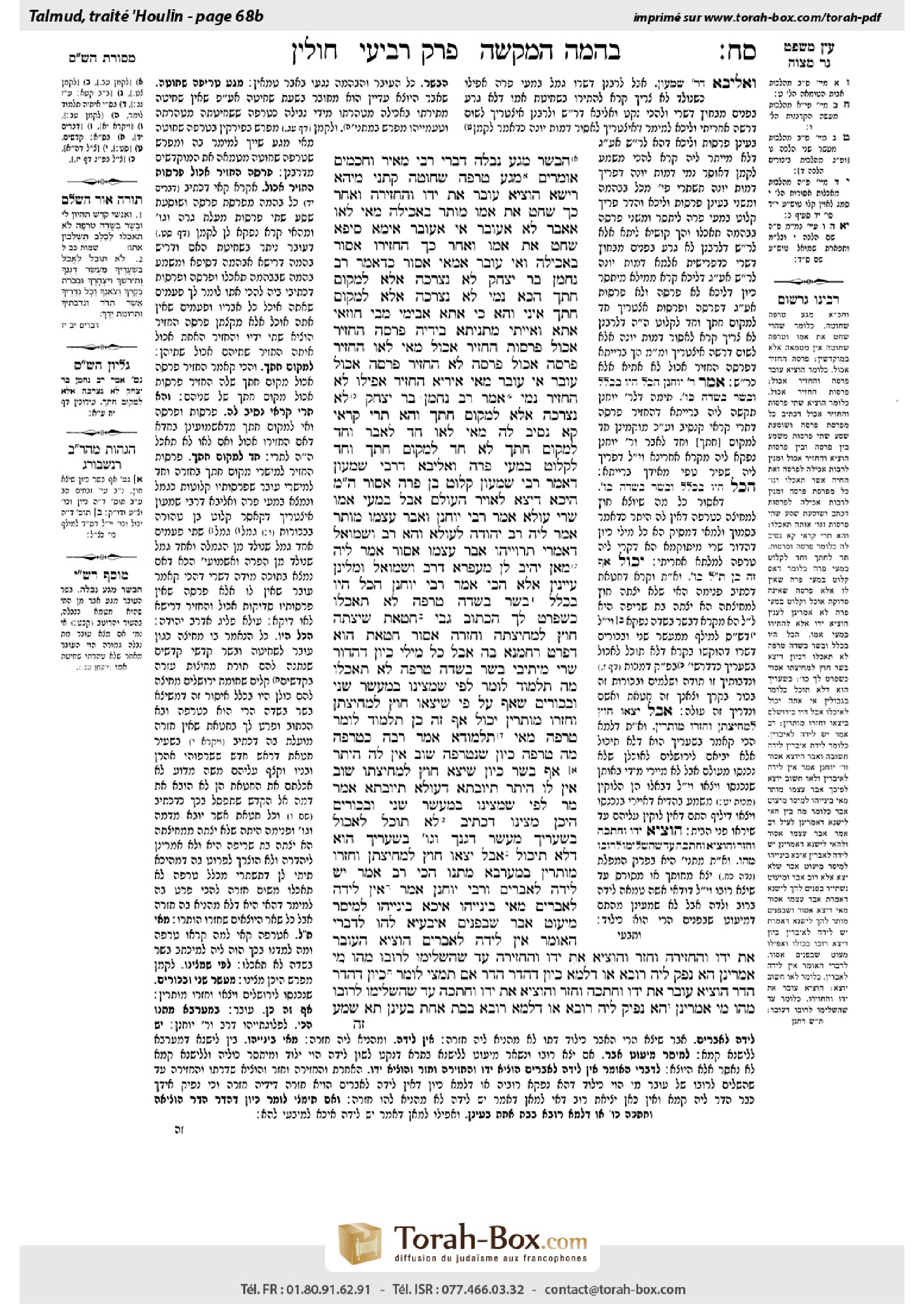
Chullin 68b: Talmud study for Daf Yomi
Study the Talmud for Daf Yomi with scanned pages, Hebrew text, English translations from Sefaria and AI-generated French translations.
Passage selection and English or AI-generated French translation are available where the scan has annotations. Daf Study is independent of Torah-Box and Sefaria.
Browse Chullin · חולין · All tractatesChullin 68b text and translations
This page of Chullin includes the Aramaic text, an English translation and an AI-generated French translation, alongside the scan above.
חולין ס״ח ב · Aramaic and Hebrew text
הַבָּשָׂר מַגַּע נְבֵלָה, דִּבְרֵי רַבִּי מֵאִיר.
וַחֲכָמִים אוֹמְרִים: מַגַּע טְרֵפָה שְׁחוּטָה.
קָתָנֵי מִיהָא רֵישָׁא: הוֹצִיא עוּבָּר אֶת יָדוֹ וְהֶחְזִירָהּ, וְאַחַר כָּךְ שָׁחַט אֶת אִמּוֹ – מוּתָּר בַּאֲכִילָה; מַאי לָאו אַאֵבֶר? לָא, אַעוּבָּר.
אִי אַעוּבָּר, אֵימָא סֵיפָא: שָׁחַט אֶת אִמּוֹ וְאַחַר כָּךְ הֶחְזִירוֹ – אָסוּר בַּאֲכִילָה; וְאִי עוּבָּר, אַמַּאי אָסוּר?
כִּדְאָמַר רַב נַחְמָן בַּר יִצְחָק: לֹא נִצְרְכָה אֶלָּא לִמְקוֹם חֲתָךְ, הָכָא נָמֵי לֹא נִצְרְכָה אֶלָּא לִמְקוֹם חֲתָךְ.
אִינִי? וְהָא כִּי אֲתָא אֲבִימִי מִבֵּי חוֹזָאֵי, אֲתָא וְאַיְיתִי מַתְנִיתָא בִּידֵיהּ: פַּרְסָה הֶחְזִיר – אֱכוֹל, פְּרָסוֹת הֶחְזִיר – אֱכוֹל. מַאי לָאו הֶחְזִיר פַּרְסָה – אֲכוּל פַּרְסָה?
לֹא, הֶחֱזִיר פַּרְסָה – אֱכוֹל עוּבָּר. אִי עוּבָּר, מַאי אִירְיָא הֶחְזִיר? אֲפִילּוּ לֹא הֶחֱזִיר נָמֵי! אָמַר רַב נַחְמָן בַּר יִצְחָק: לֹא נִצְרְכָה אֶלָּא לִמְקוֹם חֲתָךְ.
וְהָא תְּרֵי קְרָאֵי קָא נָסֵיב לַהּ! מַאי לָאו חַד לְאֵבֶר, וְחַד לִמְקוֹם חֲתָךְ? לָא, חַד לִמְקוֹם חֲתָךְ, וְחַד לְקָלוּט בִּמְעֵי פָרָה.
וְאַלִּיבָּא דְּרַבִּי שִׁמְעוֹן, דְּאָמַר רַבִּי שִׁמְעוֹן: קָלוּט בֶּן פָּרָה אָסוּר. הָנֵי מִילֵּי הֵיכָא דְּיָצָא לַאֲוִיר הָעוֹלָם, אֲבָל בִּמְעֵי אִמּוֹ – שְׁרֵי.
עוּלָּא אָמַר רַבִּי יוֹחָנָן: וְאֵבֶר עַצְמוֹ מוּתָּר.
אֲמַר לֵיהּ רַב יְהוּדָה לְעוּלָּא: וְהָא רַב וּשְׁמוּאֵל דְּאָמְרִי תַּרְוַיְיהוּ אֵבֶר עַצְמוֹ אָסוּר! אֲמַר לֵיהּ: מַאן יָהֵיב לַן מֵעַפְרָא דְּרַב וּשְׁמוּאֵל וּמָלֵינַן עַיְינִין, אֶלָּא הָכִי אָמַר רַבִּי יוֹחָנָן: הַכֹּל הָיוּ בִּכְלַל ״בָּשָׂר בַּשָּׂדֶה טְרֵפָה לֹא תֹאכֵלוּ״,
כְּשֶׁפָּרַט לְךָ הַכָּתוּב גַּבֵּי חַטָּאת שֶׁיָּצְתָה חוּץ לִמְחִיצָתָהּ וְחָזְרָה – אָסוּר, חַטָּאת הוּא דִּפְרַט רַחֲמָנָא בָּהּ, אֲבָל כֹּל מִילֵּי – כֵּיוָן דַּהֲדוּר – שְׁרֵי.
מֵיתִיבִי: ״בָּשָׂר בַּשָּׂדֶה טְרֵפָה לֹא תֹאכֵלוּ״, מָה תַּלְמוּד לוֹמַר? לְפִי שֶׁמָּצִינוּ בְּמַעֲשֵׂר שֵׁנִי וּבִכּוּרִים, שֶׁאַף עַל פִּי שֶׁיָּצְאוּ חוּץ לִמְחִיצָתָן וְחָזְרוּ – מוּתָּרִין, יָכוֹל אַף זֶה כֵּן? תַּלְמוּד לוֹמַר ״טְרֵפָה״.
מַאי תַּלְמוּדָא? אָמַר רַבָּה: כִּטְרֵפָה, מָה טְרֵפָה – כֵּיוָן שֶׁנִּטְרְפָה שׁוּב אֵין לָהּ הֶיתֵּר, אַף בָּשָׂר – כֵּיוָן שֶׁיָּצָא חוּץ לִמְחִיצָתוֹ שׁוּב אֵין לוֹ הֶיתֵּר! תְּיוּבְתָּא דְעוּלָּא, תְּיוּבְתָּא.
אָמַר מָר: לְפִי שֶׁמָּצִינוּ בְּמַעֲשֵׂר שֵׁנִי וּבִכּוּרִים. הֵיכָן מָצִינוּ?
דִּכְתִיב: ״לֹא תוּכַל לֶאֱכֹל בִּשְׁעָרֶיךָ מַעְשַׂר דְּגָנֶךָ וְגוֹ׳״, בִּשְׁעָרֶיךָ הוּא דְּלָא תֵּיכוּל, אֲבָל יָצְאוּ חוּץ לִמְחִיצָתָן וְחָזְרוּ – מוּתָּרִין.
בְּמַעְרְבָא מַתְנוּ הָכִי, רַב אָמַר: יֵשׁ לֵידָה לְאֵבָרִים, וְרַבִּי יוֹחָנָן אָמַר: אֵין לֵידָה לְאֵבָרִים.
מַאי בֵּינַיְיהוּ? אִיכָּא בֵּינַיְיהוּ לְמֵיסַר מִיעוּט אֵבֶר שֶׁבִּפְנִים.
אִיבַּעְיָא לְהוּ: לְדִבְרֵי הָאוֹמֵר אֵין לֵידָה לְאֵבָרִים, הוֹצִיא הָעוּבָּר אֶת יָדוֹ וְהֶחְזִירָהּ, וְחָזַר וְהוֹצִיא אֶת יָדוֹ וְהֶחְזִירָהּ, עַד שֶׁהִשְׁלִימוֹ לְרוּבּוֹ, מַהוּ? מִי אָמְרִינַן הָא נְפַק לֵיהּ רוּבָּא, אוֹ דִלְמָא כֵּיוָן דַּהֲדַר הָדַר?
אִם תִּמְצֵי לוֹמַר, כֵּיוָן דַּהֲדַר הָדַר, הוֹצִיא עוּבָּר אֶת יָדוֹ וַחֲתָכָהּ, וְחָזַר וְהוֹצִיא אֶת יָדוֹ וַחֲתָכָהּ, עַד שֶׁהִשְׁלִימוֹ לְרוּבּוֹ, מַהוּ? מִי אָמְרִינַן הָא נָפֵיק לֵיהּ רוּבָּא, אוֹ דִלְמָא רוּבָּא בְּבַת אַחַת בָּעֵינַן?
תָּא שְׁמַע:
Chullin 68b · English translation
then the flesh of both the mother animal and the fetus, excluding the foreleg, is impure due to contact with a carcass. Since the foreleg of the now dead fetus was not permitted through an act of slaughtering, it is regarded as a carcass. It therefore imparts impurity to the rest of the flesh, which was in contact with it. This is the statement of Rabbi Meir.
And the Rabbis say: Although the slaughter of the mother animal does not permit the consumption of the foreleg, it does serve to prevent the foreleg from imparting the ritual impurity of a carcass. Accordingly, the flesh has the status of having been in contact with a slaughtered tereifa. By Torah law, consumption of the animal is prohibited but it does not impart ritual impurity. The Sages decreed it to be impure in that it disqualifies sacrificial flesh with which it comes in contact.
The Gemara explains the challenge to Rav’s ruling: In any event, the first clause of the baraita teaches: If the fetus extended its foreleg outside the mother animal’s body and then brought it back inside and then afterward one slaughtered its mother, its consumption is permitted. What, is it not referring to the limb, i.e., the foreleg, and the baraita rules that it is permitted, in contradiction to Rav’s ruling? The Gemara responds: No, it is referring to the rest of the fetus.
The Gemara questions this: If the baraita is referring to the fetus, say the latter clause: If one first slaughtered its mother, and only afterward the fetus returned its foreleg inside, its consumption is prohibited. The Gemara explains the question: And if it is referring to the fetus, why should it be prohibited in this case?
The Gemara answers: The baraita is referring to the fetus, and should be explained in a manner similar to that which Rav Naḥman bar Yitzḥak said, in explanation of a ruling in a baraita cited below, that it is necessary only with regard to the location of the cut limb on the fetus’s body. If the foreleg was severed at precisely the point that lay on the boundary between the inside and outside when it was extended outside the womb, the location of the cut on the fetus’s body is also prohibited. Here too, one can explain that this ruling is necessary only with regard to the location of the cut, and it teaches that if the fetus did not return its foreleg, then not only is the foreleg prohibited but the location of the cut is prohibited as well. The foreleg itself, though, is prohibited even if it was brought back inside before the slaughter.
The Gemara asks: Is that so? But when Avimi came from Bei Ḥozai he came and brought a baraita with him: One of the sources (see 69a) that the slaughter of a pregnant animal also serves to permit the consumption of the fetus is the verse: “And every animal that has a split hoof and is cloven into two hooves, chews the cud, of the animals, it you may eat” (Deuteronomy 14:6). The verse mentions both “hoof” in the singular and “hooves” in the plural to teach that sometimes one may eat two hooves and sometimes only one, as follows: If the fetus extended two of its hooves outside the womb, if it returned one hoof one may eat, if it brought back both hooves one may eat. What, is it not that the baraita means that if it brought back one hoof one may eat that hoof, and likewise if it brought back both hooves one may eat both of them, in contradiction to Rav’s ruling?
The Gemara responds: No, it means that if it brought back one hoof or even both, one may eat the rest of the fetus but not the hooves. The Gemara objects: If it is referring to the permitted status of the fetus, why does it specifically state that it brought back the hoof? Even if it did not bring it back the fetus would be permitted. Rav Naḥman bar Yitzḥak said the ruling of the baraita is necessary only with regard to the location of the cut limb on the body of the fetus. If the limb were to be severed at precisely the point that lay on the boundary between the inside and the outside when it was extended outside the womb, then the location of the cut on the fetus’s body would also be prohibited, but only if the fetus had not brought back that limb before the mother animal was slaughtered.
The Gemara persists: But even given Rav Naḥman bar Yitzḥak’s claim the baraita adduces two verses, i.e., the mention of hoof and hooves. What, is it not that one serves to permit the limb, in contradiction to Rav’s ruling, and the other one serves to permit the location of the cut, in accordance with Rav Naḥman bar Yitzḥak’s ruling? The Gemara responds: No; one mention does serve to permit the location of the cut, but the other one serves to permit a fetus with non-cloven hooves [kalut] found inside the womb of a cow that was slaughtered. Although the fetus does not bear the distinguishing characteristics of a kosher species, it is nevertheless permitted by virtue of the slaughter of its mother.
And it is necessary to have a specific source to permit this according to the opinion of Rabbi Shimon, as Rabbi Shimon says: A calf with non-cloven hooves born from a kosher cow is forbidden, as the calf does not bear the distinguishing characteristics of a kosher species. The verse teaches that this matter applies only where the fetus emerged into the airspace of the world, i.e., it was born before the mother animal was slaughtered. But if it was still inside its mother’s womb when the mother was slaughtered, it is permitted.
§ The Gemara attempted to challenge Rav’s ruling that once a limb of a fetus is extended outside the mother animal’s body it becomes prohibited even if it was then brought back, but did not find a conclusive refutation. It now presents a dissenting opinion: Ulla says that Rabbi Yoḥanan says: And even the limb itself is permitted by virtue of the slaughter of the mother animal.
Rav Yehuda said to Ulla: But Rav and Shmuel both say the limb itself is prohibited; how can you say otherwise? Ulla said to him: Who will give us some of the dust of the graves of Rav and Shmuel and we will fill our eyes with it; such is the greatness of those Sages. But I follow the opinion of Rabbi Yoḥanan, and this is what Rabbi Yoḥanan says: Initially one would assume all flesh that is permitted due to being within a certain boundary, e.g., a fetus inside its mother’s womb, the flesh of offerings of the most sacred order within the Temple courtyard, and the flesh of offerings of lesser sanctity within Jerusalem, was included in the verse: “And flesh, in the field, a tereifa, you shall not eat” (Exodus 22:30). The verse is interpreted to teach that if such flesh leaves its boundaries it is rendered forbidden, even should it subsequently return.
Once another verse applies the concept for you specifically with regard to a sin offering, teaching that if it went outside of its boundary and returned it is prohibited (see Leviticus 10:18), then it is apparent that the Merciful One specifically applied the concept to a sin offering. But with regard to all other items that left their boundary, once they are brought back they are permitted, including the limb of a fetus that was extended outside the womb and then was brought back.
The Gemara raises an objection to the opinion of Ulla and Rabbi Yoḥanan from a baraita: It is derived from the verse: “And flesh, in the field, a tereifa, you shall not eat,” that flesh that leaves the boundary in which it is permitted is thereby rendered forbidden like a tereifa. Why must the verse state that it is like a tereifa? The baraita explains: Since we find with regard to second tithe and first fruits that even though they went outside of their boundary, which is the city of Jerusalem and the only place where it is permitted to eat them, nevertheless if they are brought back to there they are once again permitted, one might have thought that also with regard to this prohibition, that of flesh that leaves its boundary, it is so, i.e., if it is brought back it once again becomes permitted for consumption. Therefore, the verse states: “A tereifa.”
The Gemara clarifies: What is the biblical derivation from the term “a tereifa”? Rabba said: The verse indicates that the prohibition of flesh that left its boundary is like the prohibition of a tereifa. Just as with regard to a tereifa, once an animal is mortally wounded, rendering it a tereifa, it can no longer regain a permitted status, so too with regard to flesh referred to in the verse: Once it has gone outside of its boundary it can no longer regain permitted status. Accordingly, if the limb of a fetus was extended outside the womb it would thereby become permanently prohibited, contradicting the opinion of Ulla and Rabbi Yoḥanan. The Gemara concludes: The refutation of the statement of Ulla is indeed a conclusive refutation.
The Gemara analyzes the baraita, which states: The Master said: Since we find with regard to second tithe and first fruits that although they left their boundary, if they are brought back there they are again permitted. The Gemara asks: Where did we find this, i.e., what is the source for this halakha?
The Gemara explains that it is written: “You may not eat within your gates the tithe of your grain, or of your wine, or of your oil, or the firstborn of your herd or of your flock, nor any of your vows that you have vowed, nor your voluntary offerings, nor the offering of your hand. But you shall eat them before the Lord your God” (Deuteronomy 12:17–18). The phrase “the tithe of your grain, or of your wine, or of your oil” is referring to second tithe, and the phrase “the offering of your hand” is referring to first fruits. The verse states that all the items listed may be eaten only “before the Lord your God,” i.e., within the city of Jerusalem. The prohibition stated in the verse is that within your gates, i.e., outside of Jerusalem, you may not eat these items. But by inference, if these items went outside of their boundary, i.e., outside of Jerusalem, and then were brought back, they are permitted.
§ The Gemara explained the dispute between Rav and Rabbi Yoḥanan in the way in which it was taught in Babylonia. The Gemara notes that in the West, Eretz Yisrael, they taught the dispute like this: Rav says there is a concept of birth with regard to limbs. When a limb is extended outside the womb, it is considered born and is independent of the mother animal. Consequently, it can never be permitted by virtue of the slaughter of the mother animal. And Rabbi Yoḥanan says that there is no concept of birth with regard to limbs. Since the limb is never considered to have been born, as long as it is inside the mother animal when the mother animal is slaughtered it will be permitted by virtue of that slaughter.
The Gemara asks: What is the difference between these two versions which explain why Rav deemed the limb forbidden? The Gemara answers: The practical difference between them is in a case in which only the majority of a limb was extended outside the womb. In that case, the issue is whether or not to prohibit the minority of the limb that remained inside. If the limb is forbidden because it is considered to have been born, the entire limb would be forbidden and not just the part that was extended. If the limb is forbidden because it left its boundary, then only the part that extended outside the womb would be forbidden.
A dilemma was raised before the Sages: According to the statement of the one who says there is no concept of birth with regard to limbs, if the fetus extended its foreleg outside the womb and brought it back, and again it extended its other foreleg outside and brought it back, and continued to extend parts of its body outside until the total amount that had been outside the womb constituted the majority of the fetus, what is the halakha? Do we say that ultimately the majority of the fetus has left the womb and the entire fetus should be regarded as having been born, and consequently the slaughter of its mother can no longer permit its being consumed? Or perhaps, since it brought each limb back, the limbs are considered to have been brought back; therefore, the majority of the fetus is not considered to have left the womb and it is not regarded as having been born. In that case, the slaughter of its mother would still permit its being consumed.
The Gemara asks: If you want to say that since it brought back each limb, they are considered to have been brought back and the majority of the fetus is not considered to have left the womb, the following dilemma still arises: If the fetus extended its foreleg outside and someone severed it, and again it extended its other foreleg outside and someone severed it, and this continued with its other limbs until the total amount outside the womb constituted the majority of the fetus, what is the halakha? Do we say that since the majority of the fetus has left the womb, the entire fetus should be regarded as having been born and therefore the slaughter of its mother can no longer permit it? Or perhaps, in order for the fetus to be regarded as having been born we require a majority of the fetus to leave simultaneously, which does not exist in this case.
The Gemara suggests: Come and hear a proof from the mishna:
Chullin 68b · Traduction française (IA)
alors la chair de l'animal mère et du fœtus, à l'exception des avant-bras, est impure en raison du contact avec un cadavre. Puisque l'avant-bras du fœtus maintenant mort n'était pas permis par un acte de bain rituel, il est considéré comme un cadavre. Il transmet donc l'impureté à la chair restante, qui était en contact avec lui. C'est la déclaration du Rabbi Meir.
Et les Sages disent : Bien que le bain rituel de l'animal mère ne permette pas la consommation de l'avant-bras, il sert à empêcher l'avant-bras de transmettre l'impureté rituelle du cadavre. Ainsi, la chair a le statut d'avoir été en contact avec un animal tué. Selon la Loi divine, la consommation de l'animal est interdite, mais elle ne transmet pas l'impureté rituelle. Les Sages ont décrété qu'elle est impure, car elle rend disqualifiée la chair sacrée avec laquelle elle entre en contact.
La Guemara explique le défi à la décision de Rav : En tout cas, la première clause de la baraïta enseigne : Si le fœtus a étendu son avant-bras en dehors du corps de l'animal mère et l'a ensuite ramené à l'intérieur, puis si l'on a tué l'animal mère, sa consommation est permise. Qu'est-ce que cela ne signifie pas par référence au membre, c'est-à-dire l'avant-bras, et la baraïta règle qu'il est permis, en contradiction avec la décision de Rav ? La Guemara répond : Non, il s'agit du reste du fœtus.
La Guemara pose une question : Si la baraïta fait référence au fœtus, disons la dernière clause : Si l'on a d'abord sacrifié la mère, et seulement ensuite le fœtus a ramené son avant-bras à l'intérieur, sa consommation est interdite. La Guemara explique la question : Et si elle fait référence au fœtus, pourquoi devrait-il être interdit dans ce cas ?
La Guemara répond : La baraïta fait référence au fœtus, et devrait être expliquée de manière similaire à celle que Rav Naḥman bar Yitzḥak a donnée, dans l'explication d'une décision dans une baraïta citée ci-dessous, à savoir qu'il est nécessaire uniquement en ce qui concerne la localisation du membre coupé sur le corps du fœtus. Si l'avant-bras avait été coupé exactement au point qui se situait à la frontière entre l'intérieur et l'extérieur lorsqu'il était étendu en dehors du ventre, la localisation du coup sur le corps du fœtus est également interdite. Ici aussi, on peut expliquer que cette décision est nécessaire uniquement en ce qui concerne la localisation du coup, et elle enseigne que si le fœtus n'a pas ramené son avant-bras, alors non seulement l'avant-bras est interdit, mais aussi la localisation du coup est interdite. L'avant-bras lui-même est interdit même s'il a été ramené à l'intérieur avant le sacrifice.
La Guemara demande : Est-ce ainsi ? Mais lorsque Avimi est venu de Bei Ḥozai, il est venu avec une baraïta : L'une des sources (voir 69a) qui affirme que la mise à mort d'un animal enceinte permet aussi la consommation du fœtus est la verset : « Et tout animal qui a un sabot divisé et est divisé en deux sabots, qui mâche l'herbe, des animaux, vous pouvez manger » (Deutéronome 14:6). Le verset mentionne à la fois « sabot » au singulier et « sabots » au pluriel pour enseigner que parfois on peut manger deux sabots et parfois seulement un, comme suit : Si le fœtus a étendu deux de ses sabots en dehors du ventre, si l'on a ramené un sabot, on peut manger, si l'on a ramené les deux sabots, on peut manger. Qu'est-ce que cela ne signifie pas que la baraïta veut dire que si l'on a ramené un sabot, on peut manger ce sabot, et de même si l'on a ramené les deux sabots, on peut manger les deux, en contradiction avec la décision de Rav ?
La Guemara répond : Non, cela signifie que si l'on a ramené un sabot ou même les deux, on peut manger le reste du fœtus mais pas les sabots. La Guemara s'oppose : Si elle fait référence à l'état permis du fœtus, pourquoi spécifie-t-elle qu'il a ramené le sabot ? Même si l'on n'a pas ramené le sabot, le fœtus serait permis. Rav Naḥman bar Yitzḥak a dit que la décision de la baraïta est nécessaire uniquement en ce qui concerne la localisation du membre coupé sur le corps du fœtus. Si le membre avait été coupé exactement au point qui se situait à la frontière entre l'intérieur et l'extérieur lorsqu'il était étendu en dehors du ventre, alors la localisation du coup sur le corps du fœtus serait également interdite, mais uniquement si le fœtus n'avait pas ramené ce membre avant le sacrifice de l'animal mère.
La Guemara persiste : Mais même en tenant compte de la déclaration de Rav Naḥman bar Yitzḥak, la baraïta cite deux versets, c'est-à-dire la mention du sabot et des sabots. Qu'est-ce que cela ne signifie pas que l'un sert à permettre le membre, en contradiction avec la décision de Rav, et l'autre sert à permettre la localisation du coup, conformément à la déclaration de Rav Naḥman bar Yitzḥak ? La Guemara répond : Non ; une mention sert à permettre la localisation du coup, mais l'autre sert à permettre un fœtus avec des sabots non cloisonnés [kalut] trouvé à l'intérieur du ventre d'une vache sacrifiée. Bien que le fœtus ne porte pas les caractéristiques distinctives d'une espèce kasher, il est toutefois permis grâce au sacrifice de sa mère.
Il est nécessaire d'avoir une source spécifique pour permettre cela selon l'opinion du Rabbi Shimon, car le Rabbi Shimon dit : Un veau avec des sabots non cloisonnés né d'une vache kasher est interdit, car le veau ne porte pas les caractéristiques distinctives d'une espèce kasher. Le verset enseigne que cela s'applique uniquement lorsque le fœtus est entré dans l'air du monde, c'est-à-dire qu'il est né avant que la mère ne soit sacrifiée. Mais si le fœtus était encore à l'intérieur de son ventre lorsque la mère a été sacrifiée, il est permis.
§ La Guemara a tenté de contester la décision de Rav selon laquelle une fois qu'un membre du fœtus est étendu en dehors du corps de l'animal mère, il devient interdit même s'il est ensuite ramené, mais n'a pas trouvé une réfutation concluante. Elle présente maintenant une opinion divergente : Ulla dit que Rabbi Yoḥanan dit : Et même le membre lui-même est permis grâce au sacrifice de l'animal mère.
Rav Yehuda a dit à Ulla : Mais Rav et Shmuel disent tous les deux que le membre lui-même est interdit ; comment peux-tu dire le contraire ? Ulla a répondu à lui : Qui nous donnera un peu de poussière des tombes de Rav et de Shmuel et nous remplirons nos yeux avec elle ; telle est la grandeur de ces Sages. Mais je suis partisan de l'opinion de Rabbi Yoḥanan, et c'est ce que Rabbi Yoḥanan dit : On pourrait d'abord penser que toute chair qui est permise en raison d'être dans une certaine limite, par exemple, un fœtus dans le ventre de sa mère, la chair des offrandes de l'ordre le plus sacré dans le cour de l'Étemel, et la chair des offrandes de moindre sanctité à Jérusalem, était incluse dans la parole : « Et la chair, dans le champ, un tereifa, tu ne mangeras pas » (Exode 22:30). La parole est interprétée pour enseigner que si cette chair sort de ses limites, elle devient interdite, même si elle revient ensuite.
Une fois qu'un autre verset applique ce concept spécifiquement à toi concernant une offrande expiatoire, enseignant que si elle est sortie de sa limite et est revenue, elle est interdite (voir Lévitique 10:18), alors il est évident que l'Éternel a spécifiquement appliqué ce concept à une offrande expiatoire. Mais concernant tous les autres objets qui ont quitté leur limite, une fois qu'ils sont ramenés, ils sont permis, y compris le membre d'un fœtus qui a été étendu hors du ventre et puis ramené.
Le Guemara soulève une objection contre l'opinion d'Ulla et de Rabbi Yoḥanan à partir d'une baraïta : Il est tiré du verset : « Et la chair, dans le champ, un tereifa, tu ne mangeras pas », que la chair qui sort de la limite dans laquelle elle est permise devient interdite comme un tereifa. Pourquoi le verset doit-il préciser qu'il s'agit d'un tereifa ? La baraïta explique : Puisque nous trouvons concernant la deuxième tithe et les premiers fruits que même s'ils sont sortis de leur limite, qui est la ville de Jérusalem et l'unique lieu où ils sont permis à manger, néanmoins si on les ramène là, ils sont à nouveau permis, on pourrait penser que cela est aussi vrai concernant cette interdiction, celle de la chair qui sort de sa limite, c'est-à-dire si elle est ramenée, elle devient à nouveau permise à manger. C'est pourquoi le verset dit : « Un tereifa. »
Le Guemara clarifie : Quel est le dérivation biblique du terme « un tereifa » ? Rabba a dit : Le verset indique que l'interdiction de la chair qui a quitté sa limite est comme l'interdiction d'un tereifa. Aussi longtemps qu'un animal est grièvement blessé, le rendant un tereifa, il ne peut plus reprendre un statut permis, de même que pour la chair mentionnée dans le verset : une fois qu'elle a quitté sa limite, elle ne peut plus reprendre un statut permis. Ainsi, si le membre d'un fœtus a été étendu hors du ventre, il deviendrait définitivement interdit, contredisant l'opinion d'Ulla et de Rabbi Yoḥanan. Le Guemara conclut : La réfutation de l'argument d'Ulla est effectivement une réfutation concluante.
Le Guemara analyse la baraïta, qui dit : Le Maître a dit : Puisque nous trouvons concernant la deuxième tithe et les premiers fruits que même s'ils sont sortis de leur limite, si on les ramène là, ils sont à nouveau permis. Le Guemara demande : Où trouvons-nous cela, c'est-à-dire quelle est la source de cette halakha ?
Le Guemara explique que cela est écrit : « Tu ne mangeras pas à tes portes la dîme de tes grains, ou de ton vin, ou de ton huile, ou le premier-né de ton troupeau ou de ton bétail, ni aucun de tes vœux que tu as faits, ni tes offrandes volontaires, ni l'offrande de ta main. Mais tu les mangeras devant l'Éternel ton Dieu » (Deutéronome 12:17–18). La phrase « la dîme de tes grains, ou de ton vin, ou de ton huile » fait référence à la dîme secondaire, et la phrase « l'offrande de ta main » fait référence aux premiers fruits. Le verset indique que tous les objets listés peuvent être mangés seulement « devant l'Éternel ton Dieu », c'est-à-dire à l'intérieur de la ville de Jérusalem. L'interdiction mentionnée dans le verset est que « à tes portes », c'est-à-dire en dehors de Jérusalem, tu ne mangeras pas ces objets. Par déduction, si ces objets sont sortis de leur limite, c'est-à-dire en dehors de Jérusalem, et puis ramenés, ils sont permis.
§ Le Guemara explique la dispute entre Rav et Rabbi Yoḥanan de la manière dont elle a été enseignée en Babylone. Le Guemara note que dans l'Ouest, en Eretz Yisrael, ils enseignent la dispute ainsi : Rav dit qu'il y a un concept de naissance concernant les membres. Lorsqu'un membre est étendu hors du ventre, il est considéré comme né et est indépendant de l'animal mère. Ainsi, il ne peut jamais être permis grâce à la mise à mort de l'animal mère. Et Rabbi Yoḥanan dit qu'il n'y a pas de concept de naissance concernant les membres. Puisque le membre n'est jamais considéré comme né, tant qu'il est à l'intérieur de l'animal mère lorsqu'elle est mise à mort, il sera permis grâce à cette mise à mort.
Le Guemara demande : Quelle est la différence entre ces deux versions qui expliquent pourquoi Rav considère le membre comme interdit ? Le Guemara répond : La différence pratique entre elles réside dans le cas où seulement la majorité d'un membre a été étendue hors du ventre. Dans ce cas, la question est de savoir si l'on doit interdire la minorité du membre restant à l'intérieur. Si le membre est interdit parce qu'il est considéré comme né, l'ensemble du membre serait interdit et pas seulement la partie étendue. Si le membre est interdit parce qu'il a quitté sa limite, alors seulement la partie étendue serait interdite.
Un dilemme a été soulevé devant les Sages : Selon l'affirmation de celui qui dit qu'il n'y a pas de concept de naissance concernant les membres, si le fœtus étendait son avant-bras hors du ventre et le ramenait, et à nouveau il étendait son autre avant-bras hors du ventre et le ramenait, et continuait ainsi à étendre des parties de son corps hors du ventre jusqu'à ce que la quantité totale qui avait été hors du ventre constitue la majorité du fœtus, quelle est la halakha ? Disons-nous que finalement la majorité du fœtus a quitté le ventre et que le fœtus doit être considéré comme né, et par conséquent la bête de la mère ne peut plus permettre sa consommation ? Ou peut-être, puisque chaque membre a été ramené, les membres sont considérés comme ayant été ramenés ; par conséquent, la majorité du fœtus n'est pas considérée comme ayant quitté le ventre et il n'est pas considéré comme né. Dans ce cas, la bête de la mère permettrait toujours sa consommation.
Le Guemara demande : Si vous voulez dire que puisque chaque membre a été ramené, ils sont considérés comme ayant été ramenés et que la majorité du fœtus n'est pas considérée comme ayant quitté le ventre, le dilemme suivant reste : Si le fœtus étendait son avant-bras hors du ventre et que quelqu'un le coupait, et à nouveau il étendait son autre avant-bras hors du ventre et que quelqu'un le coupait, et cela continuait avec ses autres membres jusqu'à ce que la quantité totale hors du ventre constitue la majorité du fœtus, quelle est la halakha ? Disons-nous que puisque la majorité du fœtus a quitté le ventre, le fœtus doit être considéré comme né et par conséquent la bête de la mère ne peut plus permettre sa consommation ? Ou peut-être, afin que le fœtus soit considéré comme né, nous exigeons que la majorité du fœtus quitte le ventre simultanément, ce qui n'existe pas dans ce cas-ci.
Le Guemara suggère : Viens écouter une preuve tirée de la mitsna :
Traduction française générée par IA à partir de l’édition anglaise de Sefaria. Vérifie toujours un passage avec le texte source.
Text from Sefaria: William Davidson Edition - Vocalized Aramaic (unknown); William Davidson Edition - English (CC BY NC).