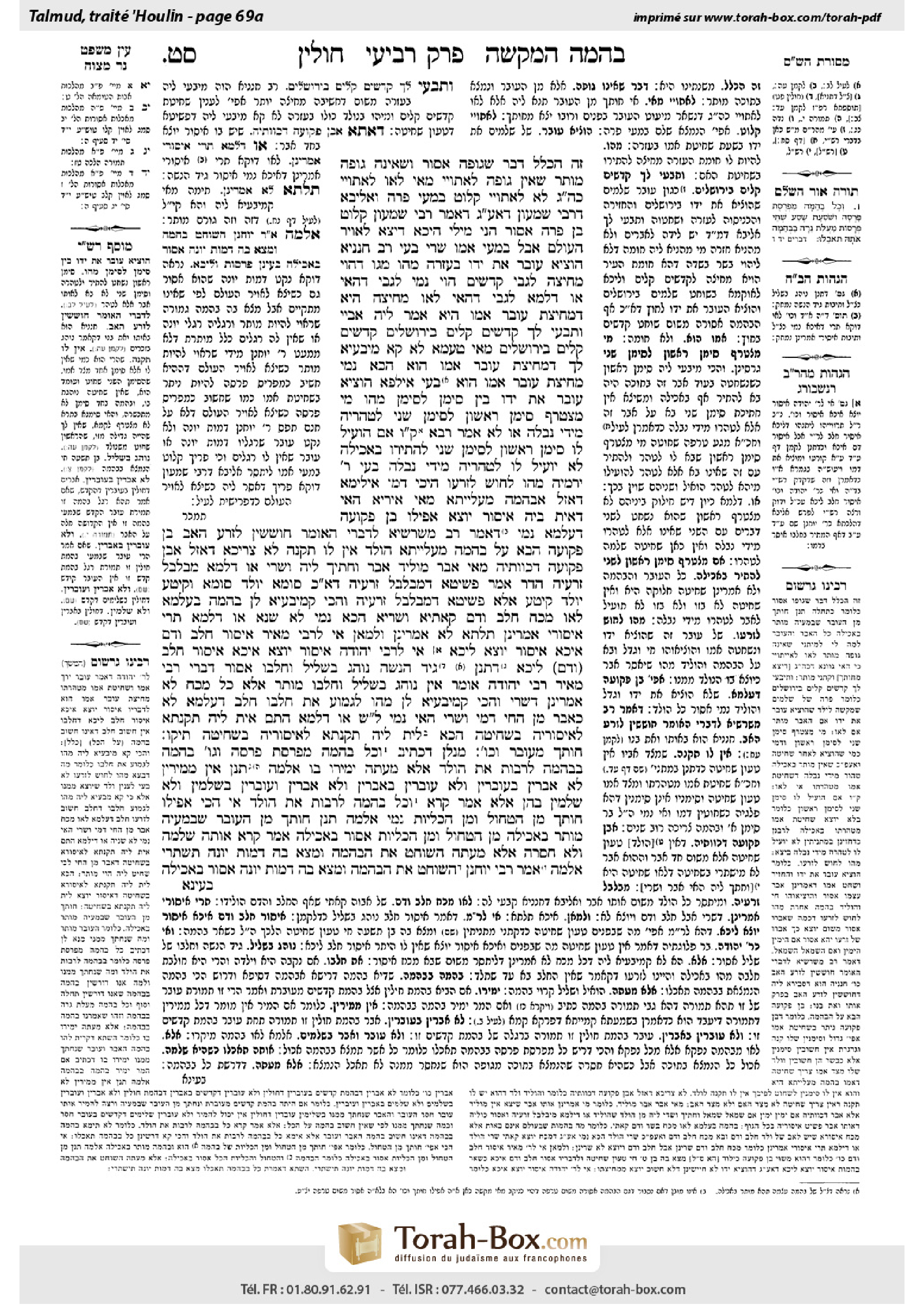
Chullin 69a: Talmud study for Daf Yomi
Study the Talmud for Daf Yomi with scanned pages, Hebrew text, English translations from Sefaria and AI-generated French translations.
Passage selection and English or AI-generated French translation are available where the scan has annotations. Daf Study is independent of Torah-Box and Sefaria.
Browse Chullin · חולין · All tractatesChullin 69a text and translations
This page of Chullin includes the Aramaic text, an English translation and an AI-generated French translation, alongside the scan above.
חולין ס״ט א · Aramaic and Hebrew text
זֶה הַכְּלָל: דָּבָר שֶׁגּוּפָהּ – אָסוּר, וְשֶׁאֵינָהּ גּוּפָהּ – מוּתָּר. שֶׁאֵין גּוּפָהּ לְאֵתוֹיֵי מַאי? לָאו לְאֵתוֹיֵי כְּהַאי גַּוְנָא?
לָא, לְאֵתוֹיֵי קָלוּט בִּמְעֵי פָּרָה, וְאַלִּיבָּא דְּרַבִּי שִׁמְעוֹן, דְּאַף עַל גַּב דְּאָמַר רַבִּי שִׁמְעוֹן: קָלוּט בֶּן פָּרָה אָסוּר – הָנֵי מִילֵּי הֵיכָא דְּיָצָא לַאֲוִיר הָעוֹלָם, אֲבָל בִּמְעֵי אִמּוֹ – שְׁרֵי.
בָּעֵי רַב חֲנַנְיָא: הוֹצִיא עוּבָּר אֶת יָדוֹ בָּעֲזָרָה, מַהוּ? מִגּוֹ דְּהָוֵי מְחִיצָה לְגַבֵּי קָדָשִׁים – הָוֵי נָמֵי לְגַבֵּי דְּהַאי, אוֹ דִלְמָא לְגַבֵּי דְּהַאי לָאו מְחִיצָה הִיא, דִּמְחִיצַת עוּבָּר – אִמּוֹ הִיא?
אֲמַר לֵיהּ אַבָּיֵי: וְתִבְּעֵי לָךְ קָדָשִׁים קַלִּים בִּירוּשָׁלַיִם? קָדָשִׁים קַלִּים בִּירוּשָׁלַיִם מַאי טַעְמָא לָא קָא מִיבַּעְיָא לָךְ? דִּמְחִיצַת עוּבָּר אִמּוֹ הִוא, הָכָא נָמֵי מְחִיצַת עוּבָּר אִמּוֹ הִוא.
בָּעֵי אִילְפָא: הוֹצִיא עוּבָּר אֶת יָדוֹ בֵּין סִימָן לְסִימָן, מַהוּ?
מִי מִצְטָרֵף סִימָן רִאשׁוֹן לְסִימָן שֵׁנִי לְטַהוֹרֵיהּ מִידֵי נְבֵלָה, אוֹ לָא? אָמַר רָבָא: קַל וָחוֹמֶר, אִם הוֹעִיל לוֹ סִימָן רִאשׁוֹן לְסִימָן שֵׁנִי לְהַתִּירוֹ בַּאֲכִילָה, לֹא יוֹעִיל לוֹ לְטַהוֹרֵיהּ מִידֵי נְבֵלָה?
בָּעֵי רַבִּי יִרְמְיָה: מַהוּ לָחוֹשׁ לְזַרְעוֹ?
הֵיכִי דָמֵי? אִילֵּימָא דַּאֲזַל אַבְּהֵמָה מְעַלַּיְיתָא, מַאי אִירְיָא הַאי דְּאִית בֵּיהּ אִיסּוּר יוֹצֵא?
אֲפִילּוּ בֶּן פְּקוּעָה דְּעָלְמָא נָמֵי, דְּאָמַר רַב מְשַׁרְשְׁיָא: לְדִבְרֵי הָאוֹמֵר חוֹשְׁשִׁין לְזֶרַע הָאָב, בֶּן פְּקוּעָה הַבָּא עַל בְּהֵמָה מְעַלַּיְיתָא – הַוָּלָד אֵין לוֹ תַּקָּנָה.
לָא צְרִיכָא, דַּאֲזַל אַבֶּן פְּקוּעָה דִּכְוָותֵיהּ. מַאי? אֵבֶר מוֹלִיד אֵבֶר, וְחָתֵיךְ לֵיהּ וּשְׁרֵי, אוֹ דִלְמָא מִבַּלְבַּל זַרְעֵיהּ?
הֲדַר אָמַר: פְּשִׁיטָא דְּמִבַּלְבַּל זַרְעֵיהּ, דְּאִם כֵּן, סוֹמֵא יִוָּלֵד סוֹמֵא, וְקִיטֵּעַ יִוָּלֵד קִיטֵּעַ!
אֶלָּא פְּשִׁיטָא דְּמִבַּלְבַּל זַרְעֵיהּ, וְהָכִי קָמִיבַּעְיָא לַן: בְּהֵמָה בְּעָלְמָא, לָאו מִכֹּחַ חֵלֶב וָדָם קָאָתְיָא, וְשָׁרְיָא? הָכָא נָמֵי לָא שְׁנָא. אוֹ דִלְמָא: תְּרֵי אִיסּוּרֵי אָמְרִינַן, תְּלָתָא לָא אָמְרִינַן?
וּלְמַאן? אִי לְרַבִּי מֵאִיר – אִיסּוּר חֵלֶב וָדָם אִיכָּא, אִיסּוּר יוֹצֵא לֵיכָּא.
אִי לְרַבִּי יְהוּדָה – אִיסּוּר יוֹצֵא אִיכָּא, אִיסּוּר חֵלֶב וָדָם לֵיכָּא!
דִּתְנַן: גִּיד הַנָּשֶׁה נוֹהֵג בַּשְּׁלִיל, וְחֶלְבּוֹ אָסוּר, דִּבְרֵי רַבִּי מֵאִיר. רַבִּי יְהוּדָה אוֹמֵר: אֵין נוֹהֵג בַּשְּׁלִיל, וְחֶלְבּוֹ מוּתָּר.
אֶלָּא, כֹּל מִכֹּחַ לָא אָמְרִינַן דִּשְׁרֵי.
וְהָכִי קָמִיבַּעְיָא לַן: מַהוּ לִגְמוֹעַ אֶת חֲלָבוֹ? חָלָב דְּעָלְמָא לָא כְּאֵבֶר מִן הַחַי דָּמֵי, וּשְׁרֵי, הַאי נָמֵי לָא שְׁנָא.
אוֹ דִלְמָא הָתָם, אִית לֵיהּ תַּקַּנְתָּא לְאִיסּוּרֵיהּ בִּשְׁחִיטָה, הָכָא לֵית לֵיהּ תַּקַּנְתָּא לְאִיסּוּרֵיהּ בִּשְׁחִיטָה? תֵּיקוּ.
חוֹתֵךְ מֵעוּבָּר וְכוּ׳. מְנָלַן? דִּכְתִיב: ״וְכׇל בְּהֵמָה מַפְרֶסֶת פַּרְסָה וְגוֹ׳״, ״בְּהֵמָה … בַּבְּהֵמָה״ – לְרַבּוֹת אֶת הַוָּלָד.
אֶלָּא מֵעַתָּה, יָמִירוּ בּוֹ!
אַלְּמָה תְּנַן: אֵין מְמִירִין לֹא אֵבָרִין בְּעוּבָּרִין, וְלֹא עוּבָּרִין בְּאֵבָרִין, וְלֹא אֵבָרִין וְעוּבָּרִין בִּשְׁלֵמִין, וְלֹא שְׁלֵמִין בָּהֶן!
אֶלָּא, אָמַר קְרָא: ״וְכׇל בְּהֵמָה״, לְרַבּוֹת אֶת הַוָּלָד.
אִי הָכִי, אֲפִילּוּ חוֹתֵךְ מִן הַטְּחוֹל וּמִן הַכְּלָיוֹת נָמֵי, אַלְּמָה תְּנַן: חוֹתֵךְ מִן הָעוּבָּר שֶׁבְּמֵעֶיהָ – מוּתָּר בַּאֲכִילָה, מִן הַטְּחוֹל וּמִן הַכְּלָיוֹת – אָסוּר בַּאֲכִילָה? אָמַר קְרָא: ״אוֹתָהּ״ – שְׁלֵמָה וְלֹא חֲסֵרָה.
אֶלָּא מֵעַתָּה, הַשּׁוֹחֵט אֶת הַבְּהֵמָה וּמָצָא בָּהּ דְּמוּת יוֹנָה תִּשְׁתְּרֵי? אַלְּמָה אָמַר רַבִּי יוֹחָנָן: הַשּׁוֹחֵט אֶת הַבְּהֵמָה וּמָצָא בָּהּ דְּמוּת יוֹנָה (אסור) [אֲסוּרָה] בַּאֲכִילָה?
Chullin 69a · English translation
This is the principle: An item that is part of an animal’s body that was severed prior to the slaughter is prohibited to be consumed even after slaughter, and an item that is not part of its body, i.e., its fetus, is permitted by virtue of its slaughter. The Gemara asks: Just prior to stating the principle, the mishna states the halakha that even if parts of a fetus are cut from it the slaughter of the mother permits it. If so, when the mishna presents the principle and states that an item that is not part of its body is permitted, what is added? Is it not to include a case like this, where the majority of the fetus has already left the womb, and nevertheless the principle clarifies that the rest of the fetus that remains inside the womb is permitted?
The Gemara rejects this suggestion: No, it comes to include a fetus with non-cloven hooves found inside the womb of a cow that was slaughtered. Although the fetus does not bear the hallmarks of a kosher animal, which has split hooves and chews its cud, it is nevertheless permitted to be consumed by virtue of the slaughter of its mother. And a specific clause in the mishna permitting this is necessary according to the opinion of Rabbi Shimon, as Rabbi Shimon says: A calf with non-cloven hooves born from a kosher cow is forbidden, as the calf does not bear the hallmarks of a kosher animal. The mishna teaches that this matter applies only where the fetus emerged into the airspace of the world, i.e., it was born before the mother animal was slaughtered. But if it is still inside its mother’s womb when the mother is slaughtered, it is permitted to be consumed.
§ The Gemara taught that the reason to deem a limb of a fetus that was extended outside the womb forbidden for consumption is because it went outside of its boundary. Based on this, Rav Ḥananya raises a dilemma: If the fetus of a sacrificial animal of the most sacred order extended its foreleg outside the womb while in the Temple courtyard and then brought it back, what is the halakha? Will the slaughter of the mother permit that limb? Do we say that since the courtyard is regarded as the boundary for such sacrificial animals, as they are permitted only when in the courtyard, therefore it is also regarded as the boundary for this fetus, and even if it extended its limb outside of the womb, it is irrelevant since it ultimately remained within its boundary? Or perhaps, for this fetus, the courtyard is not considered its boundary, as the boundary of a fetus is its mother, and so the limb would become prohibited.
Abaye said to Rav Ḥananya: But why don’t you raise the same dilemma with regard to the fetuses of offerings of lesser sanctity, which are permitted only within Jerusalem? Abaye continues: It would appear that concerning offerings of lesser sanctity within Jerusalem, what is the reason that you did not raise this dilemma? It is because it is clear to you that the boundary of a fetus is its mother. But here too, concerning a fetus of an offering of the most sacred order, one must say that the boundary of a fetus is its mother, and not the Temple courtyard.
§ The baraita cited on 68b discusses the case of a fetus that extended a limb outside the womb. It cites the opinion of the Rabbis that although the slaughter of the mother does not permit the consumption of the limb, it does prevent it from being defined as a carcass with the associated ritual impurity. Based on this, Ilfa raises a dilemma: If the fetus extended its foreleg outside the womb between the severing of its mother’s windpipe, which is one of the organs that must be severed in ritual slaughter [siman], and the severing of the other siman, the gullet, what is the halakha?
Does the cutting of the first siman combine with that of the second siman to render that limb pure from the impurity of a carcass or not? The cutting of the first siman could potentially permit the consumption of the limb, as the limb was still inside the womb, whereas the cutting of the second siman could not permit consumption, as the limb had already been extended outside the womb. Since they have different effects, can they combine to render the limb pure? Rava said: It is an a fortiori inference: If the cutting of the first siman was effective to the extent that it can combine with the cutting of the second siman to permit the rest of the fetus for consumption, will it not be effective with regard to the limb to render it pure from the impurity of a carcass?
Rabbi Yirmeya raises a dilemma: If a fetus extended a limb outside the womb, thereby rendering the limb forbidden, and then, after the mother animal was slaughtered, the fetus emerged alive, what is the halakha concerning whether there is a need to be concerned with regard to any offspring of that fetus, i.e., that the prohibition pertaining to its limb will pass on to its offspring?
The Gemara clarifies: What are the circumstances of this case? If we say the dilemma applies to the offspring in a case where the fetus matured and mated with a full-fledged, normal animal, which would be fully permitted if slaughtered, then why raise this dilemma specifically with regard to this fetus, which has a prohibition attached to it caused by leaving its boundary?
Even in the case of a regular fetus that emerged alive from its mother’s womb after the mother was slaughtered [ben pekua], which is permitted without the need for any slaughter, the dilemma could also be raised, as Rav Mesharshiyya says: According to the statement of the one who says that when defining the status of an animal one needs to be concerned with its paternity and not only its maternity, if a ben pekua mated with a full-fledged animal, the offspring has no rectification. The offspring of two ben pekua animals is permitted without ritual slaughter. But if the father is a ben pekua but not the mother, then it is simultaneously defined as requiring slaughter, based on the mother, and being excluded from the possibility of being permitted through slaughter, based on the father. Therefore, no act of slaughter can permit it.
The Gemara answers: No, the dilemma does not concern that case. Rather, it is necessary in a case in which the fetus later mated with a ben pekua like it and had offspring. Since neither of the parents require slaughter, the offspring does not require it either. In such a case, what is the halakha? To what extent does the prohibition pertaining to the limb of the father pass to the offspring? Do we say that each limb of the father produces the corresponding limb in the offspring, and so only the parallel limb in the offspring is prohibited, and therefore one could sever that limb and the rest of the offspring will be permitted? Or perhaps the father’s seed is intermingled through the entire offspring, and so the entire offspring is prohibited.
After raising this dilemma, Rabbi Yirmeya then said: It is obvious that the seed of the father is intermingled through the entire offspring, as if it were so that each limb produces the corresponding limb, every blind father would bear blind offspring, and an amputee father would bear offspring that is an amputee.
Rather, it is obvious that the seed of the father is intermingled, and this is the dilemma we are raising: Even with regard to a regular animal, is it not produced from the influence of the forbidden fat and blood of its father and mother, and yet it is permitted to be consumed? Here too, it is no different, and although the forbidden limb of the father was an influence in the offspring’s formation, the offspring should nevertheless be permitted. Or perhaps we say that the Torah permitted these two prohibitions, the consumption of forbidden fat and the consumption of blood, but we do not say that it permitted three prohibitions, i.e., also the prohibition of a limb that left its boundary.
The Gemara asks: And according to whom is it possible to speak of three prohibitions in order to raise this dilemma? If it is in accordance with the opinion of Rabbi Meir that is difficult, because he holds that a fetus that has completed its gestational term is regarded as being independent of its mother and is no longer permitted by virtue of its mother’s slaughter. Consequently, there is a prohibition of forbidden fat and blood, just like any other animal, but there is no prohibition of a limb that leaves its boundary, as its permitted status is no longer dependent on being within its mother’s womb.
And if you say it is in accordance with the opinion of Rabbi Yehuda that is also difficult, because he holds that since ultimately the offspring was inside its mother’s womb when the mother was slaughtered, the fetus is permitted in its entirety by virtue of that slaughter. Consequently, there is a prohibition of a limb that leaves its boundary, but there is no prohibition of forbidden fat and blood.
The Gemara cites the source of the opinions of Rabbi Meir and Rabbi Yehuda: As we learned in a baraita: The prohibition of the sciatic nerve applies to the fetus that had already completed its gestational term when its mother was slaughtered, and likewise its fat is forbidden; this is the statement of Rabbi Meir. Rabbi Yehuda says that the prohibition of the sciatic nerve does not apply to the fetus, and its fat is permitted. Evidently, according to all opinions, both the prohibitions of forbidden fat and blood and the prohibition of a limb that leaves its boundary cannot apply to the same animal.
Rather, it must be that we do not say that any item that is produced from the influence of a forbidden entity is itself forbidden, as in fact it is permitted. Therefore, it would certainly be permitted to consume the offspring of a fetus whose limb had been forbidden, and the dilemma does not concern such an animal.
And this is the dilemma that we are raising: What is the halakha with regard to drinking the milk of a fetus whose limb is forbidden? Isn’t regular milk of a normal animal comparable to a limb from a living animal, given that it is taken from a live animal, and yet it is permitted? If so, this milk too should be no different, and although the milk comes from an animal whose limb is forbidden as a limb from a living animal, as it was not permitted through the slaughter of its mother, nevertheless, the milk should be permitted.
Or perhaps there, with regard to regular milk, the Torah waives the prohibition of a limb from a living animal, as there is a rectification for its prohibition through slaughter. But here, with regard to a fetus whose limb is forbidden as a limb from a living animal, there is no rectification for its prohibition through slaughter. The Gemara accepts that this was the dilemma, but concludes that no resolution for it was found, and so the dilemma shall stand unresolved.
§ The mishna states: If, prior to slaughtering an animal, one severed pieces from a fetus that is in its womb, leaving those pieces in the womb, their consumption is permitted by virtue of the slaughter of the mother animal. The Gemara asks: From where do we derive this halakha? It is derived from a verse, as it is written: “And every animal that has a split hoof and is cloven into two hooves, chews the cud, of the animals, it you may eat” (Deuteronomy 14:6). The term “of the animals [babehema]” is translated literally as: In the animal, and is referring to the term “every animal” mentioned at the beginning of the verse. Accordingly, the verse may be read as saying: Every animal in the animal you may eat, and is referring to a fetus inside its mother. It therefore serves to include the offspring, i.e., the fetus, as being permitted by its mother’s slaughter, even if parts of the fetus had been severed.
The Gemara objects: If that is so, that the phrase: Every animal of the animals, is referring to a fetus, then one should be able to substitute a non-sacred animal for the sanctified fetus of a pregnant offering, i.e., the non-sacred animal should become consecrated through the attempt to do so. This is because the verse referring to substitution also uses that phrase: “And if he shall substitute an animal for an animal [behema bivhema], it and its substitute shall be consecrated” (Leviticus 27:10). There too, the phrase “an animal for an animal” translates literally as: An animal in an animal.
Why, then, did we learn in a mishna (Temura 10a): One cannot substitute limbs of a non-sacred animal for fetuses of pregnant offerings, i.e., those limbs will not thereby be consecrated; and one cannot substitute fetuses of non-sacred animals for limbs of an offering, and one cannot substitute limbs and fetuses of non-sacred animals for whole offerings, and one cannot substitute whole, non-sacred animals for them, i.e., limbs and fetuses of offerings?
Rather, the halakha that a fetus and its severed pieces are permitted to be consumed by virtue of the slaughter of the mother animal is derived from that which the verse states: “And every animal.” The term “and every” serves to include the offspring, i.e., the fetus, as being permitted, even if parts of it had been severed.
The Gemara objects: If so, then even if one severs pieces of the spleen or of the kidneys of an animal, those pieces should be permitted as well. Why, then, did we learn in the mishna: If one severed pieces from a fetus that was in its womb, leaving those pieces in the womb, their consumption is permitted by virtue of the slaughter of the mother animal, but if one severed pieces of the spleen or of the kidneys of an animal and then slaughtered it their consumption is prohibited? The Gemara explains: That verse states: “Of the animal, it you may eat,” which indicates that slaughter permits consumption of only the whole animal, but not of the parts of the animal that it is lacking, i.e., the parts that were severed.
The Gemara objects: If that is so, that the halakha is derived from the term “and every animal,” then even in the case of one who slaughters an animal and finds a dove-shaped fetus in it, it should be permitted. Why, then, does Rabbi Yoḥanan say: One who slaughters an animal and finds a dove-shaped fetus in it, that fetus is prohibited for consumption?
Chullin 69a · Traduction française (IA)
C’est le principe : un membre qui fait partie du corps d’un animal, qui a été séparé avant l’abattage, est interdit à la consommation même après l’abattage, et un membre qui n’est pas partie de son corps, c’est-à-dire son fœtus, est permis grâce à l’abattage de la mère. La Guemara pose la question : juste avant d’énoncer ce principe, la Michna énonce la halakha selon laquelle même si des parties du fœtus sont coupées, l’abattage de la mère permet la consommation. Si c’est ainsi, quand la Michna présente le principe et affirme que le membre qui n’est pas partie du corps est permis, qu’y ajoute-t-elle ? N’est-ce pas pour inclure un cas comme celui-ci, où la majorité du fœtus a déjà quitté le ventre, et pourtant le principe clarifie que la partie restante du fœtus qui est encore dans le ventre est permise ?
La Guemara rejette cette suggestion : Non, cela vise à inclure un fœtus à cloisons non divisées trouvé dans le ventre d’une vache abattue. Bien que ce fœtus ne présente pas les caractéristiques d’un animal acceptable, qui a des cloisons divisées et mâche l’herbe, il est toutefois permis à la consommation grâce à l’abattage de sa mère. Une clause spécifique dans la Michna permettant cela est nécessaire selon l’opinion de Rabbi Shimon, car Rabbi Shimon dit : un veau à cloisons non divisées né d’une vache acceptable est interdit, car le veau ne présente pas les caractéristiques d’un animal acceptable. La Michna enseigne que cela s’applique uniquement lorsque le fœtus est sorti dans l’air du monde, c’est-à-dire qu’il est né avant que l’animal mère ne soit abattu. Mais si le fœtus est encore dans le ventre de sa mère lors de l’abattage, il est permis à la consommation.
§ La Guemara enseigne que la raison d’interdire la consommation d’un membre du fœtus qui a été étendu hors du ventre est qu’il a quitté sa limite. Sur cette base, Rav Hananya soulève un dilemme : si le fœtus d’un animal sacré de l’ordre le plus saint avait étendu son avant-bras hors du ventre dans le courant du Temple et l’avait ensuite ramené, quelle est la halakha ? L’abattage de la mère permet-il la consommation de ce membre ? Disons-nous que puisque le courant est considéré comme la limite pour ces animaux sacrés, car ils sont permis seulement lorsqu’ils sont dans le courant, donc il est également considéré comme la limite pour ce fœtus, et même s’il a étendu son membre hors du ventre, cela n’a pas d’importance puisqu’il a finalement resté dans sa limite ? Ou peut-être que pour ce fœtus, le courant n’est pas considéré comme sa limite, car la limite d’un fœtus est sa mère, et donc le membre deviendrait interdit.
Abaye dit à Rav Hananya : Mais pourquoi ne soulèves-tu pas ce même dilemme concernant les fœtus des offrandes de moindre sanctité, qui sont permis seulement à Jérusalem ? Abaye continue : Il semble que concernant les offrandes de moindre sanctité à Jérusalem, tu n’as pas soulevé ce dilemme, car tu sais que la limite d’un fœtus est sa mère. Mais ici aussi, concernant un fœtus d’une offrande de l’ordre le plus saint, il faut dire que la limite d’un fœtus est sa mère, et non le courant du Temple.
§ La baraïta citée sur 68b discute du cas d’un fœtus qui a étendu un membre hors du ventre. Elle cite l’opinion des Rabbins selon laquelle bien que l’abattage de la mère ne permette pas la consommation du membre, il empêche ce membre d’être considéré comme un cadavre avec l’impureté rituelle associée. Sur cette base, Ilfa soulève un dilemme : si le fœtus a étendu son avant-bras hors du ventre entre la section de la trachée, qui est l’un des organes qui doit être sectionné lors de l’abattage rituel [siman], et la section de la gorge, l’autre siman, quelle est la halakha ?
La section du premier siman combine-t-elle avec celle du second siman pour rendre ce membre pur de l’impureté du cadavre ? La section du premier siman pourrait potentiellement permettre la consommation du membre, car le membre était encore dans le ventre, tandis que la section du second siman ne pourrait pas permettre la consommation, car le membre avait déjà été étendu hors du ventre. Puisque leurs effets sont différents, peuvent-ils combiner pour rendre le membre pur ? Rava dit : C’est une déduction par l’exemple : si la section du premier siman était efficace à un point tel qu’elle pourrait combiner avec la section du second siman pour permettre la consommation du reste du fœtus, ne serait-il pas efficace concernant le membre pour le rendre pur de l’impureté du cadavre ?
Rabbi Yirmeya soulève un dilemme : si un fœtus a étendu un membre hors du ventre, rendant ainsi le membre interdit, et ensuite, après l’abattage de la mère, le fœtus est né vivant, quelle est la halakha concernant la nécessité de s’inquiéter d’un descendant de ce fœtus, c’est-à-dire que l’interdiction concernant son membre se transmettrait à ses descendants ?
La Guemara clarifie : Quelles sont les circonstances de ce cas ? Si nous disons que le dilemme s’applique aux descendants dans un cas où le fœtus a mûri et a couvert un animal complet, qui serait entièrement permis s’il était abattu, pourquoi soulever spécifiquement ce dilemme concernant ce fœtus, qui a une interdiction attachée à cause de son départ de sa limite ?
Même dans le cas d’un fœtus normal qui est né vivant après l’abattage de sa mère [ben pekua], qui est permis sans nécessiter d’abattage, ce dilemme pourrait également être soulevé, car Rav Mesharshiyya dit : Selon celui qui dit qu’il faut s’inquiéter de la paternité et non seulement de la maternité lors de la détermination du statut d’un animal, si un ben pekua a couvert un animal complet, l’offspring n’a pas de réparation. L’offspring de deux ben pekua est permis sans abattage rituel. Mais si le père est un ben pekua mais pas la mère, alors il est simultanément défini comme nécessitant un abattage, en raison de la mère, et exclu de la possibilité d’être permis par l’abattage, en raison du père. Ainsi, aucun acte d’abattage ne peut le permettre.
La Guemara répond : Non, ce dilemme ne concerne pas ce cas. Plutôt, il est nécessaire dans un cas où le fœtus a plus tard copulé avec un ben pekua semblable à lui et a eu des enfants. Puisque ni l'un ni l'autre des parents ne nécessitent d'être sacrifié, l'enfant ne nécessite pas non plus d'être sacrifié. Dans ce cas, quelle est la halakha ? Dans quelle mesure la prohibition concernant le membre du père passe-t-elle à l'enfant ? Disons-nous que chaque membre du père produit le membre correspondant chez l'enfant, et donc seul le membre correspondant chez l'enfant est interdit, et donc on pourrait couper ce membre et le reste de l'enfant serait autorisé ? Ou peut-être que la semence du père est mélangée à travers tout l'enfant, et donc l'enfant entier est interdit.
Après avoir soulevé ce dilemme, Rabbi Yirmeya a dit ensuite : Il est évident que la semence du père est mélangée à travers tout l'enfant, comme si chaque membre produisait le membre correspondant, et chaque père aveugle aurait un enfant aveugle, et un père amputé aurait un enfant amputé.
Plutôt, il est évident que la semence du père est mélangée, et c'est ce dilemme que nous soulevons : Même concernant un animal ordinaire, n'est-il pas produit de l'influence de la graisse et du sang interdits de ses parents, et pourtant il est permis de le consommer ? Ici aussi, c'est pareil, et bien que l'influence du membre interdit du père ait été dans la formation de l'enfant, l'enfant devrait tout de même être permis. Ou peut-être que nous disons que la Torah a permis ces deux prohibitions, la consommation de la graisse interdite et la consommation du sang, mais nous ne disons pas qu'elle a permis trois prohibitions, c'est-à-dire aussi la prohibition du membre qui sort de sa limite.
La Guemara demande : Et selon qui peut-on parler de trois prohibitions afin de soulever ce dilemme ? Si c'est selon l'opinion de Rabbi Meir, cela est difficile, car il considère que le fœtus qui a terminé son terme de gestation est regardé comme indépendant de sa mère et n'est plus permis par la raison de la mort de sa mère. Par conséquent, il y a une prohibition de la graisse et du sang interdits, comme tout autre animal, mais il n'y a pas de prohibition du membre qui sort de sa limite, car son statut permis n'est plus dépendant d'être dans le ventre de sa mère.
Et si vous dites que c'est selon l'opinion de Rabbi Yehuda, cela est aussi difficile, car il considère que puisque finalement l'enfant était dans le ventre de sa mère lorsqu'elle a été sacrifiée, l'enfant est entièrement permis grâce à ce sacrifice. Par conséquent, il y a une prohibition du membre qui sort de sa limite, mais il n'y a pas de prohibition de la graisse et du sang interdits.
La Guemara cite la source des opinions de Rabbi Meir et Rabbi Yehuda : Comme nous avons appris dans une baraïta : La prohibition du nerf sciatique s'applique au fœtus qui avait déjà terminé son terme de gestation lorsqu'il a été sacrifié, et de même sa graisse est interdite ; c'est l'opinion de Rabbi Meir. Rabbi Yehuda dit que la prohibition du nerf sciatique ne s'applique pas au fœtus, et sa graisse est permise. Évidemment, selon toutes les opinions, les prohibitions de la graisse et du sang interdits et la prohibition du membre qui sort de sa limite ne peuvent pas s'appliquer au même animal.
Plutôt, il faut comprendre que nous ne disons pas que tout ce qui est produit sous l'influence d'une entité interdite est lui-même interdit, car en réalité il est permis. Par conséquent, il serait certainement permis de consommer l'enfant d'un fœtus dont un membre avait été interdit, et ce dilemme ne concerne pas un tel animal.
Et c'est ce dilemme que nous soulevons : Quelle est la halakha concernant la consommation du lait d'un fœtus dont un membre est interdit ? N'est-ce pas le lait ordinaire d'un animal normal comparable à un membre d'un animal vivant, puisque c'est tiré d'un animal vivant, et pourtant il est permis ? Si c'est le cas, ce lait devrait être pareil, et bien que le lait vienne d'un animal dont un membre est interdit comme un membre d'un animal vivant, puisqu'il n'était pas permis grâce au sacrifice de sa mère, néanmoins, le lait devrait être permis.
Ou peut-être, concernant le lait ordinaire, la Torah dispense la prohibition du membre d'un animal vivant, car il y a une rectification de cette prohibition grâce au sacrifice. Mais ici, concernant un fœtus dont un membre est interdit comme un membre d'un animal vivant, il n'y a pas de rectification de cette prohibition grâce au sacrifice. La Guemara accepte que c'était ce dilemme, mais conclut qu'aucune résolution n'a été trouvée, et donc ce dilemme restera sans solution.
§ La mitsva stipule : Si, avant de sacrifier un animal, on a coupé des morceaux d'un fœtus qui est dans son ventre, laissant ces morceaux dans le ventre, leur consommation est permise grâce au sacrifice de l'animal mère. La Guemara demande : D'où dérive cette halakha ? Elle est dérivée d'un verset, comme il est écrit : « Et tout animal qui a un sabot divisé et est cloisonné en deux sabots, qui rumine, des bêtes, vous pouvez manger » (Deutéronome 14:6). Le terme « des bêtes [babehema] » est littéralement traduit comme : Dans la bête, et il fait référence au terme « tout animal » mentionné au début du verset. Ainsi, le verset peut être lu comme disant : Tout animal dans la bête vous pouvez manger, et il fait référence à un fœtus à l'intérieur de sa mère. Il sert donc à inclure l'enfant, c'est-à-dire le fœtus, comme étant permis grâce au sacrifice de sa mère, même si des parties du fœtus avaient été coupées.
La Guemara s'oppose : Si c'est ainsi, c'est-à-dire que la phrase « Tout animal des animaux » fait référence à un fœtus, alors on devrait pouvoir substituer un animal non sacré au fœtus sacré d'une offrande enceinte, c'est-à-dire que l'animal non sacré deviendrait sacré par l'effort de substitution. Cela est dû au fait que la versette qui parle de substitution utilise également cette phrase : « Et s'il substitue un animal à un animal [behema bivhema], il et son substitut seront sacrés » (Lévitique 27:10). Là aussi, la phrase « un animal pour un animal » se traduit littéralement par : un animal dans un animal.
Pourquoi, alors, avons-nous appris dans une mitsva (Temura 10a) : On ne peut substituer des membres d'un animal non sacré aux fœtus d'offrandes enceintes, c'est-à-dire que ces membres ne deviendront pas ainsi sacrés ; et on ne peut substituer des fœtus d'animaux non sacrés aux membres d'une offrande, et on ne peut substituer des membres et des fœtus d'animaux non sacrés aux offrandes entières, et on ne peut substituer des animaux non sacrés entiers à ceux-ci, c'est-à-dire aux membres et aux fœtus d'offrandes ?
En réalité, la halakha selon laquelle un fœtus et ses morceaux séparés sont permis à la consommation grâce à la mise à mort de l'animal mère est tirée de la versette qui dit : « Et tout animal. » Le terme « et tout » sert à inclure l'offspring, c'est-à-dire le fœtus, comme étant permis, même si des parties de lui avaient été séparées.
La Guemara s'oppose : Si c'est ainsi, alors même si l'on sépare des morceaux de la rate ou des reins d'un animal, ceux-ci devraient être permis également. Pourquoi, alors, avons-nous appris dans la Michna : Si l'on sépare des morceaux d'un fœtus qui était dans le ventre, en laissant ces morceaux dans le ventre, leur consommation est permise grâce à la mise à mort de l'animal mère, mais si l'on sépare des morceaux de la rate ou des reins d'un animal et ensuite le tue, leur consommation est interdite ? La Guemara explique : Cette versette dit : « De l'animal, tu peux manger », ce qui indique que la mise à mort permet la consommation uniquement de l'animal entier, mais pas des parties de l'animal qui manquent, c'est-à-dire les parties qui ont été séparées.
La Guemara s'oppose : Si c'est ainsi, c'est-à-dire que la halakha est tirée du terme « et tout animal », alors même dans le cas d'une personne qui tue un animal et trouve un fœtus en forme de colombe dedans, il devrait être permis. Pourquoi, alors, Rabbi Yoḥanan dit-il : Une personne qui tue un animal et trouve un fœtus en forme de colombe dedans, ce fœtus est interdit à la consommation ?
Traduction française générée par IA à partir de l’édition anglaise de Sefaria. Vérifie toujours un passage avec le texte source.
Text from Sefaria: William Davidson Edition - Vocalized Aramaic (unknown); William Davidson Edition - English (CC BY NC).