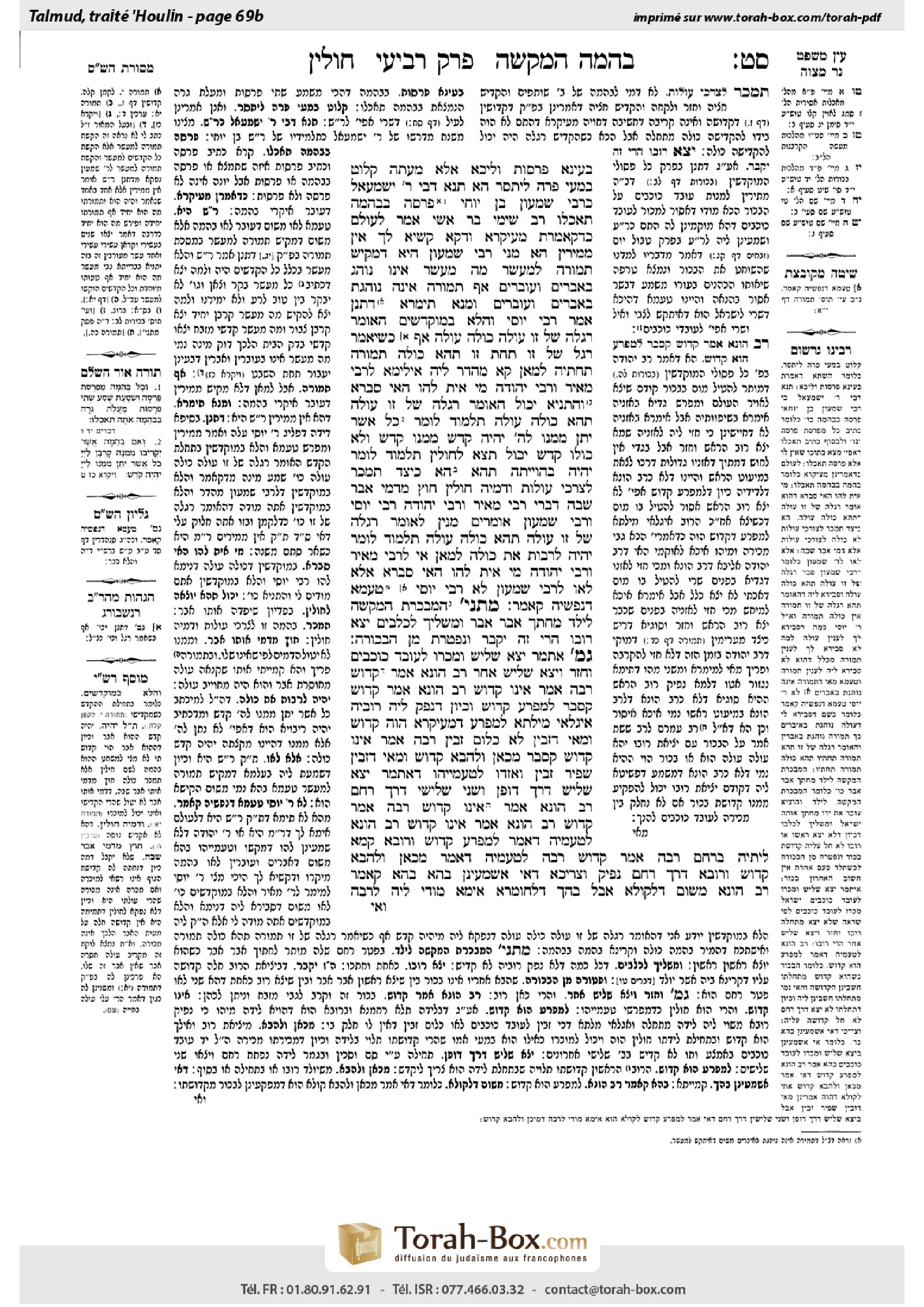
Chullin 69b: Talmud study for Daf Yomi
Study the Talmud for Daf Yomi with scanned pages, Hebrew text, English translations from Sefaria and AI-generated French translations.
Passage selection and English or AI-generated French translation are available where the scan has annotations. Daf Study is independent of Torah-Box and Sefaria.
Browse Chullin · חולין · All tractatesChullin 69b text and translations
This page of Chullin includes the Aramaic text, an English translation and an AI-generated French translation, alongside the scan above.
חולין ס״ט ב · Aramaic and Hebrew text
בָּעֵינָא פְּרָסוֹת, וְלֵיכָּא.
אֶלָּא מֵעַתָּה, קָלוּט בִּמְעֵי פָּרָה לִיתְּסַר? הָא תָּנָא דְּבֵי רַבִּי יִשְׁמָעֵאל כְּרַבִּי שִׁמְעוֹן בֶּן יוֹחַי: ״פַּרְסָה בַּבְּהֵמָה תֹּאכֵלוּ״.
רַב שִׁימִי בַּר אָשֵׁי אָמַר: לְעוֹלָם כִּדְקָאָמְרַתְּ מֵעִיקָּרָא, וּדְקָא קַשְׁיָא לָךְ ״אֵין מְמִירִין״, הָא מַנִּי? רַבִּי שִׁמְעוֹן הִיא, דְּמַקֵּישׁ תְּמוּרָה לְמַעֲשֵׂר: מָה מַעֲשֵׂר אֵינוֹ נוֹהֵג בָּאֵבָרִים וְעוּבָּרִים, אַף תְּמוּרָה אֵינָהּ נוֹהֶגֶת בָּאֵבָרִים וְעוּבָּרִים.
וּמְנָא תֵּימְרָא, דִּתְנַן: אָמַר רַבִּי יוֹסֵי: וַהֲלֹא בְּמוּקְדָּשִׁים, הָאוֹמֵר: ״רַגְלָהּ שֶׁל זוֹ עוֹלָה״ – כּוּלָּהּ עוֹלָה, אַף כְּשֶׁיֹּאמַר: ״רֶגֶל שֶׁל זוֹ תַּחַת זוֹ״ – תְּהֵא כּוּלָּהּ תְּמוּרָה תַּחְתֶּיהָ.
לְמַאן קָא מַהְדַּר לֵיהּ? אִילֵּימָא לְרַבִּי מֵאִיר וְרַבִּי יְהוּדָה, מִי אִית לְהוּ הַאי סְבָרָא? וְהָתַנְיָא: יָכוֹל הָאוֹמֵר ״רַגְלָהּ שֶׁל זוֹ עוֹלָה״ תְּהֵא כּוּלָּהּ עוֹלָה? תַּלְמוּד לוֹמַר: ״כֹּל אֲשֶׁר יִתֵּן מִמֶּנּוּ לַה׳ יִהְיֶה קֹּדֶשׁ״ – מִמֶּנּוּ קֹדֶשׁ, וְלֹא כּוּלּוֹ קֹדֶשׁ.
יָכוֹל תֵּצֵא לְחוּלִּין? תַּלְמוּד לוֹמַר: ״יִהְיֶה״ – בַּהֲוָיָיתָהּ תְּהֵא. הָא כֵּיצַד? תִּמָּכֵר לְצׇרְכֵי עוֹלוֹת, וְדָמֶיהָ חוּלִּין, חוּץ מִדְּמֵי אֵבֶר שֶׁבָּהּ – דִּבְרֵי רַבִּי מֵאִיר וְרַבִּי יְהוּדָה.
רַבִּי יוֹסֵי וְרַבִּי שִׁמְעוֹן אוֹמְרִים: מִנַּיִן לָאוֹמֵר ״רַגְלָהּ שֶׁל זוֹ עוֹלָה״ – תְּהֵא כּוּלָּהּ עוֹלָה? תַּלְמוּד לוֹמַר: ״יִהְיֶה״ – לְרַבּוֹת אֶת כּוּלָּהּ.
לְמַאן? אִי לְרַבִּי מֵאִיר וְרַבִּי יְהוּדָה – מִי אִית לְהוּ הַאי סְבָרָא? אֶלָּא לָאו לְרַבִּי שִׁמְעוֹן!
לָא, רַבִּי יוֹסֵי טַעְמָא דְנַפְשֵׁיהּ קָאָמַר.
מַתְנִי׳ הַמְבַכֶּרֶת, הַמְקַשָּׁה לֵילֵד – מְחַתֵּךְ אֵבֶר אֵבֶר, וּמַשְׁלִיךְ לִכְלָבִים. יָצָא רוּבּוֹ – הֲרֵי זֶה יִקָּבֵר, וְנִפְטֶרֶת מִן הַבְּכוֹרָה.
גְּמָ׳ אִתְּמַר: יָצָא שְׁלִישׁ וּמְכָרוֹ לְגוֹי, וְחָזַר וְיָצָא שְׁלִישׁ אַחֵר – רַב הוּנָא אָמַר: קָדוֹשׁ, רַבָּה אָמַר: אֵינוֹ קָדוֹשׁ.
רַב הוּנָא אָמַר קָדוֹשׁ: קָסָבַר לְמַפְרֵעַ קָדוֹשׁ, וְכֵיוָן דִּנְפַק לֵיהּ רוּבֵּיהּ – אִיגַּלַּאי מִילְּתָא לְמַפְרֵעַ דְּמֵעִיקָּרָא הֲוָה קָדוֹשׁ, וּמַאי דְּזַבֵּין – לֹא כְּלוּם זַבֵּין.
רַבָּה אָמַר אֵינוֹ קָדוֹשׁ: קָסָבַר מִכָּאן וּלְהַבָּא קָדוֹשׁ, וּמַאי דְּזַבֵּין – שַׁפִּיר זַבֵּין.
וְאָזְדוּ לְטַעְמַיְיהוּ, דְּאִתְּמַר: יָצָא שְׁלִישׁ דֶּרֶךְ דּוֹפֶן, וּשְׁנֵי שְׁלִישֵׁי דֶּרֶךְ רֶחֶם – רַב הוּנָא אָמַר: אֵינוֹ קָדוֹשׁ, רַבָּה אָמַר: קָדוֹשׁ.
רַב הוּנָא אָמַר: אֵינוֹ קָדוֹשׁ. רַב הוּנָא לְטַעְמֵיהּ, דְּאָמַר: לְמַפְרֵעַ קָדוֹשׁ, וְרוּבָּא קַמָּא לֵיתֵיהּ בְּרֶחֶם. רַבָּה אָמַר: קָדוֹשׁ. רַבָּה לְטַעְמֵיהּ, דְּאָמַר: מִכָּאן וּלְהַבָּא קָדוֹשׁ, וְרוּבָּא דֶּרֶךְ רֶחֶם נָפֵיק.
וּצְרִיכָא, דְּאִי אַשְׁמְעִינַן בְּהָא: בְּהָא קָאָמַר רַב הוּנָא מִשּׁוּם דִּלְקוּלָּא, אֲבָל בְּהָךְ דִּלְחוּמְרָא – אֵימָא מוֹדֵי לֵיהּ לְרַבָּה.
Chullin 69b · English translation
The Gemara explains: In order for the fetus to be permitted, I require that it have hooves, and a dove-shaped fetus does not have hooves.
The Gemara objects: If that is so, that the fetus is permitted only if it fulfills the conditions mentioned in that verse, then a fetus with non-cloven hooves found inside a cow’s womb should be forbidden, whereas the baraita cited on 68b states that it is permitted. The Gemara answers: This is as the school of Rabbi Yishmael taught in accordance with the opinion of Rabbi Shimon ben Yoḥai: Each phrase in the verse is taken as a sufficient condition. Furthermore, the term “hoof” can be understood independently of the phrase “cloven into two hooves,” and is referring to a non-cloven hoof. Accordingly, the verse can be interpreted as teaching: An animal that has a hoof, in the animal, it you may eat, and teaches that even a fetus with a non-cloven hoof is permitted.
Rav Shimi bar Ashi said: Actually, the halakha that the fetus and its severed pieces are permitted should be derived as you previously said, i.e., from the phrase: An animal in the animal. And with regard to that which posed a difficulty for you, i.e., the mishna in Temura that states one cannot substitute a non-sacred animal for the fetus of a pregnant offering, that difficulty can be resolved by saying: In accordance with whose opinion is this? It is the opinion of Rabbi Shimon, who compares substitution to the animal tithe: Just as the animal tithe does not apply to limbs and fetuses but only to live animals that can walk, as it is stated: “Whatever passes under the rod” (Leviticus 27:32), so too, substitution does not apply to limbs and fetuses.
The Gemara asks: And from where do you say that this mishna expresses the opinion of Rabbi Shimon? The Gemara explains: As we learned in the same mishna (Temura 10a) that Rabbi Yosei says: But with regard to consecrated offerings, if one says the leg of this animal is a burnt offering, then all of the animal is consecrated as a burnt offering. Accordingly, even with regard to substitution, if one says: The leg of this non-sacred animal should be substituted instead of that offering, the entire animal should be a substitute in its stead.
Rabbi Yosei clearly disagrees with the opinion that substituting a limb is not possible. But Rabbi Yosei’s formulation indicates that even according to that opinion, if a single limb is consecrated then the entire animal becomes consecrated. The Gemara clarifies: To whom is Rabbi Yosei responding? If we say he is responding to Rabbi Meir and Rabbi Yehuda, do they accept this reasoning? But isn’t it taught in a baraita: One might have thought that in the case of one who says: The leg of this animal is a burnt offering, all of it will be a burnt offering. Therefore, the verse states: “And if it is an animal of those that they bring as an offering to the Lord, anything of it that one gives to the Lord, it shall be sacred” (Leviticus 27:9). The verse indicates that the part of it that one gives will be sacred, but all of it will not be sacred.
A non-sacred animal with a consecrated limb may not be sacrificed. Accordingly, one might have thought the consecrated limb may be redeemed and thereby transferred to non-sacred status. Therefore, the verse states: “It shall be sacred,” indicating that it shall remain as it is. How is this possible? The animal should be sold for the needs of burnt offerings, i.e., to an individual who will sacrifice the entire animal as a burnt offering, and the payment received for the animal will be non-sacred, except for the payment received in exchange for that one limb that is consecrated. This is the statement of Rabbi Meir and Rabbi Yehuda.
Rabbi Yosei and Rabbi Shimon say: From where is it derived that in the case of one who says: The leg of this animal is a burnt offering, all of it becomes a burnt offering? The verse states: “It shall be sacred.” This serves to include all of the animal, indicating that it all becomes sacred.
The Gemara reiterates its question: To whom is Rabbi Yosei responding? Rabbi Yosei clearly disagrees with the opinion that if a single limb is consecrated then the entire animal becomes consecrated. If we say he is responding to Rabbi Meir and Rabbi Yehuda, do they accept this reasoning? Rather, isn’t Rabbi Yosei responding to Rabbi Shimon, as the Gemara suggests above in resolution of the difficulty from the mishna in Temura?
The Gemara responds: No, it is possible that Rabbi Yosei is not responding directly to any other opinion; rather, he stated his own reasoning, without reference to that of another Sage. Consequently, his statement affords no proof that the mishna in Temura expresses the opinion of Rabbi Shimon.
MISHNA: Upon its birth, the firstborn male offspring of a domesticated animal is automatically consecrated with firstborn status, and it is prohibited to derive benefit from it. Furthermore, if it dies, it may not be discarded, but must be buried. If an animal that was giving birth to a firstborn male was encountering difficulty giving birth, and in order to alleviate the difficulty one wishes to terminate the birth, he may cut up the fetus limb by limb and cast it to the dogs. Since the fetus was not born, it is non-sacred and does not require burial. If a majority of the fetus had already emerged, it is considered to have been born and is therefore consecrated; consequently, if one cut it up it must be buried, and the mother animal is exempted from having firstborn status conferred on any future offspring.
GEMARA: An amoraic dispute was stated with regard to a case in which one-third of a firstborn fetus emerged from the womb and then one sold it to a gentile, and then another one-third of the fetus emerged. Once a majority of the fetus emerges it is considered born. The halakha is that a fetus partly owned by a gentile is not consecrated as a firstborn. In this case, the firstborn was sold to a gentile only after it had already partially emerged from the womb. Rav Huna says it is consecrated, while Rabba says it is not consecrated.
The Gemara elaborates: Rav Huna says it is consecrated, as he maintains a firstborn is consecrated retroactively from the moment the first part of its body emerges from the womb. And therefore in this case, once most of it had emerged, it became clarified retroactively that it had already been consecrated from the outset, and so with regard to that which he had sold to a gentile, it arises that he did not actually sell anything at all. Since it had already been consecrated, he did not have full ownership of it to be able to sell it.
Rabba says it is not consecrated, as he maintains a firstborn is consecrated from that point forward, i.e., only at the moment the majority of it emerges. And so with regard to that which he had sold to a gentile, it arises that he had sold it properly, i.e., the sale was valid because at the time of the sale it had not been consecrated. Accordingly, by the time the majority of its body emerged it was already partly owned by a gentile, and that prevented it from being consecrated.
The Gemara notes: Rav Huna and Rabba follow their lines of reasoning, as another dispute between them was stated with regard to a case in which one-third of a firstborn fetus emerged through the wall of the womb, i.e., via caesarean section, and then the other two-thirds emerged through the opening of the womb. The halakha is that a fetus is consecrated only if it emerged through the opening of the womb. In this case a majority did emerge through the opening, but the first majority to emerge was not through the opening. Rav Huna says it is not consecrated and Rabba says it is consecrated.
The Gemara elaborates: When Rav Huna says it is not consecrated Rav Huna conforms to his standard line of reasoning, as he says a firstborn is consecrated retroactively, since the birth consecrates it. And in this case, the first majority that emerged, which defined its birth, was not through the opening of the womb. Therefore, it was not consecrated. Conversely, when Rabba says it is consecrated Rabba conforms to his standard line of reasoning, as he says a firstborn is consecrated from that point forward, i.e., only once a majority of the fetus has emerged from the opening of the womb. This is because the emergence of a majority of the fetus through the opening of the womb consecrates it, even if that is not the first majority, and in this case the majority of the animal emerged through the opening of the womb.
The Gemara notes: And it is necessary to convey Rav Huna and Rabba’s dispute in both of these cases. As, had the Sages taught us only their dispute with regard to this case, where after one-third emerged it was sold to a gentile, one might have thought that it is only with regard to this case that Rav Huna says the animal is consecrated retroactively. This is because to rule it is consecrated from that point forward would be a leniency, as then the fetus would be exempt from being subject to firstborn status. But with regard to that case, when one-third emerged through the wall of the womb, where Rabba’s opinion would lead to a stringency, one might say that Rav Huna concedes to Rabba.
Chullin 69b · Traduction française (IA)
La Guemara explique : Afin que le fœtus soit permis, il faut qu'il ait des sabots, et un fœtus en forme de colombe n'a pas de sabots.
La Guemara s'oppose : Si c'est ainsi, c'est-à-dire que le fœtus est permis uniquement s'il remplit les conditions mentionnées dans cette versette, alors un fœtus avec des sabots non cloisonnés trouvé dans le ventre d'une vache devrait être interdit, alors que la baraïta citée sur 68b affirme qu'il est permis. La Guemara répond : C'est selon l'enseignement de la maison de Rabbi Yishmael, conformément à l'opinion de Rabbi Shimon ben Yoḥai : chaque phrase du verset est prise comme une condition suffisante. De plus, le terme « sabot » peut être compris indépendamment de la phrase « cloisonné en deux sabots », et fait référence à un sabot non cloisonné. Ainsi, le verset peut être interprété comme enseignant : un animal qui a un sabot, dans l'animal, vous pouvez le manger, et enseigne que même un fœtus avec un sabot non cloisonné est permis.
Rav Shimi bar Ashi dit : En réalité, la halakha que le fœtus et ses morceaux séparés sont permis doit être dérivée comme vous l'avez dit précédemment, c'est-à-dire à partir de la phrase : un animal dans l'animal. Et concernant ce qui posait une difficulté pour vous, c'est-à-dire la mitsva de Temura qui affirme qu'on ne peut substituer un animal non sacré au fœtus d'une offrande enceinte, cette difficulté peut être résolue en disant : selon l'opinion de qui est-ce ? C'est l'opinion de Rabbi Shimon, qui compare la substitution à l'offrande de l'animal : tout comme l'offrande de l'animal ne s'applique pas aux membres et aux fœtus mais uniquement aux animaux vivants qui peuvent marcher, comme il est dit : « Tout ce qui passe sous le bâton » (Lévitique 27:32), de même la substitution ne s'applique pas aux membres et aux fœtus.
La Guemara pose une question : Et d'où dites-vous que cette mitsna exprime l'opinion de Rabbi Shimon ? La Guemara explique : Comme nous avons appris dans la même mitsna (Temura 10a) que Rabbi Yosei dit : Mais concernant les offrandes consacrées, si l'on dit que la jambe de cet animal est une offrande brûlée, alors tout l'animal est consacré comme offrande brûlée. Ainsi, même concernant la substitution, si l'on dit : la jambe de cet animal non sacré devrait être substituée à cette offrande, l'animal entier devrait être un substitut à sa place.
Rabbi Yosei s'oppose clairement à l'opinion selon laquelle la substitution d'un membre n'est pas possible. Mais la formulation de Rabbi Yosei indique que même selon cette opinion, si un seul membre est consacré, l'animal entier devient consacré. La Guemara clarifie : à qui Rabbi Yosei répond-il ? Si nous disons qu'il répond à Rabbi Meir et Rabbi Yehuda, acceptent-ils ce raisonnement ? Mais n'est-il pas enseigné dans une baraïta : on pouvait penser que dans le cas d'une personne qui dit : la jambe de cet animal est une offrande brûlée, tout ce qu'il y a de lui deviendra une offrande brûlée. Ainsi, le verset dit : « Et si c'est un animal de ceux qu'ils offrent à l'Éternel, tout ce qu'on lui donne à l'Éternel sera saint » (Lévitique 27:9). Le verset indique que la partie qu'on lui donne sera sainte, mais tout l'animal ne sera pas saint.
Un animal non sacré avec un membre consacré ne peut pas être sacrifié. Ainsi, on pouvait penser que le membre consacré peut être racheté et ainsi transféré à un statut non sacré. Ainsi, le verset dit : « Il sera saint », indiquant qu'il restera tel quel. Comment est-ce possible ? L'animal devrait être vendu pour les besoins des offrandes brûlées, c'est-à-dire à une personne qui sacrifiera l'animal entier comme offrande brûlée, et la rémunération reçue pour l'animal sera non sacrée, sauf la rémunération reçue en échange de ce membre consacré. C'est l'opinion de Rabbi Meir et Rabbi Yehuda.
Rabbi Yosei et Rabbi Shimon disent : d'où est-il dérivé que dans le cas d'une personne qui dit : la jambe de cet animal est une offrande brûlée, tout l'animal devient une offrande brûlée ? Le verset dit : « Il sera saint ». Cela sert à inclure tout l'animal, indiquant que tout devient saint.
La Guemara réitère sa question : à qui Rabbi Yosei répond-il ? Rabbi Yosei s'oppose clairement à l'opinion selon laquelle si un seul membre est consacré, l'animal entier devient consacré. Si nous disons qu'il répond à Rabbi Meir et Rabbi Yehuda, acceptent-ils ce raisonnement ? Plutôt, n'est-ce pas Rabbi Yosei qui répond à Rabbi Shimon, comme la Guemara suggère ci-dessus dans la résolution de la difficulté provenant de la mitsva de Temura ?
La Guemara répond : Non, il est possible que Rabbi Yosei ne réponde pas directement à l'opinion d'un autre Sage ; plutôt, il a formulé son raisonnement sans référence à celui d'un autre Sage. Ainsi, son déclaration ne fournit pas de preuve que la mitsva de Temura exprime l'opinion de Rabbi Shimon.
MITSVA : À sa naissance, le premier-né mâle d'un animal domestique est automatiquement consacré avec le statut de premier-né, et il est interdit d'en tirer un bénéfice. De plus, si celui-ci meurt, il ne peut pas être rejeté, mais doit être enterré. Si un animal qui donnait naissance à un premier-né était en difficulté pour accoucher, et afin d'atténuer cette difficulté, on souhaitait arrêter l'accouchement, on pouvait couper le fœtus membre par membre et le jeter aux chiens. Puisque le fœtus n'était pas né, il est non sacré et n'a pas besoin d'être enterré. Si une majorité du fœtus avait déjà émergé, il est considéré comme né et donc consacré ; par conséquent, si l'on le coupait en morceaux, il devait être enterré, et l'animal mère est exempté du statut de premier-né conféré à tout futur enfant.
GUEMARA : Un débat entre les amoraim a été évoqué concernant un cas où un tiers d'un fœtus de premier-né avait émergé du ventre et puis on l'avait vendu à un non-juif, et ensuite un autre tiers du fœtus avait émergé. Une fois que la majorité du fœtus émerge, il est considéré comme né. La halakha est que un fœtus partiellement possédé par un non-juif n'est pas consacré comme premier-né. Dans ce cas, le premier-né avait été vendu à un non-juif après qu'il avait déjà partiellement émergé du ventre. Rav Huna dit qu'il est consacré, tandis que Rabba dit qu'il n'est pas consacré.
La Guemara développe : Rav Huna dit qu'il est consacré, car il maintient qu'un premier-né est consacré de manière rétrospective dès que la première partie de son corps sort du ventre. Ainsi, dans ce cas, une fois que la majorité de son corps avait déjà sorti, il est devenu clair rétrosivement qu'il avait déjà été consacré dès le départ, et donc, concernant ce qu'il avait vendu à un non-juif, il ressort qu'il n'avait en réalité vendu rien du tout. Puisqu'il avait déjà été consacré, il n'avait pas la pleine propriété pour pouvoir le vendre.
Rabba dit qu'il n'est pas consacré, car il maintient qu'un premier-né est consacré à partir de ce moment, c'est-à-dire uniquement au moment où la majorité de son corps sort. Ainsi, concernant ce qu'il avait vendu à un non-juif, il ressort qu'il avait vendu correctement, c'est-à-dire la vente était valide, car au moment de la vente, il n'avait pas encore été consacré. Ainsi, lorsque la majorité de son corps est sortie, il était déjà partiellement propriété d'un non-juif, ce qui empêchait son consécration.
La Guemara note : Rav Huna et Rabba suivent leurs raisonnements respectifs, car un autre débat entre eux a été évoqué dans le cas où un tiers d'un fœtus premier-né est sorti à travers la paroi du ventre, c'est-à-dire par césarienne, et ensuite les deux tiers restants sont sortis à travers l'ouverture du ventre. La halakha est que le fœtus est consacré uniquement s'il est sorti à travers l'ouverture du ventre. Dans ce cas, la majorité est sortie à travers l'ouverture, mais la première majorité à sortir n'était pas à travers l'ouverture. Rav Huna dit qu'il n'est pas consacré et Rabba dit qu'il est consacré.
La Guemara développe : Lorsque Rav Huna dit qu'il n'est pas consacré, Rav Huna suit sa ligne de raisonnement habituelle, car il dit qu'un premier-né est consacré de manière rétrospective, puisque la naissance le consacre. Et dans ce cas, la première majorité à sortir, qui définissait sa naissance, n'était pas à travers l'ouverture du ventre. Ainsi, il n'était pas consacré. À l'inverse, lorsque Rabba dit qu'il est consacré, Rabba suit sa ligne de raisonnement habituelle, car il dit qu'un premier-né est consacré à partir de ce moment, c'est-à-dire uniquement une fois que la majorité du fœtus est sortie à travers l'ouverture du ventre. Cela est dû au fait que la sortie de la majorité du fœtus à travers l'ouverture du ventre le consacre, même si ce n'est pas la première majorité, et dans ce cas, la majorité de l'animal est sortie à travers l'ouverture du ventre.
La Guemara note : Il est nécessaire de transmettre le débat entre Rav Huna et Rabba dans ces deux cas. Car, si les Sages nous avaient appris leur débat uniquement concernant ce cas, où un tiers avait été vendu à un non-juif, on pourrait penser que c'est uniquement dans ce cas que Rav Huna dit que l'animal est consacré de manière rétrospective. Cela est dû au fait que si on adoptait la position de consacrer à partir de ce moment, cela serait une facilité, car alors le fœtus serait exempt de la statut de premier-né. Mais concernant ce cas, où un tiers avait été sorti à travers la paroi du ventre, où la position de Rabba mènerait à une stricte application, on pourrait dire que Rav Huna reconnaît la position de Rabba.
Traduction française générée par IA à partir de l’édition anglaise de Sefaria. Vérifie toujours un passage avec le texte source.
Text from Sefaria: William Davidson Edition - Vocalized Aramaic (unknown); William Davidson Edition - English (CC BY NC).