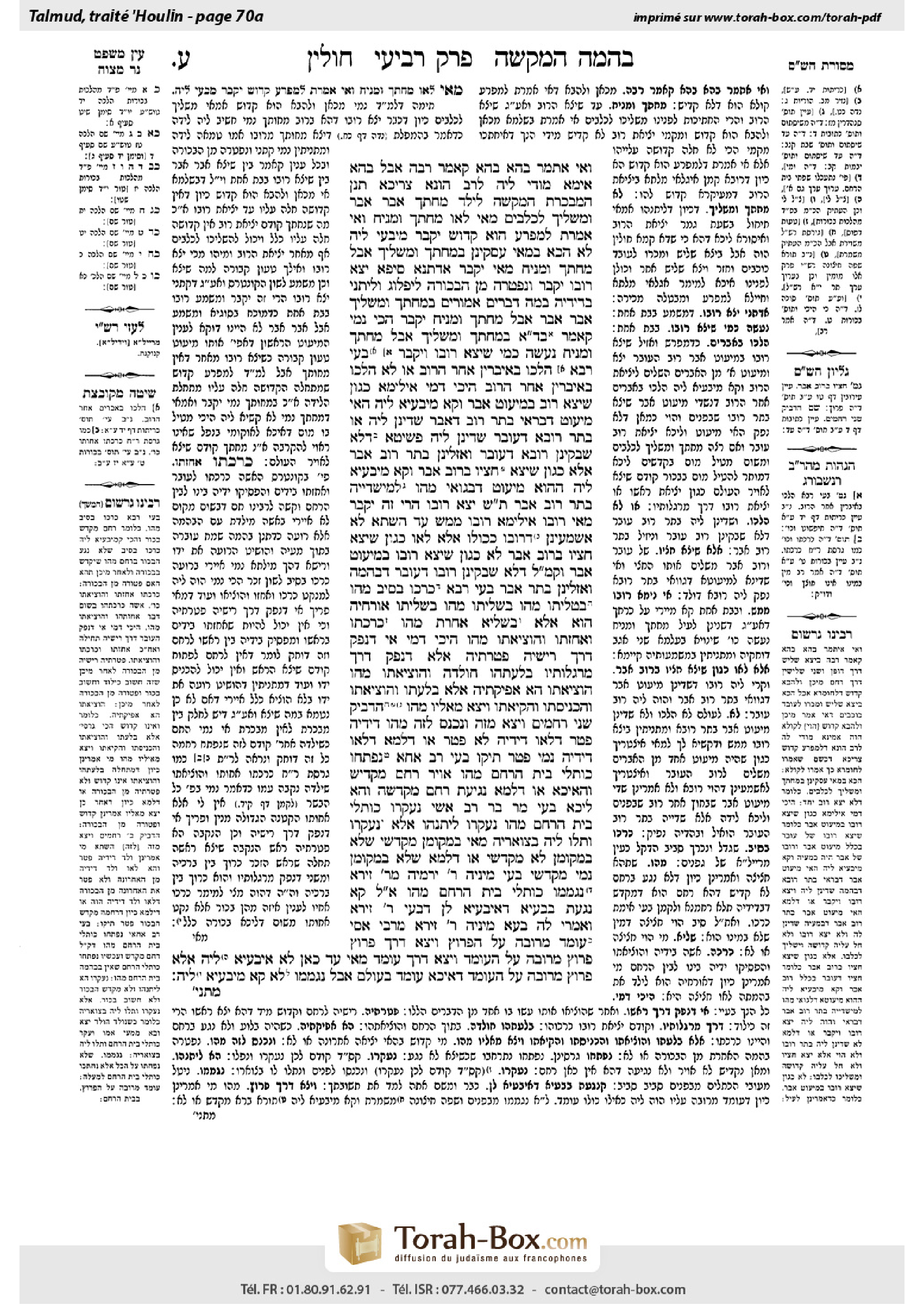
Chullin 70a: Talmud study for Daf Yomi
Study the Talmud for Daf Yomi with scanned pages, Hebrew text, English translations from Sefaria and AI-generated French translations.
Passage selection and English or AI-generated French translation are available where the scan has annotations. Daf Study is independent of Torah-Box and Sefaria.
Browse Chullin · חולין · All tractatesChullin 70a text and translations
This page of Chullin includes the Aramaic text, an English translation and an AI-generated French translation, alongside the scan above.
חולין ע׳ א · Aramaic and Hebrew text
וְאִי אִתְּמַר בְּהָא: בְּהָא קָאָמַר רַבָּה, אֲבָל בְּהָא – אֵימָא מוֹדֵי לֵיהּ לְרַב הוּנָא, צְרִיכָא.
תְּנַן: הַמְבַכֶּרֶת הַמְקַשָּׁה לֵילֵד – מְחַתֵּךְ אֵבֶר אֵבֶר וּמַשְׁלִיךְ לִכְלָבִים. מַאי לָאו, מְחַתֵּךְ וּמַנִּיחַ? וְאִי אָמְרַתְּ לְמַפְרֵעַ הוּא קָדוֹשׁ – יִקָּבֵר מִיבְּעֵי לֵיהּ!
לָא, הָכָא בְּמַאי עָסְקִינַן? בִּמְחַתֵּךְ וּמַשְׁלִיךְ.
אֲבָל מְחַתֵּךְ וּמַנִּיחַ, מַאי יִקָּבֵר? אַדִּתְנָא סֵיפָא: ״יָצָא רוּבּוֹ יִקָּבֵר וְנִפְטְרָה מִן הַבְּכוֹרָה״, לִיפְלוֹג וְלִיתְנֵי בְּדִידֵיהּ: בַּמֶּה דְּבָרִים אֲמוּרִים – בִּמְחַתֵּךְ וּמַשְׁלִיךְ אֵבֶר אֵבֶר, אֲבָל מְחַתֵּךְ וּמַנִּיחַ – יִקָּבֵר.
הָכִי נָמֵי קָאָמַר: בַּמֶּה דְּבָרִים אֲמוּרִים? בִּמְחַתֵּךְ וּמַשְׁלִיךְ, אֲבָל מְחַתֵּךְ וּמַנִּיחַ – נַעֲשָׂה כְּמִי שֶׁיָּצָא רוּבּוֹ, וְיִקָּבֵר.
בָּעֵי רָבָא: הָלְכוּ בְּאֵיבָרִין אַחַר הָרוֹב, אוֹ לֹא הָלְכוּ בְּאֵיבָרִין אַחַר הָרוֹב?
הֵיכִי דָּמֵי: אִילֵּימָא, כְּגוֹן שֶׁיָּצָא רוֹב בְּמִיעוּט אֵבֶר, וְקָא מִיבַּעְיָא לֵיהּ: הַאי מִיעוּט דְּבָרַאי, בָּתַר רוֹב דְּאֵבֶר שָׁדֵינַן לֵיהּ, אוֹ בָּתַר רוּבָּא דְּעוּבָּר שָׁדֵינַן לֵיהּ?
פְּשִׁיטָא דְּלָא שָׁבְקִינַן רוּבָּא דְּעוּבָּר, וְאָזְלִינַן בָּתַר רוֹב אֵבֶר!
אֶלָּא, כְּגוֹן שֶׁיָּצָא חֶצְיוֹ בְּרוֹב אֵבֶר, וְקָא מִיבַּעְיָא לֵיהּ: הָהוּא מִיעוּט דִּבְגַוַּאי, מַהוּ לְמִישְׁדְּיֵיהּ בָּתַר רוֹב אֵבֶר?
תָּא שָׁמַע: יָצָא רוּבּוֹ – הֲרֵי זֶה יִקָּבֵר. מַאי רוּבּוֹ? אִילֵּימָא רוּבּוֹ מַמָּשׁ, עַד הַשְׁתָּא לָא אַשְׁמְעִינַן דְּרוּבּוֹ כְּכוּלּוֹ?
אֶלָּא לָאו, כְּגוֹן שֶׁיָּצָא חֶצְיוֹ בְּרוֹב אֵבֶר!
לָא, כְּגוֹן שֶׁיָּצָא רוּבּוֹ בְּמִיעוּט אֵבֶר, וְקָא מַשְׁמַע לַן דְּלָא שָׁבְקִינַן רוּבּוֹ דְּעוּבָּר דִּבְהֵמָה וְאָזְלִינַן בָּתַר אֵבֶר.
בָּעֵי רָבָא: כְּרָכוֹ בְּסִיב, מַהוּ? בְּטַלִּיתוֹ, מַהוּ?
בְּשִׁלְיָתוֹ, מַהוּ? בְּשִׁלְיָתוֹ? אוֹרְחֵיהּ הוּא! אֶלָּא בְּשִׁלְיָא אַחֶרֶת, מַהוּ?
כְּרָכַתּוּ וַאֲחָזַתּוּ וְהוֹצִיאַתּוּ, מַהוּ? הֵיכִי דָמֵי? אִי דִּנְפַק דֶּרֶךְ רֵישֵׁיהּ – פְּטַרְתֵּיהּ! אֶלָּא דִּנְפַק דֶּרֶךְ מַרְגְּלוֹתָיו.
בְּלָעַתְהוּ חוּלְדָּה וְהוֹצִיאַתּוּ, מַהוּ? הוֹצִיאַתּוּ? הָא אַפֵּיקְתֵּיהּ! אֶלָּא, בְּלָעַתּוּ וְהוֹצִיאַתּוּ, וְהִכְנִיסַתּוּ וֶהֱקִיאַתּוּ, וְיָצָא מֵאֵלָיו, מַהוּ?
הִדְבִּיק שְׁנֵי רְחָמִים, וְיָצָא מִזֶּה וְנִכְנַס לָזֶה, מַהוּ? דִּידֵיהּ פָּטַר, דְּלָאו דִּידֵיהּ לָא פָּטַר, אוֹ דִלְמָא דְּלָאו דִּידֵיהּ נָמֵי פָּטַר? תֵּיקוּ.
בָּעֵי רַב אַחָא: נִפְתְּחוּ כּוֹתְלֵי בֵּית הָרֶחֶם, מַהוּ? אֲוִיר רֶחֶם מַקְדִּישׁ, וְהָאִיכָּא, אוֹ דִלְמָא נְגִיעַת רֶחֶם מְקַדְּשָׁה, וְהָא לֵיכָּא?
בָּעֵי מָר בַּר רַב אָשֵׁי: נֶעְקְרוּ כּוֹתְלֵי בֵּית הָרֶחֶם, מַהוּ? נֶעְקְרוּ – לֵיתַנְהוּ! אֶלָּא נֶעְקְרוּ וְתָלוּ לֵיהּ בְּצַוְּארֵיהּ, מַאי? בִּמְקוֹמָן מְקַדְּשִׁי, שֶׁלֹּא בִּמְקוֹמָן לֹא מְקַדְּשִׁי, אוֹ דִלְמָא שֶׁלֹּא בִּמְקוֹמָן נָמֵי מְקַדְּשִׁי?
בָּעֵי מִינֵּיהּ רַבִּי יִרְמְיָה מֵרַבִּי זֵירָא: נִגְמְמוּ כּוֹתְלֵי בֵּית הָרֶחֶם, מַהוּ? אֲמַר לֵיהּ: קָא נָגְעַתְּ בְּבַעְיָא דְּאִיבַּעְיָא לַן, דְּבָעֵי רַבִּי זֵירָא, וְאָמְרִי לַהּ בְּעָא מִינֵּיהּ רַבִּי זֵירָא מֵרַבִּי אַסִּי: עוֹמֵד מְרוּבֶּה עַל הַפָּרוּץ וְיָצָא דֶּרֶךְ פָּרוּץ, פָּרוּץ מְרוּבֶּה עַל הָעוֹמֵד וְיָצָא דֶּרֶךְ עוֹמֵד, מַאי?
עַד כָּאן לָא אִיבַּעְיָא לֵיהּ אֶלָּא פָּרוּץ מְרוּבֶּה עַל הָעוֹמֵד, דְּאִיכָּא עוֹמֵד בְּעוֹלָם, אֲבָל נִגְמְמוּ – לָא קָא מִיבַּעְיָא לֵיהּ.
Chullin 70a · English translation
And if their dispute was stated only with regard to that case, when one-third emerged through the wall of the womb, one might have thought it is only in that case that Rabba says the animal is consecrated from that point forward, as that results in a stringency, i.e., the fetus is subject to firstborn status. But in this case, when after one-third emerged it was sold to a gentile, and where ruling that the animal is consecrated from that point forward results in a leniency, one might say that Rabba concedes to Rav Huna. Therefore, it was necessary for the dispute to be stated in both cases.
The Gemara raises a difficulty with the opinion of Rav Huna. We learned in the mishna: If an animal that was giving birth to a firstborn male was encountering difficulty giving birth, and in order to alleviate the difficulty one wishes to terminate the birth, he may cut up the fetus limb by limb and cast it to the dogs. What, is it not teaching that one cuts each limb and leaves it outside the body, casting the limbs to the dogs only after he has already extracted a majority of its body? And if you say a firstborn is consecrated retroactively, then once the majority of the fetus emerges from the womb all of the limbs would be consecrated retroactively according to Rav Huna. Accordingly, the mishna should have said the limbs must be buried.
The Gemara responds: No, here we are dealing with one who cuts each limb and immediately casts it to the dogs, before any consecration takes effect.
The Gemara asks: But according to this, if one cuts the limbs and leaves them, what is the halakha? Each one must be buried. If that is so, rather than teaching in the latter clause of the mishna: If a majority of the fetus had already emerged it is considered to have been born and duly consecrated, and so if one cut it up it must be buried, and any future offspring from that animal is exempted from firstborn status; let the tanna instead distinguish and teach a case in which the limbs are consecrated within the context of the first case itself, in the following manner: In what case is this statement, that the limbs may be cast to the dogs, said? It is with regard to one who cuts pieces of the fetus and immediately casts them to the dogs limb by limb, before a majority has emerged. But if one cuts and leaves the limbs until a majority has emerged, each one of them must be buried.
The Gemara answers: That is indeed what the latter clause of the mishna is saying: In what case is this statement said? It is with regard to one who cuts and casts the limbs to the dogs before a majority emerges. But if one cuts and leaves the limbs until a majority emerges it is regarded as though a majority of it emerged at one time, and so it must be buried.
§ Rava raises a dilemma: Does one follow the majority with regard to limbs or does one not follow the majority with regard to limbs?
The Gemara asks: What are the circumstances of this dilemma; what exactly is Rava’s question? If we say it is referring to a case where the majority of the fetus emerged, but that majority includes the emergence of the minority part of one of its limbs, then Rava is raising the following dilemma: With regard to this minority part of a limb that is outside the womb, do we cast it, i.e., count it, together with the majority of that limb, which is still inside the womb, as if the entire limb was still inside the womb? If so, it would be regarded as though a majority of the fetus has not yet emerged. Or perhaps we cast it and count it together with the majority of the fetus that has already emerged, and so it is regarded as though a majority of the fetus has emerged and it is duly consecrated.
The Gemara rejects this possibility: In that case it is obvious that we do not disregard the majority of the fetus and go after the majority of the limb. Consequently, Rava would not have raised a dilemma about this.
Rather, the dilemma is referring to a case where half of the fetus emerged, but that half includes the majority of a certain limb, and Rava raises the following dilemma: With regard to this minority part of a limb that is inside the womb, what is the halakha as to whether one casts it and counts it together with the majority of that limb and considers it as if that entire limb has emerged? If it is counted, it would be regarded as though a majority of the fetus has emerged, and it is duly consecrated.
The Gemara suggests: Come and hear a resolution from a statement of the mishna: If a majority of the fetus had already emerged, it is considered to have been born and duly consecrated, and so if one cut it up it must be buried. The Gemara clarifies: What is meant by a majority of the fetus? If we say it means literally the majority of the fetus, then the following difficulty arises: Until now had we not learned the principle that the majority of an item is considered like all of it? This is a well-established principle and it is not necessary to teach it again in this context.
Rather, is the mishna not referring to a case where half of the fetus emerged, but that half includes the majority of a limb? If so, the mishna directly resolves Rava’s dilemma and teaches that the minority part of the limb inside the womb is regarded as though it had emerged.
The Gemara responds: No, the mishna could be referring to a case where the majority of the fetus emerged, but that majority includes the emergence of the minority of a limb, and it teaches us that we do not disregard the majority of the fetus and go after the majority of the limb.
§ A firstborn animal is consecrated by virtue of the fact that its birth is the first in which the womb of the mother opens, as indicated by the verse: “Consecrate to Me every firstborn, that which opens the womb” (Exodus 13:2). Concerning this condition, Rava raises a dilemma: If one wrapped the fetus in the bast of a palm tree while it was still in the womb, and it therefore did not come in contact with the opening of the womb directly when it emerged, what is the halakha with regard to whether it is consecrated? Likewise, if one wrapped it in his robe when it emerged, what is the halakha?
Rava adds: If it emerged wrapped in its afterbirth, what is the halakha? The Gemara interjects: How could one suggest that being wrapped in its afterbirth would pose a problem? That is its natural manner of birth, and the afterbirth is consequently not considered an interposition. Accordingly, it is considered as though it was in direct contact with the opening of the womb. Rather, Rava’s dilemma must be as follows: If it emerged wrapped in the afterbirth of a different animal, what is the halakha?
Another dilemma: If one wrapped it in one’s hands and held it and brought it out in that fashion, such that the fetus did not come in direct contact with the opening of the womb, what is the halakha? With regard to all these dilemmas the Gemara asks: What are the circumstances? If the fetus had already partially emerged headfirst and then one wrapped up the body, which was still inside the womb, the halakha in such a case is clear: Since its head emerged, it is already considered to have been born and to have opened up the womb, and it is duly consecrated. Rather, the dilemma is in a case where it partially emerged hind legs first, and the majority of the body, which was still in the womb, was wrapped before it emerged.
Rava raises additional dilemmas: If a weasel entered the womb and swallowed the fetus there, and then exited the womb, bringing the fetus out in its stomach, what is the halakha? The Gemara interjects: Is there any doubt about a case where the weasel brought the fetus out in its stomach? In such a case it is the weasel that brought it out, and it is certainly not regarded as though the fetus opened the womb. Rather, the dilemma concerns a case where the weasel swallowed the fetus and brought it out, and then brought it back into the womb and vomited it out while inside the womb, and the fetus subsequently emerged of its own accord. What is the halakha in this case?
Another dilemma: If one pressed together the openings of two wombs of two animals giving birth to firstborns, and a fetus exited from the womb of this animal and entered the womb of that animal, and then emerged from the womb of the second animal, after which the second animal gave birth to its fetus, what is the halakha with regard to whether the fetus of the second animal is consecrated as a firstborn? Is the womb considered to have opened only when its own fetus emerges from inside, but a fetus that is not its own is not halakhically considered to have opened the womb? Or perhaps even a fetus that is not its own is also considered to have opened the womb? The Gemara does not provide a resolution for these dilemmas and concludes: The dilemma shall stand unresolved.
Rav Aḥa raises a dilemma: If the walls of the opening of the womb opened and widened to such an extent that when the fetus emerged it did not touch them, what is the halakha? Does the airspace of the opening of the womb consecrate the fetus as it is born, and this situation exists here in this case; or perhaps it is the contact with the opening of the womb that consecrates it, and this situation does not exist here in this case?
Mar bar Rav Ashi raises a dilemma: If the walls of the opening of the womb were removed, what is the halakha? The Gemara interjects: The halakha in this case is clear, since if they were removed they are not there to consecrate the fetus. Rather, the dilemma is in a case where they were removed from their original place, recessed inside the womb, and as the fetus emerged, the walls lay on its neck. In such a case, what is the halakha? Do the walls of the opening of the womb consecrate a fetus only when they are in their natural place, but when they are not in their natural place they cannot consecrate a fetus? Or perhaps when they are not in their natural place they also consecrate the fetus.
Rabbi Yirmeya raises a dilemma before Rabbi Zeira: If the walls of the opening of the womb were thinned [nigmemu] by removing the inner layer, what is the halakha? If the fetus then emerges through them is it consecrated? Rabbi Zeira said to him: You have touched upon a dilemma that was already raised before us, and that discussion provides the answer to your dilemma. As Rabbi Zeira raised a dilemma, and some say Rabbi Zeira raised that dilemma before Rabbi Asi: If a section of the opening of the womb was cut away, but the standing section, i.e., the part remaining, is greater in size than the breached, removed, section, and the offspring emerged through the breached section; or if the breached section is greater in size than the standing section and the offspring emerged through the standing section, what is the halakha?
Rabbi Zeira explains how this dilemma can resolve Rabbi Yirmeya’s dilemma: That dilemma was raised only with regard to a case where the breached section is greater than the standing section, as there is at least some part of the womb still standing and therefore one can consider the possibility that it could consecrate the fetus. But a dilemma was not raised with regard to a case where the walls were thinned, because in that case it is obvious that the fetus is not consecrated, as there is nothing left to consecrate it.
Chullin 70a · Traduction française (IA)
Et si leur débat n'était évoqué qu'en ce cas précis, lorsqu'un tiers est sorti du ventre, on pourrait penser que Rabba affirme que l'animal est consacré à partir de ce point, uniquement dans ce cas précis, car cela entraîne une stricte application, c'est-à-dire que le fœtus est soumis au statut de premier-né. Mais dans ce cas précis, lorsqu'après que le tiers est sorti, il a été vendu à un non-Juif, et que la consécration de l'animal à partir de ce point entraîne une facilité, on pourrait dire que Rabba reconnaît la position de Rav Huna. Ainsi, il était nécessaire que le débat soit évoqué dans les deux cas.
Le Guemara soulève une difficulté concernant l'opinion de Rav Huna. Nous avons appris dans la mitsna : Si un animal qui donnait naissance à un premier-né masculin avait des difficultés à accoucher, et qu'on souhaitait atténuer cette difficulté en voulant interrompre l'accouchement, on pouvait couper le fœtus membre par membre et le jeter aux chiens. Qu'est-ce que cela ne signifie pas qu'on coupe chaque membre et qu'on le laisse en dehors du corps, en jetant les membres aux chiens seulement après avoir déjà extrait la majorité du corps ? Et si l'on dit qu'un premier-né est consacré en rétrospective, alors une fois que la majorité du fœtus est sortie du ventre, tous les membres seraient consacrés en rétrospective selon Rav Huna. Ainsi, la mitsna devrait avoir dit que les membres doivent être enterrés.
Le Guemara répond : Non, ici nous parlons d'une personne qui coupe chaque membre et le jette immédiatement aux chiens, avant que la consécration ne prenne effet.
Le Guemara pose la question : Mais selon cela, si l'on coupe les membres et qu'on les laisse, quelle est la halakha ? Chacun doit être enterré. Si c'est ainsi, plutôt que d'apprendre dans la seconde partie de la mitsna : Si la majorité du fœtus avait déjà émergé, on le considère comme né et consacré, et donc si l'on le coupe, il doit être enterré, et tout descendant de cet animal est exempté du statut de premier-né ; pourquoi ne pas distinguer et enseigner un cas où les membres sont consacrés dans le contexte même du premier cas, de la manière suivante : Dans quel cas cette déclaration, que les membres peuvent être jetés aux chiens, est-elle évoquée ? C'est dans le cas d'une personne qui coupe des morceaux du fœtus et les jette immédiatement aux chiens membre par membre, avant que la majorité ne sorte. Mais si l'on coupe et qu'on laisse les membres jusqu'à ce que la majorité sorte, chacun d'eux doit être enterré.
Le Guemara répond : C'est exactement ce que la seconde partie de la mitsna évoque : Dans quel cas cette déclaration est-elle évoquée ? C'est dans le cas d'une personne qui coupe et jette les membres aux chiens avant que la majorité ne sorte. Mais si l'on coupe et qu'on laisse les membres jusqu'à ce que la majorité sorte, on considère cela comme si la majorité du fœtus était sortie d'un seul coup, et donc il doit être enterré.
§ Rava soulève un dilemme : Suit-on la majorité concernant les membres ou ne suit-on pas la majorité concernant les membres ?
Le Guemara pose la question : Quelles sont les circonstances de ce dilemme ; quelle est exactement la question de Rava ? Si l'on dit qu'il s'agit d'un cas où la majorité du fœtus est sortie, mais que cette majorité inclut l'émergence de la partie mineure d'un de ses membres, alors Rava soulève le dilemme suivant : Concernant cette partie mineure d'un membre qui est en dehors du ventre, l'on jette-t-il, c'est-à-dire compte-t-on, cela avec la majorité de ce membre, qui est encore à l'intérieur du ventre, comme si l'ensemble du membre était encore à l'intérieur du ventre ? Si c'est le cas, cela serait considéré comme si la majorité du fœtus n'avait pas encore émergé. Ou peut-être l'on jette et compte cela avec la majorité du fœtus qui a déjà émergé, et donc on considère cela comme si la majorité du fœtus avait émergé et qu'elle est consacrée.
Le Guemara rejette cette possibilité : Dans ce cas, il est évident que nous ne négligeons pas la majorité du fœtus pour aller après la majorité du membre. Ainsi, Rava n'aurait pas soulevé ce dilemme.
Plutôt, le dilemme fait référence à un cas où la moitié du fœtus est sortie, mais que cette moitié inclut la majorité d'un certain membre, et Rava soulève le dilemme suivant : Concernant cette partie mineure d'un membre qui est à l'intérieur du ventre, quelle est la halakha concernant le fait de jeter et de compter cela avec la majorité de ce membre, et de considérer cela comme si l'ensemble du membre était sorti ? Si on le compte, cela serait considéré comme si la majorité du fœtus avait émergé, et qu'elle est consacrée.
Le Guemara suggère : Viens entendre une résolution tirée d'une déclaration de la Michna : Si la majorité du fœtus avait déjà émergé, on le considère comme né et consacré, et donc si l'on le coupe, il doit être enterré. Le Guemara précise : De quoi parle-t-on par « la majorité du fœtus » ? Si l'on dit qu'il s'agit littéralement de la majorité du fœtus, alors la difficulté suivante surgit : Jusqu'à présent n'avons-nous pas appris le principe que la majorité d'un objet est considérée comme l'ensemble ? C'est un principe bien établi et il n'est pas nécessaire de le répéter dans ce contexte.
Plutôt, la Michna ne parle-t-elle pas d'un cas où la moitié du fœtus est sortie, mais que cette moitié inclut la majorité d'un membre ? Si c'est le cas, la Michna résout directement le dilemme de Rava et enseigne que la partie mineure du membre à l'intérieur du ventre est considérée comme si elle avait émergé.
Le Guemara répond : Non, la Michna pourrait faire référence à un cas où la majorité du fœtus est sortie, mais que cette majorité inclut l'émergence de la minorité d'un membre, et elle nous enseigne que nous ne négligeons pas la majorité du fœtus pour aller après la majorité du membre.
§ Un animal premier est consacré en raison du fait que sa naissance est la première dans laquelle le ventre de la mère s'ouvre, comme indiqué par la parole : « Conscacré-moi tout premier-né, celui qui ouvre le ventre » (Exode 13:2). Concernant cette condition, Rava soulève un dilemme : Si l'on enveloppait le fœtus dans la paille d'un palmier pendant qu'il était encore dans le ventre, et qu'il n'avait donc pas directement contacté l'ouverture du ventre lorsqu'il est sorti, quelle est la halakha concernant le fait qu'il soit consacré ? De même, si l'on enveloppait le fœtus dans sa robe lorsqu'il sortait, quelle est la halakha ?
Rava ajoute : Si l'animal sortait enveloppé de ses déjections, quelle est la halakha ? La Guemara interrompt : Comment pourrait-on suggérer que l'enveloppement par les déjections pose un problème ? C'est sa manière naturelle de naître, et les déjections ne sont donc pas considérées comme un obstacle. Ainsi, on considère qu'il a directement contacté l'ouverture du ventre. Plutôt, le dilemme de Rava doit être le suivant : Si l'animal sortait enveloppé des déjections d'un autre animal, quelle est la halakha ?
Un autre dilemme : Si l'on enveloppait l'animal dans ses mains et le tenait ainsi pour le sortir, de sorte que le fœtus n'avait pas directement contacté l'ouverture du ventre, quelle est la halakha ? Concernant tous ces dilemmes, la Guemara pose la question : Quelles sont les circonstances ? Si le fœtus avait déjà commencé à sortir la tête en premier, puis qu'on enveloppait le corps, qui était encore dans le ventre, la halakha dans ce cas est claire : Puisque sa tête est sortie, on considère qu'il est né et qu'il a ouvert le ventre, et il est donc consacré. Plutôt, le dilemme est dans le cas où le fœtus sortait d'abord les pattes arrière, et la majorité du corps, qui était encore dans le ventre, était enveloppée avant qu'il ne sorte.
Rava soulève d'autres dilemmes : Si un raton laveur entrait dans le ventre et avalait le fœtus là, puis sortait du ventre, apportant le fœtus dans son estomac, quelle est la halakha ? La Guemara interrompt : Y a-t-il un doute concernant un cas où le raton laveur apportait le fœtus dans son estomac ? Dans ce cas, c'est le raton laveur qui l'a sorti, et on ne considère certainement pas que le fœtus ait ouvert le ventre. Plutôt, le dilemme concerne un cas où le raton laveur avalait le fœtus et le sortait, puis le remettait dans le ventre et le vomissait à l'intérieur, et le fœtus sortait ensuite de lui-même. Quelle est la halakha dans ce cas ?
Un autre dilemme : Si l'on avait réunis les ouvertures des ventres de deux animaux donnant naissance à des premiers-nés, et qu'un fœtus sortait du ventre de cet animal et entrait dans le ventre de l'autre, puis sortait du ventre de l'autre animal, après quoi l'autre animal donnait naissance à son fœtus, quelle est la halakha concernant le fait que le fœtus de l'autre animal soit consacré comme premier-né ? Le ventre est-il considéré comme ouvert uniquement lorsqu'un fœtus propre sort de lui, mais un fœtus qui n'est pas le sien n'est pas halakhiquement considéré comme ayant ouvert le ventre ? Ou peut-être même un fœtus qui n'est pas le sien est-il également considéré comme ayant ouvert le ventre ? La Guemara ne fournit pas de résolution à ces dilemmes et conclut : Ce dilemme restera sans réponse.
Rav Aḥa soulève un dilemme : Si les parois de l'ouverture du ventre s'étaient ouvertes et élargies à tel point que lors de la naissance le fœtus n'avait pas touché ces parois, quelle est la halakha ? L'air de l'ouverture du ventre consacre-t-il le fœtus lorsqu'il est né, et cette situation existe ici ? Ou peut-être c'est le contact avec l'ouverture du ventre qui consacre le fœtus, et cette situation n'existe pas ici ?
Mar bar Rav Ashi soulève un dilemme : Si les parois de l'ouverture du ventre avaient été retirées, quelle est la halakha ? La Guemara interrompt : La halakha dans ce cas est claire, puisque si elles avaient été retirées, elles ne sont plus là pour consacrer le fœtus. Plutôt, le dilemme est dans le cas où elles avaient été retirées de leur place originale, récessées dans le ventre, et que lors de la naissance, les parois reposaient sur le cou du fœtus. Dans ce cas, quelle est la halakha ? Les parois de l'ouverture du ventre consacrent-elles le fœtus uniquement lorsqu'elles sont à leur place naturelle, mais lorsqu'elles ne le sont pas, elles ne peuvent pas consacrer le fœtus ? Ou peut-être même lorsqu'elles ne sont pas à leur place naturelle, elles consacrent le fœtus ?
Rabbi Yirmeya soulève un dilemme devant Rabbi Zeira : Si les parois de l'ouverture du ventre avaient été épaissies [nigmemu] en retirant la couche interne, quelle est la halakha ? Si le fœtus sortait alors à travers elles, est-il consacré ? Rabbi Zeira dit à lui : Vous avez abordé un dilemme déjà soulevé devant nous, et cette discussion fournit la réponse à votre dilemme. Comme Rabbi Zeira avait soulevé un dilemme, et certains disent que Rabbi Zeira avait soulevé ce dilemme devant Rabbi Asi : Si une section de l'ouverture du ventre avait été coupée, mais la section restante, c'est-à-dire la partie restante, était plus grande que la section brisée, retirée, et que l'offspring sortait à travers la section brisée ; ou si la section brisée était plus grande que la section restante et que l'offspring sortait à travers la section restante, quelle est la halakha ?
Rabbi Zeira explique comment ce dilemme peut résoudre celui de Rabbi Yirmeya : Ce dilemme a été soulevé uniquement dans le cas où la section brisée est plus grande que la section restante, car il reste au moins une partie du ventre et donc on peut considérer la possibilité qu'elle consacre le fœtus. Mais un dilemme n'a pas été soulevé dans le cas où les parois étaient épaissies, car dans ce cas, il est évident que le fœtus n'est pas consacré, car il n'y a plus rien à consacrer.
Traduction française générée par IA à partir de l’édition anglaise de Sefaria. Vérifie toujours un passage avec le texte source.
Text from Sefaria: William Davidson Edition - Vocalized Aramaic (unknown); William Davidson Edition - English (CC BY NC).