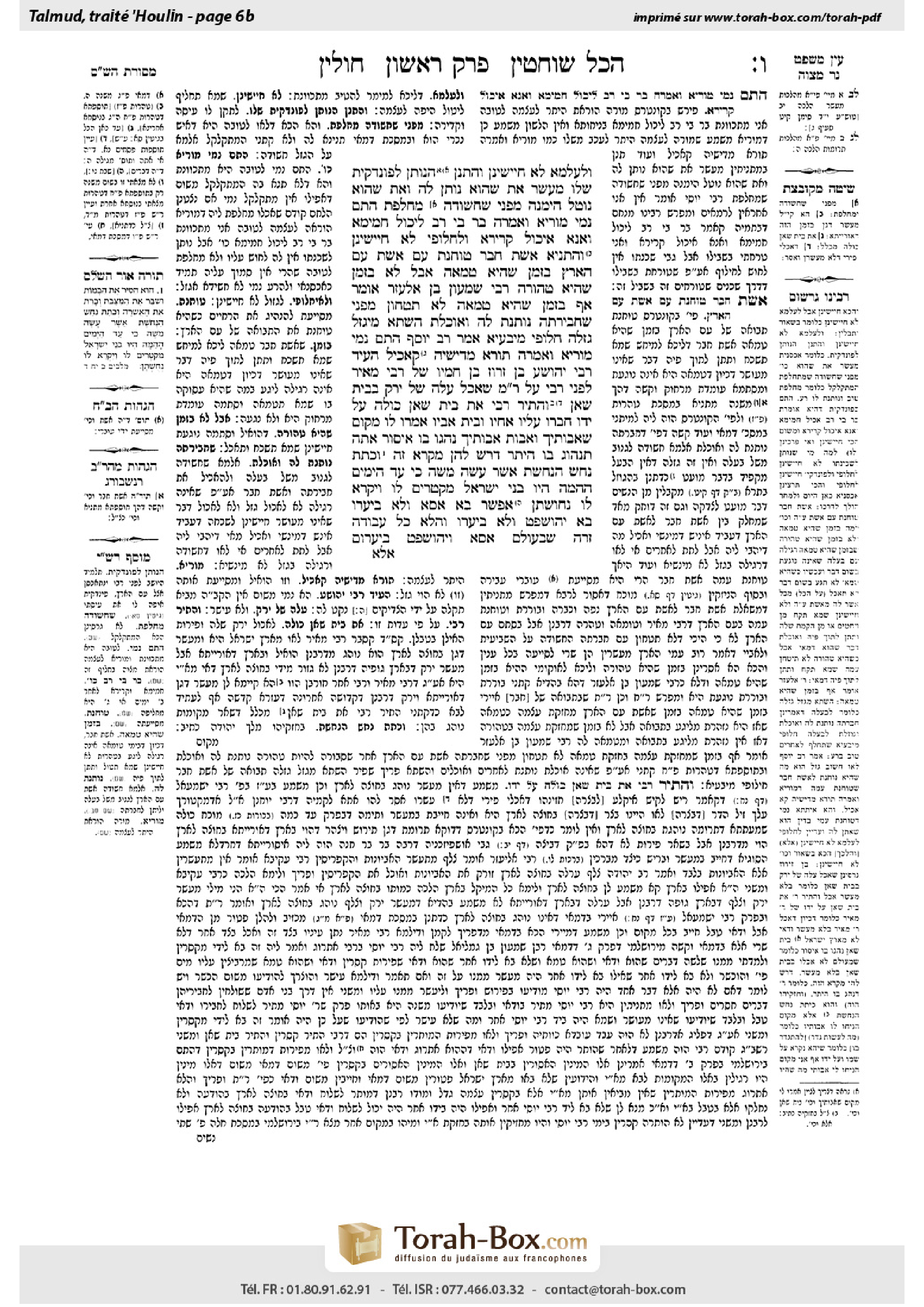
Chullin 6b: Talmud study for Daf Yomi
Study the Talmud for Daf Yomi with scanned pages, Hebrew text, English translations from Sefaria and AI-generated French translations.
Passage selection and English or AI-generated French translation are available where the scan has annotations. Daf Study is independent of Torah-Box and Sefaria.
Browse Chullin · חולין · All tractatesChullin 6b text and translations
This page of Chullin includes the Aramaic text, an English translation and an AI-generated French translation, alongside the scan above.
חולין ו׳ ב · Aramaic and Hebrew text
וּלְעָלְמָא לָא חָיְישִׁינַן? וְהָתְנַן: הַנּוֹתֵן לַפּוּנְדָּקִית שֶׁלּוֹ – מְעַשֵּׂר אֵת שֶׁהוּא נוֹתֵן לָהּ וְאֵת שֶׁהוּא נוֹטֵל הֵימֶנָּה, מִפְּנֵי שֶׁחֲשׁוּדָהּ מַחְלֶפֶת! הָתָם נָמֵי מוֹרְיָא וְאָמְרָה: בַּר בֵּי רַב לֵיכוֹל חַמִּימָא, וַאֲנָא אֵיכוֹל קָרִירָא.
וּלְחַלּוֹפֵי לָא חָיְישִׁינַן? וְהָתַנְיָא: אֵשֶׁת חָבֵר טוֹחֶנֶת עִם אֵשֶׁת עַם הָאָרֶץ בִּזְמַן שֶׁהִיא טְמֵאָה, אֲבָל לֹא בִּזְמַן שֶׁהִיא טְהוֹרָה.
רַבִּי שִׁמְעוֹן בֶּן אֶלְעָזָר אוֹמֵר: אַף בִּזְמַן שֶׁהִיא טְמֵאָה לֹא תִּטְחוֹן, מִפְּנֵי שֶׁחֲבֶירְתָּהּ נוֹתֶנֶת לָהּ וְאוֹכֶלֶת.
הַשְׁתָּא מִיגְזָל גָּזְלָה, חַלּוֹפֵי מִיבַּעְיָא? אָמַר רַב יוֹסֵף: הָתָם נָמֵי מוֹרְיָא וְאָמְרָה ״תּוֹרָא מִדְּיָשֵׁיהּ קָאָכֵיל״.
הֵעִיד רַבִּי יְהוֹשֻׁעַ בֶּן זֵרוּז, בֶּן חָמִיו שֶׁל רַבִּי מֵאִיר, לִפְנֵי רַבִּי עַל רַבִּי מֵאִיר שֶׁאָכַל עָלֶה שֶׁל יָרָק בְּבֵית שְׁאָן, וְהִתִּיר רַבִּי אֶת בֵּית שְׁאָן כּוּלָּהּ עַל יָדוֹ.
חָבְרוּ עָלָיו אֶחָיו וּבֵית אָבִיו, אָמְרוּ לוֹ: מָקוֹם שֶׁאֲבוֹתֶיךָ וַאֲבוֹת אֲבוֹתֶיךָ נָהֲגוּ בּוֹ אִיסּוּר, אַתָּה תִּנְהוֹג בּוֹ הֶיתֵּר?
דְּרַשׁ לָהֶן מִקְרָא זֶה: ״וְכִתַּת נְחַשׁ הַנְּחֹשֶׁת אֲשֶׁר עָשָׂה מֹשֶׁה כִּי עַד הַיָּמִים הָהֵמָּה הָיוּ בְנֵי יִשְׂרָאֵל מְקַטְּרִים לוֹ וַיִּקְרָא לוֹ נְחֻשְׁתָּן״. אֶפְשָׁר בָּא אָסָא וְלֹא בִּיעֲרוֹ, בָּא יְהוֹשָׁפָט וְלֹא בִּיעֲרוֹ? וַהֲלֹא כׇּל עֲבוֹדָה זָרָה שֶׁבָּעוֹלָם אָסָא וִיהוֹשָׁפָט בִּיעֲרוּם!
Chullin 6b · English translation
The Gemara asks: And in general, in a case not involving one’s mother-in-law, are we not concerned about the possibility of replacement? But didn’t we learn in a mishna (Demai 3:5): One who gives dough or a pot of food to his innkeeper [pundakit] who is an am ha’aretz to bake or cook, tithes what he gives her and tithes what he takes back from her, due to the fact that she is suspected of replacing the ingredients? The Gemara answers: There too, her intentions are good, as the innkeeper rationalizes her deception and says: Let the student of Torah eat my hot food and I will eat his cold food.
The Gemara asks: And are we not concerned about replacement of the ingredients? But isn’t it taught in a baraita: The wife of a ḥaver, one devoted to the meticulous observance of mitzvot, especially the halakhot of ritual purity, teruma, and tithes, grinds grain with the wife of an am ha’aretz when the wife of the ḥaver is ritually impure with the impurity of a menstruating woman. In that case, there is no concern that she will eat her counterpart’s untithed produce, as, since she is impure she will refrain from touching the grain so that she will not render it impure. But she may not do so when she is ritually pure, due to the concern that she will eat the untithed produce.
Rabbi Shimon ben Elazar says: Even when she is impure, the wife of the ḥaver may not grind grain together with the wife of the am ha’aretz, due to the fact that her counterpart gives her grain and she eats it without touching the rest of the grain.
The Gemara infers: Now that there is suspicion that the wife of the am ha’aretz steals from her husband’s grain and gives it to her counterparts, is it necessary to say that she is suspect with regard to replacing ingredients? Rav Yosef said: There too there are special circumstances, as the wife of the am ha’aretz rationalizes her behavior and says metaphorically: The ox eats from its threshing, and believes that the wife of the ḥaver is entitled to some of the grain that she is grinding.
§ The Gemara resumes its discussion of the statement that the righteous would not experience mishaps. Rabbi Yehoshua ben Zeruz, son of the father-in-law of Rabbi Meir, testified before Rabbi Yehuda HaNasi about Rabbi Meir that he ate the leaf of a vegetable in Beit She’an without tithing or separating teruma, as he holds that Beit She’an is not part of Eretz Yisrael and therefore is not sacred with its sanctity. And Rabbi Yehuda HaNasi permitted all the produce of Beit She’an on the basis of his testimony.
His brothers and his father’s household united against him and said to him: In a place where your fathers and the fathers of your fathers treated untithed produce as forbidden, will you treat it as permitted?
Rabbi Yehuda HaNasi interpreted this verse to them: “And he broke in pieces the copper serpent that Moses had made; for until those days the children of Israel burned incense to it; and it was called Nehushtan” (II Kings 18:4). Is it possible that they burned incense to it and Asa, a righteous king, came and did not eradicate it, and Jehoshaphat, a righteous king, came and did not eradicate it, and it remained until the time of Hezekiah? But didn’t Asa and Jehoshaphat eradicate all objects of idol worship in the world?
Chullin 6b · Traduction française (IA)
Le Guemara pose la question : Et en général, dans un cas ne concernant pas sa belle-mère, ne sommes-nous pas préoccupés par la possibilité de substitution ? Mais n'avons-nous pas appris dans une mitsva (Demai 3:5) : Celui qui donne du pain ou une marmite de nourriture à son hôte [pundakit], qui est un am ha'aretz, pour le faire cuire ou cuire, doit titrer ce qu'il lui donne et titrer ce qu'il reprend de chez elle, en raison du fait qu'elle est soupçonnée de remplacer les ingrédients ? Le Guemara répond : Il en va de même, ses intentions sont bonnes, car l'hôte justifie son tromperie et dit : Que l'étudiant de la Torah mange ma nourriture chaude et je mangerai sa nourriture froide.
Le Guemara pose la question : Et ne sommes-nous pas préoccupés par la substitution des ingrédients ? Mais n'est-il pas enseigné dans une baraïta : La femme d'un ḥaver, un homme dévoué à l'observation minutieuse des mitsvot, surtout les halakhot de pureté rituelle, de terouma et des dîmes, moud le grain avec la femme d'un am ha'aretz lorsque la femme du ḥaver est impure avec l'impureté d'une femme en cours de menstruation. Dans ce cas, il n'y a pas de préoccupation qu'elle mange la production non titrée de son contrepartie, car, puisqu'elle est impure, elle évitera de toucher le grain afin de ne pas le rendre impur. Mais elle ne peut pas le faire lorsqu'elle est pure, en raison de la préoccupation qu'elle mange la production non titrée.
Rabbi Shimon ben Elazar dit : Même lorsqu'elle est impure, la femme du ḥaver ne doit pas moudre le grain avec la femme de l'am ha'aretz, en raison du fait que sa contrepartie lui donne du grain et elle le mange sans toucher le reste du grain.
Le Guemara déduit : Maintenant que l'on soupçonne que la femme de l'am ha'aretz vole du grain de son mari et le donne à ses compagnes, est-il nécessaire de dire qu'elle est suspecte en ce qui concerne la substitution des ingrédients ? Rav Yosef dit : Il en va de même, il y a des circonstances spéciales, car la femme de l'am ha'aretz justifie son comportement et dit métaphoriquement : L'âne mange de son épluchage, et croit que la femme du ḥaver a droit à une partie du grain qu'elle moud.
§ Le Guemara reprend la discussion de l'affirmation selon laquelle les justes ne connaissent pas de malheurs. Rabbi Yehoshua ben Zeruz, fils du beau-père de Rabbi Meir, témoigna devant Rabbi Yehuda HaNasi à propos de Rabbi Meir qu'il avait mangé la feuille d'un légume à Beth-Séhon sans titrer ni séparer la terouma, car il considère que Beth-Séhon n'appartient pas à la Terre d'Israël et n'est donc pas sacrée. Et Rabbi Yehuda HaNasi permit toute la production de Beth-Séhon sur la base de son témoignage.
Ses frères et sa famille paternelle s'unirent contre lui et lui dirent : Dans un lieu où vos pères et les pères de vos pères traitaient la production non titrée comme interdite, voudriez-vous la traiter comme permise ?
Rabbi Yehuda HaNasi interpréta cette versette à leur sujet : « Et il brisa en morceaux le serpent de cuivre que Moïse avait fait ; car jusqu'à ces jours les enfants d'Israël brûlaient des encens à lui ; et on l'appelait Nehushtan » (II Rois 18:4). Est-ce possible qu'ils aient brûlé des encens à lui et qu'Asa, un roi juste, soit venu et n'ait pas éradiqué, et qu'Jehoshaphat, un roi juste, soit venu et n'ait pas éradiqué, et qu'il ait resté jusqu'au temps d'Hachia ? Mais n'Asa et Jehoshaphat n'ont-ils pas éradiqué tous les objets de culte idolâtre du monde ?
Traduction française générée par IA à partir de l’édition anglaise de Sefaria. Vérifie toujours un passage avec le texte source.
Text from Sefaria: William Davidson Edition - Vocalized Aramaic (unknown); William Davidson Edition - English (CC BY NC).