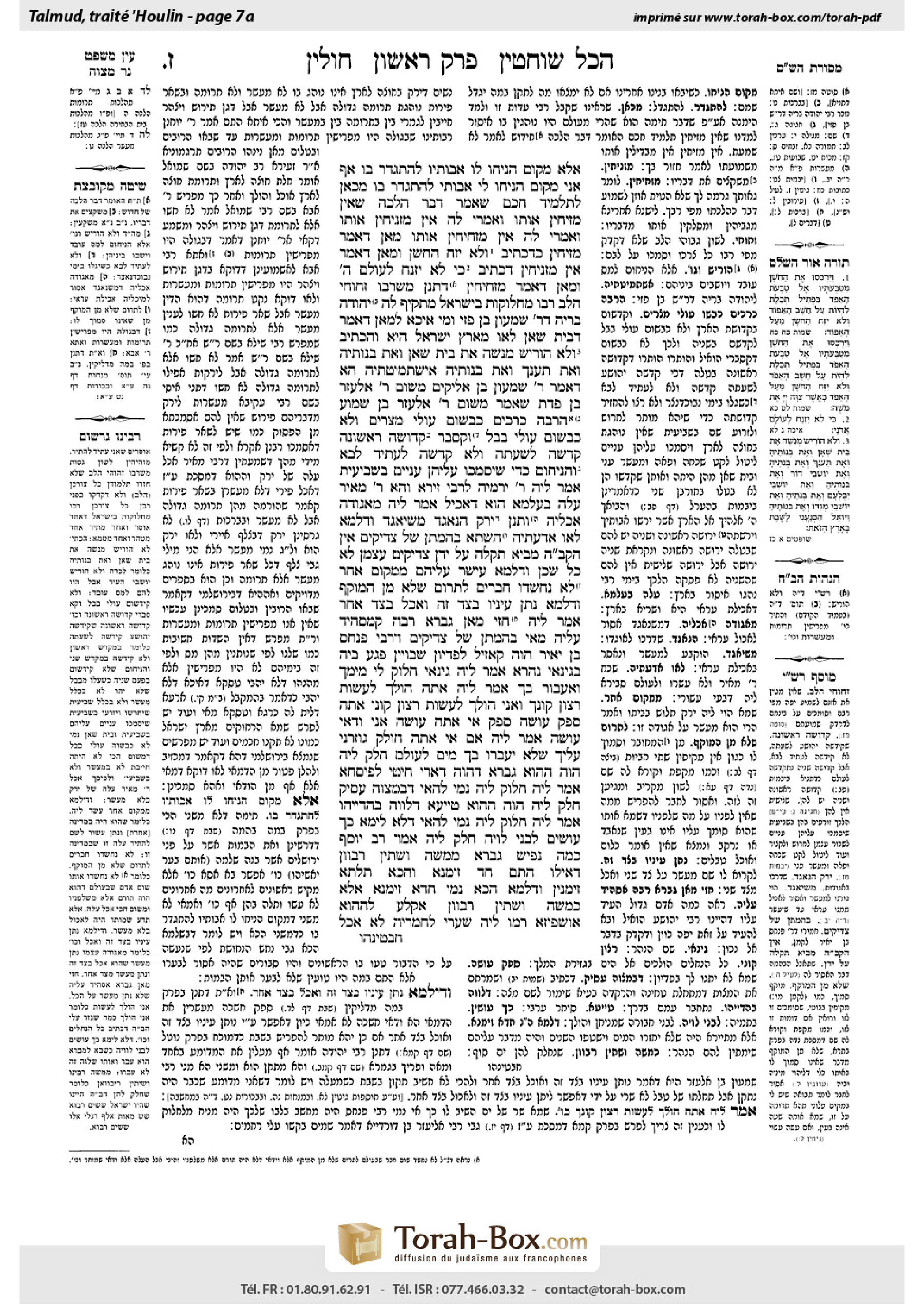
Chullin 7a: Talmud study for Daf Yomi
Study the Talmud for Daf Yomi with scanned pages, Hebrew text, English translations from Sefaria and AI-generated French translations.
Passage selection and English or AI-generated French translation are available where the scan has annotations. Daf Study is independent of Torah-Box and Sefaria.
Browse Chullin · חולין · All tractatesChullin 7a text and translations
This page of Chullin includes the Aramaic text, an English translation and an AI-generated French translation, alongside the scan above.
חולין ז׳ א · Aramaic and Hebrew text
אֶלָּא מָקוֹם הִנִּיחוּ לוֹ אֲבוֹתָיו לְהִתְגַּדֵּר בּוֹ, אַף אֲנִי מָקוֹם הִנִּיחוּ לִי אֲבוֹתַי לְהִתְגַּדֵּר בּוֹ.
מִכָּאן לְתַלְמִיד חָכָם שֶׁאָמַר דְּבַר הֲלָכָה, שֶׁאֵין מְזִיחִין אוֹתוֹ, וְאָמְרִי לָהּ: אֵין מַזְנִיחִין אוֹתוֹ, וְאָמְרִי לָהּ: אֵין מַזְחִיחִין אוֹתוֹ.
מַאן דְּאָמַר ״מְזִיחִין״ – כְּדִכְתִיב: ״וְלֹא יִזַּח הַחֹשֶׁן״, וּמַאן דְּאָמַר ״אֵין מַזְנִיחִין״ – דִּכְתִיב: ״כִּי לֹא יִזְנַח לְעוֹלָם ה׳״, וּמַאן דְּאָמַר ״מַזְחִיחִין״ – דִּתְנַן: מִשֶּׁרַבּוּ זְחוּחֵי הַלֵּב רַבּוּ מַחְלוֹקוֹת בְּיִשְׂרָאֵל.
מַתְקֵיף לַהּ יְהוּדָה בְּרֵיהּ דְּרַבִּי שִׁמְעוֹן בֶּן פַּזִּי: וּמִי אִיכָּא לְמַאן דְּאָמַר דְּבֵית שְׁאָן לָאו מֵאֶרֶץ יִשְׂרָאֵל הִיא? וְהָכְתִיב: ״וְלֹא הוֹרִישׁ מְנַשֶּׁה אֶת בֵּית שְׁאָן וְאֶת בְּנוֹתֶיהָ וְאֶת תַּעְנַךְ וְאֶת בְּנֹתֶיהָ״!
אִישְׁתְּמִיטְתֵּיהּ הָא דְּאָמַר רַבִּי שִׁמְעוֹן בֶּן אֶלְיָקִים, מִשּׁוּם רַבִּי אֶלְעָזָר בֶּן פְּדָת, שֶׁאָמַר מִשּׁוּם רַבִּי אֶלְעָזָר בֶּן שַׁמּוּעַ: הַרְבֵּה כְּרַכִּים כְּבָשׁוּם עוֹלֵי מִצְרַיִם, וְלֹא כְּבָשׁוּם עוֹלֵי בָּבֶל.
וְקָסָבַר: קְדוּשָּׁה רִאשׁוֹנָה קִדְּשָׁה לִשְׁעָתָהּ וְלֹא קִדְּשָׁה לֶעָתִיד לָבֹא, וְהִנִּיחוּם כְּדֵי שֶׁיִּסְמְכוּ עֲלֵיהֶן עֲנִיִּים בַּשְּׁבִיעִית.
אֲמַר לֵיהּ רַבִּי יִרְמְיָה לְרַבִּי זֵירָא: וְהָא רַבִּי מֵאִיר עָלֶה בְּעָלְמָא הוּא דְּאָכֵיל! אֲמַר לֵיהּ: מֵאֲגוּדָּה אַכְלֵיהּ, וּתְנַן: יָרָק הַנֶּאֱגָד מִשֶּׁיֵּאָגֵד.
וְדִלְמָא לָאו אַדַּעְתֵּיהּ? הַשְׁתָּא, בְּהֶמְתָּן שֶׁל צַדִּיקִים אֵין הַקָּדוֹשׁ בָּרוּךְ הוּא מֵבִיא תַּקָּלָה עַל יָדָן, צַדִּיקִים עַצְמָן לֹא כׇּל שֶׁכֵּן!
וְדִלְמָא עִישֵּׂר עֲלֵיהֶם מִמָּקוֹם אַחֵר? לֹא נֶחְשְׁדוּ חֲבֵרִים לִתְרוֹם שֶׁלֹּא מִן הַמּוּקָּף. וְדִלְמָא נָתַן עֵינָיו בְּצַד זֶה וְאָכַל בְּצַד אַחֵר? אֲמַר לֵיהּ: חֲזִי מַאן גַּבְרָא רַבָּה קָמַסְהֵיד עֲלֵיהּ.
מַאי בְּהֶמְתָּן שֶׁל צַדִּיקִים? דְּרַבִּי פִּנְחָס בֶּן יָאִיר הֲוָה קָאָזֵיל לְפִדְיוֹן שְׁבוּיִין, פְּגַע בֵּיהּ בְּגִינַּאי נַהֲרָא.
אֲמַר לֵיהּ: גִּינַּאי, חֲלוֹק לִי מֵימֶךָ וְאֶעֱבוֹר בָּךְ! אֲמַר לֵיהּ: אַתָּה הוֹלֵךְ לַעֲשׂוֹת רְצוֹן קוֹנֶךָ וַאֲנִי הוֹלֵךְ לַעֲשׂוֹת רְצוֹן קוֹנִי, אַתָּה סָפֵק עוֹשֶׂה סָפֵק אִי אַתָּה עוֹשֶׂה, אֲנִי וַדַּאי עוֹשֶׂה. אֲמַר לֵיהּ: אִם אִי אַתָּה חוֹלֵק גּוֹזְרַנִי עָלֶיךָ שֶׁלֹּא יַעַבְרוּ בְּךָ מַיִם לְעוֹלָם. חֲלַק לֵיהּ.
הֲוָה הָהוּא גַּבְרָא דַּהֲוָה דָּארֵי חִיטֵּי לְפִיסְחָא, אֲמַר לֵיהּ חֲלוֹק לֵיהּ נָמֵי לְהַאי, דִּבְמִצְוָה עָסֵיק. חֲלַק לֵיהּ. הֲוָה הָהוּא טַיָּיעָא דִּלְוָוה בַּהֲדַיְיהוּ, אֲמַר לֵיהּ חֲלוֹק לֵיהּ נָמֵי לְהַאי, דְּלָא לֵימָא: ״כָּךְ עוֹשִׂים לִבְנֵי לְוִיָּה״, חֲלַק לֵיהּ.
אָמַר רַב יוֹסֵף: כַּמָּה נְפִישׁ גַּבְרָא מִמֹּשֶׁה וְשִׁתִּין רִבְּוָון, דְּאִילּוּ הָתָם חַד זִימְנָא, וְהָכָא תְּלָתָא זִימְנִין. וְדִלְמָא הָכָא נָמֵי חֲדָא זִימְנָא? אֶלָּא כְּמֹשֶׁה וְשִׁתִּין רִבְּוָון.
אִקְּלַע לְהָהוּא אוּשְׁפִּיזָא, רְמוֹ לֵיהּ שְׂעָרֵי לְחַמְרֵיהּ, לָא אֲכַל.
Chullin 7a · English translation
Rather, it must be that in not eradicating the serpent, his ancestors left Hezekiah room through which to achieve prominence [lehitgader]. I too can say that my ancestors left me room through which to achieve prominence by permitting untithed produce from Beit She’an.
The Gemara adds: From here one learns with regard to a Torah scholar who states a new matter of halakha that one does not move [meziḥin] him from his position; and some say: One does not disregard [mazniḥin] him; and some say: One does not attribute his innovative statement to his conceit [mazḥiḥin].
The Gemara explains: With regard to the one who says meziḥin, it is as that which is written: “And the breastplate shall not be loosed [yizaḥ] from the ephod” (Exodus 28:28). And with regard to the one who says: One does not disregard [mazniḥin], it is as it is written: “For the Lord will not abandon [yizaḥ] forever” (Lamentations 3:31). And with regard to the one who says mazḥiḥin, it is as we learned in a baraita (Tosefta, Sota 14:9): From the time that those with conceited [zeḥuḥei] hearts proliferated, dispute proliferated among the Jewish people.
Yehuda, son of Rabbi Shimon ben Pazi, objects to the basic halakha: And is there anyone who says that Beit She’an is not part of Eretz Yisrael? But isn’t it written: “And Manasseh did not drive out the inhabitants of Beth She’an and its towns, nor of Taanach and its towns” (Judges 1:27).
The Gemara answers: That which Rabbi Shimon ben Elyakim says in the name of Rabbi Elazar ben Pedat, who says in the name of Rabbi Elazar ben Shammua, escaped the attention of Yehuda: Many cities were conquered by those who ascended from Egypt to Eretz Yisrael, led by Joshua, son of Nun, and were not conquered by those who ascended from Babylonia to Eretz Yisrael in the return to Zion led by Ezra. Among those cities was Beit She’an.
And Rabbi Yehuda HaNasi holds: The initial consecration with which Eretz Yisrael was sanctified during the era of Joshua, son of Nun, in terms of the obligation to fulfill land-based mitzvot, sanctified Eretz Yisrael for its time but did not sanctify it forever. Rather, the obligation lapsed with the exile to Babylonia. When those who ascended from Babylonia returned to Eretz Yisrael and sanctified the land, they left certain places unsanctified, so that the poor would rely upon them for sustenance during the Sabbatical Year, when produce is not plentiful. Since these areas were not sanctified, it is permitted to sow crops there during the Sabbatical Year, and the poor will not go hungry. Once Rabbi Yehuda HaNasi discovered that Beit She’an was one of those cities, he exempted it from land-based mitzvot.
Rabbi Yirmeya said to Rabbi Zeira: How did Rabbi Yehuda HaNasi rely on the testimony of Rabbi Yehoshua ben Zeruz to exempt from terumot and tithes produce that grows in Beit She’an? But wasn’t it merely a leaf that Rabbi Meir ate? It is permitted to eat untithed produce incidentally, not in the framework of a meal. Rabbi Zeira said to him: He ate the leaf from a bundle, and we learned in a mishna (Ma’asrot 1:5): With regard to a vegetable that is typically bound in a bundle, one is obligated to separate teruma and tithes from the moment that it is bound. From that point, one may not eat from it even incidentally before tithing.
Rabbi Yirmeya said to Rabbi Zeira: And perhaps it was not on Rabbi Meir’s mind, and his attention was diverted when he ate the leaf. Rabbi Zeira answered: Now, since even with regard to the animals of the righteous, the Holy One, Blessed be He, does not generate mishaps through them, is it not all the more so true that the righteous themselves would not experience mishaps?
Rabbi Yirmeya asked: And perhaps Rabbi Meir tithed those leaves from produce in another place. Rabbi Zeira answered: Ḥaverim are not suspected of separating teruma from produce that is not proximate to the produce for which it is being separated. Rabbi Yirmeya asked: And perhaps Rabbi Meir set his sight on this side of the vegetable with the intent of separating teruma and tithes, and ate a leaf on the other side. Rabbi Zeira said to him: See who the great man is who is testifying about Rabbi Meir. Certainly a man of the stature of Rabbi Yehoshua ben Zeruz accurately observed and reported Rabbi Meir’s actions.
§ The Gemara asks: What is the reference to animals of the righteous, about whom it is stated that God does not generate mishaps through them? It is based on the incident where Rabbi Pineḥas ben Ya’ir was going to engage in the redemption of captives, and he encountered the Ginai River.
He said to the river: Ginai, part your water for me and I will pass through you. The river said to him: You are going to perform the will of your Maker and I am going to perform the will of my Maker, to flow in my path. With regard to you, it is uncertain whether you will perform His will successfully, and it is uncertain whether you will not perform His will successfully. I will certainly perform His will successfully. Rabbi Pineḥas ben Ya’ir said to the river: If you do not part, I will decree upon you that water will never flow through you. The river parted for him.
There was a certain man who was carrying wheat for the preparation of matza for Passover. Rabbi Pineḥas ben Ya’ir said to the river: Part your waters for that person too, as he is engaged in the performance of a mitzva. The river parted for him. There was a certain Arab [taya’a] who was accompanying them. Rabbi Pineḥas ben Ya’ir said to the river: Part your waters for that person too, so that he will not say: Is that what one does to a person who accompanies him? The river parted for him.
Rav Yosef said: How great is this man, Rabbi Pineḥas ben Ya’ir, greater than Moses and the six hundred thousand who left Egypt, as there, at the Red Sea, the waters parted one time, and here the waters parted three times. The Gemara asks: And perhaps here too, the waters parted one time, and the river began to flow again only after all three of them passed. Rather, this man was as great as Moses and the six hundred thousand children of Israel.
After crossing the river, Rabbi Pineḥas ben Ya’ir happened to come to a certain inn [ushpiza]. His hosts cast barley before his donkey for him to eat. The donkey did not eat it.
Chullin 7a · Traduction française (IA)
Plutôt, cela doit signifier que, en ne supprimant pas le serpent, ses ancêtres ont laissé à Hézékiel une voie par laquelle il pouvait s'élever [lehitgader]. Je peux aussi dire que mes ancêtres m'ont laissé une voie par laquelle je pouvais m'élever en permettant les produits non bénis de Beit She’an.
La Guemara ajoute : On apprend de là que, concernant un savant de la Torah qui affirme une nouvelle matière de halakha, on ne le déplace [meziḥin] pas de sa position ; et certains disent : On ne le néglige pas [mazniḥin] ; et certains disent : On ne l'attribue pas à son orgueil [mazḥiḥin].
La Guemara explique : Concernant celui qui dit meziḥin, c'est comme ce qui est écrit : « Et le sein ne sera pas détaché [yizaḥ] de l'éphod » (Exode 28:28). Et concernant celui qui dit : On ne le néglige pas [mazniḥin], c'est comme ce qui est écrit : « Car l'Éternel ne laissera pas [yizaḥ] éternellement » (Lamentations 3:31). Et concernant celui qui dit mazḥiḥin, c'est comme nous avons appris dans une baraïta (Tosefta, Sota 14:9) : Depuis que ceux d'âmes orgueilleuses [zeḥuḥei] se sont multipliés, les querelles se sont multipliées parmi le peuple juif.
Yehuda, fils de Rabbi Shimon ben Pazi, s'oppose à la halakha fondamentale : Et qui donc dit que Beit She’an n'est pas partie de la Terre d'Israël ? Mais n'est-il pas écrit : « Et Manasses n'a pas expulsé les habitants de Beth She’an et de ses villes, ni de Taanach et de ses villes » (Juges 1:27).
La Guemara répond : Ce que Rabbi Shimon ben Elyakim dit au nom de Rabbi Elazar ben Pedat, qui dit au nom de Rabbi Elazar ben Shammua, a échappé à Yehuda : Beaucoup de villes ont été conquises par ceux qui sont montés d'Égypte vers la Terre d'Israël, conduits par Josué, fils de Nun, et n'ont pas été conquises par ceux qui sont montés de Babylone vers la Terre d'Israël lors du retour à Jérusalem, conduits par Ezra. Parmi ces villes se trouvait Beit She’an.
Et Rabbi Yehuda HaNasi dit : La consécration initiale par laquelle la Terre d'Israël a été sanctifiée durant l'époque de Josué, fils de Nun, en termes de l'obligation de remplir les commandements terrestres, a sanctifié la Terre d'Israël pour son époque mais ne l'a pas sanctifiée pour toujours. Plutôt, l'obligation a cessé avec l'exil en Babylone. Lorsque ceux qui sont montés de Babylone sont revenus en Terre d'Israël et ont sanctifié la terre, ils ont laissé certains lieux non sanctifiés, afin que les pauvres puissent s'appuyer sur eux pour leur subsistance durant l'année sabbatique, lorsque les récoltes ne sont pas abondantes. Puisque ces zones n'étaient pas sanctifiées, il est permis de semer des cultures là durant l'année sabbatique, et les pauvres ne mourront pas de faim. Une fois que Rabbi Yehuda HaNasi a découvert que Beit She’an était l'une de ces villes, il l'a exempté des commandements terrestres.
Rabbi Yirmeya a dit à Rabbi Zeira : Comment Rabbi Yehuda HaNasi s'est-il appuyé sur le témoignage de Rabbi Yehoshua ben Zeruz pour exempter de terumot et de dîmes les produits qui poussent à Beit She’an ? Mais n'était-ce pas simplement une feuille que Rabbi Meir a mangé ? Il est permis de manger des produits non bénis accidentellement, pas dans le cadre d'un repas. Rabbi Zeira a dit à lui : Il a mangé la feuille d'un faisceau, et nous avons appris dans une mitsva (Ma’asrot 1:5) : Concernant un légume qui est généralement lié en faisceau, on est tenu de séparer la terouma et les dîmes dès qu'il est lié. À partir de ce moment, on ne peut pas manger de lui-même accidentellement avant de le bénir.
Rabbi Yirmeya a dit à Rabbi Zeira : Et peut-être que ce n'était pas dans l'esprit de Rabbi Meir, et son attention était détournée lorsqu'il a mangé la feuille. Rabbi Zeira a répondu : Maintenant, puisque même concernant les bêtes des justes, l'Éternel, béni soit Son Nom, ne génère pas d'ennuis à travers elles, n'est-ce pas encore plus vrai que les justes eux-mêmes ne connaîtraient pas d'ennuis ?
Rabbi Yirmeya a demandé : Et peut-être que Rabbi Meir a bénit ces feuilles provenant de produits d'un autre lieu. Rabbi Zeira a répondu : Les frères ne sont pas soupçonnés de séparer la terouma à partir de produits qui ne sont pas proches de ceux pour lesquels ils sont séparés. Rabbi Yirmeya a demandé : Et peut-être que Rabbi Meir a fixé son regard sur ce côté du légume avec l'intention de séparer la terouma et les dîmes, et a mangé une feuille de l'autre côté. Rabbi Zeira a dit à lui : Voyez qui est le grand homme qui témoigne à propos de Rabbi Meir. Certainement un homme de la stature de Rabbi Yehoshua ben Zeruz a observé et rapporté précisément les actions de Rabbi Meir.
§ La Guemara demande : De quelle référence s'agit-il des bêtes des justes, dont il est dit qu'Il ne génère pas d'ennuis à travers elles ? Cela est basé sur l'incident où Rabbi Pineḥas ben Ya’ir allait entreprendre la délivrance des captifs, et il rencontra le fleuve Ginai.
Il lui dit au fleuve : Ginai, divise tes eaux pour moi et je passerai par toi. Le fleuve lui répondit : Vous allez accomplir la volonté de votre Créateur et je vais accomplir la volonté de mon Créateur, en suivant mon chemin. En ce qui te concerne, il est incertain si tu accompliras Sa volonté avec succès, et il est incertain si tu ne l'accompliras pas avec succès. Je vais certainement accomplir Sa volonté avec succès. Rabbi Pineḥas ben Ya’ir lui dit au fleuve : Si tu ne divises pas, je décréterai contre toi que l'eau ne coulera plus jamais à travers toi. Le fleuve s'est divisé pour lui.
Il y avait un certain homme qui portait du blé pour la préparation de la matza de Pessah. Rabbi Pineḥas ben Ya’ir dit au fleuve : Divise tes eaux pour cette personne aussi, car il est engagé dans l'accomplissement d'une mitsva. Le fleuve s'est divisé pour lui. Il y avait un certain Arabe [taya’a] qui les accompagnait. Rabbi Pineḥas ben Ya’ir dit au fleuve : Divise tes eaux pour cette personne aussi, afin qu'il ne dise pas : C'est ce que l'on fait à une personne qui accompagne ? Le fleuve s'est divisé pour lui.
Rav Yosef a dit : Quel homme extraordinaire est-ce que Rabbi Pinḥas ben Ya’ir, plus grand que Moïse et les six cent mille qui sont sortis d’Égypte, car là, à la mer Rouge, les eaux s’étaient divisées une fois, et ici les eaux s’étaient divisées trois fois. La Guemara demande : Et peut-être que là aussi, les eaux s’étaient divisées une fois, et le fleuve n’avait recommencé à couler qu’après que les trois eurent traversé. En réalité, cet homme était aussi grand que Moïse et les six cent mille enfants d’Israël.
Après avoir traversé le fleuve, Rabbi Pinḥas ben Ya’ir arriva par hasard à une certaine auberge [ushpiza]. Ses hôtes jetèrent du blé devant son âne pour qu’il le mange. L’âne ne voulut pas en manger.
Traduction française générée par IA à partir de l’édition anglaise de Sefaria. Vérifie toujours un passage avec le texte source.
Text from Sefaria: William Davidson Edition - Vocalized Aramaic (unknown); William Davidson Edition - English (CC BY NC).