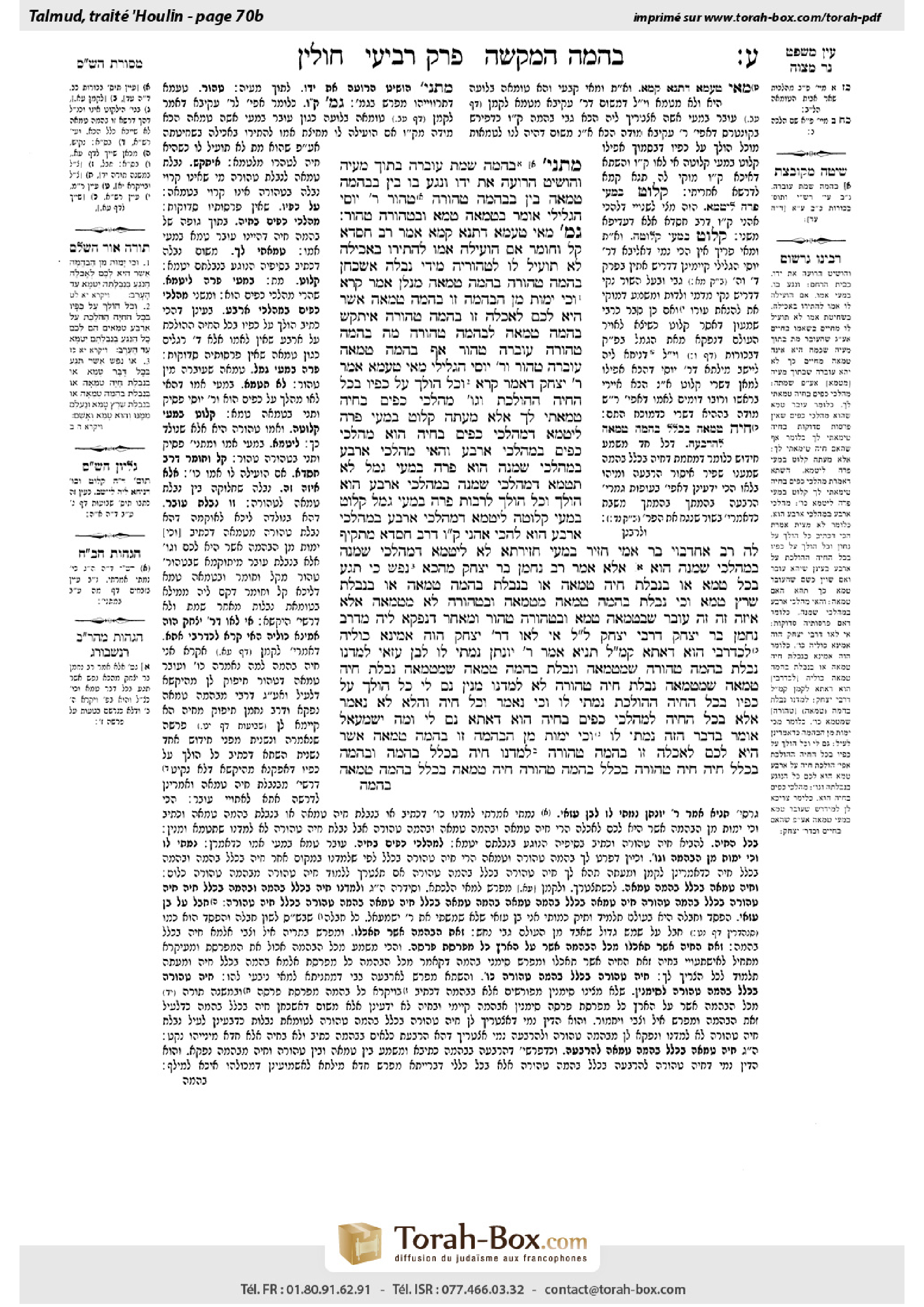
Chullin 70b: Talmud study for Daf Yomi
Study the Talmud for Daf Yomi with scanned pages, Hebrew text, English translations from Sefaria and AI-generated French translations.
Passage selection and English or AI-generated French translation are available where the scan has annotations. Daf Study is independent of Torah-Box and Sefaria.
Browse Chullin · חולין · All tractatesChullin 70b text and translations
This page of Chullin includes the Aramaic text, an English translation and an AI-generated French translation, alongside the scan above.
חולין ע׳ ב · Aramaic and Hebrew text
מַתְנִי׳ בְּהֵמָה שֶׁמֵּת עוּבָּרָהּ בְּתוֹךְ מֵעֶיהָ וְהוֹשִׁיט הָרוֹעֶה אֶת יָדוֹ וְנָגַע בּוֹ, בֵּין בִּבְהֵמָה טְמֵאָה בֵּין בִּבְהֵמָה טְהוֹרָה – טָהוֹר. רַבִּי יוֹסֵי הַגְּלִילִי אוֹמֵר: בִּטְמֵאָה – טָמֵא, וּבִטְהוֹרָה – טָהוֹר.
גְּמָ׳ מַאי טַעְמָא דְּתַנָּא קַמָּא? אָמַר רַב חִסְדָּא: קַל וָחוֹמֶר, אִם הוֹעִילָה אִמּוֹ לְהַתִּירוֹ בַּאֲכִילָה, לֹא תּוֹעִיל לוֹ לְטַהוֹרֵיהּ מִידֵי נְבֵלָה?
אַשְׁכְּחַן בְּהֵמָה טְהוֹרָה, בְּהֵמָה טְמֵאָה מְנָלַן? אָמַר קְרָא: ״וְכִי יָמוּת מִן הַבְּהֵמָה״ – זוֹ בְּהֵמָה טְמֵאָה, ״אֲשֶׁר הִיא לָכֶם לְאׇכְלָה״ – זוֹ בְּהֵמָה טְהוֹרָה, אִיתַּקַּשׁ בְּהֵמָה טְמֵאָה לִבְהֵמָה טְהוֹרָה: מָה בְּהֵמָה טְהוֹרָה – עוּבָּרָהּ טָהוֹר, אַף בְּהֵמָה טְמֵאָה – עוּבָּרָהּ טָהוֹר.
וְרַבִּי יוֹסֵי הַגְּלִילִי, מַאי טַעְמָא? אָמַר רַבִּי יִצְחָק: דְּאָמַר קְרָא ״וְכׇל הוֹלֵךְ עַל כַּפָּיו בְּכׇל הַחַיָּה הַהֹלֶכֶת וְגוֹ׳״ – מְהַלְּכֵי כַּפַּיִם בְּחַיָּה טִמֵּאתִי לָךְ.
אֶלָּא מֵעַתָּה, קָלוּט בִּמְעֵי פָרָה לִיטַמֵּא, דִּמְהַלְּכֵי כַפַּיִם בְּחַיָּה הוּא? מְהַלְּכֵי כַפַּיִם בִּמְהַלְּכֵי אַרְבַּע, וְהַאי מְהַלְּכֵי אַרְבַּע בִּמְהַלְּכֵי שְׁמֹנֶה הוּא.
פָּרָה בִּמְעֵי גָמָל לֹא תְּטַמֵּא, דִּמְהַלְּכֵי שְׁמֹנֶה בִּמְהַלְּכֵי אַרְבַּע הוּא, ״הוֹלֵךְ״, ״וְכׇל הוֹלֵךְ״ – לְרַבּוֹת פָּרָה בִּמְעֵי גָמָל.
קָלוּט בִּמְעֵי קְלוּטָה לִיטַמֵּא, דִּמְהַלְּכֵי אַרְבַּע בִּמְהַלְּכֵי אַרְבַּע הוּא! לְהָכִי אַהֲנִי קַל וָחוֹמֶר דְּרַב חִסְדָּא.
מַתְקֵיף לַהּ רַב אַחָדְבוּי בַּר אַמֵּי: חֲזִיר בִּמְעֵי חֲזִירְתָּא לָא לִיטַמֵּא, דִּמְהַלְּכֵי שְׁמֹנֶה בִּמְהַלְּכֵי שְׁמֹנֶה הוּא!
אֶלָּא אָמַר רַב נַחְמָן בַּר יִצְחָק, מֵהָכָא: ״נֶפֶשׁ כִּי תִגַּע בְּכׇל טָמֵא אוֹ בְנִבְלַת חַיָּה טְמֵאָה אוֹ בְּנִבְלַת בְּהֵמָה טְמֵאָה אוֹ בְּנִבְלַת שֶׁרֶץ טָמֵא״.
וְכִי נִבְלַת בְּהֵמָה טְמֵאָה מְטַמְּאָה, וּבִטְהוֹרָה לֹא מְטַמְּאָה? אֶלָּא אֵיזֶה זֶה? זֶה עוּבָּר, שֶׁבִּטְמֵאָה טָמֵא, וּבִטְהוֹרָה טָהוֹר.
וּמֵאַחַר דְּנָפְקָא לֵיהּ מִדְּרַב נַחְמָן בַּר יִצְחָק, דְּרַבִּי יִצְחָק לְמָה לִי? אִי לָאו דְּרַבִּי יִצְחָק, הֲוָה אָמֵינָא: כּוּלֵּיהּ לְכִדְרַבִּי הוּא דַּאֲתָא, קָא מַשְׁמַע לַן.
תַּנְיָא, אָמַר רַבִּי יוֹנָתָן: נַמְתִּי לוֹ לְבֶן עַזַּאי, לָמַדְנוּ נִבְלַת בְּהֵמָה טְהוֹרָה שֶׁמְּטַמְּאָה, וְנִבְלַת בְּהֵמָה טְמֵאָה שֶׁמְּטַמְּאָה, נִבְלַת חַיָּה טְמֵאָה שֶׁמְּטַמְּאָה.
נִבְלַת חַיָּה טְהוֹרָה לֹא לָמַדְנוּ מִנַּיִן? נָם לִי: ״כָּל הוֹלֵךְ עַל כַּפָּיו בְּכׇל הַחַיָּה הַהֹלֶכֶת״.
נַמְתִּי לוֹ: וְכִי נֶאֱמַר ״וְכׇל חַיָּה״? וַהֲלֹא לֹא נֶאֱמַר אֶלָּא ״בְּכׇל הַחַיָּה״, לִמְהַלְּכֵי כַּפַּיִם בְּחַיָּה הוּא דַּאֲתָא. נָם לִי: וּמָה יִשְׁמָעֵאל אוֹמֵר בְּדָבָר הַזֶּה?
נַמְתִּי לוֹ: ״וְכִי יָמוּת מִן הַבְּהֵמָה״ – זוֹ בְּהֵמָה טְמֵאָה, ״אֲשֶׁר הִיא לָכֶם לְאׇכְלָה״ – זוֹ בְּהֵמָה טְהוֹרָה, לָמַדְנוּ חַיָּה בִּכְלַל בְּהֵמָה, וּבְהֵמָה בִּכְלַל חַיָּה.
חַיָּה טְהוֹרָה בִּכְלַל בְּהֵמָה טְהוֹרָה, חַיָּה טְמֵאָה בִּכְלַל בְּהֵמָה טְמֵאָה,
Chullin 70b · English translation
MISHNA: With regard to an animal whose fetus died in its womb and the shepherd reached his hand into the womb and touched the fetus, both in the case of a non-kosher animal and in the case of a kosher animal the fetus does not have the status of an animal carcass that imparts ritual impurity, and the shepherd remains ritually pure. Rabbi Yosei HaGelili says: In the case of a non-kosher animal it is impure, and in the case of a kosher animal it is pure.
GEMARA: The Gemara asks: What is the reason for the ruling of the first tanna? Rav Ḥisda said: It is apparent through an a fortiori inference: If being inside its mother is effective to permit it for consumption through the slaughter of its mother even if the fetus was found dead inside the womb, then should being inside its mother not also be effective to render it pure from the impurity of an animal carcass?
The Gemara asks: We found a rationale for this halakha with regard to a kosher animal; from where do we derive that the same applies to a non-kosher animal? The Gemara answers that the verse states: “And when a domesticated animal dies, of those that you eat, one who touches its carcass shall be impure until the evening” (Leviticus 11:39). The Gemara interprets the verse as follows: “And when a domesticated animal dies,” this is referring to a non-kosher animal; “of those that you eat,” this is referring to a kosher animal. The verse thereby juxtaposes a non-kosher animal to a kosher animal with regard to imparting impurity of a carcass, and teaches that just as with regard to a kosher animal, its fetus that died in its womb is pure, as derived above through an a fortiori inference, so too, with regard to a non-kosher animal, its dead fetus is pure.
The Gemara asks: And as for Rabbi Yosei HaGelili, what is the reason for his ruling? Rabbi Yitzḥak said that the verse states with regard to non-kosher animals that do not have cloven hooves: “And whatever walks on its paws, among any [bekhol] undomesticated animal [ḥayya] that walks on all fours, they are impure for you; whoever touches their carcass shall be impure until the evening” (Leviticus 11:27). Rabbi Yosei HaGelili expounds this verse as follows: Those animals that walk on their paws, i.e., that do not have cloven hooves, which are inside the body of an animal, I rendered impure for you. Rabbi Yitzḥak interprets the term bekhol as meaning: Inside the body of, and the word ḥayya as meaning: A live animal. Accordingly, he understands the verse to be referring to a dead fetus found inside a living animal.
The Gemara objects: If that is so, then a dead fetus with non-cloven hooves found inside a cow should be impure, despite the fact that it is from a kosher species, as it is an animal that walks on its paws that is inside the body of a kosher animal. The Gemara explains: The verse renders impure an animal that walks upon its four paws that is inside an animal that walks on four paws. But this is a case of an animal that walks on four inside an animal that walks on eight. Since the mother cow’s hooves are entirely split into two parts, it actually walks on eight parts and is not the animal referred to by the verse.
The Gemara raises another objection: If that is so, then a dead fetus in the form of a cow, which has eight parts to its legs, inside the womb of a camel, a non-kosher animal with non-cloven hooves, should not be impure, as it is an animal that walks on eight inside an animal that walks on four, and the verse is not referring to it. The Gemara responds that the verse could have stated: Walks upon, but instead states: “And whatever walks upon,” i.e., the addition of the word “whatever” serves to include a dead cow fetus in the womb of a camel, teaching that it is impure.
The Gemara objects: If that is so, then a dead fetus with non-cloven hooves inside the womb of a cow with non-cloven hooves should be impure, as it is an animal that walks on four inside an animal that walks on four, but the halakha is that since the mother is a kosher species, it is pure. The Gemara explains: It is to that end that the a fortiori inference of Rav Ḥisda is effective, as it renders pure the fetuses of all kosher animals, even if their hooves are not fully cloven.
Rav Aḥadvoi bar Ami objects to this explanation that the verse renders impure only animals that walk on four inside animals that walk on four: If that is so, a dead pig fetus inside the womb of a female pig should not be impure, as a pig has cloven hooves, and so it is an animal that walks on eight inside an animal that walks on eight, and so the verse is not referring to it.
Rather, Rav Naḥman bar Yitzḥak said that Rabbi Yosei HaGelili’s opinion is derived from here: The verse states with regard to the sliding-scale offering brought by one who was unaware that he was impure when he ate consecrated food or entered the Temple: “A person who touched anything impure, or the carcass of a non-kosher undomesticated animal, or the carcass of a non-kosher domesticated animal, or the carcass of an impure creeping animal, and is guilty, it having being hidden from him that he is impure” (Leviticus 5:2).
The verse presents a difficulty: Does only a carcass of a non-kosher animal impart impurity, and that of a kosher animal not impart impurity? The halakha is that both do. Rather, what is this animal to which the verse is referring? This is a fetus, which if inside a non-kosher animal is impure, and if inside a kosher animal is pure.
The Gemara asks: And since this halakha is derived from the statement of Rav Naḥman bar Yitzḥak, why do I need the proof of Rabbi Yitzḥak from the verse: “And whatever walks on its paws, among any undomesticated animal that walks on all fours” (Leviticus 11:27)? The Gemara explains: Were it not for the derivation of Rabbi Yitzḥak, I would say that the entire verse expounded by Rav Naḥman bar Yitzḥak comes to teach only that which Rabbi Yehuda HaNasi derived from it, as cited by the Gemara later on. Rabbi Yitzḥak’s statement teaches us that the verse is also to be expounded as Rav Naḥman bar Yitzḥak explained.
§ It is taught in a baraita that Rabbi Yonatan, a student of Rabbi Yishmael, says: I said [namti] to ben Azzai: We learned that a carcass of a kosher domesticated animal imparts impurity from the verse: “And when a domesticated animal dies, of those that you eat, one who touches its carcass shall be impure until the evening” (Leviticus 11:39). And we learned that a carcass of a non-kosher domesticated animal imparts impurity, and that a carcass of a non-kosher undomesticated animal imparts impurity, from the verse: “A person who touched anything impure, or the carcass of a non-kosher undomesticated animal, or the carcass of a non-kosher domesticated animal” (Leviticus 5:2).
But we did not yet learn about a carcass of a kosher undomesticated animal. From where is it derived that it imparts impurity? Ben Azzai said to me that this is derived from the verse: “And whatever walks on its paws, among any undomesticated animal that walks on all fours” (Leviticus 11:27). The inclusive term “among any” serves to include even a carcass of a kosher undomesticated animal among those that impart impurity.
Rabbi Yonatan continues. I said to ben Azzai: But does it state: And any undomesticated animal? Isn’t it stated only: “Among any undomesticated animal”? And as explained earlier, this comes to teach that a dead fetus in the form of any of the animals that walk on their paws inside an undomesticated animal imparts impurity. He said to me: And what does Rabbi Yishmael, your teacher, say about this matter?
I said to him that Rabbi Yishmael derives all these halakhot from the verse: “And when a domesticated animal dies, of those that you eat, one who touches its carcass shall be impure until the evening” (Leviticus 11:39), as follows: “And when a domesticated animal [habehema] dies,” this is referring to a non-kosher animal; “of those that you eat,” this is referring to a kosher animal. And we learned that a ḥayya is included in the category of a behema, i.e., the term behema can also refer collectively to both domesticated and undomesticated animals. And likewise, a behema is included in the category of a ḥayya.
Furthermore, a kosher ḥayya is included when the Torah makes reference to a kosher behema, and a non-kosher ḥayya is included when the Torah makes reference to a non-kosher behema.
Chullin 70b · Traduction française (IA)
MICHNA : Concernant un animal dont le fœtus est mort dans son ventre et que le berger a mis sa main dans le ventre et a touché le fœtus, tant dans le cas d'un animal non-kosher que dans celui d'un animal kosher, le fœtus ne possède pas le statut d'un cadavre d'animal transmettant la souillure rituelle, et le berger demeure rituellement pur. Rabbi Yosei HaGelili dit : Dans le cas d'un animal non-kosher, il est souillé, et dans le cas d'un animal kosher, il est pur.
GUEMARA : La Guemara demande : Quel est le raisonnement du premier tanna ? Rav Ḥisda dit : Cela est évident par une déduction a fortiori : Si être à l'intérieur de sa mère est efficace pour permettre sa consommation par la mise à mort de sa mère même si le fœtus est trouvé mort à l'intérieur du ventre, alors ne devrait-il pas être efficace également pour le rendre pur par rapport à la souillure d'un cadavre d'animal ?
La Guemara demande : Nous avons trouvé une justification pour cette halakha concernant un animal kosher ; d'où tirons-nous que cela s'applique également à un animal non-kosher ? La Guemara répond que la Parashah dit : « Et quand un animal domestique meurt, de ceux que vous mangez, celui qui touche son cadavre sera souillé jusqu'au soir » (Lévitique 11:39). La Guemara interprète cette Parashah ainsi : « Et quand un animal domestique meurt », cela fait référence à un animal non-kosher ; « de ceux que vous mangez », cela fait référence à un animal kosher. La Parashah juxtapose ainsi un animal non-kosher à un animal kosher concernant la transmission de la souillure d'un cadavre, et enseigne que tout comme, concernant un animal kosher, son fœtus mort dans son ventre est pur, comme déduit ci-dessus par une déduction a fortiori, ainsi, concernant un animal non-kosher, son fœtus mort est pur.
La Guemara pose la question : Et quant à Rabbi Yosei HaGelili, quelle est la raison de son décision ? Rabbi Yitzḥak dit que la parabole mentionne les animaux non-kosher qui n'ont pas de paquets de pieds : « Et tout ce qui marche sur ses pattes, parmi tout [bekhol] animal sauvage [ḥayya] qui marche sur quatre pattes, ils sont impurs pour vous ; celui qui touche leur carcasse devient impur jusqu'au soir » (Lévitique 11:27). Rabbi Yosei HaGelili développe cette parabole ainsi : Ces animaux qui marchent sur leurs pattes, c'est-à-dire ceux qui n'ont pas de paquets de pieds, qui sont à l'intérieur du corps d'un animal, je les ai rendus impurs pour vous. Rabbi Yitzḥak interprète le terme bekhol comme signifiant : à l'intérieur du corps, et le mot ḥayya comme signifiant : un animal vivant. Ainsi, il comprend que la parabole fait référence à un fœtus mort trouvé à l'intérieur d'un animal vivant.
La Guemara s'oppose à cela : Si c'est ainsi, alors un fœtus mort avec des paquets de pieds non divisés trouvé à l'intérieur d'une vache devrait être impur, malgré le fait qu'il provienne d'une espèce kasher, car il s'agit d'un animal qui marche sur ses pattes à l'intérieur du corps d'un animal kasher. La Guemara explique : La parabole rend impur un animal qui marche sur ses quatre pattes à l'intérieur d'un animal qui marche sur quatre pattes. Mais c'est le cas d'un animal qui marche sur quatre pattes à l'intérieur d'un animal qui marche sur huit. Puisque les paquets de pieds de la vache mère sont entièrement divisés en deux parties, elle marche effectivement sur huit parties et n'est pas l'animal mentionné par la parabole.
La Guemara soulève une autre objection : Si c'est ainsi, alors un fœtus mort en forme de vache, qui a huit parties aux pattes, à l'intérieur du ventre d'une chameau, un animal non-kosher aux pieds non cloisonnés, ne devrait pas être impur, car c'est un animal qui marche sur huit à l'intérieur d'un animal qui marche sur quatre, et la parole du texte ne s'applique pas à lui. La Guemara répond que le texte aurait pu dire : « Marche sur », mais il dit au contraire : « Et tout ce qui marche sur », c'est-à-dire que l'ajout du mot « tout » sert à inclure un fœtus de vache mort à l'intérieur du ventre d'un chameau, enseignant qu'il est impur.
La Guemara s'oppose à cela : Si c'est ainsi, alors un fœtus mort aux pieds non cloisonnés à l'intérieur du ventre d'une vache aux pieds non cloisonnés devrait être impur, car c'est un animal qui marche sur quatre à l'intérieur d'un animal qui marche sur quatre, mais la halakha est que, puisque la mère est une espèce kasher, elle est pure. La Guemara explique : C'est à cet effet que l'inférence a fortiori de Rav Ḥisda est efficace, car elle rend pure le fœtus de tous les animaux kashers, même si leurs pieds ne sont pas entièrement cloisonnés.
Rav Aḥadvoi bar Ami s'oppose à cette explication en disant que le texte rend impur uniquement les animaux qui marchent sur quatre à l'intérieur d'animaux qui marchent sur quatre : Si c'est ainsi, un fœtus de porc mort à l'intérieur du ventre d'une femelle porc ne devrait pas être impur, car le porc a des pieds cloisonnés, et donc c'est un animal qui marche sur huit à l'intérieur d'un animal qui marche sur huit, et donc le texte ne s'applique pas à lui.
Plutôt, Rav Naḥman bar Yitzḥak a dit que l'opinion de Rabbi Yosei HaGelili est tirée de là : la parabole mentionne, concernant l'offrande à échelle variable apportée par celui qui ne savait pas qu'il était impur lorsqu'il a mangé de la nourriture consacrée ou est entré dans le Temple : « Celui qui a touché quelque chose d'impur, ou la carcasse d'un animal non-kosher non domestiqué, ou la carcasse d'un animal non-kosher domestiqué, ou la carcasse d'un animal impur rampant, et qui est coupable, car cela lui était caché qu'il était impur » (Lévitique 5:2).
La parabole présente une difficulté : est-ce que seul la carcasse d'un animal non-kosher transmet l'impureté, et celle d'un animal kosher ne transmet pas l'impureté ? La halakha est que les deux transmettent l'impureté. Plutôt, de quel animal la parabole parle-t-elle ? Cet animal est un fœtus, qui est impur s'il est à l'intérieur d'un animal non-kosher, et pur s'il est à l'intérieur d'un animal kosher.
Le Guemara demande : et puisque cette halakha est tirée de la déclaration de Rav Naḥman bar Yitzḥak, pourquoi ai-je besoin de la preuve de Rabbi Yitzḥak tirée de la parabole : « Et tout ce qui marche sur ses pattes, parmi tout animal non domestiqué qui marche sur quatre pattes » (Lévitique 11:27) ? Le Guemara explique : sans la dérivation de Rabbi Yitzḥak, je dirais que toute la parabole interprétée par Rav Naḥman bar Yitzḥak vient uniquement enseigner ce que Rabbi Yehuda HaNasi en a tiré, comme cité plus tard par le Guemara. La déclaration de Rabbi Yitzḥak nous apprend que la parabole doit également être interprétée comme Rav Naḥman bar Yitzḥak l'a expliqué.
§ Il est enseigné dans une baraïta que Rabbi Yonatan, disciple de Rabbi Yishmael, dit : J’ai dit [namti] à Ben Azzai : Nous avons appris que la carcasse d’un animal domestique kasher transmet l’impureté, d’après la parole : « Et quand un animal domestique meurt, de ceux que vous mangez, celui qui touchera sa carcasse sera impur jusqu’au soir » (Lévitique 11:39). Et nous avons appris que la carcasse d’un animal domestique non kasher transmet l’impureté, ainsi que la carcasse d’un animal sauvage non kasher transmet l’impureté, d’après la parole : « L’homme qui touchera quelque chose d’impur, ou la carcasse d’un animal sauvage non kasher, ou la carcasse d’un animal domestique non kasher » (Lévitique 5:2).
Mais nous n’avons pas encore appris la question de la carcasse d’un animal sauvage kasher. D’où est-elle dérivée pour transmettre l’impureté ? Ben Azzai me dit que cela est dérivé de la parole : « Et tout ce qui marche sur ses pieds, parmi tout animal sauvage qui marche sur quatre pieds » (Lévitique 11:27). Le terme inclusif « parmi tout » sert à inclure même la carcasse d’un animal sauvage kasher parmi ceux qui transmettent l’impureté.
Rabbi Yonatan continue. J’ai dit à Ben Azzai : Mais ne dit-on pas : « Et tout animal sauvage » ? N’est-ce pas dit seulement : « Parmi tout animal sauvage » ? Et comme cela a été expliqué plus tôt, cela sert à enseigner que le fœtus mort ayant la forme de tout animal qui marche sur ses pieds à l’intérieur d’un animal sauvage transmet l’impureté. Il m’a dit : Et que dit Rabbi Yishmael, votre maître, à propos de cette question ?
J’ai dit à lui que Rabbi Yishmael dérive toutes ces halakhot de la parole : « Et quand un animal domestique [habehema] meurt, de ceux que vous mangez, celui qui touchera sa carcasse sera impur jusqu’au soir » (Lévitique 11:39), comme suit : « Et quand un animal domestique [habehema] meurt », cela fait référence à un animal non kasher ; « de ceux que vous mangez », cela fait référence à un animal kasher. Et nous avons appris que le chayya est inclus dans la catégorie du behema, c’est-à-dire que le terme behema peut aussi désigner collectivement à la fois les animaux domestiques et les animaux sauvages. De même, le behema est inclus dans la catégorie du chayya.
De plus, un chayya kasher est inclus lorsqu’il y a référence dans la Torah à un behema kasher, et un chayya non kasher est inclus lorsqu’il y a référence dans la Torah à un behema non kasher.
Traduction française générée par IA à partir de l’édition anglaise de Sefaria. Vérifie toujours un passage avec le texte source.
Text from Sefaria: William Davidson Edition - Vocalized Aramaic (unknown); William Davidson Edition - English (CC BY NC).