Chullin 71a: Talmud study for Daf Yomi
Study the Talmud for Daf Yomi with scanned pages, Hebrew text, English translations from Sefaria and AI-generated French translations.
Passage selection and English or AI-generated French translation are available where the scan has annotations. Daf Study is independent of Torah-Box and Sefaria.
Browse Chullin · חולין · All tractatesChullin 71a text and translations
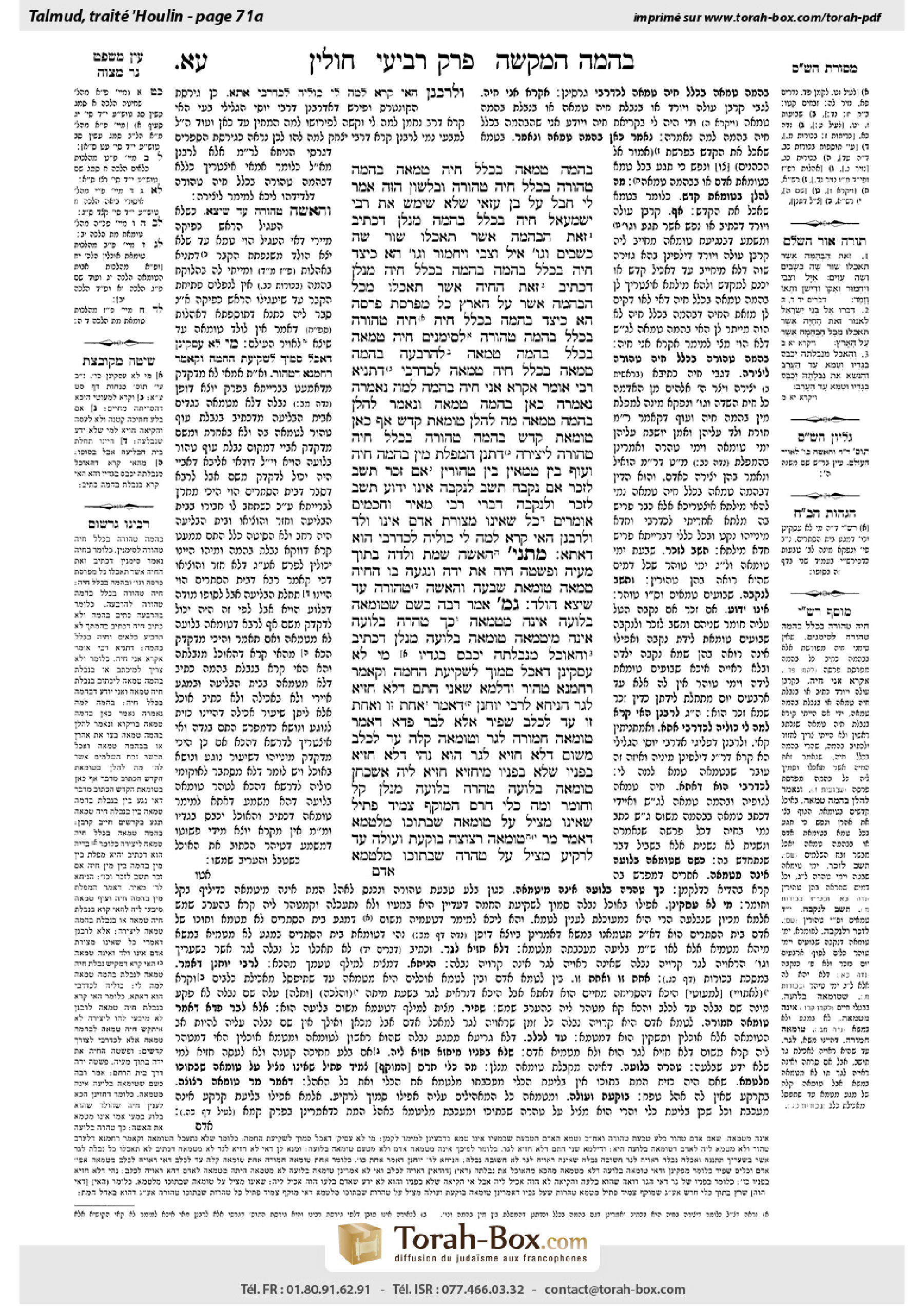
This page of Chullin includes the Aramaic text, an English translation and an AI-generated French translation, alongside the scan above.
חולין ע״א א · Aramaic and Hebrew text
בְּהֵמָה טְמֵאָה בִּכְלַל חַיָּה טְמֵאָה, בְּהֵמָה טְהוֹרָה בִּכְלַל חַיָּה טְהוֹרָה, וּבַלָּשׁוֹן הַזֶּה אָמַר לִי: חֲבָל עַל בֶּן עַזַּאי שֶׁלֹּא שִׁימֵּשׁ אֶת רַבִּי יִשְׁמָעֵאל.
חַיָּה בִּכְלַל בְּהֵמָה מְנָלַן? דִּכְתִיב: ״זֹאת הַבְּהֵמָה אֲשֶׁר תֹּאכֵלוּ שׁוֹר שֵׂה כְשָׂבִים וְגוֹ׳ אַיָּל וּצְבִי וְיַחְמוּר וְגוֹ׳״, הָא כֵּיצַד? חַיָּה בִּכְלַל בְּהֵמָה.
בְּהֵמָה בִּכְלַל חַיָּה מְנָלַן? דִּכְתִיב: ״זֹאת הַחַיָּה אֲשֶׁר תֹּאכְלוּ מִכׇּל הַבְּהֵמָה אֲשֶׁר עַל הָאָרֶץ כֹּל מַפְרֶסֶת פַּרְסָה״, הָא כֵּיצַד? בְּהֵמָה בִּכְלַל חַיָּה.
חַיָּה טְהוֹרָה בִּכְלַל בְּהֵמָה טְהוֹרָה – לְסִימָנִים.
חַיָּה טְמֵאָה בִּכְלַל בְּהֵמָה טְמֵאָה – לְהַרְבָּעָה.
בְּהֵמָה טְמֵאָה בִּכְלַל חַיָּה טְמֵאָה – לְכִדְרַבִּי.
דְּתַנְיָא, רַבִּי אוֹמֵר: אֶקְרָא אֲנִי ״חַיָּה״, בְּהֵמָה לָמָּה נֶאֶמְרָה?
נֶאֶמְרָה כָּאן ״בְּהֵמָה טְמֵאָה״, וְנֶאֱמַר לְהַלָּן ״בְּהֵמָה טְמֵאָה״, מָה לְהַלָּן טוּמְאַת קֹדֶשׁ – אַף כָּאן טוּמְאַת קֹדֶשׁ.
בְּהֵמָה טְהוֹרָה בִּכְלַל חַיָּה טְהוֹרָה, לִיצִירָה, דִּתְנַן: הַמַּפֶּלֶת מִין בְּהֵמָה חַיָּה וָעוֹף, בֵּין טְמֵאִין בֵּין טְהוֹרִין, אִם זָכָר – תֵּשֵׁב לְזָכָר.
אִם נְקֵבָה – תֵּשֵׁב לִנְקֵבָה.
אֵינוֹ יָדוּעַ – תֵּשֵׁב לְזָכָר וְלִנְקֵבָה,
דִּבְרֵי רַבִּי מֵאִיר.
וַחֲכָמִים אוֹמְרִים: כֹּל שֶׁאֵינוֹ מִצּוּרַת אָדָם אֵינוֹ וָלָד.
וּלְרַבָּנַן, הַאי קְרָא לְמָה לִי?
כּוּלֵּיהּ לְכִדְרַבִּי הוּא דַּאֲתָא.
מַתְנִי׳ הָאִשָּׁה שֶׁמֵּת וְלָדָהּ בְּתוֹךְ מֵעֶיהָ, וּפָשְׁטָה חַיָּה אֶת יָדָהּ וְנָגְעָה בּוֹ – הַחַיָּה טְמֵאָה טוּמְאַת שִׁבְעָה, וְהָאִשָּׁה טְהוֹרָה עַד שֶׁיֵּצֵא הַוָּלָד.
גְּמָ׳ אָמַר רַבָּה: כְּשֵׁם שֶׁטּוּמְאָה בְּלוּעָה אֵינָהּ מְטַמְּאָה, כָּךְ טׇהֳרָה בְּלוּעָה אֵינָהּ מִיטַּמְּאָה.
טוּמְאָה בְּלוּעָה מְנָלַן? דִּכְתִיב: ״וְהָאֹכֵל מִנִּבְלָתָהּ יְכַבֵּס בְּגָדָיו״, מִי לָא עָסְקִינַן דַּאֲכַל סָמוּךְ לִשְׁקִיעַת הַחַמָּה, וְקָאָמַר רַחֲמָנָא טָהוֹר.
וְדִלְמָא שָׁאנֵי הָתָם, דְּלָא חַזְיָא לְגֵר.
הָנִיחָא לְרַבִּי יוֹחָנָן, דְּאָמַר: אַחַת זוֹ וְאַחַת זוֹ, עַד לְכֶלֶב – שַׁפִּיר.
אֶלָּא לְבַר פְּדָא, דְּאָמַר: טוּמְאָה חֲמוּרָה לְגֵר, וְטוּמְאָה קַלָּה עַד לְכֶלֶב – מִשּׁוּם דְּלָא חַזְיָא לְגֵר הוּא!
נְהִי דְּלָא חַזְיָא בְּפָנָיו, שֶׁלֹּא בְּפָנָיו מִיחַזְיָא חַזְיָא לֵיהּ.
אַשְׁכְּחַן טוּמְאָה בְּלוּעָה, טׇהֳרָה בְּלוּעָה מְנָלַן?
קַל וָחוֹמֶר: וּמָה כְּלִי חֶרֶס הַמּוּקָּף צָמִיד פָּתִיל, שֶׁאֵינוֹ מַצִּיל עַל טוּמְאָה שֶׁבְּתוֹכוֹ מִלְּטַמֵּא, דְּאָמַר מָר: טוּמְאָה רְצוּצָה בּוֹקַעַת וְעוֹלָה עַד לָרָקִיעַ – מַצִּיל עַל טׇהֳרָה שֶׁבְּתוֹכוֹ מִלְּטַמֵּא,
Chullin 71a · English translation
And likewise, a non-kosher behema is included in the category of a non-kosher ḥayya, and a kosher behema is included in the category of a kosher ḥayya. Accordingly, although the verse here is referring to a behema, it is understood to be referring collectively to both a behema and a ḥayya, and teaches that the carcasses of both types impart impurity. And upon hearing this, ben Azzai said to me in these words: Woe [ḥaval] unto ben Azzai, who did not serve Rabbi Yishmael.
The Gemara analyzes Rabbi Yishmael’s statement: From where do we derive that according to the Torah, a ḥayya is included in the category of a behema? As it is written: “These are the behema that you may eat: An ox, a sheep, and a goat, a deer, and a gazelle, and a fallow deer, and a wild goat, and an oryx, and an aurochs, and a wild sheep” (Deuteronomy 14:4–5). Despite employing the term “behema,” the verse also lists the deer and the gazelle, which are undomesticated animals. How is this possible? From here it is evident that a ḥayya is included by the Torah in the category of a behema.
From where do we derive that according to the Torah, a behema is included in the category of a ḥayya? As it is written: “These are the ḥayya that you may eat, among all the behema that are on the earth. Whatever parts the hoof” (Leviticus 11:2–3). How is this possible, that the verse mentions a ḥayya and then refers to a behema? This indicates that a domesticated animal is included in the category of a ḥayya by the Torah.
The Gemara further clarifies: The principle that a kosher ḥayya is included by the Torah in the category of a kosher behema is relevant with regard to the distinguishing characteristics of kosher animals. The Torah states with regard to a domesticated animal that only a species that chews its cud and has cloven hooves is kosher. Nevertheless, this requirement is understood as a reference to both domesticated and undomesticated animals.
The principle that a non-kosher ḥayya is included by the Torah in the category of a non-kosher behema is relevant with regard to the prohibition against mating one species with another. The Torah states the prohibition with regard to a behema: “You shall not let your animal [behema] mate with a diverse kind” (Leviticus 19:19). Nevertheless, this is understood as referring to both a behema and a ḥayya.
The principle that a non-kosher behema is included by the Torah in the category of a non-kosher ḥayya is relevant with regard to that which Rabbi Yehuda HaNasi taught, as it is taught in a baraita: The verse delineates a case in which one is obligated to bring a sliding-scale offering as an atonement: “A person who touched anything impure, or the carcass of a non-kosher undomesticated animal [ḥayya], or the carcass of a non-kosher domesticated animal [behema], or the carcass of an impure creeping animal, and is guilty, it having being hidden from him that he is impure” (Leviticus 5:2). But the nature of the transgression for which the person requires atonement is not apparent from the verse.
Rabbi Yehuda HaNasi says: Since a domesticated animal is also referred to as a ḥayya, it would be sufficient if I would read, i.e., the verse would write, only the clause about a ḥayya, and I would have known that one who touches a carcass of any non-kosher animal is impure. Why, then, is an explicit clause about a behema stated? It serves as the basis for a verbal analogy.
It is stated here, with regard to one who is unaware that he touched an impure item: “Non-kosher behema,” and it is likewise stated below, with regard to one who was aware that he touched an impure item: “Non-kosher behema,” in the following verse: “And when any one shall touch any impure thing, whether it is the impurity of man, or a non-kosher behema, and then eats of the flesh of a peace offering to the Lord, that soul shall be cut off from its people” (Leviticus 7:21). Just as below, the verse is referring to the defiling of sacrificial foods, so too here, the reference is to the defiling of sacrificial foods, and therefore one must bring a sliding-scale offering as an atonement.
The Gemara clarifies the final statement: The principle that a kosher behema is included by the Torah in the category of a kosher ḥayya is relevant with regard to the formation of children. As we learned in a mishna (Nidda 21a): With regard to a woman who miscarries a fetus that appears to be in the form of a type of behema, ḥayya, or bird, whether it had the form of a non-kosher species or a kosher species, if the fetus is a male, then she observes the periods of impurity and purity required for giving birth to a male.
The mishna continues: And if the fetus is a female, then she observes the periods required for giving birth to a female. After giving birth to a male, a woman is impure for seven days, during which it is prohibited for her to engage in intercourse. During the next thirty-three days she may immerse in a ritual bath at any time, after which she is permitted to engage in intercourse even should she then experience a discharge of uterine blood. Nevertheless, during the entire forty-day period she may not enter the Temple or be in contact with consecrated foods. After giving birth to a girl, the length of each of these periods is doubled to fourteen days and sixty-six days, respectively (see Leviticus 12:2–5).
If the sex of the fetus is unknown, she observes the strictures of a woman who gave birth both to a male and to a female. Accordingly, it is prohibited for her to engage in intercourse for the fourteen days after birth, after which she immerses in a ritual bath. After that she is permitted to engage in intercourse despite any discharge of uterine blood until the fortieth day after birth, i.e., for thirty-three days following the seven days she would have been prohibited from engaging in intercourse if the fetus was male. The prohibition against entering the Temple, however, continues until eighty days have passed from the birth.
This is the statement of Rabbi Meir. The Gemara elsewhere (Nidda 22b) explains that Rabbi Meir derives his opinion from the fact that the term “formation” is used to describe both the formation of man: “Then the Lord God formed man” (Genesis 2:7), and the formation of animals and birds: “The Lord God formed every animal [ḥayya] of the field, and every bird of the air” (Genesis 2:19). Furthermore, he holds that the term “ḥayya” is referring to both domesticated and undomesticated animals, and concludes that a woman observes these periods of purity and impurity if the fetus has the form of any of these types of animals.
And the Rabbis say: Any fetus that is not of human form is not regarded as an offspring with regard to observance of these periods of purity and impurity, and she is permitted to engage in intercourse provided she does not experience a discharge of uterine blood.
§ The Gemara returns to explaining the opinion of the Rabbis, cited in the mishna, who hold that a dead fetus found inside its mother’s womb does not impart impurity, irrespective of whether it is of a kosher or a non-kosher animal. Rabbi Yosei HaGelili disagrees and holds that a dead fetus inside a non-kosher animal imparts impurity. He derives this from the verse: “A person who touched anything impure, or the carcass of a non-kosher ḥayya, or the carcass of a non-kosher behema, or the carcass of an impure creeping animal, and is guilty” (Leviticus 5:2), which is referring only to non-kosher animals. The Gemara asks: And according to the Rabbis, why do I need this verse?
The Gemara answers: The entire verse comes to teach that which Rabbi Yehuda HaNasi taught in the baraita cited earlier, that the verse obligates one to bring a sliding-scale offering only in cases where one partook of consecrated foods or entered the Temple while in a state of impurity of which one was unaware.
MISHNA: With regard to a woman whose fetus died in her womb and the midwife extended her hand into the womb and touched the fetus, the midwife is thereby rendered impure with the seven-day impurity imparted by a corpse, and the woman remains ritually pure until the offspring emerges from the womb.
GEMARA: Rabba says: Just as a ritually impure item that is encapsulated within a body does not impart impurity to an item that comes in contact with it, so too, a ritually pure item that is encapsulated within a body cannot be rendered impure if it comes in contact with an impure item. For example, if one swallowed a ring that was ritually pure and then entered a tent containing a corpse, the ring would not be rendered impure.
The Gemara asks: From where do we derive that an encapsulated impure item does not impart impurity? As it is written: “And one who eats of its carcass shall wash his clothes, and be impure until the evening” (Leviticus 11:40), i.e., he must immerse his body and garments in a ritual bath, and he then becomes pure at sunset. Are we not dealing even with a case where one ate from the carcass close to sunset and then immersed? And yet the Merciful One states that he is pure once the sun sets, despite the fact that his stomach still contains pieces of the carcass that have not yet been digested. If so, it is apparent that an encapsulated impure item does not impart impurity.
The Gemara challenges: But perhaps it is different there, as with regard to the prohibition against eating a carcass the Torah states: “You shall not eat any carcass; you may give it to the gentile resident who is in your cities” (Deuteronomy 14:21). The juxtaposition of the two parts of the verse teaches that the prohibition is limited to a carcass that is fit to be given to a gentile resident, i.e., it is fit for human consumption. Accordingly, perhaps the carcass that the person ate does not impart impurity, as it is no longer fit for a gentile resident, i.e., it is now unsuitable for human consumption.
The Gemara comments that the effectiveness of the proof depends on whether a carcass can impart impurity to a person despite its not being fit for human consumption: This proof works out well according to the opinion of Rabbi Yoḥanan, who says: A carcass imparts impurity to both this, a person, and that, food, even if it is unfit for human consumption, until it is no longer fit for consumption by a dog. According to this opinion the proof is understood well, as the carcass in the person’s stomach still has the ability to impart impurity to him because it is still fit for consumption by a dog. Therefore, it is apparent that the only reason it does not impart impurity is that it is encapsulated within his body.
But according to the opinion of bar Padda, who says a carcass has the severe form of ritual impurity, which can impart impurity to people only while it is still fit to be eaten by a gentile resident and it has the light form of ritual impurity even until the point that it is no longer fit for consumption by a dog, this proof is flawed. This is because it is possible the carcass in the person’s stomach does not render him impure simply because it is no longer fit for human consumption. Can one claim that the carcass cannot impart impurity because it is no longer fit for a gentile resident?
Granted that the carcass is not fit to be eaten by someone when it was eaten in his presence, as he is aware that it was swallowed and considers it disgusting to eat a swallowed item, but it is still sometimes fit for a person to eat when it was eaten not in his presence and he is unaware that it had been previously swallowed. This is possible where one consumed a small piece of food and did not chew it prior to swallowing. The Gemara concedes this point and therefore accepts the proof.
The Gemara asks: We found a source for the halakha that an encapsulated impure item does not impart impurity. From where do we derive that a pure item that is encapsulated within another body cannot be rendered impure if it comes in contact with an impure item?
The Gemara explains: It is derived through an a fortiori inference: If an earthenware vessel that is closed with a tightly sealed cover, which does not shield, i.e., prevent, the impure piece of a corpse contained within it from imparting impurity to other items in the same tent as it; the Gemara interrupts the explication of the inference and clarifies: As the Master said: The impure piece of a corpse that is in a tight space; e.g., it is buried in the ground and there is not a handbreadth of hollow space above it, beneath the dirt, breaks through the earth above it and ascends up to the heavens, imparting impurity in that path. The Gemara resumes the explication of the inference: Although the tightly sealed earthenware vessel does not shield the impure item, it does shield a pure item contained within it from being rendered impure (see Numbers 19:15).
Chullin 71a · Traduction française (IA)
De même, un bétail non-kosher est inclus dans la catégorie d'un animal non-kosher (ḥayya), et un bétail kosher est inclus dans la catégorie d'un animal kosher (ḥayya). Ainsi, bien que le verset ici mentionne un bétail, il est compris comme faisant référence collectivement à la fois au bétail et à l'animal, et enseigne que les cadavres des deux types transmettent l'impureté. Et en entendant cela, ben Azzai me dit en ces termes : Malheur [ḥaval] à ben Azzai, qui n'a pas servi Rabbi Yishmael.
La Guemara analyse l'affirmation de Rabbi Yishmael : D'où dérivons-nous que selon la Torah, un animal (ḥayya) est inclus dans la catégorie d'un bétail ? Comme il est écrit : « Ces sont les bétails que vous pouvez manger : un taureau, un mouton, un chèvre, un chevreuil, un gazelle, un chevreuil sauvage, un bouc, un oryx, un aurochs, et un mouton sauvage » (Deutéronome 14 : 4–5). Bien qu'employant le terme « bétail », le verset cite aussi le chevreuil et le gazelle, qui sont des animaux sauvages. Comment est-ce possible ? Cela montre clairement que selon la Torah, un animal (ḥayya) est inclus dans la catégorie d'un bétail.
D'où dérivons-nous que selon la Torah, un bétail est inclus dans la catégorie d'un animal (ḥayya) ? Comme il est écrit : « Ces sont les animaux (ḥayya) que vous pouvez manger, parmi tous les bétails qui sont sur la terre. Tout ce qui a des ongles » (Lévitique 11 : 2–3). Comment est-ce possible, que le verset mentionne un animal (ḥayya) puis fait référence à un bétail ? Cela indique que selon la Torah, un animal domestiqué est inclus dans la catégorie d'un animal (ḥayya).
La Guemara clarifie davantage : le principe selon lequel un animal (ḥayya) kosher est inclus selon la Torah dans la catégorie d'un bétail kosher est pertinent en ce qui concerne les caractéristiques distinctives des animaux kosher. La Torah stipule concernant un animal domestiqué que seul une espèce qui rumine et a des ongles est kosher. Cependant, cette exigence est comprise comme s'appliquant à la fois aux animaux domestiques et aux animaux sauvages.
Le principe selon lequel un animal (ḥayya) non-kosher est inclus selon la Torah dans la catégorie d'un bétail non-kosher est pertinent en ce qui concerne l'interdiction de faire descendre un espèce avec une autre. La Torah stipule cette interdiction concernant un bétail : « Vous ne ferez pas manger à votre bétail un autre genre » (Lévitique 19 : 19). Cependant, cela est compris comme s'appliquant à la fois à un bétail et à un animal (ḥayya).
Le principe selon lequel un bétail non-kosher est inclus selon la Torah dans la catégorie d'un animal (ḥayya) non-kosher est pertinent en ce qui concerne ce que Rabbi Yehuda HaNasi a enseigné, comme il est dit dans une baraïta : Le verset décrit un cas où l'on est tenu de présenter un sacrifice proportionnel comme expiation : « Un homme qui a touché quelque chose d'impur, ou le cadavre d'un animal (ḥayya) non-kosher, ou le cadavre d'un bétail non-kosher, ou le cadavre d'un animal impur rampant, et qui est coupable, et qui ne savait pas qu'il était impur » (Lévitique 5 : 2). Cependant, la nature du péché pour lequel la personne a besoin d'expiation n'est pas clairement indiquée dans le verset.
Rabbi Yehuda HaNasi dit : Puisque l'animal domestique est aussi appelé un ḥayya, il suffirait que le verset écrive seulement la clause concernant un ḥayya, et je saurais que celui qui touche le cadavre d'un animal non-kosher est impur. Pourquoi alors la clause explicite concernant un bétail est-elle mentionnée ? Elle sert de base à une analogie verbale.
Il est dit ici, concernant celui qui ne savait pas qu'il a touché un objet impur : « Bétail non-kosher », et il est également dit plus bas, concernant celui qui savait qu'il a touché un objet impur : « Bétail non-kosher », dans le verset suivant : « Et quand quelqu'un touchera quelque chose d'impur, que ce soit l'impureté d'un homme, ou un bétail non-kosher, et qu'il mange de la chair d'un sacrifice païen au Seigneur, cette âme sera coupée de son peuple » (Lévitique 7 : 21). Tout comme en bas, le verset fait référence à la contamination des aliments sacrés, de même ici, la référence est à la contamination des aliments sacrés, et donc on doit présenter un sacrifice proportionnel comme expiation.
La Guemara clarifie la dernière affirmation : le principe selon lequel un bétail kosher est inclus selon la Torah dans la catégorie d'un ḥayya kosher est pertinent en ce qui concerne la formation des enfants. Comme nous l'avons appris dans une mitsva (Nidda 21a) : concernant une femme qui perd un fœtus qui semble avoir la forme d'un type de bétail, d'un ḥayya ou d'un oiseau, que ce soit un espèce non-kosher ou un espèce kosher, si le fœtus est un mâle, alors elle observe les périodes d'impureté et de pureté nécessaires pour la naissance d'un mâle.
La mitsva continue : et si le fœtus est une femelle, alors elle observe les périodes nécessaires pour la naissance d'une femelle. Après avoir donné naissance à un mâle, une femme est impure pendant sept jours, pendant lesquels il est interdit à elle de s'engager dans des relations sexuelles. Pendant les trente-trois jours suivants, elle peut se baigner rituellement à tout moment, après quoi elle est autorisée à s'engager dans des relations sexuelles même si elle éprouve ensuite un dégagement de sang utérin. Cependant, pendant toute la période de quarante jours, elle ne peut pas entrer dans le Temple ni être en contact avec les aliments consacrés. Après avoir donné naissance à une fille, la durée de chaque période est doublée à quatorze jours et soixante-six jours, respectivement (voir Lévitique 12 : 2–5).
Si le sexe du fœtus est inconnu, elle observe les règles d'une femme qui a donné naissance à la fois à un mâle et à une femelle. Ainsi, il est interdit à elle d'engager des relations sexuelles pendant les quatorze jours suivant la naissance, après quoi elle se baigne rituellement. Après cela, elle est autorisée à s'engager dans des relations sexuelles malgré tout dégagement de sang utérin jusqu'au quarantième jour après la naissance, c'est-à-dire pendant trente-trois jours suivant les sept jours où elle était interdite à s'engager dans des relations sexuelles si le fœtus était un mâle. Cependant, l'interdiction d'entrer dans le Temple persiste jusqu'à ce que soixante-dix jours aient passé depuis la naissance.
C'est la déclaration du Rabbi Meïr. La Guemara ailleurs (Nidda 22b) explique que le Rabbi Meïr tire son opinion du fait que le terme « formation » est utilisé pour décrire à la fois la formation de l'homme : « Alors l'Éternel Dieu forma l'homme » (Genèse 2:7), et la formation des animaux et des oiseaux : « L'Éternel Dieu forma toute bête du champ, et toute oie du ciel » (Genèse 2:19). De plus, il considère que le terme « bête » désigne à la fois les animaux domestiques et les animaux sauvages, et conclut que la femme observe ces périodes de pureté et d'impureté si le fœtus a la forme de l'un de ces types d'animaux.
Et les Rabbins disent : Tout fœtus qui n'est pas de forme humaine n'est pas considéré comme un enfant en ce qui concerne l'observation de ces périodes de pureté et d'impureté, et elle est autorisée à avoir des relations sexuelles à condition qu'elle ne ressente pas un écoulement de sang utérin.
§ La Guemara revient à l'explication de l'opinion des Rabbins, citée dans la mitsna, qui affirment qu'un fœtus mort trouvé dans le ventre de sa mère ne transmet pas l'impureté, qu'il s'agisse d'un animal kasher ou non kasher. Le Rabbi Yosei HaGelili désaccorde et affirme qu'un fœtus mort dans un animal non kasher transmet l'impureté. Il tire cette conclusion du verset : « Celui qui a touché quelque chose d'impur, ou la carcasse d'une bête non kasher, ou la carcasse d'une bête de boucherie non kasher, ou la carcasse d'un animal impur rampant, et qui est coupable » (Lévitique 5:2), qui se réfère uniquement aux animaux non kashers. La Guemara demande : Et selon les Rabbins, pourquoi ai-je besoin de ce verset ?
La Guemara répond : L'ensemble du verset vient enseigner ce que le Rabbi Yehuda HaNasi a enseigné dans la baraïta citée plus haut, à savoir que le verset impose de présenter un sacrifice proportionnel uniquement dans les cas où l'on a mangé des aliments consacrés ou qu'on a pénétré dans le Temple dans un état d'impureté dont on n'était pas conscient.
GUEMARA : En ce qui concerne une femme dont le fœtus est mort dans son ventre et la sage-femme a tendu la main dans le ventre et a touché le fœtus, la sage-femme devient impure avec l'impureté de sept jours transmise par un cadavre, et la femme reste pure jusqu'à ce que l'enfant sorte du ventre.
GUEMARA : Rabba dit : Comme un objet impur enfermé dans un corps ne transmet pas l'impureté à un objet qui entre en contact avec lui, de même, un objet pur enfermé dans un corps ne peut pas devenir impur s'il entre en contact avec un objet impur. Par exemple, si l'on avalait un anneau pur et puis entrait dans une tente contenant un cadavre, l'anneau ne deviendrait pas impur.
La Guemara demande : D'où tirons-nous que l'objet enfermé impur ne transmet pas l'impureté ? Comme il est écrit : « Et celui qui mange de sa carcasse doit laver ses vêtements et être impur jusqu'au soir » (Lévitique 11:40), c'est-à-dire qu'il doit immerger son corps et ses vêtements dans un bain rituel, et il devient pur au coucher du soleil. Ne sommes-nous pas en présence d'un cas où l'on a mangé de la carcasse près du coucher du soleil et puis s'est immergé ? Et pourtant, l'Éternel Miséricordieux dit qu'il est pur une fois que le soleil est couché, malgré le fait que son estomac contient encore des morceaux de carcasse non digérés. Si c'est ainsi, il est évident que l'objet enfermé impur ne transmet pas l'impureté.
La Guemara conteste : Mais peut-être est-ce différent là, car concernant l'interdiction de manger une carcasse, la Torah dit : « Vous ne mangerez aucun cadavre ; vous donnerez cela à l'habitant étranger qui est en votre ville » (Dèvarim 14:21). La juxtaposition des deux parties du verset enseigne que l'interdiction est limitée à une carcasse qui est propre à être donnée à un habitant étranger, c'est-à-dire qu'elle est propre à la consommation humaine. Ainsi, peut-être la carcasse que la personne a mangée ne transmet pas l'impureté, car elle n'est plus propre à un habitant étranger, c'est-à-dire qu'elle n'est plus propre à la consommation humaine.
La Guemara commente que l'efficacité de la preuve dépend du fait que la carcasse puisse transmettre l'impureté à une personne malgré le fait qu'elle ne soit pas propre à la consommation humaine : cette preuve fonctionne bien selon l'opinion du Rabbi Yoḥanan, qui dit : une carcasse transmet l'impureté à la fois à une personne et à la nourriture, même si elle n'est pas propre à la consommation humaine, jusqu'à ce qu'elle ne soit plus propre à la consommation par un chien. Selon cette opinion, la preuve est bien comprise, car la carcasse dans l'estomac de la personne a encore la capacité de transmettre l'impureté à lui car elle est encore propre à la consommation par un chien. Ainsi, il est évident que la seule raison pour laquelle elle ne transmet pas l'impureté est qu'elle est enfermée dans son corps.
Mais selon l'opinion de bar Padda, qui dit qu'une carcasse a la forme grave d'impureté rituelle, qui peut transmettre l'impureté aux personnes uniquement tant qu'elle est encore propre à la consommation par un habitant étranger, et la forme légère d'impureté rituelle même jusqu'au point où elle n'est plus propre à la consommation par un chien, cette preuve est fausse. Cela est dû au fait que la carcasse dans l'estomac de la personne ne rendrait pas impur simplement parce qu'elle n'est plus propre à la consommation humaine. Peut-on affirmer que la carcasse ne peut pas transmettre l'impureté parce qu'elle n'est plus propre à un habitant étranger ?
Admettons que la carcasse n'est pas propre à être mangée par quelqu'un lorsqu'elle a été mangée en sa présence, car il est conscient qu'il l'a avalé et considère qu'il est dégoûtant de manger un objet avalé, mais elle est encore parfois propre à être mangée par une personne lorsqu'elle a été mangée sans sa présence et qu'il n'est pas conscient qu'elle avait été précédemment avalée. Cela est possible dans le cas où l'on a consommé une petite quantité de nourriture et n'a pas mâché avant de l'avaler. La Guemara admet ce point et donc accepte la preuve.
La Guemara demande : Nous avons trouvé une source pour la halakha selon laquelle un objet enfermé ne transmet pas l'impureté. D'où tirons-nous que l'objet pur enfermé dans un autre corps ne peut pas devenir impur s'il entre en contact avec un objet impur ?
La Guemara explique : Cela est déduit par une inférence a fortiori : Si un récipient en terre fermé par un couvercle étanche, qui ne protège pas, c'est-à-dire ne prévient pas l'élément impur d'un cadavre contenu en lui de transmettre l'impureté à d'autres objets dans le même tentérieur ; la Guemara interrompt l'explication de l'inférence et précise : Comme le Maître a dit : L'élément impur d'un cadavre contenu dans un espace étroit ; par exemple, il est enterré dans le sol et il n'y a pas un tefach d'espace vide au-dessus de lui, sous le sol, il percera le sol au-dessus de lui et montera jusqu'au ciel, transmettant l'impureté sur ce chemin. La Guemara reprend l'explication de l'inférence : Bien que le récipient en terre fermé ne protège pas l'élément impur, il protège un objet pur contenu en lui de devenir impur (cf. Nombres 19 : 15).
Traduction française générée par IA à partir de l’édition anglaise de Sefaria. Vérifie toujours un passage avec le texte source.
Text from Sefaria: William Davidson Edition - Vocalized Aramaic (unknown); William Davidson Edition - English (CC BY NC).