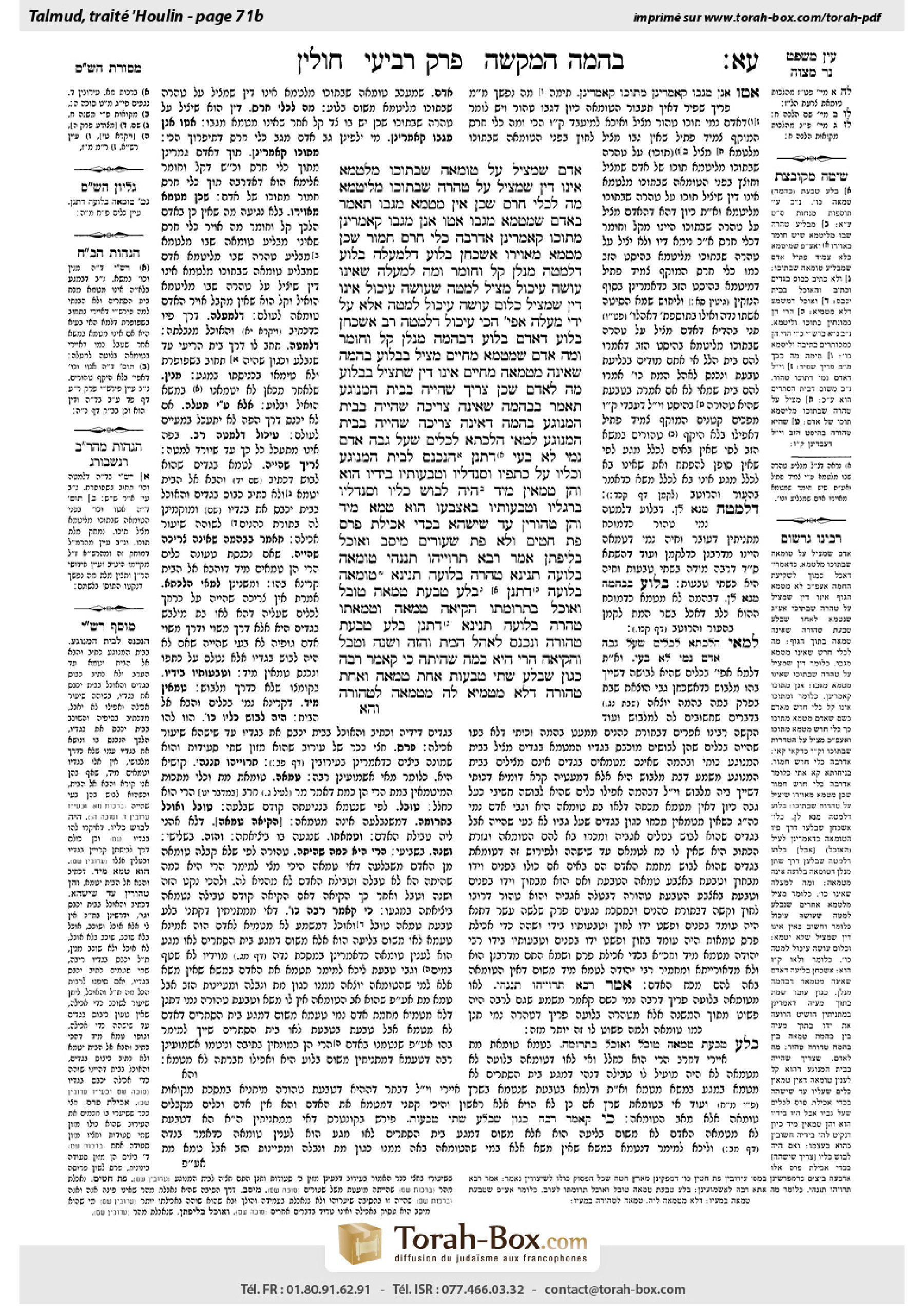
Chullin 71b: Talmud study for Daf Yomi
Study the Talmud for Daf Yomi with scanned pages, Hebrew text, English translations from Sefaria and AI-generated French translations.
Passage selection and English or AI-generated French translation are available where the scan has annotations. Daf Study is independent of Torah-Box and Sefaria.
Browse Chullin · חולין · All tractatesChullin 71b text and translations
This page of Chullin includes the Aramaic text, an English translation and an AI-generated French translation, alongside the scan above.
חולין ע״א ב · Aramaic and Hebrew text
אָדָם שֶׁמַּצִּיל עַל טוּמְאָה שֶׁבְּתוֹכוֹ מִלְּטַמֵּא – אֵינוֹ דִּין שֶׁמַּצִּיל עַל טׇהֳרָה שֶׁבְּתוֹכוֹ מִלִּיטַּמֵּא?
מָה לִכְלִי חֶרֶס, שֶׁכֵּן אֵין מִטַּמֵּא מִגַּבּוֹ, תֹּאמַר בָּאָדָם שֶׁמִּטַּמֵּא מִגַּבּוֹ?
אַטּוּ אֲנַן מִגַּבּוֹ קָאָמְרִינַן? מִתּוֹכוֹ קָאָמְרִינַן!
אַדְּרַבָּה, כְּלִי חֶרֶס חָמוּר, שֶׁכֵּן מְטַמֵּא מֵאֲוִירוֹ.
אַשְׁכְּחַן בָּלוּעַ דִּלְמַעְלָה, בָּלוּעַ דִּלְמַטָּה מְנָלַן? קַל וָחוֹמֶר: וּמָה לְמַעְלָה, שֶׁאֵינוֹ עוֹשֶׂה עִיכּוּל – מַצִּיל, לְמַטָּה שֶׁעוֹשֶׂה עִיכּוּל – אֵינוֹ דִּין שֶׁמַּצִּיל?
כְּלוּם עוֹשֶׂה עִיכּוּל לְמַטָּה אֶלָּא עַל יְדֵי מַעְלָה? אֲפִילּוּ הָכִי, עִיכּוּל דִּלְמַטָּה רַב.
אַשְׁכְּחַן בָּלוּעַ דְּאָדָם, בָּלוּעַ דִּבְהֵמָה מְנָלַן? קַל וָחוֹמֶר: וּמָה אָדָם שֶׁמִּטַּמֵּא מֵחַיִּים מַצִּיל בְּבָלוּעַ, בְּהֵמָה שֶׁאֵינָהּ מְטַמְּאָה מֵחַיִּים – אֵינוֹ דִּין שֶׁתַּצִּיל בְּבָלוּעַ?
מָה לְאָדָם, שֶׁכֵּן צָרִיךְ שְׁהִיָּיה בְּבַיִת הַמְנוּגָּע, תֹּאמַר בִּבְהֵמָה, שֶׁאֵינָהּ צְרִיכָה שְׁהִיָּיה בְּבַיִת הַמְנוּגָּע?
בְּהֵמָה דְּאֵינָהּ צְרִיכָה שְׁהִיָּיה בְּבַיִת הַמְנוּגָּע, לְמַאי הִלְכְתָא? לְכֵלִים שֶׁעַל גַּבָּהּ. אָדָם נָמֵי לָא בָּעֵי!
דִּתְנַן: הַנִּכְנָס לְבַיִת הַמְנוּגָּע וְכֵלָיו עַל כְּתֵפָיו, וְסַנְדָּלָיו וְטַבְּעוֹתָיו בְּיָדָיו – הוּא וְהֵן טְמֵאִין מִיָּד. הָיָה לָבוּשׁ כֵּלָיו וְסַנְדָּלָיו בְּרַגְלָיו וְטַבְּעוֹתָיו בְּאֶצְבָּעוֹ – הוּא טָמֵא מִיָּד, וְהֵן טְהוֹרִין עַד שֶׁיִּשְׁהֶא בִּכְדֵי אֲכִילַת פְּרָס, פַּת חִטִּים וְלֹא פַּת שְׂעוֹרִים, מֵיסֵב וְאוֹכֵל בְּלִיפְתָּן.
אָמַר רָבָא: תַּרְוַיְיהוּ תְּנַנְהִי, טוּמְאָה בְּלוּעָה תְּנֵינָא, טׇהֳרָה בְּלוּעָה תְּנֵינָא!
טוּמְאָה בְּלוּעָה – דִּתְנַן: בָּלַע טַבַּעַת טְמֵאָה, טוֹבֵל וְאוֹכֵל בִּתְרוּמָתוֹ; הֱקִיאָהּ – טְמֵאָה, וְטִמְּאַתּוּ.
טׇהֳרָה בְּלוּעָה תְּנֵינָא, דִּתְנַן: בָּלַע טַבַּעַת טְהוֹרָה, וְנִכְנַס לְאֹהֶל הַמֵּת, וְהִזָּה וְשָׁנָה וְטָבַל וֶהֱקִיאָהּ – הֲרֵי הִיא כְּמָה שֶׁהָיְתָה.
כִּי קָאָמַר רַבָּה, כְּגוֹן שֶׁבָּלַע שְׁתֵּי טַבָּעוֹת, אַחַת טְמֵאָה וְאַחַת טְהוֹרָה, דְּלָא מְטַמְּיָא לַהּ טְמֵאָה לִטְהוֹרָה.
Chullin 71b · English translation
Then with regard to a person, who does shield the impurity of a piece of a corpse contained within him from imparting impurity to other items in the same tent, as the Gemara derived above, is it not logical that he shields a pure item contained within him from being rendered impure?
The Gemara challenges the inference: What is notable about an earthenware vessel? It is notable in that it cannot become impure through a source of impurity coming in contact with its exterior. Can you say, then, that it is comparable to a person, who can become impure through a source of impurity coming in contact with his exterior? Since here the halakhot concerning impurity of a person are more stringent than those concerning an earthenware vessel, one cannot apply to a person a leniency with regard to an earthenware vessel.
The Gemara responds: Is that to say we are speaking of rendering an item impure through a source of impurity coming in contact with its exterior? We are in fact speaking of where the impurity comes in contact with its interior. For such cases, it is reasonable to compare the case of a person with an earthenware vessel.
The Gemara adds: On the contrary, the contraction of impurity by an earthenware vessel is more stringent than that of a person, as it becomes impure through the presence of a source of impurity in its airspace, even if the source does not touch the vessel itself. By contrast, a person is rendered impure from a source of impurity in his airspace, e.g., in his mouth, only if it actually touches him, and the a fortiori inference remains valid.
The Gemara asks: We found a source for the halakha that an impure item encapsulated in a body that entered it from above, i.e., through the mouth, does not impart impurity. From where do we derive that an impure item encapsulated in a body that entered it from below, i.e., through the rectum, also does not impart impurity? The Gemara answers: It is derived through an a fortiori inference: And if, when the impure item enters from above, through the mouth, which is a place that does not digest the food, the body nevertheless shields the impure item from imparting impurity, then with regard to a case where the impure item enters from below, which is a place that does digest food, is it not logical that the body should shield it from imparting impurity?
The Gemara challenges the basis of the inference: Isn’t digestion performed below only by means of the chewing and digestive functions of the body above? The Gemara explains: Even so, the digestion performed below is greater than that performed above.
The Gemara asks: We found a source for the halakha that an impure item encapsulated in the body of a person does not impart impurity; from where do we derive that an impure item encapsulated in the body of an animal does not impart impurity? The Gemara answers: It is derived through an a fortiori inference: If the body of a person, who can impart impurity even while he is still alive, e.g., if he is a leper or a zav, nevertheless shields the impure item encapsulated inside him from imparting impurity, then with regard to an animal, which does not impart impurity while it is alive, is it not logical that it should shield an impure item encapsulated inside it from imparting impurity?
The Gemara challenges the inference: What is notable about the impurity of a person? It is notable in that if he entered a leprous house, in order for his garment to be rendered impure he needs to remain in the leprous house for a minimal period of time (see Leviticus 14:33–53). Can you say, then, that it is comparable to an animal, which does not need to remain in a leprous house for a minimal period of time? Rather, any utensils placed upon it are rendered impure immediately upon its entry. Since here the halakhot concerning impurity of an animal are more stringent than those concerning a person, one cannot necessarily apply to an animal a leniency with regard to a person.
The Gemara responds: When it is stated about an animal that it does not need to remain in a leprous house for a minimal period of time, with regard to what halakha was that said? A living animal itself cannot be impure. Perforce, the statement is referring to utensils that are placed upon its back, and they are rendered impure immediately upon entry. But in this regard there is no difference between animals and people: A person as well does not need to remain in the leprous house for a minimal period of time in order to render impure any utensils placed on his back. Rather, they are rendered impure immediately upon entry.
This is as we learned in a mishna (Nega’im 13:9): With regard to one who enters a leprous house with his clothes resting on his shoulders but who is not wearing them in the normal manner, and his sandals and his rings are in his hands, both he and they, the clothes, sandals, and rings, are rendered ritually impure immediately. If he was dressed in his clothes, and his sandals were on his feet and his rings were on his fingers, he is rendered impure immediately upon entering the house, but they, the clothes, sandals, and rings, remain pure until he remains in the house for the time it takes to eat a half-loaf of bread. This calculation is made with wheat bread and not with barley bread, which takes more time to eat than wheat bread. In addition, the calculation is made with regard to one who is reclining, and eating the bread together with a relish usually consumed with bread, which hastens the eating.
§ Rabba stated above that an encapsulated impure item cannot impart impurity and that an item that is ritually pure that is encapsulated within another body cannot be rendered impure. Rava said: Why is this statement necessary? We learn both halakhot in a mishna: We learn about an encapsulated impure item, and we learn about an encapsulated pure item.
Rava elaborates: With regard to an encapsulated impure item, the halakha is as we learned (Mikvaot 10:8): If someone swallowed a ring that was impure due to having been in contact with a corpse, he is thereby rendered impure. To render himself pure he immerses and then he may partake of his teruma, despite the fact that the impure ring is still inside him. The reason this is permitted is that since the ring is encapsulated inside the person’s body it cannot impart impurity. If he vomited out this ring it remains impure, as it was not purified by his immersion, and therefore it renders him impure upon its exit from his body.
Likewise, we learn the halakha that an encapsulated pure item cannot be rendered impure, as we learn in the same mishna (Mikvaot 10:8): If one swallowed a ritually pure ring and then entered a tent containing a corpse, thereby contracting impurity, and then in order to render him pure someone sprinkled upon him the water that is mixed with the ashes of the red heifer, once on the third day and again on the seventh day as required, and then he immersed, thereby completing the purification process; and then he vomited out the ring, the ring is pure as it always was, i.e., it was not rendered impure from the corpse.
The Gemara answers: The cases in the mishna concern the possibility of imparting impurity from the ring to the body within which it is contained and vice versa. But when Rabba was speaking he was referring to imparting impurity from one item to another where both are contained together inside a body, such as where a person swallowed two rings, one impure and one pure, and they came in direct contact with one another. Rabba taught that even in this case the impure ring does not render the pure ring impure.
Chullin 71b · Traduction française (IA)
En ce qui concerne une personne, qui protège la souillure d’un fragment de corps contenu en lui-même de transmettre la souillure à d’autres objets dans la même tente, comme l’a déduit la Guemara ci-dessus, n’est-il pas logique qu’il protège un objet pur contenu en lui-même de devenir souillé ?
La Guemara conteste cette déduction : Qu’est-ce qui est notable d’un vase en terre ? C’est qu’il ne peut devenir souillé par une source de souillure en contact avec son extérieur. Peut-on alors affirmer qu’il est comparable à une personne, qui peut devenir souillée par une source de souillure en contact avec son extérieur ? Puisque les halakhot concernant la souillure d’une personne sont plus strictes que celles concernant un vase en terre, on ne peut pas appliquer à une personne une allègement applicable à un vase en terre.
La Guemara répond : Est-ce que cela signifie que nous parlons de rendre un objet souillé par une source de souillure en contact avec son extérieur ? Nous parlons en réalité de cas où la souillure entre en contact avec son intérieur. Dans ces cas, il est raisonnable de comparer le cas d’une personne à celui d’un vase en terre.
La Guemara ajoute : Au contraire, la contraction de souillure par un vase en terre est plus stricte que celle d’une personne, car elle devient souillée par la présence d’une source de souillure dans son espace aérien, même si cette source ne touche pas le vase lui-même. En revanche, une personne devient souillée par une source de souillure dans son espace aérien, par exemple dans sa bouche, uniquement si celle-ci le touche effectivement, et l’inférence a fortiori reste valable.
La Guemara pose la question : Nous avons trouvé une source pour la halakha selon laquelle un objet souillé enfermé dans un corps qui entre en lui par le haut, c’est-à-dire par la bouche, ne transmet pas la souillure. D’où dérivons-nous que l’objet souillé enfermé dans un corps qui entre en lui par le bas, c’est-à-dire par l’anus, ne transmet pas non plus la souillure ? La Guemara répond : C’est dérivé par une inférence a fortiori : Et si, lorsque l’objet souillé entre par le haut, par la bouche, qui est un lieu qui ne digère pas les aliments, le corps ne protège pas l’objet souillé de transmettre la souillure, alors, concernant le cas où l’objet souillé entre par le bas, qui est un lieu qui digère les aliments, n’est-il pas logique que le corps protège l’objet souillé de transmettre la souillure ?
La Guemara conteste la base de l’inférence : N’est-ce pas que la digestion est effectuée par le bas uniquement par les fonctions de mastication et de digestion du corps au-dessus ? La Guemara explique : Même ainsi, la digestion effectuée par le bas est plus grande que celle effectuée par le haut.
La Guemara pose la question : Nous avons trouvé une source pour la halakha selon laquelle un objet souillé enfermé dans le corps d’une personne ne transmet pas la souillure ; d’où dérivons-nous que l’objet souillé enfermé dans le corps d’un animal ne transmet pas non plus la souillure ? La Guemara répond : C’est dérivé par une inférence a fortiori : Si le corps d’une personne, qui peut transmettre la souillure même lorsqu’elle est encore vivante, par exemple si elle est une personne lèpreuse ou un zav, ne protège pas l’objet souillé enfermé en lui de transmettre la souillure, alors, concernant un animal, qui ne transmet pas la souillure lorsqu’il est vivant, n’est-il pas logique qu’il protège l’objet souillé enfermé en lui de transmettre la souillure ?
La Guemara conteste l’inférence : Qu’est-ce qui est notable de la souillure d’une personne ? C’est que si elle entre dans une maison lèpreuse, afin que son vêtement devienne souillé, elle a besoin de rester dans la maison lèpreuse pendant une période minimale (voir Lévitique 14:33–53). Peut-on alors affirmer qu’il est comparable à un animal, qui n’a pas besoin de rester dans une maison lèpreuse pendant une période minimale ? Plutôt, tout ustensile placé sur lui devient immédiatement souillé à son entrée. Puisque les halakhot concernant la souillure d’un animal sont plus strictes que celles concernant une personne, on ne peut pas nécessairement appliquer à un animal une allègement applicable à une personne.
La Guemara répond : Lorsqu’il est dit d’un animal qu’il n’a pas besoin de rester dans une maison lèpreuse pendant une période minimale, concernant quelle halakha a-t-on dit cela ? Un animal vivant ne peut pas être souillé. Par conséquent, cette déclaration fait référence aux ustensiles placés sur son dos, qui deviennent immédiatement souillés à leur entrée. Mais en ce qui concerne cela, il n’y a pas de différence entre les animaux et les personnes : une personne non plus n’a pas besoin de rester dans la maison lèpreuse pendant une période minimale afin de rendre souillés les ustensiles placés sur son dos. Plutôt, ils deviennent immédiatement souillés à leur entrée.
C’est ce que nous avons appris dans une mitsva (Nega’im 13:9) : Concernant celui qui entre dans une maison lèpreuse avec ses vêtements sur ses épaules mais qui ne les porte pas normalement, et ses sandales et ses bagues sont dans ses mains, à la fois lui et ses vêtements, sandales et bagues deviennent souillés immédiatement. Si il était vêtu normalement, et ses sandales étaient sur ses pieds et ses bagues sur ses doigts, il devient immédiatement souillé à son entrée dans la maison, mais les vêtements, sandales et bagues restent purs jusqu’à ce qu’il reste dans la maison pendant le temps nécessaire pour manger une demi-livre de pain. Ce calcul est fait avec du pain de blé et non avec du pain de seigle, qui prend plus de temps à manger que le pain de blé. De plus, le calcul est fait concernant celui qui est allongé, et mange le pain avec un accompagnement habituellement consommé avec du pain, ce qui accélère la consommation.
§ Rabba a dit ci-dessus qu’un objet souillé enfermé ne transmet pas la souillure et qu’un objet purement rituellement enfermé dans un autre corps ne peut pas devenir souillé. Rava a dit : Pourquoi cette déclaration est-elle nécessaire ? Nous apprenons ces deux halakhot dans une mitsva : Nous apprenons concernant un objet souillé enfermé et nous apprenons concernant un objet purement rituellement enfermé.
Rava développe : Concernant un objet impur enfermé, la halakha est comme nous l'avons appris (Mikvaot 10:8) : Si quelqu'un a avalé un anneau impur en raison de son contact avec un cadavre, il devient ainsi impur. Pour se rendre pur, il s'immerge et peut alors consommer sa terouma, malgré le fait que l'anneau impur reste à l'intérieur de son corps. La raison pour laquelle cela est permis est que puisque l'anneau est enfermé dans le corps de la personne, il ne peut pas transmettre l'impureté. Si la personne vomit cet anneau, il reste impur, car il n'a pas été purifié par son immersion, et donc il rend la personne impure lors de son éjection du corps.
De même, nous apprenons la halakha selon laquelle un objet pur enfermé ne peut pas devenir impur, comme nous l'apprenons dans la même mitsva (Mikvaot 10:8) : Si quelqu'un a avalé un anneau rituellement pur et est ensuite entré dans une tente contenant un cadavre, devenant ainsi impur, et ensuite, afin de se rendre pur, quelqu'un a aspergé sur lui l'eau mélangé aux cendres de l'âne rouge, une fois le troisième jour et à nouveau le septième jour comme requis, et ensuite il s'est immergé, achevant ainsi le processus de purification ; et ensuite il a éjecté l'anneau, l'anneau est pur car il était toujours pur, c'est-à-dire qu'il n'a pas été rendu impur par le cadavre.
La Guemara répond : Les cas mentionnés dans la mitsva concernent la possibilité de transmettre l'impureté de l'anneau au corps dans lequel il est contenu et vice versa. Mais lorsque Rabba parlait, il faisait référence à la transmission d'impureté d'un objet à un autre, lorsque les deux sont contenus ensemble dans un corps, comme dans le cas où une personne a avalé deux anneaux, l'un impur et l'autre pur, et qu'ils se sont trouvés en contact direct l'un avec l'autre. Rabba a enseigné que même dans ce cas, l'anneau impur ne rend pas l'anneau pur impur.
Traduction française générée par IA à partir de l’édition anglaise de Sefaria. Vérifie toujours un passage avec le texte source.
Text from Sefaria: William Davidson Edition - Vocalized Aramaic (unknown); William Davidson Edition - English (CC BY NC).