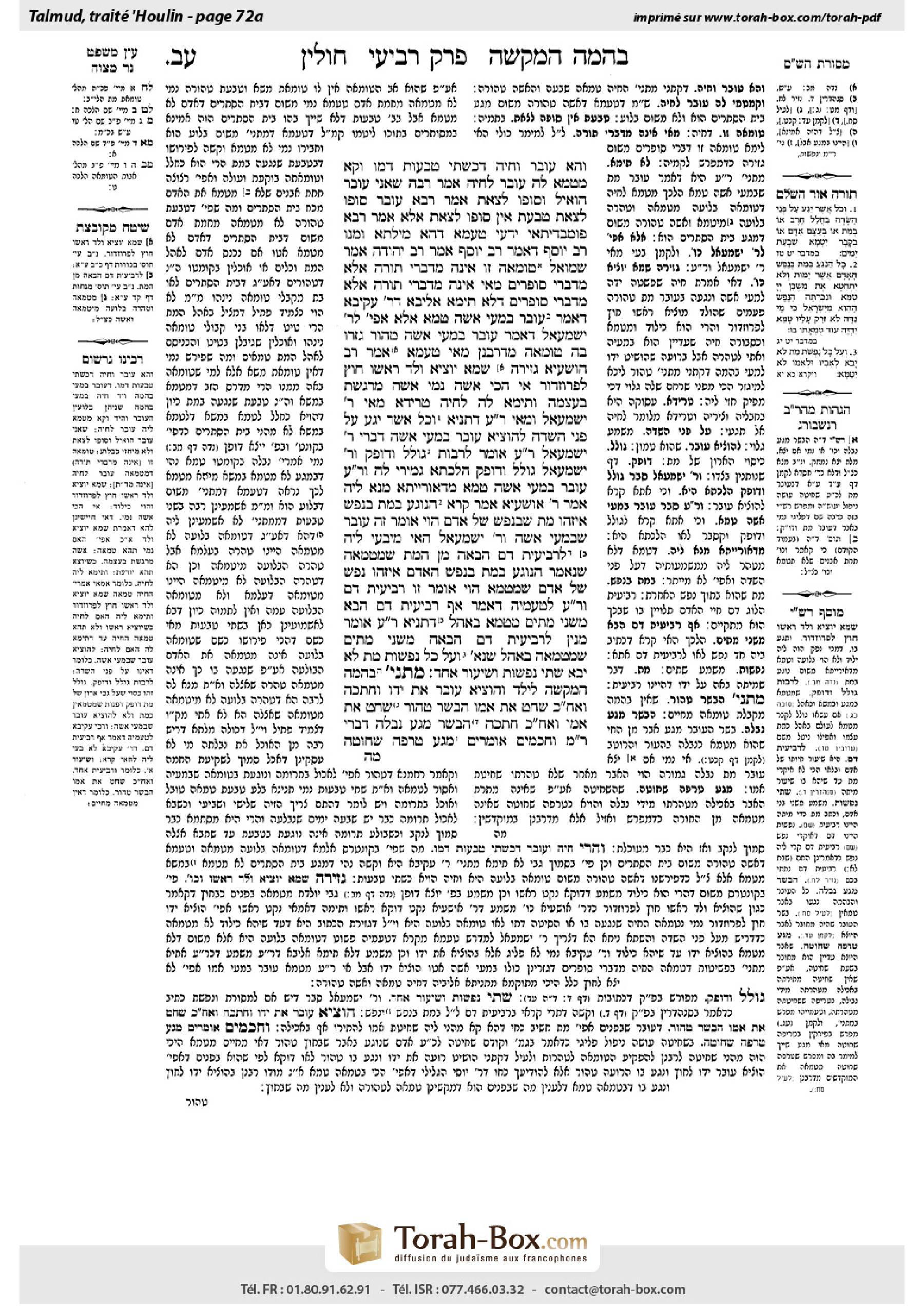
Chullin 72a: Talmud study for Daf Yomi
Study the Talmud for Daf Yomi with scanned pages, Hebrew text, English translations from Sefaria and AI-generated French translations.
Passage selection and English or AI-generated French translation are available where the scan has annotations. Daf Study is independent of Torah-Box and Sefaria.
Browse Chullin · חולין · All tractatesChullin 72a text and translations
This page of Chullin includes the Aramaic text, an English translation and an AI-generated French translation, alongside the scan above.
חולין ע״ב א · Aramaic and Hebrew text
וְהָא עוּבָּר וְחַיָּה, דְּכִשְׁתֵּי טַבָּעוֹת דָּמוּ, וְקָא מְטַמֵּא לַהּ עוּבָּר לְחַיָּה?
אָמַר רַבָּה: שָׁאנֵי עוּבָּר, הוֹאִיל וְסוֹפוֹ לָצֵאת. אָמַר רָבָא: עוּבָּר סוֹפוֹ לָצֵאת, טַבַּעַת אֵין סוֹפָהּ לָצֵאת? אֶלָּא אָמַר רָבָא: פּוּמְבְּדִיתָאֵי יָדְעִי טַעְמָא דְּהָא מִילְּתָא, וּמַנּוּ? רַב יוֹסֵף.
דְּאָמַר רַב יוֹסֵף אָמַר רַב יְהוּדָה אָמַר שְׁמוּאֵל: טוּמְאָה זוֹ אֵינָהּ מִדִּבְרֵי תוֹרָה, אֶלָּא מִדִּבְרֵי סוֹפְרִים. מַאי אֵינָהּ מִדִּבְרֵי תוֹרָה אֶלָּא מִדִּבְרֵי סוֹפְרִים? דְּלָא תֵּימָא אַלִּיבָּא דְּרַבִּי עֲקִיבָא דְּאָמַר: ״עוּבָּר בִּמְעֵי אִשָּׁה טָמֵא״, אֶלָּא אֲפִילּוּ לְרַבִּי יִשְׁמָעֵאל דְּאָמַר: ״עוּבָּר בִּמְעֵי אִשָּׁה טָהוֹר״, גְּזַרוּ בַּהּ טוּמְאָה מִדְּרַבָּנַן.
מַאי טַעְמָא? אָמַר רַב הוֹשַׁעְיָא: גְּזֵירָה שֶׁמָּא יוֹצִיא וָלָד רֹאשׁוֹ חוּץ לַפְּרוֹזְדוֹר.
אִי הָכִי, אִשָּׁה נָמֵי? אִשָּׁה מַרְגֶּשֶׁת בְּעַצְמָהּ. וְתֵימָא לַהּ לְחַיָּה! טְרִידָא.
מַאי רַבִּי יִשְׁמָעֵאל, וּמַאי רַבִּי עֲקִיבָא? דְּתַנְיָא: ״וְכֹל אֲשֶׁר יִגַּע עַל פְּנֵי הַשָּׂדֶה״ – לְהוֹצִיא עוּבָּר בִּמְעֵי אִשָּׁה, דִּבְרֵי רַבִּי יִשְׁמָעֵאל. רַבִּי עֲקִיבָא אוֹמֵר: לְרַבּוֹת גּוֹלֵל וְדוֹפֵק.
וְרַבִּי יִשְׁמָעֵאל, גּוֹלֵל וְדוֹפֵק – הִלְכְתָא גְּמִירִי לַהּ. וְרַבִּי עֲקִיבָא, עוּבָּר בִּמְעֵי אִשָּׁה טָמֵא מִדְּאוֹרָיְיתָא – מְנָא לֵיהּ? אָמַר רַבִּי אוֹשַׁעְיָא, אָמַר קְרָא: ״הַנּוֹגֵעַ בְּמֵת בְּנֶפֶשׁ״, אֵיזֶהוּ מֵת שֶׁבְּנֶפֶשׁ שֶׁל אָדָם? הֱוֵי אוֹמֵר זֶה עוּבָּר שֶׁבִּמְעֵי אִשָּׁה.
וְרַבִּי יִשְׁמָעֵאל, הַאי מִיבְּעֵי לֵיהּ לִרְבִיעִית דָּם הַבָּאָה מִן הַמֵּת, שֶׁמְּטַמְּאָה, שֶׁנֶּאֱמַר: ״הַנֹּגֵעַ בְּמֵת בְּנֶפֶשׁ הָאָדָם״, אֵיזֶהוּ נֶפֶשׁ שֶׁל אָדָם שֶׁמְּטַמֵּא? הֱוֵי אוֹמֵר זוֹ רְבִיעִית דָּם.
וְרַבִּי עֲקִיבָא לְטַעְמֵיהּ, דְּאָמַר: אַף רְבִיעִית דָּם הַבָּאָה מִשְּׁנֵי מֵתִים מְטַמֵּא בְּאֹהֶל, דְּתַנְיָא: רַבִּי עֲקִיבָא אוֹמֵר: מִנַּיִן לִרְבִיעִית דָּם הַבָּאָה מִשְּׁנֵי מֵתִים שֶׁמְּטַמְּאָה בְּאֹהֶל?
שֶׁנֶּאֱמַר: ״וְעַל כׇּל נַפְשֹׁת מֵת לֹא יָבֹא״, שְׁתֵּי נְפָשׁוֹת וְשִׁיעוּר אֶחָד.
מַתְנִי׳ בְּהֵמָה הַמְקַשָּׁה לֵילֵד, וְהוֹצִיא עוּבָּר אֶת יָדוֹ, וַחֲתָכָהּ, וְאַחַר כָּךְ שָׁחַט אֶת אִמּוֹ – הַבָּשָׂר טָהוֹר. שָׁחַט אֶת אִמּוֹ וְאַחַר כָּךְ חֲתָכָהּ – הַבָּשָׂר מַגַּע נְבֵלָה, דִּבְרֵי רַבִּי מֵאִיר.
וַחֲכָמִים אוֹמְרִים: מַגַּע טְרֵפָה שְׁחוּטָה,
Chullin 72a · English translation
The Gemara objects: But what about the mishna’s case of a dead fetus in its mother’s womb, and a midwife who touched it there, which is similar to the case of two swallowed rings, and yet the mishna rules that the fetus renders the midwife impure.
Rabba said: A fetus is different from a ring in this regard, since it will ultimately leave the womb. Rava said in puzzlement: Is that to say that a fetus will ultimately leave the womb, but a ring that someone swallowed will not ultimately leave his body? A ring will certainly be expelled eventually as well. Rather, Rava said: The scholars of Pumbedita know the reason for this matter, and who is the Sage referred to as the scholars of Pumbedita? It is Rav Yosef.
As Rav Yosef says that Rav Yehuda says that Shmuel says: This impurity of the midwife in the mishna’s case is not in effect by Torah law; rather, it was decreed by rabbinic law. The Gemara asks: What was Shmuel’s intention in emphasizing: It is not in effect by Torah law; rather, it was decreed by rabbinic law? It should have sufficed for him to say simply the impurity is decreed by rabbinic law. The Gemara answers: He said this so that you should not say that the ruling of the mishna is only in accordance with the opinion of Rabbi Akiva, who says that one who touches a dead fetus in a woman’s womb is impure by Torah law, and that is why the midwife was rendered impure. Rather, even according to the opinion of Rabbi Yishmael, who says that one who touches a dead fetus in a woman’s womb is pure by Torah law, nevertheless, the Sages decreed that a midwife who touches it is impure by rabbinic law.
The Gemara asks: What is the reason for this decree? Rav Hoshaya said: It is a rabbinic decree lest the fetus extend its head out of the concealed opening of its mother’s womb. If it did, it would be regarded as having been born, and it would then be ritually impure by Torah law. The Sages were concerned that the fetus extended its head and then the head returned inside but the midwife did not notice. Consequently, when she touched the fetus she mistakenly assumed she remained ritually pure. To safeguard against this, the Sages decreed that in any case where she touches the dead fetus, she is ritually impure.
The Gemara objects: If so, the Sages should also decree that the woman herself, who is carrying the fetus, is impure, since she also might not notice that the fetus’s head emerged. The Gemara explains: A woman accurately senses with regard to her own body whether the head of the fetus had emerged. The Gemara asks: But then she would have said this to the midwife. Why is there a need for a decree? The Gemara answers: Since the mother is distracted by the pain of childbirth, she does not have the presence of mind to warn the midwife.
The Gemara cited a dispute as to whether one who touches a dead fetus in a woman’s womb is ritually impure. It now elucidates that dispute: What is the opinion of Rabbi Yishmael, and what is the opinion of Rabbi Akiva? As it is taught in a baraita with regard to the verse: “And whoever in the open field touches one who is slain by the sword, or one who dies on his own, or a bone of a man, or a grave, shall be impure seven days” (Numbers 19:16). The phrase “in the open field” indicates that one is rendered impure only in a case where he touches an exposed corpse. This serves to exclude one who touches a dead fetus in a woman’s womb from being rendered impure; this is the statement of Rabbi Yishmael. Rabbi Akiva says: This phrase serves to include the grave cover and the grave walls, upon which the cover rests, as sources of impurity that render impure anyone who touches them.
The Gemara asks: And from where does Rabbi Yishmael derive that the grave cover and the grave walls render one who touches them impure? He learned this halakha through tradition, not from a verse. The Gemara asks: And as for Rabbi Akiva, from where does he derive that a dead fetus in a woman’s womb is impure by Torah law? Rabbi Oshaya said he derives it from the verse that states: “Whoever touches of a corpse, of the life of a person that died, he will be impure” (Numbers 19:13). The term “of the life” can also be interpreted as: Inside the life. What is the case of a corpse that is inside the life of a person? You must say that this is a dead fetus inside a woman’s womb.
The Gemara comments: And Rabbi Yishmael requires that verse to teach about a quarter-log of blood that comes from a corpse, meaning that even it imparts impurity like a corpse, as it is stated: “Whoever touches of a corpse, of the life of a person that died” (Numbers 19:13). What is the case of a life of a person that imparts impurity? You must say this is referring to a quarter-log of blood, as blood is regarded as the life force of a person, as the verse states: “For the blood is the life” (Deuteronomy 12:23), and a person requires a minimum of a quarter-log of blood to survive.
The Gemara comments: And Rabbi Akiva does not accept this derivation. He conforms to his line of reasoning, as he says even a quarter-log of blood that comes from two corpses imparts ritual impurity in a tent to people and other items that are under the same roof. As it is taught in a baraita: From where is it derived that a quarter-log of blood that came out of two separate corpses also imparts ritual impurity in a tent?
It is derived from a verse, as it is stated with regard to the prohibition against priests coming in contact with a dead body: “He shall not come upon any people that are a corpse [nafshot met]” (Leviticus 21:11). The use of the plural form “people [nafshot]” indicates that the blood imparts impurity even if it comes from two people, as blood is referred to as “nefesh” (see Deuteronomy 12:23), and the use of the singular form “corpse [met]” indicates that this blood combines to complete one measure, i.e., the minimum amount of a quarter-log required to impart impurity.
MISHNA: If an animal was encountering difficulty giving birth and as a result the fetus extended its foreleg outside the mother’s womb, and someone severed it and afterward slaughtered the mother animal, the flesh of the fetus is ritually pure. If one first slaughtered the mother animal and afterward severed the foreleg, the flesh of both the mother animal and the fetus are ritually impure due to having been in contact with a carcass. Since the foreleg was not permitted to be consumed through the act of slaughtering, it is regarded as a carcass with the associated ritual impurity. The rest of the flesh, which was permitted to be consumed by the slaughter, was in contact with it and so was rendered ritually impure from it; this is the statement of Rabbi Meir.
And the Rabbis say: The flesh has the ritual impurity of having been in contact with a tereifa that was slaughtered, as the limb is regarded as a tereifa that was slaughtered. By Torah law, although it is prohibited to consume it, it does not impart ritual impurity. Nevertheless, the Sages decreed that a tereifa that was slaughtered, as well as anything that comes in contact with it, is regarded as ritually impure to the extent that it disqualifies sacrificial foods that come in contact with it.
Chullin 72a · Traduction française (IA)
La Guemara s'oppose : Mais que devient le cas d'un fœtus mort dans le ventre de sa mère et d'une sage-femme qui l'a touché, similaire au cas de deux anneaux avalés, et pourtant la mitsva déclare que le fœtus rend la sage-femme impure.
Rabba dit : Le fœtus est différent de l'anneau dans ce cas, car il sortira finalement du ventre. Rava, en perplexité, demande : Voulait-on dire que le fœtus sortira finalement du ventre, mais que l'anneau avalé ne sortira pas finalement du corps ? L'anneau sera certainement évacué à un moment donné. En réalité, Rava dit : Les sages de Pumbedita connaissent la raison de cette affaire, et qui est le Sage désigné comme les sages de Pumbedita ? C'est Rav Yosef.
Comme Rav Yosef dit que Rav Yehuda dit que Shmuel dit : L'impureté de la sage-femme dans le cas de la mitsva n'est pas en vigueur selon la Loi juive, mais a été décrétée par la Loi rabbinique. La Guemara demande : Quel était l'intention de Shmuel en soulignant : Ce n'est pas en vigueur selon la Loi juive, mais a été décrétée par la Loi rabbinique ? Il aurait suffi qu'il dise simplement que l'impureté est décrétée par la Loi rabbinique. La Guemara répond : Il a dit cela afin que vous ne pensiez pas que la décision de la mitsva est seulement selon l'opinion de Rabbi Akiva, qui dit que celui qui touche un fœtus mort dans le ventre d'une femme est impur selon la Loi juive, et c'est pourquoi la sage-femme est devenue impure. En revanche, même selon l'opinion de Rabbi Yishmael, qui dit que celui qui touche un fœtus mort dans le ventre d'une femme est pur selon la Loi juive, néanmoins, les Sages ont décrété que la sage-femme qui le touche est impure selon la Loi rabbinique.
La Guemara demande : Quelle est la raison de ce décret ? Rav Hoshaya dit : C'est un décret rabbinique afin que le fœtus ne sorte pas la tête de l'ouverture cachée du ventre de sa mère. S'il le faisait, il serait considéré comme né, et il serait alors impur selon la Loi juive. Les Sages craignaient que le fœtus sorte la tête, puis que la tête rentre à l'intérieur mais que la sage-femme ne le remarque pas. Ainsi, lorsqu'elle touchait le fœtus, elle pensait avoir resté pure. Pour se prémunir contre cela, les Sages ont décrété que dans tout cas où elle touche le fœtus mort, elle est impure.
La Guemara s'oppose : Si c'est ainsi, les Sages devraient aussi décréter que la femme elle-même, qui porte le fœtus, est impure, car elle aussi pourrait ne pas remarquer que la tête du fœtus est sortie. La Guemara explique : La femme sent précisément avec son propre corps si la tête du fœtus est sortie. La Guemara demande : Mais alors elle aurait dit cela à la sage-femme. Pourquoi avoir besoin d'un décret ? La Guemara répond : Parce que la mère est distraite par la douleur du travail et n'a pas l'esprit pour avertir la sage-femme.
La Guemara cite un débat sur le fait que celui qui touche un fœtus mort dans le ventre d'une femme est impur. Elle éclaire maintenant ce débat : Quelle est l'opinion de Rabbi Yishmael et quelle est l'opinion de Rabbi Akiva ? Comme il est enseigné dans une baraïta concernant la verset : « Et celui qui touche un mort dans le champ, ou un mort qui meurt de lui-même, ou une osse de l'homme, ou un tombeau, sera impur sept jours » (Nombres 19:16). L'expression « dans le champ » indique que l'on est rendu impur uniquement dans le cas où l'on touche un cadavre exposé. Cela sert à exclure celui qui touche un fœtus mort dans le ventre d'une femme de la rendre impur ; c'est l'opinion de Rabbi Yishmael. Rabbi Akiva dit : Cette expression sert à inclure la couverture du tombeau et les murs du tombeau, sur lesquels la couverture repose, comme sources d'impureté qui rendent impur celui qui les touche.
La Guemara demande : Et d'où Rabbi Yishmael dérive-t-il que la couverture du tombeau et les murs du tombeau rendent impur celui qui les touche ? Il a appris cette halakha par tradition, pas à partir d'un verset. La Guemara demande : Et concernant Rabbi Akiva, d'où dérive-t-il que le fœtus mort dans le ventre d'une femme est impur selon la Loi juive ? Rav Oshaya dit qu'il le dérive du verset qui dit : « Celui qui touche un cadavre, de la vie d'une personne qui est morte, sera impur » (Nombres 19:13). L'expression « de la vie » peut aussi être interprétée comme : à l'intérieur de la vie. Quel est le cas d'un cadavre qui est à l'intérieur de la vie d'une personne ? Vous devez dire que c'est un fœtus mort à l'intérieur du ventre d'une femme.
La Guemara commente : Et Rabbi Yishmael exige ce verset pour enseigner sur un quart de log de sang qui vient d'un cadavre, c'est-à-dire que même cela transmet l'impureté comme un cadavre, comme il est dit : « Celui qui touche un cadavre, de la vie d'une personne qui est morte » (Nombres 19:13). Quel est le cas d'une vie d'une personne qui transmet l'impureté ? Vous devez dire que cela fait référence à un quart de log de sang, car le sang est considéré comme la force vitale d'une personne, comme le verset dit : « Car le sang est la vie » (Deutéronome 12:23), et une personne a besoin d'un minimum de quart de log de sang pour survivre.
La Guemara commente : Et Rabbi Akiva ne reconnaît pas cette dérivation. Il suit sa ligne de raisonnement, car il dit même un quart de log de sang qui vient de deux cadavres transmet l'impureté rituelle dans une tente aux personnes et aux objets qui sont sous le même toit. Comme il est enseigné dans une baraïta : D'où dérive-t-il que un quart de log de sang qui est sorti de deux cadavres séparés transmet l'impureté rituelle dans une tente ?
Il est dérivé d'un verset, comme il est dit concernant l'interdiction aux prêtres de se rapprocher d'un cadavre : « Il ne doit pas se rapprocher de toute personne qui est un cadavre [nafshot met] » (Lévitique 21:11). L'emploi du pluriel « personnes [nafshot] » indique que le sang transmet l'impureté même s'il vient de deux personnes, car le sang est appelé « nefesh » (voir Deutéronome 12:23), et l'emploi du singulier « cadavre [met] » indique que ce sang se combine pour former une mesure, c'est-à-dire la quantité minimale de quart de log nécessaire pour transmettre l'impureté.
MICHNA : Si un animal éprouvait des difficultés à accoucher et que, en conséquence, le fœtus avait sorti son avant-bras en dehors du ventre de la mère, et que quelqu'un l'avait coupé, puis sacrifié la mère, la chair du fœtus est pure rituellement. Si l'on sacrifia d'abord la mère et ensuite on coupa l'avant-bras, la chair de la mère et du fœtus est impure rituellement en raison de leur contact avec un cadavre. Puisque l'avant-bras n'était pas permis à la consommation par le sacrifice, il est considéré comme un cadavre avec l'impureté rituelle associée. La reste de la chair, qui était permise à la consommation par le sacrifice, a été en contact avec lui et donc est devenue impure rituellement à cause de lui ; c'est la déclaration du Rabbi Meir.
Et les Sages disent : la chair a l'impureté rituelle de contact avec un téréifah qui a été sacrifié, car le membre est considéré comme un téréifah qui a été sacrifié. Selon la loi divine, bien qu'il soit interdit de le consommer, il ne transmet pas l'impureté rituelle. Cependant, les Sages ont ordonné que le téréifah sacrifié, ainsi que tout ce qui entre en contact avec lui, soit considéré comme impur rituellement à l'égard de ce qui rend les aliments sacrés impurs par contact.
Traduction française générée par IA à partir de l’édition anglaise de Sefaria. Vérifie toujours un passage avec le texte source.
Text from Sefaria: William Davidson Edition - Vocalized Aramaic (unknown); William Davidson Edition - English (CC BY NC).