Chullin 72b: Talmud study for Daf Yomi
Study the Talmud for Daf Yomi with scanned pages, Hebrew text, English translations from Sefaria and AI-generated French translations.
Passage selection and English or AI-generated French translation are available where the scan has annotations. Daf Study is independent of Torah-Box and Sefaria.
Browse Chullin · חולין · All tractatesChullin 72b text and translations
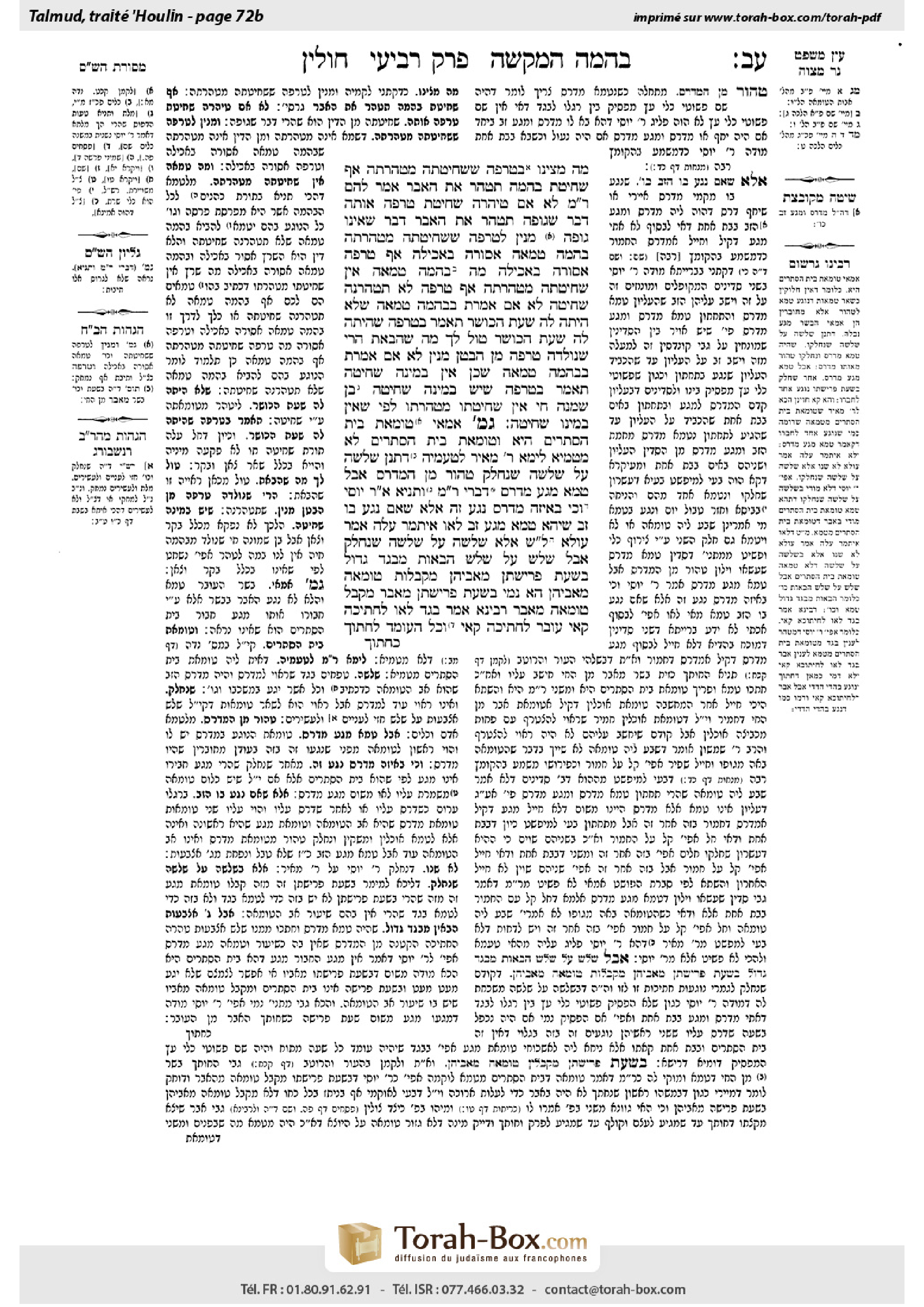
This page of Chullin includes the Aramaic text, an English translation and an AI-generated French translation, alongside the scan above.
חולין ע״ב ב · Aramaic and Hebrew text
מָה מָצִינוּ בִּטְרֵפָה שֶׁשְּׁחִיטָתָהּ מְטַהַרְתָּהּ, אַף שְׁחִיטַת בְּהֵמָה תְּטַהֵר אֶת הָאֵבֶר.
אָמַר לָהֶם רַבִּי מֵאִיר: לֹא, אִם טִיהֲרָה שְׁחִיטַת טְרֵפָה אוֹתָהּ, דָּבָר שֶׁגּוּפָהּ, תְּטַהֵר אֶת הָאֵבֶר דָּבָר שֶׁאֵינוֹ גּוּפָהּ?
מִנַּיִן לִטְרֵפָה שֶׁשְּׁחִיטָתָהּ מְטַהַרְתָּהּ? בְּהֵמָה טְמֵאָה אֲסוּרָה בַּאֲכִילָה, אַף טְרֵפָה אֲסוּרָה בַּאֲכִילָה, מָה בְּהֵמָה טְמֵאָה – אֵין שְׁחִיטָתָהּ מְטַהַרְתָּהּ, אַף טְרֵפָה – לֹא תְּטַהֲרֶנָּה שְׁחִיטָה!
לֹא, אִם אָמַרְתָּ בִּבְהֵמָה טְמֵאָה שֶׁלֹּא הָיְתָה לָהּ שְׁעַת הַכּוֹשֶׁר, תֹּאמַר בִּטְרֵפָה שֶׁהָיְתָה לָהּ שְׁעַת הַכּוֹשֶׁר?
טוֹל לְךָ מַה שֶּׁהֵבֵאתָ, הֲרֵי שֶׁנּוֹלְדָה טְרֵפָה מִן הַבֶּטֶן, מִנַּיִן?
לֹא, אִם אָמַרְתָּ בִּבְהֵמָה טְמֵאָה שֶׁכֵּן אֵין בְּמִינָהּ שְׁחִיטָה, תֹּאמַר בִּטְרֵפָה שֶׁיֵּשׁ בְּמִינָהּ שְׁחִיטָה?
בֶּן שְׁמֹנֶה חַי, אֵין שְׁחִיטָתוֹ מְטַהַרְתּוֹ, לְפִי שֶׁאֵין בְּמִינוֹ שְׁחִיטָה.
גְּמָ׳ אַמַּאי? טוּמְאַת בֵּית הַסְּתָרִים הִיא, וְטוּמְאַת בֵּית הַסְּתָרִים לָא מְטַמְּיָא! לֵימָא רַבִּי מֵאִיר לְטַעְמֵיהּ?
דִּתְנַן: שְׁלֹשָׁה עַל שְׁלֹשָׁה שֶׁנֶּחְלַק – טָהוֹר מִן הַמִּדְרָס,
אֲבָל טָמֵא מַגַּע מִדְרָס, דִּבְרֵי רַבִּי מֵאִיר.
וְתַנְיָא, אָמַר רַבִּי יוֹסֵי: וְכִי בְּאֵיזֶה מִדְרָס נָגַע זֶה? אֶלָּא שֶׁאִם נָגַע בּוֹ זָב, שֶׁיְּהֵא טָמֵא מַגַּע זָב.
לָאו אִיתְּמַר עֲלַהּ, אָמַר עוּלָּא: לֹא שָׁנוּ אֶלָּא שְׁלֹשָׁה עַל שְׁלֹשָׁה שֶׁנֶּחְלַק.
אֲבָל שָׁלֹשׁ עַל שָׁלֹשׁ הַבָּאוֹת מִבֶּגֶד גָּדוֹל – בִּשְׁעַת פְּרִישָׁתָן מֵאֲבִיהֶן, מְקַבְּלוֹת טוּמְאָה מֵאֲבִיהֶן. הָא נָמֵי בִּשְׁעַת פְּרִישָׁתָן מֵאֵבֶר, מְקַבֵּל טוּמְאָה מֵאֵבֶר.
רָבִינָא אָמַר: בֶּגֶד – לָאו לַחֲתִיכָה קָאֵי, עוּבָּר – לַחֲתִיכָה קָאֵי, וְכׇל הָעוֹמֵד לַחְתּוֹךְ
Chullin 72b · English translation
The Rabbis explain the rationale behind their opinion: Just as we found in the case of a tereifa that its slaughter renders it ritually pure according to Torah law, i.e., ritual slaughter prevents it from having the ritual impurity of a carcass despite not rendering the animal permitted for consumption, so too, the slaughter of the mother animal should render the limb of its fetus that left the womb ritually pure, despite the fact that its consumption is prohibited.
Rabbi Meir said to them: No, if the slaughter of a tereifa renders the body of the animal ritually pure, it is because the slaughter is performed on something that is part of its body, i.e., its throat. Does it necessarily follow that you should also render the limb that left the womb pure, given that it is something that is not part of the mother’s body? Certainly not.
The mishna asks: From where is it derived with regard to a tereifa that its slaughter renders it ritually pure, i.e., prevents it from having the ritual impurity of a carcass? The mishna notes there is a reason to say the slaughter should not render it pure, as one can compare a tereifa with a non-kosher animal: A non-kosher animal is prohibited for consumption; so too, a tereifa is prohibited for consumption. Therefore, conclude: Just as with regard to a non-kosher animal, its slaughter does not render it ritually pure, so too with regard to a tereifa, its slaughter should not render it ritually pure.
The mishna questions the comparison: No, if you said that slaughtering cannot prevent an animal from having the ritual impurity of a carcass in the case of a non-kosher animal, which is distinct in that it did not have a period of potential fitness when slaughtering it could have rendered its consumption permitted, does it necessarily follow that you should also say this in the case of a tereifa, which did have a period of potential fitness? Perhaps, since the animal had a period of potential fitness its slaughter remains effective in preventing it from having the ritual impurity of a carcass.
The mishna rejects this distinction: Take back to yourself this claim that you brought, as it is insufficient. What about a case where an animal was born as a tereifa from the womb, and so it never had a period of potential fitness? For such a case, from where is it derived that its slaughter renders it ritually pure?
The mishna reformulates the distinction: No, if you say that slaughtering cannot prevent a prohibited animal from having the ritual impurity of a carcass with regard to a non-kosher animal, which is distinct in that there are no animals of its kind that are permitted through slaughtering, as the Torah states the concept of slaughtering only with regard to kosher animals, does it necessarily follow that you should also say this with regard to a tereifa kosher animal, given that there are other animals of its kind that are permitted through slaughtering, i.e., kosher animals that are not tereifa? Perhaps, since the concept of slaughtering is relevant to that kind of animal it can serve to prevent the animal from having the ritual impurity of a carcass even if the slaughter cannot render it permitted for consumption.
The mishna notes: Based on this reasoning, one must conclude that with regard to an eight-month-old fetus that was born alive, slaughter does not render it ritually pure, as there are no animals of its kind that are permitted through slaughtering. The Torah applies the concept of slaughter only with regard to animals that were born full term.
GEMARA: The mishna states that according to Rabbi Meir, if a foreleg of a fetus emerges from the womb and is severed after the slaughter of the mother, it is regarded as a carcass with the associated ritual impurity. Furthermore, the rest of the fetus from which it was cut is thereby rendered ritually impure through its contact with the foreleg. The Gemara asks: Why should the rest of the fetus be impure? This is a case of impurity imparted within a concealed area, as the point of contact between the foreleg and the fetus existed when they were still naturally connected to each other. And the halakha is that an impure item within a concealed area does not impart impurity. If the two items were in contact in a concealed area and not on an external surface, impurity cannot be imparted from one item to the other. Shall we say that Rabbi Meir conforms to his standard line of reasoning in this regard, as he holds that an impure item within a concealed area does impart impurity?
This is as we learned in a mishna (Kelim 27:10) concerning ritual impurity imparted by treading: If a person who is ritually impure due to having experienced a bodily emission, such as a man who experiences a gonorrhea-like discharge [zav], sits or leans upon an item that was designated for that purpose, the item is rendered ritually impure due to ritual impurity imparted by treading. The item will then impart impurity to people or utensils that come in contact with it. In the case of a garment that is impure with ritual impurity imparted by treading that was three by three handbreadths in size, i.e., the minimum size to impart such impurity, that was split into smaller pieces, each part is ritually pure with regard to ritual impurity imparted by treading and will no longer impart impurity to people and utensils that come in contact with it.
The mishna continues: But each piece will still have the ritual impurity of having been in contact with an item that imparts ritual impurity imparted by treading. Before the garment was split, when it still imparted ritual impurity imparted by treading, each piece of the garment was in contact with another part of it. Through that connection, each piece was rendered ritually impure with the impurity of having been in contact with ritual impurity imparted by treading. When the garment was subsequently split, although the pieces were no longer able to impart ritual impurity imparted by treading, they retained the ritual impurity they acquired through their contact with the other pieces before the garment was split. This is the statement of Rabbi Meir. In this case, the contact between the pieces occurred within a concealed area, as the connection between parts of the same item has the status of a connection within a concealed area. Evidently, Rabbi Meir holds that impurity can be imparted within a concealed area.
And it is taught in that mishna that Rabbi Yosei says, disagreeing with Rabbi Meir: But what source of impurity imparted by treading did these pieces touch? Rabbi Yosei disregards the contact between the pieces that occurred before the garment was split, as that contact has the status of a connection within a concealed area. Rather, the only way the pieces could still be ritually impure is if a zav had touched the garment directly, e.g., when he sat on the garment he also touched it with his skin. In that case the garment would have also been rendered ritually impure due to contact with a zav, and that impurity would remain even after the garment was split. It would appear, then, that the opinion of Rabbi Meir in the mishna here can be reconciled only with the opinion of Rabbi Meir in the mishna in Kelim, but not with the opinion of Rabbi Yosei.
The Gemara responds: Wasn’t it stated with regard to that mishna in Kelim that Ulla said: They taught that Rabbi Yosei disagrees with Rabbi Meir only in the case of a garment of three by three handbreadths that was split into smaller pieces, as once it is split, there is no piece large enough to impart to the other pieces impurity imparted through treading.
But with regard to pieces of three by three fingerbreadths that come, i.e., are cut, from a large garment, everyone agrees that at the time of their separation from their original garment, before they are fully detached from it, they are rendered impure through their contact with the original garment, despite the fact that the contact occurs within a concealed area. In this case of the mishna here also, one can say that at the time of separation of the flesh of the fetus from the limb, i.e., the foreleg, it is rendered impure through its contact with the limb. According to Ulla, then, the mishna can be reconciled also with the opinion of Rabbi Yosei.
Ravina said there is a different explanation of how the mishna can be reconciled with the opinion of Rabbi Yosei: A garment does not stand, i.e., is not intended, to be cut. On the contrary, it is better for it to remain whole. Therefore, the connections between its pieces are regarded as being within a concealed area that cannot impart impurity. By contrast, with regard to a fetus that extends its foreleg, the foreleg does stand to be cut, as it is prohibited for consumption while the rest of the fetus is permitted, and the halakhic principle is that any item that stands to be cut
Chullin 72b · Traduction française (IA)
Les Rabbins expliquent la raison de leur opinion : Tout comme nous avons trouvé dans le cas d'un téréifah que son sacrifice rend l'animal rituellement pur selon la loi divine, c'est-à-dire que le sacrifice rituel empêche l'animal de présenter l'impureté rituelle d'un cadavre malgré le fait qu'il ne rend l'animal comestible, de même, le sacrifice de l'animal mère devrait rendre le membre du fœtus qui est sorti du ventre rituellement pur, malgré le fait que sa consommation est interdite.
Rabbi Meïr dit à ceux-ci : Non, si le sacrifice d'un téréifah rend le corps de l'animal rituellement pur, c'est parce que le sacrifice est effectué sur quelque chose qui fait partie du corps, c'est-à-dire sa gorge. Est-ce que cela implique nécessairement que vous devriez aussi rendre le membre qui est sorti du ventre pur, étant donné qu'il est quelque chose qui n'appartient pas au corps de la mère ? Certainement pas.
La mitsva pose la question : D'où est-il tiré concernant un téréifah que son sacrifice le rend rituellement pur, c'est-à-dire qu'il l'empêche de présenter l'impureté rituelle d'un cadavre ? La mitsva note qu'il y a une raison de dire que le sacrifice ne devrait pas le rendre pur, car on peut comparer un téréifah à un animal non-kosher : un animal non-kosher est interdit à la consommation ; de même, un téréifah est interdit à la consommation. Ainsi, concluez : Tout comme concernant un animal non-kosher, son sacrifice ne le rend pas rituellement pur, de même concernant un téréifah, son sacrifice ne devrait pas le rendre rituellement pur.
La mitsva questionne cette comparaison : Non, si vous dites que le sacrifice ne peut pas empêcher un animal de présenter l'impureté rituelle d'un cadavre dans le cas d'un animal non-kosher, qui est distinct dans le sens où il n'avait pas de période de potentiel de pureté lors du sacrifice où il aurait pu rendre sa consommation permise, est-ce que cela implique nécessairement que vous devriez aussi dire cela dans le cas d'un téréifah, qui avait une période de potentiel de pureté ? Peut-être, puisque l'animal avait une période de potentiel de pureté, son sacrifice reste efficace pour l'empêcher de présenter l'impureté rituelle d'un cadavre.
La mitsva rejette cette distinction : Revenez à vous-même cette affirmation que vous avez apportée, car elle est insuffisante. Qu'en est-il d'un cas où un animal est né téréifah du ventre, et donc n'avait pas de période de potentiel de pureté ? Pour ce cas, d'où est-il tiré que son sacrifice le rend rituellement pur ?
La mitsva reformule cette distinction : Non, si vous dites que le sacrifice ne peut pas empêcher un animal interdit de présenter l'impureté rituelle d'un cadavre concernant un animal non-kosher, qui est distinct dans le sens où il n'y a pas d'animaux de cette espèce qui soient permis par le sacrifice, car la Torah établit la notion de sacrifice uniquement concernant les animaux kasher, est-ce que cela implique nécessairement que vous devriez aussi dire cela concernant un téréifah, étant donné qu'il existe d'autres animaux de cette espèce qui sont permis par le sacrifice, c'est-à-dire des animaux kasher qui ne sont pas téréifah ? Peut-être, puisque la notion de sacrifice est pertinente pour cette espèce d'animal, elle peut servir à empêcher l'animal de présenter l'impureté rituelle d'un cadavre même si le sacrifice ne rend pas la consommation permise.
La mitsva note : Selon cette raisonnement, on doit conclure que concernant un fœtus de huit mois qui est né vivant, la mise à mort ne le rend pas rituellement pur, car il n'y a pas d'animaux de cette espèce qui soient permis par la mise à mort. La Torah applique la notion de mise à mort uniquement concernant les animaux nés à terme.
GUEMARA : La mitsva affirme que selon Rabbi Meïr, si un avant-bras d'un fœtus sort du ventre et est coupé après la mise à mort de la mère, il est considéré comme un cadavre avec l'impureté rituelle associée. De plus, la partie restante du fœtus à partir de laquelle il a été coupé devient ainsi impure par contact avec l'avant-bras. La Guemara pose la question : Pourquoi la partie restante du fœtus devrait-elle être impure ? C'est un cas d'impureté transmise dans une zone cachée, car le point de contact entre l'avant-bras et le fœtus existait lorsqu'ils étaient encore naturellement connectés. Et la halakha est que l'objet impur dans une zone cachée ne transmet pas l'impureté. Si les deux objets étaient en contact dans une zone cachée et non sur une surface externe, l'impureté ne peut pas être transmise d'un objet à l'autre. Devons-nous dire que Rabbi Meïr suit sa ligne de raisonnement habituelle à cet égard, car il considère que l'objet impur dans une zone cachée transmet l'impureté ?
C'est ce que nous avons appris dans une mitsna (Kelim 27:10) concernant l'impureté transmise par la marche : Si une personne impure rituellement, par exemple un homme qui a une émission corporelle telle qu'une décharge de gonorée [zav], s'assoit ou s'appuie sur un objet destiné à cette fin, l'objet devient impur par l'impureté transmise par la marche. Cet objet transmettra alors l'impureté aux personnes ou aux ustensiles qui le touchent. Dans le cas d'un vêtement impur par l'impureté transmise par la marche, qui mesurait trois par trois palmes, c'est-à-dire la taille minimale pour transmettre cette impureté, qui a été divisé en morceaux plus petits, chaque partie est pure concernant l'impureté transmise par la marche et ne transmettra plus l'impureté aux personnes et aux ustensiles qui le touchent.
La Michna continue : Mais chaque morceau restera encore souillé par le contact avec un objet qui transmet la souillure, transmise par la marche. Avant que la robe ne soit coupée, quand elle transmettait encore la souillure par la marche, chaque morceau de la robe était en contact avec une autre partie d'elle-même. Par ce contact, chaque morceau était rendu souillé par la souillure transmise par la marche. Lorsque la robe fut ultérieurement coupée, bien que les morceaux ne pussent plus transmettre la souillure par la marche, ils conservèrent la souillure qu'ils avaient acquise par leur contact avec les autres morceaux avant que la robe ne soit coupée. C'est la déclaration du Rabbi Meïr. Dans ce cas, le contact entre les morceaux s'est produit dans un endroit caché, car la connexion entre les parties d'un même objet a le statut d'une connexion dans un endroit caché. Il semble que le Rabbi Meïr considère que la souillure peut être transmise dans un endroit caché.
Et il est enseigné dans cette Michna que le Rabbi Yosei dit, en désaccord avec le Rabbi Meïr : Mais quelle source de souillure par la marche ces morceaux ont-ils touché ? Le Rabbi Yosei ignore le contact entre les morceaux qui s'est produit avant que la robe ne soit coupée, car ce contact a le statut d'une connexion dans un endroit caché. Plutôt, la seule façon dont les morceaux pouvaient encore être souillés est si un zav avait touché la robe directement, par exemple, lorsqu'il s'était assis sur la robe, il avait également touché la robe avec sa peau. Dans ce cas, la robe aurait également été rendue souillée par contact avec un zav, et cette souillure aurait persisté même après que la robe fût coupée. Il semble donc que l'opinion du Rabbi Meïr dans cette Michna puisse être conciliée uniquement avec l'opinion du Rabbi Meïr dans la Michna de Kelim, mais pas avec l'opinion du Rabbi Yosei.
La Guemara répond : N'était-il pas dit concernant cette Michna de Kelim que Ulla a dit : Ils ont enseigné que le Rabbi Yosei s'oppose au Rabbi Meïr uniquement dans le cas d'une robe de trois par trois tefachim qui a été coupée en morceaux plus petits, car une fois qu'elle est coupée, il n'y a plus de morceau suffisamment grand pour transmettre la souillure par la marche aux autres morceaux.
Mais concernant des morceaux de trois par trois tefachim qui viennent, c'est-à-dire sont coupés, d'une grande robe, tout le monde convient que lors de leur séparation de leur robe originale, avant qu'ils ne soient entièrement détachés d'elle, ils sont rendus souillés par leur contact avec la robe originale, malgré le fait que ce contact s'est produit dans un endroit caché. Dans ce cas de la Michna ici aussi, on peut dire que lors de la séparation de la chair du fœtus du membre, c'est-à-dire du avant-bras, il est rendu souillé par son contact avec le membre. Selon Ulla, alors, la Michna peut être conciliée aussi avec l'opinion du Rabbi Yosei.
Ravina a dit qu'il existe une autre explication de la façon dont la Michna peut être conciliée avec l'opinion du Rabbi Yosei : Une robe ne se tient pas, c'est-à-dire n'est pas conçue, à être coupée. Au contraire, il est préférable qu'elle reste entière. Par conséquent, les connexions entre ses morceaux sont considérées comme se trouvant dans un endroit caché qui ne peut pas transmettre la souillure. À l'inverse, concernant un fœtus qui étend son avant-bras, l'avant-bras se tient à être coupé, car il est interdit à la consommation tandis que le reste du fœtus est permis, et le principe halakhique est que tout objet qui se tient à être coupé
Traduction française générée par IA à partir de l’édition anglaise de Sefaria. Vérifie toujours un passage avec le texte source.
Text from Sefaria: William Davidson Edition - Vocalized Aramaic (unknown); William Davidson Edition - English (CC BY NC).