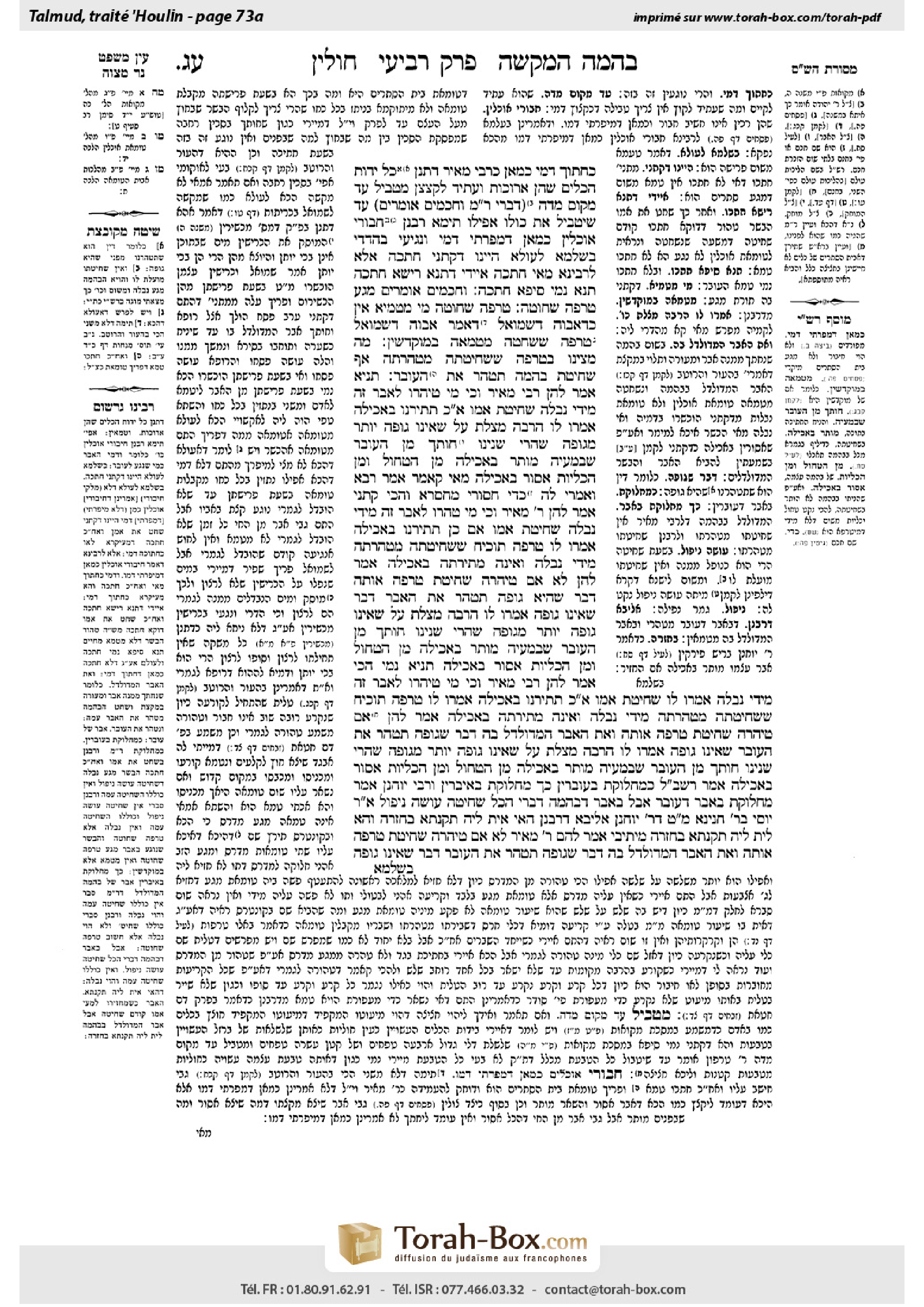
Chullin 73a: Talmud study for Daf Yomi
Study the Talmud for Daf Yomi with scanned pages, Hebrew text, English translations from Sefaria and AI-generated French translations.
Passage selection and English or AI-generated French translation are available where the scan has annotations. Daf Study is independent of Torah-Box and Sefaria.
Browse Chullin · חולין · All tractatesChullin 73a text and translations
This page of Chullin includes the Aramaic text, an English translation and an AI-generated French translation, alongside the scan above.
חולין ע״ג א · Aramaic and Hebrew text
כְּחָתוּךְ דָּמֵי.
כְּמַאן? כְּרַבִּי מֵאִיר, דִּתְנַן: כָּל יְדוֹת הַכֵּלִים שֶׁהֵן אֲרוּכּוֹת וְעָתִיד לְקׇצְצָן – מַטְבִּיל עַד מָקוֹם מִדָּה, דִּבְרֵי רַבִּי מֵאִיר.
וַחֲכָמִים אוֹמְרִים: עַד שֶׁיַּטְבִּיל אֶת כּוּלּוֹ.
אֲפִילּוּ תֵּימָא רַבָּנַן, חִבּוּרֵי אֳכָלִין כְּמַאן דְּמִפַּרְתִי דָּמֵי, וּנְגִיעִי בַּהֲדָדֵי.
בִּשְׁלָמָא לְעוּלָּא, הַיְינוּ דְּקָתָנֵי ״חֲתָכָהּ״, אֶלָּא לְרָבִינָא, מַאי ״חֲתָכָהּ״? אַיְּידֵי דִּתְנָא רֵישָׁא ״חֲתָכָהּ״, תְּנָא נָמֵי סֵיפָא ״חֲתָכָהּ״.
וַחֲכָמִים אוֹמְרִים: מַגַּע טְרֵפָה שְׁחוּטָה. טְרֵפָה שְׁחוּטָה מִי מְטַמְּיָא? אִין, כְּדַאֲבוּהּ דִּשְׁמוּאֵל, דְּאָמַר אֲבוּהּ דִּשְׁמוּאֵל: טְרֵפָה שֶׁשְּׁחָטָהּ מְטַמְּאָה בְּמוּקְדָּשִׁין.
מָה מָצִינוּ בִּטְרֵפָה שֶׁשְּׁחִיטָתָהּ מְטַהַרְתָּהּ, אַף שְׁחִיטַת בְּהֵמָה תְּטַהֵר אֶת הָעוּבָּר.
תַּנְיָא, אָמַר לָהֶן רַבִּי מֵאִיר: וְכִי מִי טִיהֲרוֹ לְאֵבֶר זֶה מִידֵי נְבֵלָה? שְׁחִיטַת אִמּוֹ! אִם כֵּן, תַּתִּירֶנּוּ בַּאֲכִילָה!
אָמְרוּ לוֹ: הַרְבֵּה מַצֶּלֶת עַל שֶׁאֵינוֹ גּוּפָהּ יוֹתֵר מִגּוּפָהּ, שֶׁהֲרֵי שָׁנִינוּ: חוֹתֵךְ מִן הָעוּבָּר שֶׁבְּמֵעֶיהָ – מוּתָּר בַּאֲכִילָה, מִן הַטְּחוֹל וּמִן הַכְּלָיוֹת – אָסוּר בַּאֲכִילָה.
מַאי קָאָמַר? אָמַר רָבָא, וְאָמְרִי לַהּ כְּדִי: חַסּוֹרֵי מְחַסְּרָא וְהָכִי קָתָנֵי, אָמַר לָהֶן רַבִּי מֵאִיר: וְכִי מִי טִהֲרוֹ לְאֵבֶר זֶה מִידֵּי נְבֵלָה? שְׁחִיטַת אִמּוֹ, אִם כֵּן תַּתִּירֶנּוּ בַּאֲכִילָה! אָמְרוּ לוֹ: טְרֵפָה תּוֹכִיחַ, שֶׁשְּׁחִיטָתָהּ מְטַהַרְתָּהּ מִידֵי נְבֵלָה וְאֵינָהּ מַתִּירָתָהּ בַּאֲכִילָה.
אָמַר לָהֶן: לֹא, אִם טִיהֲרָה שְׁחִיטַת טְרֵפָה אוֹתָהּ, דָּבָר שֶׁהִיא גּוּפָהּ, תְּטַהֵר אֶת הָאֵבֶר דָּבָר שֶׁאֵינוֹ גּוּפָהּ? אָמְרוּ לוֹ: הַרְבֵּה מַצֶּלֶת עַל שֶׁאֵינוֹ גּוּפָהּ יוֹתֵר מִגּוּפָהּ, שֶׁהֲרֵי שָׁנִינוּ: חוֹתֵךְ מִן הָעוּבָּר שֶׁבְּמֵעֶיהָ – מוּתָּר בַּאֲכִילָה, מִן הַטְּחוֹל וּמִן הַכְּלָיוֹת – אָסוּר בַּאֲכִילָה.
תַּנְיָא נָמֵי הָכִי: אָמַר לָהֶן רַבִּי מֵאִיר: וְכִי מִי טִיהֲרוֹ לְאֵבֶר זֶה מִידֵּי נְבֵלָה? אָמְרוּ לוֹ: שְׁחִיטַת אִמּוֹ. אִם כֵּן, תַּתִּירֶנּוּ בַּאֲכִילָה! אָמְרוּ לוֹ: טְרֵפָה תּוֹכִיחַ, שֶׁשְּׁחִיטָתָהּ מְטַהַרְתָּהּ מִידֵי נְבֵלָה וְאֵינָהּ מַתִּירָתָהּ בַּאֲכִילָה.
אָמַר לָהֶן: אִם טִיהֲרָה שְׁחִיטַת טְרֵפָה אוֹתָהּ וְאֶת הָאֵבֶר הַמְדוּלְדָּל בָּהּ, דָּבָר שֶׁגּוּפָהּ, תְּטַהֵר אֶת הָעוּבָּר שֶׁאֵינוֹ גּוּפָהּ?
אָמְרוּ לוֹ: הַרְבֵּה מַצֶּלֶת עַל שֶׁאֵינוֹ גּוּפָהּ יוֹתֵר מִגּוּפָהּ, שֶׁהֲרֵי שָׁנִינוּ: חוֹתֵךְ מִן הָעוּבָּר שֶׁבְּמֵעֶיהָ – מוּתָּר בַּאֲכִילָה, מִן הַטְּחוֹל וּמִן הַכְּלָיוֹת – אָסוּר בַּאֲכִילָה.
אָמַר רַבִּי שִׁמְעוֹן בֶּן לָקִישׁ: כְּמַחְלוֹקֶת בְּעוּבָּרִין, כָּךְ מַחְלוֹקֶת בְּאֵיבָרִין.
וְרַבִּי יוֹחָנָן אָמַר: מַחְלוֹקֶת בְּאֵבֶר דְּעוּבָּר, אֲבָל בְּאֵבֶר דִּבְהֵמָה – דִּבְרֵי הַכֹּל שְׁחִיטָה עוֹשָׂה נִיפּוּל.
אָמַר רַבִּי יוֹסֵי בְּרַבִּי חֲנִינָא: מַאי טַעְמָא דְּרַבִּי יוֹחָנָן אַלִּיבָּא דְּרַבָּנַן? הַאי אִית לֵיהּ תַּקַּנְתָּא בַּחֲזָרָה, וְהָא לֵית לֵיהּ תַּקַּנְתָּא בַּחֲזָרָה.
מֵיתִיבִי: אָמַר לָהֶם רַבִּי מֵאִיר: לֹא, אִם טִיהֲרָה שְׁחִיטַת טְרֵפָה אוֹתָהּ וְאֶת הָאֵבֶר הַמְדוּלְדָּל בָּהּ – דָּבָר שֶׁגּוּפָהּ, תְּטַהֵר אֶת הָעוּבָּר – דָּבָר שֶׁאֵינוֹ גּוּפָהּ?
Chullin 73a · English translation
is regarded as though it were cut. Therefore, it is regarded as though the foreleg had already been severed from the body of the fetus, and the point of contact between them is not considered to be a concealed area. Rather, it is regarded as if the foreleg and fetus were two separate items that came into contact with each other. Consequently, the former can impart impurity to the latter.
The Gemara asks: In accordance with whose opinion is this halakhic principle that Ravina cites? It is in accordance with the opinion of Rabbi Meir, as we learned in a mishna (Mikvaot 10:5): When a vessel is immersed in a ritual bath, it is purified only if all parts of the vessel are submerged at the same time. But with regard to any handles of vessels that are too long and therefore will ultimately be cut off, one must immerse them only until the point of their eventual size. Even though the part of the handle that will be cut off is not submerged, the vessel is nevertheless purified; this is the statement of Rabbi Meir. Evidently, Rabbi Meir holds that even though the handle is still physically attached, since that part of the handle stands to be cut off, it is already regarded as though it were cut off. Consequently, immersing the handle up until that point is regarded as immersing the entire vessel.
And the Rabbis say that the vessel is not purified until he immerses all of it, including the handle. Apparently, the Rabbis do not hold that an item that stands to be cut is regarded as though it was already cut, and Ravina’s explanation is in accordance only with the opinion of Rabbi Meir.
The Gemara responds: You may even say that Ravina’s explanation is in accordance with the opinion of the Rabbis. The disagreement between the Rabbis and Rabbi Meir concerns utensils, but even the Rabbis agree that the connections between two pieces of food are disregarded, and the item is considered as though it is already separated into two pieces that are touching one another, and so ritual impurity can be imparted from one piece to another. Similarly, the fetus and the foreleg are considered like food in this regard. Therefore, it is considered as if they have already been separated and are touching, allowing the foreleg to impart impurity to the fetus.
The Gemara asks: Granted, according to the explanation of Ulla that the fetus was rendered impure at the time of separation of the flesh of the fetus from the limb, this explanation is consistent with that which the mishna teaches, that the foreleg was severed from the body of the fetus. But according to the explanation of Ravina, the connection between the foreleg and fetus is like that of food, and even if the foreleg was never severed from the fetus it would still impart impurity to the fetus. What, then, is the reason the mishna states it was severed? The Gemara answers: Since the mishna needed to teach in the first clause that the foreleg was severed, it also taught in the latter clause that it was severed, for stylistic consistency, even though the halakha would apply even were it not severed.
§ The mishna states: And the Rabbis say: The flesh of a fetus that extended its foreleg outside the mother’s womb and whose mother was subsequently slaughtered has ritual impurity due to having been in contact with a tereifa that was slaughtered. The Gemara asks: Does a slaughtered tereifa impart impurity? The Gemara answers: Yes, and this is in accordance with the statement of Shmuel’s father, as Shmuel’s father says: The Sages decreed that a tereifa that one slaughtered imparts impurity to sacrificial animals, i.e., it will disqualify them if it comes in contact with them.
§ The mishna cites the Rabbis’ rationale for their opinion: Just as we found in the case of a tereifa that its slaughter renders it ritually pure according to Torah law, i.e., it prevents it from having the ritual impurity of a carcass, despite not rendering the animal permitted for consumption, so too, the slaughter of the mother animal should render the limb of its fetus that left the womb ritually pure, despite the fact that it is prohibited for consumption.
The mishna itself proceeds to cite Rabbi Meir’s response to this claim. The Gemara here cites a different version of his response based on that which is taught in a baraita: Rabbi Meir said to the Rabbis: But what renders this limb pure from the impurity of a carcass? You might say it is the slaughter of its mother, but if so, the act of slaughter should also permit it even for consumption.
The Rabbis said to him: The slaughter of an animal has a greater effect in shielding that which is not part of its body from having the ritual impurity of a carcass than that which is part of its body, as is apparent from that which we learned in the mishna (68a): If, prior to slaughtering an animal, one severs pieces from a fetus that is in its womb, leaving those pieces in the womb, their consumption is permitted by virtue of the slaughter of the mother animal. By contrast, if one severs pieces of the spleen or of the kidneys of an animal and then slaughtered it, then even if those pieces were left inside the animal, their consumption is prohibited.
The Gemara clarifies the response of the Rabbis: What are the Rabbis saying? Rava said, and some say it unattributed [kedi] to any particular Sage, that the baraita is incomplete, and this is what it is teaching: Rabbi Meir said to the Rabbis: But what renders this limb pure from the impurity of a carcass? You might say it is the slaughter of its mother, but if so, it should also permit it even for consumption. In response the Rabbis said to him: Let the halakha of a tereifa prove the point, as its slaughter renders it pure from the impurity of a carcass but it does not permit it for consumption. Similarly, the slaughter of the mother animal should render pure even the foreleg of its fetus, even if it does not permit it for consumption.
Rabbi Meir said to them: No, even if the slaughter of a tereifa renders the animal itself pure from having the impurity of a carcass, that is true with regard to something that is part of its own body. Does it necessarily follow that it should also render pure the limb of its fetus, which is something that is not part of its own body? The Rabbis said to him: The slaughter of an animal has a greater effect in shielding that which is not part of its body from having the impurity of a carcass than that which is part of its body, as is apparent from that which we learned in the mishna at the beginning of the chapter: If one severs pieces from a fetus that is in an animal’s womb and then slaughters the mother animal, their consumption is permitted. By contrast, if one severs pieces of the spleen or of the kidneys of an animal and then slaughters it, their consumption is prohibited.
The Gemara notes that this clarification of Rava is also taught explicitly in a baraita: Rabbi Meir said to the Rabbis: But what renders this limb pure from the impurity of a carcass? The Rabbis said to him: It is the slaughter of its mother. Rabbi Meir responded: But if so, it should also permit it even for consumption. In response the Rabbis said to him: Let the halakha of a tereifa prove the point, as its slaughter renders it pure from the impurity of a carcass but it does not permit it for consumption. Similarly, the slaughter of the mother animal should render pure even the foreleg of its fetus, even if it does not permit it for consumption.
Rabbi Meir said to them: Even if the slaughter of a tereifa renders the animal itself pure, and likewise the slaughter of any animal renders the limb that was partially cut from it but still hangs from it pure from imparting the impurity of a carcass despite being prohibited for consumption, that is the halakha with regard to something that is part of its own body. Does it necessarily follow that it should also render pure the limb of its fetus, which is something that is not part of its own body?
The Rabbis said to him: The slaughter of an animal has a greater effect in shielding that which is not part of its body from imparting the ritual impurity of a carcass than that which is part of its body, as is apparent from that which we have learned in the mishna above: If one severed pieces from a fetus that was in an animal’s womb and then slaughtered the mother animal, their consumption is permitted. But if one severed pieces of the spleen or of the kidneys of an animal and then slaughtered it, their consumption is prohibited.
§ Rabbi Shimon ben Lakish said: Just as there is a dispute between Rabbi Meir and the Rabbis with regard to fetuses, concerning whether the slaughter of the mother prevents a limb that emerged from the womb from having the impurity of a carcass, so too, they have a parallel dispute with regard to limbs of an animal that were partially cut from it but still hanging from it, whether the slaughter of the animal prevents such limbs from having the impurity of a carcass.
And Rabbi Yoḥanan said: Their dispute is only with regard to a limb of a fetus that emerged from the womb, but with regard to a limb hanging from an animal, everyone agrees that the slaughter of the animal renders such a limb as though it had already fallen off prior to the slaughter, and the slaughter does not prevent the limb from having the impurity of a carcass.
Rabbi Yosei, son of Rabbi Ḥanina, said: What is the reason for the distinction made by Rabbi Yoḥanan concerning the opinion of the Rabbis that the slaughter of an animal renders pure the limb of its fetus, but does not render pure a limb hanging from the animal itself? The reason is that this limb of the fetus that emerged from its womb has a means of rectification by returning back inside the womb, in accordance with the opinion that it will then be permitted for consumption by virtue of the slaughter of the mother animal. But this hanging limb does not have a means of rectification by returning, as it cannot be reattached to the animal’s body.
The Gemara raises an objection to Rabbi Yoḥanan’s opinion from the baraita cited above: Rabbi Meir said to them: No, even if the slaughter of a tereifa renders pure the animal itself and similarly the slaughter of any animal renders pure the limb that is hanging from it from having the impurity of a carcass, this is true with regard to something that is part of its own body. Does it necessarily follow that it should also render pure the limb of its fetus, which is something that is not part of its own body?
Chullin 73a · Traduction française (IA)
On estime qu'il est comme s'il avait été coupé. Ainsi, on le considère comme si la cuisse avait déjà été séparée du corps du fœtus, et le point de contact entre eux n'est pas considéré comme une zone cachée. Plutôt, on le considère comme si la cuisse et le fœtus étaient deux objets distincts qui s'étaient simplement touchés. Par conséquent, le premier peut transmettre l'impureté au second.
Le Guemara pose la question : Selon l'opinion de quel maître est-ce que ce principe halakhique que cite Ravina ? C'est selon l'opinion de Rabbi Meir, comme nous l'avons appris dans une mitsva (Mikvaot 10:5) : Lorsqu'un récipient est immergé dans un bain rituel, il est purifié uniquement si toutes les parties du récipient sont immergées en même temps. Mais concernant les manches des récipients qui sont trop longs et donc finiront par être coupés, on doit immerger jusqu'au point de leur taille finale. Même si la partie du manche qui sera coupée n'est pas immergée, le récipient est tout de même purifié ; c'est l'opinion de Rabbi Meir. Apparemment, Rabbi Meir considère que même si la partie du manche est encore physiquement attachée, puisqu'elle est destinée à être coupée, elle est déjà considérée comme coupée. Par conséquent, immerger le manche jusqu'à ce point est considéré comme immerger l'ensemble du récipient.
Et les Rabbins disent que le récipient n'est purifié qu'une fois qu'on a immergé tout, y compris le manche. Apparemment, les Rabbins ne considèrent pas qu'un objet qui est destiné à être coupé est déjà considéré comme coupé, et l'explication de Ravina est en conformité uniquement avec l'opinion de Rabbi Meir.
Le Guemara répond : On peut même dire que l'explication de Ravina est en conformité avec l'opinion des Rabbins. Le désaccord entre les Rabbins et Rabbi Meir concerne les ustensiles, mais même les Rabbins admettent que les connexions entre deux morceaux de nourriture sont négligées, et l'objet est considéré comme s'il était déjà séparé en deux morceaux qui s'effleuraient l'un l'autre, permettant ainsi la transmission de l'impureté d'un morceau à l'autre. De même, le fœtus et la cuisse sont considérés comme de la nourriture à cet égard. Par conséquent, on les considère comme s'ils étaient déjà séparés et en contact, permettant ainsi à la cuisse de transmettre l'impureté au fœtus.
Le Guemara pose la question : Admettons que l'explication d'Ulla, selon laquelle le fœtus a été rendu impur au moment de la séparation de la chair du fœtus du membre, est cohérente avec ce que la mitsna enseigne, à savoir que la cuisse avait été séparée du corps du fœtus. Mais selon l'explication de Ravina, la connexion entre la cuisse et le fœtus est comme celle de la nourriture, et même si la cuisse n'avait jamais été séparée du fœtus, elle aurait tout de même transmis l'impureté au fœtus. Qu'est-ce alors qui justifie que la mitsna indique qu'elle avait été séparée ? Le Guemara répond : Puisque la mitsna avait besoin d'enseigner dans la première partie que la cuisse avait été séparée, elle a aussi enseigné dans la seconde partie qu'elle avait été séparée, pour la cohérence stylistique, même si la halakha s'appliquerait même si elle n'avait pas été séparée.
§ La mitsna dit : Et les Rabbins disent : La chair d'un fœtus qui avait étendu son avant-bras en dehors du ventre de sa mère et dont la mère a été ensuite sacrifiée est rendue impure par contact avec un tereifa sacrifié. Le Guemara pose la question : Un tereifa sacrifié transmet-il l'impureté ? Le Guemara répond : Oui, et cela est conforme à la déclaration de Shmuel père, comme Shmuel père dit : Les Sages ont ordonné que le tereifa sacrifié transmette l'impureté aux animaux sacrés, c'est-à-dire qu'il les rendra impurs s'il entre en contact avec eux.
§ La mitsva cite la raison des Rabbins pour leur opinion : Comme nous l'avons trouvé dans le cas d'un tereifa dont la mort le rend rituellement pur selon la loi divine, c'est-à-dire qu'elle empêche ce tereifa d'avoir l'impureté de la carcasse, malgré le fait qu'elle ne rend l'animal permis à la consommation, ainsi aussi, la mort de l'animal mère devrait rendre pure la partie du fœtus qui est sortie du ventre, malgré le fait qu'elle soit interdite à la consommation.
§ La mitsva elle-même passe à citer la réponse de Rabbi Meir à cette affirmation. Le Guemara cite ici une version différente de sa réponse, basée sur ce qui est enseigné dans une baraïta : Rabbi Meir dit aux Rabbins : Mais qu'est-ce qui rend cette partie pure de l'impureté de la carcasse ? Vous pourriez dire que c'est la mort de sa mère, mais si c'est le cas, la mort devrait aussi permettre la consommation.
Les Rabbins lui répondent : La mort d'un animal a un effet plus fort pour protéger ce qui n'en fait pas partie de l'impureté de la carcasse que ce qui en fait partie, comme on le voit dans ce que nous avons appris dans la mitsva (68a) : Si, avant de sacrifier un animal, on coupe des morceaux d'un fœtus qui est dans son ventre, laissant ces morceaux dans le ventre, leur consommation est permise grâce à la mort de l'animal mère. À l'inverse, si on coupe des morceaux de la rate ou des reins d'un animal et ensuite on le sacrifie, même si ces morceaux sont laissés à l'intérieur de l'animal, leur consommation est interdite.
Le Guemara clarifie la réponse des Rabbins : De quoi les Rabbins parlent-ils ? Rava a dit, et certains disent sans l'attribuer à un sage particulier, que la baraïta est incomplète, et c'est ce qu'elle enseigne : Rabbi Meir dit aux Rabbins : Mais qu'est-ce qui rend cette partie pure de l'impureté de la carcasse ? Vous pourriez dire que c'est la mort de sa mère, mais si c'est le cas, cela devrait aussi permettre la consommation. En réponse, les Rabbins lui disent : Faites preuve de la halakha du tereifa, comme sa mort le rend pur de l'impureté de la carcasse mais ne le permet pas à la consommation. De même, la mort de l'animal mère devrait rendre pure même la cuisse du fœtus, même si elle ne le permet pas à la consommation.
Rabbi Meir dit à ceux-ci : Non, même si la mise à mort d'un tereifa rend l'animal lui-même pur en ce qui concerne l'impureté d'un cadavre, cela est vrai concernant quelque chose qui fait partie de son propre corps. Est-ce que cela implique nécessairement qu'il devrait aussi rendre pur le membre du fœtus, qui est quelque chose qui n'appartient pas à son propre corps ? Les Rabbins dirent à lui : La mise à mort d'un animal a un effet plus fort en protégeant ce qui n'appartient pas à son propre corps contre l'impureté d'un cadavre que ce qui appartient à son propre corps, comme on peut le voir à partir de ce que nous avons appris dans la mitsna au début du chapitre : Si l'on coupe des morceaux d'un fœtus qui est dans le ventre d'un animal et ensuite on tue l'animal mère, leur consommation est permise. À l'inverse, si l'on coupe des morceaux du foie ou des reins d'un animal et ensuite on le tue, leur consommation est interdite.
Le Guemara note que cette clarification de Rava est aussi enseignée explicitement dans une baraïta : Rabbi Meir dit aux Rabbins : Mais ce membre est-il rendu pur de l'impureté d'un cadavre ? Les Rabbins dirent à lui : C'est la mise à mort de sa mère. Rabbi Meir répondit : Mais si c'est ainsi, cela devrait aussi permettre sa consommation. En réponse, les Rabbins dirent à lui : Faisons valoir la halakha du tereifa, comme sa mise à mort le rend pur de l'impureté d'un cadavre mais ne permet pas sa consommation. De même, la mise à mort de l'animal mère devrait rendre pur même le membre du fœtus, même s'il ne permet pas sa consommation.
Rabbi Meir dit à ceux-ci : Même si la mise à mort d'un tereifa rend l'animal lui-même pur, et de même la mise à mort d'un animal rend le membre qui a été partiellement coupé mais qui reste accroché pur de l'impureté d'un cadavre malgré l'interdiction de sa consommation, cela est la halakha concernant quelque chose qui fait partie de son propre corps. Est-ce que cela implique nécessairement qu'il devrait aussi rendre pur le membre du fœtus, qui est quelque chose qui n'appartient pas à son propre corps ?
Les Rabbins dirent à lui : La mise à mort d'un animal a un effet plus fort en protégeant ce qui n'appartient pas à son propre corps contre l'impureté d'un cadavre que ce qui appartient à son propre corps, comme on peut le voir à partir de ce que nous avons appris dans la mitsva ci-dessus : Si l'on a coupé des morceaux d'un fœtus qui était dans le ventre d'un animal et ensuite on a tué l'animal mère, leur consommation est permise. Mais si l'on a coupé des morceaux du foie ou des reins d'un animal et ensuite on l'a tué, leur consommation est interdite.
§ Rabbi Shimon ben Lakish dit : Comme il y a un débat entre Rabbi Meir et les Rabbins concernant les fœtus, concernant la question de savoir si la mise à mort de la mère empêche un membre qui est sorti du ventre d'avoir l'impureté d'un cadavre, de même, ils ont un débat parallèle concernant les membres d'un animal qui ont été partiellement coupés mais qui restent accrochés, concernant la question de savoir si la mise à mort de l'animal empêche ces membres d'avoir l'impureté d'un cadavre.
Et Rabbi Yoḥanan dit : Leur débat est seulement concernant un membre d'un fœtus qui est sorti du ventre, mais concernant un membre accroché à un animal, tout le monde convient que la mise à mort de l'animal rend ce membre comme s'il avait déjà tombé avant la mise à mort, et la mise à mort ne prévient pas le membre d'avoir l'impureté d'un cadavre.
Rabbi Yosei, fils de Rabbi Ḥanina, dit : Quelle est la raison de la distinction faite par Rabbi Yoḥanan concernant l'opinion des Rabbins que la mise à mort d'un animal rend pur le membre du fœtus, mais ne rend pas pur un membre accroché à l'animal lui-même ? La raison est que ce membre du fœtus qui est sorti de son ventre a un moyen de réparation en revenant dans le ventre, conformément à l'opinion selon laquelle il sera alors permis à la consommation grâce à la mise à mort de l'animal mère. Mais ce membre accroché n'a pas un moyen de réparation en revenant, car il ne peut pas être réattache à l'animal.
Le Guemara soulève un objet contre l'opinion de Rabbi Yoḥanan à partir de la baraïta citée ci-dessus : Rabbi Meir dit à ceux-ci : Non, même si la mise à mort d'un tereifa rend l'animal lui-même pur et de même la mise à mort d'un animal rend pur le membre qui est accroché à lui de l'impureté d'un cadavre, cela est vrai concernant quelque chose qui fait partie de son propre corps. Est-ce que cela implique nécessairement qu'il devrait aussi rendre pur le membre du fœtus, qui est quelque chose qui n'appartient pas à son propre corps ?
Traduction française générée par IA à partir de l’édition anglaise de Sefaria. Vérifie toujours un passage avec le texte source.
Text from Sefaria: William Davidson Edition - Vocalized Aramaic (unknown); William Davidson Edition - English (CC BY NC).