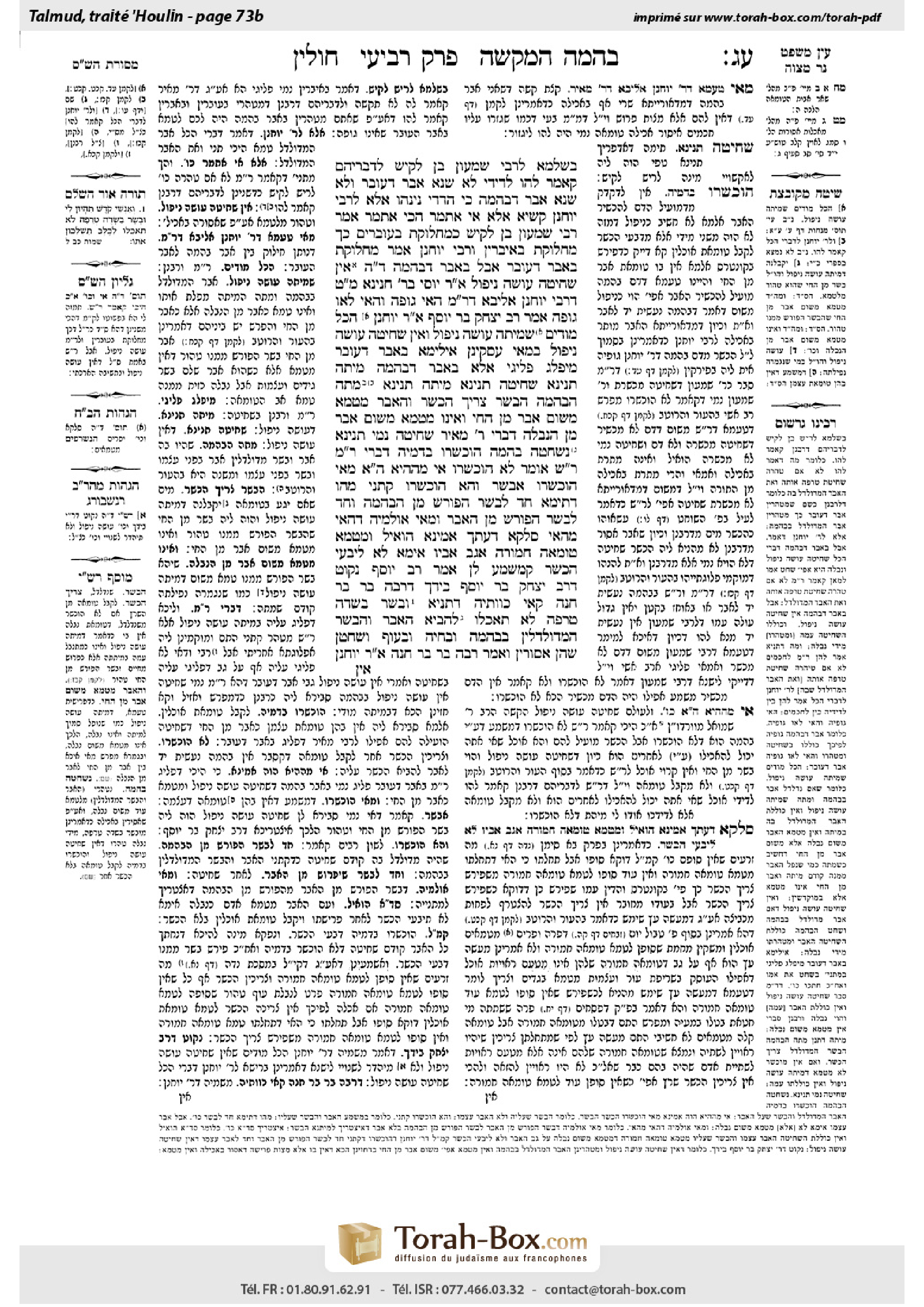
Chullin 73b: Talmud study for Daf Yomi
Study the Talmud for Daf Yomi with scanned pages, Hebrew text, English translations from Sefaria and AI-generated French translations.
Passage selection and English or AI-generated French translation are available where the scan has annotations. Daf Study is independent of Torah-Box and Sefaria.
Browse Chullin · חולין · All tractatesChullin 73b text and translations
This page of Chullin includes the Aramaic text, an English translation and an AI-generated French translation, alongside the scan above.
חולין ע״ג ב · Aramaic and Hebrew text
בִּשְׁלָמָא לְרַבִּי שִׁמְעוֹן בֶּן לָקִישׁ, לְדִבְרֵיהֶם קָאָמַר לְהוּ: לְדִידִי לָא שְׁנָא אֵבֶר דְּעוּבָּר וְלָא שְׁנָא אֵבֶר דִּבְהֵמָה, כִּי הֲדָדֵי נִינְהוּ.
אֶלָּא לְרַבִּי יוֹחָנָן, קַשְׁיָא.
אֶלָּא, אִי אִתְּמַר הָכִי אִתְּמַר: אָמַר רַבִּי שִׁמְעוֹן בֶּן לָקִישׁ: כְּמַחְלוֹקֶת בְּעוּבָּרִים, כָּךְ מַחֲלוֹקֶת בְּאֵיבָרִין, וְרַבִּי יוֹחָנָן אָמַר: מַחְלוֹקֶת בְּאֵבֶר דְּעוּבָּר, אֲבָל בְּאֵבֶר דִּבְהֵמָה – דִּבְרֵי הַכֹּל אֵין שְׁחִיטָה עוֹשָׂה נִיפּוּל.
אָמַר רַבִּי יוֹסֵי בְּרַבִּי חֲנִינָא: מַאי טַעְמָא דְּרַבִּי יוֹחָנָן אַלִּיבָּא דְּרַבִּי מֵאִיר? הַאי גּוּפָהּ, וְהַאי לָאו גּוּפָהּ.
אָמַר רַב יִצְחָק בַּר יוֹסֵף אָמַר רַבִּי יוֹחָנָן: הַכֹּל מוֹדִים שֶׁמִּיתָה עוֹשָׂה נִיפּוּל, וְאֵין שְׁחִיטָה עוֹשָׂה נִיפּוּל.
בְּמַאי עָסְקִינַן? אִילֵימָא בְּאֵבֶר דְּעוּבָּר – מִיפְלָג פְּלִיגִי! אֶלָּא בְּאֵבֶר דִּבְהֵמָה – מִיתָה תְּנֵינָא, שְׁחִיטָה תְּנֵינָא.
מִיתָה תְּנֵינָא: מֵתָה הַבְּהֵמָה – הַבָּשָׂר צָרִיךְ הֶכְשֵׁר, וְהָאֵבֶר מְטַמֵּא מִשּׁוּם אֵבֶר מִן הַחַי, וְאֵינוֹ מְטַמֵּא מִשּׁוּם אֵבֶר מִן הַנְּבֵלָה; דִּבְרֵי רַבִּי מֵאִיר.
שְׁחִיטָה נָמֵי תְּנֵינָא: נִשְׁחֲטָה בְּהֵמָה – הוּכְשְׁרוּ בְּדָמֶיהָ, דִּבְרֵי רַבִּי מֵאִיר. רַבִּי שִׁמְעוֹן אוֹמֵר: לֹא הוּכְשְׁרוּ.
אִי מֵהַהִיא, הֲוָה אָמֵינָא: מַאי ״הוּכְשְׁרוּ״ – אַבָּשָׂר.
וְהָא ״הוּכְשְׁרוּ״ קָתָנֵי, מַהוּ דְּתֵימָא: חַד לְבָשָׂר הַפּוֹרֵשׁ מִן הַבְּהֵמָה, וְחַד לְבָשָׂר הַפּוֹרֵשׁ מִן הָאֵבֶר.
וּמַאי אוּלְמֵיהּ דְּהַאי מֵהַאי? סָלְקָא דַּעְתָּךְ אָמֵינָא, הוֹאִיל וּמְטַמֵּא טוּמְאָה חֲמוּרָה אַגַּב אָבִיו, אֵימָא לָא לִיבְעֵי הֶכְשֵׁר, קָמַשְׁמַע לַן.
אָמַר רַב יוֹסֵף: נְקוֹט דְּרַב יִצְחָק בַּר יוֹסֵף בִּידָךְ, דְּרַבָּה בַּר בַּר חָנָה קָאֵי כְּוָותֵיהּ. דְּתַנְיָא: ״וּבָשָׂר בַּשָּׂדֶה טְרֵפָה לֹא תֹאכֵלוּ״ – לְהָבִיא הָאֵבֶר וְהַבָּשָׂר הַמְדוּלְדָּלִין בִּבְהֵמָה וּבְחַיָּה וּבְעוֹף, וּשְׁחָטָן, שֶׁהֵן אֲסוּרִין. וְאָמַר רַבָּה בַּר בַּר חָנָה אָמַר רַבִּי יוֹחָנָן:
Chullin 73b · English translation
Rabbi Meir’s statement appears inconsistent with his opinion, as he holds that a hanging limb is not rendered pure by slaughtering the animal. The Gemara suggests that this difficulty can be resolved only according to Rabbi Shimon ben Lakish’s version of the Rabbis’ opinion, but not according to Rabbi Yoḥanan’s version. Granted, according to Rabbi Shimon ben Lakish, one can explain that Rabbi Meir was speaking in accordance with the statement of the Rabbis, as follows: According to my own opinion, there is no difference with regard to the limb of a fetus, and there is no difference with regard to a limb hanging from an animal; they are the same in that the slaughter of the animal does not render either of them pure. Accordingly, Rabbi Meir must have been speaking in accordance with the opinion of the Rabbis that a limb hanging from an animal is rendered pure by the animal’s slaughter.
But according to Rabbi Yoḥanan, who holds that both the Rabbis and Rabbi Meir agree that a limb hanging from an animal is not rendered pure by the animal’s slaughter, Rabbi Meir’s statement is difficult, as it is inconsistent with both his opinion and the Rabbis’ opinion. The Gemara concedes the challenge.
Rather, if such a dispute was stated, it was stated like this: Rabbi Shimon ben Lakish said: Just as there is a dispute between Rabbi Meir and the Rabbis with regard to fetuses whose limbs emerged from the womb, so too, they have a parallel dispute with regard to limbs hanging from an animal. And Rabbi Yoḥanan said: Their dispute is only with regard to the limb of a fetus that emerged from the womb; but with regard to a limb hanging from an animal, everyone agrees that the slaughter of the animal does not render such a limb as though it had already fallen off prior to the slaughter, and does not impart the impurity of a carcass. According to this version of Rabbi Yoḥanan’s understanding of the dispute, Rabbi Meir’s statement is consistent even with his own opinion.
Rabbi Yosei, son of Rabbi Ḥanina, said: What is the reason for the distinction made by Rabbi Yoḥanan concerning the opinion of Rabbi Meir, that the slaughter of an animal does not render pure the limb of its fetus, but it does render pure a limb hanging from the animal itself? It is that this hanging limb is part of the animal’s body, but that, the limb of the fetus, is not part of its body.
§ The Gemara continues to elucidate the dispute between Rabbi Meir and the Rabbis. Rav Yitzḥak bar Yosef says that Rabbi Yoḥanan says: Everyone agrees that the death of an animal by means other than slaughter renders a limb as though it had already fallen off prior to the animal’s death. Therefore, it will not have the impurity of a carcass, but it will have the impurity of a limb taken from a living animal. And likewise, everyone agrees that the slaughter of the animal does not render a limb as though it had already fallen off prior to the slaughter, and therefore it will not have the impurity of a carcass.
The Gemara clarifies: What are we dealing with here? If we say we are dealing with a limb of its fetus that emerged from its womb, Rabbi Meir and the Rabbis explicitly disagree with regard to this case. Rather, we are dealing with a limb hanging from an animal. But if so, Rabbi Yoḥanan’s statement is unnecessary. With regard to a hanging limb, we already learn about the effect of the death of the animal in a mishna elsewhere, and we already learn about the effect of the slaughter of the animal in a mishna elsewhere.
The Gemara elaborates: We already learn about the effect of the death of an animal in the mishna (127b): If the animal died without slaughter, any hanging flesh needs to be rendered susceptible to contracting ritual impurity in order to become impure. This is accomplished by coming in contact with liquid, with the owner’s approval. The reason is that its halakhic status is that of flesh severed from a living animal, which is ritually pure and does not have the status of an unslaughtered carcass. And a hanging limb imparts impurity as a limb severed from a living animal, but does not impart impurity as a limb from a carcass; this is the statement of Rabbi Meir. Evidently, Rabbi Meir holds that upon the animal’s death, anything hanging from the animal is considered as though it had already fallen off before the animal’s death. Since the mishna does not record that the Rabbis disagree, it would appear that they agree.
Likewise, we already learn about the effect of the slaughter of an animal in the same mishna: If the animal is slaughtered, they, the limb and the flesh hanging from it, are thereby rendered susceptible to impurity, by coming in contact with its blood. Blood is one of the seven liquids that render foods susceptible to impurity and its presence is considered to be with the approval of the owner, as it makes the meat look redder and fresher; this is the statement of Rabbi Meir. Rabbi Shimon says: They were not rendered susceptible to impurity through the animal’s own blood, but only once they were wet with another liquid, with the owner’s approval. It is apparent that both opinions in that mishna agree that the limb does not have the impurity of a limb severed from a living animal. Evidently, they hold that the slaughter does not render the hanging limb as though it had already fallen off beforehand.
Given that the mishna has already taught both halakhot, what was the necessity of Rabbi Yoḥanan’s statement? The Gemara answers: If these halakhot were derived only from that mishna, I would say that actually, slaughter does render a hanging limb as though it had already fallen off beforehand, and such a limb would have the impurity of a limb severed from a live animal. If so, what does the mishna mean when it states: They are rendered susceptible to impurity by coming in contact with its blood? Ostensibly, the intention is that both the limb and the flesh must be rendered susceptible to impurity, which indicates that the limb does not have any impurity of its own. The Gemara explains: One would have explained that the need to be rendered susceptible to impurity is referring only to the flesh, as flesh severed from a living animal does not have any impurity of its own.
The Gemara objects: But the mishna teaches: They are rendered susceptible, in the plural, which is apparently referring to both the flesh and the limb, which were mentioned previously in the mishna. The Gemara explains: You might say that the plural is used because the statement is referring to two types of hanging flesh that upon slaughter are considered to have been separated from a living animal: One is for flesh that separates from the body of the animal, and the other one is for flesh that separates from the hanging limb. Neither type has its own impurity, so they must be rendered susceptible to impurity by coming in contact with liquid.
The Gemara asks: But in what way is it more compelling to apply the halakha to this type of flesh than to that type, making it necessary to state the halakha with regard to both? The Gemara answers: It might enter your mind to say that since flesh that is attached to a limb severed from a living animal imparts the same severe form of ritual impurity as the limb on account of being a part of it, one might say that once the flesh is separated from the limb it does not need to then be rendered susceptible to impurity. To reject this possibility, the mishna uses the plural form to teach us that this type of flesh does need to be rendered susceptible to impurity.
§ Rav Yosef said: Take the statement that Rav Yitzḥak bar Yosef says that Rabbi Yoḥanan says, i.e., that the slaughter of an animal does not render a hanging limb as though it had already fallen off prior to the slaughter, in your hand, i.e., accept it as correct, as Rabba bar bar Ḥana also holds in accordance with this opinion. As it is taught in a baraita: “And flesh that is torn in the field, you shall not eat” (Exodus 22:30). This serves to include the case of the limb or the flesh that was partially cut off but was still hanging on a domesticated animal or on an undomesticated animal or on a bird, and one slaughtered them; it is derived that they are prohibited as limbs severed from a living animal. And Rabba bar bar Ḥana says that Rabbi Yoḥanan says with regard to the ruling of this baraita:
Chullin 73b · Traduction française (IA)
L'opinion de Rabbi Meïr semble incohérente avec son propre point de vue, car il affirme qu'un membre pendant ne devient pas pur par l'abattage de l'animal. La Guemara suggère que cette difficulté peut être résolue uniquement selon la version de l'opinion des Sages telle que présentée par Rabbi Shimon ben Lakish, et non selon la version de Rabbi Yoḥanan. En effet, selon Rabbi Shimon ben Lakish, on peut expliquer que Rabbi Meïr parlait en conformité avec l'opinion des Sages, comme suit : Selon mon propre point de vue, il n'y a pas de différence concernant le membre d'un fœtus, et il n'y a pas de différence concernant un membre pendant d'un animal ; ils sont identiques dans le sens où l'abattage de l'animal ne rend ni l'un ni l'autre pur. Ainsi, Rabbi Meïr doit avoir parlé en conformité avec l'opinion des Sages selon laquelle un membre pendant d'un animal devient pur par l'abattage de l'animal.
Mais selon Rabbi Yoḥanan, qui affirme que tant les Sages que Rabbi Meïr s'accordent sur le fait qu'un membre pendant d'un animal ne devient pas pur par l'abattage de l'animal, l'affirmation de Rabbi Meïr est difficile, car elle est incohérente à la fois avec son propre point de vue et celui des Sages. La Guemara reconnaît cette difficulté.
En réalité, si un tel débat avait été énoncé, il aurait été formulé ainsi : Rabbi Shimon ben Lakish a dit : Tout comme il existe un débat entre Rabbi Meïr et les Sages concernant les fœtus dont les membres sont sortis du ventre, de même, ils ont un débat parallèle concernant les membres pendants d'un animal. Et Rabbi Yoḥanan a dit : Leur débat est uniquement concernant le membre d'un fœtus sorti du ventre ; mais concernant un membre pendant d'un animal, tout le monde s'accorde sur le fait que l'abattage de l'animal ne rend pas ce membre comme s'il avait déjà tombé avant l'abattage, et ne transmet pas l'impureté d'une carcasse. Selon cette compréhension de Rabbi Yoḥanan du débat, l'affirmation de Rabbi Meïr est cohérente même avec son propre point de vue.
Rabbi Yosei, fils de Rabbi Ḥanina, a dit : Quelle est la raison de la distinction faite par Rabbi Yoḥanan concernant l'opinion de Rabbi Meïr, à savoir que l'abattage d'un animal ne rend pas pur le membre du fœtus, mais qu'il rend pur le membre pendant lui-même ? C'est que ce membre pendant est partie du corps de l'animal, tandis que le membre du fœtus n'en est pas partie.
§ La Guemara continue d'expliquer le débat entre Rabbi Meïr et les Sages. Rav Yitzḥak bar Yosef dit que Rabbi Yoḥanan dit : Tout le monde s'accorde sur le fait que la mort d'un animal par un moyen autre que l'abattage rend un membre comme s'il avait déjà tombé avant la mort de l'animal. Ainsi, il ne possède pas l'impureté d'une carcasse, mais il possède l'impureté d'un membre tiré d'un animal vivant. De même, tout le monde s'accorde sur le fait que l'abattage de l'animal ne rend pas un membre comme s'il avait déjà tombé avant l'abattage, et par conséquent, il ne possède pas l'impureté d'une carcasse.
La Guemara clarifie : De quoi est-on en train de parler ici ? Si l'on dit qu'on parle d'un membre du fœtus sorti de son ventre, Rabbi Meïr et les Sages s'entendent explicitement sur ce cas. En réalité, on parle d'un membre pendante d'un animal. Mais si c'est le cas, l'affirmation de Rabbi Yoḥanan est inutile. Concernant un membre pendante, on a déjà appris l'effet de la mort de l'animal dans un mitsva ailleurs, et on a déjà appris l'effet de l'abattage de l'animal dans un mitsva ailleurs.
La Guemara développe : On a déjà appris l'effet de la mort de l'animal dans le mitsva (127b) : Si l'animal est mort sans être abattu, toute chair pendante doit être rendue susceptible de contracter une impureté rituelle afin de devenir impure. Cela est accompli par le contact avec un liquide, avec l'accord du propriétaire. La raison est que son statut halakhique est celui d'une chair séparée d'un animal vivant, qui est rituellement pure et ne possède pas le statut d'une carcasse non abattue. Et un membre pendante transmet l'impureté comme un membre séparé d'un animal vivant, mais ne transmet pas l'impureté comme un membre d'une carcasse ; c'est l'affirmation de Rabbi Meïr. Il semble que Rabbi Meïr affirme que lors de la mort de l'animal, toute chose pendante est considérée comme si elle avait déjà tombé avant la mort de l'animal. Puisque le mitsva ne mentionne pas que les Sages s'opposent à cela, il semble qu'ils s'accordent.
De même, nous avons déjà appris l'effet de l'abattage de l'animal dans la même mitsva : Si l'animal est abattu, le membre et la chair pendante sont ainsi rendus susceptibles d'impureté par le contact avec son sang. Le sang est l'un des sept liquides qui rendent les aliments susceptibles d'impureté, et sa présence est considérée comme l'accord du propriétaire, car il rend la viande plus rouge et fraîche ; c'est l'affirmation de Rabbi Meïr. Rabbi Shimon dit : Ils ne sont pas rendus susceptibles d'impureté par le sang de l'animal lui-même, mais seulement une fois qu'ils sont mouillés par un autre liquide, avec l'accord du propriétaire. Il est évident que les deux opinions dans cette mitsva s'accordent sur le fait que le membre ne possède pas l'impureté d'un membre séparé d'un animal vivant. Il semble qu'ils affirment que l'abattage ne rend pas le membre pendante comme s'il avait déjà tombé avant.
Étant donné que la mitsva a déjà enseigné ces deux halakhot, quelle était la nécessité de l'affirmation de Rabbi Yoḥanan ? La Guemara répond : Si ces halakhot avaient été dérivées uniquement de cette mitsva, je dirais que, en réalité, l'abattage rend un membre pendante comme s'il avait déjà tombé avant, et ce membre aurait l'impureté d'un membre séparé d'un animal vivant. Si c'est le cas, que signifie la mitsva lorsqu'elle dit : Ils sont rendus susceptibles d'impureté par le contact avec son sang ? Apparemment, l'intention est que le membre et la chair doivent être rendus susceptibles d'impureté, ce qui indique que le membre ne possède pas d'impureté propre. La Guemara explique : On aurait pu expliquer que le besoin de rendre susceptible d'impureté fait référence uniquement à la chair, car une chair séparée d'un animal vivant ne possède pas d'impureté propre.
La Guemara rétorque : Mais la Miqna enseigne : Ils deviennent souillables, au pluriel, ce qui semble faire référence à la viande et au membre, mentionnés précédemment dans la Miqna. La Guemara explique : On pourrait dire que le pluriel est utilisé parce que l'affirmation fait référence à deux types de viande suspendue qui, lors de la mise à mort, sont considérés comme séparés d'un animal vivant : l'un est pour la viande qui se détache du corps de l'animal, et l'autre est pour la viande qui se détache du membre suspendu. Aucun de ces deux types ne possède une souillure propre, donc ils doivent devenir souillables en contactant un liquide.
La Guemara demande : Mais en quoi cette sorte de viande est-elle plus pertinente pour appliquer la halakha que celle-ci, rendant nécessaire d'énoncer la halakha à l'égard des deux types ? La Guemara répond : On pourrait penser que puisque la viande attachée à un membre séparé d'un animal vivant transmet la même forme grave de souillure rituelle que le membre en raison de son appartenance, on pourrait dire que lorsqu'elle est séparée du membre, elle n'a plus besoin d'être rendue souillable. Pour rejeter cette possibilité, la Miqna utilise la forme plurielle afin de nous enseigner que cette sorte de viande doit être rendue souillable.
§ Rav Yosef dit : Prends la déclaration que Rav Yitzḥak bar Yosef dit que Rabbi Yoḥanan dit, c'est-à-dire que la mise à mort d'un animal ne rend pas un membre suspendu comme s'il avait déjà tombé avant la mise à mort, en ta main, c'est-à-dire accepte-la comme correcte, car Rabba bar bar Ḥana aussi la maintient selon cet avis. Comme il est enseigné dans une baraïta : « Et la viande qui est déchirée dans le champ, tu ne la mangeras pas » (Exode 22:30). Cela sert à inclure le cas du membre ou de la viande qui a été partiellement coupée mais qui était encore suspendu sur un animal domestique ou sur un animal sauvage ou sur un oiseau, et l'on a mis à mort ces animaux ; on en déduit qu'ils sont interdits comme des membres séparés d'un animal vivant. Et Rabba bar bar Ḥana dit que Rabbi Yoḥanan dit concernant la décision de cette baraïta :
Traduction française générée par IA à partir de l’édition anglaise de Sefaria. Vérifie toujours un passage avec le texte source.
Text from Sefaria: William Davidson Edition - Vocalized Aramaic (unknown); William Davidson Edition - English (CC BY NC).