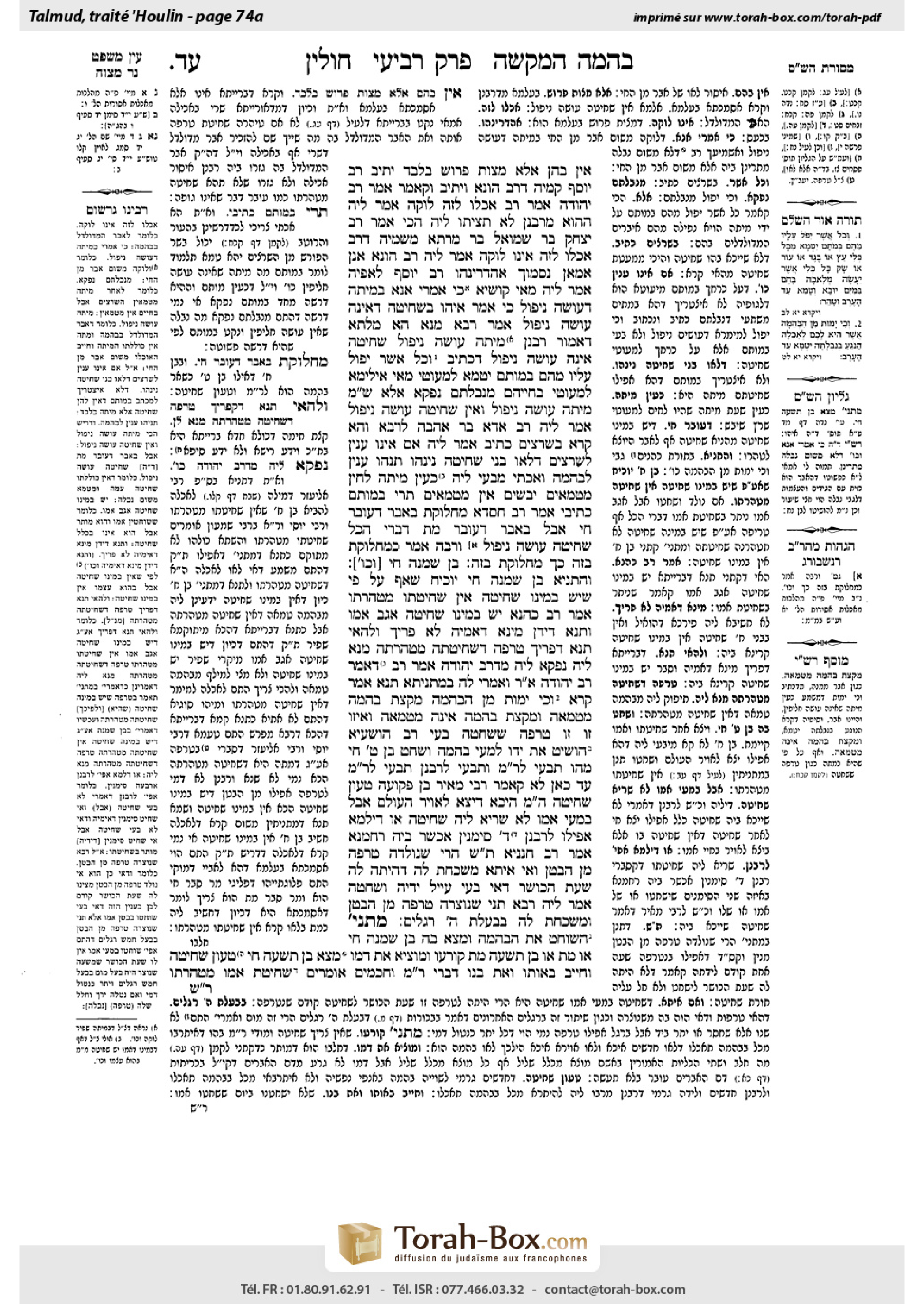
Chullin 74a: Talmud study for Daf Yomi
Study the Talmud for Daf Yomi with scanned pages, Hebrew text, English translations from Sefaria and AI-generated French translations.
Passage selection and English or AI-generated French translation are available where the scan has annotations. Daf Study is independent of Torah-Box and Sefaria.
Browse Chullin · חולין · All tractatesChullin 74a text and translations
This page of Chullin includes the Aramaic text, an English translation and an AI-generated French translation, alongside the scan above.
חולין ע״ד א · Aramaic and Hebrew text
אֵין בָּהֶן אֶלָּא מִצְוַת פְּרוֹשׁ בִּלְבָד.
יָתֵיב רַב יוֹסֵף קַמֵּיהּ דְּרַב הוּנָא, וְיָתֵיב וְקָאָמַר: אָמַר רַב יְהוּדָה אָמַר רַב: אֲכָלוֹ לָזֶה – לוֹקֶה. אֲמַר לֵיהּ הָהוּא מֵרַבָּנַן: לָא תְּצִיתוּ לֵיהּ, הָכִי אָמַר רַב יִצְחָק בַּר שְׁמוּאֵל בַּר מָרְתָא מִשְּׁמֵיהּ דְרַב: אֲכָלוֹ לָזֶה – אֵינוֹ לוֹקֶה.
אֲמַר לֵיהּ רַב הוּנָא: אֲנַן אַמַּאן נִסְמוֹךְ? אַהְדְּרִינְהוּ רַב יוֹסֵף לְאַפֵּיהּ, אֲמַר לֵיהּ: מַאי קוּשְׁיָא? כִּי אֲמַרִי אֲנָא – בְּמִיתָה, דְּעוֹשָׂה נִיפּוּל; כִּי אֲמַר אִיהוּ – בִּשְׁחִיטָה, דְּאֵינָהּ עוֹשָׂה נִיפּוּל.
אָמַר רָבָא: מְנָא הָא מִלְּתָא דַאֲמוּר רַבָּנַן: מִיתָה עוֹשָׂה נִיפּוּל, שְׁחִיטָה אֵינָהּ עוֹשָׂה נִיפּוּל, דִּכְתִיב: ״וְכֹל אֲשֶׁר יִפֹּל עָלָיו מֵהֶם בְּמֹתָם יִטְמָא״, לְמַעוֹטֵי מַאי? אִילֵּימָא לְמַעוֹטֵי בְּחַיֵּיהֶם – מִ״נִּבְלָתָם״ נָפְקָא, אֶלָּא שְׁמַע מִינַּהּ: מִיתָה עוֹשָׂה נִיפּוּל, וְאֵין שְׁחִיטָה עוֹשָׂה נִיפּוּל.
אֲמַר לֵיהּ רַב אַדָּא בַּר אַהֲבָה לְרָבָא: וְהָא קְרָא בִּשְׁרָצִים כְּתִיב! אֲמַר לֵיהּ: אִם אֵינוֹ עִנְיָן לִשְׁרָצִים, דְּלָאו בְּנֵי שְׁחִיטָה נִינְהוּ – תְּנֵהוּ עִנְיָן לִבְהֵמָה.
וְאַכַּתִּי מִבְּעֵי לֵיהּ, כְּעֵין מִיתָה: לַחִין – מְטַמְּאִים, יְבֵשִׁים – אֵין מְטַמְּאִים! תְּרֵי ״בְּמֹתָם״ כְּתִיבִי.
אָמַר רַב חִסְדָּא: מַחְלוֹקֶת בְּאֵבֶר דְּעוּבָּר חַי, אֲבָל בְּאֵבֶר דְּעוּבָּר מֵת – דִּבְרֵי הַכֹּל שְׁחִיטָה עוֹשָׂה נִיפּוּל. וְרַבָּה אָמַר: כְּמַחְלוֹקֶת בָּזֶה כָּךְ מַחְלוֹקֶת בָּזֶה.
בֶּן שְׁמֹנֶה חַי. וְהָתַנְיָא: בֶּן שְׁמֹנֶה חַי יוֹכִיחַ, שֶׁאַף עַל פִּי שֶׁיֵּשׁ בְּמִינוֹ שְׁחִיטָה – אֵין שְׁחִיטָתוֹ מְטַהַרְתּוֹ.
אָמַר רַב כָּהֲנָא: יֵשׁ בְּמִינוֹ שְׁחִיטָה אַגַּב אִמּוֹ, וְתַנָּא דִּידַן מִינָא דְּאִמֵּיהּ לָא פָּרֵיךְ.
וּלְהַאי תַּנָּא דְּפָרֵיךְ, טְרֵפָה דִּשְׁחִיטָתָהּ מְטַהַרְתָּהּ מְנָא לֵיהּ? נָפְקָא לֵיהּ מִדְּרַב יְהוּדָה אָמַר רַב, דְּאָמַר רַב יְהוּדָה אָמַר רַב, וְאָמְרִי לַהּ בְּמַתְנִיתָא תָּנָא: אָמַר קְרָא ״וְכִי יָמוּת מִן הַבְּהֵמָה״, מִקְצָת בְּהֵמָה מְטַמְּאָה וּמִקְצָת בְּהֵמָה אֵינָהּ מְטַמְּאָה, וְאֵיזוֹ זוֹ? זוֹ טְרֵפָה שֶׁשְּׁחָטָהּ.
בָּעֵי רַב הוֹשַׁעְיָא: הוֹשִׁיט אֶת יָדוֹ לִמְעֵי בְּהֵמָה, וְשָׁחַט בֶּן תִּשְׁעָה חַי, מַהוּ? תִּבְּעֵי לְרַבִּי מֵאִיר, וְתִבְּעֵי לְרַבָּנַן.
תִּבְּעֵי לְרַבִּי מֵאִיר: עַד כָּאן לָא קָאָמַר רַבִּי מֵאִיר בֶּן פְּקוּעָה טָעוּן שְׁחִיטָה – הָנֵי מִילֵּי הֵיכָא דְּיָצָא לַאֲוִיר הָעוֹלָם, אֲבָל בִּמְעֵי אִמּוֹ – לָא שָׁרְיָא לֵיהּ שְׁחִיטָה.
אוֹ דִילְמָא, אֲפִילּוּ לְרַבָּנַן, אַרְבָּעָה סִימָנִין אַכְשַׁר בֵּיהּ רַחֲמָנָא.
אָמַר רַב חֲנַנְיָא, תָּא שְׁמַע: הֲרֵי שֶׁנּוֹלְדָה טְרֵפָה מִן הַבֶּטֶן, וְאִי אִיתָא, מַשְׁכַּחַתְּ לַהּ דְּהָיְתָה לָהּ שְׁעַת הַכּוֹשֶׁר, דְּאִי בָּעֵי עַיֵּיל יְדֵיהּ וְשַׁחֲטַהּ!
אֲמַר לֵיהּ רָבָא: תָּנֵי שֶׁנּוֹצְרָה טְרֵפָה מִן הַבֶּטֶן, וּמַשְׁכַּחַתְּ לַהּ בְּבַעֲלַת חָמֵשׁ רַגְלַיִם.
מַתְנִי׳ הַשּׁוֹחֵט אֶת הַבְּהֵמָה, וּמָצָא בָּהּ בֶּן שְׁמֹנֶה חַי אוֹ מֵת, אוֹ בֶּן תִּשְׁעָה מֵת – קוֹרְעוֹ וּמוֹצִיא אֶת דָּמוֹ.
מָצָא בֶּן תִּשְׁעָה חַי – טָעוּן שְׁחִיטָה, וְחַיָּיב בְּ״אוֹתוֹ וְאֶת בְּנוֹ״, דִּבְרֵי רַבִּי מֵאִיר. וַחֲכָמִים אוֹמְרִים: שְׁחִיטַת אִמּוֹ מְטַהַרְתּוֹ.
Chullin 74a · English translation
In fact, such limbs and flesh are not prohibited by Torah law, as the slaughter does not render them as though they had already fallen off prior to the slaughter, and the verse cited in the baraita is not a true derivation but a mere support. Accordingly, with regard to them, there is nothing other than a rabbinic mitzva to separate oneself from consuming them.
§ Rav Yosef sat before Rav Huna, and he sat and said: Rav Yehuda says that Rav says: If one ate this hanging limb he is flogged for violating the prohibition against eating a limb from a living animal. One of the Sages said to him: Do not listen to his statement in the name of Rav, as this is what Rav Yitzḥak bar Shmuel bar Marta says in the name of Rav: If one ate this hanging limb he is not flogged.
Rav Huna said to Rav Yosef: Upon whose version of Rav’s ruling shall we rely? Rav Yosef turned his face away in anger and said to him: What is the difficulty? When I said in Rav’s name that one is flogged for eating a limb that had been hanging from an animal when it died, I was referring to a case of death by means other than slaughter, which renders the limb as though it had already fallen off prior to the animal’s death. When Rav Yitzḥak bar Shmuel bar Marta said in the name of Rav that one is not flogged, he was referring to the case of a slaughter, which does not render the limb as though it had already fallen off prior to the slaughter and therefore serves to render the limb permitted for consumption.
§ Rava said: From where is this matter that the Sages stated derived: The death of an animal by means other than slaughter renders a hanging limb as though it had already fallen off prior to the slaughter, whereas the slaughter of the animal does not render a limb as though it had already fallen off? As it is written with regard to the eight species of impure creeping animals: “And anything that these fall upon, when they are dead, it shall be impure” (Leviticus 11:32). What does the term “when they are dead” serve to exclude? If we say it serves to exclude the time when they are alive, that principle is derived from: “And everything upon which any part of their carcass falls shall be impure” (Leviticus 11:35), which explicitly states that only their carcasses impart impurity. Rather, learn from the verse that death renders a hanging limb as though it had already fallen off, and slaughter does not render a hanging limb as though it had already fallen off.
Rav Adda bar Ahava said to Rava: But this verse is written with regard to creeping animals, which do not require slaughter. How then can a halakha with regard to slaughter be derived from here? Rava said to him: If, because it is superfluous, this verse is not referring to the matter of creeping animals, which are not subject to the requirement of slaughter, apply it to the matter of an animal, which is subject to slaughter.
The Gemara objects: But the phrase “when they are dead, it shall be impure” is still necessary to teach a different halakha, i.e., that they impart impurity only when they are still in a state similar to their state at the time of their death, i.e., if they are moist they impart impurity, whereas if they are dry they do not impart impurity. The Gemara explains that “when they are dead” is written twice, once in the verse cited, and once in the previous verse, which states: “Whoever touches them when they are dead shall be impure until the evening” (Leviticus 11:31).
§ The Gemara returns to the dispute in the mishna (72a) with regard to a fetus that extended its foreleg and then its mother was slaughtered. Rabbi Meir holds that the foreleg is regarded as a carcass with the associated impurity, while the Rabbis hold that although it is not permitted for consumption, the slaughter prevents it from having the impurity of a carcass. With regard to this dispute, Rav Ḥisda said: The dispute concerns only the limb of a fetus that was alive when the mother was slaughtered; but concerning the case of the limb of a fetus that was dead when the mother was slaughtered, everyone agrees that slaughter renders the fetus’s limb as though it had already fallen off prior to the slaughter, and it imparts impurity as a limb from a living animal. But Rabba said: Just as there is a dispute between Rabbi Meir and the Rabbis concerning this case, where the fetus was alive, so too, there is a dispute between them concerning that case, where the fetus had died.
§ The mishna states that an eight-month-old fetus that was born alive is not rendered ritually pure by slaughtering it. The reason given is that the concept of permitting an animal through slaughter is never stated with regard to that kind of animal. The Gemara challenges: But isn’t it taught in a baraita in a discussion about whether slaughter renders a tereifa pure from the impurity of a carcass: An eight-month-old fetus that was born alive will prove the point, as even though there are other animals of that kind that are permitted through slaughter, its slaughter does not render it pure from having the impurity of a carcass. This refutes the claim that the issue of slaughter rendering an animal pure from having the impurity of a carcass is a function of whether or not the concept of slaughter applies to that kind of animal.
Rav Kahana said: The tanna of the baraita holds that even with regard to an eight-month-old fetus it can be said that there are animals of that kind that are permitted through slaughter, i.e., when they are still inside the womb and the mother is slaughtered; such an animal is permitted by virtue of the slaughter of its mother. Therefore, he cites the case of an eight-month-old fetus as a refutation. But the tanna of our mishna holds that the fact that this kind of animal is permitted by virtue of the slaughter of its mother does not define it as a kind of animal concerning which there is a concept of slaughter, and therefore he holds that this case cannot be used as a refutation.
The Gemara asks: And according to that tanna of the baraita, who does use it as a refutation, from where does he derive that the slaughter of a tereifa renders it pure from having the impurity of a carcass? The Gemara answers that he derives it from that which Rav Yehuda says that Rav says, as Rav Yehuda says that Rav says, and some say it was taught in a baraita: The verse states: “And if some domesticated animal, of which you may eat, dies, one who touches its carcass shall be impure until the evening” (Leviticus 11:39). The word “some” teaches that only some dead animals impart impurity as a carcass, but some dead animals do not impart impurity as a carcass. And what is it that does not impart impurity? That is a tereifa that one slaughtered.
§ Rav Hoshaya raises a dilemma: If one inserted his hand inside the womb of an animal and slaughtered a nine-month-old fetus that was alive, what is the halakha? Does the slaughter performed inside the mother render the fetus permitted? The Gemara notes: This dilemma may be raised according to the opinion of Rabbi Meir, and it may be raised according to the opinion of the Rabbis.
The Gemara elaborates: It may be raised according to the opinion of Rabbi Meir. It is possible that Rabbi Meir states in the mishna below that a nine-month-old ben pekua requires slaughter, and slaughter renders the animal permitted only in that case, because that statement may apply only in a case where the animal emerged into the airspace of the world, i.e., once it was born alive. But if it is still inside its mother, its slaughter does not render it permitted.
Or perhaps even the Rabbis, who disagree with Rabbi Meir and maintain that a nine-month-old ben pekua is permitted by virtue of its mother’s slaughter, would concede that the slaughter of the fetus itself also permits it. Perhaps with regard to such an animal the Merciful One considers four simanim, i.e., the windpipe and the gullet of the mother and the windpipe and the gullet of the fetus, to be fit for slaughter, and the fetus is permitted by the cutting of either pair.
Rav Ḥananya said: Come and hear a resolution of this dilemma from the mishna (72b), as it considers an animal that was born as a tereifa from the womb as one that never had a period of potential fitness. But if it is so, that one can slaughter a fetus in its mother’s womb, you find that actually it did have a period of potential fitness, as if one wants to, he can insert his hand into the womb and slaughter it before it develops into a tereifa.
Rava said to Rav Ḥananya: Teach that mishna as referring to a case where the fetus was formed as a tereifa from its outset while inside the womb, and you find such a case where a fetus has five legs, which certainly developed from the outset. Consequently, there was never a possibility of slaughtering it.
MISHNA: In the case of one who slaughtered an animal and found within it an eight-month-old fetus, i.e., one that was not full term, whether it was alive or dead, or a nine-month-old fetus, i.e., one that was full term, that was dead, that fetus is permitted by virtue of the slaughter of its mother, as it is considered part of its mother. Therefore, its blood is considered part of its mother’s blood and is prohibited, so one must tear the fetus and remove its blood before it may be consumed.
If he found within it a live nine-month-old fetus, it requires its own slaughter, as it is considered an independent full-fledged animal, and if one slaughters both the mother and fetus on the same day, one is liable for violating the prohibition against slaughtering an animal itself and its offspring on the same day; this is the statement of Rabbi Meir. And the Rabbis say: Even when the fetus is nine months old, it is still considered part of its mother, and the slaughter of its mother renders it permitted for consumption.
Chullin 74a · Traduction française (IA)
En effet, ces membres et cette chair ne sont pas interdits par la loi torahique, car la mise à mort ne les rend pas comme s'ils avaient déjà tombé avant la mise à mort, et la citation du baraïta n'est pas une dérivation véritable mais un simple appui. Ainsi, concernant ces choses, il n'y a rien d'autre qu'une mitsva rabbinique de se séparer de leur consommation.
§ Rav Yosef s'est assis devant Rav Huna, et il a dit : Rav Yehuda dit que Rav dit : Si l'on a mangé ce membre pendant, on est battu pour avoir violé l'interdiction de manger un membre d'un animal vivant. Un des Sages a dit à lui : N'écoute pas sa déclaration en nom de Rav, car c'est ce que Rav Yitzḥak bar Shmuel bar Marta dit en nom de Rav : Si l'on a mangé ce membre pendant, on n'est pas battu.
Rav Huna a dit à Rav Yosef : Sur quelle version de la décision de Rav devons-nous nous appuyer ? Rav Yosef a tourné le visage en colère et a dit à lui : Quel est le problème ? Lorsque j'ai dit en nom de Rav que l'on est battu pour avoir mangé un membre qui pendait d'un animal lors de sa mort, j'étais en train de parler d'un cas de mort non provoquée par la mise à mort, qui rend le membre comme s'il avait déjà tombé avant la mort de l'animal. Lorsque Rav Yitzḥak bar Shmuel bar Marta a dit en nom de Rav que l'on n'est pas battu, il parlait du cas de la mise à mort, qui ne rend pas le membre comme s'il avait déjà tombé avant la mise à mort et donc permet sa consommation.
§ Rava a dit : D'où cette matière que les Sages ont établi : La mort d'un animal non provoquée par la mise à mort rend un membre pendante comme s'il avait déjà tombé avant la mise à mort, tandis que la mise à mort de l'animal ne rend pas un membre comme s'il avait déjà tombé avant la mise à mort. Comme il est écrit concernant les huit espèces d'animaux rampants : « Et tout ce qui tombe sur eux lorsqu'ils sont morts, il sera impur » (Lévitique 11:32). À quoi sert le terme « lorsqu'ils sont morts » ? Si nous disons qu'il sert à exclure le temps où ils sont vivants, ce principe est tiré de : « Et tout ce sur lequel tombera une partie de leur carcasse sera impur » (Lévitique 11:35), qui stipule explicitement que seule leur carcasse transmet l'impureté. Plutôt, apprenez de la parole que la mort rend un membre pendante comme s'il avait déjà tombé, et la mise à mort ne rend pas un membre comme s'il avait déjà tombé.
Rav Adda bar Ahava a dit à Rava : Mais cette parole est écrite concernant les animaux rampants, qui n'exigent pas de mise à mort. Comment alors peut-on tirer une halakha concernant la mise à mort de là ? Rava a dit à lui : Si, parce qu'il est superflu, cette parole ne fait pas référence à la matière des animaux rampants, qui ne sont pas soumis à la nécessité de la mise à mort, appliquez-la à la matière de l'animal, qui est soumis à la mise à mort.
La Guemara s'oppose : Mais la phrase « lorsqu'ils sont morts, il sera impur » est encore nécessaire pour enseigner une autre halakha, c'est-à-dire qu'ils transmettent l'impureté uniquement lorsqu'ils sont dans un état similaire à leur état au moment de leur mort, c'est-à-dire si ils sont humides, ils transmettent l'impureté, tandis que si ils sont secs, ils ne transmettent pas l'impureté. La Guemara explique que « lorsqu'ils sont morts » est écrit deux fois, une fois dans la parole citée, et une fois dans la parole précédente, qui stipule : « Qui touche eux lorsqu'ils sont morts sera impur jusqu'au soir » (Lévitique 11:31).
§ La Guemara reprend la dispute dans la mitsva (72a) concernant un fœtus qui a étendu son avant-bras et ensuite sa mère a été tuée. Rabbi Meir considère que l'avant-bras est regardé comme un cadavre avec l'impureté associée, tandis que les Rabbins considèrent que bien qu'il ne soit pas permis à la consommation, la mise à mort l'empêche d'avoir l'impureté de cadavre. Concernant cette dispute, Rav Ḥisda a dit : La dispute concerne uniquement le membre d'un fœtus qui était vivant lors de la mort de la mère ; concernant le cas du membre d'un fœtus qui était mort lors de la mort de la mère, tout le monde convient que la mise à mort rend le membre du fœtus comme s'il avait déjà tombé avant la mise à mort, et il transmet l'impureté comme un membre d'un animal vivant. Mais Rabba a dit : Tout comme il y a une dispute entre Rabbi Meir et les Rabbins concernant ce cas, où le fœtus était vivant, ainsi, il y a une dispute entre eux concernant ce cas, où le fœtus était mort.
§ La mitsva stipule qu'un fœtus de huit mois qui est né vivant n'est pas rendu rituellement pur par sa mise à mort. La raison donnée est que le concept de permettre un animal par la mise à mort n'est jamais mentionné concernant ce type d'animal. La Guemara conteste : Mais n'est-il pas enseigné dans un baraïta, dans un débat concernant si la mise à mort rend un tereifa pur de l'impureté de cadavre : un fœtus de huit mois qui est né vivant servira à prouver le point, car même s'il y a d'autres animaux de ce type qui sont permis par la mise à mort, sa mise à mort ne le rend pas pur de l'impureté de cadavre. Cela réfute l'affirmation que la question de la mise à mort rendant un animal pur de l'impureté de cadavre dépend de si le concept de mise à mort s'applique à ce type d'animal.
Rav Kahana a dit : Le tanna du baraïta considère que même concernant un fœtus de huit mois, on peut dire qu'il existe des animaux de ce type qui sont permis par la mise à mort, c'est-à-dire lorsqu'ils sont encore dans le ventre de leur mère et que celle-ci est tuée ; cet animal est permis grâce à la mise à mort de sa mère. Par conséquent, il cite le cas du fœtus de huit mois comme une réfutation. Mais le tanna de notre mitsva considère que le fait que ce type d'animal soit permis grâce à la mise à mort de sa mère ne définit pas ce type d'animal comme un type concernant lequel il y a un concept de mise à mort, et par conséquent, il considère que ce cas ne peut pas être utilisé comme une réfutation.
La Guemara pose la question : Et selon ce tanna du baraïta qui l'utilise comme une réfutation, d'où tire-t-il que la mise à mort d'un tereifa rend l'animal propre à l'égard de l'impureté de la carcasse ? La Guemara répond qu'il tire cela de ce que Rav Yéhuda dit que Rav a dit, comme Rav Yéhuda dit que Rav a dit, et certains disent qu'il a été enseigné dans un baraïta : La Parashah dit : « Et si un animal domestique, dont vous pouvez manger, meurt, celui qui touchera sa carcasse sera impur jusqu'au soir » (Lévitique 11:39). Le mot « quelque » enseigne que seul certains animaux morts transmettent l'impureté de la carcasse, mais certains animaux morts ne transmettent pas l'impureté de la carcasse. Et qu'est-ce qui ne transmet pas l'impureté ? C'est un tereifa que l'on a tué.
§ Rav Hoshaya soulève un dilemme : Si l'on insère sa main dans le ventre d'un animal et qu'on tue un fœtus de neuf mois qui est vivant, quelle est la halakha ? La mise à mort effectuée à l'intérieur de la mère rend-elle le fœtus permis ? La Guemara note : Ce dilemme peut être soulevé selon l'opinion de Rabbi Meir, et il peut être soulevé selon l'opinion des Rabbins.
La Guemara développe : Il peut être soulevé selon l'opinion de Rabbi Meir. Il est possible que Rabbi Meir affirme dans la mitsva ci-dessous que le fœtus de neuf mois qui est un ben pekua nécessite la mise à mort, et que la mise à mort rend l'animal permis uniquement dans ce cas, car cette déclaration peut s'appliquer uniquement dans un cas où l'animal est sorti dans l'air de la création du monde, c'est-à-dire une fois qu'il est né vivant. Mais si l'animal est encore à l'intérieur de sa mère, sa mise à mort ne rend pas l'animal permis.
Ou peut-être même les Rabbins, qui s'opposent à Rabbi Meir et affirment que le ben pekua de neuf mois est permis grâce à la mise à mort de sa mère, reconnaîtraient que la mise à mort du fœtus lui-même le rend également permis. Peut-être que, concernant un tel animal, l'Éternel considère quatre simanim, c'est-à-dire le trachée et l'œsophage de la mère et le trachée et l'œsophage du fœtus, comme propres à la mise à mort, et le fœtus est permis par le tranchage de l'un ou l'autre de ces paires.
Rav Hananya dit : Viens écouter la résolution de ce dilemme dans la mitsna (72b), qui considère un animal né comme un tereifa du ventre comme un animal qui n'a jamais eu une période de potentiel de bonté. Mais si c'est ainsi, que l'on puisse tuer un fœtus à l'intérieur de sa mère, tu trouves que, en réalité, il a eu une période de potentiel de bonté, car si l'on veut, on peut insérer sa main dans le ventre et le tuer avant qu'il ne devienne un tereifa.
Rava dit à Rav Hananya : Apprends cette mitsna comme se rapportant à un cas où le fœtus a été formé comme un tereifa dès le début à l'intérieur du ventre, et tu trouves un tel cas où un fœtus a cinq pattes, ce qui a certainement été formé dès le début. Ainsi, il n'y avait jamais de possibilité de le tuer.
MICHNA : Dans le cas d'une personne qui a sacrifié un animal et a trouvé à l'intérieur un fœtus de huit mois, c'est-à-dire un fœtus non mûr, que ce soit vivant ou mort, ou un fœtus de neuf mois, c'est-à-dire un fœtus mûr, qui était mort, ce fœtus est permis grâce à la mise à mort de sa mère, car il est considéré comme faisant partie de sa mère. Ainsi, son sang est considéré comme faisant partie du sang de sa mère et est interdit, donc on doit déchirer le fœtus et enlever son sang avant de le consommer.
Si l'on trouvait à l'intérieur un fœtus vivant de neuf mois, il nécessite sa propre mise à mort, car il est considéré comme un animal indépendant et complet, et si l'on tue à la fois la mère et le fœtus le même jour, l'on est puni pour avoir violé l'interdiction de tuer un animal et son descendant le même jour ; c'est l'opinion de Rabbi Meir. Et les Rabbins disent : Même quand le fœtus est de neuf mois, il est encore considéré comme faisant partie de sa mère, et la mise à mort de sa mère le rend permis à la consommation.
Traduction française générée par IA à partir de l’édition anglaise de Sefaria. Vérifie toujours un passage avec le texte source.
Text from Sefaria: William Davidson Edition - Vocalized Aramaic (unknown); William Davidson Edition - English (CC BY NC).