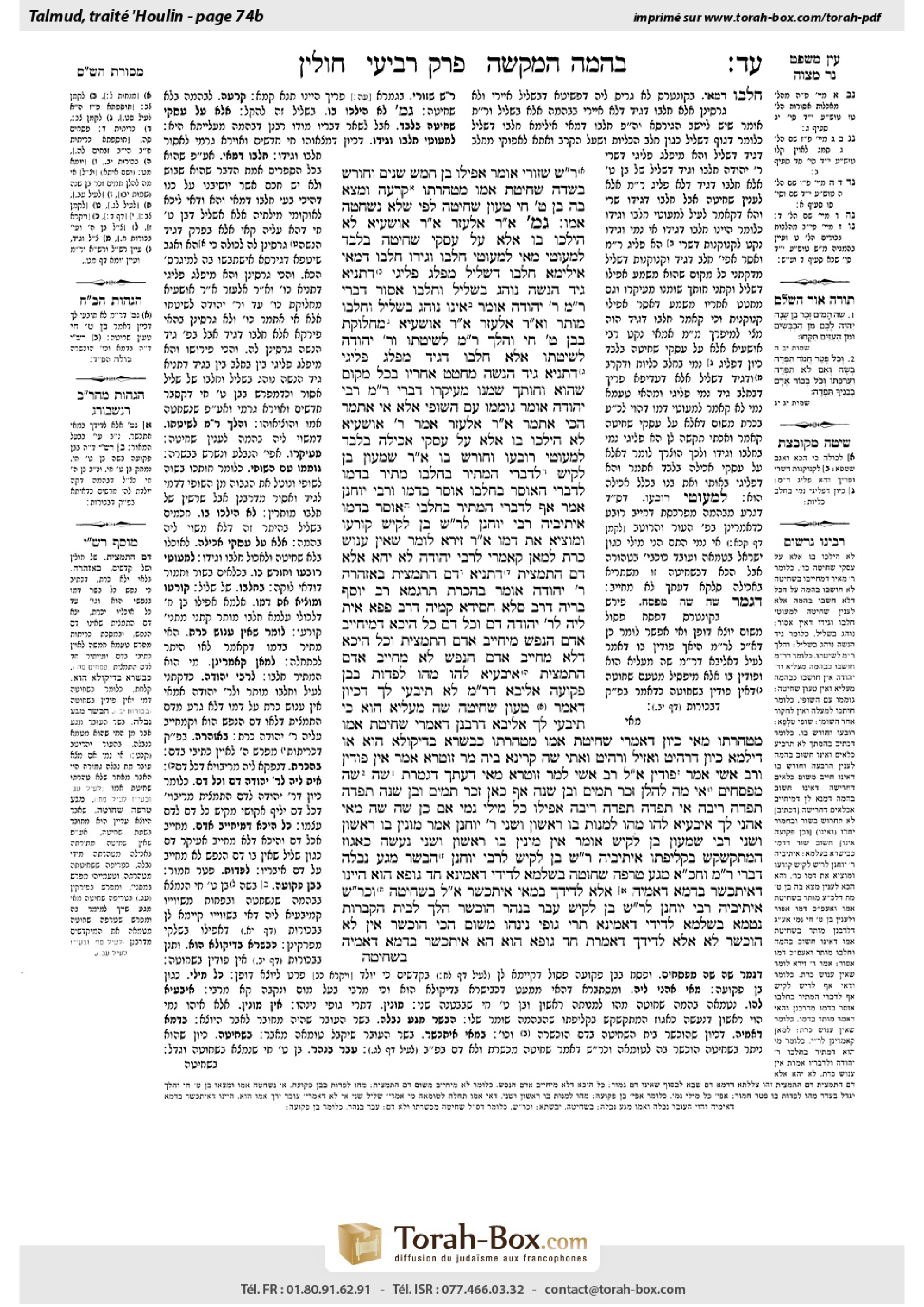
Chullin 74b: Talmud study for Daf Yomi
Study the Talmud for Daf Yomi with scanned pages, Hebrew text, English translations from Sefaria and AI-generated French translations.
Passage selection and English or AI-generated French translation are available where the scan has annotations. Daf Study is independent of Torah-Box and Sefaria.
Browse Chullin · חולין · All tractatesChullin 74b text and translations
This page of Chullin includes the Aramaic text, an English translation and an AI-generated French translation, alongside the scan above.
חולין ע״ד ב · Aramaic and Hebrew text
רַבִּי שִׁמְעוֹן שֵׁזוּרִי אוֹמֵר: אֲפִילּוּ בֶּן חָמֵשׁ שָׁנִים וְחוֹרֵשׁ בַּשָּׂדֶה – שְׁחִיטַת אִמּוֹ מְטַהַרְתּוֹ. קְרָעָהּ וּמָצָא בָּהּ בֶּן תִּשְׁעָה חַי – טָעוּן שְׁחִיטָה, לְפִי שֶׁלֹּא נִשְׁחֲטָה אִמּוֹ.
גְּמָ׳ אָמַר רַבִּי אֶלְעָזָר אָמַר רַבִּי אוֹשַׁעְיָא: לֹא הִילְּכוּ בּוֹ אֶלָּא עַל עִסְקֵי שְׁחִיטָה בִּלְבַד. לְמַעוֹטֵי מַאי? לְמַעוֹטֵי חֶלְבּוֹ וְגִידוֹ.
חֶלְבּוֹ דְּמַאי? אִילֵּימָא: חֶלְבּוֹ דִּשְׁלִיל, מִפְלָג פְּלִיגִי! דְּתַנְיָא: גִּיד הַנָּשֶׁה נוֹהֵג בַּשְּׁלִיל וְחֶלְבּוֹ אָסוּר, דִּבְרֵי רַבִּי מֵאִיר. רַבִּי יְהוּדָה אוֹמֵר: אֵינוֹ נוֹהֵג בַּשְּׁלִיל וְחֶלְבּוֹ מוּתָּר. וְאָמַר רַבִּי אֶלְעָזָר אָמַר רַבִּי אוֹשַׁעְיָא: מַחְלוֹקֶת בְּבֶן תִּשְׁעָה חַי, וְהָלַךְ רַבִּי מֵאִיר לְשִׁיטָתוֹ, וְרַבִּי יְהוּדָה לְשִׁיטָתוֹ.
אֶלָּא, חֶלְבּוֹ דְּגִיד מִפְלָג פְּלִיגִי, דְּתַנְיָא: גִּיד הַנָּשֶׁה – מְחַטֵּט אַחֲרָיו בְּכׇל מָקוֹם שֶׁהוּא, וְחוֹתֵךְ שַׁמְנוֹ מֵעִיקָּרוֹ, דִּבְרֵי רַבִּי מֵאִיר. רַבִּי יְהוּדָה אוֹמֵר: גּוֹמְמוֹ עִם הַשּׁוֹפִי.
אֶלָּא אִי אִתְּמַר – הָכִי אִתְּמַר, אָמַר רַבִּי אֶלְעָזָר אָמַר רַבִּי אוֹשַׁעְיָא: לֹא הִילְּכוּ בּוֹ אֶלָּא עַל עִסְקֵי אֲכִילָה בִּלְבַד, לְמַעוֹטֵי רוֹבְעוֹ, וְחוֹרֵשׁ בּוֹ.
אָמַר רַבִּי שִׁמְעוֹן בֶּן לָקִישׁ: לְדִבְרֵי הַמַּתִּיר בְּחֶלְבּוֹ – מַתִּיר בְּדָמוֹ, לְדִבְרֵי הָאוֹסֵר בְּחֶלְבּוֹ – אוֹסֵר בְּדָמוֹ. וְרַבִּי יוֹחָנָן אָמַר: אַף לְדִבְרֵי הַמַּתִּיר בְּחֶלְבּוֹ – אוֹסֵר בְּדָמוֹ.
אֵיתִיבֵיהּ רַבִּי יוֹחָנָן לְרַבִּי שִׁמְעוֹן בֶּן לָקִישׁ: קוֹרְעוֹ וּמוֹצִיא אֶת דָּמוֹ. אָמַר רַבִּי זֵירָא: לוֹמַר שֶׁאֵין עָנוּשׁ כָּרֵת.
לְמַאן קָאָמְרִי? לְרַבִּי יְהוּדָה, לֹא יְהֵא אֶלָּא דַּם הַתַּמְצִית, דְּתַנְיָא: דַּם הַתַּמְצִית בְּאַזְהָרָה, רַבִּי יְהוּדָה אוֹמֵר: בְּהִכָּרֵת.
תַּרְגְּמָא רַב יוֹסֵף בְּרֵיהּ דְּרַב סַלָּא חֲסִידָא קַמֵּיהּ דְּרַב פָּפָּא: אִית לֵיהּ לְרַבִּי יְהוּדָה ״דָּם״ וְ״כׇל דָּם״, כֹּל הֵיכָא דְּמִיחַיַּיב אַדַּם הַנֶּפֶשׁ – מִיחַיַּיב אַדַּם הַתַּמְצִית, וְכֹל הֵיכָא דְּלָא מִחַיַּיב אַדַּם הַנֶּפֶשׁ – לָא מִחַיַּיב אַדַּם הַתַּמְצִית.
אִיבַּעְיָא לְהוּ: מַהוּ לִפְדּוֹת בְּבֶן פְּקוּעָה? אַלִּיבָּא דְּרַבִּי מֵאִיר לָא תִּיבְּעֵי לָךְ, דְּכֵיוָן דְּאָמַר טָעוּן שְׁחִיטָה – שֶׂה מְעַלְּיָא הוּא.
כִּי תִּיבְּעֵי לָךְ אַלִּיבָּא דְּרַבָּנַן, דְּאָמְרִי: שְׁחִיטַת אִמּוֹ מְטַהַרְתּוֹ, מַאי? כֵּיוָן דְּאָמְרִי שְׁחִיטַת אִמּוֹ מְטַהַרְתּוֹ – כְּבִשְׂרָא בְּדִיקּוּלָא הוּא, אוֹ דִילְמָא, כֵּיוָן דְּרָהֵיט וְאָזֵיל וְרָהֵיט וְאָתֵי – ״שֶׂה״ קָרֵינָא בֵּיהּ?
מָר זוּטְרָא אָמַר: אֵין פּוֹדִין, וְרַב אָשֵׁי אָמַר: פּוֹדִין.
אֲמַר לֵיהּ רַב אָשֵׁי לְמָר זוּטְרָא: מַאי דַּעְתָּךְ? דְּגָמְרַתְּ ״שֶׂה״ ״שֶׂה״ מִפְּסָחִים?
אִי מָה לְהַלָּן – זָכָר, תָּמִים, וּבֶן שָׁנָה, אַף כָּאן – זָכָר, תָּמִים, וּבֶן שָׁנָה! ״תִּפְדֶּה״ ״תִּפְדֶּה״ רִיבָּה.
אִי ״תִּפְדֶּה״ ״תִּפְדֶּה״ רִיבָּה, אֲפִילּוּ כֹּל מִילֵּי נָמֵי, אִם כֵּן ״שֶׂה״ ״שֶׂה״ מַאי אַהֲנִי לָךְ?
אִיבַּעְיָא לְהוּ: מַהוּ לִמְנוֹת בּוֹ רִאשׁוֹן וְשֵׁנִי?
רַבִּי יוֹחָנָן אָמַר: מוֹנִין בּוֹ רִאשׁוֹן וְשֵׁנִי. רַבִּי שִׁמְעוֹן בֶּן לָקִישׁ אוֹמֵר: אֵין מוֹנִין בּוֹ רִאשׁוֹן וְשֵׁנִי, נַעֲשָׂה כֶּאֱגוֹז הַמִּתְקַשְׁקֵשׁ בִּקְלִיפָּתוֹ.
אֵיתִיבֵיהּ רַבִּי שִׁמְעוֹן בֶּן לָקִישׁ לְרַבִּי יוֹחָנָן: הַבָּשָׂר מַגַּע נְבֵלָה – דִּבְרֵי רַבִּי מֵאִיר.
וַחֲכָמִים אוֹמְרִים: מַגַּע טְרֵפָה שְׁחוּטָה.
בִּשְׁלָמָא לְדִידִי, דְּאָמֵינָא חַד גּוּפָא הוּא – הַיְינוּ דְּאִיתַּכְשַׁר בִּדְמָא דְּאִמֵּיהּ, אֶלָּא לְדִידָךְ, בְּמַאי אִיתַּכְשַׁר?
אֲמַר לֵיהּ: בִּשְׁחִיטָה, וּכְרַבִּי שִׁמְעוֹן.
אֵיתִיבֵיהּ רַבִּי יוֹחָנָן לְרַבִּי שִׁמְעוֹן בֶּן לָקִישׁ: עָבַר בְּנָהָר – הוּכְשַׁר, הָלַךְ לְבֵית הַקְּבָרוֹת – נִטְמָא.
בִּשְׁלָמָא לְדִידִי דְּאָמֵינָא תְּרֵי גּוּפֵי נִינְהוּ, מִשּׁוּם הָכִי: הוּכְשַׁר – אִין, לֹא הוּכְשַׁר – לָא, אֶלָּא לְדִידָךְ דְּאָמְרַתְּ חַד גּוּפָא הוּא, הָא אִיתַּכְשַׁר בִּדְמָא דְּאִמֵּיהּ!
Chullin 74b · English translation
Rabbi Shimon Shezuri says: Even if the fetus emerged alive and is now five years old and plowing in the field, the earlier slaughter of its mother rendered it permitted and it does not require slaughter before it is eaten. But if one tore an animal, i.e., he killed it without slaughtering it, and inside he found a live nine-month-old fetus, everyone agrees that the fetus requires its own slaughter because its mother was not slaughtered.
GEMARA: Rabbi Elazar says that Rabbi Oshaya says: The Sages discussed the permissibility of a live nine-month-old fetus found inside a slaughtered animal only with regard to the matter of whether it requires its own slaughter. The Gemara asks: What does Rav Oshaya’s statement serve to exclude? Rav Oshaya’s statement indicates that with regard to other matters all agree that it is considered an independent animal, with the associated prohibitions. The Gemara suggests: It serves to exclude its fat, i.e., the fats that are prohibited in a regular animal, such as the fat of the kidneys and innards, and its sciatic nerve.
The Gemara asks: The fat of which part? If we say that this is referring to the fat of the fetus, that is difficult because the Sages disagree as to whether or not it is permitted, as it is taught in a baraita: The prohibition of the sciatic nerve applies to a fetus and its fat is prohibited; this is the statement of Rabbi Meir. Rabbi Yehuda says: The prohibition of the sciatic nerve does not apply to a fetus, and its fat is permitted. And Rabbi Elazar says that Rabbi Oshaya says: This dispute concerns a live nine-month-old fetus, and Rabbi Meir follows his standard line of reasoning, which he expressed in the mishna, that such a fetus is considered an independent full-fledged animal; and Rabbi Yehuda follows his standard line of reasoning, as expressed by the Rabbis in the mishna, that such a fetus is considered a part of the mother.
Rather, say that Rabbi Elazar is referring to the fat of the sciatic nerve of the fetus, which all agree is permitted. The Gemara rejects this as well: But the Sages also disagree with regard to that, as it is taught in a baraita: With regard to the sciatic nerve, one scrapes around it to remove it entirely in any place that it is found in the thigh, and one cuts out its fat completely, even those fats that are sunk into the flesh; this is the statement of Rabbi Meir. Rabbi Yehuda says: One cuts out the nerve and the fat that is level with the flesh of the thigh, but there is no obligation to remove all traces of the fat.
Rather, if Rabbi Oshaya’s statement was stated, it was stated like this: Rabbi Elazar says that Rabbi Oshaya says: The Sages discussed the permissibility of the fetus only with regard to matters of consumption, i.e., whether or not it must be slaughtered in order to permit its flesh and whether or not the fat and the sciatic nerve are permitted. This statement serves to exclude only one who copulates with the animal, or one who plows with it together with an animal of a different species, as everyone agrees that these prohibitions apply to such a fetus just as they do to any other animal.
§ A related amoraic dispute is cited concerning a live nine-month-old fetus found inside a slaughtered animal: Rabbi Shimon ben Lakish said: According to the statement of Rabbi Yehuda, who permits the fat, he also permits its blood; according to the statement of Rabbi Meir, who prohibits its fat, he also prohibits its blood. And Rabbi Yoḥanan said: Even according to Rabbi Yehuda, who permits its fat, he prohibits its blood.
Rabbi Yoḥanan raised an objection to Rabbi Shimon ben Lakish from the mishna, which states with regard to an eight-month-old fetus, whether alive or dead, or a dead nine-month-old fetus, found inside a slaughtered animal, that since it is considered part of the mother its blood is prohibited. Therefore, one must tear the fetus and remove its blood before it may be consumed. The mishna prohibits the blood but apparently permits the rest of the fetus, including its fat, which contradicts the opinion of Rabbi Shimon ben Lakish. In resolution of this difficulty, Rabbi Zeira said: Rabbi Shimon ben Lakish meant to say only that the consumption of blood lost as the fetus died is not punishable by excision from the World-to-Come [karet], whereas Rabbi Yoḥanan holds that it is.
The Gemara clarifies: According to whom did Rabbi Shimon ben Lakish state that one who permits the fat of the fetus also holds that the consumption of its blood is not punishable by karet? Ostensibly, it is according to the opinion of Rabbi Yehuda, who permits its fat. But that is difficult, because this blood should be regarded only as blood of exudate, i.e., blood that exudes from the neck of the animal after the initial spurt of its slaughter concludes. This blood did not spurt out during the slaughter of the mother. Rabbi Yehuda holds that consumption of even this blood is punishable by karet, as it is taught in a baraita: The consumption of blood of exudate is prohibited by a regular prohibition and is punishable with lashes, unlike the initial spurt of blood, known as blood of the soul, whose consumption is punishable by karet. Rabbi Yehuda says: Blood of exudate is also punishable by karet.
Rav Yosef, son of Rav Salla the Pious, interpreted this matter before Rav Pappa: One of the verses prohibiting the consumption of blood states: “And whoever…eats any blood, and I will set My face against that soul that eats the blood, and will cut him off from among his people” (Leviticus 17:10). Rabbi Yehuda holds that since it would have been sufficient for the verse to state: Blood, but instead it states: “Any blood,” it is interpreted as teaching that wherever one is liable for karet for the consumption of blood of the soul, i.e., the initial spurt from the slaughter, as is the halakha with regard to a regular animal, one is also liable for karet for the consumption of blood of exudate, i.e., the rest of the blood. But wherever one is not liable for karet for the consumption of blood of the soul, as is the halakha with regard to the blood of a fetus according to Rabbi Yehuda, who holds that the fetus is not considered an independent life, one is also not liable for karet for the consumption of blood of exudate; rather, its blood is subject to a regular prohibition.
§ A dilemma was raised before the Sages: What is the halakha with regard to redeeming a firstborn donkey with a ben pekua? Can one perform the mitzva, as stated in the Torah: “And every firstborn of a donkey you shall redeem with a lamb” (Exodus 13:13), with this animal? The Gemara elaborates: According to the opinion of Rabbi Meir do not raise the dilemma, as, since he says a ben pekua requires slaughter, evidently it is a full-fledged lamb, and therefore it can certainly be used to redeem a donkey.
When should you raise the dilemma? Raise it according to the opinion of the Rabbis, as they say that the slaughter of its mother renders it permitted. What is the halakha in this case? Does one say that since the Rabbis say that the slaughter of its mother renders it permitted, it is apparent that despite being physically alive, a ben pekua is halakhically regarded like meat placed in a pot, which cannot be used to redeem a donkey (see Bekhorot 12a)? Or perhaps, since the animal is running back and forth, i.e., it is alive, we call it a lamb and it can be used?
Mar Zutra said: One cannot redeem a donkey with this lamb, and Rav Ashi said: One can redeem it.
Rav Ashi said to Mar Zutra: What is the reason for your opinion? Is it because you derive the halakhot of redeeming a firstborn donkey from Paschal offerings by means of a verbal analogy between the term “lamb” (Exodus 13:13) written concerning a firstborn donkey and “lamb” (Exodus 12:5) written concerning a Paschal offering, and a ben pekua is unfit for sacrifice as a Paschal offering?
If so, just as there, with regard to the Paschal offering, it must be male, unblemished, and in its first year, so too here, the lamb must be male, unblemished, and in its first year. Yet the mishna in Bekhorot (9a) states explicitly that one may redeem with a female lamb, and even if it is blemished, and also with one that is past its first year. Mar Zutra responded: The repetition of the words “You shall redeem,” “You shall not redeem” written in the verse: “And every firstborn of a donkey you shall redeem with a lamb, and if you shall not redeem it then you shall break its neck” (Exodus 13:13), included a lamb that does not fulfill these criteria.
Rav Ashi responds: If the repetition of “You shall redeem,” “You shall not redeem” serves to amplify, then it should even amplify all other types of lambs, including a ben pekua, i.e., they should also be included in the category of those that are fit for redemption. Mar Zutra answers: If that was so, what purpose would the verbal analogy of “lamb,” “lamb” serve? Rather, the repetition of “You shall redeem” serves to include all types of lambs, but the verbal analogy still serves to exclude a ben pekua.
§ A dilemma was raised before the Sages: According to the Rabbis, a ben pekua is permitted for consumption and is therefore susceptible to ritual impurity. If the ben pekua was still inside the slaughtered mother and the body of the mother came in contact with a primary source of ritual impurity, what is the halakha with regard to counting the mother as having first-degree ritual impurity and the ben pekua as having second-degree ritual impurity? If the fetus is considered independent of the mother, it is rendered impure only through its contact with the mother and so would have second-degree impurity. But if it is considered part of the mother it would have the same first-degree impurity as the mother.
Rabbi Yoḥanan says: One counts the mother as having first-degree impurity and the ben pekua as having second-degree impurity. Rabbi Shimon ben Lakish says: One does not count the mother as having first-degree impurity and the ben pekua as having second-degree impurity. Rather, the fetus has first-degree impurity like its mother, as it is considered like a nut rattling in its shell; this is considered a single entity such that if impurity touches the shell, both the nut and the shell are rendered impure with the same degree of impurity.
Rabbi Shimon ben Lakish raised an objection to Rabbi Yoḥanan from the mishna (72a): If a fetus extended its foreleg outside its mother’s womb and then the mother was slaughtered, and afterward the foreleg was severed, the flesh of both the mother and the fetus are ritually impure due to having been in contact with a carcass. Since the foreleg was not permitted through an act of slaughter it is regarded as a carcass with the associated ritual impurity. The rest of the flesh, which was permitted, was in contact with it and was thereby rendered ritually impure; this is the statement of Rabbi Meir.
And the Rabbis say: The flesh has the ritual impurity of having been in contact with a tereifa that was slaughtered. The limb is regarded as a tereifa that was slaughtered, which by Torah law is prohibited for consumption but does not carry ritual impurity. Nevertheless, the Sages decreed that if a tereifa was slaughtered and then came in contact with another item, the other item should be regarded as ritually impure to the extent that it will disqualify sacrificial foods that come in contact with it.
Rabbi Shimon ben Lakish explains his objection: Granted, according to my opinion, as I say that the mother and fetus together are one entity; that is why the flesh of the fetus is rendered susceptible to ritual impurity through the blood of its mother that spilled onto the body of the mother. When the blood from the mother’s slaughter renders the mother susceptible to impurity, the fetus is also rendered susceptible to impurity, as it is considered part of the mother. But according to your opinion, that the fetus is an independent entity, through what means is it rendered susceptible to contracting impurity from its foreleg?
Rabbi Yoḥanan said to Rabbi Shimon ben Lakish: It is rendered susceptible through the slaughter of its mother, which also permits the consumption of the fetus, and this is in accordance with the opinion of Rabbi Shimon, who maintains that the flesh of a slaughtered animal is rendered susceptible to ritual impurity by virtue of the fact that it is permitted for consumption, even if it did not come in contact with blood or one of the other six liquids. Accordingly, the fetus will be susceptible to impurity even if it is not considered part of its mother.
Rabbi Yoḥanan raised an objection to Rabbi Shimon ben Lakish from a baraita: If a ben pekua grew up and passed through a river, it was thereby rendered susceptible to impurity. Therefore, if it went from there to a cemetery, it is rendered impure.
Rabbi Yoḥanan explains his objection: Granted, according to my opinion, as I say that the mother and fetus are two entities; it is due to that reason that only if the ben pekua itself has been rendered susceptible to impurity by coming in contact with the water of the river, yes, it can be rendered impure upon entering a cemetery, whereas if it has not been rendered susceptible to impurity through these waters, no, it does not become impure when it enters a cemetery. But according to your opinion, in which you said that the mother and fetus together are one entity, why is it necessary for it to have passed through a river? It was already rendered susceptible to impurity through the blood of its mother that spilled onto the mother’s body when it was slaughtered.
Chullin 74b · Traduction française (IA)
Rabbi Shimon Shezuri dit : Même si le fœtus est né vivant et est maintenant âgé de cinq ans et laboure le champ, la mise à mort précoce de sa mère l'a rendu permis et il ne nécessite pas d'être sacrifié avant d'être mangé. Mais si l'on a tué un animal, c'est-à-dire qu'on l'a tué sans le sacrifier, et qu'on a trouvé à l'intérieur un fœtus vivant de neuf mois, tous s'accordent sur le fait que le fœtus nécessite sa propre mise à mort car sa mère n'a pas été sacrifiée.
GUEMARA : Rabbi Elazar dit que Rabbi Oshaya dit : Les Sages ont discuté de la permisssibilité d'un fœtus vivant de neuf mois trouvé à l'intérieur d'un animal sacrifié uniquement en ce qui concerne la question de savoir s'il nécessite sa propre mise à mort. La Guemara pose la question : À quoi sert la déclaration de Rabbi Oshaya ? La déclaration de Rabbi Oshaya indique que concernant d'autres matières, tous s'accordent sur le fait qu'il est considéré comme un animal indépendant, avec les interdits associés. La Guemara suggère : Elle sert à exclure sa graisse, c'est-à-dire les graisses interdites dans un animal ordinaire, comme la graisse des reins et des viscères, et son nerf sciatique.
La Guemara pose la question : De quelle partie s'agit-il ? Si nous disons que cela fait référence à la graisse du fœtus, cela est difficile car les Sages s'entendent sur le fait qu'il est permis ou non, comme il est enseigné dans une baraïta : L'interdiction du nerf sciatique s'applique à un fœtus et sa graisse est interdite ; c'est l'opinion de Rabbi Meir. Rabbi Yehuda dit : L'interdiction du nerf sciatique ne s'applique pas à un fœtus et sa graisse est permise. Et Rabbi Elazar dit que Rabbi Oshaya dit : Ce débat concerne un fœtus vivant de neuf mois, et Rabbi Meir suit sa ligne de raisonnement habituelle, celle qu'il a exprimée dans la mitsna, selon laquelle ce fœtus est considéré comme un animal indépendant et complet ; et Rabbi Yehuda suit sa ligne de raisonnement habituelle, comme exprimée par les Rabbins dans la mitsna, selon laquelle ce fœtus est considéré comme une partie de la mère.
Plutôt, disons que Rabbi Elazar fait référence à la graisse du nerf sciatique du fœtus, que tous s'accordent à dire qu'elle est permise. La Guemara rejette cela également : Mais les Sages s'entendent aussi sur ce point, comme il est enseigné dans une baraïta : Concernant le nerf sciatique, on enlève entièrement autour de lui dans tout endroit où il est trouvé dans la cuisse, et on enlève entièrement sa graisse, même celles qui sont enfoncées dans la chair ; c'est l'opinion de Rabbi Meir. Rabbi Yehuda dit : On enlève le nerf et la graisse qui est au niveau de la chair de la cuisse, mais il n'y a pas d'obligation d'enlever toutes les traces de graisse.
Plutôt, si la déclaration de Rabbi Oshaya a été faite, elle a été faite ainsi : Rabbi Elazar dit que Rabbi Oshaya dit : Les Sages ont discuté de la permisssibilité du fœtus uniquement en ce qui concerne les matières de consommation, c'est-à-dire si il faut le sacrifier pour permettre sa chair et si sa graisse et son nerf sciatique sont permis. Cette déclaration sert à exclure seulement celui qui a des relations sexuelles avec l'animal, ou celui qui le laboure avec un animal d'une autre espèce, car tous s'accordent sur le fait que ces interdits s'appliquent à ce fœtus comme à tout autre animal.
§ Un débat entre les amoraïm est cité concernant un fœtus vivant de neuf mois trouvé à l'intérieur d'un animal sacrifié : Rabbi Shimon ben Lakish dit : Selon l'opinion de Rabbi Yehuda, qui permet la graisse, il permet aussi son sang ; selon l'opinion de Rabbi Meir, qui interdit sa graisse, il interdit aussi son sang. Et Rabbi Yoḥanan dit : Même selon l'opinion de Rabbi Yehuda, qui permet sa graisse, il interdit son sang.
Rabbi Yoḥanan a soulevé une objection contre Rabbi Shimon ben Lakish à partir de la mitsna, qui stipule concernant un fœtus de huit mois, vivant ou mort, ou un fœtus mort de neuf mois, trouvé à l'intérieur d'un animal sacrifié, que puisque c'est considéré comme une partie de la mère, son sang est interdit. Ainsi, il faut déchirer le fœtus et enlever son sang avant de le consommer. La mitsna interdit le sang mais semble permettre le reste du fœtus, y compris sa graisse, ce qui contredit l'opinion de Rabbi Shimon ben Lakish. Pour résoudre cette difficulté, Rabbi Zeira a dit : Rabbi Shimon ben Lakish voulait dire seulement que la consommation du sang perdu lorsque le fœtus est mort n'est pas punissable par l'exil du monde à venir [karet], tandis que Rabbi Yoḥanan considère qu'il l'est.
La Guemara clarifie : Selon quel avis Rabbi Shimon ben Lakish a-t-il dit que celui qui permet la graisse du fœtus considère aussi que la consommation de son sang n'est pas punissable par karet ? Apparemment, c'est selon l'opinion de Rabbi Yehuda, qui permet sa graisse. Mais cela est difficile, car ce sang devrait être considéré uniquement comme du sang d'exsudation, c'est-à-dire du sang qui s'exsude du cou de l'animal après la première émission de sa mise à mort. Ce sang n'a pas été émis lors de la mise à mort de la mère. Rabbi Yehuda considère que la consommation même de ce sang est punissable par karet, comme il est enseigné dans une baraïta : La consommation du sang d'exsudation est interdite par une interdiction ordinaire et est punissable par des fessures, contrairement à l'émission initiale du sang, connue comme le sang de l'âme, dont la consommation est punissable par karet. Rabbi Yehuda dit : Le sang d'exsudation est aussi punissable par karet.
Rav Yosef, fils de Rav Salla le Juste, a interprété cette question devant Rav Pappa : L'une des versets interdisant la consommation du sang dit : « Et celui qui… mange tout sang, et je mettrai mon visage contre l'âme qui mange le sang, et je le ferai périr parmi son peuple » (Lévitique 17:10). Rabbi Yehuda affirme que puisque le verset aurait suffi à dire : « Sang », mais qu'il dit plutôt : « Tout sang », cela signifie qu'il enseigne que là où l'on est puni de karet pour la consommation du sang de l'âme, c'est-à-dire le premier jet du sacrifice, comme c'est la halakha concernant un animal ordinaire, on est également puni de karet pour la consommation du sang de l'exsudat, c'est-à-dire le reste du sang. Mais là où l'on n'est pas puni de karet pour la consommation du sang de l'âme, comme c'est la halakha concernant le sang d'un fœtus selon Rabbi Yehuda, qui considère que le fœtus n'est pas une vie indépendante, on n'est pas non plus puni de karet pour la consommation du sang de l'exsudat ; plutôt, son sang est soumis à une interdiction ordinaire.
§ Un dilemme a été soulevé devant les Sages : Quelle est la halakha concernant la délivrance d'un âne premier-né avec un ben pekua ? Peut-on accomplir la mitsva, comme dit la Torah : « Et chaque premier-né d'un âne tu le délivreras avec un agneau » (Ex 13:13), avec cet animal ? La Guemara développe : Selon l'opinion de Rabbi Meir, on ne soulève pas ce dilemme, car, puisque selon lui un ben pekua nécessite la mise à mort, il s'agit clairement d'un agneau complet, et donc il peut certainement être utilisé pour délivrer un âne.
Quand faut-il soulever ce dilemme ? Soulevez-le selon l'opinion des Rabbins, car ils disent que la mise à mort de sa mère le rend permis. Quelle est la halakha dans ce cas ? Dit-on que puisque les Rabbins disent que la mise à mort de sa mère le rend permis, il est évident que malgré être physiquement vivant, un ben pekua est halakhiquement considéré comme de la viande placée dans une marmite, ce qui ne peut être utilisé pour délivrer un âne (voir Bekhorot 12a) ? Ou bien, puisque l'animal court de-ci de-là, c'est-à-dire qu'il est vivant, on l'appelle un agneau et il peut être utilisé ?
Mar Zutra dit : On ne peut pas délivrer un âne avec ce agneau, et Rav Ashi dit : On peut le délivrer.
Rav Ashi dit à Mar Zutra : Quel est le motif de votre opinion ? Est-ce parce que vous dérivez les halakhot de la délivrance d'un âne premier-né des offrandes pascal par analogie verbale entre le terme « agneau » (Exode 13:13) concernant un âne premier-né et « agneau » (Exode 12:5) concernant une offrande pascal, et un ben pekua n'est pas adapté à l'offrande pascal ?
Si c'est ainsi, tout comme là, concernant l'offrande pascal, il doit être mâle, sans défaut, et de son premier âge, ainsi ici, l'agneau doit être mâle, sans défaut, et de son premier âge. Cependant, la mishna dans Bekhorot (9a) affirme explicitement qu'on peut délivrer avec une agnelle, même si elle est déficiente, et même si elle est passée de son premier âge. Mar Zutra répondit : La répétition des mots « Tu délivreras », « Tu ne délivreras pas » écrites dans le verset : « Et chaque premier-né d'un âne tu le délivreras avec un agneau, et si tu ne le délivreras pas, tu briseras son cou » (Exode 13:13), inclut un agneau qui ne remplit pas ces critères.
Rav Ashi répondit : Si la répétition de « Tu délivreras », « Tu ne délivreras pas » sert à élargir, alors elle devrait même élargir tous les autres types d'agneaux, y compris un ben pekua, c'est-à-dire qu'ils devraient également être inclus dans la catégorie de ceux qui sont aptes à la délivrance. Mar Zutra répondit : Si c'était ainsi, à quel usage servirait l'analogie verbale de « agneau », « agneau » ? Plutôt, la répétition de « Tu délivreras » sert à inclure tous les types d'agneaux, mais l'analogie verbale sert encore à exclure un ben pekua.
§ Un dilemme a été soulevé devant les Sages : Selon les Rabbins, un ben pekua est permis à la consommation et donc susceptible de souillure rituelle. Si le ben pekua était encore à l'intérieur de la mère tuée et que le corps de la mère a été en contact avec une source principale de souillure rituelle, quelle est la halakha concernant le comptage de la mère comme ayant une souillure rituelle de premier degré et du ben pekua comme ayant une souillure rituelle de deuxième degré ? Si le fœtus est considéré comme indépendant de la mère, il est rendu souillé uniquement par son contact avec la mère et aurait donc une souillure rituelle de deuxième degré. Mais si on le considère comme faisant partie de la mère, il aurait la même souillure rituelle de premier degré que la mère.
Rabbi Yoḥanan dit : On compte la mère comme ayant une souillure rituelle de premier degré et le ben pekua comme ayant une souillure rituelle de deuxième degré. Rabbi Shimon ben Lakish dit : On ne compte pas la mère comme ayant une souillure rituelle de premier degré et le ben pekua comme ayant une souillure rituelle de deuxième degré. Plutôt, le fœtus a une souillure rituelle de premier degré comme sa mère, car il est considéré comme un noyau qui vibre dans sa coque ; cela est considéré comme une entité unique telle que si la souillure touche la coque, à la fois le noyau et la coque sont rendus souillés avec le même degré de souillure.
Rabbi Shimon ben Lakish a soulevé une objection contre Rabbi Yoḥanan à partir de la mishna (72a) : Si un fœtus avait étendu son avant-bras en dehors du ventre de sa mère et ensuite la mère avait été tuée, et ensuite l'avant-bras avait été séparé, la chair de la mère et du fœtus est souillée rituellement en raison d'avoir été en contact avec un cadavre. Puisque l'avant-bras n'était pas permis par un acte de sacrifice, il est considéré comme un cadavre avec la souillure rituelle associée. La chair restante, qui était permise, a été en contact avec elle et a donc été rendue souillée rituellement ; c'est l'opinion de Rabbi Meir.
Et les Sages disent : La viande est souillée par contact avec un tereifa qui a été tué. Le membre est considéré comme un tereifa tué, qui est interdit à la consommation selon la loi divine, mais ne transmet pas la souillure rituelle. Cependant, les Sages ont décrété que si un tereifa a été tué et est ensuite entré en contact avec un autre objet, cet autre objet doit être considéré comme souillé rituellement à tel point qu'il rend impur les aliments sacrés qui en viennent en contact.
Rabbi Shimon ben Lakish explique son objection : C'est vrai, selon mon opinion, car je dis que la mère et le fœtus sont une seule entité ; c'est pourquoi la viande du fœtus est rendue susceptible de souillure par le sang de sa mère qui s'est échappé du corps de la mère. Lorsque le sang de la mort de la mère rend la mère souillée, le fœtus est également rendu susceptible de souillure, car il est considéré comme faisant partie de la mère. Mais selon votre opinion, où vous dites que le fœtus est une entité indépendante, par quel moyen est-il rendu susceptible de contracter la souillure à partir de son avant-bras ?
Rabbi Yoḥanan dit à Rabbi Shimon ben Lakish : Il est rendu susceptible par la mort de sa mère, ce qui permet également la consommation du fœtus, et cela correspond à l'opinion de Rabbi Shimon, qui affirme que la viande d'un animal sacrifié est rendue susceptible de souillure par le fait qu'elle est permise à la consommation, même si elle n'a pas été en contact avec le sang ou l'un des six autres liquides. Ainsi, le fœtus sera susceptible de souillure même s'il n'est pas considéré comme faisant partie de sa mère.
Rabbi Yoḥanan souleva une objection contre Rabbi Shimon ben Lakish à partir d'une baraïta : Si un ben pekua a grandi et a traversé un fleuve, il est ainsi rendu susceptible de souillure. Par conséquent, s'il arrive ensuite dans un cimetière, il devient impur.
Rabbi Yoḥanan explique son objection : C'est vrai, selon mon opinion, car je dis que la mère et le fœtus sont deux entités ; c'est pour cette raison que seul si le ben pekua lui-même est rendu susceptible de souillure par contact avec l'eau du fleuve, oui, il peut devenir impur en entrant dans un cimetière, tandis que si ce n'est pas le cas, non, il ne devient pas impur en entrant dans un cimetière. Mais selon votre opinion, où vous avez dit que la mère et le fœtus sont une seule entité, pourquoi a-t-il fallu qu'il traverse un fleuve ? Il était déjà rendu susceptible de souillure par le sang de sa mère qui s'était échappé du corps de la mère lors de sa mort.
Traduction française générée par IA à partir de l’édition anglaise de Sefaria. Vérifie toujours un passage avec le texte source.
Text from Sefaria: William Davidson Edition - Vocalized Aramaic (unknown); William Davidson Edition - English (CC BY NC).