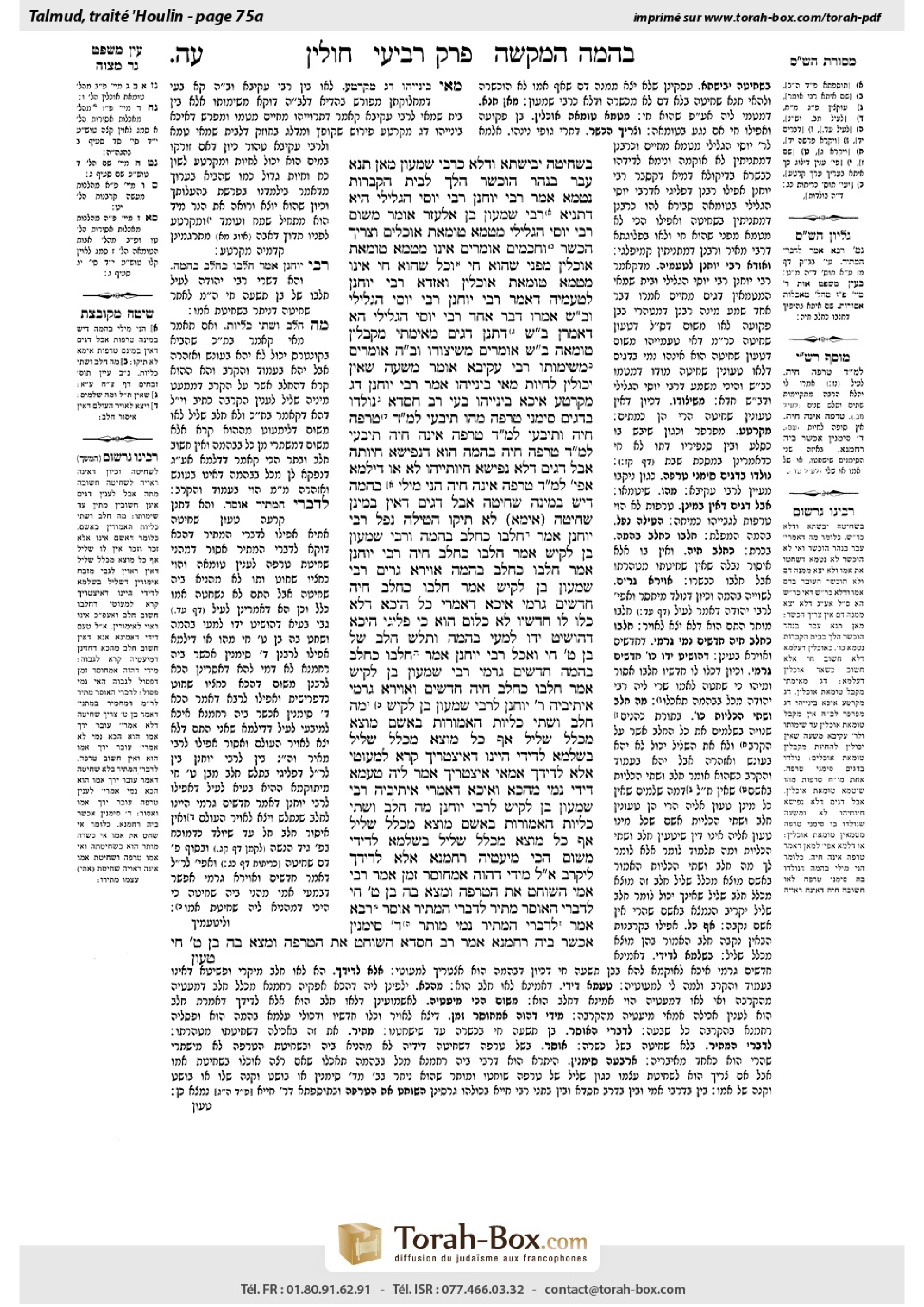
Chullin 75a: Talmud study for Daf Yomi
Study the Talmud for Daf Yomi with scanned pages, Hebrew text, English translations from Sefaria and AI-generated French translations.
Passage selection and English or AI-generated French translation are available where the scan has annotations. Daf Study is independent of Torah-Box and Sefaria.
Browse Chullin · חולין · All tractatesChullin 75a text and translations
This page of Chullin includes the Aramaic text, an English translation and an AI-generated French translation, alongside the scan above.
חולין ע״ה א · Aramaic and Hebrew text
בִּשְׁחִיטָה יַבִּישְׁתָּא, וּדְלָא כְּרַבִּי שִׁמְעוֹן.
מַאן תַּנָּא עָבַר בְּנָהָר הוּכְשַׁר, הָלַךְ לְבֵית הַקְּבָרוֹת נִטְמָא? אָמַר רַבִּי יוֹחָנָן: רַבִּי יוֹסֵי הַגְּלִילִי הִיא, דְּתַנְיָא: רַבִּי שִׁמְעוֹן בֶּן אֶלְעָזָר אוֹמֵר מִשּׁוּם רַבִּי יוֹסֵי הַגְּלִילִי: מְטַמֵּא טוּמְאַת אֳכָלִים, וְצָרִיךְ הֶכְשֵׁר. וַחֲכָמִים אוֹמְרִים: אֵינוֹ מְטַמֵּא טוּמְאַת אֳכָלִין, מִפְּנֵי שֶׁהוּא חַי, וְכׇל שֶׁהוּא חַי אֵינוֹ מְטַמֵּא טוּמְאַת אֳכָלִין.
וְאַזְדָּא רַבִּי יוֹחָנָן לְטַעְמֵיהּ, דְּאָמַר רַבִּי יוֹחָנָן: רַבִּי יוֹסֵי הַגְּלִילִי וּבֵית שַׁמַּאי אָמְרוּ דָּבָר אֶחָד.
רַבִּי יוֹסֵי הַגְּלִילִי – הָא דַּאֲמַרַן. בֵּית שַׁמַּאי, דִּתְנַן: דָּגִים, מֵאֵימָתַי מְקַבְּלִין טוּמְאָה? בֵּית שַׁמַּאי אוֹמְרִים: מִשֶּׁיִּצּוֹדוּ, וּבֵית הִלֵּל אוֹמְרִים: מִשֶּׁיָּמוּתוּ. רַבִּי עֲקִיבָא אוֹמֵר: מִשָּׁעָה שֶׁאֵין יְכוֹלִין לִחְיוֹת.
מַאי בֵּינַיְיהוּ? אָמַר רַבִּי יוֹחָנָן: דָּג מְקַרְטֵעַ אִיכָּא בֵּינַיְיהוּ.
בָּעֵי רַב חִסְדָּא: נוֹלְדוּ בְּדָגִים סִימָנֵי טְרֵפָה, מַהוּ? תִּיבְּעֵי לְמַאן דְּאָמַר טְרֵפָה חַיָּה, וְתִיבְּעֵי לְמַאן דְּאָמַר טְרֵפָה אֵינָהּ חַיָּה.
תִּיבְּעֵי לְמַאן דְּאָמַר טְרֵפָה חַיָּה, בְּהֵמָה הוּא דִּנְפִישָׁא חַיּוּתַהּ, אֲבָל דָּגִים דְּלָא נְפִישָׁא חַיּוּתַיְיהוּ – לָא, אוֹ דִילְמָא אֲפִילּוּ לְמַאן דְּאָמַר טְרֵפָה אֵינָהּ חַיָּה, הָנֵי מִילֵּי בְּהֵמָה דְּיֵשׁ בְּמִינָהּ שְׁחִיטָה, אֲבָל דָּגִים דְּאֵין בְּמִינָן שְׁחִיטָה – אֵימָא לָא. תֵּיקוּ.
הֵטִילָה נֵפֶל, רַבִּי יוֹחָנָן אָמַר: חֶלְבּוֹ כְּחֵלֶב בְּהֵמָה, וְרַבִּי שִׁמְעוֹן בֶּן לָקִישׁ אָמַר: חֶלְבּוֹ כְּחֵלֶב חַיָּה.
רַבִּי יוֹחָנָן אָמַר: חֶלְבּוֹ כְּחֵלֶב בְּהֵמָה – אַוֵּירָא גָּרֵים. רַבִּי שִׁמְעוֹן בֶּן לָקִישׁ אָמַר: חֶלְבּוֹ כְּחֵלֶב חַיָּה – חֳדָשִׁים גָּרְמִי.
אִיכָּא דְאָמְרִי: כֹּל הֵיכָא דְּלֹא כָּלוּ לוֹ חֳדָשָׁיו – לָא כְּלוּם הוּא. כִּי פְּלִיגִי – הֵיכָא דְּהוֹשִׁיט יָדוֹ לִמְעֵי בְּהֵמָה, וְתָלַשׁ חֵלֶב שֶׁל בֶּן תִּשְׁעָה חַי וְאָכַל. רַבִּי יוֹחָנָן אָמַר: חֶלְבּוֹ כְּחֵלֶב בְּהֵמָה, חֳדָשִׁים גָּרְמִי. רַבִּי שִׁמְעוֹן בֶּן לָקִישׁ אָמַר: חֶלְבּוֹ כְּחֵלֶב חַיָּה, חֳדָשִׁים וְאַוֵּירָא גָּרְמִי.
אֵיתִיבֵיהּ רַבִּי יוֹחָנָן לְרַבִּי שִׁמְעוֹן בֶּן לָקִישׁ: מָה חֵלֶב וּשְׁתֵּי כְלָיוֹת הָאֲמוּרוֹת בְּאָשָׁם – מוּצָא מִכְּלַל שְׁלִיל, אַף כֹּל – מוּצָא מִכְּלַל שְׁלִיל.
בִּשְׁלָמָא לְדִידִי, הַיְינוּ דְּאִיצְטְרִיךְ קְרָא לְמַעוֹטֵי, אֶלָּא לְדִידָךְ, אַמַּאי אִיצְטְרִיךְ? אֲמַר לֵיהּ: טַעְמָא דִּידִי נָמֵי מֵהָכָא.
וְאִיכָּא דְּאָמְרִי, אֵיתִיבֵיהּ רַבִּי שִׁמְעוֹן בֶּן לָקִישׁ לְרַבִּי יוֹחָנָן: מָה חֵלֶב וּשְׁתֵּי כְלָיוֹת הָאֲמוּרוֹת בְּאָשָׁם מוּצָא מִכְּלַל שְׁלִיל, אַף כֹּל – מוּצָא מִכְּלַל שְׁלִיל.
בִּשְׁלָמָא לְדִידִי, מִשּׁוּם הָכִי מַיעֲטֵיהּ רַחֲמָנָא, אֶלָּא לְדִידָךְ – לִיקְרַב? אֲמַר לֵיהּ: מִידֵּי דְּהָוֵה אַמְּחוּסַּר זְמַן.
אָמַר רַבִּי אַמֵּי: הַשּׁוֹחֵט אֶת הַטְּרֵפָה וּמָצָא בָּהּ בֶּן תִּשְׁעָה חַי, לְדִבְרֵי הָאוֹסֵר – מַתִּיר, לְדִבְרֵי הַמַּתִּיר – אוֹסֵר.
רָבָא אָמַר: לְדִבְרֵי הַמַּתִּיר נָמֵי מוּתָּר, אַרְבָּעָה סִימָנִין אַכְשַׁר בֵּיהּ רַחֲמָנָא.
אָמַר רַב חִסְדָּא: הַשּׁוֹחֵט אֶת הַטְּרֵפָה, וּמָצָא בָּהּ בֶּן תִּשְׁעָה חַי –
Chullin 75a · English translation
Rabbi Shimon ben Lakish answers: The baraita is referring to a case where the slaughter of the mother was dry, i.e., where no blood was emitted, and therefore, even the mother was not rendered susceptible to ritual impurity. And the baraita is not in accordance with the opinion of Rabbi Shimon, who maintains that the flesh of a slaughtered animal is rendered susceptible to ritual impurity by virtue of the fact that it is permitted for consumption, regardless of whether or not it came into contact with blood or other liquids.
The Gemara asks: Who is the tanna who taught this baraita: If a ben pekua grew up and passed through a river, it was thereby rendered susceptible to impurity, and therefore if it went from there to a cemetery, it is rendered impure? Rabbi Yoḥanan said: It is the opinion of Rabbi Yosei HaGelili, as it is taught in a baraita that Rabbi Shimon ben Elazar says in the name of Rabbi Yosei HaGelili: The flesh of a ben pekua can become impure with the ritual impurity of food, but it first needs to be rendered susceptible to ritual impurity by coming in contact with liquid. But the Rabbis say: It cannot become impure with the ritual impurity of food because it is alive, and any live animal cannot become impure with the ritual impurity of food, even if it is permitted for consumption.
The Gemara notes: And Rabbi Yoḥanan follows his standard line of reasoning, as Rabbi Yoḥanan says that Rabbi Yosei HaGelili and Beit Shammai said the same thing, i.e., they both hold that even a live animal can become impure with the ritual impurity of food.
The opinion of Rabbi Yosei HaGelili is that which we stated in the baraita. The opinion of Beit Shammai is as we learned in a mishna (Okatzin 3:8): With regard to fish, from when are they susceptible to impurity as food? Beit Shammai say: From when they are caught in a trap, as at this point they are considered food, since they do not require slaughter. And Beit Hillel say: From when they die. Rabbi Akiva says: From when they are no longer able to live.
The Gemara analyzes that mishna: What is the difference between the opinions of Rabbi Akiva and Beit Hillel? Rabbi Yoḥanan said: The difference between them is the case of a convulsing fish. Rabbi Akiva holds that such a fish can already become ritually impure, while Beit Hillel require it to have actually died.
Rav Ḥisda raises a dilemma: According to Rabbi Akiva, if symptoms of a tereifa developed in a fish, e.g., a perforation in the intestines, which will certainly result in the animal’s death (see 42a), what is the halakha? Can it already be rendered ritually impure as if it were now dead? The Gemara clarifies: One can raise this dilemma according to the one who says that an animal that is a tereifa can live, i.e., it will not necessarily die within a year, and one can raise this dilemma according to the one who says that a tereifa cannot live, but will die within a year.
The Gemara elaborates: One can raise this dilemma according to the one who says that a tereifa can live, as perhaps that opinion is limited to an animal, as an animal has a strong life force, and it could live despite such symptoms. But with regard to a fish, whose life force is not strong, all would agree that it will not survive. Or perhaps, even according to the one who says that a tereifa cannot live, it is possible that this matter, that a tereifa is regarded as dead, applies only to an animal, as the requirement to slaughter it in order to permit it for consumption applies to this type of creature, i.e., to animals, and so to invalidate its slaughter, the Torah classifies an animal that is a tereifa as though it is dead. But with regard to fish, where the requirement to slaughter it in order to permit it does not apply to this type of creature, I would say that a fish with symptoms of a tereifa is not considered as though it were dead. The Gemara concludes: The dilemma shall stand unresolved.
§ The Rabbis state in the mishna that a nine-month-old fetus is considered to be part of its mother. Therefore, when the mother is slaughtered, the entire fetus is permitted, including all its fats. The Gemara asks: If an animal expelled a non-viable newborn, what is the status of the fetus’s fat? Rabbi Yoḥanan said: Its fat is like the fat of any other domesticated animal, and one is liable to receive karet if he eats it. And Rabbi Shimon ben Lakish said: Its fat is like the fat of an undomesticated animal, which is not prohibited.
The Gemara elaborates: Rabbi Yoḥanan said: Its fat is like the fat of any other domesticated animal, as he maintains that the exit of a fetus through the airspace of the opening of the womb causes it to be regarded as an independent animal. Rabbi Shimon ben Lakish said: Its fat is like the fat of an undomesticated animal, as he maintains that the completion of the months of gestation causes a fetus to be regarded as an independent animal, and this stillborn did not reach this stage.
Some say that there is another explanation of this dispute: In any case where its months of gestation were not completed, everyone agrees that it is nothing, i.e., it is not an independent animal and its fat is not included in the prohibition of forbidden fats. When they disagree it is with regard to a case where one inserted his hand into the womb of an animal and removed the fat of a live nine-month-old fetus and ate it. Rabbi Yoḥanan said: Its fat is like the fat of any other domesticated animal, as the months of gestation alone cause it to be regarded as an independent animal. Rabbi Shimon ben Lakish said: Its fat is like the fat of an undomesticated animal, as it is the months of gestation and its exit through the airspace of the opening of the womb that together cause it to be regarded as an independent animal. Since this fetus was not yet born, it is not subject to the prohibition of forbidden fats.
Rabbi Yoḥanan raised an objection to Rabbi Shimon ben Lakish from a baraita that discusses the sacrifice of the fat surrounding a fetus inside a pregnant animal: Just as with regard to the requirement to sacrifice the fat and two kidneys (see Leviticus 7:3–4), which is stated with regard to a guilt offering, the fat of a fetus is excluded from the category of fats that one is required to sacrifice because a guilt offering is always a male, so too, with regard to every offering, even in the case of a female offering, the fat of a fetus is excluded from the category of fats that one is required to sacrifice.
Rabbi Yoḥanan explains his objection: Granted, according to my opinion that the fat of a fetus is forbidden for consumption, this is why a verse was necessary to exclude it from being sacrificed on the altar. But according to your opinion that it is not forbidden, why is a verse necessary to exclude it? Rabbi Shimon ben Lakish said to him: My explanation is also derived from the verse here, which serves as the source for the fact that the fat of a fetus is not forbidden.
And some say that there is another version of this objection in which Rabbi Shimon ben Lakish raised an objection to Rabbi Yoḥanan from that baraita: Just as with regard to the requirement to sacrifice “the fat and two kidneys” that is stated with regard to a guilt offering, the fat of a fetus is excluded from the category of fats that one is required to sacrifice, so too, with regard to every offering, the fat of a fetus is excluded from the category of fats that one is required to sacrifice.
Rabbi Shimon ben Lakish explains the objection: Granted, according to my opinion that the fat of the fetus is not prohibited like the other fats, it is due to that reason that the Merciful One excludes it from the requirement of being sacrificed. But according to your opinion, that the fat of the fetus is considered one of the forbidden fats, let it also be sacrificed. Rabbi Yoḥanan said to him: The reason that this fat is not sacrificed is just as it is with regard to an offering whose time has not yet arrived, i.e., it is not yet seven days old, which may not be sacrificed (see Leviticus 22:27) despite being of a species of animal that may be sacrificed. Similarly, with regard to the fat of the fetus, despite being included among those fats that are prohibited, it may not be sacrificed.
§ The Gemara returns to the dispute in the mishna with regard to a nine-month-old fetus found alive inside its slaughtered mother. Rabbi Meir holds that the fetus itself must be slaughtered in order to permit it, whereas the Rabbis hold that it is permitted by virtue of the slaughter of its mother. Rabbi Ami said: With regard to one who slaughtered a tereifa and found inside it a live nine-month-old fetus: According to the statement of Rabbi Meir, who prohibits a nine-month-old fetus found inside a kosher animal until it is slaughtered itself, if it is found inside a tereifa he permits the fetus once it is slaughtered itself. But according to the statement of Rabbi Yehuda, referred to as the Rabbis in the mishna, who permits a nine-month-old fetus found inside a kosher animal by virtue of the slaughter of its mother, if it is found inside a tereifa he prohibits it, even if it is slaughtered itself.
Rava said: According to the statement of Rabbi Yehuda, who permits a nine-month-old fetus found inside a kosher animal by virtue of the slaughter of its mother, he also permits it if it is found inside a tereifa, once the fetus itself is slaughtered. The reason is that the Merciful One considers four simanim to be fit for slaughter, i.e., the windpipe and gullet of the mother and those of the fetus, with the fetus being permitted by the cutting of either pair.
Rav Ḥisda said: With regard to one who slaughtered a tereifa and found inside it a live nine-month-old fetus,
Chullin 75a · Traduction française (IA)
Rabbi Shimon ben Lakish répond : La baraïta fait référence à un cas où la mise à mort de la mère était sèche, c'est-à-dire où aucun sang n'était émis, et par conséquent, même la mère n'était pas rendue susceptible de souillure rituelle. Et la baraïta ne correspond pas à l'opinion de Rabbi Shimon, qui maintient que la chair d'un animal tué est rendue susceptible de souillure rituelle en raison du fait qu'elle est permise à la consommation, indépendamment du fait qu'elle ait ou non été en contact avec du sang ou d'autres liquides.
Le Guemara pose la question : Qui est le tanna qui a enseigné cette baraïta : Si un ben pekua a grandi et a traversé un fleuve, il était ainsi rendu susceptible de souillure, et par conséquent, si il est allé d'abord vers un cimetière, il est rendu souillé ? Rabbi Yoḥanan dit : C'est l'opinion de Rabbi Yosei HaGelili, comme il est enseigné dans une baraïta que Rabbi Shimon ben Elazar dit en nom de Rabbi Yosei HaGelili : La chair d'un ben pekua peut devenir souillée par la souillure rituelle des aliments, mais elle doit d'abord être rendue susceptible de souillure rituelle en entrant en contact avec un liquide. Mais les Rabbins disent : Elle ne peut pas devenir souillée par la souillure rituelle des aliments car elle est vivante, et tout animal vivant ne peut pas devenir souillé par la souillure rituelle des aliments, même s'il est permis à la consommation.
Le Guemara note : Et Rabbi Yoḥanan suit sa ligne de raisonnement habituelle, comme Rabbi Yoḥanan dit que Rabbi Yosei HaGelili et Beit Shammai ont dit la même chose, c'est-à-dire qu'ils maintiennent tous les deux que même un animal vivant peut devenir souillé par la souillure rituelle des aliments.
L'opinion de Rabbi Yosei HaGelili est celle que nous avons évoquée dans la baraïta. L'opinion de Beit Shammai est celle que nous avons appris dans une mitsva (Okatzin 3:8) : Concernant les poissons, à partir de quel moment sont-ils souillables comme aliments ? Beit Shammai dit : À partir du moment où ils sont attrapés dans un piège, car à ce moment-là ils sont considérés comme des aliments, puisqu'ils n'ont pas besoin d'être sacrifiés. Et Beit Hillel dit : À partir du moment où ils meurent. Rabbi Akiva dit : À partir du moment où ils ne peuvent plus vivre.
Le Guemara analyse cette mitsva : Quelle est la différence entre les opinions de Rabbi Akiva et de Beit Hillel ? Rabbi Yoḥanan dit : La différence entre eux est le cas d'un poisson convulsif. Rabbi Akiva considère que ce poisson peut déjà devenir souillé, tandis que Beit Hillel exige qu'il ait réellement mouru.
Rav Ḥisda soulève un dilemme : Selon Rabbi Akiva, si des symptômes d'un tereifa se développent dans un poisson, par exemple, une perforation dans les intestins, qui entraînera certainement la mort de l'animal (voir 42a), quelle est la halakha ? Ce poisson peut-il déjà être rendu souillé comme s'il était mort ? Le Guemara précise : On peut soulever ce dilemme selon celui qui dit qu'un animal tereifa peut vivre, c'est-à-dire qu'il ne mourra pas nécessairement dans l'année, et on peut soulever ce dilemme selon celui qui dit qu'un tereifa ne peut pas vivre, mais mourra dans l'année.
Le Guemara développe : On peut soulever ce dilemme selon celui qui dit qu'un tereifa peut vivre, car peut-être que cette opinion est limitée aux animaux, car un animal a une force vitale forte, et il pourrait vivre malgré ces symptômes. Mais concernant un poisson, dont la force vitale n'est pas forte, tous seraient d'accord sur le fait qu'il ne survivra pas. Ou peut-être, même selon celui qui dit qu'un tereifa ne peut pas vivre, il est possible que cette question, à savoir qu'un tereifa est considéré comme mort, s'applique uniquement aux animaux, car la nécessité de les sacrifier pour les rendre permis à la consommation s'applique à ce type de créature, c'est-à-dire aux animaux, et donc pour invalider leur sacrifice, la Torah classe un animal tereifa comme s'il était mort. Mais concernant les poissons, où la nécessité de les sacrifier pour les rendre permis à la consommation ne s'applique pas à ce type de créature, je dirais qu'un poisson avec des symptômes de tereifa n'est pas considéré comme s'il était mort. Le Guemara conclut : Ce dilemme restera sans solution.
§ Les Rabbins disent dans la mitsna qu'un fœtus de neuf mois est considéré comme faisant partie de sa mère. Par conséquent, lorsque la mère est sacrifiée, l'ensemble du fœtus est permis, y compris toutes ses graisses. Le Guemara pose la question : Si un animal expulse un nouveau-né non viable, quel est le statut des graisses du fœtus ? Rabbi Yoḥanan dit : Ses graisses sont comme les graisses d'un autre animal domestique, et on est puni de karet s'il les mange. Et Rabbi Shimon ben Lakish dit : Ses graisses sont comme les graisses d'un animal sauvage, qui n'est pas interdit.
Le Guemara développe : Rabbi Yoḥanan dit : Ses graisses sont comme les graisses d'un autre animal domestique, car il maintient que la sortie d'un fœtus par l'ouverture du ventre le rend considéré comme un animal indépendant. Rabbi Shimon ben Lakish dit : Ses graisses sont comme les graisses d'un animal sauvage, car il maintient que la fin des mois de gestation rend un fœtus considéré comme un animal indépendant, et ce fœtus n'a pas atteint ce stade.
Certains disent qu'il existe une autre explication de ce débat : Dans tout cas où les mois de gestation n'ont pas été achevés, tout le monde convient qu'il n'est rien, c'est-à-dire qu'il n'est pas un animal indépendant et ses graisses ne sont pas incluses dans l'interdiction des graisses interdites. Lorsqu'ils divergent, c'est concernant le cas où l'on a inséré sa main dans le ventre d'un animal et on a retiré la graisse d'un fœtus vivant de neuf mois et l'on l'a mangé. Rabbi Yoḥanan dit : Ses graisses sont comme les graisses d'un autre animal domestique, car les mois de gestation seul suffisent pour le rendre considéré comme un animal indépendant. Rabbi Shimon ben Lakish dit : Ses graisses sont comme les graisses d'un animal sauvage, car c'est la fin des mois de gestation et sa sortie par l'ouverture du ventre qui ensemble le rendent considéré comme un animal indépendant. Puisque ce fœtus n'était pas encore né, il n'est pas soumis à l'interdiction des graisses interdites.
Rabbi Yoḥanan a soulevé une objection contre Rabbi Shimon ben Lakish à partir d'une baraïta qui discute du sacrifice du gras entourant un fœtus à l'intérieur d'un animal enceinte : Tout comme concernant la nécessité de sacrifier le gras et les deux reins (cf. Lévitique 7:3–4), qui est mentionné dans le contexte d'un sacrifice expiatoire, le gras du fœtus est exclu de la catégorie des gras que l'on est tenu de sacrifier, car un sacrifice expiatoire est toujours masculin, de même, concernant chaque sacrifice, même dans le cas d'un sacrifice féminin, le gras du fœtus est exclu de la catégorie des gras que l'on est tenu de sacrifier.
Rabbi Yoḥanan explique son objection : Bien sûr, selon mon opinion que le gras du fœtus est interdit à la consommation, c'est pourquoi un verset a été nécessaire pour l'exclure de la catégorie des graisses que l'on est tenu de sacrifier. Mais selon votre opinion que cela n'est pas interdit, pourquoi un verset est-il nécessaire pour l'exclure ? Rabbi Shimon ben Lakish a dit à lui : Mon explication est également tirée de ce verset ici, qui sert de source au fait que le gras du fœtus n'est pas interdit.
Et certains disent qu'il existe une autre version de cette objection, dans laquelle Rabbi Shimon ben Lakish a soulevé une objection contre Rabbi Yoḥanan à partir de cette baraïta : Tout comme concernant la nécessité de sacrifier « le gras et les deux reins » qui est mentionné dans le contexte d'un sacrifice expiatoire, le gras du fœtus est exclu de la catégorie des graisses que l'on est tenu de sacrifier, de même, concernant chaque sacrifice, le gras du fœtus est exclu de la catégorie des graisses que l'on est tenu de sacrifier.
Rabbi Shimon ben Lakish explique l'objection : Bien sûr, selon mon opinion que le gras du fœtus n'est pas interdit comme les autres gras, c'est pour cette raison que l'Éternel exclut ce gras de la nécessité de sacrifice. Mais selon votre opinion, que le gras du fœtus est considéré comme l'un des gras interdits, qu'on le sacrifie également. Rabbi Yoḥanan a dit à lui : La raison pour laquelle ce gras n'est pas sacrifié est la même que celle d'un sacrifice dont l'époque n'est pas encore arrivée, c'est-à-dire qui n'a pas encore sept jours, qui ne peut pas être sacrifié (cf. Lévitique 22:27) malgré le fait d'être de la espèce d'animaux qui peuvent être sacrifiés. De même, concernant le gras du fœtus, malgré le fait d'être inclus parmi ces gras interdits, il ne peut pas être sacrifié.
§ Le Guemara retourne à la dispute dans la mitsna concernant un fœtus de neuf mois trouvé vivant à l'intérieur de sa mère tuée. Rabbi Meir affirme que le fœtus lui-même doit être tué afin de le permettre, tandis que les Rabbins affirment qu'il est permis grâce à la tuée de sa mère. Rabbi Ami a dit : Concernant celui qui a tué un tereifa et a trouvé à l'intérieur un fœtus vivant de neuf mois : Selon l'affirmation de Rabbi Meir, qui interdit un fœtus de neuf mois trouvé à l'intérieur d'un animal kasher jusqu'à ce qu'il soit tué lui-même, si l'on le trouve à l'intérieur d'un tereifa, il permet le fœtus une fois qu'il est tué lui-même. Mais selon l'affirmation de Rabbi Yehuda, désigné comme les Rabbins dans la mitsna, qui permet un fœtus de neuf mois trouvé à l'intérieur d'un animal kasher grâce à la tuée de sa mère, si l'on le trouve à l'intérieur d'un tereifa, il l'interdit, même si on le tue lui-même.
Rava a dit : Selon l'affirmation de Rabbi Yehuda, qui permet un fœtus de neuf mois trouvé à l'intérieur d'un animal kasher grâce à la tuée de sa mère, il permet également ce fœtus si l'on le trouve à l'intérieur d'un tereifa, une fois que le fœtus lui-même est tué. La raison est que l'Éternel considère quatre simanim comme adaptés à la tuée, c'est-à-dire le trachée et le gosier de la mère et ceux du fœtus, avec le fœtus étant permis par le tranchage de l'un ou l'autre couple.
Rav Ḥisda a dit : Concernant celui qui a tué un tereifa et a trouvé à l'intérieur un fœtus vivant de neuf mois,
Traduction française générée par IA à partir de l’édition anglaise de Sefaria. Vérifie toujours un passage avec le texte source.
Text from Sefaria: William Davidson Edition - Vocalized Aramaic (unknown); William Davidson Edition - English (CC BY NC).