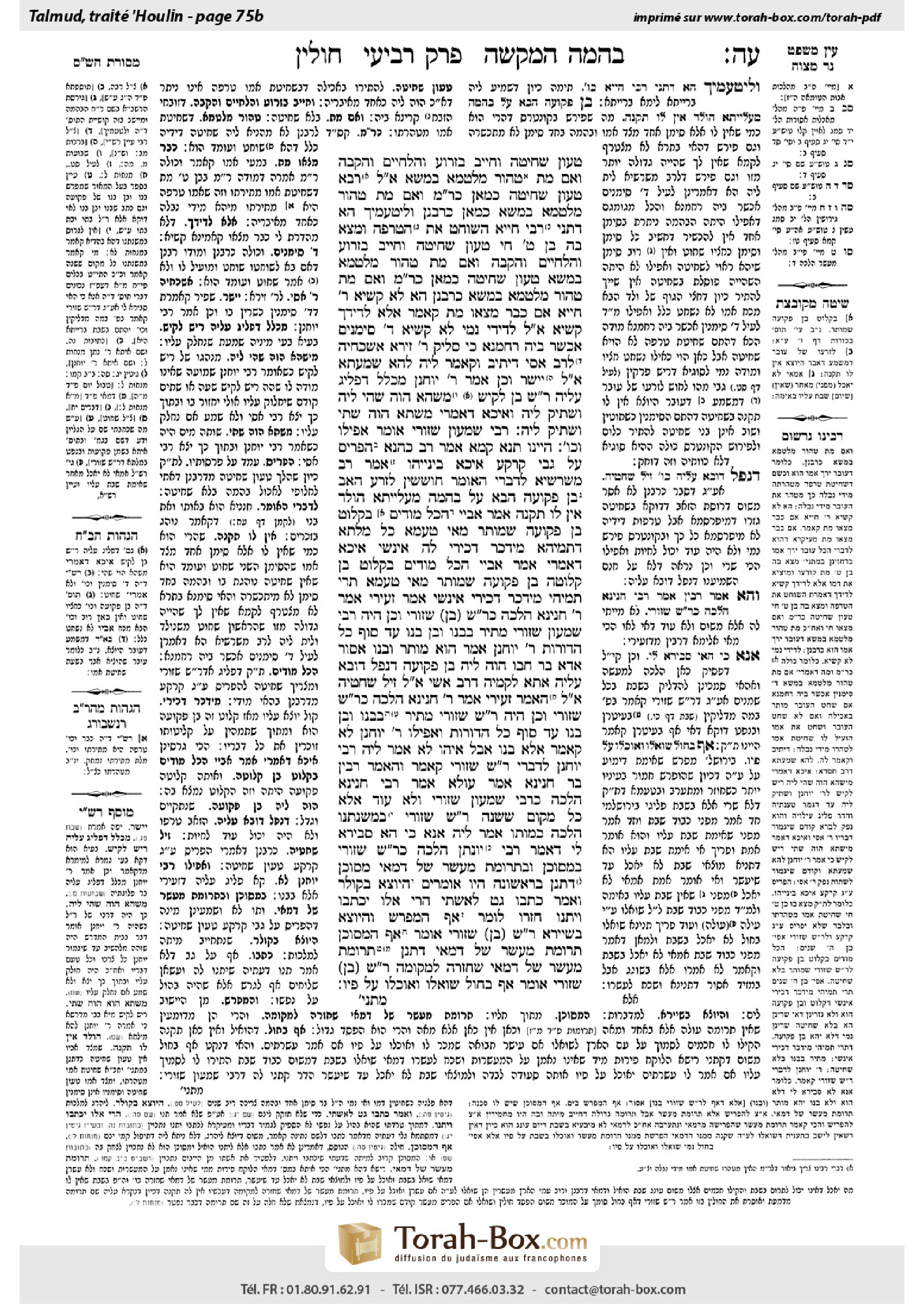
Chullin 75b: Talmud study for Daf Yomi
Study the Talmud for Daf Yomi with scanned pages, Hebrew text, English translations from Sefaria and AI-generated French translations.
Passage selection and English or AI-generated French translation are available where the scan has annotations. Daf Study is independent of Torah-Box and Sefaria.
Browse Chullin · חולין · All tractatesChullin 75b text and translations
This page of Chullin includes the Aramaic text, an English translation and an AI-generated French translation, alongside the scan above.
חולין ע״ה ב · Aramaic and Hebrew text
טָעוּן שְׁחִיטָה, וְחַיָּיב בִּזְרוֹעַ וְהַלְּחָיַיִם וְהַקֵּבָה, וְאִם מֵת – טָהוֹר מִלְּטַמֵּא בְּמַשָּׂא.
אֲמַר לֵיהּ רָבָא: טָעוּן שְׁחִיטָה – כְּמַאן? כְּרַבִּי מֵאִיר, וְאִם מֵת טָהוֹר מִלְּטַמֵּא בְּמַשָּׂא – כְּמַאן? כְּרַבָּנַן.
וְלִיטַעְמָיךְ, הָא דְתָנֵי רַבִּי חִיָּיא: הַשּׁוֹחֵט אֶת הַטְּרֵפָה וּמָצָא בָּהּ בֶּן תִּשְׁעָה חַי – טָעוּן שְׁחִיטָה, וְחַיָּיב בִּזְרוֹעַ וְהַלְּחָיַיִם וְהַקֵּבָה, וְאִם מֵת – טָהוֹר מִלְּטַמֵּא בְּמַשָּׂא. טָעוּן שְׁחִיטָה כְּמַאן? כְּרַבִּי מֵאִיר, וְאִם מֵת – טָהוֹר מִלְּטַמֵּא בְּמַשָּׂא, כְּרַבָּנַן.
הָא לָא קַשְׁיָא, רַבִּי חִיָּיא אִם כְּבָר מְצָאוֹ מֵת קָאָמַר, אֶלָּא לְדִידָךְ קַשְׁיָא!
אֲמַר לֵיהּ: לְדִידִי נָמֵי לָא קַשְׁיָא, אַרְבָּעָה סִימָנִים אַכְשַׁר בֵּיהּ רַחֲמָנָא.
כִּי סָלֵיק רַבִּי זֵירָא, אַשְׁכְּחֵיהּ לְרַב אַסִּי דְּיָתֵיב וְקָאָמַר לֵיהּ לְהָא שְׁמַעְתָּא. אֲמַר לֵיהּ: יִישַׁר, וְכֵן אָמַר רַבִּי יוֹחָנָן. מִכְּלָל דִּפְלִיג עֲלֵיהּ רַבִּי שִׁמְעוֹן בֶּן לָקִישׁ?
מִשְׁהָא הֲוָה שָׁהֵי לֵיהּ וְשָׁתֵיק לֵיהּ, וְאִיכָּא דְּאָמְרִי: מִשְׁתָּא הֲוָה שָׁתֵי וְשָׁתֵיק לֵיהּ.
רַבִּי שִׁמְעוֹן שֵׁזוּרִי אוֹמֵר: אֲפִילּוּ וְכוּ׳. הַיְינוּ תַּנָּא קַמָּא! אָמַר רַב כָּהֲנָא: הִפְרִיס עַל גַּבֵּי קַרְקַע אִיכָּא בֵּינַיְיהוּ.
אָמַר רַב מְשַׁרְשְׁיָא: לְדִבְרֵי הָאוֹמֵר חוֹשְׁשִׁין לְזֶרַע הָאָב, בֶּן פְּקוּעָה הַבָּא עַל בְּהֵמָה מְעַלַּיְיתָא – הַוָּלָד אֵין לוֹ תַּקָּנָה.
אָמַר אַבָּיֵי: הַכֹּל מוֹדִים בְּקָלוּט בֶּן פְּקוּעָה שֶׁמּוּתָּר, מַאי טַעְמָא? כֹּל מִלְּתָא דִּתְמִיהָא מִידְכָּר דְּכִירִי לַהּ אִינָשֵׁי. אִיכָּא דְּאָמְרִי: אָמַר אַבָּיֵי: הַכֹּל מוֹדִים בְּקָלוּט בֶּן קְלוּטָה בֶּן פְּקוּעָה שֶׁמּוּתָּר, מַאי טַעְמָא? תְּרֵי תְּמִיהֵי מִידְכָּר דְּכִירִי אִינָשֵׁי.
אָמַר זְעֵירִי אָמַר רַבִּי חֲנִינָא: הֲלָכָה כְּרַבִּי שִׁמְעוֹן שֵׁזוּרִי, וְכֵן הָיָה רַבִּי שִׁמְעוֹן שֵׁזוּרִי מַתִּיר בִּבְנוֹ וּבֶן בְּנוֹ עַד סוֹף כׇּל הַדּוֹרוֹת. רַבִּי יוֹחָנָן אָמַר: הוּא מוּתָּר, וּבְנוֹ אָסוּר.
אַדָּא בַּר חָבוּ הֲוָה לֵיהּ בֶּן פְּקוּעָה דִּנְפַל דֵּיבָא עֲלֵיהּ, אֲתָא לְקַמֵּיהּ דְּרַב אָשֵׁי. אֲמַר לֵיהּ: זִיל שַׁחְטֵיהּ. אֲמַר לֵיהּ: הָאָמַר זְעֵירִי אָמַר רַבִּי חֲנִינָא: הֲלָכָה כְּרַבִּי שִׁמְעוֹן שֵׁזוּרִי, וְכֵן הָיָה רַבִּי שִׁמְעוֹן שֵׁזוּרִי מַתִּיר בִּבְנוֹ וּבֶן בְּנוֹ עַד סוֹף כׇּל הַדּוֹרוֹת, וַאֲפִילּוּ רַבִּי יוֹחָנָן לָא קָאָמַר אֶלָּא בְּנוֹ, אֲבָל אִיהוּ לָא!
אֲמַר לֵיהּ: רַבִּי יוֹחָנָן לְדִבְרֵי רַבִּי שִׁמְעוֹן שֵׁזוּרִי קָאָמַר.
וְהָאָמַר רָבִין בַּר חֲנִינָא אָמַר עוּלָּא אָמַר רַבִּי חֲנִינָא: הֲלָכָה כְּרַבִּי שִׁמְעוֹן שֵׁזוּרִי, וְלֹא עוֹד, אֶלָּא כׇּל מָקוֹם שֶׁשָּׁנָה רַבִּי שִׁמְעוֹן שֵׁזוּרִי בְּמִשְׁנָתֵנוּ – הֲלָכָה כְּמוֹתוֹ!
אֲמַר לֵיהּ: אֲנָא כִּי הָא סְבִירָא לִי, דְּאָמַר רַבִּי יוֹנָתָן: הֲלָכָה כְּרַבִּי שִׁמְעוֹן שֵׁזוּרִי בִּמְסוּכָּן, וּבִתְרוּמַת מַעֲשֵׂר שֶׁל דְּמַאי.
מְסוּכָּן, דִּתְנַן: בָּרִאשׁוֹנָה הָיוּ אוֹמְרִים, הַיּוֹצֵא בְּקוֹלָר וְאָמַר: ״כִּתְבוּ גֵּט לְאִשְׁתִּי״, הֲרֵי אֵלּוּ יִכְתְּבוּ וְיִתְּנוּ. חָזְרוּ לוֹמַר: אַף הַמְפָרֵשׁ וְהַיּוֹצֵא בִּשְׁיָירָא. רַבִּי שִׁמְעוֹן בֶּן שֵׁזוּרִי אוֹמֵר: אַף הַמְסוּכָּן.
תְּרוּמַת מַעֲשֵׂר שֶׁל דְּמַאי, דִּתְנַן: תְּרוּמַת מַעֲשֵׂר שֶׁל דְּמַאי שֶׁחָזְרָה לִמְקוֹמָהּ, רַבִּי שִׁמְעוֹן בֶּן שֵׁזוּרִי אוֹמֵר: אַף בַּחוֹל שׁוֹאֲלוֹ וְאוֹכְלוֹ עַל פִּיו.
Chullin 75b · English translation
the fetus requires its own slaughter to permit its consumption, and it is subject to the obligation to give the foreleg and the jaw and the maw to a priest, as is required for a non-sacred animal that is slaughtered. But nevertheless, if it dies, the fact that its mother was slaughtered serves to render it pure with regard to imparting impurity to people through their carrying of it, as it does not impart the impurity of a carcass.
Rava said to Rav Ḥisda: Your ruling is inconsistent. When you say it requires slaughter, in accordance with whose opinion is that? It is in accordance with the opinion of Rabbi Meir, that a live nine-month-old fetus is not permitted by virtue of its mother’s slaughter. But when you say that if it dies, it is pure with regard to imparting impurity through carrying, in accordance with whose opinion is that? It is in accordance with the opinion of the Rabbis.
Rav Ḥisda replied: And according to your reasoning, the same difficulty arises with that which Rabbi Ḥiyya teaches in a baraita: With regard to one who slaughtered an animal that is a tereifa and found inside it a live nine-month-old fetus, it requires its own slaughter, and it is subject to the obligation to give the foreleg and the jaw and the maw to a priest. But nevertheless, if it dies, it is pure with regard to imparting impurity through carrying. When he says that it requires slaughter, in accordance with whose opinion is that? It is in accordance with the opinion of Rabbi Meir. But when he says that if it dies, it is pure with regard to imparting impurity through carrying, it is in accordance with the opinion of the Rabbis.
Rava responded: That is not difficult, as it is possible that Rabbi Ḥiyya was speaking about if one found that the fetus had already died inside the mother. In such a case, Rabbi Meir concedes that its mother’s slaughter renders it pure, as stated in the mishna. Accordingly, the baraita is entirely in accordance with the opinion of Rabbi Meir. But according to your opinion, that even if it was found alive and died later it is pure from the impurity of a carcass, it is difficult.
Rav Ḥisda said to Rava: According to my opinion also it is not difficult, as I claim that the entire baraita is in accordance with the opinion of the Rabbis, and although the slaughter of its mother permits the fetus, its own slaughter can also permit it, as the Merciful One considers four simanim to be fit for slaughter, two of the mother and two of the fetus, the fetus being permitted through the cutting of either pair.
The Gemara relates: When Rabbi Zeira ascended to Eretz Yisrael, Rav Asi found him sitting and saying this halakha of Rav Ḥisda, i.e., that the Merciful One considers four simanim to be fit for slaughter. Rav Asi said to him: That is correct, and so says Rabbi Yoḥanan. Rabbi Zeira asked him: Can I conclude by inference from your statement that Rabbi Shimon ben Lakish, Rabbi Yoḥanan’s colleague, disagrees with him?
Rav Asi answered: I do not know, as after Rabbi Yoḥanan made his statement, Rabbi Shimon ben Lakish was waiting for him to see if he would retract, and he therefore remained silent about whether or not he disagreed. But it is possible that after I left, he disagreed. And some say that Rav Asi said: At that time, Rabbi Shimon ben Lakish was drinking, and that is why he remained silent. Therefore, I do not know whether or not he disagreed.
§ The mishna teaches that Rabbi Shimon Shezuri says: Even if a nine-month-old fetus emerged alive and is now five years old and plowing in the field it does not require slaughter. The Gemara asks: This opinion of Rabbi Shimon Shezuri is identical to that of the first tanna, i.e., the Rabbis. What difference is there between them? Rav Kahana said: The difference between them is a case where the fetus stood upon the ground. According to the opinion of the first tanna, once the fetus walks on the ground there is a rabbinic decree requiring that it be slaughtered before it is consumed, lest people mistakenly permit other animals without slaughter. Rabbi Shimon Shezuri disagrees and holds that it does not require slaughter.
Rav Mesharshiyya said: According to the statement of the one who says that when defining the status of an animal one needs to be concerned with its paternity, if a ben pekua copulated with a full-fledged animal, the offspring has no rectification. Although when the mother and father are each a ben pekua the offspring is permitted without ritual slaughter, if the father is a ben pekua but the mother is not, the offspring is simultaneously defined as requiring slaughter, based on the mother, and being excluded from the requirement for slaughter, based on the father. Therefore, no act of slaughter can permit it.
Abaye says: Everyone, i.e., even the first tanna, who requires the slaughter of a ben pekua that stood upon the ground, agrees with regard to a ben pekua with non-cloven hooves that was found inside a kosher animal, that it is permitted by virtue of the slaughter of its mother. What is the reason for this? It is that people remember any bizarre matter, and there is no concern that if it is permitted without slaughter, people will mistakenly permit regular animals without slaughter. Some say that Abaye said: Everyone agrees with regard to a ben pekua with non-cloven hooves found inside an animal with non-cloven hooves that was itself born to a kosher animal, that the fetus is permitted without slaughter even if it stood on the ground. What is the reason? It is that people remember two bizarre matters.
Ze’eiri says that Rabbi Ḥanina says: The halakha is in accordance with the opinion of Rabbi Shimon ben Shezuri that a ben pekua is permitted without slaughter even if it stood upon the ground. And similarly, Rabbi Shimon Shezuri would permit without slaughter the offspring of a ben pekua and the offspring of its offspring, and so on to the end of all future generations. Rabbi Yoḥanan says: It, the ben pekua itself, is permitted, but its offspring is prohibited unless it is slaughtered.
The Gemara relates: Adda bar Ḥavu had a ben pekua that was attacked by a bear and was about to die. He came before Rav Ashi to inquire what to do. Rav Ashi said to him: Go and slaughter it before it dies so that you can eat it, in accordance with the opinion of the first tanna that if a ben pekua stood upon the ground it requires slaughter. Adda bar Ḥavu said to Rav Ashi: But doesn’t Ze’eiri say that Rabbi Ḥanina says: The halakha is in accordance with the opinion of Rabbi Shimon Shezuri that a ben pekua is permitted without slaughter even if it stood upon the ground, and similarly, Rabbi Shimon Shezuri would permit without slaughter the offspring of a ben pekua and the offspring of its offspring, and so on to the end of all future generations? And even Rabbi Yoḥanan, who disagreed, said his dissenting opinion only with regard to its offspring, but with regard to a ben pekua itself, he did not disagree that it is permitted.
Rav Ashi said to Adda bar Ḥavu: Rabbi Yoḥanan was speaking according to the statement of Rabbi Shimon Shezuri, i.e., he said that even Rabbi Shimon Shezuri permits only a ben pekua itself, but not its offspring. But Rabbi Yoḥanan himself agrees with the first tanna that a ben pekua that stood upon the ground is prohibited without slaughter.
Adda bar Ḥavu persisted: But didn’t Ravin bar Ḥanina say that Ulla says that Rabbi Ḥanina says with regard to a different issue: The halakha is in accordance with the opinion of Rabbi Shimon Shezuri; and moreover, not only is the halakha in accordance with his opinion with regard to this matter, but in any place where Rabbi Shimon Shezuri taught a halakha in our Mishna, the halakha is in accordance with his opinion?
Rav Ashi said to Adda bar Ḥavu: I hold in accordance with this statement of Rabbi Yonatan, as Rabbi Yonatan says: The halakha is in accordance with the opinion of Rabbi Shimon Shezuri in the case of one who is dangerously ill, and in the case of teruma of the tithe of doubtfully tithed produce [demai], but not in other cases, e.g., in the case of his disagreement with the first tanna concerning a ben pekua.
The Gemara now elaborates on these two cases. The case of one who is dangerously ill is as we learned in a mishna (Gittin 65b): Initially, the Sages would say that in the case of one who is taken out in a neck chain [bekolar] to be executed and who said: Write a bill of divorce for my wife, these people who hear should write the document and give it to her. Although there was no explicit instruction to give it to her, this is understood to have been his intention, in order to release her from the obligation to perform levirate marriage or the ritual through which she becomes free of her levirate bonds [ḥalitza]. They then said that this halakha applies even to one who sets sail and one who departs in a caravan to a distant place. A bill of divorce is given to his wife under these circumstances even if her husband said only: Write a bill of divorce for my wife. Rabbi Shimon ben Shezuri says: Even in the case of one who is dangerously ill who gives that instruction, they write the bill of divorce and give it to his wife.
The case of teruma of the tithe of demai is as we learned in a mishna (Demai 4:1): With regard to teruma of the tithe of demai, i.e., teruma of the tithe that was separated from the produce of an am ha’aretz, who is suspected of not separating tithes properly, that fell and returned to its original place, becoming mingled with the rest of produce from which it had been separated, Rabbi Shimon ben Shezuri says: Even on a weekday one may ask the am ha’aretz whether or not he separated the necessary tithes and then eat based on his statement.
Chullin 75b · Traduction française (IA)
le fœtus nécessite sa propre immolation pour permettre sa consommation, et il est soumis à l'obligation de donner la cuisse et la mâchoire et la gueule à un prêtre, comme c'est exigé pour un animal non sacré qui est immolé. Mais néanmoins, si celui-ci meurt, le fait que sa mère ait été immolée suffit à le rendre pur en ce qui concerne la transmission de l'impureté par le port de son corps, car il ne transmet pas l'impureté d'un cadavre.
Rava dit à Rav Ḥisda : Votre décision est incohérente. Lorsque vous dites qu'il nécessite l'immolation, selon quel avis est-ce ? C'est selon l'avis de Rabbi Meir, qui considère qu'un fœtus de neuf mois vivant n'est pas permis par la mort de sa mère. Mais lorsque vous dites que si celui-ci meurt, il est pur en ce qui concerne la transmission de l'impureté par le port, selon quel avis est-ce ? C'est selon l'avis des Rabbins.
Rav Ḥisda répondit : Et selon votre raisonnement, la même difficulté survient avec ce que Rabbi Ḥiyya enseigne dans une baraïta : En ce qui concerne celui qui a immolé un animal tereifa et a trouvé à l'intérieur un fœtus vivant de neuf mois, il nécessite sa propre immolation, et il est soumis à l'obligation de donner la cuisse et la mâchoire et la gueule à un prêtre. Mais néanmoins, si celui-ci meurt, il est pur en ce qui concerne la transmission de l'impureté par le port. Lorsqu'il dit qu'il nécessite l'immolation, selon quel avis est-ce ? C'est selon l'avis de Rabbi Meir. Mais lorsque il dit que si celui-ci meurt, il est pur en ce qui concerne la transmission de l'impureté par le port, c'est selon l'avis des Rabbins.
Rava répondit : Ce n'est pas difficile, car il est possible que Rabbi Ḥiyya parle du cas où l'on découvre que le fœtus est déjà mort à l'intérieur de la mère. Dans ce cas, Rabbi Meir reconnaît que la mort de sa mère le rend pur, comme mentionné dans la mitsna. Ainsi, la baraïta est entièrement conforme à l'avis de Rabbi Meir. Mais selon votre avis, que même s'il est trouvé vivant et meurt plus tard il est pur de l'impureté d'un cadavre, c'est difficile.
Rav Ḥisda dit à Rava : Selon mon avis également, cela n'est pas difficile, car je soutiens que toute la baraïta est conforme à l'avis des Rabbins, et bien que la mort de sa mère permette le fœtus, son propre immolation peut aussi le permettre, car l'Éternel considère quatre simanim comme aptes à l'immolation, deux de la mère et deux du fœtus, le fœtus étant permis par le tranchage de l'un ou l'autre de ces paires.
La Guemara rapporte : Lorsque Rabbi Zeira est monté en Terre d'Israël, Rav Asi le trouva assis en train de dire cette halakha de Rav Ḥisda, c'est-à-dire que l'Éternel considère quatre simanim comme aptes à l'immolation. Rav Asi dit à lui : C'est correct, et c'est ainsi que dit Rabbi Yoḥanan. Rabbi Zeira demanda : Puis-je conclure par déduction de votre déclaration que Rabbi Shimon ben Lakish, collègue de Rabbi Yoḥanan, s'y oppose ?
Rav Asi répondit : Je ne sais pas, car après que Rabbi Yoḥanan ait fait cette déclaration, Rabbi Shimon ben Lakish attendait qu'il rétracte, et il a donc gardé le silence sur le fait qu'il s'y oppose ou non. Mais il est possible que, après que je sois parti, il s'y oppose. Et certains disent que Rav Asi dit : À ce moment-là, Rabbi Shimon ben Lakish buvait, et c'est pourquoi il a gardé le silence. Ainsi, je ne sais pas s'il s'y oppose ou non.
§ La mitsva enseigne que Rabbi Shimon Shezuri dit : Même si un fœtus de neuf mois est né vivant et est maintenant âgé de cinq ans et laboure le champ, il ne nécessite pas d'immolation. La Guemara pose la question : Cette opinion de Rabbi Shimon Shezuri est identique à celle du premier tanna, c'est-à-dire des Rabbins. Quelle différence y a-t-il entre eux ? Rav Kahana dit : La différence entre eux est le cas où le fœtus est debout sur le sol. Selon l'avis du premier tanna, une fois que le fœtus marche sur le sol, il y a un décret rabbinique exigeant qu'il soit immolé avant de l'être consommé, de peur que les gens permettent par erreur d'autres animaux sans immolation. Rabbi Shimon Shezuri s'y oppose et considère qu'il ne nécessite pas d'immolation.
Rav Mesharshiyya dit : Selon la déclaration de celui qui considère qu'en définissant le statut d'un animal on doit s'occuper de son paternité, si un ben pekua a copulé avec un animal complet, l'offspring n'a pas de rectification. Bien que lorsque la mère et le père sont chacun un ben pekua, l'offspring est permis sans immolation rituelle, si le père est un ben pekua mais la mère n'est pas, l'offspring est simultanément défini comme nécessitant l'immolation, en vertu de la mère, et exclu de l'obligation d'immolation, en vertu du père. Ainsi, aucun acte d'immolation ne peut le permettre.
Abaye dit : Tout le monde, c'est-à-dire même le premier tanna, qui exige l'immolation d'un ben pekua qui est debout sur le sol, est d'accord avec celui qui dit qu'un ben pekua à des pieds non cloisonnés trouvé à l'intérieur d'un animal kasher est permis par la mort de sa mère. Quelle est la raison de cela ? C'est que les gens se souviennent de toute chose étrange, et il n'y a pas de crainte que si on le permet sans immolation, les gens permettent par erreur les animaux ordinaires sans immolation. Certains disent que Abaye dit : Tout le monde est d'accord avec celui qui dit qu'un ben pekua à des pieds non cloisonnés trouvé à l'intérieur d'un animal à des pieds non cloisonnés qui était lui-même né d'un animal kasher, est permis sans immolation même s'il est debout sur le sol. Quelle est la raison ? C'est que les gens se souviennent de deux choses étranges.
Ze’eiri dit que Rabbi Ḥanina dit : La halakha suit l'avis de Rabbi Shimon ben Shezuri qui dit qu'un ben pekua est permis sans immolation même s'il est debout sur le sol. De même, Rabbi Shimon Shezuri permettrait sans immolation l'offspring d'un ben pekua et l'offspring de son offspring, et ainsi de suite jusqu'à la fin de toutes les générations futures. Rabbi Yoḥanan dit : Il, le ben pekua lui-même, est permis, mais son offspring est interdit à moins qu'il ne soit immolé.
La Guemara rapporte : Adda bar Ḥavu avait un ben pekua attaqué par un ours et sur le point de mourir. Il s'est présenté devant Rav Ashi pour demander ce qu'il devait faire. Rav Ashi lui a dit : Allez et sacrifiez-le avant qu'il ne meure afin que vous puissiez le manger, conformément à l'opinion du premier tanna qui stipule que si un ben pekua est sur le sol, il nécessite un sacrifice. Adda bar Ḥavu a dit à Rav Ashi : Mais ne dit pas Ze’eiri que Rabbi Ḥanina dit : La halakha suit l'opinion de Rabbi Shimon Shezuri qui permet un ben pekua sans sacrifice même s'il est sur le sol, et de même, Rabbi Shimon Shezuri permettrait sans sacrifice l'offspring d'un ben pekua et l'offspring de son offspring, et ainsi de suite jusqu'à la fin de toutes les générations futures ? Et même Rabbi Yoḥanan, qui s'est opposé, a dit qu'il s'opposait uniquement à son offspring, mais concernant le ben pekua lui-même, il n'a pas contesté qu'il soit permis.
Rav Ashi a dit à Adda bar Ḥavu : Rabbi Yoḥanan parlait selon la déclaration de Rabbi Shimon Shezuri, c'est-à-dire qu'il disait que même Rabbi Shimon Shezuri permet uniquement le ben pekua lui-même, mais pas son offspring. Mais Rabbi Yoḥanan lui-même est d'accord avec le premier tanna qui stipule qu'un ben pekua sur le sol est interdit sans sacrifice.
Adda bar Ḥavu a persisté : Mais n'a-t-il pas dit Ravin bar Ḥanina que Ulla dit que Rabbi Ḥanina dit concernant une autre question : La halakha suit l'opinion de Rabbi Shimon Shezuri ; et de plus, non seulement la halakha suit son opinion concernant cette question, mais dans tout lieu où Rabbi Shimon Shezuri a enseigné une halakha dans notre Michna, la halakha suit son opinion ?
Rav Ashi a dit à Adda bar Ḥavu : Je suis d'accord avec cette déclaration de Rabbi Yonatan, car Rabbi Yonatan dit : La halakha suit l'opinion de Rabbi Shimon Shezuri dans le cas d'une personne gravement malade, et dans le cas de terouma de la tithe de demai, mais pas dans d'autres cas, par exemple, dans le cas de son désaccord avec le premier tanna concernant un ben pekua.
La Guemara éclaire maintenant ces deux cas. Le cas d'une personne gravement malade est celui que nous avons appris dans une mishna (Gittin 65b) : Initialement, les Sages disaient que dans le cas d'une personne emmenée en chaîne au cou [bekolar] pour être exécutée et qui dit : Écrivez un acte de divorce pour ma femme, ces personnes qui l'entendent devraient écrire le document et le donner à sa femme. Bien qu'il n'y ait pas d'instruction explicite de le lui donner, cela est compris comme son intention, afin de la libérer de l'obligation de mariage levirique ou de la cérémonie par laquelle elle devient libre de ses liens leviriques [ḥalitza]. Ils ont ensuite dit que cette halakha s'applique même à une personne qui embarque et à une personne qui part en caravane vers un lieu éloigné. Un acte de divorce est donné à sa femme dans ces circonstances même si son mari a dit seulement : Écrivez un acte de divorce pour ma femme. Rabbi Shimon ben Shezuri dit : Même dans le cas d'une personne gravement malade qui donne cette instruction, ils écrivent l'acte de divorce et le donnent à sa femme.
Le cas de terouma de la tithe de demai est celui que nous avons appris dans une mishna (Demai 4:1) : Concernant la terouma de la tithe de demai, c'est-à-dire la terouma de la tithe séparée par un am ha’aretz, suspecté de ne pas avoir séparé les dîmes correctement, qui est tombé et est revenu à son lieu d'origine, devenant mélangé avec les autres produits desquels il avait été séparé, Rabbi Shimon ben Shezuri dit : Même un jour de semaine, on peut demander à l'am ha’aretz s'il a séparé les dîmes nécessaires et ensuite manger en fonction de sa déclaration.
Traduction française générée par IA à partir de l’édition anglaise de Sefaria. Vérifie toujours un passage avec le texte source.
Text from Sefaria: William Davidson Edition - Vocalized Aramaic (unknown); William Davidson Edition - English (CC BY NC).