Chullin 76a: Talmud study for Daf Yomi
Study the Talmud for Daf Yomi with scanned pages, Hebrew text, English translations from Sefaria and AI-generated French translations.
Passage selection and English or AI-generated French translation are available where the scan has annotations. Daf Study is independent of Torah-Box and Sefaria.
Browse Chullin · חולין · All tractatesChullin 76a text and translations
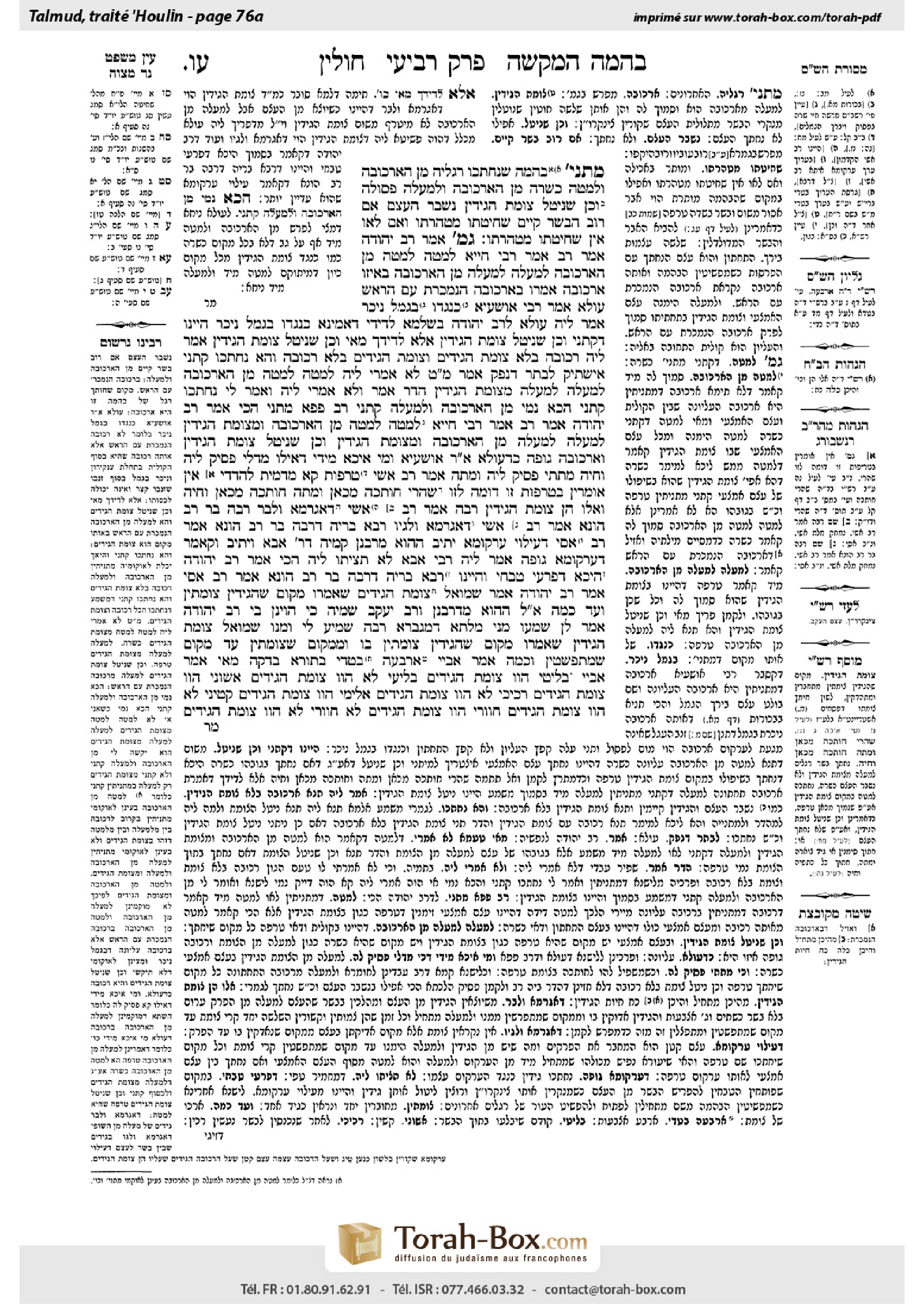
This page of Chullin includes the Aramaic text, an English translation and an AI-generated French translation, alongside the scan above.
חולין ע״ו א · Aramaic and Hebrew text
מַתְנִי׳ בְּהֵמָה שֶׁנֶּחְתְּכוּ רַגְלֶיהָ מִן הָאַרְכּוּבָּה וּלְמַטָּה – כְּשֵׁרָה, מִן הָאַרְכּוּבָּה וּלְמַעְלָה – פְּסוּלָה, וְכֵן שֶׁנִּיטַּל צוֹמֶת הַגִּידִין.
נִשְׁבַּר הָעֶצֶם, אִם רוֹב הַבָּשָׂר קַיָּים – שְׁחִיטָתוֹ מְטַהַרְתּוֹ, וְאִם לָאו – אֵין שְׁחִיטָתוֹ מְטַהַרְתּוֹ.
גְּמָ׳ אָמַר רַב יְהוּדָה אָמַר רַב אָמַר רַבִּי חִיָּיא: לְמַטָּה – לְמַטָּה מִן הָאַרְכּוּבָּה, לְמַעְלָה – לְמַעְלָה מִן הָאַרְכּוּבָּה. בְּאֵיזוֹ אַרְכּוּבָּה אָמְרוּ? בְּאַרְכּוּבָּה הַנִּמְכֶּרֶת עִם הָרֹאשׁ.
עוּלָּא אָמַר רַבִּי אוֹשַׁעְיָא: כְּנֶגְדּוֹ בְּגָמָל נִיכָּר.
אֲמַר לֵיהּ עוּלָּא לְרַב יְהוּדָה: בִּשְׁלָמָא לְדִידִי דְּאָמֵינָא כְּנֶגְדּוֹ בְּגָמָל נִיכָּר, הַיְינוּ דְּקָתָנֵי: וְכֵן שֶׁנִּיטַּל צוֹמֶת הַגִּידִין, אֶלָּא לְדִידָךְ, מַאי וְכֵן שֶׁנִּיטַּל צוֹמֶת הַגִּידִין?
אֲמַר לֵיהּ: רְכוּבָּה בְּלֹא צוֹמֶת הַגִּידִים, וְצוֹמֶת הַגִּידִים בְּלֹא רְכוּבָּה. וְהָא ״נֶחְתְּכוּ״ קָתָנֵי! אִישְׁתִּיק.
לְבָתַר דִּנְפַק אֲמַר: מַאי טַעְמָא לָא אֲמַרִי לֵיהּ, ״לְמַטָּה״ – לְמַטָּה מִן הָאַרְכּוּבָּה, ״לְמַעְלָה״ – לְמַעְלָה מִצּוֹמֶת הַגִּידִין?
הֲדַר אָמַר: וְלָא אֲמַרִי לֵיהּ, וַאֲמַר לִי: ״נֶחְתְּכוּ״ קָתָנֵי? הָכָא נָמֵי, ״מִן הָאַרְכּוּבָּה וּלְמַעְלָה״ קָתָנֵי.
רַב פָּפָּא מַתְנֵי הָכִי: אָמַר רַב יְהוּדָה אָמַר רַב אָמַר רַבִּי חִיָּיא: ״לְמַטָּה״ – לְמַטָּה מִן הָאַרְכּוּבָּה וּמִצּוֹמֶת הַגִּידִין, ״לְמַעְלָה״ – לְמַעְלָה מִן הָאַרְכּוּבָּה וּמִצּוֹמֶת הַגִּידִין, וְכֵן שֶׁנִּיטַּל צוֹמֶת הַגִּידִין. וְאַרְכּוּבָּה גּוּפַהּ כִּדְעוּלָּא אָמַר רַבִּי אוֹשַׁעְיָא.
וּמִי אִיכָּא מִידֵּי, דְּאִילּוּ מִדְּלֵי פָּסֵיק לֵיהּ וַחֲיָה, מְתַתֵּי פָּסֵיק לֵיהּ וּמֵתָה?
אָמַר רַב אָשֵׁי: טְרֵפוֹת קָא מְדַמֵּית לַהֲדָדֵי? אֵין אוֹמְרִין בִּטְרֵפוֹת זוֹ דּוֹמָה לָזוֹ, שֶׁהֲרֵי חוֹתְכָהּ מִכָּאן וָמֵתָה, חוֹתְכָהּ מִכָּאן וְחַיָּה.
וְאֵלּוּ הֵן צוֹמֶת הַגִּידִין? רַבָּה אָמַר רַב אָשֵׁי: דְּאַגַּרְמָא וּלְבַר, רַבָּה בַּר רַב הוּנָא אָמַר רַב אָשֵׁי: דְּאַגַּרְמָא וּלְגָיו, רָבָא בְּרֵיהּ דְּרַבָּה בַּר רַב הוּנָא אָמַר רַב אַסִּי: דְּעִילָּוֵי עַרְקוּמָא.
יָתֵיב הָהוּא מֵרַבָּנַן קַמֵּיהּ דְּרַבִּי אַבָּא, וְיָתֵיב וְקָאָמַר: דְּעַרְקוּמָא גּוּפַהּ. אֲמַר לֵיהּ רַבִּי אַבָּא: לָא תְּצִיתוּ לֵיהּ, הָכִי אָמַר רַב יְהוּדָה: הֵיכָא דְּפָרְעִי טַבָּחֵי. וְהַיְינוּ רָבָא בְּרֵיהּ דְּרַבָּה בַּר רַב הוּנָא אָמַר רַב אַסִּי.
אָמַר רַב יְהוּדָה אָמַר שְׁמוּאֵל: צוֹמֶת הַגִּידִים שֶׁאָמְרוּ – מְקוֹם שֶׁהַגִּידִין צוֹמְתִין, וְעַד כַּמָּה? אֲמַר לֵיהּ הָהוּא מִדְּרַבָּנַן, וְרַב יַעֲקֹב שְׁמֵיהּ: כִּי הֲוֵינַן בֵּי רַב יְהוּדָה אֲמַר לַן: שְׁמַעוּ מַנִּי מִלְּתָא דְּמִגַּבְרָא רַבָּה שְׁמִיעַ לִי, וּמַנּוּ? שְׁמוּאֵל: צוֹמֶת הַגִּידִין שֶׁאָמְרוּ – מְקוֹם שֶׁהַגִּידִין צוֹמְתִין בּוֹ, וּמִמְּקוֹם שֶׁצּוֹמְתִין עַד מְקוֹם שֶׁמִּתְפַּשְּׁטִין.
וְכַמָּה? אָמַר אַבָּיֵי: אַרְבָּעָה בַּטְדֵי בְּתוֹרָא. בְּדַקָּה מַאי? אָמַר אַבָּיֵי: בְּלִיטִי – הָווּ צוֹמֶת הַגִּידִים, בְּלִיעִי – לָא הָווּ צוֹמֶת הַגִּידִים.
אַשּׁוּנֵי – הָווּ צוֹמֶת הַגִּידִים, רַכִּיכֵי – לָא הָווּ צוֹמֶת הַגִּידִים, אַלִּימֵי – הָווּ צוֹמֶת הַגִּידִים, קַטִּינֵי – לָא הָווּ צוֹמֶת הַגִּידִים, חִוָּורֵי – הָווּ צוֹמֶת הַגִּידִים, לָא חִוָּורֵי – לָא הָווּ צוֹמֶת הַגִּידִים.
Chullin 76a · English translation
MISHNA: With regard to an animal whose hind legs were severed, if they were severed from the leg joint and below, the animal is kosher; from the leg joint and above, the animal is thereby rendered a tereifa and is not kosher. And likewise, an animal whose convergence of sinews in the thigh was removed is a tereifa and is not kosher.
If the bone of a limb was broken but the limb was not completely severed, and the animal was then slaughtered, if the majority of the flesh surrounding the bone is intact, the slaughter of the animal renders it permitted; but if not, its slaughter does not render it permitted.
GEMARA: Rav Yehuda says that Rav says that Rabbi Ḥiyya says: When the mishna makes reference to the leg being severed from the leg joint and below, it means that the cut was below the leg joint, and when it says that if it was severed from the leg joint and above it is a tereifa, it means that the cut was above the leg joint. And with regard to which leg joint did they say this? With regard to the leg joint that is sold together with the head of the animal. This is the lower leg joint that connects the lower bone, or metatarsus, and middle bone, or tibia. Accordingly, the animal is a tereifa only if the leg was severed in the middle bone or upper bone.
Ulla says that Rabbi Oshaya says: The mishna is referring to the leg joint that in most animals cannot be seen from the outside, but the corresponding joint in the leg of a camel is prominent and conspicuous. This is referring to the joint between the upper bone, or femur, and middle bone, or tibia. Accordingly, the animal is a tereifa only if it was severed in the upper bone.
Ulla said to Rav Yehuda: Granted, according to my opinion, as I say it means the joint whose corresponding joint in the leg of a camel is conspicuous, i.e., the upper joint, this explanation is consistent with that which the mishna teaches: And likewise, an animal whose convergence of sinews in the thigh was removed is not kosher. The convergence of sinews lies on the lower part of the middle bone. Since I hold that if the middle bone is severed, this does not render the animal a tereifa, it is necessary for the mishna to teach that nevertheless, if that bone was severed at the point of the convergence of sinews, this would render it a tereifa. But according to your opinion that the mishna is referring to the lower joint, and if the middle bone is severed, this renders the animal a tereifa, what is the purpose of teaching: And likewise, an animal whose convergence of sinews in the thigh was removed is not kosher?
Rav Yehuda said to Ulla: According to my opinion, the mishna is referring to two cases: The first is where the leg was severed above the lower leg joint, in the middle bone, without the removal of the convergence of sinews in the thigh, and the second is where the convergence of sinews in the thigh was removed without the leg above the leg joint being severed. Ulla then asked Rav Yehuda: But the mishna teaches: Were severed, indicating that the leg was entirely severed, which perforce includes the convergence of sinews. Rav Yehuda was silent, as he did not have a resolution.
After Ulla left, Rav Yehuda said to himself: What is the reason that I did not say to him the following resolution: When the mishna states that if the leg was severed below the leg joint the animal is kosher, it means below the lower leg joint, and when it says that if it was severed above it is a tereifa, it means in the middle bone above the convergence of sinews in the thigh. Accordingly, it would still be necessary to teach that if the convergence of sinews in the thigh was removed, this would render it a tereifa.
Rav Yehuda then said to himself: It is good that I did not suggest this resolution, as did I not initially say a resolution to him, and he said to me that it was refuted by the fact that the mishna teaches: Were severed, which clearly indicates that it was severed completely? Here too, he could have said: You cannot explain the mishna as referring only to severing the leg above the convergence of sinews, as the mishna teaches: From the lower leg joint and above, which clearly includes the entire middle bone, including the area of the convergence of sinews.
Rav Pappa teaches the previous discussion like this: Rav Yehuda says that Rav says that Rabbi Ḥiyya says: When the mishna refers to severing the leg below, it means severing below both the leg joint and the convergence of sinews in the thigh, i.e., the lower bone was severed, and when it refers to severing the leg above, it means severing above both the leg joint and the convergence of sinews in the thigh, i.e., the upper bone was severed. And then the mishna adds that with regard to the middle bone, it is only a tereifa when the convergence of sinews was removed. And this explanation assumes that the leg joint itself is referring to the upper leg joint, in accordance with that which Ulla said that Rabbi Oshaya said, i.e., that it means the joint whose corresponding joint in the leg of a camel is conspicuous.
The Gemara questions Rav Pappa’s explanation of the opinions of Ulla and Rav Yehuda: But is there any possibility that if one went higher up the leg and severed the middle bone above the convergence of sinews, it would live, i.e., the animal would not be a tereifa, but if one went down the leg and severed it on the convergence of sinews, it would be a tereifa and would die within twelve months? It is illogical that severing more of the leg is less life-threatening for the animal.
Rav Ashi said: Are you comparing different types of tereifot to one another? One cannot say with regard to tereifot that this is similar to that, as different areas of an animal’s body react differently: One cuts it from here, at a low point on the animal’s body, and it could die; and one cuts it from there, at a higher point, and it could live.
§ The Gemara asks: And which parts are included in the convergence of sinews in the thigh, such that if they are removed it renders the animal a tereifa? The sinews at the bottom of the bone cleave to it, as there is no flesh on that part of the bone. A short distance above that they separate from the bone and then they diverge from each other as they enter the flesh. Rabba says that Rav Ashi says: Those which are off the bone, before they diverge. Rabba bar Rav Huna says that Rav Ashi says: Those which are adjacent to the bone. Rava, son of Rabba bar Rav Huna, says that Rav Asi says: The convergence of sinews begins even lower and includes those which are above the arkum bone, a small bone that lies between the lower bone and the middle bone of the leg.
The Gemara relates: One of the Sages sat before Rabbi Abba, and he sat and said: The convergence of sinews includes the sinews of the arkum bone itself. Rabbi Abba said to his students: Do not listen to that Sage, as his ruling is too stringent. This is what Rav Yehuda said: It is in the place where butchers split open the animal’s leg. The Gemara comments: And this is the same as that which Rava, son of Rabba bar Rav Huna, says that Rav Asi says, i.e., that it includes the sinews above the arkum.
Rav Yehuda says that Shmuel says: The convergence of sinews in the thigh that they spoke of in the mishna is the place where the sinews converge and appear as though they are a single entity. The Gemara asks: And until how far does it extend? One of the Sages, and his name is Rav Ya’akov, said to them: When we were studying in the school of Rav Yehuda, he said to us: Hear from me a matter that I heard from a great man, and who is he? Shmuel. The convergence of sinews that they spoke of is the place where the sinews converge, and it extends from the place where they converge until the place where they diverge and are subsumed within the flesh.
The Gemara asks: And how far is this? Abaye said: Four handbreadths in an ox. The Gemara asks: What is the measure in a small domesticated animal? Abaye said: There is no set measure; rather, as long as the sinews are prominent and are not subsumed within the flesh, they are part of the convergence of sinews in the thigh, but once they are subsumed they are not considered part of the convergence of sinews in the thigh.
Abaye adds: The sinews that are hard are part of the convergence of sinews in the thigh; those that are soft are not part of the convergence of sinews. Those that are thick are part of the convergence of sinews; those that are thin are not part of the convergence of sinews. Those that are white are part of the convergence of sinews; those that are not white are not part of the convergence of sinews.
Chullin 76a · Traduction française (IA)
MICHNA: Concernant un animal dont les jambes arrière ont été tranchées, si elles ont été tranchées au niveau du coude de la jambe et en dessous, l'animal est propre ; si elles ont été tranchées au niveau du coude de la jambe et au-dessus, l'animal est considéré comme tereifa et n'est pas propre. De même, un animal dont la convergence des nerfs dans la cuisse a été retirée est tereifa et n'est pas propre.
Si l'os d'une extrémité était brisé mais que l'extrémité n'était pas complètement tranchée, et que l'animal a ensuite été sacrifié, si la majorité de la chair entourant l'os est intacte, la sacrifice de l'animal rend l'animal permis ; mais si ce n'est pas le cas, la sacrifice de l'animal ne rend pas l'animal permis.
GUEMARA: Rav Yehuda dit que Rav dit que Rabbi Ḥiyya dit : Lorsque la mishna fait référence à la jambe étant tranchée au niveau du coude de la jambe et en dessous, cela signifie que la tranchée était en dessous du coude de la jambe, et lorsque elle dit que si elle a été tranchée au niveau du coude de la jambe et au-dessus, l'animal est tereifa, cela signifie que la tranchée était au-dessus du coude de la jambe. Et concernant quel coude de la jambe parle-t-on ici ? Concernant le coude de la jambe qui est vendu avec la tête de l'animal. C'est le coude de la jambe inférieur qui relie l'os inférieur, ou métatarsus, et l'os moyen, ou tibia. Ainsi, l'animal est tereifa uniquement si la jambe a été tranchée dans l'os moyen ou l'os supérieur.
Ulla dit que Rabbi Oshaya dit : La Michna fait référence au coude de la jambe qui, chez la plupart des animaux, ne peut pas être vu depuis l'extérieur, mais le coude correspondant dans la jambe d'un chameau est visible et évident. Cela fait référence au coude entre l'os supérieur, ou fémur, et l'os moyen, ou tibia. Ainsi, l'animal est tereifa uniquement si la section a eu lieu dans l'os supérieur.
Ulla dit à Rav Yehuda : D'accord, selon mon opinion, car je dis qu'il s'agit du joint dont le correspondant dans la jambe d'un chameau est évident, c'est-à-dire le joint supérieur, cette explication est cohérente avec ce que la Michna enseigne : Et de même, un animal dont la convergence des nerfs dans la cuisse a été retirée n'est pas kasher. La convergence des nerfs se trouve sur la partie inférieure de l'os moyen. Puisque je considère que si l'os moyen est tranché, cela ne rend pas l'animal tereifa, il est nécessaire que la Michna enseigne que néanmoins, si cet os a été tranché au point de la convergence des nerfs, cela rendrait l'animal tereifa. Mais selon votre opinion que la Michna fait référence au joint inférieur, et si l'os moyen est tranché, cela rend l'animal tereifa, à quoi sert l'enseignement de la Michna : Et de même, un animal dont la convergence des nerfs dans la cuisse a été retirée n'est pas kasher ?
Rav Yehuda dit à Ulla : Selon mon opinion, la Michna fait référence à deux cas : le premier est celui où la jambe a été tranchée au-dessus du joint inférieur de la jambe, dans l'os moyen, sans la suppression de la convergence des nerfs dans la cuisse, et le second est celui où la convergence des nerfs dans la cuisse a été retirée sans que la jambe ne soit tranchée au-dessus du joint de la jambe. Ulla demande alors à Rav Yehuda : Mais la Michna enseigne : Ont été tranchées, ce qui indique que la jambe a été entièrement tranchée, ce qui implique nécessairement la suppression de la convergence des nerfs. Rav Yehuda reste silencieux, car il n'avait pas de résolution à proposer.
Après que Ulla eut quitté, Rav Yehuda se dit : Quel est le motif que je n'ai pas dit à lui cette résolution : Lorsque la Michna dit que si la jambe a été tranchée en dessous de la jointure de la jambe, l'animal est propre, cela signifie en dessous de la jointure inférieure de la jambe, et lorsque elle dit que si elle a été tranchée au-dessus, elle est tereifa, cela signifie dans l'os moyen au-dessus de la convergence des nerfs dans la cuisse. Ainsi, il aurait encore été nécessaire d'enseigner que si la convergence des nerfs dans la cuisse a été retirée, cela rendrait l'animal tereifa.
Rav Yehuda se dit alors : C'est bon que je n'ai pas suggéré cette résolution, car n'ai-je pas dit initialement une résolution à lui, et il a dit à moi que cela était réfuté par le fait que la Michna enseigne : Ont été tranchées, ce qui indique clairement qu'elles ont été entièrement tranchées ? Ici aussi, il aurait pu dire : Vous ne pouvez pas expliquer la Michna comme faisant référence uniquement à la tranchée de la jambe au-dessus de la convergence des nerfs, car la Michna enseigne : De la jointure de la jambe et au-dessus, ce qui inclut clairement l'ensemble de l'os moyen, y compris la zone de la convergence des nerfs.
Rav Pappa enseigne la discussion précédente ainsi : Rav Yehuda dit que Rav dit que Rabbi Ḥiyya dit : Lorsque la Michna fait référence à la tranchée de la jambe en dessous, cela signifie la tranchée en dessous des deux, la jointure de la jambe et la convergence des nerfs dans la cuisse, c'est-à-dire que l'os inférieur a été tranché, et lorsque la Michna fait référence à la tranchée de la jambe au-dessus, cela signifie la tranchée au-dessus des deux, la jointure de la jambe et la convergence des nerfs dans la cuisse, c'est-à-dire que l'os supérieur a été tranché. Et ensuite, la Michna ajoute que concernant l'os moyen, il est seulement tereifa lorsque la convergence des nerfs a été retirée. Et cette explication suppose que la jointure de la jambe elle-même fait référence à la jointure supérieure de la jambe, conformément à ce que Ulla a dit que Rabbi Oshaya a dit, c'est-à-dire que cela signifie la jointure dont la jointure correspondante dans la jambe d'un chameau est visible.
La Guemara questionne l'explication de Rav Pappa concernant les opinions d'Ulla et de Rav Yehuda : Mais y a-t-il une possibilité que si l'on monte plus haut sur la jambe et qu'on tranche l'os moyen au-dessus de la convergence des nerfs, l'animal vive, c'est-à-dire qu'il ne soit pas tereifa, mais si l'on descend sur la jambe et qu'on le tranche au point de la convergence des nerfs, il est tereifa et meurt dans les douze mois ? Cela est illogique que trancher davantage de la jambe soit moins dangereux pour l'animal.
Rav Ashi dit : Vous comparez-vous des types de tereifot entre eux ? On ne peut pas dire concernant les tereifot que celle-ci est similaire à celle-là, car les différentes parties du corps d'un animal réagissent différemment : On le tranche ici, à un point bas du corps de l'animal, et il pourrait mourir ; et on le tranche là, à un point plus haut, et il pourrait vivre.
§ La Guemara pose la question : Quelles parties sont comprises dans la convergence des nerfs du mollet, de sorte que si elles sont retirées, l'animal devient téréifé ? Les nerfs au bas de l'os sont attachés à l'os, car il n'y a pas de chair sur cette partie de l'os. Une courte distance au-dessus de cela, ils se détachent de l'os et ensuite ils divergent les uns des autres en pénétrant dans la chair. Rabba dit que Rav Ashi dit : Ceux qui sont détachés de l'os, avant qu'ils ne divergent. Rabba bar Rav Huna dit que Rav Ashi dit : Ceux qui sont adjacents à l'os. Rava, fils de Rabba bar Rav Huna, dit que Rav Asi dit : La convergence des nerfs commence même plus bas et inclut ceux qui sont au-dessus de l'os arkum, un petit os qui se trouve entre l'os inférieur et l'os moyen de la jambe.
La Guemara rapporte : Un des Sages était assis devant Rabbi Abba, et il s'assit et dit : La convergence des nerfs inclut les nerfs de l'os arkum lui-même. Rabbi Abba dit à ses élèves : Ne prenez pas en compte ce Sage, car son jugement est trop strict. C'est ce que Rav Yéhuda a dit : C'est là où les bouchers ouvrent la jambe de l'animal. La Guemara commente : Et cela est identique à ce que Rava, fils de Rabba bar Rav Huna, a dit que Rav Asi a dit, c'est-à-dire qu'il inclut les nerfs au-dessus de l'os arkum.
Rav Yéhuda dit que Shmuel dit : La convergence des nerfs du mollet dont ils parlaient dans la mitsna est le lieu où les nerfs convergent et apparaissent comme s'ils étaient une seule entité. La Guemara pose la question : Et jusqu'à quelle distance cela s'étend-il ? Un des Sages, et son nom est Rav Yaakov, dit à eux : Quand nous étudionsions dans l'école de Rav Yéhuda, il nous a dit : Écoutez de moi une affaire que j'ai entendue d'un grand homme, et qui est-ce ? Shmuel. La convergence des nerfs dont ils parlaient est le lieu où les nerfs convergent, et elle s'étend du lieu où ils convergent jusqu'au lieu où ils divergent et sont absorbés dans la chair.
La Guemara pose la question : Et à quelle distance cela s'étend-il ? Abaye dit : Quatre paumes dans un bœuf. La Guemara pose la question : Quelle est la mesure dans un petit animal domestique ? Abaye dit : Il n'y a pas de mesure fixe ; plutôt, aussi longtemps que les nerfs sont visibles et ne sont pas absorbés dans la chair, ils font partie de la convergence des nerfs du mollet, mais une fois qu'ils sont absorbés, ils ne sont plus considérés comme faisant partie de la convergence des nerfs du mollet.
Abaye ajoute : Les nerfs durs font partie de la convergence des nerfs du mollet ; ceux qui sont mous ne font pas partie de la convergence des nerfs. Ceux qui sont épais font partie de la convergence des nerfs ; ceux qui sont fins ne font pas partie de la convergence des nerfs. Ceux qui sont blancs font partie de la convergence des nerfs ; ceux qui ne sont pas blancs ne font pas partie de la convergence des nerfs.
Traduction française générée par IA à partir de l’édition anglaise de Sefaria. Vérifie toujours un passage avec le texte source.
Text from Sefaria: William Davidson Edition - Vocalized Aramaic (unknown); William Davidson Edition - English (CC BY NC).