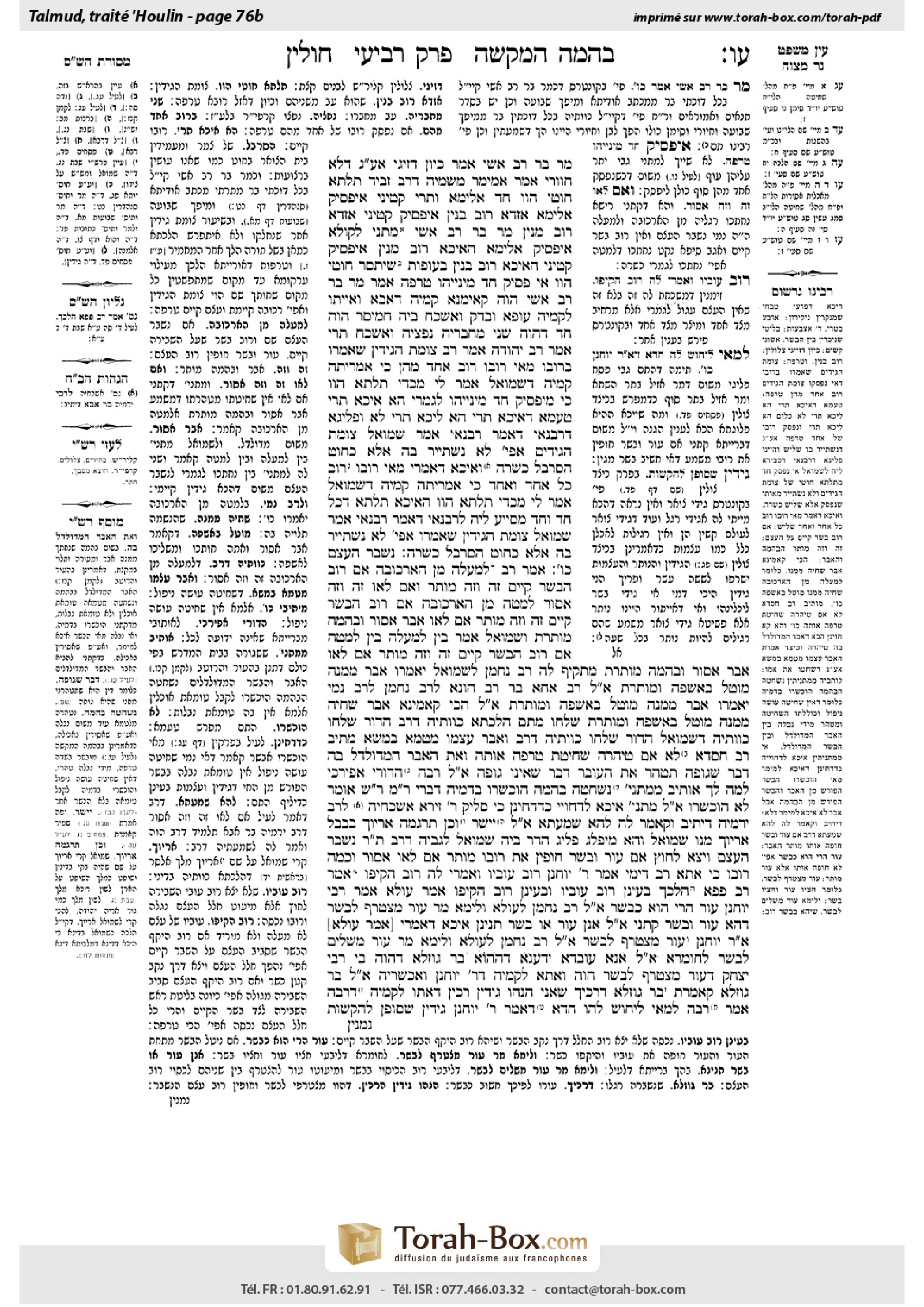
Chullin 76b: Talmud study for Daf Yomi
Study the Talmud for Daf Yomi with scanned pages, Hebrew text, English translations from Sefaria and AI-generated French translations.
Passage selection and English or AI-generated French translation are available where the scan has annotations. Daf Study is independent of Torah-Box and Sefaria.
Browse Chullin · חולין · All tractatesChullin 76b text and translations
This page of Chullin includes the Aramaic text, an English translation and an AI-generated French translation, alongside the scan above.
חולין ע״ו ב · Aramaic and Hebrew text
מָר בַּר רַב אָשֵׁי אָמַר: כֵּיוָן דְּזִיגִי – אַף עַל גַּב דְּלָא חִוָּורֵי.
אָמַר אַמֵּימָר מִשְּׁמֵיהּ דְּרַב זְבִיד: תְּלָתָא חוּטֵי הָווּ, חַד אַלִּימָא וּתְרֵי קַטִּינֵי. אִיפְּסִיק אַלִּימָא – אַזְדָּא רוֹב בִּנְיָן, אִיפְּסִיק קַטִּינֵי – אַזְדָּא רוֹב מִנְיָן. מָר בַּר רַב אָשֵׁי מַתְנֵי לְקוּלָּא: אִיפְּסִיק אַלִּימָא – הָאִיכָּא רוֹב מִנְיָן, אִיפְּסִיק קַטִּינֵי – הָאִיכָּא רוֹב בִּנְיָן.
בְּעוֹפוֹת שִׁיתְּסַר חוּטֵי הָווּ, אִיפְּסִיק חַד מִינַּיְיהוּ – טְרֵפָה. אָמַר מָר בַּר רַב אָשֵׁי: הֲוָה קָאֵימְנָא קַמֵּיהּ דְּאַבָּא, וְאַיְיתוֹ לְקַמֵּיהּ עוֹפָא, וּבְדַק וְאַשְׁכַּח בֵּיהּ חֲמֵיסַר. הֲוָה חַד דַּהֲוָה שָׁנֵי מֵחַבְרֵיהּ, נַפְּצֵיהּ וְאַשְׁכַּח תְּרֵי.
אָמַר רַב יְהוּדָה אָמַר רַב: צוֹמֶת הַגִּידִין שֶׁאָמְרוּ בְּרוּבּוֹ; מַאי רוּבּוֹ? רוֹב אֶחָד מֵהֶן. כִּי אַמְרִיתַהּ קַמֵּיהּ דִּשְׁמוּאֵל, אָמַר לִי: מִכְּדֵי תְּלָתָא הָווּ, כִּי מִיפְּסִיק חַד מִינַּיְיהוּ לִגְמָרֵי, הָא אִיכָּא תְּרֵי.
טַעְמָא דְּאִיכָּא תְּרֵי, הָא לֵיכָּא תְּרֵי – לָא, וּפְלִיגָא דְּרַבְנַאי, דְּאָמַר רַבְנַאי אָמַר שְׁמוּאֵל: צוֹמֶת הַגִּידִים, אֲפִילּוּ לֹא נִשְׁתַּיֵּיר בָּהּ אֶלָּא כְּחוּט הַסַּרְבָּל – כְּשֵׁרָה.
וְאִיכָּא דְּאָמְרִי: מַאי רוּבּוֹ? רוֹב כׇּל אֶחָד וְאֶחָד. כִּי אַמְרִיתַהּ קַמֵּיהּ דִּשְׁמוּאֵל, אָמַר לִי: מִכְּדֵי תְּלָתָא הָווּ, הָאִיכָּא תְּלָתָא דְּכֹל חַד וְחַד מְסַיַּיע לֵיהּ לְרַבְנַאי, דְּאָמַר רַבְנַאי אָמַר שְׁמוּאֵל: צוֹמֶת הַגִּידִין שֶׁאָמְרוּ, אֲפִילּוּ לֹא נִשְׁתַּיֵּיר בָּהּ אֶלָּא כְּחוּט הַסַּרְבָּל – כְּשֵׁרָה.
נִשְׁבַּר הָעֶצֶם כּוּ׳.
אָמַר רַב: לְמַעְלָה מִן הָאַרְכּוּבָּה, אִם רוֹב הַבָּשָׂר קַיָּים – זֶה וָזֶה מוּתָּר, וְאִם לָאו – זֶה וָזֶה אָסוּר. לְמַטָּה מִן הָאַרְכּוּבָּה, אִם רוֹב הַבָּשָׂר קַיָּים – זֶה וָזֶה מוּתָּר, אִם לָאו – אֵבֶר אָסוּר וּבְהֵמָה מוּתֶּרֶת.
וּשְׁמוּאֵל אָמַר: בֵּין לְמַעְלָה בֵּין לְמַטָּה, אִם רוֹב הַבָּשָׂר קַיָּים – זֶה וָזֶה מוּתָּר, אִם לָאו – אֵבֶר אָסוּר, וּבְהֵמָה מוּתֶּרֶת.
מַתְקֵיף לַהּ רַב נַחְמָן לִשְׁמוּאֵל: יֹאמְרוּ ״אֵבֶר מִמֶּנָּה מוּטָּל בָּאַשְׁפָּה וּמוּתֶּרֶת״? אֲמַר לֵיהּ רַב אַחָא בַּר רַב הוּנָא לְרַב נַחְמָן: לְרַב נָמֵי יֹאמְרוּ ״אֵבֶר מִמֶּנָּה מוּטָּל בָּאַשְׁפָּה וּמוּתֶּרֶת״!
אֲמַר לֵיהּ: הָכִי קָאָמֵינָא, אֵבֶר שֶׁחָיָה מִמֶּנָּה מוּטָּל בָּאַשְׁפָּה, וּמוּתֶּרֶת?
שְׁלַחוּ מִתָּם: הִלְכְתָא כְּוָותֵיהּ דְּרַב, הֲדוּר שְׁלַחוּ: כְּוָותֵיהּ דִּשְׁמוּאֵל, הֲדוּר שְׁלַחוּ: כְּוָותֵיהּ דְּרַב, וְאֵבֶר עַצְמוֹ מְטַמֵּא בְּמַשָּׂא.
מֵתִיב רַב חִסְדָּא: לֹא, אִם טִיהֲרָה שְׁחִיטַת טְרֵפָה אוֹתָהּ וְאֶת הָאֵבֶר הַמְדוּלְדָּל בָּהּ – דָּבָר שֶׁגּוּפָהּ, תְּטַהֵר אֶת הָעוּבָּר – דָּבָר שֶׁאֵינוֹ גּוּפָהּ?
אֲמַר לֵיהּ רַבָּה: הַדּוֹרֵי אַפִּירְכֵי לְמָה לָךְ? אוֹתֵיב מִמַּתְנִיתִין! נִשְׁחֲטָה בְּהֵמָה – הוּכְשְׁרוּ בְּדָמֶיהָ, דִּבְרֵי רַבִּי מֵאִיר. רַבִּי שִׁמְעוֹן אוֹמֵר: לֹא הוּכְשְׁרוּ.
אֲמַר לֵיהּ: מַתְנִיתִין אִיכָּא לְדַחוֹיֵי, כִּדְדָחֵינַן.
כִּי סָלֵיק רַבִּי זֵירָא, אַשְׁכְּחֵיהּ לְרַב יִרְמְיָה דְּיָתֵיב וְקָאָמַר לַהּ לְהָא שְׁמַעְתָּא. אֲמַר לֵיהּ: יִישַׁר, וְכֵן תַּרְגְּמַהּ אַרְיוֹךְ בְּבָבֶל. אַרְיוֹךְ מַנּוּ? שְׁמוּאֵל. וְהָא מִיפְלָג פְּלִיג! הֲדַר בֵּיהּ שְׁמוּאֵל לְגַבֵּיהּ דְּרַב.
תָּנוּ רַבָּנַן: נִשְׁבַּר הָעֶצֶם וְיָצָא לַחוּץ, אִם עוֹר וּבָשָׂר חוֹפִין אֶת רוּבּוֹ – מוּתָּר, אִם לָאו – אָסוּר. וְכַמָּה רוּבּוֹ? כִּי אֲתָא רַב דִּימִי אָמַר רַבִּי יוֹחָנָן: רוֹב עוֹבְיוֹ, וְאָמְרִי לַהּ: רוֹב הֶקֵּיפוֹ. אָמַר רַב פָּפָּא: הִלְכָּךְ, בָּעֵינַן רוֹב עוֹבְיוֹ וּבָעֵינַן רוֹב הֶקֵּיפוֹ.
אָמַר עוּלָּא אָמַר רַבִּי יוֹחָנָן: עוֹר הֲרֵי הוּא כְּבָשָׂר. אֲמַר לֵיהּ רַב נַחְמָן לְעוּלָּא: וְלֵימָא מָר עוֹר מְצָרֵף לְבָשָׂר, דְּהָא ״עוֹר וּבָשָׂר״ קָתָנֵי! אֲמַר לֵיהּ: אֲנַן ״עוֹר אוֹ בָּשָׂר״ תָּנֵינַן.
אִיכָּא דְּאָמְרִי [אָמַר עוּלָּא], אָמַר רַבִּי יוֹחָנָן: עוֹר מִצְטָרֵף לְבָשָׂר. אֲמַר לֵיהּ רַב נַחְמָן לְעוּלָּא: וְלֵימָא מָר עוֹר מַשְׁלִים לְבָשָׂר לְחוּמְרָא!
אֲמַר לֵיהּ: אֲנָא עוֹבָדָא יָדַעְנָא, דְּהָהוּא בַּר גּוֹזָלָא דַּהֲוָה בֵּי רַבִּי יִצְחָק, דְּעוֹר מְצָרֵף לְבָשָׂר הֲוָה, וַאֲתָא לְקַמֵּיהּ דְּרַבִּי יוֹחָנָן וְאַכְשְׁרֵיהּ. אֲמַר לֵיהּ: בַּר גּוֹזָלָא קָאָמְרַתְּ? בַּר גּוֹזָלָא דְּרַכִּיךְ שָׁאנֵי.
הָנְהוּ גִּידִין רַכִּין דַּאֲתוֹ לְקַמֵּיהּ דְּרַבָּה, אָמַר רַבָּה: לְמַאי לֵיחוּשׁ לְהוּ? חֲדָא, דְּאָמַר רַבִּי יוֹחָנָן: גִּידִין שֶׁסּוֹפָן לְהַקְשׁוֹת
Chullin 76b · English translation
Mar bar Rav Ashi said: Once the sinews begin to be translucent, even if they are not actually white, they are considered part of the convergence of sinews.
§ With regard to the removal of the convergence of sinews in the thigh, which renders the animal a tereifa, Ameimar says in the name of Rav Zevid: There are three strands, i.e., sinews; one is thick and the other two are thin. If the thick sinew was severed, a majority of the structure of the convergence of sinews is gone, as the thick sinew is thicker than the other two combined. If the thin ones were severed, then a majority of the number of sinews is gone. If either type of majority has been severed, the animal is rendered a tereifa. Conversely, Mar bar Rav Ashi teaches a lenient version of this ruling: If the thick sinew was severed, since there is a majority of the number of sinews that remains, the animal is not a tereifa. Likewise, if the thin ones were severed, since there is a majority of the structure that remains intact, the animal is not a tereifa.
The Gemara comments: All this applies to animals, whereas with regard to birds, there are sixteen strands; if even one of them is severed, it is a tereifa. Mar bar Rav Ashi said: I was standing before father, i.e., Rav Ashi, and they brought before him a bird, and he examined it to see if it was a tereifa and found fifteen sinews. There was one of them that was different from the others; he broke it apart and it was found to be composed of two sinews.
The Gemara returns to the issue of the convergence of sinews in an animal. Rav Yehuda says that Rav says: The convergence of sinews in the thigh of which the Sages spoke, stating that if it is severed the animal is a tereifa, is referring to the severing of the majority of it. Rav Yehuda added: What is the meaning of the majority of it? This means the majority of one of the sinews. Rav Yehuda further stated: When I stated this halakha in the name of Rav before Shmuel, he said to me: Since they are three sinews, when one of them is severed entirely, there are still two remaining, which means that the majority of the convergence of sinews is intact. Therefore, the animal is still kosher.
The Gemara infers from Shmuel’s statement: The reason the animal is not a tereifa is only that there are two remaining, from which it may be inferred that if there are not two remaining it is not kosher, despite the fact that the other sinew is intact. The Gemara notes: And according to this version of his opinion, Shmuel disagrees with the opinion of Rabbenai, who also stated his ruling in Shmuel’s name. As Rabbenai says that Shmuel says: With regard to the convergence of sinews in the thigh, even if only one sinew remains of it, which is as thick as the string used to close the neckline of a cloak [hasarbal], the animal is kosher.
And some say that there is a different version of this discussion. Rav Yehuda said: What is the meaning of a majority of it? This means a majority of each and every one of the sinews. Rav Yehuda added: When I stated this halakha in the name of Rav before Shmuel, he said to me: Since they are three sinews, there is one-third of each and every one, and that should be sufficient. There is no need for a majority of each sinew to remain. The Gemara notes: Rav Yehuda’s statement in the name of Shmuel supports the opinion of Rabbenai, as Rabbenai says that Shmuel says: With regard to the convergence of sinews in the thigh of which the Sages spoke, even if there remains of each of the three sinews only as much as the thickness of the string used to close the neckline of a cloak, the animal is kosher. This also indicates that there is no need for a majority of the sinew to remain.
§ The mishna states: If the bone of a limb was broken but the limb was not completely severed, and the animal was then slaughtered, if the majority of the flesh surrounding the bone is intact, the slaughter of the animal renders it permitted; but if not, its slaughter does not render it permitted.
Rav says: If the bone was broken above the leg joint and then the animal was slaughtered, if a majority of the flesh around the break is intact, both this, the animal itself, and that, the limb, are permitted. The break does not render the animal a tereifa and the limb is not regarded as a hanging limb; therefore it is permitted by the slaughter of the animal. But if not, i.e., if a majority of the flesh around the break is not intact, both this and that, the animal and the limb, are prohibited. If the bone was broken below the leg joint, then if a majority of the flesh is intact, both this and that are permitted; if not, then the limb itself is prohibited from the area of the break and below, as it is not permitted by the slaughter of the animal, but the rest of the animal is permitted.
And Shmuel says: Whether the break is above or below the leg joint, the halakha is the same: If a majority of the flesh is intact, both this and that, the limb and the animal, are permitted. If the majority of the flesh is not intact, the limb is prohibited and the animal is permitted. Even if the leg was broken above the leg joint the animal does not become a tereifa unless the leg was entirely severed.
Rav Naḥman objects to this ruling of Shmuel: If one permits the animal despite the fact that its leg is prohibited, people will say: A limb from the animal is placed in the garbage, as it is prohibited, and yet the animal itself is permitted? They may then mistakenly conclude that even if that leg had been completely severed from the animal, the animal would be permitted. Rav Aḥa bar Rav Huna said to Rav Naḥman: This concern also exists according to the opinion of Rav, in a case where the bone is broken below the joint and the flesh is not intact. Rav rules in that case that the animal is permitted and the limb is prohibited. But is there not the concern that people will say: A limb from this animal is placed in the garbage, and the animal itself is permitted?
Rav Naḥman said to him: This is what I meant to say: People will say: A limb from which this animal lives, i.e., which if removed, renders the animal a tereifa, is placed in the garbage, and the animal itself is permitted? The concern exists only according to the opinion of Shmuel, who permits the animal even when the break is above the joint, as were it severed there, the animal would thereby be rendered a tereifa. People may mistakenly equate the case where the bone was broken and the case where it was severed and permit both. The concern does not exist according to the opinion of Rav, as he permits the animal only in a case where the bone is broken below the joint, and even if it were severed there that would not render it a tereifa.
§ With regard to this dispute, they sent a ruling from there, Eretz Yisrael: The halakha is in accordance with the opinion of Rav that if the bone was broken above the leg joint, if a majority of the flesh around the break is not intact, both the animal and the limb are prohibited. They then sent a ruling: The halakha is in accordance with the opinion of Shmuel that only the limb is prohibited. They then sent a ruling: The halakha is in accordance with the opinion of Rav that the animal is a tereifa, and they added that the limb itself is not rendered pure by the slaughter; rather, it imparts the impurity of a limb from a living animal by carrying. The animal itself, though, is rendered pure from the impurity of a carcass and is prohibited only as a tereifa.
Rav Ḥisda raises an objection from a baraita cited earlier (73a) concerning whether the slaughter of a mother animal can render pure a limb of its fetus that was extended outside the womb even though the act of slaughter cannot render the fetus permitted for consumption. The Rabbis brought proof for their opinion that this limb is rendered pure from the halakha that a tereifa is rendered pure by slaughter even though it is not thereby permitted for consumption. Rabbi Meir responded: No, even if the slaughter of a tereifa renders the animal itself pure, and likewise, the slaughter of any animal renders pure the limb that was partially cut from it but still hangs from it from imparting the impurity of a carcass, despite the fact that this animal or limb is prohibited for consumption, that is so with regard to something that is part of its own body. Does it necessarily follow that it should also render pure the limb of its fetus, which is something that is not part of its own body? It is explicit in Rabbi Meir’s claim that the hanging limb of a tereifa is rendered pure by the slaughter of the animal.
Rabba said to Rav Ḥisda: Why are you searching after refutations from baraitot that are not known by all? You can raise a conclusive refutation from the mishna (127b): With regard to the limb or flesh of an animal that was partially severed but remains hanging from it, if the animal was slaughtered, the limb and the flesh were thereby rendered susceptible to contracting the impurity of food by the blood of the animal, as blood is one of the seven liquids that render foods susceptible to impurity; this is the statement of Rabbi Meir. Rabbi Shimon says: They were not rendered susceptible with the blood of the slaughtered animal. It is evident that according to all opinions in the mishna, the hanging limb and flesh are not regarded as a limb or flesh from a living animal, which would not need to be rendered susceptible to impurity, as they impart their own impurity.
Rav Ḥisda said to Rabba: The difficulty from the mishna can be refuted, as we refuted it earlier (73a), by claiming that the dispute about the blood rendering the animal susceptible to impurity concerns only the hanging flesh, but that a hanging limb from an animal that was slaughtered does have the status of a limb from a living animal and the associated impurity.
The Gemara relates that when Rabbi Zeira ascended to Eretz Yisrael he found Rav Yirmeya sitting and saying this halakha of Rav, i.e., that if the bone is broken above the leg joint and the flesh is not intact, the animal is a tereifa. Rabbi Zeira said to him: You have spoken well, and Aryokh interpreted the matter likewise in Babylonia. The Gemara asks: Who is Aryokh? It is Shmuel. But that is difficult, as Shmuel disagrees with Rav concerning this issue. The Gemara explains: Shmuel retracted his opinion in favor of that of Rav.
§ The Sages taught in a baraita: In a case where the bone broke and protruded outward, if skin and flesh cover a majority of the bone the animal is permitted; if not, it is prohibited. The Gemara asks: And how much is a majority of a bone? When Rav Dimi came from Eretz Yisrael to Babylonia, he said that Rabbi Yoḥanan says: A majority of its width, and some say that he said: A majority of its circumference. Rav Pappa said: Therefore, as there is no clear ruling on the matter, we require that the bone be covered by a majority of its width, and we also require that it be covered by a majority of its circumference.
Ulla said that Rabbi Yoḥanan said: Skin is like flesh with regard to this issue, i.e., if the flesh has been removed but the skin covers a majority of the bone, the animal is kosher. Rav Naḥman said to Ulla: And let the Master say that skin combines with flesh, i.e., that if flesh and skin together cover a majority of the bone the animal is kosher, as the tanna of the above baraita teaches: Skin and flesh, which indicates that skin alone is ineffective. Ulla said to him: We learned that the baraita states: Skin or flesh.
Some say that there is a different version of this discussion: Ulla said that Rabbi Yoḥanan said: Skin combines with flesh. Rav Naḥman said to Ulla: And let the Master say that skin completes the amount of flesh required, and this is a stringent ruling. This would mean that if the majority of the bone is covered mostly with flesh and the rest of the majority is covered with skin the animal is kosher, but if the majority is covered half with flesh and half with skin, it is not kosher.
Ulla said to him: I know my ruling from the following incident: As there was a certain fledgling that was in the house of Rabbi Yitzḥak, and its leg broke, and it was a situation where the skin combined with flesh to cover the majority of the bone. And Rabbi Yitzḥak came before Rabbi Yoḥanan and he deemed the bird kosher. Rav Naḥman said to him: Do you speak of a fledgling? The halakha in the case of a fledgling is different, as its skin is soft and is considered like flesh.
The Gemara further relates: There was a case involving certain soft sinews that combined with flesh to cover the majority of a broken bone, and they came before Rabba for a ruling. Rabba said: What concern is there with the sinews in this case? First, there is no concern, because Rabbi Yoḥanan says: With regard to sinews that will ultimately harden,
Chullin 76b · Traduction française (IA)
Mar bar Rav Ashi a dit : Lorsque les nerfs commencent à être translucides, même s'ils ne sont pas effectivement blancs, on les considère comme faisant partie de la convergence des nerfs.
§ En ce qui concerne l'élimination de la convergence des nerfs dans la cuisse, ce qui rend l'animal tereifa, Ameimar dit au nom de Rav Zevid : Il y a trois nerfs, c'est-à-dire des nerfs ; l'un est épais et les deux autres sont fins. Si le nerf épais a été sectionné, une majorité de la structure de la convergence des nerfs est perdue, car le nerf épais est plus épais que les deux autres combinés. Si les nerfs fins ont été sectionnés, alors une majorité du nombre des nerfs est peruse. Si l'une ou l'autre de ces majorités a été sectionnée, l'animal est rendu tereifa. À l'inverse, Mar bar Rav Ashi enseigne une version plus clémente de cette décision : Si le nerf épais a été sectionné, puisqu'il reste une majorité du nombre de nerfs, l'animal n'est pas tereifa. De même, si les nerfs fins ont été sectionnés, puisqu'il reste une majorité de la structure intacte, l'animal n'est pas tereifa.
La Guemara commente : Tout cela s'applique aux animaux, tandis que concernant les oiseaux, il y a seize nerfs ; si même un seul d'entre eux est sectionné, l'oiseau est tereifa. Mar bar Rav Ashi a dit : Je me tenais devant mon père, c'est-à-dire Rav Ashi, et on lui présenta un oiseau, et il l'examina pour voir s'il était tereifa et trouva quinze nerfs. Il y avait un de ceux-ci qui était différent des autres ; il le brisa et il s'avéra qu'il était composé de deux nerfs.
La Guemara reprend la question de la convergence des nerfs dans un animal. Rav Yehuda dit que Rav dit : La convergence des nerfs dans la cuisse dont les Sages parlaient, en disant que si elle est sectionnée l'animal est tereifa, fait référence à la section de la majorité de cette convergence. Rav Yehuda ajouta : De quoi parle-t-on lorsqu'on dit la majorité ? Cela signifie la majorité d'un seul des nerfs. Rav Yehuda ajouta encore : Lorsque j'ai énoncé cette halakha au nom de Rav devant Shmuel, il m'a dit : Puisque ce sont trois nerfs, lorsque l'un d'entre eux est entièrement sectionné, il en reste deux, ce qui signifie que la majorité de la convergence des nerfs est intacte. Par conséquent, l'animal est encore kosher.
La Guemara déduit de la déclaration de Shmuel : La raison pour laquelle l'animal n'est pas tereifa est seulement parce qu'il en reste deux, d'où l'on peut déduire que si ce n'est pas le cas, il n'est pas kosher, malgré le fait que le nerf restant est intact. La Guemara note : Et selon cette version de son opinion, Shmuel est en désaccord avec l'opinion des Rabbenai, qui ont également énoncé leur décision au nom de Shmuel. Comme les Rabbenai disent que Shmuel dit : En ce qui concerne la convergence des nerfs dans la cuisse, même si seul un nerf reste de celui-ci, qui est aussi épais que la corde utilisée pour fermer le col d'une cape [hasarbal], l'animal est kosher.
Et certains disent qu'il existe une autre version de cette discussion. Rav Yehuda dit : De quoi parle-t-on lorsqu'on dit la majorité ? Cela signifie la majorité de chaque nerf individuel. Rav Yehuda ajouta : Lorsque j'ai énoncé cette halakha au nom de Rav devant Shmuel, il m'a dit : Puisque ce sont trois nerfs, il en reste un tiers de chaque nerf, et cela devrait suffire. Il n'y a pas besoin que la majorité de chaque nerf reste intacte. La Guemara note : La déclaration de Rav Yehuda au nom de Shmuel soutient l'opinion des Rabbenai, car les Rabbenai disent que Shmuel dit : En ce qui concerne la convergence des nerfs dans la cuisse dont les Sages parlaient, même si il reste de chaque nerf seulement autant que l'épaisseur de la corde utilisée pour fermer le col d'une cape, l'animal est kosher. Cela montre également qu'il n'y a pas besoin que la majorité des nerfs reste intacte.
§ La mitsna dit : Si le os d'une extrémité a été brisé mais que l'extrémité n'a pas été entièrement séparée, et que l'animal a ensuite été sacrifié, si la majorité de la chair entourant l'os est intacte, la sacrifice de l'animal rend l'animal permis ; mais si ce n'est pas le cas, son sacrifice ne rend pas l'animal permis.
Rav dit : Si l'os a été brisé au-dessus de l'articulation du genou et que l'animal a ensuite été sacrifié, si la majorité de la chair autour de la fracture est intacte, à la fois l'animal lui-même et l'extrémité sont permis. La fracture ne rend pas l'animal tereifa et l'extrémité n'est pas considérée comme une extrémité pendante ; par conséquent, elle est permise par le sacrifice de l'animal. Mais si ce n'est pas le cas, c'est-à-dire si la majorité de la chair autour de la fracture n'est pas intacte, à la fois l'animal et l'extrémité sont interdits. Si l'os a été brisé en dessous de l'articulation du genou, alors si la majorité de la chair est intacte, à la fois l'animal et l'extrémité sont permis ; si ce n'est pas le cas, l'extrémité elle-même est interdite à partir de la zone de la fracture et en dessous, car elle n'est pas permise par le sacrifice de l'animal, mais le reste de l'animal est permis.
Et Shmuel dit : Quelle que soit la position de la fracture, au-dessus ou en dessous de l'articulation du genou, la halakha est la même : Si la majorité de la chair est intacte, à la fois l'extrémité et l'animal sont permis. Si la majorité de la chair n'est pas intacte, l'extrémité est interdite et l'animal est permis. Même si la jambe a été brisée au-dessus de l'articulation du genou, l'animal ne devient tereifa que si la jambe a été entièrement séparée.
Rav Naḥman s'oppose à cette décision de Shmuel : Si l'on permet l'animal malgré le fait que sa jambe est interdite, les gens diront : Une jambe de l'animal est placée dans la poubelle, car elle est interdite, et pourtant l'animal lui-même est permis ? Ils pourraient alors conclure à tort que même si cette jambe avait été entièrement séparée de l'animal, l'animal serait permis. Rav Aḥa bar Rav Huna dit à Rav Naḥman : Cette préoccupation existe également selon l'opinion de Rav, dans un cas où l'os est brisé en dessous de l'articulation et la chair n'est pas intacte. Rav règle dans ce cas que l'animal est permis et la jambe est interdite. Mais n'y a-t-il pas la préoccupation que les gens diront : Une jambe de cet animal est placée dans la poubelle, et l'animal lui-même est permis ?
Rav Naḥman a dit à lui : C'est ce que je voulais dire : les gens diront : un membre dont l'animal vit, c'est-à-dire dont l'ablation rendrait l'animal tereifa, est mis dans la poubelle, et l'animal lui-même est permis ? L'inquiétude existe uniquement selon l'opinion de Shmuel, qui permet l'animal même si la fracture est au-dessus de l'articulation, comme si l'animal avait été tranché là, ce qui le rendrait tereifa. Les gens peuvent confondre à tort le cas où l'os est brisé et le cas où il est tranché et permettre les deux. L'inquiêté n'existe pas selon l'opinion de Rav, car il permet l'animal uniquement dans le cas où l'os est brisé en dessous de l'articulation, et même si l'animal avait été tranché là, cela ne le rendrait pas tereifa.
§ En ce qui concerne ce débat, ils ont envoyé un avis depuis Eretz Yisrael : la halakha suit l'opinion de Rav, disant que si l'os est brisé au-dessus de l'articulation du membre, et que la majorité de la chair autour de la fracture n'est pas intacte, à la fois l'animal et le membre sont interdits. Ils ont ensuite envoyé un autre avis : la halakha suit l'opinion de Shmuel, disant que seul le membre est interdit. Ils ont ensuite envoyé un autre avis : la halakha suit l'opinion de Rav, disant que l'animal est tereifa, et ils ont ajouté que le membre lui-même n'est pas rendu pur par la bête sacrée ; au contraire, il transmet l'impureté d'un membre d'un animal vivant par le port. L'animal lui-même, en revanche, est rendu pur de l'impureté d'un cadavre et est interdit uniquement comme tereifa.
Rav Ḥisda évoque un objet d'opposition tiré d'une baraïta citée plus tôt (73a) concernant si la bête sacrée d'une bête mère peut rendre pur un membre de son fœtus qui était étendu en dehors du ventre, même si l'acte de sacrifice ne rend pas le fœtus permis à la consommation. Les Rabbins ont apporté une preuve pour leur opinion en disant que ce membre est rendu pur par la bête sacrée, même si cela ne le rend pas permis à la consommation. Rabbi Meir a répondu : Non, même si la bête sacrée d'un tereifa rend la bête elle-même pure, et de même, la bête sacrée de toute bête rend pur le membre qui a été partiellement coupé mais qui reste suspendu, malgré le fait que cette bête ou ce membre soit interdit à la consommation, cela est ainsi concernant quelque chose qui fait partie de son propre corps. Est-ce que cela implique nécessairement qu'il doive aussi rendre pur le membre du fœtus, qui est quelque chose qui n'appartient pas à son propre corps ? Il est explicite dans l'affirmation de Rabbi Meir que le membre pendant d'un tereifa est rendu pur par la bête sacrée de l'animal.
Rabba a dit à Rav Ḥisda : Pourquoi cherchez-vous des réfutations tirées de baraitot qui ne sont pas connus de tous ? Vous pouvez évoquer une réfutation concluante tirée de la mishna (127b) : concernant le membre ou la chair d'un animal partiellement séparé mais restant suspendu, si l'animal a été sacrifié, le membre et la chair ont été rendus sujets à contracter l'impureté par le sang de l'animal, car le sang est l'un des sept liquides qui rendent les aliments sujets à l'impureté ; c'est l'opinion de Rabbi Meir. Rabbi Shimon dit : Ils n'ont pas été rendus sujets à l'impureté par le sang de l'animal sacrifié. Il est évident que selon toutes les opinions de la mishna, le membre et la chair suspendus ne sont pas considérés comme un membre ou une chair d'un animal vivant, ce qui ne nécessiterait pas d'être rendu sujet à l'impureté, car ils transmettent leur propre impureté.
Rav Ḥisda a dit à Rabba : La difficulté tirée de la michna peut être réfutée, comme nous l'avons réfutée plus tôt (73a), en affirmant que le débat concernant le sang rendant l'animal sujet à l'impureté concerne uniquement la chair suspendue, mais que le membre suspendu d'un animal sacrifié a le statut d'un membre d'un animal vivant et l'impureté associée.
La Guemara rapporte que lorsque Rabbi Zeira est monté en Eretz Yisrael, il a trouvé Rav Yirmeya assis et disant cette halakha de Rav, c'est-à-dire que si l'os est brisé au-dessus de l'articulation du membre et que la chair n'est pas intacte, l'animal est tereifa. Rabbi Zeira a dit à lui : Vous avez raison, et Aryokh a interprété la question de la même manière en Babylonie. La Guemara pose la question : Qui est Aryokh ? C'est Shmuel. Mais cela est difficile, car Shmuel est en désaccord avec Rav sur ce point. La Guemara explique : Shmuel a renoncé à son opinion en faveur de celle de Rav.
§ Les Sages ont enseigné dans une baraïta : Dans le cas où l'os s'est brisé et a sauté, si la peau et la chair recouvrent la majorité de l'os, l'animal est permis ; si ce n'est pas le cas, il est interdit. La Guemara pose la question : Et combien est la majorité d'un os ? Lorsque Rav Dimi est venu d'Eretz Yisrael en Babylonie, il a dit que Rabbi Yoḥanan disait : la majorité de sa largeur, et certains disent qu'il a dit : la majorité de son circonférence. Rav Pappa a dit : donc, comme il n'y a pas de règlement clair sur la question, nous exigeons que l'os soit recouvert par la majorité de sa largeur, et nous exigeons également qu'il soit recouvert par la majorité de sa circonférence.
Ulla a dit que Rabbi Yoḥanan disait : la peau est comme la chair concernant cette question, c'est-à-dire que si la chair a été retirée mais la peau recouvre la majorité de l'os, l'animal est kosher. Rav Naḥman a dit à Ulla : Et laissez le Maître dire que la peau s'associe à la chair, c'est-à-dire que si la chair et la peau ensemble recouvrent la majorité de l'os, l'animal est kosher, car le tanna de la baraïta ci-dessus enseigne : peau et chair, ce qui indique que la peau seule est inefficace. Ulla a dit à lui : Nous avons appris que la baraïta dit : peau ou chair.
Certains disent qu'il existe une autre version de cette discussion : Ulla a dit que Rabbi Yoḥanan disait : la peau s'associe à la chair. Rav Naḥman a dit à Ulla : Et laissez le Maître dire que la peau complète la quantité de chair requise, et c'est une règle stricte. Cela signifierait que si la majorité de l'os est recouverte principalement de chair et que la reste de la majorité est recouverte de peau, l'animal est kosher, mais si la majorité est recouverte à moitié de chair et à moitié de peau, il n'est pas kosher.
Ulla lui dit : Je connais mon jugement à partir de l'incident suivant : Il y avait un petit oiseau qui était chez Rabbi Yitzḥak, et son pied s'était cassé, et c'était une situation où la peau s'était combinée avec la chair pour couvrir la majorité de l'os. Et Rabbi Yitzḥak est venu devant Rabbi Yoḥanan et il a estimé que l'oiseau était propre. Rav Naḥman lui dit : Parlez-vous d'un petit oiseau ? La halakha dans le cas d'un petit oiseau est différente, car sa peau est molle et est considérée comme de la chair.
La Guemara rapporte davantage l'histoire suivante : Il y avait un cas concernant certaines fibres molles qui s'étaient combinées avec la chair pour couvrir la majorité d'un os cassé, et ils sont venus devant Rabba pour un jugement. Rabba dit : Quel est l'enjeu des fibres dans ce cas ? Premièrement, il n'y a pas d'enjeu, car Rabbi Yoḥanan dit : En ce qui concerne les fibres qui finiront par durcir,
Traduction française générée par IA à partir de l’édition anglaise de Sefaria. Vérifie toujours un passage avec le texte source.
Text from Sefaria: William Davidson Edition - Vocalized Aramaic (unknown); William Davidson Edition - English (CC BY NC).