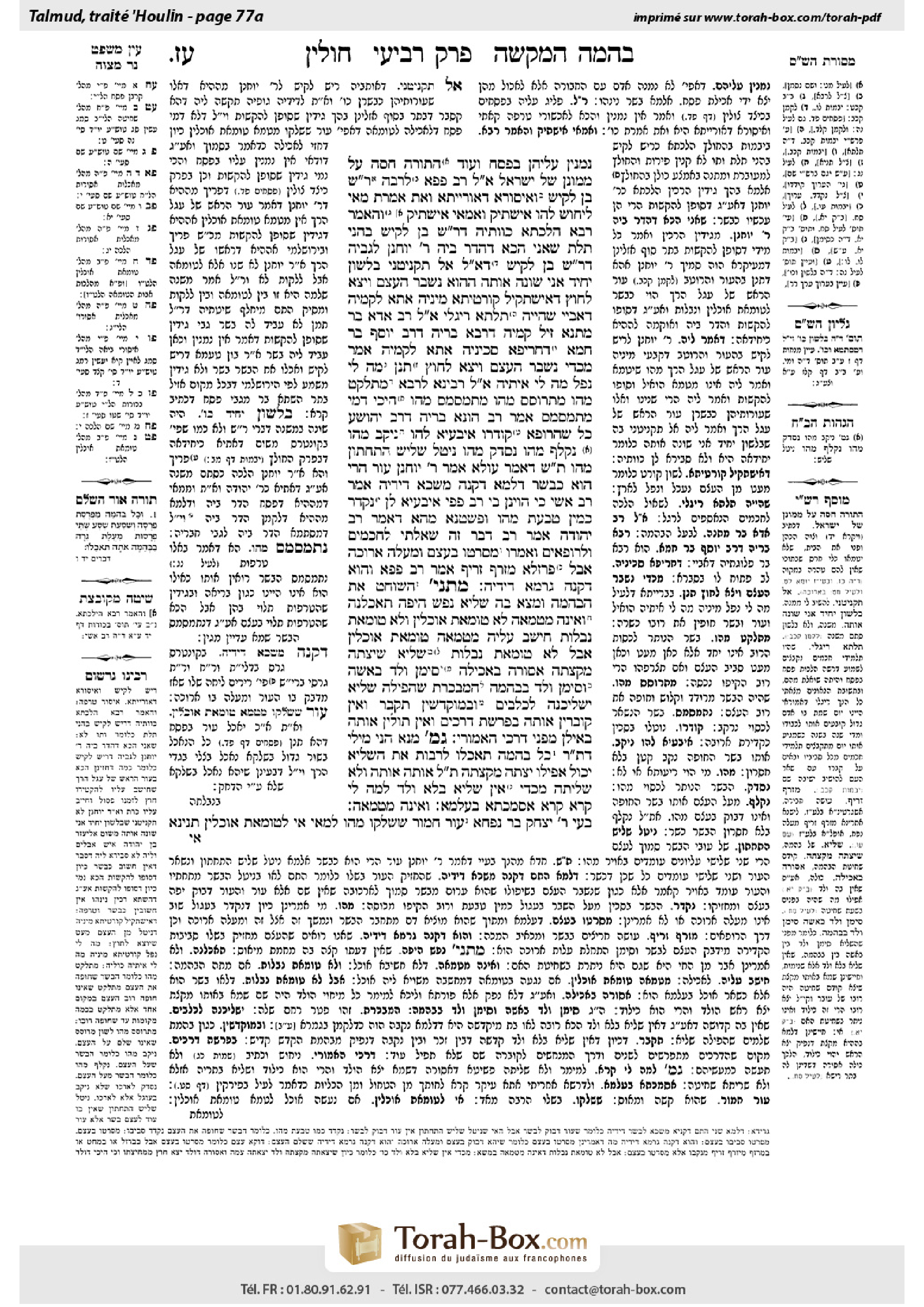
Chullin 77a: Talmud study for Daf Yomi
Study the Talmud for Daf Yomi with scanned pages, Hebrew text, English translations from Sefaria and AI-generated French translations.
Passage selection and English or AI-generated French translation are available where the scan has annotations. Daf Study is independent of Torah-Box and Sefaria.
Browse Chullin · חולין · All tractatesChullin 77a text and translations
This page of Chullin includes the Aramaic text, an English translation and an AI-generated French translation, alongside the scan above.
חולין ע״ז א · Aramaic and Hebrew text
נִמְנִין עֲלֵיהֶן בַּפֶּסַח, וְעוֹד, הַתּוֹרָה חָסָה עַל מָמוֹנָן שֶׁל יִשְׂרָאֵל.
אֲמַר לֵיהּ רַב פָּפָּא לְרַבָּה: רַבִּי שִׁמְעוֹן בֶּן לָקִישׁ, וְאִיסּוּרָא דְּאוֹרָיְיתָא, וְאַתְּ אָמְרַתְּ: מַאי לֵיחוּשׁ לְהוּ?! אִישְׁתִּיק.
וְאַמַּאי אִישְׁתִּיק? וְהָאָמַר רָבָא: הִלְכְתָא כְּוָותֵיהּ דְּרַבִּי שִׁמְעוֹן בֶּן לָקִישׁ בְּהָנֵי תְּלָת!
שָׁאנֵי הָכָא, דַּהֲדַר בֵּיהּ רַבִּי יוֹחָנָן לְגַבֵּיהּ דְּרַבִּי שִׁמְעוֹן בֶּן לָקִישׁ, דַּאֲמַר לֵיהּ: אַל תַּקְנִיטֵנִי, בִּלְשׁוֹן יָחִיד אֲנִי שׁוֹנֶה אוֹתָהּ.
הָהוּא נִשְׁבַּר הָעֶצֶם וְיָצָא לַחוּץ, דְּאִישְׁתְּקִיל קוּרְטִיתָא מִינֵּיהּ, אֲתָא לְקַמֵּיהּ דְּאַבָּיֵי, שַׁהֲיֵיהּ תְּלָתָא רִיגְלֵי.
אֲמַר לֵיהּ רַב אַדָּא בַּר מַתְנָא: זִיל קַמֵּיהּ דְּרָבָא בְּרֵיהּ דְּרַב יוֹסֵף בַּר חָמָא, דַּחֲרִיפָא סַכִּינֵיהּ. אֲתָא לְקַמֵּיהּ, אֲמַר: מִכְּדֵי ״נִשְׁבַּר הָעֶצֶם וְיָצָא לַחוּץ״ תְּנַן, מָה לִי נְפַל, מָה לִי אִיתֵיהּ?
אֲמַר לֵיהּ רָבִינָא לְרָבָא: מִתְלַקֵּט מַהוּ? מִתְרוֹסֵס מַהוּ? מִתְמַסְמֵס מַהוּ? הֵיכִי דָּמֵי מִתְמַסְמֵס? אָמַר רַב הוּנָא בְּרֵיהּ דְּרַב יְהוֹשֻׁעַ: כֹּל שֶׁהָרוֹפֵא קוֹדְרוֹ.
אִיבַּעְיָא לְהוּ: נִיקַּב מַהוּ? נִקְלַף מַהוּ? נִסְדַּק מַהוּ? נִיטַּל שְׁלִישׁ הַתַּחְתּוֹן מַהוּ?
תָּא שְׁמַע, דְּאָמַר עוּלָּא אָמַר רַבִּי יוֹחָנָן: עוֹר הֲרֵי הוּא כְּבָשָׂר, דִּלְמָא דִּקְנָה מַשְׁכָּא דִּידֵיהּ.
אָמַר רַב אָשֵׁי: כִּי הֲוֵינַן בֵּי רַב פַּפֵּי, אִיבַּעְיָא לַן: נִקְדַּר כְּמִין טַבַּעַת, מַהוּ? וּפְשַׁטְנָא מֵהָא דְּאָמַר רַב יְהוּדָה אָמַר רַב: דָּבָר זֶה שָׁאַלְתִּי לַחֲכָמִים וְלָרוֹפְאִים, וְאָמְרוּ: מְסָרְטוֹ בְּעֶצֶם וּמַעֲלֶה אֲרוּכָה, אֲבָל פַּרְזְלָא מִזְרָף זָרֵיף. אָמַר רַב פָּפָּא: וְהוּא דִּקְנָה גַּרְמָא דִּידֵיהּ.
מַתְנִי׳ הַשּׁוֹחֵט אֶת הַבְּהֵמָה וּמָצָא בָּהּ שִׁלְיָא – נֶפֶשׁ הַיָּפֶה תֹּאכְלֶנָּה, וְאֵינָהּ מְטַמְּאָה לֹא טוּמְאַת אֳכָלִין וְלֹא טוּמְאַת נְבֵלוֹת. חִישֵּׁב עָלֶיהָ – מְטַמְּאָה טוּמְאַת אֳכָלִין, אֲבָל לֹא טוּמְאַת נְבֵלוֹת.
שִׁלְיָא שֶׁיָּצְתָה מִקְצָתָהּ – אֲסוּרָה בַּאֲכִילָה, סִימַן וָלָד בָּאִשָּׁה וְסִימַן וָלָד בַּבְּהֵמָה.
הַמְבַכֶּרֶת שֶׁהִפִּילָה שִׁלְיָא – יַשְׁלִיכֶנָּה לִכְלָבִים, וּבַמּוּקְדָּשִׁין תִּקָּבֵר, וְאֵין קוֹבְרִין אוֹתָהּ בְּפָרָשַׁת דְּרָכִים, וְאֵין תּוֹלִין אוֹתָהּ בְּאִילָן, מִפְּנֵי דַּרְכֵי הָאֱמוֹרִי.
גְּמָ׳ מְנָא הָנֵי מִילֵּי? דְּתָנוּ רַבָּנַן: ״כֹּל (בהמה) [בַּבְּהֵמָה] תֹּאכֵלוּ״ – לְרַבּוֹת אֶת הַשִּׁלְיָא. יָכוֹל אֲפִילּוּ יָצְתָה מִקְצָתָהּ? תַּלְמוּד לוֹמַר: ״אוֹתָהּ״ – אוֹתָהּ וְלֹא שִׁלְיָתָהּ.
מִכְּדִי אֵין שִׁלְיָא בְּלֹא וָלָד, לְמָה לִי קְרָא? קְרָא אַסְמַכְתָּא בְּעָלְמָא.
וְאֵינָהּ מְטַמְּאָה. בָּעֵי רַבִּי יִצְחָק בַּר נַפָּחָא: עוֹר חֲמוֹר שֶׁשְּׁלָקוֹ מַהוּ? לְמַאי? אִי לְטוּמְאַת אֳכָלִין – תְּנֵינָא,
Chullin 77a · English translation
one may be registered as part of a group that will eat the Paschal offering on their account, i.e., even if those sinews are the only part of the lamb he will eat. Evidently, such sinews are regarded as flesh. And furthermore, the Torah spared the money of the Jewish people, and one must tend toward leniency.
Rav Pappa said to Rabba: But Rabbi Shimon ben Lakish disagrees with Rabbi Yoḥanan and holds that one may not be registered for those sinews, as they will eventually harden and are therefore not considered flesh. And therefore, the broken bone in this case is not covered by flesh and the animal is prohibited by Torah law as a tereifa, and yet you say: What concern is there with the sinews in this case? Rabba was silent.
The Gemara asks: And why was Rabba silent? But doesn’t Rava say that the halakha is in accordance with the opinion of Rabbi Shimon ben Lakish in his disputes with Rabbi Yoḥanan only with regard to these three matters, i.e., three matters that are mentioned in Yevamot 36a, and not in other cases? If so, Rabba could simply have replied that the halakha is not in accordance with the opinion of Rabbi Shimon ben Lakish with regard to this issue.
The Gemara answers: Here, with regard to sinews that will ultimately harden, it is different, as Rabbi Yoḥanan retracted his ruling in favor of the opinion of Rabbi Shimon ben Lakish, as when Rabbi Shimon ben Lakish raised a difficulty against Rabbi Yoḥanan’s opinion, Rabbi Yoḥanan said to him: Do not provoke me by asking questions to refute my opinion that the fact that the sinews will ultimately harden is disregarded, as I teach it in explanation of a lone opinion (see Pesaḥim 84a). Even Rabbi Yoḥanan conceded that the opinion he expressed was only according to one Sage, but is not the halakha.
The Gemara relates: There was a certain case in which a bone in an animal’s leg broke and protruded outward. This bone was mostly covered with flesh and skin, but a small piece [kurtita] of the bone had been removed from it. The case came before Abaye, who delayed his response until three pilgrimage Festivals had passed, when the Sages gathered together and he could ask them.
Rav Adda bar Mattana said to the owner of the animal: Go before Rava, son of Rav Yosef bar Ḥama, whose knife is sharp, i.e., he has insight into halakhic matters and decides matters quickly, and ask him to decide your case. The owner came before Rava to seek his opinion. Rava said to him: Since we learned in the baraita (76b): If the bone broke and protruded outward, if skin and flesh cover a majority of the bone the animal is permitted, what difference is there to me if the bone fell out, and what difference is there to me if it is in its place? In either case, the animal is permitted.
With regard to a case where flesh covers the majority of a broken bone, Ravina said to Rava: If the flesh was torn in pieces and spread over the area, and if gathered it would constitute a majority, what is the halakha? Similarly, if the flesh was pulverized and thin, what is the halakha? If it was decomposed, what is the halakha? The Gemara asks: What are the circumstances of this case in which the flesh is decomposed? Rav Huna, son of Rav Yehoshua, said: This is referring to any kind of flesh that the doctor cuts away [kodro] and removes to enable the surrounding area to heal.
A dilemma was raised before the Sages: If the flesh that covers the bone was perforated, what is the halakha? Likewise, if the flesh was peeled off the bone, what is the halakha? If it was cracked, what is the halakha? If the bottom third of the width of the flesh, i.e., the part that is adjacent to the bone, was removed, what is the halakha?
The Gemara suggests: Come and hear, as Ulla says that Rabbi Yoḥanan says: Skin is like flesh. This would appear to indicate that any covering is sufficient. The Gemara refutes this proof: Perhaps Rabbi Yoḥanan was referring to a specific case where there was never flesh on the bone, but only skin, e.g., adjacent to the knee, where the skin holds its own place close to the bone. This ruling may not apply in an area where there was flesh. Perhaps in such a place the bone must be covered by flesh that is still healthy.
Rav Ashi said: While we were studying in Rav Pappi’s study hall, we raised a dilemma: If the flesh and skin were cut in the shape of a ring around the break, and yet most of the circumference of the bone is surrounded by flesh, what is the halakha? And we resolved this dilemma from this statement that Rav Yehuda says that Rav says: I asked about this matter to the Sages and to the doctors, what to do when a bone breaks and the surrounding flesh has been cut away, and they said: One makes an incision in it with a sharp piece of bone to help the blood flow and then congeal, and in this manner the wound will heal. The Gemara notes: But one should not make the incision with an iron implement, as it will cause inflammation. Rav Pappa said: And this advice should be implemented only in a case where one can see that the bone is holding firmly onto its flesh, as only in such a case will the flesh heal.
MISHNA: In the case of one who slaughters an animal and finds a placenta in its womb, one with a hearty soul [nefesh hayafa], i.e., who is not repulsed by it, may eat it, as its consumption was permitted by virtue of the slaughter of the mother. Nevertheless, since generally speaking, people do not consume such placentas, it is not regarded as food and so it cannot become impure with the ritual impurity of food even were it to come into contact with a source of impurity. And furthermore, it does not impart the ritual impurity of animal carcasses as it was permitted by virtue of the slaughter of the mother. But if one intended to eat it, one thereby elevated it to the status of food, and the placenta becomes impure with the ritual impurity of food if it comes into contact with a source of impurity. But even so, it still does not impart the ritual impurity of animal carcasses.
With regard to a placenta, part of which emerged from the womb before the mother was slaughtered, its consumption is prohibited even after the mother animal is slaughtered because the emergence of the placenta is an indication of a fetus in a woman and an indication of a fetus in an animal. Accordingly, there is a concern that the head of the fetus might have emerged in that part of the placenta, thereby rendering the fetus as having been born, a status that precludes it from being permitted by the slaughter of its mother. Since the offspring is prohibited, its placenta is likewise prohibited.
If an animal that was giving birth to its firstborn expelled a placenta, one may cast it to the dogs, and one does not need to be concerned that the placenta came from a male fetus that has the consecrated status of a firstborn. But in the case of sacrificial animals the placenta must be buried, because it came from a fetus that is assumed to have been sacred. The mishna adds: But one may neither bury it at an intersection, nor may one hang it on a tree, superstitious rites intended to prevent the animal from miscarrying again, due to the prohibition against following the ways of the Amorite, which prohibits Jews from practicing the superstitious rites observed by gentiles.
GEMARA: With regard to the ruling that a placenta is permitted by virtue of the mother’s slaughter, the Gemara asks: From where is this matter derived? As the Sages taught: “And every animal that parts the hoof, and has the hooves wholly cloven in two, and chews the cud, of the animals, it you may eat” (Deuteronomy 14:6). The verse is the source of the halakha that a fetus is permitted by virtue of the mother’s slaughter (see 69a). The word “every” at the beginning of the verse serves to include the placenta as well as the fetus. One might have thought that a placenta is permitted even if part of it emerged from the womb before slaughter. Therefore, the verse states: “It you may eat,” i.e., you may eat it, the slaughtered animal, but not its placenta, if it partially emerged.
The Gemara objects: Now the assumption is that there is no placenta without a fetus. Therefore, if part of the placenta emerged, there is a concern that the head of the fetus might have emerged in that part of the placenta, thereby rendering the fetus as having been born. Such a status would preclude it from being permitted by the slaughter of its mother. Why do I need a verse to teach this? The Gemara explains: The verse is a mere support for the halakha, but not the source for it.
§ The mishna states: And a placenta found inside a slaughtered animal cannot become impure with the ritual impurity of food and does not impart the ritual impurity of animal carcasses. In a related discussion, Rabbi Yitzḥak bar Nappaḥa raises a dilemma: A donkey hide that one cooked and it became softened, what is its halakhic status? The Gemara asks: With regard to what issue did he raise this dilemma? If it was with regard to the ritual impurity of food, we already learn this halakha in a baraita,
Chullin 77a · Traduction française (IA)
On peut être inscrit comme faisant partie d'un groupe qui mangera l'offrande pascal à son compte, c'est-à-dire même si ces nerfs sont la seule partie duagne qu'il mangera. Évidemment, ces nerfs sont considérés comme de la chair. Et de plus, la Torah a préservé l'argent du peuple juif, et on doit tendre à la leniencie.
Rav Pappa dit à Rabba : Mais Rabbi Shimon ben Lakish est en désaccord avec Rabbi Yoḥanan et considère que l'on ne peut pas être inscrit pour ces nerfs, car ils finiront par durcir et ne sont donc pas considérés comme de la chair. Et par conséquent, le os brisé dans ce cas n'est pas recouvert de chair et l'animal est interdit par la loi juive comme tereifa, et pourtant vous dites : Quel intérêt y a-t-il aux nerfs dans ce cas ? Rabba restait silencieux.
La Guemara pose la question : Et pourquoi Rabba restait-il silencieux ? Mais ne dit-on pas que Rava affirme que la halakha suit l'opinion de Rabbi Shimon ben Lakish dans ses débats avec Rabbi Yoḥanan uniquement concernant ces trois matières, c'est-à-dire trois matières mentionnées dans Yevamot 36a, et non dans d'autres cas ? Si tel est le cas, Rabba aurait pu simplement répondre que la halakha ne suit pas l'opinion de Rabbi Shimon ben Lakish concernant cette question.
La Guemara répond : Ici, concernant les nerfs qui finiront par durcir, c'est différent, car Rabbi Yoḥanan a rétracté son avis en faveur de l'opinion de Rabbi Shimon ben Lakish, car lorsque Rabbi Shimon ben Lakish a soulevé une difficulté contre l'opinion de Rabbi Yoḥanan, Rabbi Yoḥanan lui a dit : Ne me provoque pas en posant des questions pour contester mon opinion selon laquelle le fait que les nerfs finiront par durcir est négligé, car je l'explique dans l'explication d'une opinion isolée (voir Pesaḥim 84a). Même Rabbi Yoḥanan a admis que l'opinion qu'il exprimait était selon un seul Sage, mais n'est pas la halakha.
La Guemara rapporte : Il y avait un cas où un os dans la jambe d'un animal s'était brisé et était sorti. Cet os était principalement recouvert de chair et de peau, mais une petite partie [kurtita] de l'os avait été retirée. Ce cas est venu devant Abaye, qui a reporté sa réponse jusqu'après trois fêtes de pèlerinage, lorsque les Sages se réunissaient et qu'il pouvait poser la question.
Rav Adda bar Mattana dit à l'propriétaire de l'animal : Allez devant Rava, fils de Rav Yosef bar Ḥama, dont le couteau est aigu, c'est-à-dire qu'il a une compréhension approfondie des questions halakhiques et décide les affaires rapidement, et demandez-lui de décider votre cas. L'propriétaire est venu devant Rava pour demander son avis. Rava a dit à lui : Puisque nous avons appris dans la baraïta (76b) : Si l'os s'est brisé et est sorti, si la peau et la chair recouvrent la majorité de l'os, l'animal est permis, quelle différence y a-t-il pour moi si l'os est tombé, et quelle différence y a-t-il pour moi si il est en place ? Dans les deux cas, l'animal est permis.
Concernant un cas où la chair recouvre la majorité d'un os brisé, Ravina a dit à Rava : Si la chair était déchirée et étalée sur la zone, et si elle était rassemblée elle constituerait la majorité, quelle est la halakha ? De même, si la chair était pulvérisée et fine, quelle est la halakha ? Si elle était décomposée, quelle est la halakha ? La Guemara pose la question : Quelles sont les circonstances de ce cas où la chair est décomposée ? Rav Huna, fils de Rav Yehoshua, a dit : Cela fait référence à toute sorte de chair que le médecin retire [kodro] pour permettre la guérison de la zone environnante.
Un dilemme a été soulevé devant les Sages : Si la chair qui recouvre l'os était perfore, quelle est la halakha ? De même, si la chair avait été retirée de l'os, quelle est la halakha ? Si elle était fissurée, quelle est la halakha ? Si le tiers inférieur de la largeur de la chair, c'est-à-dire la partie adjacente à l'os, avait été retiré, quelle est la halakha ?
La Guemara suggère : Venez entendre, car Ulla dit que Rabbi Yoḥanan dit : La peau est comme la chair. Cela semble indiquer que tout recouvrement est suffisant. La Guemara réfute cette preuve : Peut-être que Rabbi Yoḥanan faisait référence à un cas spécifique où il n'y avait jamais de chair sur l'os, mais seulement de la peau, par exemple à côté du genou, où la peau tient sa place près de l'os. Cette décision pourrait ne pas s'appliquer dans une zone où il y avait de la chair. Peut-être dans un tel endroit, l'os doit être recouvert de chair saine.
Rav Ashi a dit : Tandis que nous étudions dans la salle de Rav Pappi, nous avons soulevé un dilemme : Si la chair et la peau avaient été coupées en forme d'anneau autour de la fissure, et pourtant la majorité de la circonférence de l'os était entourée de chair, quelle est la halakha ? Et nous avons résolu ce dilemme à partir de cette déclaration que Rav Yehuda rapporte que Rav a dit : J'ai posé cette question aux Sages et aux médecins, à quoi faire lorsqu'un os se brise et que la chair environnante a été retirée, et ils ont dit : On fait une incision avec un morceau aigu d'os pour aider le sang à circuler et à coaguler, et ainsi la plaie guérira. La Guemara note : Mais on ne doit pas faire l'incision avec un outil en fer, car cela provoquerait une inflammation. Rav Pappa a dit : Et ce conseil doit être appliqué uniquement dans un cas où l'on peut voir que l'os tient fermement à sa chair, car seulement dans ce cas la chair guérira.
MICHNA : Dans le cas d'une personne qui sacrifie un animal et découvre un placenta dans son ventre, celui qui a un âme robuste [nefesh hayafa], c'est-à-dire qui n'est pas rebuté par cela, peut le manger, car sa consommation était permise par la sacrifice de la mère. Cependant, puisque généralement les gens ne mangent pas de tels placenta, il n'est pas considéré comme de la nourriture et donc ne peut pas devenir impur par contact avec une source d'impureté. De plus, il ne transmet pas l'impureté rituelle des cadavres d'animaux, car il était permis par la sacrifice de la mère. Mais si l'on avait l'intention de le manger, on l'a élevé à la catégorie de nourriture, et le placenta devient impur par contact avec une source d'impureté. Cependant, même ainsi, il ne transmet pas l'impureté rituelle des cadavres d'animaux.
Concernant la placente, dont une partie est sortie du ventre avant que la mère ne soit tuée, sa consommation est interdite même après la mort de l'animal mère, car la sortie de la placente est un signe d'un fœtus dans une femme et un signe d'un fœtus dans un animal. Ainsi, il y a une crainte que la tête du fœtus ait pu sortir dans cette partie de la placente, ce qui rendrait le fœtus né, un statut qui l'empêche d'être permis par la mise à mort de sa mère. Puisque l'offspring est interdit, sa placente est également interdite.
Si un animal qui donnait naissance à son premier-né expulse une placente, on peut la jeter aux chiens, et on n'a pas à craindre que la placente provienne d'un fœtus mâle qui a le statut sacré de premier-né. Mais dans le cas d'animaux sacrés, la placente doit être enterrée, car elle provient d'un fœtus supposé sacré. La mitsna ajoute : On ne peut ni l'enterrer à un carrefour, ni l'accrocher à un arbre, des rites superstitieux visant à empêcher l'animal de se reprendre à l'accouchement, en raison de l'interdiction de suivre les coutumes des Amoréens, qui interdisent aux Juifs de pratiquer les rites superstitieux observés par les Gentils.
GUEMARA : Concernant la décision selon laquelle la placente est permise grâce à la mise à mort de la mère, la Guemara pose la question : D'où cette matière est-elle dérivée ? Comme les Sages ont enseigné : « Et tout animal qui divise le sabot, et dont les sabots sont entièrement cloisonnés en deux, et qui mâche l'herbe, des animaux, vous pouvez manger » (Deutéronome 14:6). La verset est la source de la halakha selon laquelle le fœtus est permis grâce à la mise à mort de la mère (voir 69a). Le mot « tout » au début du verset sert à inclure la placente ainsi que le fœtus. On aurait pu penser que la placente est permise même si une partie d'elle est sortie du ventre avant la mise à mort. Ainsi, le verset dit : « Vous pouvez manger », c'est-à-dire vous pouvez manger l'animal tué, mais pas sa placente, si une partie d'elle est sortie.
La Guemara s'oppose : L'hypothèse est que la placente n'existe pas sans fœtus. Ainsi, si une partie de la placente est sortie, il y a une crainte que la tête du fœtus ait pu sortir dans cette partie de la placente, ce qui rendrait le fœtus né, un statut qui l'empêche d'être permis grâce à la mise à mort de sa mère. Pourquoi ai-je besoin d'un verset pour enseigner cela ? La Guemara explique : Le verset est un simple soutien pour la halakha, mais pas la source de celle-ci.
§ La mitsna dit : Et la placente trouvée à l'intérieur d'un animal tué ne peut pas devenir impure par l'impureté rituelle des aliments et ne transmet pas l'impureté rituelle des cadavres d'animaux. Dans une discussion liée, Rabbi Yitzḥak bar Nappaḥa soulève un dilemme : Une peau de chameau que l'on a cuite et qui est devenue molle, quelle est son statut halakhique ? La Guemara demande : Concernant quelle question a-t-il soulevé ce dilemme ? Si c'était concernant l'impureté rituelle des aliments, nous apprenons déjà cette halakha dans une baraïta,
Traduction française générée par IA à partir de l’édition anglaise de Sefaria. Vérifie toujours un passage avec le texte source.
Text from Sefaria: William Davidson Edition - Vocalized Aramaic (unknown); William Davidson Edition - English (CC BY NC).