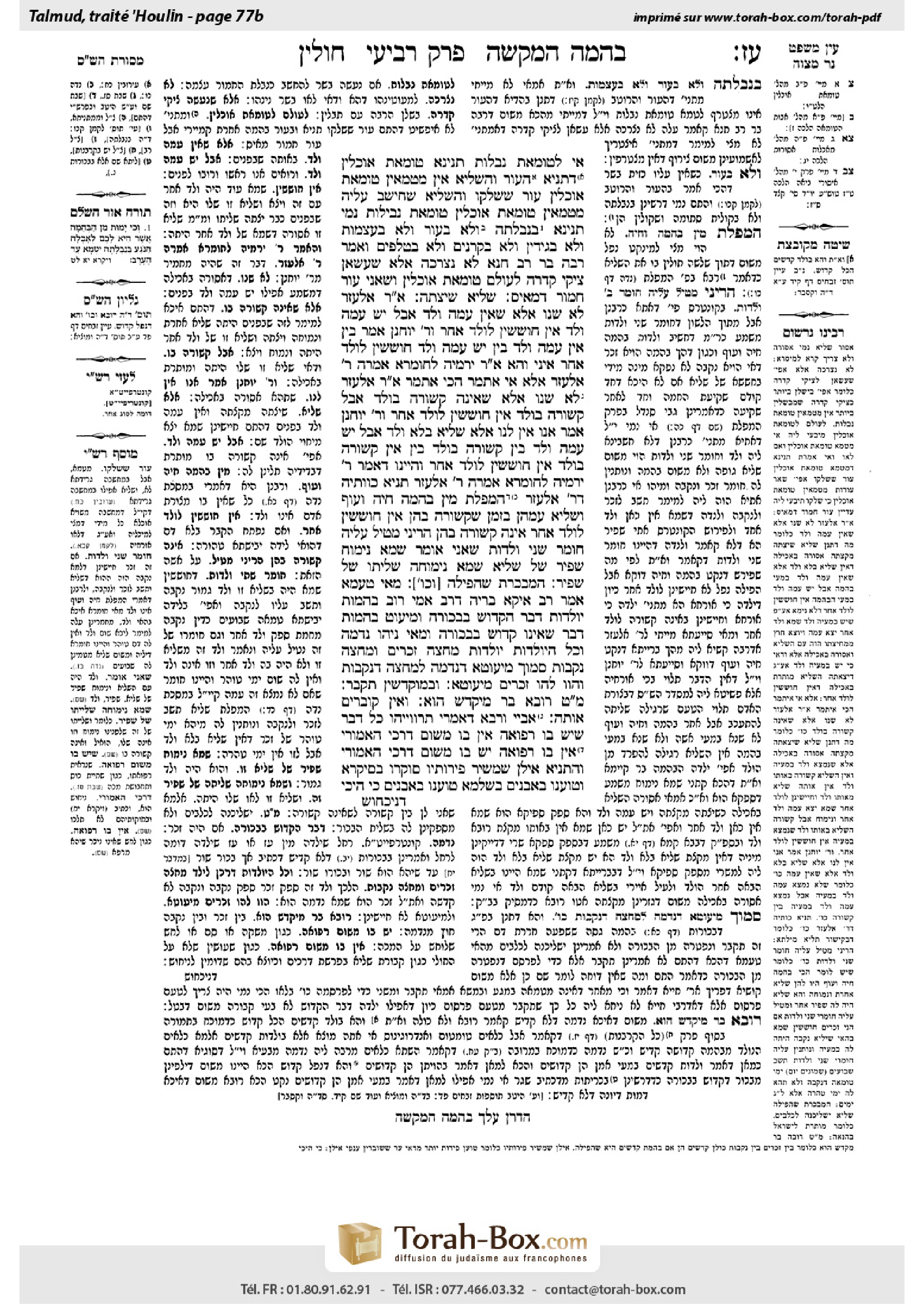
Chullin 77b: Talmud study for Daf Yomi
Study the Talmud for Daf Yomi with scanned pages, Hebrew text, English translations from Sefaria and AI-generated French translations.
Passage selection and English or AI-generated French translation are available where the scan has annotations. Daf Study is independent of Torah-Box and Sefaria.
Browse Chullin · חולין · All tractatesChullin 77b text and translations
This page of Chullin includes the Aramaic text, an English translation and an AI-generated French translation, alongside the scan above.
חולין ע״ז ב · Aramaic and Hebrew text
אִי לְטוּמְאַת נְבֵלוֹת – תְּנֵינָא.
טוּמְאַת אֳכָלִין, דְּתַנְיָא: הָעוֹר וְהַשִּׁלְיָא – אֵין מִטַּמְּאִין טוּמְאַת אֳכָלִין, עוֹר שֶׁשְּׁלָקוֹ, וְהַשִּׁלְיָא שֶׁחִישֵּׁב עָלֶיהָ – מְטַמְּאִין טוּמְאַת אֳכָלִין.
טוּמְאַת נְבֵילוֹת נָמֵי תְּנֵינָא: ״בְּנִבְלָתָהּ״ – וְלֹא בָּעוֹר, וְלֹא בְּעַצְמוֹתָיו, וְלֹא בַּגִּידִין, וְלֹא בַּקַּרְנַיִם, וְלֹא בַּטְּלָפַיִם.
וְאָמַר רַבָּה בַּר רַב חָנָא: לֹא נִצְרְכָה אֶלָּא שֶׁעֲשָׂאָן צִיקֵי קְדֵרָה.
לְעוֹלָם טוּמְאַת אֳכָלִין, וְשָׁאנֵי עוֹר חֲמוֹר דִּמְאִיס.
שִׁלְיָא שֶׁיָּצְתָה. אָמַר רַבִּי אֶלְעָזָר: לֹא שָׁנוּ אֶלָּא שֶׁאֵין עִמָּהּ וָלָד, אֲבָל יֵשׁ עִמָּהּ וָלָד – אֵין חוֹשְׁשִׁין לְוָלָד אַחֵר. וְרַבִּי יוֹחָנָן אָמַר: בֵּין אֵין עִמָּהּ וָלָד בֵּין יֵשׁ עִמָּהּ וָלָד – חוֹשְׁשִׁין לְוָלָד אַחֵר.
אִינִי? וְהָא אָמַר רַבִּי יִרְמְיָה: לְחוּמְרָא אַמְרַהּ רַבִּי אֶלְעָזָר!
אֶלָּא, אִי אִתְּמַר הָכִי אִתְּמַר, אָמַר רַבִּי אֶלְעָזָר: לֹא שָׁנוּ אֶלָּא שֶׁאֵינָהּ קְשׁוּרָה בַּוָּלָד, אֲבָל קְשׁוּרָה בַּוָּלָד – אֵין חוֹשְׁשִׁין לְוָלָד אַחֵר.
וְרַבִּי יוֹחָנָן אָמַר: אָנוּ אֵין לָנוּ אֶלָּא שִׁלְיָא בְּלֹא וָלָד, אֲבָל יֵשׁ עִמָּהּ וָלָד, בֵּין קְשׁוּרָה בַּוָּלָד בֵּין אֵין קְשׁוּרָה בַּוָּלָד – אֵין חוֹשְׁשִׁין לְוָלָד אַחֵר, וְהַיְינוּ דְּאָמַר רַבִּי יִרְמְיָה: לְחוּמְרָא אַמְרַהּ ר׳ אֶלְעָזָר.
תַּנְיָא כְּוָותֵיהּ דְּרַבִּי אֶלְעָזָר: הַמַּפֶּלֶת מִין בְּהֵמָה חַיָּה וָעוֹף, וְשִׁלְיָא עִמָּהֶן, בִּזְמַן שֶׁקְּשׁוּרָה בָּהֶן – אֵין חוֹשְׁשִׁין לְוָלָד אַחֵר, אֵינָהּ קְשׁוּרָה בָּהֶן – הֲרֵינִי מֵטִיל עָלֶיהָ חוֹמֶר שְׁנֵי וְלָדוֹת.
שֶׁאֲנִי אוֹמַר: שֶׁמָּא נִימּוֹחַ שָׁפִיר שֶׁל שִׁלְיָא, שֶׁמָּא נִימּוֹחָה שִׁלְיָתוֹ שֶׁל שָׁפִיר.
הַמְבַכֶּרֶת שֶׁהִפִּילָה. מַאי טַעְמָא? אָמַר רַב אִיקָא בְּרֵיהּ דְּרַב אַמֵּי: רוֹב בְּהֵמוֹת יוֹלְדוֹת דָּבָר הַקָּדוֹשׁ בִּבְכוֹרָה, וּמִיעוּט בְּהֵמוֹת דָּבָר שֶׁאֵינוֹ קָדוֹשׁ בִּבְכוֹרָה, וּמַאי נִיהוּ? נִדְמֶה.
וְכׇל הַיּוֹלְדוֹת יוֹלְדוֹת מֶחֱצָה זְכָרִים וּמֶחֱצָה נְקֵבוֹת, סְמוֹךְ מִיעוּטָא דְּנִדְמֶה לְמֶחֱצָה דִּנְקֵבוֹת, וְהָווּ לְהוּ זְכָרִים מִיעוּטָא.
וּבַמּוּקְדָּשִׁין תִּקָּבֵר. מַאי טַעְמָא? רוּבָּא בַּר מִיקְדָּשׁ הוּא.
וְאֵין קוֹבְרִים אוֹתָהּ. אַבָּיֵי וְרָבָא דְּאָמְרִי תַּרְוַויְיהוּ: כׇּל דָּבָר שֶׁיֵּשׁ בּוֹ רְפוּאָה – אֵין בּוֹ מִשּׁוּם דַּרְכֵי הָאֱמוֹרִי, אֵין בּוֹ רְפוּאָה – יֵשׁ בּוֹ מִשּׁוּם דַּרְכֵי הָאֱמוֹרִי.
וְהָתַנְיָא: אִילָן שֶׁמַּשִּׁיר פֵּירוֹתָיו, סוֹקְרוֹ בְּסִיקְרָא וְטוֹעֲנוֹ בַּאֲבָנִים. בִּשְׁלָמָא טוֹעֲנוֹ בַּאֲבָנִים – כִּי הֵיכִי
Chullin 77b · English translation
and if you say it was with regard to the ritual impurity of animal carcasses, we already learn that halakha as well in another baraita.
The Gemara elaborates: With regard to the ritual impurity of food, it is as it is taught in a baraita: The hide and the placenta of an animal, which people do not typically eat, cannot become impure with the ritual impurity of foods. But a hide that one cooked until it became edible and a placenta that one intended to eat can become impure with the impurity of foods.
With regard to the ritual impurity of animal carcasses also, we already learn in a baraita: The verse states: “And when a domesticated animal dies, of those that you eat, one who touches its carcass shall be impure until the evening” (Leviticus 11:39). The verse indicates that one is rendered impure if he touches its carcass, but not if he touches its hide, and not its bones, and not its sinews, and not its horns, and not its hooves.
And Rabba bar Rav Ḥana said with regard to this baraita: This derivation is necessary only for a case in which one prepared these parts of the animal as a meat pudding [tzikei kedera], in which they are cooked for an extended period and spices are added. One might have thought they would be considered edible flesh and therefore impart the impurity of a carcass. The baraita therefore teaches that this is not so.
Given these two baraitot, why did Rabbi Yitzḥak Nappaḥa inquire about the status of the cooked hide of a donkey? The Gemara answers: Actually, Rabbi Yitzḥak Nappaḥa was inquiring about the impurity of foods, and although the halakha was already taught in the first baraita, Rabbi Yitzḥak Nappaḥa thought it is possible that the hide of a donkey is different, as it is repulsive and perhaps even when cooked it is not regarded as food.
§ The mishna states: With regard to a placenta, part of which emerged from the womb before the mother was slaughtered, its consumption is prohibited, as there is a concern that the head of the fetus might have emerged in that part of the placenta. Commenting on this mishna, Rabbi Elazar says: The Sages taught this halakha only in a case where there was no fetus found in the mother’s womb. But if there was a fetus with its head and the majority of its body in the womb, one need not be concerned for the existence of another fetus that might have been in the placenta. Therefore, the consumption of the placenta is permitted. But Rabbi Yoḥanan says: Whether there was no fetus found in the womb, or whether there was a fetus, one needs to be concerned for the existence of another fetus in the placenta, and therefore its consumption is prohibited.
According to the way the Gemara records the dispute, Rabbi Yoḥanan rules stringently and Rabbi Elazar rules leniently. The Gemara asks: Is that so? But doesn’t Rabbi Yirmeya say concerning this dispute: Rabbi Elazar said an explanation of the mishna that presents a stringency?
Rather, if it was stated, it was stated like this: Rabbi Elazar says: The ruling of the mishna is that the placenta is prohibited even if a fetus is found inside the womb. But the Sages taught this only in a case where the placenta is not attached to the fetus found inside. Consequently, one must be concerned with the possibility that the placenta came from another fetus that already left the womb, and it is therefore prohibited. But if it is attached to the fetus found inside, there is no concern for the possibility that the placenta came from another fetus, and therefore it is permitted.
And Rabbi Yoḥanan says: In my understanding of the mishna, we have the ruling that the placenta is prohibited only in a case where there is a placenta without any fetus being found. But if a fetus was found with it, then whether it is attached to the fetus or whether it is not attached to the fetus, there is no concern for the existence of another fetus. The Gemara confirms: And this understanding of the two opinions is in line with that which Rabbi Yirmeya says: Rabbi Elazar said an explanation of the mishna that presents a stringency.
It is taught in a baraita in accordance with the opinion of Rabbi Elazar: The periods of purity and impurity observed by a woman after giving birth apply only after delivering a fetus with a human form. With regard to a woman who expels a fetus that has the form of a type of domesticated animal, undomesticated animal, or bird, and there is a placenta with them, the halakha is as follows: When the placenta is attached to them, there is no concern for the existence of another fetus that may have had a human form. But if the placenta is not attached to them, it is possible there was another fetus that had a human form and so I must impose upon the woman the severity of two types of births, i.e., both the longer period of impurity observed after delivering a female, and the shorter period of purity observed after delivering a male.
The reason is that I can say: Perhaps the placenta that was found did not come from the fetus that was found, but from a fetus with a human form. To say this one must be concerned with the possibility that perhaps the fetus of the placenta that was found had a human form, and that fetus dissolved, and perhaps the placenta of the fetus that was found dissolved.
§ The mishna states: If an animal that was giving birth to its firstborn expelled a placenta, one may cast it to the dogs. The Gemara asks: What is the reason for this ruling? Rav Ika, son of Rav Ami, said: The majority of domesticated animals give birth to something that can be consecrated with firstborn status, i.e., an animal with the same form as its mother, but a minority of animals give birth to something that cannot be consecrated with firstborn status, and what is this? It is an animal that resembles a species other than that of its mother.
And furthermore, with regard to all gestating animals, when they give birth, half of their offspring are male and half are female. Therefore, one can combine the minority of animals that resemble another species with the half that are females, and arrive at the conclusion that male offspring that resemble their species, which are the only offspring that can be consecrated with firstborn status, are the minority. Accordingly, one does not need to be concerned that the placenta found was from an animal consecrated with the status of a firstborn.
§ The continuation of the mishna states: But in the case of sacrificial animals the placenta must be buried, because it came from a fetus that is assumed to have been sacred. The Gemara asks: What is the reason to assume this? The Gemara answers: It is because the majority of the offspring of sacrificial animals are fit to be sacred, as, in contrast to firstborn status, both female and male offspring of sacrificial animals can be sacred. Therefore, one must be concerned that the offspring, and its placenta, were sacred.
§ The mishna adds: But one may neither bury it at an intersection, nor may one hang it on a tree, due to the prohibition against following the ways of the Amorite. The Gemara cites Abaye and Rava, who both said: Anything that has an apparently effective medicinal purpose or any other logical reason behind it is not subject to the prohibition against following the ways of the Amorite. But if it does not have an apparently effective medicinal purpose it is subject to the prohibition against following the ways of the Amorite.
The Gemara challenges: But isn’t it taught in a baraita: If there is a tree that sheds its fruit prematurely, one may paint it with red paint and load it with stones, even though this is the practice of the Amorites? The Gemara explains the difficulty: Granted, it is permitted to load it with stones, as one does so for a logical reason, in order
Chullin 77b · Traduction française (IA)
et si vous dites que cela concerne l'impureté rituelle des cadavres d'animaux, nous avons déjà appris la halakha à propos d'une autre baraïta.
La Guemara développe : Concernant l'impureté rituelle des aliments, il est comme il est enseigné dans une baraïta : La peau et le placenta d'un animal, qui ne sont pas habituellement mangés, ne peuvent pas devenir impurs avec l'impureté rituelle des aliments. Mais une peau que l'on a cuite jusqu'à ce qu'elle devienne comestible et un placenta que l'on avait l'intention de manger peuvent devenir impurs avec l'impureté des aliments.
Concernant l'impureté rituelle des cadavres d'animaux également, nous avons déjà appris dans une baraïta : Le verset dit : « Et quand un animal domestique meurt, de ceux que vous mangez, celui qui touche son cadavre sera impur jusqu'au soir » (Lévitique 11:39). Le verset indique que l'on devient impur en touchant son cadavre, mais pas en touchant sa peau, ni ses os, ni ses nerfs, ni ses cornes, ni ses sabots.
Et Rabba bar Rav Ḥana dit à propos de cette baraïta : Cette dérivation est nécessaire uniquement dans un cas où l'on prépare ces parties de l'animal en bouillon de viande [tzikei kedera], où elles sont cuites pendant une longue période et des épices sont ajoutées. On pouvait penser qu'elles seraient considérées comme de la viande comestible et donc transmettraient l'impureté du cadavre. La baraïta enseigne donc que ce n'est pas le cas.
Étant donné ces deux baraitot, pourquoi Rabbi Yitzḥak Nappaḥa a-t-il interrogé sur le statut de la peau cuite d'un âne ? La Guemara répond : En réalité, Rabbi Yitzḥak Nappaḥa interrogeait sur l'impureté des aliments, et bien que la halakha ait déjà été enseignée dans la première baraïta, Rabbi Yitzḥak Nappaḥa pensait qu'il était possible que la peau d'un âne soit différente, car elle est répugnante et peut-être même lorsqu'elle est cuite, elle n'est pas considérée comme de la nourriture.
§ La mitsna dit : Concernant le placenta, dont une partie est sortie du ventre avant que la mère ne soit tuée, sa consommation est interdite, car il y a une crainte que la tête du fœtus ait pu sortir dans cette partie du placenta. Commentant cette mitsna, Rabbi Elazar dit : Les Sages ont enseigné cette halakha uniquement dans le cas où aucun fœtus n'avait été trouvé dans le ventre de la mère. Mais si un fœtus avec sa tête et la majorité de son corps était dans le ventre, on n'a pas besoin de craindre l'existence d'un autre fœtus dans le placenta. Par conséquent, la consommation du placenta est permise. Mais Rabbi Yoḥanan dit : Quel que soit le cas, s'il n'y avait pas de fœtus trouvé dans le ventre ou s'il y en avait un, on doit craindre l'existence d'un autre fœtus dans le placenta, et par conséquent sa consommation est interdite.
Selon la manière dont la Guemara rapporte le débat, Rabbi Yoḥanan adopte une interprétation stricte et Rabbi Elazar une interprétation clémente. La Guemara demande : C’est ainsi ? Mais ne dit pas Rabbi Yirmeya concernant ce débat : Rabbi Elazar a-t-il dit une explication de la mitsna qui présente une stricteur ?
Plutôt, si cela a été dit, cela a été dit ainsi : Rabbi Elazar dit : La décision de la mitsna est que la placenta est interdite même si un fœtus est trouvé dans le ventre. Mais les Sages ont enseigné cela uniquement dans le cas où la placenta n’est pas attachée au fœtus trouvé à l’intérieur. Ainsi, on doit s’inquiéter de la possibilité que la placenta provienne d’un autre fœtus qui a déjà quitté le ventre, et il est donc interdit. Mais si elle est attachée au fœtus trouvé à l’intérieur, il n’y a pas de raison de s’inquiéter de la possibilité que la placenta provienne d’un autre fœtus, et donc elle est permise.
Et Rabbi Yoḥanan dit : Selon mon interprétation de la mitsna, nous avons la décision que la placenta est interdite uniquement dans le cas où il y a une placenta sans aucun fœtus trouvé. Mais si un fœtus a été trouvé avec elle, alors que ce soit attaché au fœtus ou non, il n’y a pas de raison de s’inquiéter de l’existence d’un autre fœtus. La Guemara confirme : Et cette interprétation des deux opinions correspond à ce que Rabbi Yirmeya dit : Rabbi Elazar a-t-il dit une explication de la mitsna qui présente une stricteur ?
Il est enseigné dans une baraïta selon l’opinion de Rabbi Elazar : Les périodes de pureté et d’impureté observées par une femme après l’accouchement s’appliquent uniquement après l’accouchement d’un fœtus ayant une forme humaine. En ce qui concerne une femme qui expulse un fœtus ayant la forme d’un animal domestique, d’un animal sauvage ou d’un oiseau, et qui a une placenta avec elle, la halakha est la suivante : Lorsque la placenta est attachée à elle, il n’y a pas de raison de s’inquiéter de l’existence d’un autre fœtus pouvant avoir une forme humaine. Mais si la placenta n’est pas attachée à elle, il est possible qu’il y ait eu un autre fœtus ayant une forme humaine, et donc il faut imposer à la femme la sévérité de deux types d’accouchement, c’est-à-dire à la fois la période plus longue d’impureté après l’accouchement d’une femelle et la période plus courte de pureté après l’accouchement d’un mâle.
La raison est que je peux dire : Peut-être la placenta trouvée n’est pas venue du fœtus trouvé, mais d’un fœtus ayant une forme humaine. Pour dire cela, il faut s’inquiéter de la possibilité que le fœtus de la placente trouvée ait une forme humaine, et que ce fœtus ait dissous, et peut-être que la placenta du fœtus trouvé ait dissous.
§ La mitsva stipule : Si un animal qui accouche de son premier-né expulse une placenta, on peut la jeter aux chiens. La Guemara demande : Quelle est la raison de cette décision ? Rav Ika, fils de Rav Ami, dit : La plupart des animaux domestiques accouchent de quelque chose qui peut être consacré en premier-né, c’est-à-dire un animal ayant la même forme que sa mère, mais une minorité d’animaux accouchent de quelque chose qui ne peut pas être consacré en premier-né, et de quoi s’agit-il ? C’est un animal ayant une forme différente de celle de sa mère.
Et de plus, concernant tous les animaux en gestation, lorsqu'ils donnent naissance, la moitié de leurs petits sont mâles et la moitié femelles. Par conséquent, on peut combiner la minorité d'animaux qui ressemblent à une autre espèce avec la moitié qui sont des femelles, et conclure que les petits mâles qui ressemblent à leur espèce, qui sont les seuls petits pouvant être consacrés avec le statut de premier-né, sont la minorité. Ainsi, on n'a pas besoin de s'inquiéter que le placenta trouvé provienne d'un animal consacré avec le statut de premier-né.
§ La continuation de la mitsva dit : Mais dans le cas d'animaux sacrifiés, le placenta doit être enterré, car il provient d'un fœtus qui est supposé être sacré. La Guemara demande : Quelle est la raison de cette supposition ? La Guemara répond : C'est parce que la majorité des petits d'animaux sacrifiés sont aptes à être sacrés, contrairement au statut de premier-né, car à la différence du premier-né, à la fois les petits mâles et femelles d'animaux sacrifiés peuvent être sacrés. Par conséquent, on doit s'inquiéter que le petit et son placenta soient sacrés.
§ La mitsva ajoute : Mais on ne peut ni enterrer cela à un carrefour, ni accrocher cela à un arbre, en raison de l'interdiction de suivre les coutumes des Amorites. La Guemara cite Abaye et Rava, qui ont tous les deux dit : Tout ce qui a un but médical apparent ou toute autre raison logique est exempt de l'interdiction de suivre les coutumes des Amorites. Mais si cela n'a pas un but médical apparent, il est soumis à l'interdiction de suivre les coutumes des Amorites.
La Guemara conteste : Mais n'est-il pas enseigné dans une baraïta : Si un arbre perd ses fruits prématurément, on peut le peindre en rouge et le charger de pierres, même si c'est la pratique des Amorites ? La Guemara explique la difficulté : En effet, il est permis de le charger de pierres, car on le fait pour une raison logique, afin
Traduction française générée par IA à partir de l’édition anglaise de Sefaria. Vérifie toujours un passage avec le texte source.
Text from Sefaria: William Davidson Edition - Vocalized Aramaic (unknown); William Davidson Edition - English (CC BY NC).