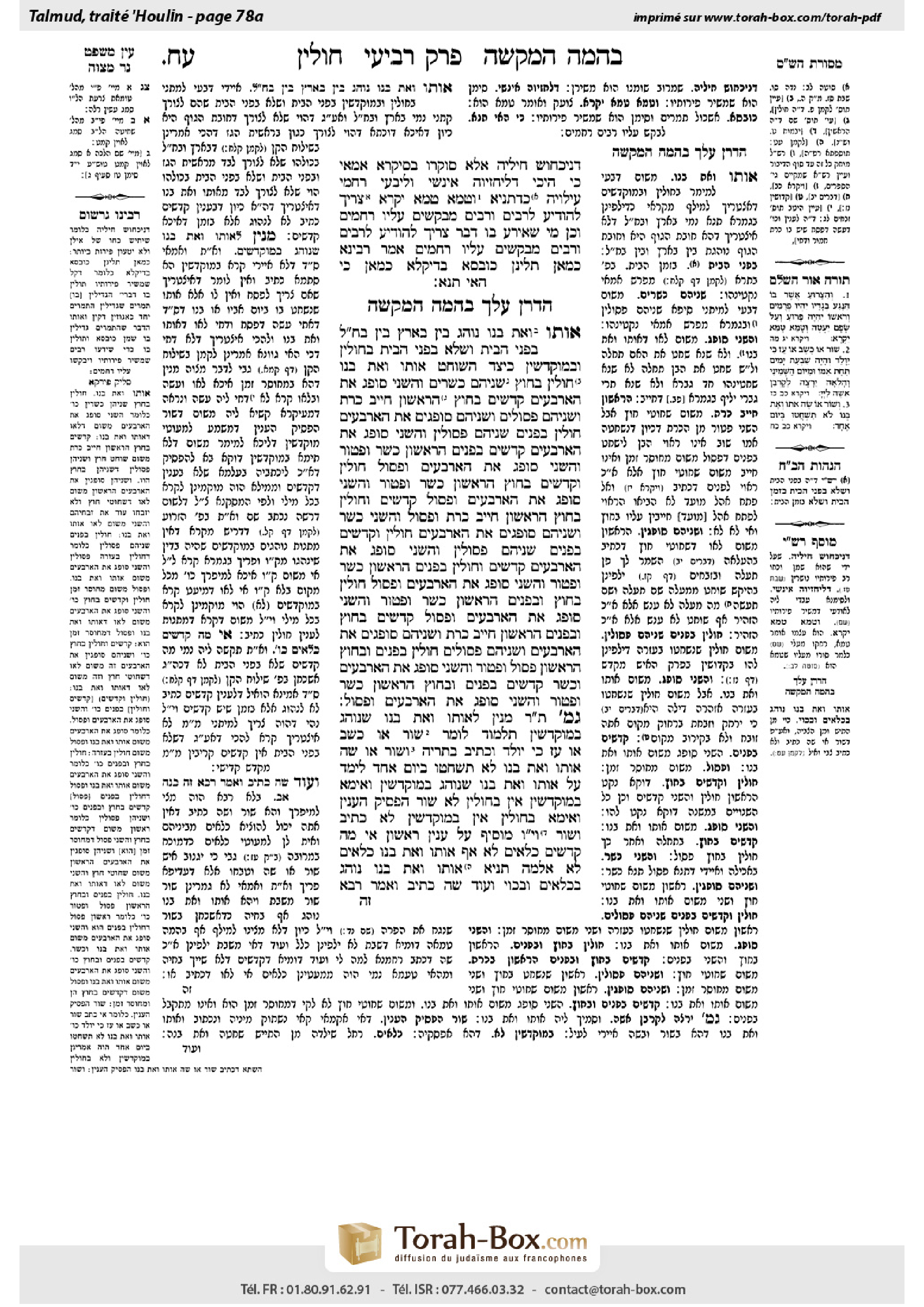
Chullin 78a: Talmud study for Daf Yomi
Study the Talmud for Daf Yomi with scanned pages, Hebrew text, English translations from Sefaria and AI-generated French translations.
Passage selection and English or AI-generated French translation are available where the scan has annotations. Daf Study is independent of Torah-Box and Sefaria.
Browse Chullin · חולין · All tractatesChullin 78a text and translations
This page of Chullin includes the Aramaic text, an English translation and an AI-generated French translation, alongside the scan above.
חולין ע״ח א · Aramaic and Hebrew text
דְּנִיכְחוֹשׁ חֵילֵיהּ, אֶלָּא סוֹקְרוֹ בְּסִיקְרָא אַמַּאי? כִּי הֵיכִי דְּלִיחְזְיוּהּ אִינָשֵׁי וְלִיבְעֻי רַחֲמֵי עִילָּוֵיהּ.
כִּדְתַנְיָא: ״וְטָמֵא טָמֵא יִקְרָא״ – צָרִיךְ לְהוֹדִיעַ לָרַבִּים, וְרַבִּים מְבַקְּשִׁים עָלָיו רַחֲמִים. וְכֵן מִי שֶׁאֵירַע בּוֹ דָּבָר – צָרִיךְ לְהוֹדִיעַ לָרַבִּים, וְרַבִּים מְבַקְּשִׁים עָלָיו רַחֲמִים.
אָמַר רָבִינָא: כְּמַאן תָּלֵינַן כּוּבְסָא בְּדִיקְלָא, כְּמַאן? כִּי הַאי תַּנָּא.
הֲדַרַן עֲלָךְ בְּהֵמָה הַמְקַשָּׁה.
מַתְנִי׳ אוֹתוֹ וְאֶת בְּנוֹ נוֹהֵג בֵּין בָּאָרֶץ בֵּין בְּחוּצָה לָאָרֶץ, בִּפְנֵי הַבַּיִת וְשֶׁלֹּא בִּפְנֵי הַבַּיִת, בְּחוּלִּין וּבְמוּקְדָּשִׁין.
כֵּיצַד? הַשּׁוֹחֵט אוֹתוֹ וְאֶת בְּנוֹ, חוּלִּין בַּחוּץ – שְׁנֵיהֶם כְּשֵׁרִים, וְהַשֵּׁנִי סוֹפֵג אֶת הָאַרְבָּעִים.
קָדָשִׁים בַּחוּץ – הָרִאשׁוֹן חַיָּיב כָּרֵת, וּשְׁנֵיהֶם פְּסוּלִים, וּשְׁנֵיהֶם סוֹפְגִים אֶת הָאַרְבָּעִים.
חוּלִּין בִּפְנִים – שְׁנֵיהֶם פְּסוּלִין, וְהַשֵּׁנִי סוֹפֵג אֶת הָאַרְבָּעִים; קָדָשִׁים בִּפְנִים – הָרִאשׁוֹן כָּשֵׁר וּפָטוּר, וְהַשֵּׁנִי סוֹפֵג אֶת הָאַרְבָּעִים וּפָסוּל.
חוּלִּין וְקָדָשִׁים בַּחוּץ – הָרִאשׁוֹן כָּשֵׁר, וּפָטוּר, וְהַשֵּׁנִי סוֹפֵג אֶת הָאַרְבָּעִים, וּפָסוּל.
קָדָשִׁים וְחוּלִּין בַּחוּץ – הָרִאשׁוֹן חַיָּיב כָּרֵת וּפָסוּל, וְהַשֵּׁנִי כָּשֵׁר, וּשְׁנֵיהֶם סוֹפְגִים אֶת הָאַרְבָּעִים.
חוּלִּין וְקָדָשִׁים בִּפְנִים – שְׁנֵיהֶם פְּסוּלִין, וְהַשֵּׁנִי סוֹפֵג אֶת הָאַרְבָּעִים. קָדָשִׁים וְחוּלִּין בִּפְנִים – הָרִאשׁוֹן כָּשֵׁר וּפָטוּר, וְהַשֵּׁנִי סוֹפֵג אֶת הָאַרְבָּעִים וּפָסוּל.
חוּלִּין בַּחוּץ וּבִפְנִים – הָרִאשׁוֹן כָּשֵׁר, וּפָטוּר, וְהַשֵּׁנִי סוֹפֵג אֶת הָאַרְבָּעִים, וּפָסוּל.
קָדָשִׁים בַּחוּץ וּבִפְנִים – הָרִאשׁוֹן חַיָּיב כָּרֵת, וּשְׁנֵיהֶם סוֹפְגִים אֶת הָאַרְבָּעִים, וּשְׁנֵיהֶם פְּסוּלִים.
חוּלִּין בִּפְנִים וּבַחוּץ – הָרִאשׁוֹן פָּסוּל, וּפָטוּר, וְהַשֵּׁנִי סוֹפֵג אֶת הָאַרְבָּעִים, וְכָשֵׁר. קָדָשִׁים בִּפְנִים וּבַחוּץ – הָרִאשׁוֹן כָּשֵׁר, וּפָטוּר, וְהַשֵּׁנִי סוֹפֵג אֶת הָאַרְבָּעִים, וּפָסוּל.
גְּמָ׳ תָּנוּ רַבָּנַן: מִנַּיִן לְאוֹתוֹ וְאֶת בְּנוֹ שֶׁנּוֹהֵג בְּמוּקְדָּשִׁין? תַּלְמוּד לוֹמַר: ״שׁוֹר אוֹ כֶשֶׂב אוֹ עֵז כִּי יִוָּלֵד״, וּכְתִיב בָּתְרֵיהּ: ״וְשׁוֹר אוֹ שֶׂה אֹתוֹ וְאֶת בְּנוֹ לֹא תִשְׁחֲטוּ בְּיוֹם אֶחָד״ – לִימֵּד עַל אוֹתוֹ וְאֶת בְּנוֹ שֶׁנּוֹהֵג בְּמוּקְדָּשִׁין.
וְאֵימָא: בְּמוּקְדָּשִׁין – אִין, בְּחוּלִּין – לָא! ״שׁוֹר״ הִפְסִיק הָעִנְיָן.
וְאֵימָא: בְּחוּלִּין – אִין, בְּמוּקְדָּשִׁין – לָא! כְּתִיב: ״וְשׁוֹר״ – וָי״ו מוֹסִיף עַל עִנְיָן רִאשׁוֹן.
אִי מָה קָדָשִׁים כִּלְאַיִם לָא, אַף אוֹתוֹ וְאֶת בְּנוֹ כִּלְאַיִם לָא? אַלְּמָה תַּנְיָא: אוֹתוֹ וְאֶת בְּנוֹ נוֹהֵג בְּכִלְאַיִם וּבְכוֹי?
וְעוֹד, ״שֶׂה״ כְּתִיב, וְאָמַר רָבָא:
Chullin 78a · English translation
that the tree’s strength will lessen. It is possible that the tree shed its fruits prematurely due to excessive blossoming. It taxes the tree to sustain these blossoms, and this may render the tree incapable of sustaining the fruits that subsequently grow from the blossoms. Stones were used to weaken the tree during blossoming, thereby reducing the number of blossoms that it needed to nourish. But with regard to painting it with red paint, for what benefit is it performed that makes it permitted despite the fact that this was the practice of the Amorites? The Gemara explains: One does so in order that people will see the tree and pray for it.
As it is taught in a baraita: It is derived from the verse: “And he will cry: Impure, impure” (Leviticus 13:45), that a leper must publicize the fact that he is ritually impure. He must announce his pain to the masses, and the masses will pray for mercy on his behalf. And likewise, one to whom any unfortunate matter happens must announce it to the masses, and then the masses will pray for mercy on his behalf.
Ravina said: In accordance with whose opinion do we hang bunches of unripe dates on a palm tree that casts off its dates, despite the fact that this is the practice of the Amorites? It is in accordance with the opinion of this tanna of the baraita just cited, who states that one must announce such occurrences to the masses so that they will pray for mercy.
MISHNA: The prohibition against slaughtering an animal itself and its offspring applies both in Eretz Yisrael and outside of Eretz Yisrael, both in the presence, i.e., the time, of the Temple and not in the presence of the Temple, and it applies with regard to non-sacred animals and with regard to sacrificial animals.
How so? In the case of one who slaughters an animal itself and its offspring, both of which are non-sacred, and slaughters them outside the Temple courtyard, both of the animals are fit for consumption, but for slaughtering the second animal, one incurs [sofeg] the forty lashes for violating the prohibition: “You shall not slaughter it and its offspring both in one day” (Leviticus 22:28).
If both animals were sacrificial animals slaughtered outside the Temple courtyard, then for slaughtering the first animal, one is liable to receive excision from the World-to-Come [karet]. For slaughtering the second animal one is not liable to receive karet. The second animal was not fit for sacrifice, since one may not slaughter an animal and its offspring on the same day. And both animals are disqualified for use as offerings, and for the slaughter of both of them, one incurs forty lashes apiece: The first being a sacrificial animal slaughtered outside the courtyard and the second being the offspring of an animal slaughtered that day.
If both animals were non-sacred and slaughtered inside the Temple courtyard, both of them are unfit to be sacrificed, being non-sacred animals slaughtered in the courtyard. And for slaughter of the second animal, one incurs the forty lashes for slaughtering an animal and its offspring on a single day. If both animals were sacrificial animals slaughtered inside the Temple courtyard, the first is fit for sacrifice, and one who slaughters it is exempt from any punishment. But for slaughter of the second animal, one incurs the forty lashes for slaughtering an animal and its offspring on a single day, and it is unfit for sacrifice, because one was not allowed to slaughter it on that day.
If the first animal was non-sacred and the second a sacrificial animal, and both were slaughtered outside the Temple courtyard, the first is fit for consumption and one who slaughters it is exempt from any punishment. But for slaughtering the second animal, one incurs the forty lashes for slaughtering an animal and its offspring on a single day, and the animal is unfit for sacrifice.
If the first animal was a sacrificial animal and the second was non-sacred and both were slaughtered outside the Temple courtyard, for the first animal, one is liable to receive karet for slaughtering a sacrificial animal outside the courtyard, and the animal is unfit for sacrifice. And the second is fit for consumption; and for the slaughter of both of them one incurs forty lashes apiece: The first being a sacrificial animal slaughtered outside the courtyard and the second being the offspring of an animal slaughtered that day.
If the first animal was non-sacred and the second was a sacrificial animal and both were slaughtered inside the Temple courtyard, both of them are unfit for sacrifice. And for slaughtering the second animal, one incurs the forty lashes. If the first animal was a sacrificial animal and the second was non-sacred and both were slaughtered inside the Temple courtyard, the first is fit for sacrifice and one who slaughters it is exempt from any punishment. And for slaughtering the second animal, one incurs the forty lashes, and the animal is unfit for sacrifice, as it is non-sacred.
If both animals were non-sacred, and one slaughters them, the first outside the Temple courtyard and the second inside the Temple courtyard, the first is fit for consumption and one who slaughters it is exempt from any punishment. And for slaughtering the second animal, one incurs the forty lashes for slaughtering an animal and its offspring on a single day, and the animal is unfit for sacrifice as it is non-sacred.
If both animals were sacrificial animals, and one slaughters them, the first outside the Temple courtyard and the second inside the Temple courtyard, for slaughtering the first animal one is liable to receive karet, and for slaughtering both of them one incurs forty lashes apiece. One set of lashes is given because the first was a sacrificial animal slaughtered outside the courtyard, and the second set of lashes is given because the second animal is the offspring of an animal slaughtered that day. And both of them are unfit for sacrifice.
If both animals were non-sacred, and one slaughters them, the first inside the Temple courtyard and the second outside the Temple courtyard, the first is unfit for sacrifice, as it is non-sacred, and the one who slaughters it is exempt. And for the second, one incurs the forty lashes and the animal is fit for consumption. If both animals were sacrificial animals, and one slaughters them, the first inside the Temple courtyard and the second outside the Temple courtyard, the first is fit for sacrifice and one who slaughters it is exempt. And for the second animal, one incurs the forty lashes, and the animal is unfit for sacrifice because its requisite time has not yet arrived.
GEMARA: The Sages taught in a baraita: From where is it derived that the prohibition against slaughtering an animal itself and its offspring in a single day applies to sacrificial animals? It is derived from a verse, as the verse states: “When a bull, or a sheep, or a goat, is born…but from the eighth day and forward it may be accepted for an offering…to the Lord” (Leviticus 22:27), and it is written in the following verse: “And whether it be a bull or a sheep, you shall not slaughter it and its offspring both in one day.” The juxtaposition of the verses teaches with regard to the prohibition against slaughtering an animal itself and its offspring that it applies to sacrificial animals as well.
The Gemara challenges: But since this prohibition is taught in the context of other halakhot of consecrated animals, perhaps I will say: Yes, it applies to sacrificial animals, but it does not apply to non-sacred animals. The Gemara explains: The repetitive phrase “and whether it be a bull or a sheep” in the second verse, when those types of animals, i.e., bulls and sheep, were already mentioned in the first verse, interrupted the topic, clarifying that the second verse is not referring to sacrificial animals.
The Gemara challenges: But if so, I will say: Yes, the prohibition applies to non-sacred animals, but it does not apply to sacrificial animals. The Gemara explains: Since in that verse it is written: “And whether it be a bull…you shall not slaughter it and its offspring,” the conjunction “and” adds the prohibition stated in the second verse to the first matter, including sacrificial animals as well.
The Gemara challenges: If this prohibition also applies to sacrificial animals, perhaps just as with regard to sacrificial animals, the offspring of diverse kinds is not included, e.g., the offspring of a ewe and a goat is unfit to be an offering, so too with regard to the prohibition of: A mother and its offspring, the offspring of diverse kinds should not be included, so that in the case of the offspring of a ewe and a goat, it would be permitted to slaughter the mother and offspring on the same day. Why, then, is it taught in a baraita (see Tosefta 5:1): The prohibition of: A mother and its offspring, applies to the offspring of diverse kinds and to a koy, a kosher animal with characteristics of both domesticated and undomesticated animals?
And additionally, why should the prohibition of: A mother and its offspring, apply to the offspring of diverse kinds? “A sheep,” is written in the verse with regard to that prohibition, and Rava said
Chullin 78a · Traduction française (IA)
que la force de l'arbre s'affaiblira. Il est possible que l'arbre perde ses fruits prématurément en raison d'une floraison excessive. La floraison exige une dépense considérable de la part de l'arbre, ce qui pourrait rendre l'arbre incapable de soutenir les fruits qui en viendront ensuite. Des pierres ont été utilisées pour affaiblir l'arbre pendant la floraison, réduisant ainsi le nombre de fleurs qu'il devait nourrir. Mais concernant la peinture de l'arbre avec de la peinture rouge, quel est l'avantage qui rend cette pratique permise, malgré le fait qu'elle fût la coutume des Amorites ? La Guemara explique : On le fait afin que les gens voient l'arbre et prie pour lui.
Comme il est enseigné dans une baraïta : Il est tiré de la parole : « Et il criera : Impur, impur » (Lv. 13:45), que le lépreux doit rendre public le fait qu'il est impur rituellement. Il doit annoncer sa souffrance au peuple, et le peuple prie pour sa miséricorde. De même, celui à qui quelque malheur arrive doit l'annoncer au peuple, et alors le peuple prie pour sa miséricorde.
Ravina a dit : Selon l'opinion de qui est-ce que nous accrochons des dates non mûres à un palmier qui rejette ses dates, malgré le fait que cela soit la coutume des Amorites ? C'est selon l'opinion de ce tanna de la baraïta cité précédemment, qui affirme que l'on doit annoncer de tels événements au peuple afin qu'ils prient pour la miséricorde.
MICHNA : L'interdiction de sacrifier un animal et son descendant s'applique à la fois en Terre d'Israël et en dehors, à la fois pendant la présence, c'est-à-dire l'époque, du Temple et non pendant la présence du Temple, et s'applique à la fois aux animaux non sacrés et aux animaux sacrés.
Comment cela ? Dans le cas d'une personne qui sacrifie un animal et son descendant, tous deux non sacrés, et qui les sacrifie en dehors du cour de l'Autel, les deux animaux sont comestibles, mais pour sacrifier le second animal, l'individu est puni de quarante coups de fouet pour avoir violé l'interdiction : « Tu ne sacrifieras pas l'animal et son descendant le même jour » (Lv. 22:28).
Si les deux animaux étaient des animaux sacrés sacrifiés en dehors du cour de l'Autel, alors pour sacrifier le premier animal, l'individu est puni de karet, c'est-à-dire d'être expulsé du monde à venir. Pour sacrifier le second animal, l'individu n'est pas puni de karet. Le second animal n'était pas digne d'être offert, car on ne peut pas sacrifier un animal et son descendant le même jour. Et les deux animaux sont disqualifiés pour être utilisés comme offrandes, et pour le sacrifice des deux, l'individu est puni de quarante coups de fouet chacun : le premier étant un animal sacré sacrifié en dehors du cour de l'Autel et le second étant le descendant d'un animal sacrifié ce jour-là.
Si les deux animaux étaient non sacrés et sacrifiés dans le cour de l'Autel, les deux sont inaptes à être offerts, étant des animaux non sacrés sacrifiés dans le cour de l'Autel. Et pour le sacrifice du second animal, l'individu est puni de quarante coups de fouet pour avoir sacrifié un animal et son descendant le même jour. Si les deux animaux étaient des animaux sacrés sacrifiés dans le cour de l'Autel, le premier est digne d'être offert, et celui qui le sacrifie est exempt de toute punition. Mais pour le sacrifice du second animal, l'individu est puni de quarante coups de fouet pour avoir sacrifié un animal et son descendant le même jour, et il est inapte à être offert, car on ne pouvait pas le sacrifier ce jour-là.
Si le premier animal était non sacré et le second un animal sacré, et les deux étaient sacrifiés en dehors du cour de l'Autel, le premier est comestible et celui qui le sacrifie est exempt de toute punition. Mais pour sacrifier le second animal, l'individu est puni de quarante coups de fouet pour avoir sacrifié un animal et son descendant le même jour, et l'animal est inapte à être offert.
Si le premier animal était un animal sacré et le second non sacré, et les deux étaient sacrifiés en dehors du cour de l'Autel, pour le premier animal, l'individu est puni de karet pour avoir sacrifié un animal sacré en dehors du cour de l'Autel, et l'animal est inapte à être offert. Et le second est comestible ; et pour le sacrifice des deux, l'individu est puni de quarante coups de fouet chacun : le premier étant un animal sacré sacrifié en dehors du cour de l'Autel et le second étant le descendant d'un animal sacrifié ce jour-là.
Si le premier animal était non sacré et le second un animal sacré, et les deux étaient sacrifiés dans le cour de l'Autel, les deux sont inaptes à être offerts. Et pour sacrifier le second animal, l'individu est puni de quarante coups de fouet. Si le premier animal était un animal sacré et le second non sacré, et les deux étaient sacrifiés dans le cour de l'Autel, le premier est digne d'être offert et celui qui le sacrifie est exempt de toute punition. Et pour sacrifier le second animal, l'individu est puni de quarante coups de fouet, et l'animal est inapte à être offert, car il est non sacré.
Si les deux animaux étaient non sacrés, et l'un est sacrifié, le premier en dehors du cour de l'Autel et le second dans le cour de l'Autel, le premier est comestible et celui qui le sacrifie est exempt de toute punition. Et pour sacrifier le second animal, l'individu est puni de quarante coups de fouet pour avoir sacrifié un animal et son descendant le même jour, et l'animal est inapte à être offert, car il est non sacré.
Si les deux animaux étaient des animaux sacrés, et l'un est sacrifié, le premier en dehors du cour de l'Autel et le second dans le cour de l'Autel, pour sacrifier le premier animal, l'individu est puni de karet, et pour sacrifier les deux, l'individu est puni de quarante coups de fouet chacun. Un ensemble de coups est donné parce que le premier était un animal sacré sacrifié en dehors du cour de l'Autel, et l'autre ensemble de coups est donné parce que le second animal est le descendant d'un animal sacrifié ce jour-là. Et les deux sont inaptes à être offerts.
Si les deux animaux étaient non sacrés, et qu'un seul les sacrifie, le premier à l'intérieur du courtyard du Temple et le second à l'extérieur du courtyard du Temple, le premier est inadapté à l'offrande, car il est non sacré, et celui qui le sacrifie est exempt. Et pour le second, on subit quarante coups de fouet et l'animal est adapté à la consommation. Si les deux animaux étaient des animaux sacrés, et qu'un seul les sacrifie, le premier à l'intérieur du courtyard du Temple et le second à l'extérieur du courtyard du Temple, le premier est adapté à l'offrande et celui qui le sacrifie est exempt. Et pour l'animal second, on subit quarante coups de fouet, et l'animal est inadapté à l'offrande car son temps requis n'a pas encore arrivé.
GUEMARA : Les Sages ont enseigné dans une baraïta : D'où est tiré le fait que la prohibition de sacrifier un animal et son descendant en un seul jour s'applique aux animaux sacrés ? C'est tiré d'un verset, car le verset dit : « Quand un taureau, ou une brebis, ou un bouc est né… mais à partir du huitième jour et après cela, il peut être accepté comme offrande… à l'Éternel » (Lévitique 22:27), et il est écrit dans le verset suivant : « Et qu'il s'agisse d'un taureau ou d'une brebis, tu ne sacrifieras pas celui-ci et son descendant le même jour. » La juxtaposition des versets enseigne concernant la prohibition de sacrifier un animal et son descendant que cela s'applique également aux animaux sacrés.
La Guemara conteste : Mais puisque cette prohibition est enseignée dans le contexte d'autres halakhot concernant les animaux consacrés, peut-être dirai-je : Oui, elle s'applique aux animaux sacrés, mais elle ne s'applique pas aux animaux non sacrés. La Guemara explique : La répétition du phrasé « et qu'il s'agisse d'un taureau… » dans le second verset, lorsque ces types d'animaux, c'est-à-dire les taureaux et les brebis, avaient déjà été mentionnés dans le premier verset, interrompait le sujet, clarifiant que le second verset ne fait pas référence aux animaux sacrés.
La Guemara conteste : Mais si c'est ainsi, je dirai : Oui, la prohibition s'applique aux animaux non sacrés, mais elle ne s'applique pas aux animaux sacrés. La Guemara explique : Puisque dans ce verset il est écrit : « Et qu'il s'agisse d'un taureau… tu ne sacrifieras pas celui-ci et son descendant », la conjonction « et » ajoute la prohibition du second verset à la première matière, incluant les animaux sacrés également.
La Guemara conteste : Si cette prohibition s'applique également aux animaux sacrés, peut-être justement comme concernant les animaux sacrés, le descendant de diverses espèces n'est pas inclus, par exemple, le descendant d'une brebis et d'un bouc est inadapté à l'offrande, ainsi aussi concernant la prohibition de : la mère et son descendant, le descendant de diverses espèces ne devrait pas être inclus, de sorte que dans le cas du descendant d'une brebis et d'un bouc, il serait permis de sacrifier la mère et le descendant le même jour. Pourquoi donc est-il enseigné dans une baraïta (voir Tosefta 5:1) : La prohibition de : la mère et son descendant, s'applique au descendant de diverses espèces et à un koy, un animal kasher ayant des caractéristiques de tant d'animaux domestiqués que non domestiqués ?
Et en outre, pourquoi la prohibition de : la mère et son descendant, s'applique-t-elle au descendant de diverses espèces ? « Une brebis », est écrit dans le verset concernant cette prohibition, et Rava a dit
Traduction française générée par IA à partir de l’édition anglaise de Sefaria. Vérifie toujours un passage avec le texte source.
Text from Sefaria: William Davidson Edition - Vocalized Aramaic (unknown); William Davidson Edition - English (CC BY NC).