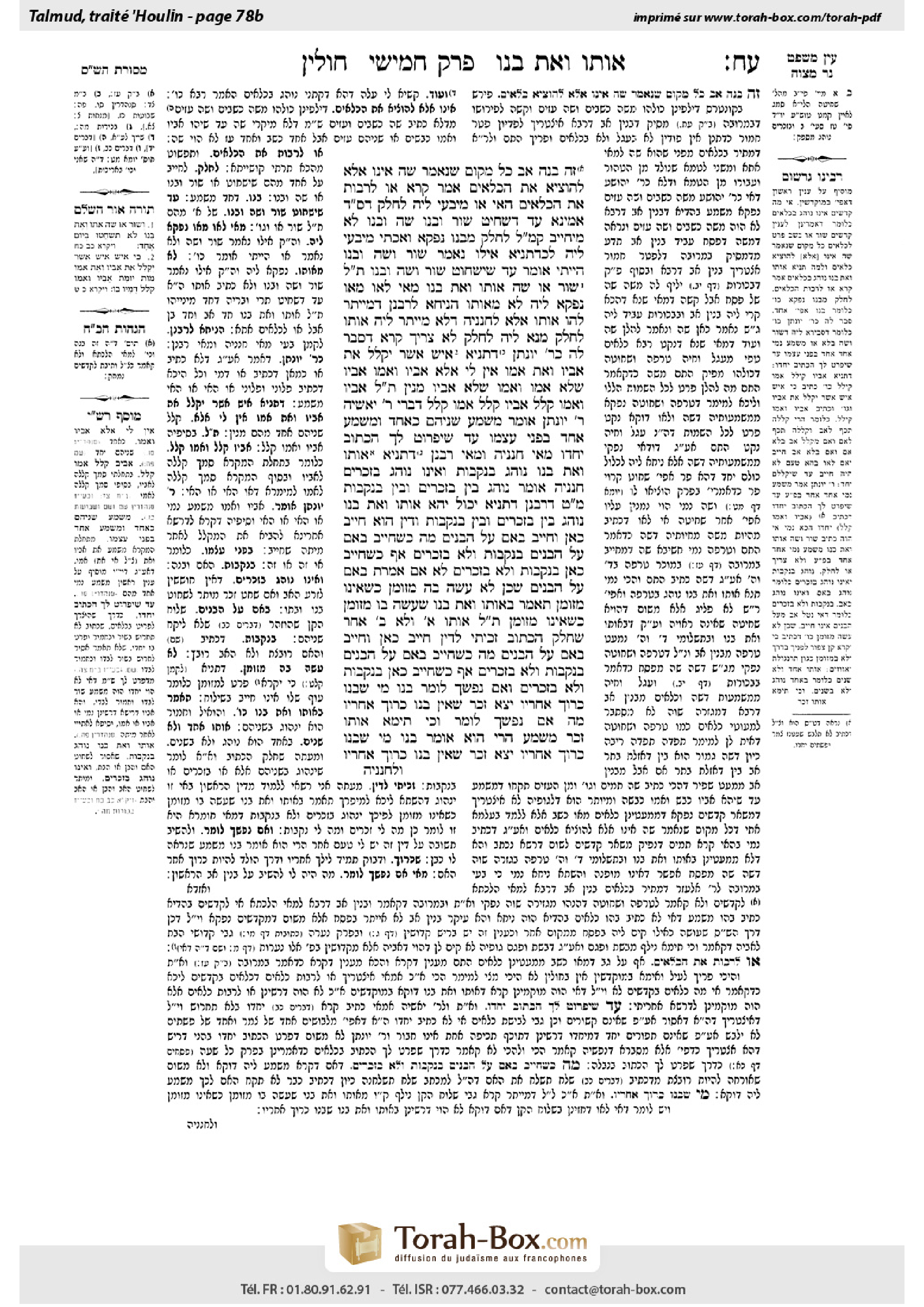
Chullin 78b: Talmud study for Daf Yomi
Study the Talmud for Daf Yomi with scanned pages, Hebrew text, English translations from Sefaria and AI-generated French translations.
Passage selection and English or AI-generated French translation are available where the scan has annotations. Daf Study is independent of Torah-Box and Sefaria.
Browse Chullin · חולין · All tractatesChullin 78b text and translations
This page of Chullin includes the Aramaic text, an English translation and an AI-generated French translation, alongside the scan above.
חולין ע״ח ב · Aramaic and Hebrew text
זֶה בָּנָה אָב – כׇּל מָקוֹם שֶׁנֶּאֱמַר ״שֶׂה״ אֵינוֹ אֶלָּא לְהוֹצִיא אֶת הַכִּלְאַיִם. אָמַר קְרָא ״אוֹ״ לְרַבּוֹת אֶת הַכִּלְאַיִם.
הַאי ״אוֹ״ מִיבְּעֵי לֵיהּ לְחַלֵּק, דְּסָלְקָא דַּעְתָּךְ אָמֵינָא: עַד דְּשָׁחֵיט שׁוֹר וּבְנוֹ שֶׂה וּבְנוֹ לָא מִיחַיַּיב, קָא מַשְׁמַע לַן. לְחַלֵּק – מִ״בְּנוֹ״ נָפְקָא.
וְאַכַּתִּי מִיבְּעֵי לֵיהּ לְכִדְתַנְיָא: אִילּוּ נֶאֱמַר ״שׁוֹר וָשֶׂה וּבְנוֹ״, הָיִיתִי אוֹמֵר: עַד שֶׁיִּשְׁחוֹט שׁוֹר וָשֶׂה וּבְנוֹ, תַּלְמוּד לוֹמַר: ״שׁוֹר אוֹ שֶׂה אוֹתוֹ וְאֶת בְּנוֹ״. מַאי לָאו מֵ״אוֹ״ נָפְקָא לֵיהּ? לָא, מֵ״אוֹתוֹ״.
הָנִיחָא לְרַבָּנַן, דִּמְיַיתַּר לְהוּ ״אוֹתוֹ״, אֶלָּא לַחֲנַנְיָה, דְּלָא מְיַיתַּר לֵיהּ ״אוֹתוֹ״, לְחַלֵּק מְנָא לֵיהּ? לְחַלֵּק לָא צְרִיךְ קְרָא, דְּסָבַר לַהּ כְּרַבִּי יוֹנָתָן.
דְּתַנְיָא: ״אִישׁ אֲשֶׁר יְקַלֵּל אֶת אָבִיו וְאֶת אִמּוֹ״, אֵין לִי אֶלָּא אָבִיו וְאִמּוֹ, אָבִיו שֶׁלֹּא אִמּוֹ וְאִמּוֹ שֶׁלֹּא אָבִיו מִנַּיִן? תַּלְמוּד לוֹמַר: ״אָבִיו וְאִמּוֹ קִלֵּל״ – אָבִיו קִלֵּל, אִמּוֹ קִלֵּל, דִּבְרֵי רַבִּי יֹאשִׁיָּה.
רַבִּי יוֹנָתָן אוֹמֵר: מַשְׁמָע שְׁנֵיהֶם כְּאֶחָד, וּמַשְׁמָע אֶחָד בִּפְנֵי עַצְמוֹ, עַד שֶׁיִּפְרוֹט לְךָ הַכָּתוּב ״יַחְדָּו״.
מַאי חֲנַנְיָה, וּמַאי רַבָּנַן? דְּתַנְיָא: אוֹתוֹ וְאֶת בְּנוֹ נוֹהֵג בִּנְקֵבוֹת, וְאֵינוֹ נוֹהֵג בִּזְכָרִים. חֲנַנְיָה אוֹמֵר: נוֹהֵג בֵּין בִּזְכָרִים וּבֵין בִּנְקֵבוֹת.
מַאי טַעְמָא דְּרַבָּנַן? דְּתַנְיָא: יָכוֹל יְהֵא אוֹתוֹ וְאֶת בְּנוֹ נוֹהֵג בֵּין בִּזְכָרִים וּבֵין בִּנְקֵבוֹת? וְדִין הוּא: חִיֵּיב כָּאן, וְחַיָּיב בְּאֵם עַל הַבָּנִים; מָה כְּשֶׁחִיֵּיב בְּאֵם עַל הַבָּנִים – בִּנְקֵבוֹת וְלֹא בִּזְכָרִים, אַף כְּשֶׁחִיֵּיב כָּאן – בִּנְקֵבוֹת וְלֹא בִּזְכָרִים.
לֹא, אִם אָמַרְתָּ בְּאֵם עַל הַבָּנִים, שֶׁכֵּן לֹא עָשָׂה בָּהּ מְזוּמָּן כְּשֶׁאֵינוֹ מְזוּמָּן, תֹּאמַר בְּאוֹתוֹ וְאֶת בְּנוֹ, שֶׁעָשָׂה בּוֹ מְזוּמָּן כְּשֶׁאֵינוֹ מְזוּמָּן?
תַּלְמוּד לוֹמַר: ״אוֹתוֹ״ – אֶחָד וְלֹא שְׁנַיִם. אַחַר שֶׁחִלֵּק הַכָּתוּב, זָכִיתִי לְדִין: חִיֵּיב כָּאן וְחִיֵּיב בְּאֵם עַל הַבָּנִים – מָה כְּשֶׁחִיֵּיב בְּאֵם עַל הַבָּנִים – בִּנְקֵבוֹת וְלֹא בִּזְכָרִים, אַף כְּשֶׁחִיֵּיב כָּאן – בִּנְקֵבוֹת וְלֹא בִּזְכָרִים.
וְאִם נַפְשְׁךָ לוֹמַר, ״בְּנוֹ״ – מִי שֶׁבְּנוֹ כָּרוּךְ אַחֲרָיו, יָצָא זָכָר שֶׁאֵין בְּנוֹ כָּרוּךְ אַחֲרָיו.
מָה אִם נַפְשְׁךָ לוֹמַר? וְכִי תֵּימָא ״אוֹתוֹ״ זָכָר מַשְׁמַע, הֲרֵי הוּא אוֹמֵר ״בְּנוֹ״ – מִי שֶׁבְּנוֹ כָּרוּךְ אַחֲרָיו, יָצָא זָכָר שֶׁאֵין בְּנוֹ כָּרוּךְ אַחֲרָיו.
Chullin 78b · English translation
concerning the verse: “These are the animals that you may eat: An ox, a seh of sheep, and a seh of goats” (Deuteronomy 14:4), that this verse establishes a paradigm for other cases: Wherever the word seh is stated in the Torah, it serves only to exclude an animal of diverse kinds. The Hebrew word seh denotes either a sheep or a goat. The offspring of diverse kinds, which is neither a sheep nor a goat, does not qualify as a seh. The Gemara answers that with regard to a mother and its offspring, the verse states: “Whether it be a bull or a sheep” (Leviticus 22:28), and the “or” is superfluous there and serves to include the offspring of diverse kinds.
The Gemara challenges: This word “or” is necessary to separate the prohibitions, as it might enter your mind to say: One is not liable unless he slaughters both a bull and its offspring and a sheep and its offspring in a single day. Therefore, the word “or” teaches us that one is liable for slaughtering either type of animal with its offspring. The Gemara responds: Separating the prohibitions is derived from the use of the words “its offspring” instead of their offspring.
The Gemara challenges: But the word “or” is still necessary for that which is taught in a baraita: If it were stated: A bull, and a sheep, and its offspring you shall not slaughter in one day, I would say: One is not liable unless he slaughters a bull, and a sheep, and the offspring of one of them in a single day. Therefore, the verse states: “A bull or a sheep…it and its offspring” (Leviticus 22:28), to teach that one is liable even for slaughtering either of them and its offspring. What, is it not from the word “or” that the baraita derives this halakha? The Gemara responds: No, it is derived from the word “it,” and the offspring of diverse kinds are included in the prohibition due to the word “or.”
The Gemara asks: This works out well according to the opinion of the Rabbis, cited further in the discussion, for whom the word “it” is superfluous and can be used for this derivation, leaving the word “or” available to include the offspring of diverse kinds; but according to the opinion of Ḥananya, for whom the word “it” is not superfluous, from where does he derive that one is to separate into two prohibitions slaughtering either a bull with its offspring or a sheep with its offspring? The Gemara answers that there is no need for a verse to separate them into two prohibitions, as Ḥananya holds in accordance with the opinion of Rabbi Yonatan.
As it is taught in a baraita: From the verse: “A man who curses his father and his mother shall die” (Leviticus 20:9), I have derived only that one is liable if he curses both his father and his mother. From where do I derive that if one curses his father but not his mother, or his mother but not his father, he is liable? The continuation of the verse states: “His father and his mother he has cursed, his blood is upon him.” In the first part of the verse, the word “curses” is in proximity to “his father,” and in the last part of the verse, “cursed” is in proximity to “his mother.” This teaches that the verse is referring to both a case where he cursed only his father and a case where he cursed only his mother; this is the statement of Rabbi Yoshiya. Rabbi Yoshiya maintains that conjunctions are interpreted strictly unless the verse indicates otherwise.
Rabbi Yonatan says: There is no need for this derivation, because the phrase “his father and his mother” indicates that one is liable if he curses both of them together, and it also indicates that he is liable if he curses either one of them on their own, unless the verse specifies that one is liable only if he curses both together. An example of a verse where the Torah specifies that the halakha applies only to the two elements in conjunction is: “You shall not plow with an ox and a donkey together” (Deuteronomy 22:10). According to Rabbi Yonatan, had the verse stated with regard to a mother and its offspring: A bull and a sheep, and not: A bull or a sheep, one would still be liable for slaughtering each with its own offspring independently. Therefore, the word “or” is superfluous, and is utilized by Ḥananya, who agrees with the opinion of Rabbi Yonatan, to include the offspring of diverse kinds in this prohibition.
The Gemara asks: What is the opinion of Ḥananya, and what is the opinion of the Rabbis that were mentioned earlier? Their opinions are elucidated as it is taught in a baraita: Despite the fact that the verse is written in the masculine form, the prohibition against slaughtering itself and its offspring in a single day applies to females, i.e., to a mother and its offspring, but it does not apply to males, i.e., a male animal and its offspring. Ḥananya says: It applies both to males and to females.
The Gemara asks: What is the reasoning of the Rabbis, i.e., the first tanna? Their reasoning is as it is taught in a baraita: One might have thought that the prohibition against slaughtering a mother and its offspring would apply both to males and to females. But could one not derive this by logical inference, reaching the opposite conclusion: The Torah rendered one obligated here not to slaughter an animal and its offspring in a single day, and the Torah rendered one obligated with regard to a mother bird with its chicks not to seize them together, but to dispatch the mother. Just as when it rendered one obligated with regard to a mother bird with its chicks, the obligation applies to female birds but not to males, as the verse states: “And the mother sitting on the chicks” (Deuteronomy 22:6), so too, when it rendered one obligated here, with regard to an animal and its offspring, the obligation should apply to female animals, but not to males.
One may respond: No, if you say that this is so with regard to a mother bird with its chicks, for which the Torah did not render prepared ones equivalent to unprepared ones, as the obligation to dispatch the mother bird applies only where one happens to encounter a mother bird with its chicks spontaneously, but not to ones that he keeps in his property, shall you also say that this is so with regard to the prohibition of an animal itself and its offspring, for which the Torah rendered prepared ones equivalent to unprepared ones, prohibiting an animal and its offspring even if they are prepared? If so, the prohibition against slaughtering an animal and its offspring should apply to both males and females.
Therefore, the verse states: “A bull or a sheep, it and its offspring” (Leviticus 22:28). The superfluous word “it” indicates that this applies to only one parent, but not to two. The baraita continues: After the verse separated the parents, rendering the prohibition applicable to only one of them, I merited returning to the logical inference mentioned earlier: The Torah rendered one obligated here not to slaughter an animal and its offspring in a single day, and the Torah rendered one obligated to dispatch the mother with regard to a mother bird with its chicks. Just as when it rendered one obligated with regard to a mother bird with its chicks, the obligation applies to females but not to males, so too, when it rendered one obligated here, the obligation applies to females but not to males.
And if it is your wish to say that one can refute this, that refutation can be countered by the following derivation: The verse states: “It and its offspring” (Leviticus 22:28), indicating that this applies to that parent whose offspring clings to it. This serves to exclude the male parent, whose offspring does not cling to it.
The Gemara asks: To what possible refutation is the expression: If it is your wish to say, referring? The Gemara explains that the possible refutation is: And if you would say that the word “it,” in the verse denotes a male, as it is expressed in the masculine gender in the Hebrew, the response is that the verse also states “its offspring” in that verse, indicating that this applies to that parent whose offspring clings to it. This serves to exclude the male parent, whose offspring does not cling to it.
Chullin 78b · Traduction française (IA)
en ce qui concerne la parole : « Ces sont les animaux que vous pouvez manger : un bœuf, un seïr de brebis, et un seïr de chèvre » (Deutéronome 14:4), ce verset établit un modèle pour d'autres cas : partout que le mot seïr est utilisé dans la Torah, il sert uniquement à exclure un animal de différentes espèces. Le mot hébreu seïr désigne soit une brebis soit une chèvre. L'animal de différentes espèces, qui n'est ni une brebis ni une chèvre, ne peut pas être considéré comme un seïr. La Guemara répond que concernant la mère et son petit, le verset dit : « Que ce soit un taureau ou une brebis » (Lévitique 22:28), et le « ou » est superflu là et sert à inclure l'animal de différentes espèces.
La Guemara conteste : ce mot « ou » est nécessaire pour distinguer les prohibitions, car il pourrait entrer dans votre esprit de penser que l'on n'est pas responsable à moins qu'on sacrifie à la fois un taureau et son petit, une brebis et son petit dans la même journée. Ainsi, le mot « ou » nous enseigne que l'on est responsable de sacrifier soit un type d'animal avec son petit. La Guemara répond : la distinction des prohibitions est tirée de l'emploi des mots « son petit » plutôt que « leurs petits ».
La Guemara conteste : mais le mot « ou » est encore nécessaire pour ce qui est enseigné dans une baraïta : si on avait dit : un taureau, et une brebis, et leur petit vous ne devez pas les sacrifier en une seule journée, je dirais : l'on n'est pas responsable à moins qu'on sacrifie un taureau, et une brebis, et le petit d'un d'eux en une seule journée. Ainsi, le verset dit : « Un taureau ou une brebis… et son petit » (Lévitique 22:28), pour enseigner que l'on est responsable même de sacrifier l'un d'eux et son petit. Qu'est-ce que ce n'est pas du mot « ou » que la baraïta tire cette halakha ? La Guemara répond : non, elle est tirée du mot « il », et les animaux de différentes espèces sont inclus dans la prohibition grâce au mot « ou ».
La Guemara pose la question : cela s'applique bien selon l'opinion des Rabbins, cités plus loin dans la discussion, pour qui le mot « il » est superflu et peut être utilisé pour cette dérivation, laissant le mot « ou » disponible pour inclure les descendants d'espèces différentes ; mais selon l'opinion d'Hananya, pour qui le mot « il » n'est pas superflu, d'où tire-t-il qu'il faut distinguer deux prohibitions en sacrifiant soit un taureau avec son petit soit une brebis avec son petit ? La Guemara répond que l'on n'a pas besoin d'un verset pour distinguer ces deux prohibitions, car Hananya suit l'opinion de Rabbi Yonatan.
Comme il est enseigné dans une baraïta : à partir du verset : « Celui qui maudit son père et sa mère mourra » (Lévitique 20:9), j'ai dérivé seulement que l'on est responsable si l'on maudit à la fois son père et sa mère. D'où dérive-t-on que si l'on maudit son père mais pas sa mère, ou sa mère mais pas son père, l'on est responsable ? La continuation du verset dit : « Son père et sa mère qu'il a maudits, sa sang est sur lui. » Dans la première partie du verset, le mot « maudit » est proche de « son père », et dans la dernière partie du verset, « maudit » est proche de « sa mère ». Cela enseigne que le verset fait référence à un cas où l'on a maudit seulement son père et à un cas où l'on a maudit seulement sa mère ; c'est l'opinion de Rabbi Yosia. Rabbi Yosia maintient que les conjonctions sont interprétées strictement à moins que le verset ne le précise autrement.
Rabbi Yonatan dit : il n'y a pas besoin de cette dérivation, car la phrase « son père et sa mère » indique que l'on est responsable si l'on maudit les deux ensemble, et qu'il est responsable si l'on maudit l'un d'eux seul, à moins que le verset ne précise que l'on est responsable uniquement si l'on maudit les deux ensemble. Un exemple de verset où la Torah précise que la halakha s'applique uniquement aux deux éléments en conjonction est : « Vous ne plongerez pas un bœuf et un âne ensemble » (Deutéronome 22:10). Selon Rabbi Yonatan, si le verset avait dit concernant une mère et son petit : un taureau et une brebis, et non : un taureau ou une brebis, l'on serait responsable de sacrifier chacun avec son propre petit. Ainsi, le mot « ou » est superflu, et est utilisé par Hananya, qui suit l'opinion de Rabbi Yonatan, pour inclure les animaux de différentes espèces dans cette prohibition.
La Guemara pose la question : quelle est l'opinion de Hananya, et quelle est l'opinion des Rabbins mentionnés plus tôt ? Leur opinion est clarifiée comme il est enseigné dans une baraïta : malgré que le verset est écrit à la forme masculine, la prohibition contre sacrifier l'animal et son petit en une seule journée s'applique aux femelles, c'est-à-dire à la mère et son petit, mais ne s'applique pas aux mâles, c'est-à-dire à un animal mâle et son petit. Hananya dit : elle s'applique à la fois aux mâles et aux femelles.
La Guemara pose la question : quelle est la raison de l'opinion des Rabbins, c'est-à-dire du premier tanna ? Leur raisonnement est comme il est enseigné dans une baraïta : l'on pourrait penser que la prohibition contre la mise à mort de la mère et de son petit s'applique à la fois aux mâles et aux femelles. Mais l'on ne pourrait pas déduire cela par une déduction logique, aboutissant à la conclusion opposée : la Torah a rendu l'obligation de ne pas sacrifier un animal et son petit en une seule journée, et la Torah a rendu l'obligation concernant un oiseau mère et ses petits de ne pas les saisir ensemble mais de tuer la mère. Tout comme lorsqu'elle a rendu l'obligation concernant un oiseau mère et ses petits, l'obligation s'applique aux oiseaux femelles mais pas aux mâles, comme le verset dit : « Et la mère assise sur ses petits » (Deutéronome 22:6), ainsi aussi, lorsqu'elle a rendu l'obligation ici, concernant un animal et ses petits, l'obligation devrait s'appliquer aux animaux femelles mais pas aux mâles.
On peut répondre : Non, si vous dites que cela est ainsi concernant une poule avec ses poussins, pour laquelle la Torah n'a pas rendu équivalents les préparés et les non-préparés, car l'obligation de faire partir la poule mère s'applique uniquement lorsqu'on rencontre une poule mère avec ses poussins de manière spontanée, mais pas ceux que l'on tient dans sa propriété, devriez-vous aussi dire que cela est ainsi concernant l'interdiction de l'animal lui-même et de ses petits, pour laquelle la Torah a rendu équivalents les préparés et les non-préparés, interdisant l'animal et ses petits même s'ils sont préparés ? Si c'est ainsi, l'interdiction de sacrifier un animal et ses petits devrait s'appliquer aux mâles et aux femelles.
Par conséquent, la Sainte Écriture dit : « Un taureau ou une brebis, lui et ses petits » (Lévitique 22:28). Le mot superflu « lui » indique que cela s'applique à un seul parent, pas à deux. La baraïta continue : Après que la Sainte Écriture ait séparé les parents, rendant l'interdiction applicable à un seul d'entre eux, je mérite de revenir à l'inférence logique mentionnée plus tôt : La Torah a rendu obligatoire ici de ne pas sacrifier un animal et ses petits en un seul jour, et la Torah a rendu obligatoire de faire partir la mère concernant une poule mère avec ses poussins. Tout comme lorsque la Torah a rendu obligatoire concernant une poule mère avec ses poussins, l'obligation s'applique aux femelles mais pas aux mâles, de même, lorsque la Torah a rendu obligatoire ici, l'obligation s'applique aux femelles mais pas aux mâles.
Et si vous souhaitez dire que l'on peut réfuter cela, cette réfutation peut être contredite par la dérivation suivante : La Sainte Écriture dit : « Lui et ses petits » (Lévitique 22:28), indiquant que cela s'applique à ce parent dont les petits s'accrochent à lui. Cela sert à exclure le parent mâle, dont les petits ne s'accrochent pas à lui.
Le Guemara demande : À quelle réfutation possible fait référence l'expression : « Si c'est votre volonté de dire » ? Le Guemara explique que la réfutation possible est : Et si vous dites que le mot « il », dans la Sainte Écriture, désigne un mâle, car il est exprimé au masculin dans l'hébreu, la réponse est que la Sainte Écriture dit aussi « ses petits » dans cette même Sainte Écriture, indiquant que cela s'applique à ce parent dont les petits s'accrochent à lui. Cela sert à exclure le parent mâle, dont les petits ne s'accrochent pas à lui.
Traduction française générée par IA à partir de l’édition anglaise de Sefaria. Vérifie toujours un passage avec le texte source.
Text from Sefaria: William Davidson Edition - Vocalized Aramaic (unknown); William Davidson Edition - English (CC BY NC).