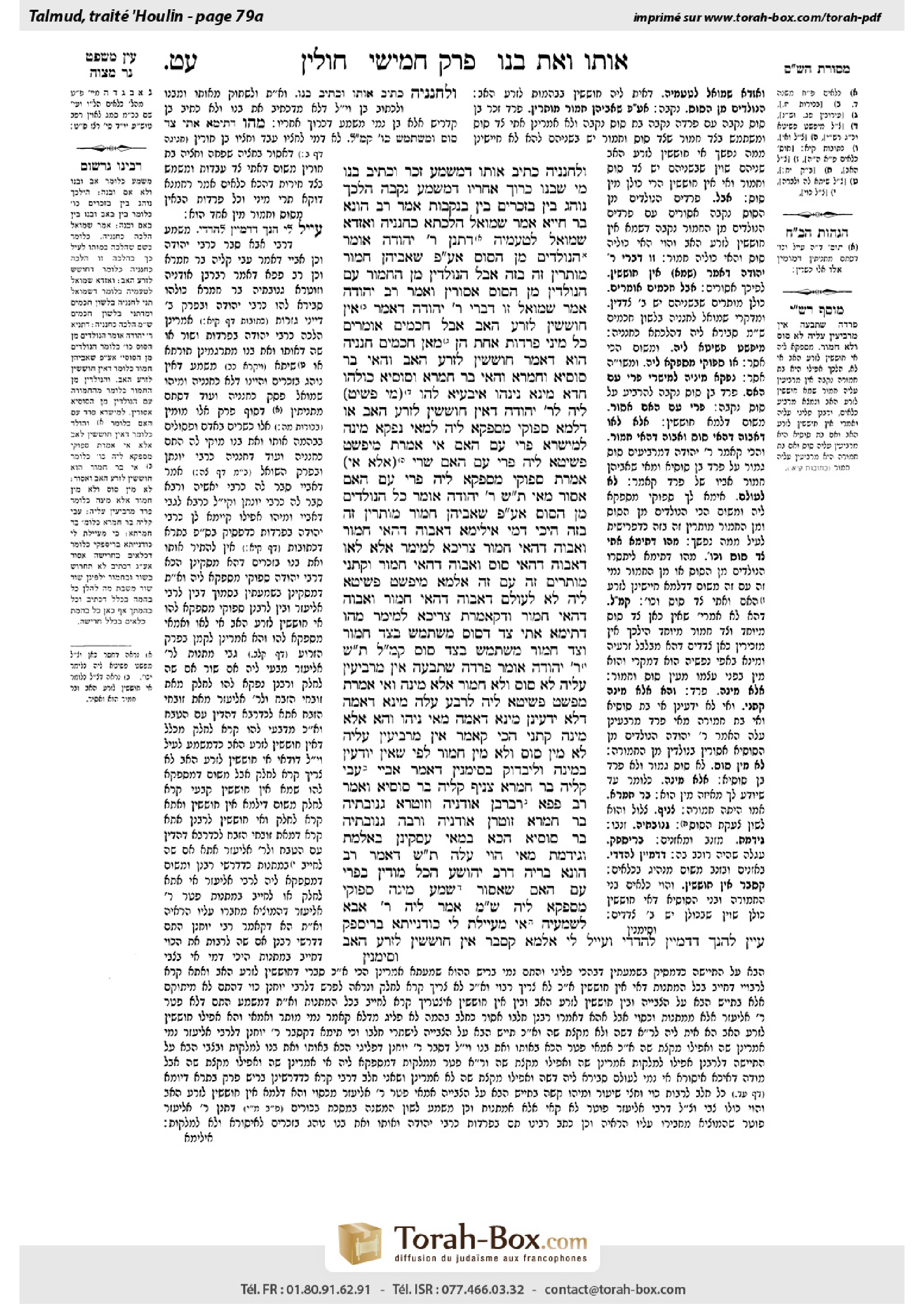
Chullin 79a: Talmud study for Daf Yomi
Study the Talmud for Daf Yomi with scanned pages, Hebrew text, English translations from Sefaria and AI-generated French translations.
Passage selection and English or AI-generated French translation are available where the scan has annotations. Daf Study is independent of Torah-Box and Sefaria.
Browse Chullin · חולין · All tractatesChullin 79a text and translations
This page of Chullin includes the Aramaic text, an English translation and an AI-generated French translation, alongside the scan above.
חולין ע״ט א · Aramaic and Hebrew text
וְלַחֲנַנְיָה, כְּתִיב ״אוֹתוֹ״ דְּמַשְׁמַע זָכָר, וּכְתִיב ״בְּנוֹ״ – מִי שֶׁבְּנוֹ כָּרוּךְ אַחֲרָיו דְּמַשְׁמַע נְקֵבָה, הִלְכָּךְ נוֹהֵג בֵּין בִּזְכָרִים בֵּין בִּנְקֵבוֹת.
אָמַר רַב הוּנָא בַּר חִיָּיא אָמַר שְׁמוּאֵל: הִלְכְתָא כַּחֲנַנְיָה, וְאַזְדָּא שְׁמוּאֵל לְטַעְמֵיהּ, דִּתְנַן: רַבִּי יְהוּדָה אוֹמֵר: הַנּוֹלָדִים מִן הַסּוּס, אַף עַל פִּי שֶׁאֲבִיהֶן חֲמוֹר – מוּתָּרִין זֶה בְּזֶה, אֲבָל הַנּוֹלָדִין מִן הַחֲמוֹר עִם הַנּוֹלָדִין מִן הַסּוּס – אֲסוּרִין.
וְאָמַר רַב יְהוּדָה אָמַר שְׁמוּאֵל: זוֹ דִּבְרֵי רַבִּי יְהוּדָה, דְּאָמַר אֵין חוֹשְׁשִׁין לְזֶרַע הָאָב, אֲבָל חֲכָמִים אוֹמְרִים: כׇּל מִינֵי פְּרָדוֹת אַחַת הֵן.
מַאן חֲכָמִים? חֲנַנְיָה הוּא, דְּאָמַר חוֹשְׁשִׁין לְזֶרַע הָאָב, וְהַאי בַּר סוּסְיָא וַחֲמָרָא, וְהַאי בַּר חֲמָרָא וְסוּסְיָא – כּוּלְּהוּ חֲדָא מִינָא נִינְהוּ.
אִיבַּעְיָא לְהוּ: מִי פְּשִׁיט לֵיהּ לְרַבִּי יְהוּדָה דְּאֵין חוֹשְׁשִׁין לְזֶרַע הָאָב, אוֹ דִלְמָא סַפּוֹקֵי מְסַפְּקָא לֵיהּ? לְמַאי נָפְקָא מִינַּהּ?
לְמִישְׁרֵא פְּרִי עִם הָאֵם, אִי אָמְרַתְּ: מִיפְשָׁט פְּשִׁיטָא לֵיהּ – פְּרִי עִם הָאֵם שְׁרֵי, אֶלָּא אִי אָמְרַתְּ: סַפּוֹקֵי מְסַפְּקָא לֵיהּ – פְּרִי עִם הָאֵם אָסוּר.
מַאי תָּא שְׁמַע: רַבִּי יְהוּדָה אוֹמֵר: כׇּל הַנּוֹלָדִים מִן הַסּוּס, אַף עַל פִּי שֶׁאֲבִיהֶן חֲמוֹר – מוּתָּרִין זֶה בָּזֶה. הֵיכִי דָמֵי? אִילֵּימָא דַּאֲבוּהּ דְּהַאי חֲמוֹר וַאֲבוּהּ דְּהַאי חֲמוֹר – צְרִיכָא לְמֵימַר? אֶלָּא לָאו דַּאֲבוּהּ דְּהַאי סוּס וַאֲבוּהּ דְּהַאי חֲמוֹר;
וְקָתָנֵי מוּתָּרִים זֶה עִם זֶה, אַלְמָא מִיפְשָׁט פְּשִׁיטָא לֵיהּ!
לָא, לְעוֹלָם דַּאֲבוּהּ דְּהַאי חֲמוֹר, וַאֲבוּהּ דְּהַאי חֲמוֹר. וּדְקָאָמְרַתְּ: צְרִיכָא לְמֵימַר? מַהוּ דְּתֵימָא: אָתֵי צַד דְּסוּס מִשְׁתַּמֵּשׁ בְּצַד חֲמוֹר, וְצַד חֲמוֹר מִשְׁתַּמֵּשׁ בְּצַד סוּס, קָא מַשְׁמַע לַן.
תָּא שְׁמַע: רַבִּי יְהוּדָה אוֹמֵר, פִּרְדָּה שֶׁתָּבְעָה – אֵין מַרְבִּיעִין עָלֶיהָ לֹא סוּס וְלֹא חֲמוֹר, אֶלָּא מִינָהּ. וְאִי אָמְרַתְּ מִפְשָׁט פְּשִׁיטָא לֵיהּ לַרְבַּע עֲלַהּ מִינָא דְּאִמַּהּ! דְּלָא יָדְעִינַן מִינָא דְּאִמַּהּ מַאי נִיהוּ.
וְהָא ״אֶלָּא מִינַּהּ״ קָתָנֵי? הָכִי קָאָמַר: אֵין מַרְבִּיעִין עָלֶיהָ לֹא מִין סוּס וְלֹא מִין חֲמוֹר, לְפִי שֶׁאֵין יוֹדְעִין בְּמִינָהּ. וְלִיבְדּוֹק בְּסִימָנִין? דְּאָמַר אַבָּיֵי: עָבֵי קָלֵיהּ – בַּר חַמָּרָא, צְנִיף קָלֵיהּ – בַּר סוּסְיָא. וְאָמַר רַב פָּפָּא: רַבְרְבָן אוּדְנֵיהּ וְזוּטְרָא גְּנוּבְתֵיהּ – בַּר חַמָּרָא, זוּטְרָן אוּדְנֵיהּ וְרַבָּה גְּנוּבְתֵיהּ – בַּר סוּסְיָא. הָכָא בְּמַאי עָסְקִינַן? בְּאִלֶּמֶת וְגִידֶּמֶת.
מַאי הָוֵי עֲלַהּ? תָּא שְׁמַע, דְּאָמַר רַב הוּנָא בְּרֵיהּ דְּרַב יְהוֹשֻׁעַ: הַכֹּל מוֹדִין בִּפְרִי עִם הָאֵם שֶׁאָסוּר. שְׁמַע מִינַּהּ סַפּוֹקֵי מְסַפְּקָא לֵיהּ, שְׁמַע מִינַּהּ.
אֲמַר לֵיהּ רַבִּי אַבָּא לְשַׁמָּעֵיהּ: אִי מְעַיְּילַתְּ לִי כּוּדַנְיָיתָא בְּרִיסְפַּק, עַיֵּין לְהָנָךְ דְּדָמְיָין לַהֲדָדֵי, וְעַיֵּיל לִי. אַלְמָא קָסָבַר: אֵין חוֹשְׁשִׁין לְזֶרַע הָאָב.
Chullin 79a · English translation
And according to the opinion of Ḥananya, the reason for his ruling is that it is written “it,” which indicates a male, and it is written “its offspring,” teaching that the prohibition applies to that parent whose offspring clings to it, which indicates a female. Therefore, this prohibition applies to both males and females.
Rav Huna bar Ḥiyya says that Shmuel says: The halakha is in accordance with the opinion of Ḥananya. And Shmuel follows his line of reasoning, as we learned in a mishna (Kilayim 8:4): Rabbi Yehuda says: With regard to two animals that are born from a female horse, even if the father of one is a donkey and the father of the other is a horse, they are permitted to mate with one another. Since the mothers of both are horses, the offspring are all considered of the same species. But to mate animals that are born from a female donkey with animals that are born from a female horse, even if one animal was born from a male horse and a female donkey and the other was born from a male donkey and a female horse, is prohibited, due to the prohibition of diverse kinds.
And, commenting on that mishna, Rav Yehuda says that Shmuel says: This is the statement of Rabbi Yehuda, who says: One need not be concerned with its paternity in determining the species of an animal, as the species is determined solely by the mother. But the Rabbis say: The species of an animal is determined according to both its mother and its father. Therefore, all types of mules, regardless of which parent is a horse and which is a donkey, are considered a single species and may mate with each other.
Now, whose opinion is referred to as that of the Rabbis here? It is that of Ḥananya, who says: One needs to be concerned with paternity, as, in his opinion, the prohibition against slaughtering an animal and its offspring applies to a male and its offspring as well. And therefore, with regard to the prohibition of diverse kinds as well, this mule that is the offspring of a female horse and a male donkey, and that mule that is the offspring of a female donkey and a male horse are all a single species.
A dilemma was raised before the Sages: Is Rabbi Yehuda certain that one need not be concerned with its paternity in determining the species of the offspring, or perhaps he is uncertain whether or not one need be concerned with its paternity? The Gemara asks: What is the practical difference?
The Gemara answers: The practical difference is with regard to permitting the mating of the offspring with the species of the mother, e.g., the mating of the offspring of a female horse and a male donkey together with a horse. If you say that Rabbi Yehuda is certain that one need not be concerned with its paternity, then the mating of the offspring with the species of the mother is permitted, as, in this case, they are both considered horses. But if you say that Rabbi Yehuda is uncertain, then the mating of the offspring with the species of the mother is prohibited, as one must be concerned about the species of the father.
What, then, is the answer to the question? The Gemara suggests: Come and hear a possible resolution from the mishna cited earlier: Rabbi Yehuda says: All that are born from a female horse, even if the father of one of them is a donkey, are permitted to mate with each other. What are the circumstances here? If we say that the father of this male animal is a donkey, and the father of that female animal, with which the male is to be mated, is a donkey, does it need to be said? Since the mothers of both animals are horses, they are both of exactly the same species and may certainly mate with each other. Rather, is it not that the father of this one is a horse, and the father of that other one is a donkey?
And yet it is taught that they are permitted to mate with each other. Evidently, Rabbi Yehuda is certain that one need not be concerned with its paternity in determining the species of the offspring. If he were uncertain, he would deem their mating prohibited, as the father of one is a horse while the father of the other is a donkey.
The Gemara responds: No, one cannot cite proof from this, as it can be said that actually, the father of this male animal is a donkey, and the father of that female animal is also a donkey. And with regard to that which you say: Does it need to be said that these two may mate? It does need to be said, lest you say: The horse component of the male mule comes and copulates with the donkey component of the female mule, and the donkey component of the male mule copulates specifically with the horse component of the female mule, which would violate the prohibition of diverse kinds. Therefore, Rabbi Yehuda teaches us that they are both of the same species and may mate.
The Gemara suggests: Come and hear a possible resolution from a baraita: Rabbi Yehuda says: With regard to a female mule in heat, one may not mate a horse or a donkey with her, due to the prohibition against crossbreeding diverse kinds of livestock. Rather, one mates her with one of her kind, another mule. And if you say that Rabbi Yehuda is certain that one need not be concerned with its paternity in determining the species of the offspring, then why not mate her with the species of her mother? Evidently, Rabbi Yehuda is uncertain and therefore deems it prohibited to mate her with either a horse or a donkey. The Gemara responds: The baraita is referring to a case where we do not know what the mother’s species is.
The Gemara challenges: But the baraita teaches: Rather, one mates her with one of her kind, indicating that her species is known. The Gemara explains that this is what the baraita is saying: One may not mate the species of a horse or the species of a donkey with her, because one does not usually know the species of the mother of a mule that one encounters. The Gemara suggests: But let one check her species by her distinguishing characteristics, as Abaye says: If its voice is deep, it is the offspring of a female donkey; if its voice is shrill, it is the offspring of a female horse. And Rav Pappa says: If its ears are large and its tail is small, it is the offspring of a female donkey; if its ears are small and its tail is large, it is the offspring of a female horse. The Gemara answers: Here we are dealing with a mule who is mute, and whose ears and tail are lopped off, and whose species cannot be determined. Therefore, Rabbi Yehuda’s opinion cannot be proven from this case.
The Gemara asks: What conclusion was reached about it? Come and hear a resolution, as Rav Huna, son of Rav Yehoshua, says: All, including Rabbi Yehuda, agree with regard to mating the offspring with the species of its mother that it is prohibited. Conclude from it that Rabbi Yehuda is uncertain. If he were certain that one need not be concerned with its paternity, he would deem mating the offspring with the species of its mother permitted, since the father’s species would not matter. The Gemara affirms: Conclude from it that this is so.
The Gemara relates with regard to this issue that Rabbi Abba said to his servant: If you bring me mules attached to a wagon [rispak], look for those that are similar to each other in their voices and the sizes of their ears and tails, and bring those for me, in order not to violate the prohibition of diverse kinds. Evidently, Rabbi Abba holds that with regard to the offspring of diverse kinds, one need not be concerned with its paternity, since, as explained earlier, these distinguishing characteristics indicate only the species of the mother.
Chullin 79a · Traduction française (IA)
Et selon l'opinion de Hananja, la raison de son jugement est que cela est écrit « il », ce qui indique un mâle, et cela est écrit « ses petits », enseignant que l'interdiction s'applique à ce père dont les petits s'accrochent à lui, ce qui indique une femelle. Ainsi, cette interdiction s'applique aux deux sexes.
Rav Huna bar Chiyah dit que Shmuel dit : La halakha suit l'opinion de Hananja. Et Shmuel suit sa ligne de raisonnement, comme nous l'avons appris dans une mitsva (Kilayim 8:4) : Rabbi Yehuda dit : En ce qui concerne deux animaux nés d'une jument, même si le père de l'un est un âne et le père de l'autre est un cheval, ils sont permis de s'accoupler. Puisque les mères des deux sont des chevaux, les petits sont tous considérés de la même espèce. Mais pour accoupler des animaux nés d'une jument âne avec des animaux nés d'une jument cheval, même si l'un est né d'un cheval mâle et d'une jument femelle et l'autre d'un âne mâle et d'une jument femelle, cela est interdit, en raison de l'interdiction des espèces diverses.
Et, commentant cette mitsva, Rav Yehuda dit que Shmuel dit : C'est la déclaration de Rabbi Yehuda, qui dit : On n'a pas à s'inquiéter de la paternité pour déterminer l'espèce d'un animal, puisque l'espèce est déterminée uniquement par la mère. Mais les Rabbins disent : L'espèce d'un animal est déterminée à la fois par sa mère et son père. Ainsi, toutes les mules, quels que soient les parents, sont considérées comme une seule espèce et peuvent s'accoupler entre elles.
Maintenant, quelle opinion est ici mentionnée comme celle des Rabbins ? C'est celle de Hananja, qui dit : On doit s'inquiéter de la paternité, car, selon son opinion, l'interdiction de sacrifier un animal et son petit s'applique à un mâle et son petit également. Et par conséquent, en ce qui concerne l'interdiction des espèces diverses également, cette mule, enfant d'une jument et d'un âne mâle, et cette mule, enfant d'une jument d'âne et d'un cheval mâle, sont toutes de la même espèce.
Un dilemme a été soulevé devant les Sages : Rabbi Yehuda est-il certain que l'on n'a pas à s'inquiéter de la paternité pour déterminer l'espèce de l'animal, ou peut-être est-il incertain quant à savoir s'il faut s'inquiéter de la paternité ? La Guemara demande : Quelle est la différence pratique ?
La Guemara répond : La différence pratique concerne la permission d'accoupler l'animal avec l'espèce de sa mère, par exemple, l'accouplement d'un animal né d'une jument et d'un âne mâle avec un cheval. Si vous dites que Rabbi Yehuda est certain que l'on n'a pas à s'inquiéter de la paternité, alors l'accouplement de l'animal avec l'espèce de sa mère est permis, car, dans ce cas, ils sont tous considérés comme des chevaux. Mais si vous dites que Rabbi Yehuda est incertain, alors l'accouplement de l'animal avec l'espèce de sa mère est interdit, car on doit s'inquiéter de l'espèce du père.
Quelle est donc la réponse à cette question ? La Guemara suggère : Venez écouter une possible résolution à partir de la Michna citée plus tôt : Rabbi Yehuda dit : Tous ceux nés d'une jument, même si le père de l'un d'eux est un âne, sont permis d'accoupler entre eux. Quelles sont les circonstances ici ? Si nous disons que le père de cet animal mâle est un âne, et le père de cette femelle, avec laquelle l'animal mâle doit s'accoupler, est un âne, est-ce que cela doit être dit ? Puisque les mères des deux animaux sont des chevaux, ils sont tous de la même espèce et peuvent certainement s'accoupler entre eux. Plutôt, n'est-ce pas que le père de cet un est un cheval, et le père de l'autre est un âne ?
Et pourtant, il est enseigné qu'ils sont permis d'accoupler entre eux. Évidemment, Rabbi Yehuda est certain que l'on n'a pas à s'inquiéter de la paternité pour déterminer l'espèce de l'animal. S'il était incertain, il jugerait leur accouplement interdit, car le père de l'un est un cheval tandis que celui de l'autre est un âne.
La Guemara répond : Non, on ne peut pas invoquer cette preuve, car on peut dire que, en réalité, le père de cet animal mâle est un âne, et le père de cette femelle est également un âne. Et concernant ce que vous dites : Est-ce que cela doit être dit que ces deux peuvent s'accoupler ? Il faut le dire, afin de ne pas dire que la composante cheval de l'animal mâle s'accouple avec la composante âne de l'animal femelle, et la composante âne de l'animal mâle s'accouple spécifiquement avec la composante cheval de l'animal femelle, ce qui violerait l'interdiction des espèces diverses. Ainsi, Rabbi Yehuda nous enseigne que tous sont de la même espèce et peuvent s'accoupler.
La Guemara suggère : Venez écouter une possible résolution tirée d'une baraïta : Rabbi Yehuda dit : En ce qui concerne une mule femelle en chaleur, on ne doit pas accoupler un cheval ou un âne avec elle, en raison de l'interdiction d'accoupler des espèces différentes de bêtes. Plutôt, on accouple avec un de sa propre espèce, une autre mule. Et si vous dites que Rabbi Yehuda est certain que l'on n'a pas à s'inquiéter de la paternité pour déterminer l'espèce de l'animal, pourquoi ne pas accoupler avec l'espèce de sa mère ? Évidemment, Rabbi Yehuda est incertain et donc considère donc l'accouplement avec un cheval ou un âne comme interdit. La Guemara répond : La baraïta fait référence à un cas où nous ne savons pas l'espèce de la mère.
La Guemara conteste : Mais la baraïta enseigne : Plutôt, on lui fait accoupler une bête de son espèce, ce qui indique que l'espèce de la mule est connue. La Guemara explique que c'est ce que la baraïta dit : On ne doit pas accoupler une mule avec l'espèce d'un cheval ou d'un âne, car on ne connaît généralement pas l'espèce de la mère d'une mule que l'on rencontre. La Guemara suggère : Mais on devrait vérifier l'espèce de la mule à l'aide de ses caractéristiques distinctives, comme Abaye dit : Si sa voix est grave, c'est l'enfant d'une jument ; si sa voix est aiguë, c'est l'enfant d'une jument de cheval. Et Rav Pappa dit : Si ses oreilles sont grandes et sa queue est petite, c'est l'enfant d'une jument ; si ses oreilles sont petites et sa queue est grande, c'est l'enfant d'une jument de cheval. La Guemara répond : Ici, nous parlons d'une mule muette, dont les oreilles et la queue ont été coupées, et dont l'espèce ne peut être déterminée. Par conséquent, l'opinion de Rabbi Yéhuda ne peut pas être prouvée à partir de ce cas.
La Guemara demande : Quelle conclusion a-t-on tirée à ce sujet ? Vient-on entendre une résolution, comme Rav Huna, fils de Rav Yéhoshua, dit : Tous, y compris Rabbi Yéhuda, sont d'accord sur le fait qu'il est interdit d'accoupler l'enfant avec l'espèce de sa mère. Concluez-en que Rabbi Yéhuda est incertain. S'il était certain que l'on ne devait pas s'inquiéter de son paternité, il aurait considéré comme permis d'accoupler l'enfant avec l'espèce de sa mère, car l'espèce du père n'aurait pas d'importance. La Guemara affirme : Concluez-en que c'est ainsi.
La Guemara rapporte à propos de cette question que Rabbi Abba a dit à son serviteur : Si tu me rapportes des mules attelées [rispak], cherche celles qui sont semblables entre elles en termes de leur voix et de la taille de leurs oreilles et de leurs queues, et rapporte-moi celles-ci, afin de ne pas enfreindre l'interdiction des espèces diverses. Évidemment, Rabbi Abba considère que, concernant l'offspring d'espèces diverses, l'on ne doit pas s'inquiéter de son paternité, car, comme on l'a expliqué plus tôt, ces caractéristiques distinctives indiquent uniquement l'espèce de la mère.
Traduction française générée par IA à partir de l’édition anglaise de Sefaria. Vérifie toujours un passage avec le texte source.
Text from Sefaria: William Davidson Edition - Vocalized Aramaic (unknown); William Davidson Edition - English (CC BY NC).