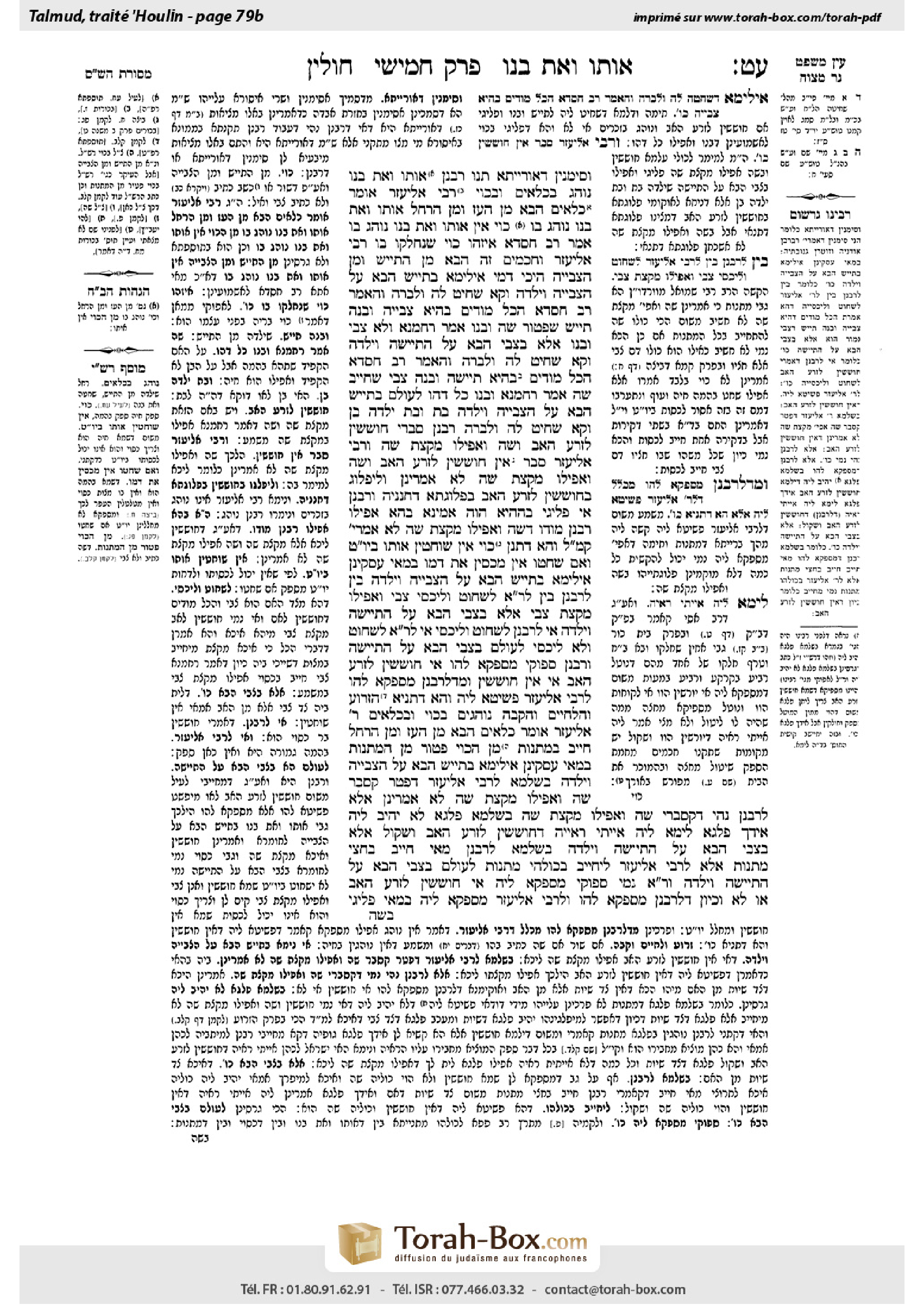
Chullin 79b: Talmud study for Daf Yomi
Study the Talmud for Daf Yomi with scanned pages, Hebrew text, English translations from Sefaria and AI-generated French translations.
Passage selection and English or AI-generated French translation are available where the scan has annotations. Daf Study is independent of Torah-Box and Sefaria.
Browse Chullin · חולין · All tractatesChullin 79b text and translations
This page of Chullin includes the Aramaic text, an English translation and an AI-generated French translation, alongside the scan above.
חולין ע״ט ב · Aramaic and Hebrew text
וְסִימָנִין דְּאוֹרָיְיתָא.
תָּנוּ רַבָּנַן: אוֹתוֹ וְאֶת בְּנוֹ נוֹהֵג בְּכִלְאַיִם וּבְכוֹי. רַבִּי אֱלִיעֶזֶר אוֹמֵר: כִּלְאַיִם הַבָּא מִן הָעֵז וּמִן הָרָחֵל – אוֹתוֹ וְאֶת בְּנוֹ נוֹהֵג בּוֹ, כּוֹי – אֵין אוֹתוֹ וְאֶת בְּנוֹ נוֹהֵג בּוֹ. אָמַר רַב חִסְדָּא: אֵיזֶהוּ כּוֹי שֶׁנֶּחְלְקוּ בּוֹ רַבִּי אֱלִיעֶזֶר וַחֲכָמִים? זֶה הַבָּא מִן הַתַּיִישׁ וּמִן הַצְּבִיָּיה.
הֵיכִי דָמֵי? אִילֵּימָא בְּתַיִישׁ הַבָּא עַל הַצְּבִיָּיה, וְיָלְדָה, וְקָא שָׁחֵיט לַהּ וְלִבְרַהּ – וְהָאָמַר רַב חִסְדָּא: הַכֹּל מוֹדִים בְּהִיא צְבִיָּיה וּבְנָהּ תַּיִישׁ, שֶׁפָּטוּר! שֶׂה וּבְנוֹ אָמַר רַחֲמָנָא, וְלֹא צְבִי וּבְנוֹ!
אֶלָּא בִּצְבִי הַבָּא עַל הַתְּיָישָׁה וְיָלְדָה, וְקָא שָׁחֵיט לַהּ וְלִבְרַהּ, וְהָאָמַר רַב חִסְדָּא: הַכֹּל מוֹדִים בְּהִיא תְּיָישָׁה וּבְנָהּ צְבִי – שֶׁחַיָּיב, ״שֶׂה״ אָמַר רַחֲמָנָא, וּבְנוֹ כֹּל דְּהוּ!
לְעוֹלָם, בְּתַיִישׁ הַבָּא עַל הַצְּבִיָּיה, וְיָלְדָה בַּת, וּבַת יָלְדָה בֵּן, וְקָא שָׁחֵיט לַהּ וְלִבְרַהּ.
רַבָּנַן סָבְרִי: חוֹשְׁשִׁין לְזֶרַע הָאָב, וְשֶׂה – וַאֲפִילּוּ מִקְצָת שֶׂה. וְרַבִּי אֱלִיעֶזֶר סָבַר: אֵין חוֹשְׁשִׁין לְזֶרַע הָאָב, וְ״שֶׂה וַאֲפִילּוּ מִקְצָת שֶׂה״ – לָא אָמְרִינַן.
וְלִיפְלוֹג בְּחוֹשְׁשִׁין לְזֶרַע הָאָב, בִּפְלוּגְתָּא דַּחֲנַנְיָה וְרַבָּנַן?
אִי פְּלִיגִי בְּהָהִיא, הֲוָה אָמֵינָא: בְּהָא אֲפִילּוּ רַבָּנַן מוֹדוּ, דְּ״שֶׂה וַאֲפִילּוּ מִקְצָת שֶׂה״ לָא אָמְרִינַן, קָא מַשְׁמַע לַן.
וְהָא דִּתְנַן: כּוֹי אֵין שׁוֹחֲטִין אוֹתוֹ בְּיוֹם טוֹב, וְאִם שְׁחָטוֹ – אֵין מְכַסִּין אֶת דָּמוֹ.
בְּמַאי עָסְקִינַן? אִילֵימָא בְּתַיִישׁ הַבָּא עַל הַצְּבִיָּיה וְיָלְדָה, בֵּין לְרַבָּנַן בֵּין לְרַבִּי אֱלִיעֶזֶר – לִשְׁחוֹט וְלִיכַסֵּי, צְבִי וַאֲפִילּוּ מִקְצָת צְבִי.
אֶלָּא בִּצְבִי הַבָּא עַל הַתְּיָישָׁה וְיָלְדָה, אִי לְרַבָּנַן – לִשְׁחוֹט וְלִיכַסֵּי, אִי לְרַבִּי אֱלִיעֶזֶר – לִשְׁחוֹט וְלָא לִיכַסֵּי.
לְעוֹלָם בִּצְבִי הַבָּא עַל הַתְּיָישָׁה, וְרַבָּנַן סַפּוֹקֵי מְסַפְּקָא לְהוּ אִי חוֹשְׁשִׁין לְזֶרַע הָאָב אִי אֵין חוֹשְׁשִׁין.
וּמִדִּלְרַבָּנַן מְסַפְּקָא לְהוּ, לְרַבִּי אֱלִיעֶזֶר פְּשִׁיטָא לֵיהּ.
וְהָא דְּתַנְיָא: הַזְּרוֹעַ וְהַלְּחָיַיִם וְהַקֵּבָה נוֹהֲגִים בְּכוֹי וּבְכִלְאַיִם. רַבִּי אֱלִיעֶזֶר אוֹמֵר: כִּלְאַיִם הַבָּא מִן הָעֵז וּמִן הָרָחֵל – חַיָּיב בְּמַתָּנוֹת, מִן הַכּוֹי – פָּטוּר מִן הַמַּתָּנוֹת.
בְּמַאי עָסְקִינַן? אִילֵימָא בְּתַיִישׁ הַבָּא עַל הַצְּבִיָּיה וְיַלְדָּה, בִּשְׁלָמָא לְרַבִּי אֱלִיעֶזֶר דְּפָטַר, קָסָבַר ״שֶׂה וַאֲפִילּוּ מִקְצָת שֶׂה״ לָא אָמְרִינַן.
אֶלָּא לְרַבָּנַן, נְהִי דְּקָסָבְרִי ״שֶׂה וַאֲפִילּוּ מִקְצָת שֶׂה״, בִּשְׁלָמָא פַּלְגָא לָא יָהֵיב לֵיהּ, אִידַּךְ פַּלְגָא לֵימָא לֵיהּ: אַיְיתִי רְאָיָיה דְּחוֹשְׁשִׁין לְזֶרַע הָאָב, וּשְׁקוֹל.
אֶלָּא, בִּצְבִי הַבָּא עַל הַתְּיָישָׁה וְיָלְדָה. בִּשְׁלָמָא לְרַבָּנַן, מַאי ״חַיָּיב״ – בַּחֲצִי מַתָּנוֹת; אֶלָּא לְרַבִּי אֱלִיעֶזֶר, לִיחַיַּיב בְּכוּלְּהִי מַתָּנוֹת?
לְעוֹלָם בִּצְבִי הַבָּא עַל הַתְּיָישָׁה וְיָלְדָה, וְרַבִּי אֱלִיעֶזֶר נָמֵי סַפּוֹקֵי מְסַפְּקָא לֵיהּ אִי חוֹשְׁשִׁין לְזֶרַע הָאָב אוֹ לָא, וְכֵיוָן דִּלְרַבָּנַן מְסַפְּקָא לְהוּ וּלְרַבִּי אֱלִיעֶזֶר מְסַפְּקָא לֵיהּ, בְּמַאי פְּלִיגִי?
Chullin 79b · English translation
And in addition, he holds that these distinguishing characteristics apply by Torah law, such that they may be relied upon to allay concerns of violating even a prohibition that is mandated by Torah law.
§ The Sages taught in a baraita (see Tosefta 5:1): The prohibition against slaughtering an animal itself and its offspring applies to the offspring of diverse kinds of animals, such as a goat and a ewe, and to the koy, even though the prohibition does not apply to undomesticated animals. Rabbi Eliezer says: With regard to a hybrid that results from the mating of a goat and a ewe, the prohibition of a mother and its offspring applies; with regard to a koy, the prohibition of a mother and its offspring does not apply. Rav Ḥisda says: What is the koy about which Rabbi Eliezer and the Rabbis disagree? It is that which results from the mating of a goat and a doe.
The Gemara asks: What are the circumstances surrounding the birth of this koy? If we say that it is the result of a goat that mates with a doe, and she gives birth, and one slaughters her and her offspring on the same day, that is difficult: But doesn’t Rav Ḥisda say: All concede in the case where she is a doe and her offspring is a goat, because she mated with a goat, that one who slaughters them both on the same day is exempt from lashes for violating the prohibition of a mother and its offspring? He is exempt because the Merciful One states: “And whether it be a bull or a sheep, you shall not slaughter it and its offspring both in one day” (Leviticus 22:28), indicating that the prohibition applies to a domesticated animal and its offspring, but not to an undomesticated animal and its offspring, such as a doe and its offspring.
Rather, perhaps this koy is the product of a deer that mates with a female goat, and she gives birth, and one slaughters her and her offspring on the same day. But doesn’t Rav Ḥisda say: All concede that in the case where she is a goat and her offspring is a deer because she mated with a deer, that one who slaughters them both on the same day is liable? He is liable because the Merciful One states in the Torah: “A sheep…and its offspring” (Leviticus 22:28), indicating that the prohibition applies to a domesticated animal such as a sheep and its offspring of any species, even if it is an undomesticated animal.
The Gemara responds: Actually, the dispute between Rabbi Eliezer and the Rabbis is in the case of a goat that mates with a doe, and she gives birth to a female offspring, a koy, and this female offspring gives birth to a male offspring, and one slaughters her and her male offspring on the same day.
The Rabbis hold: One needs to be concerned with its paternity, and therefore the koy is partially a goat due to its father, and the word “sheep” in the verse means that even if it is partially a sheep, i.e., a domesticated animal, it may not be slaughtered with its offspring in a single day. And Rabbi Eliezer holds: One need not be concerned with its paternity, and the status of the koy is unaffected by the fact that its father is a goat, and therefore, in this case we do not say that the word “sheep” mentioned in the verse means that even if it is partially a sheep it may not be slaughtered with its offspring in a single day, as the father’s component is ignored.
The Gemara challenges: And let them disagree with regard to any animal of mixed breed about whether one needs to be concerned with its paternity, i.e., with regard to the issue that is the subject of the dispute between Ḥananya and the Rabbis, whether the prohibition against slaughtering an animal and its offspring on the same day also applies to a father and its offspring because one needs to be concerned with an animal’s paternity.
The Gemara responds: If they would disagree only about that issue, I would say: With regard to this issue of a doe mother and a goat father, even the Rabbis concede that we do not say that the word “sheep” mentioned in the verse means that even if an animal is partially a sheep, i.e., a domesticated animal, it may not be slaughtered with its offspring in a single day. Therefore, the baraita teaches us that according to the Rabbis, not only does one need to be concerned with paternity, but the word “sheep” indicates that even if it is partially a sheep, i.e., a domesticated animal, it may not be slaughtered with its offspring.
The Gemara challenges: But that which we learned in a mishna (83b) appears to contradict this: One may not slaughter a koy on a Festival, because covering its blood entails the performance of prohibited labor that is permitted only if there is a definite obligation to do so. And if one slaughtered a koy on a Festival after the fact, one does not cover its blood, as the Sages prohibited transporting soil on a Festival where it is uncertain that a mitzva by Torah law exists.
The Gemara explains the question: What are we dealing with? If we say that we are dealing with a goat who mates with a doe, and she gives birth, then whether according to the opinion of the Rabbis or according to the opinion of Rabbi Eliezer, let him slaughter the koy on the Festival ab initio and cover the blood, as the mother of the koy is a deer, and the koy therefore may be termed an undomesticated animal, whose blood requires covering. This should be so even if it is partially a deer, i.e., it has an undomesticated animal component from only one parent, since all agree that the offspring’s species derives from its mother.
Rather, we must be dealing with a case of a deer that mates with a female goat, and she gives birth. This, too, is difficult: If the mishna is in accordance with the opinion of the Rabbis that one needs to be concerned with paternity, let him slaughter this koy on the Festival ab initio and cover the blood, as it is partially an undomesticated animal due to its father. If the mishna holds in accordance with the opinion of Rabbi Eliezer that one need not be concerned with paternity, let him slaughter the koy on the Festival ab initio and not cover the blood, as it should be considered a domesticated animal, whose blood does not require covering due to its mother who is a goat.
The Gemara concludes that actually this mishna is in accordance with the opinion of the Rabbis, and it is referring to a case of a deer who mates with a female goat, and the Rabbis do not say with certainty that in determining the species of an animal one must be concerned with paternity, but rather the Rabbis are simply uncertain whether one needs to be concerned with its paternity or one need not be concerned. Therefore, they rule that one should not slaughter it on a Festival, ab initio, in order to avoid a possible prohibition, and if one did slaughter it, he should not cover the blood, to avoid violating a prohibition in order to perform an uncertain mitzva.
The Gemara infers: And from the fact that the Rabbis are uncertain, and therefore they rule that the prohibition of: Itself and its offspring, applies to a koy, it can be inferred that according to the opinion of Rabbi Eliezer, who rules that the prohibition of: Itself and its offspring, does not apply to a koy, it is obvious that, with regard to a koy resulting from a deer mating with a female goat, one need not be concerned with its paternity at all.
The Gemara asks: But according to this, that which is taught in a baraita (see Tosefta 9:1) presents a difficulty: The mitzva to give the foreleg, the jaw, and the maw of non-sacred animals to a priest applies both to a koy and to the offspring of diverse kinds of animals. Rabbi Eliezer says: A hybrid that results from the mating of a goat and a ewe is obligated to have gifts of the priesthood given from it; a hybrid that results from a koy is exempt from having gifts of the priesthood given from it.
The Gemara analyzes the baraita: What type of koy are we dealing with? If we say that we are dealing with a goat who mates with a doe, and she gives birth, granted, this is consistent according to the opinion of Rabbi Eliezer, who deems it exempt from having gifts of the priesthood given from it. As he holds that we do not say that the word “sheep” (see Deuteronomy 18:3) means that even if it is partially a sheep one must give gifts of the priesthood from it, as paternity is ignored and this koy is considered solely the offspring of a doe, exempting it from having gifts given from it.
But according to the opinion of the Rabbis, even if it is granted that they hold that the word “sheep” means that even if it is partially a sheep, or any other type of domesticated animal, one is obligated to give gifts of the priesthood from it, why should the owner of this koy be required to give the gifts to a priest? Granted, he does not give the priest half of the gifts, since half of the koy, i.e., the mother’s component, is an undomesticated animal; but with regard to the other half, as well, let him say to the priest: Bring proof that one needs to be concerned with its paternity and take that half; otherwise receive nothing.
Rather, we are dealing with the case of a deer who mates with a female goat and she gives birth. Granted, this is consistent according to the opinion of the Rabbis, who say that one is obligated to give gifts of the priesthood from it, as what is meant by: Obligated? It means: It is obligated in half of the gifts, since on its mother’s side the goat component is subject to the obligation to give the gifts, but with regard to the other half of the gifts he can tell the priest: Bring proof that one need not be concerned with paternity, and take it. But according to the opinion of Rabbi Eliezer, who says that one need not be concerned with paternity at all, such that this koy would be considered a domesticated animal like its mother, let the owner be obligated in all of the gifts. Why, then, does Rabbi Eliezer deem him exempt?
The Gemara answers: Actually, it is referring to a deer who mates with a female goat, and she gives birth, and Rabbi Eliezer is also uncertain whether, in determining the species of an animal, one needs to be concerned with its paternity or not. The Gemara asks: But since the conclusion is that the Rabbis are uncertain and Rabbi Eliezer is uncertain, in what case do they disagree where Rabbi Eliezer deems the owner exempt from giving the gifts entirely?
Chullin 79b · Traduction française (IA)
Et en outre, il affirme que ces caractéristiques distinctives s'appliquent selon la halakha, de telle sorte qu'elles peuvent être utilisées pour apaiser les préoccupations liées à la violation même d'une interdiction prescrite par la Torah écrite.
§ Les Sages enseignent dans une baraïta (voir Tosefta 5:1) : L'interdiction de sacrifier un animal et son descendant s'applique aux descendants d'animaux de différentes espèces, tels qu'un bouc et une chèvre, ainsi qu'au koy, même si cette interdiction ne s'applique pas aux animaux sauvages. Rabbi Éliezer dit : En ce qui concerne un hybride résultant de la fécondation d'un bouc et d'une chèvre, l'interdiction de la mère et de son descendant s'applique ; en ce qui concerne un koy, l'interdiction de la mère et de son descendant ne s'applique pas. Rav Ḥisda dit : De quel koy s'agit-il selon Rabbi Éliezer et les Rabbins ? C'est celui qui résulte de la fécondation d'un bouc et d'une chèvre.
La Guemara pose la question : Quelles sont les circonstances de la naissance de ce koy ? Si nous disons qu'il résulte d'une chèvre qui s'accouple avec une biche, et qu'elle donne naissance, et qu'on sacrifie elle et son descendant le même jour, cela est difficile : Mais ne dit pas Rav Ḥisda : Tout le monde convient du cas où elle est une biche et son descendant est un bouc, parce qu'elle s'est accouplée avec un bouc, que celui qui sacrifie les deux le même jour est exempt de fessures pour avoir violé l'interdiction de la mère et de son descendant ? Il est exempt car le Très Miséricordieux dit : « Et que ce soit un taureau ou une brebis, tu ne sacrifieras pas lui et son descendant le même jour » (Lévitique 22:28), indiquant que l'interdiction s'applique à un animal domestique et à son descendant, mais pas à un animal sauvage et à son descendant, tels qu'une biche et son descendant.
Plutôt, peut-être ce koy est-il le produit d'un cerf qui s'accouple avec une chèvre, et elle donne naissance, et qu'on sacrifie elle et son descendant le même jour. Mais ne dit pas Rav Ḥisda : Tout le monde convient du cas où elle est une chèvre et son descendant est un cerf parce qu'elle s'est accouplée avec un cerf, que celui qui sacrifie les deux le même jour est responsable ? Il est responsable car le Très Miséricordieux dit dans la Torah : « Une brebis… et son descendant » (Lévitique 22:28), indiquant que l'interdiction s'applique à un animal domestique tel qu'une brebis et à son descendant de toute espèce, même s'il est un animal sauvage.
La Guemara répond : En réalité, le débat entre Rabbi Éliezer et les Rabbins est dans le cas d'une chèvre qui s'accouple avec une biche, et elle donne naissance à une femelle, un koy, et cette femelle donne naissance à un mâle, et qu'on sacrifie elle et son descendant mâle le même jour.
Les Rabbins affirment : On doit s'inquiéter de son paternité, et donc le koy est partiellement un bouc en raison de son père, et le mot « brebis » dans la parole signifie que même s'il est partiellement une brebis, c'est-à-dire un animal domestique, il ne peut pas être sacrifié avec son descendant le même jour. Et Rabbi Éliezer affirme : On n'a pas besoin de s'inquiéter de son paternité, et le statut du koy n'est pas affecté par le fait que son père est un bouc, et donc, dans ce cas, nous ne disons pas que le mot « brebis » mentionné dans la parole signifie que même s'il est partiellement une brebis, c'est-à-dire un animal domestique, il ne peut pas être sacrifié avec son descendant le même jour, car la composante du père est ignorée.
La Guemara soulève un défi : Et qu'ils diffèrent concernant tout animal de race mixte quant à la question de savoir si l'on doit s'inquiéter de son paternité, c'est-à-dire concernant la question qui est au centre du débat entre Ḥananya et les Rabbins, savoir si l'interdiction de sacrifier un animal et son descendant le même jour s'applique également à un père et à son descendant en raison du fait qu'on doit s'inquiéter de la paternité d'un animal.
La Guemara répond : Si ils diffèrent uniquement sur cette question, je dirais : Concernant cette question d'une mère biche et d'un père bouc, même les Rabbins reconnaissent que nous ne disons pas que le mot « brebis » mentionné dans la parole signifie que même si un animal est partiellement une brebis, c'est-à-dire un animal domestique, il ne peut pas être sacrifié avec son descendant le même jour. Par conséquent, la baraïta nous enseigne que selon les Rabbins, non seulement on doit s'inquiéter de la paternité, mais le mot « brebis » indique que même s'il est partiellement une brebis, c'est-à-dire un animal domestique, il ne peut pas être sacrifié avec son descendant.
La Guemara conteste : Mais ce que nous avons appris dans une mitsna (83b) semble contredire cela : On ne peut pas sacrifier un koy pendant un festival, car couvrir son sang implique la performance d'un travail interdit qui est permis uniquement si une obligation définie existe. Et si on a sacrifié un koy pendant un festival après coup, on ne couvre pas son sang, car les Sages ont interdit de transporter du sol pendant un festival où il est incertain qu'une mitsva selon la loi juive existe.
La Guemara explique la question : De quoi sommes-nous en train de parler ? Si nous disons que nous sommes en train de parler d'une chèvre qui s'accouple avec une biche et donne naissance, alors que l'on soit selon l'opinion des Rabbins ou selon l'opinion de Rabbi Éliezer, qu'on sacrifie le koy pendant le festival dès le début et qu'on couvre son sang, car la mère du koy est un cerf, et le koy est donc considéré comme un animal sauvage, dont le sang doit être couvert. Cela devrait être ainsi même s'il est partiellement un cerf, c'est-à-dire s'il a une composante d'animal sauvage provenant d'un seul parent, car tout le monde convient que l'espèce du descendant provient de sa mère.
Plutôt, nous devons nous occuper d'un cas d'un chevreuil qui s'accouple avec une chèvre femelle, et elle donne naissance. Cela aussi est difficile : Si la mitsva est selon l'opinion des Rabbins qui exigent de s'occuper de la paternité, qu'on sacrifie ce chevreuil pendant la fête dès le début et qu'on recouvre le sang, car il s'agit partiellement d'un animal sauvage en raison de son père. Si la mitsva suit l'opinion de Rabbi Eliezer qui ne nécessite pas de s'occuper de la paternité, qu'on sacrifie le chevreuil pendant la fête dès le début et qu'on ne recouvre pas le sang, car il doit être considéré comme un animal domestique, dont le sang n'a pas besoin d'être recouvert en raison de sa mère qui est une chèvre.
La Guemara conclut que, en réalité, cette mitsva suit l'opinion des Rabbins, et elle fait référence à un cas d'un chevreuil qui s'accouple avec une chèvre femelle, et les Rabbins ne disent pas avec certitude qu'en déterminant la espèce d'un animal, on doit s'occuper de la paternité, mais plutôt les Rabbins sont simplement incertains quant à savoir s'il faut s'occuper de la paternité ou non. Par conséquent, ils décident qu'on ne doit pas sacrifier cet animal pendant la fête dès le début afin d'éviter une possible interdiction, et si on a sacrifié cet animal, on ne doit pas recouvrir le sang, afin d'éviter de violer une interdiction pour accomplir une mitsva incertaine.
La Guemara déduit : Et du fait que les Rabbins sont incertains, et donc ils décident que l'interdiction de : Lui-même et ses descendants, s'applique à un chevreuil, on peut déduire que selon l'opinion de Rabbi Eliezer, qui affirme que l'interdiction de : Lui-même et ses descendants, ne s'applique pas à un chevreuil, il est évident que, concernant un chevreuil issu d'un chevreuil et d'une chèvre femelle, on ne doit pas s'occuper de sa paternité du tout.
La Guemara pose une question : Mais selon cela, ce qui est enseigné dans une baraïta (voir Tosefta 9:1) présente une difficulté : La mitsva de donner la cuisse, la mâchoire et la gueule des animaux non sacrés à un prêtre s'applique à la fois au chevreuil et à l'offspring d'animaux de différentes espèces. Rabbi Eliezer dit : Un hybride résultant de l'accouplement d'une chèvre et d'une brebis est tenu de donner des offrandes de prêtrise, tandis qu'un hybride résultant d'un chevreuil est exempt de donner des offrandes de prêtrise.
La Guemara analyse la baraïta : De quel type de chevreuil s'agit-il ? Si nous disons qu'il s'agit d'une chèvre qui s'accouple avec une biche et donne naissance, cela est cohérent selon l'opinion de Rabbi Eliezer, qui considère qu'il est exempt de donner des offrandes de prêtrise. Car il affirme que l'expression « brebis » (voir Deutéronome 18:3) ne signifie pas qu'il faut donner des offrandes de prêtrise même si c'est partiellement une brebis, car la paternité est ignorée et ce chevreuil est considéré uniquement comme l'offspring d'une biche, exemptant ainsi de l'obligation de donner des offrandes.
Mais selon l'opinion des Rabbins, même si cela est admis qu'ils affirment que l'expression « brebis » signifie qu'il faut donner des offrandes de prêtrise même si c'est partiellement une brebis ou n'importe quel autre type d'animal domestique, pourquoi l'propriétaire de ce chevreuil devrait-il être tenu de donner des offrandes à un prêtre ? Bien que l'on ne doive pas donner la moitié des offrandes au prêtre, car la moitié du chevreuil, c'est-à-dire la composante de la mère, est un animal sauvage ; mais concernant l'autre moitié, qu'il dise au prêtre : Apporte la preuve que l'on doit s'occuper de la paternité et prends cette moitié ; sinon, reçois rien.
Plutôt, nous sommes en présence du cas d'un chevreuil qui s'accouple avec une chèvre femelle et elle donne naissance. Cela est cohérent selon l'opinion des Rabbins, qui affirment qu'il est tenu de donner des offrandes de prêtrise, car ce qui est dit par : Tenu ? Cela signifie : Il est tenu de la moitié des offrandes, car la composante de la mère, la chèvre, est soumise à l'obligation de donner des offrandes, mais concernant l'autre moitié des offrandes, il peut dire au prêtre : Apporte la preuve que l'on ne doit pas s'occuper de la paternité et prends-la. Mais selon l'opinion de Rabbi Eliezer, qui affirme qu'on ne doit pas s'occuper de la paternité du tout, de sorte que ce chevreuil serait considéré comme un animal domestique comme sa mère, l'propriétaire serait tenu de toutes les offrandes. Pourquoi alors Rabbi Eliezer considère-t-il qu'il est exempt ?
La Guemara répond : En réalité, il s'agit d'un chevreuil qui s'accouple avec une chèvre femelle et elle donne naissance, et Rabbi Eliezer est également incertain quant à savoir si, en déterminant la espèce d'un animal, on doit s'occuper de sa paternité ou non. La Guemara pose une question : Mais puisque la conclusion est que les Rabbins sont incertains et Rabbi Eliezer est incertain, dans quel cas se déclarent-ils en désaccord où Rabbi Eliezer considère que l'propriétaire est exempt de donner les offrandes entièrement ?
Traduction française générée par IA à partir de l’édition anglaise de Sefaria. Vérifie toujours un passage avec le texte source.
Text from Sefaria: William Davidson Edition - Vocalized Aramaic (unknown); William Davidson Edition - English (CC BY NC).