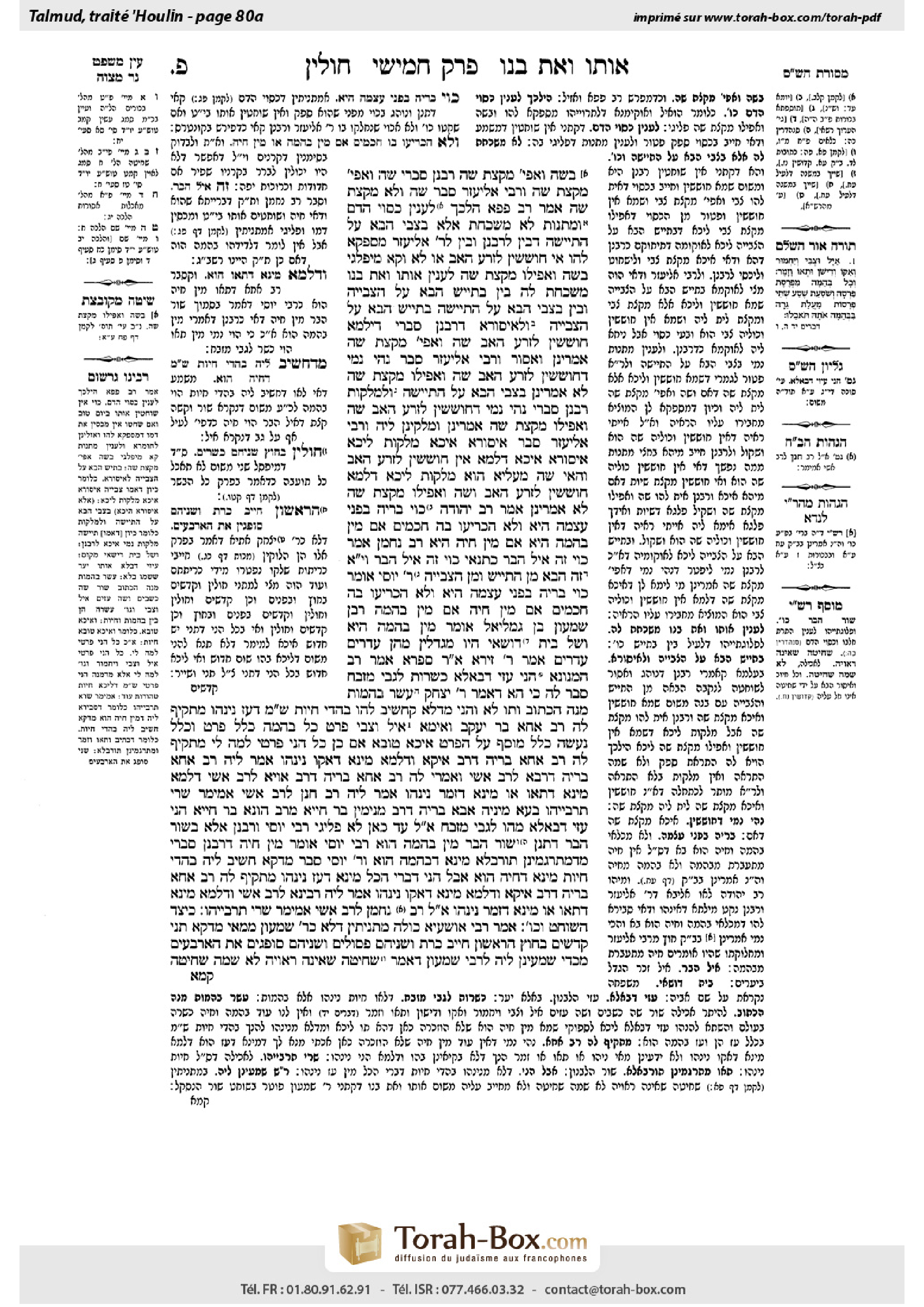
Chullin 80a: Talmud study for Daf Yomi
Study the Talmud for Daf Yomi with scanned pages, Hebrew text, English translations from Sefaria and AI-generated French translations.
Passage selection and English or AI-generated French translation are available where the scan has annotations. Daf Study is independent of Torah-Box and Sefaria.
Browse Chullin · חולין · All tractatesChullin 80a text and translations
This page of Chullin includes the Aramaic text, an English translation and an AI-generated French translation, alongside the scan above.
חולין פ׳ א · Aramaic and Hebrew text
בְּשֶׂה וַאֲפִילּוּ מִקְצָת שֶׂה, רַבָּנַן סָבְרִי: ״שֶׂה״ – וַאֲפִילּוּ מִקְצָת שֶׂה, וְרַבִּי אֱלִיעֶזֶר סָבַר: ״שֶׂה״ – וְלֹא מִקְצָת שֶׂה.
אָמַר רַב פָּפָּא: הִלְכָּךְ, לְעִנְיַן כִּסּוּי הַדָּם וּמַתָּנוֹת, לָא מַשְׁכַּחַתְּ אֶלָּא בִּצְבִי הַבָּא עַל הַתְּיָישָׁה.
דְּבֵין לְרַבָּנַן, וּבֵין לְרַבִּי אֱלִיעֶזֶר, מְסַפְּקָא לְהוּ אִי חוֹשְׁשִׁין לְזֶרַע הָאָב אוֹ לָא.
וְקָא מִיפַּלְגִי בְּ״שֶׂה וַאֲפִילּוּ מִקְצָת שֶׂה״.
לְעִנְיַן אוֹתוֹ וְאֶת בְּנוֹ, מַשְׁכַּחַתְּ לַהּ בֵּין בְּתַיִישׁ הַבָּא עַל הַצְּבִיָּיה, וּבֵין בִּצְבִי הַבָּא עַל הַתְּיָישָׁה.
בְּתַיִישׁ הַבָּא עַל הַצְּבִיָּיה, וּלְאִיסּוּרָא דְּרַבָּנַן סָבְרִי: דִּילְמָא חוֹשְׁשִׁין לְזֶרַע הָאָב, ״שֶׂה וַאֲפִילּוּ מִקְצָת שֶׂה״ אָמְרִינַן, וְאָסוּר.
וְרַבִּי אֱלִיעֶזֶר סָבַר: נְהִי נָמֵי דְּחוֹשְׁשִׁין לְזֶרַע הָאָב, ״שֶׂה וַאֲפִילּוּ מִקְצָת שֶׂה״ לָא אָמְרִינַן.
בִּצְבִי הַבָּא עַל הַתְּיָישָׁה, וּלְמַלְקוּת. רַבָּנַן סָבְרִי: נְהִי נָמֵי דְּחוֹשְׁשִׁין לְזֶרַע הָאָב, ״שֶׂה וַאֲפִילּוּ מִקְצָת שֶׂה״ אָמְרִינַן, וּמַלְקֵינַן לֵיהּ. וְרַבִּי אֱלִיעֶזֶר סָבַר: אִיסּוּרָא אִיכָּא, מַלְקוּת לֵיכָּא.
אִיסּוּרָא אִיכָּא, דִּלְמָא אֵין חוֹשְׁשִׁין לְזֶרַע הָאָב, וְהַאי שֶׂה מְעַלְּיָא הוּא. מַלְקוּת לֵיכָּא, דִּלְמָא חוֹשְׁשִׁין לְזֶרַע הָאָב.
וְ״שֶׂה וַאֲפִילּוּ מִקְצָת שֶׂה״ לָא אָמְרִינַן.
אָמַר רַב יְהוּדָה: כּוֹי – בְּרִיָּה בִּפְנֵי עַצְמָהּ הִיא, וְלֹא הִכְרִיעוּ בָּהּ חֲכָמִים אִם מִין בְּהֵמָה הִיא אִם מִין חַיָּה הִיא. רַב נַחְמָן אָמַר: כּוֹי – זֶה אֵיל הַבָּר.
כְּתַנָּאֵי: כּוֹי – זֶה אַיִל הַבָּר, וְיֵשׁ אוֹמְרִים: זֶה הַבָּא מִן הַתַּיִישׁ וּמִן הַצְּבִיָּיה. רַבִּי יוֹסֵי אוֹמֵר: כּוֹי בְּרִיָּה בִּפְנֵי עַצְמָהּ הִיא, וְלֹא הִכְרִיעוּ בָּהּ חֲכָמִים אִם מִין חַיָּה אִם מִין בְּהֵמָה. רַבָּן שִׁמְעוֹן בֶּן גַּמְלִיאֵל אוֹמֵר: מִין בְּהֵמָה הִיא, וְשֶׁל בֵּית דּוּשַׁאי הָיוּ מְגַדְּלִין מֵהֶן עֲדָרִים עֲדָרִים.
אָמַר רַבִּי זֵירָא אָמַר רַב סָפְרָא אָמַר רַב הַמְנוּנָא: הָנֵי עִזֵּי דְּבָאלָא כְּשֵׁרוֹת לְגַבֵּי מִזְבֵּחַ, סָבַר לַהּ כִּי הָא דְּאָמַר רַבִּי יִצְחָק: עֶשֶׂר בְּהֵמוֹת מָנָה הַכָּתוּב, וְתוּ לָא.
וְהָנֵי מִדְּלָא קָחָשֵׁיב לְהוּ בַּהֲדֵי חַיּוֹת – שְׁמַע מִינַּהּ דְּעֵז נִינְהוּ. מַתְקֵיף לַהּ רַב אַחָא בַּר יַעֲקֹב: וְאֵימָא ״אַיָּל וּצְבִי״ – פָּרַט, ״כׇּל בְּהֵמָה״ – כָּלַל.
פָּרַט וְכָלַל – נַעֲשֶׂה כְּלָל מוּסָף עַל הַפְּרָט, אִיכָּא טוּבָא.
אִם כֵּן, כֹּל הָנֵי פְּרָטֵי לְמָה לִי? מַתְקֵיף לַהּ רַב אַחָא בְּרֵיהּ דְּרַב אִיקָא: וְדִלְמָא מִינָא דְּאַקּוֹ נִינְהוּ!
אֲמַר לֵיהּ רַב אַחָא בְּרֵיהּ דְּרָבָא לְרַב אָשֵׁי, וְאָמְרִי לַהּ רַב אַחָא בְּרֵיהּ דְּרַב אַוְיָא לְרַב אָשֵׁי: דִּלְמָא מִינָא דִּתְאוֹ אוֹ מִינָא דְּזֶמֶר נִינְהוּ? אֲמַר לֵיהּ רַב חָנָן לְרַב אָשֵׁי: אַמֵּימָר שָׁרֵי תַּרְבַּיְיהוּ.
בְּעָא מִינֵּיהּ אַבָּא בְּרֵיהּ דְּרַב מִנְיָמִין בַּר חִיָּיא מֵרַב הוּנָא בַּר חִיָּיא: הָנֵי עִזֵּי דְּבָאלָא מַהוּ לְגַבֵּי מִזְבֵּחַ? אֲמַר לֵיהּ: עַד כָּאן לָא פְּלִיגִי רַבִּי יוֹסֵי וְרַבָּנַן אֶלָּא בְּשׁוֹר הַבָּר.
דִּתְנַן: שׁוֹר הַבָּר מִין בְּהֵמָה הוּא, רַבִּי יוֹסֵי אוֹמֵר: מִין חַיָּה. דְּרַבָּנַן סָבְרִי: מִדִּמְתַרְגְּמִינַן ״תּוֹרְבָּלָא״, מִינָא דִּבְהֵמָה הוּא, וְרַבִּי יוֹסֵי סָבַר: מִדְּקָא חָשֵׁיב לֵיהּ בַּהֲדֵי חַיּוֹת, מִינָא דְּחַיָּה הוּא. אֲבָל הָנֵי, דִּבְרֵי הַכֹּל מִינָא דְּעֵז נִינְהוּ.
מַתְקֵיף לַהּ רַב אַחָא בְּרֵיהּ דְּרַב אִיקָא: וְדִלְמָא מִינָא דְּאַקּוֹ נִינְהוּ! אֲמַר לֵיהּ רָבִינָא לְרַב אָשֵׁי: וְדִלְמָא מִינָא דְּתָאוֹ, אוֹ מִינָא דְּזֶמֶר נִינְהוּ! אֲמַר לֵיהּ רַב נַחְמָן לְרַב אָשֵׁי: אַמֵּימָר שָׁרֵי תַּרְבַּיְיהוּ.
כֵּיצַד הַשּׁוֹחֵט וְכוּ׳. אָמַר רַבִּי אוֹשַׁעְיָא: כּוּלַּהּ מַתְנִיתִין דְּלָא כְּרַבִּי שִׁמְעוֹן, מִמַּאי? מִדְּקָא תָנֵי: קָדָשִׁים בַּחוּץ הָרִאשׁוֹן חַיָּיב כָּרֵת, וּשְׁנֵיהֶם פְּסוּלִים, וּשְׁנֵיהֶם סוֹפְגִים אֶת הָאַרְבָּעִים. מִכְּדִי שָׁמְעִינַן לֵיהּ לְרַבִּי שִׁמְעוֹן דְּאָמַר: שְׁחִיטָה שֶׁאֵינָהּ רְאוּיָה – לֹא שְׁמָהּ שְׁחִיטָה,
Chullin 80a · English translation
They disagree concerning whether the word “sheep” mentioned in the verses indicates that even if it is partially a sheep, it is considered a domesticated animal. The Rabbis hold that the word “sheep” indicates that even if it is partially a sheep it is considered a domesticated animal, and Rabbi Eliezer holds that the word “sheep” indicates that it must be descended entirely from sheep or other domesticated animals, but not partially descended from sheep.
Rav Pappa says: Therefore, the cases relating to a koy must be interpreted in accordance with this understanding of the disagreement between Rabbi Eliezer and the Rabbis. With regard to the matter of covering the blood of a koy, which the mishna indicates is performed due to uncertainty as to whether a koy is an undomesticated animal, and with regard to the gifts of the priesthood, which the Rabbis require to be given from a koy as from a domesticated animal, but Rabbi Eliezer does not, you find a way to interpret the cases only if they are referring to a koy resulting from a deer who mates with a female goat.
This is so because, according to the aforementioned conclusions about their opinions, both according to the opinion of the Rabbis and according to the opinion of Rabbi Eliezer it is uncertain whether one needs to be concerned with paternity, and the koy is considered partially an undomesticated animal, or one need not be concerned, and it is considered entirely domesticated.
And they disagree as to whether the word “sheep” means that even if it is partially a sheep it is considered a domesticated animal. Therefore, the mishna, which requires one to cover the blood of a koy whose father is a deer due to uncertainty, is in accordance with the opinion of the Rabbis, because they, as opposed to Rabbi Eliezer, hold that if an animal has a domesticated component, it is considered a domesticated animal, and with regard to covering the blood if the animal has an undomesticated component, the animal is considered undomesticated. As for the gifts of the priesthood, the Rabbis require half of them to be given from this koy, as it has a domesticated component from its mother, while Rabbi Eliezer exempts one from giving them, as he holds that an animal’s parents must both be domesticated to qualify the animal as domesticated.
Rav Pappa continues: With regard to the matter of the prohibition against slaughtering an animal itself and its offspring on the same day, which the Rabbis hold applies to a koy but Rabbi Eliezer does not, you find such a case either with regard to a koy who is the daughter of a goat who mates with a doe, or with regard to a koy who is the daughter of a deer who mates with a female goat.
Rav Pappa explains: The case may be referring to a koy who is the daughter of a goat who mates with a doe, and it relates to a prohibition, i.e., whether slaughtering it and its offspring in one day is prohibited ab initio, as the Rabbis hold: Perhaps one needs to be concerned with its paternity, and this koy is therefore considered part domesticated, and we say that the word “sheep” means that even if it is partially a sheep this prohibition applies, and its slaughter on the same day as its daughter is prohibited ab initio, although one does not receive lashes for it as it is not a definite transgression.
And Rabbi Eliezer holds: Though one indeed needs to be concerned with its paternity, and this koy is considered partially domesticated, we do not say that the word “sheep” means that even if it is partially a sheep the prohibition applies. Therefore, its slaughter on the same day as its offspring is permitted.
Additionally, the case under dispute may be referring to a koy who is the daughter of a deer who mates with a female goat, and it relates to whether slaughtering it and its offspring in one day renders one liable to receive lashes. The Rabbis hold: Though one indeed needs to be concerned with its paternity, and this koy is considered partially undomesticated, we say that the word “sheep” means that the prohibition applies even if it is partially a sheep, such as this koy, and one who slaughters it and its offspring on one day is flogged. And Rabbi Eliezer holds: There is a prohibition against slaughtering this koy and its offspring on the same day, but if one slaughtered them there are no lashes.
The Gemara explains: There is a prohibition in the case of this koy that is itself a mother, since perhaps one need not be concerned with its paternity, and therefore this koy is a full-fledged sheep, like its mother. Due to uncertainty, there are no lashes for violating the prohibition because perhaps one needs to be concerned with its paternity, in which case this koy is only a partial sheep.
And according to Rabbi Eliezer, we do not say that the word “sheep” means that even if it is partially a sheep it is subject to the prohibition. Therefore, one is not flogged for slaughtering this koy on the same day as its offspring, as lashes are administered only when the witnesses give the transgressor a definite forewarning against violating the prohibition. Since the prohibition in this case is uncertain, any forewarning would be uncertain.
§ Until this point, the Gemara considered the koy to be the result of interbreeding a deer and a goat. The Gemara now cites other opinions as to its identity: Rav Yehuda says: A koy is a distinct entity, and the Sages did not determine whether it is a species of domesticated animal or a species of undomesticated animal. Rav Naḥman says: The koy is the wild ram.
The Gemara notes that this dispute is like a dispute between tanna’im cited in a baraita: The koy is the wild ram, and there are those who say: It is that which results from the mating of a goat with a doe. Rabbi Yosei says: A koy is a distinct entity, and the Sages did not determine whether it is a species of undomesticated animal or a species of domesticated animal. Rabban Shimon ben Gamliel says: It is a species of domesticated animal, and the members of the house of Dushai would raise flocks and flocks of them, as with other domesticated animals.
§ The Gemara cites a statement with regard to goats: Rabbi Zeira says that Rav Safra says that Rav Hamnuna says that these forest goats, i.e., wild goats, are fit to be sacrificed on the altar, as they are considered a type of goat. The Gemara comments that Rav Hamnuna holds in accordance with that which Rabbi Yitzḥak says: The verse lists ten kosher animals, and no more. He is referring to the verses: “These are the animals that you may eat: An ox, a seh of sheep, and a seh of goats, a deer, and a gazelle, and a fallow deer, and a wild goat, and an oryx, and an aurochs, and a wild sheep” (Deuteronomy 14:4–5). The first three are domesticated animals, while the other seven are undomesticated animals.
And with regard to these forest goats, since they are not reckoned among the undomesticated animals, learn from it that they are a type of goat, as they are also called goats and have a goat-like appearance. Rav Aḥa bar Yaakov objects to this: Perhaps wild goats are a different species of undomesticated animal not explicitly mentioned in the verse, as the next verse provides a more general description, and I will say that the verse: “A deer and a gazelle, etc.,” is a list of undomesticated animals, each of which is a specific detail. The next verse: “And any animal,” is a generalization.
According to the principles for explicating verses, when there is a detail and then a generalization, the generalization was made to expand beyond the detail. Therefore, there are more species of kosher undomesticated animals than the verse lists, one of which may be forest goats.
The Gemara responds: If so, why do I need all of these details? The mention of a single undomesticated animal and then the generalization should suffice for applying the principle of: A detail and a generalization. Rather, these are the only kosher undomesticated animals, and the forest goat must therefore be a type of domesticated goat. Rav Aḥa, son of Rav Ika, objects to this: But even if forest goats are not a different type of undomesticated animal from those mentioned in the verse, perhaps they are a type of wild goat, one of the undomesticated animals mentioned in the verse, rather than a type of domesticated goat.
With regard to this topic, Rav Aḥa, son of Rava, said to Rav Ashi, and some say it was Rav Aḥa, son of Rav Avya, who said to Rav Ashi: Perhaps they are a type of aurochs [te’o], or a type of wild sheep, which are also undomesticated animals. Rav Ḥanan said to Rav Ashi: Differing from Rav Hamnuna’s opinion, Ameimar deems the consumption of their fat permitted, which is prohibited with regard to domesticated animals, indicating that he considers forest goats a species of undomesticated animal.
Abba, son of Rav Minyamin bar Ḥiyya, inquired of Rav Huna bar Ḥiyya: What is the halakha with regard to offering these forest goats [izei devala] on the altar? Are they domesticated animals that may be sacrificed? Rav Huna bar Ḥiyya said to him: Rabbi Yosei and the Rabbis disagree only with regard to the wild ox.
As we learned in a mishna (Kilayim 8:6): The wild ox is a species of domesticated animal. Rabbi Yosei says: It is a species of undomesticated animal. As the Rabbis hold that from the fact that “aurochs” (Deuteronomy 14:5) is translated into Aramaic as: Forest ox [turbala], it can be understood that the wild ox is a species of domesticated animal, and Rabbi Yosei holds: From the fact that it is reckoned among the undomesticated animals, it can be derived that it is a species of undomesticated animal. But with regard to these forest goats, which are not reckoned among the undomesticated animals, all agree that they are a type of goat and are fit to be sacrificed upon the altar.
Rav Aḥa, son of Rav Ika, objects to this: But perhaps they are a type of wild goat. Similarly, Ravina said to Rav Ashi: But perhaps they are a type of aurochs, or a type of wild sheep. Additionally, Rav Naḥman said to Rav Ashi: Ameimar deems the consumption of their fat permitted, which is prohibited with regard to domesticated animals, as he considers them undomesticated animals.
§ The mishna teaches: How so? One who slaughters an animal itself and its offspring, etc. Rabbi Oshaya says: The entire mishna is not in accordance with the opinion of Rabbi Shimon. From where is this derived? It is derived from that which the mishna teaches: If both animals were sacrificial animals slaughtered outside the Temple courtyard, then for slaughtering the first animal, one is liable to receive karet. And both animals are disqualified for use as offerings, and for the slaughter of both of them, one incurs forty lashes. Since we have heard that Rabbi Shimon says: An act of slaughter that is unfit to permit consumption of the meat is not considered to have the halakhic status of an act of slaughter.
Chullin 80a · Traduction française (IA)
Ils divergent sur le fait que le mot « mouton » mentionné dans les versets indique que même s'il est partiellement un mouton, il est considéré comme un animal domestique. Les Rabbins affirment que le mot « mouton » indique que même s'il est partiellement un mouton, il est considéré comme un animal domestique, et Rabbi Eliezer affirme que le mot « mouton » indique qu'il doit être descendant entièrement d'un mouton ou d'autres animaux domestiques, mais pas partiellement descendant d'un mouton.
Rav Pappa dit : Par conséquent, les cas relatifs à un koy doivent être interprétés conformément à cette compréhension du désaccord entre Rabbi Eliezer et les Rabbins. En ce qui concerne la question de recouvrir le sang d'un koy, qui est effectué en raison de l'incertitude sur le fait que le koy soit un animal sauvage, et en ce qui concerne les offrandes du sacerdoce, qui les Rabbins exigent d'être données à partir d'un koy comme d'un animal domestique, mais Rabbi Eliezer ne le fait pas, vous trouvez une manière d'interpréter ces cas uniquement s'ils se réfèrent à un koy issu d'un chevreau qui s'accouple avec une chèvre.
C'est ainsi parce que, selon les conclusions mentionnées précédemment concernant leurs opinions, à la fois selon l'opinion des Rabbins et selon l'opinion de Rabbi Eliezer, il est incertain si l'on doit s'inquiéter de la paternité, et le koy est considéré partiellement comme un animal sauvage, ou si l'on n'a pas à s'en inquiéter, et il est considéré entièrement comme un animal domestique.
Et ils divergent sur le fait que le mot « mouton » signifie que même s'il est partiellement un mouton, il est considéré comme un animal domestique. Par conséquent, la mishna, qui exige de recouvrir le sang d'un koy dont le père est un chevreau en raison d'incertitude, s'inscrit dans l'opinion des Rabbins, car ils, contrairement à Rabbi Eliezer, affirment que si un animal a une composante domestique, il est considéré comme un animal domestique, et en ce qui concerne le recouvrement du sang si l'animal a une composante sauvage, l'animal est considéré comme sauvage. En ce qui concerne les offrandes du sacerdoce, les Rabbins exigent la moitié d'entre elles à partir de ce koy, car il a une composante domestique de sa mère, tandis que Rabbi Eliezer exempt de cette obligation, car il considère que les parents de l'animal doivent tous deux être domestiques pour que l'animal soit considéré comme domestique.
Rav Pappa continue : En ce qui concerne la prohibition contre l'abattage d'un animal et de son descendant le même jour, qui les Rabbins considèrent comme applicable à un koy mais que Rabbi Eliezer ne considère pas, vous trouvez un tel cas soit concernant un koy qui est la fille d'un chevreau qui s'accouple avec une biche, soit concernant un koy qui est la fille d'un chevreau qui s'accouple avec une chèvre.
Rav Pappa explique : Le cas peut se référer à un koy qui est la fille d'un chevreau qui s'accouple avec une biche, et il concerne une prohibition, c'est-à-dire si l'abattage de cet animal et de son descendant le même jour est interdit dès le début, comme les Rabbins le considèrent : Peut-être doit-on s'inquiéter de sa paternité, et ce koy est donc considéré partiellement comme domestique, et nous disons que le mot « mouton » signifie que même s'il est partiellement un mouton, cette prohibition s'applique, et l'abattage de ce koy le même jour que sa fille est interdit dès le début, bien que l'on ne reçoive pas de fessures pour cela car ce n'est pas une transgression certaine.
Et Rabbi Eliezer affirme : Bien que l'on doive effectivement s'inquiéter de sa paternité, et que ce koy soit considéré partiellement comme domestique, nous ne disons pas que le mot « mouton » signifie que même s'il est partiellement un mouton, la prohibition s'applique. Par conséquent, l'abattage de ce koy le même jour que son descendant est permis.
De plus, le cas en débat peut se référer à un koy qui est la fille d'un chevreau qui s'accouple avec une chèvre, et il concerne si l'abattage de cet animal et de son descendant le même jour rend l'individu coupable de recevoir des fessures. Les Rabbins affirment : Bien que l'on doive effectivement s'inquiéter de sa paternité, et que ce koy soit considéré partiellement comme sauvage, nous disons que le mot « mouton » signifie que la prohibition s'applique même s'il est partiellement un mouton, comme ce koy, et celui qui abat ce koy et son descendant le même jour est frappé de fessures. Et Rabbi Eliezer affirme : Il y a une prohibition contre l'abattage de ce koy et de son descendant le même jour, mais si l'on abat ces deux animaux, il n'y a pas de fessures.
La Guemara explique : Il y a une prohibition dans le cas de ce koy qui est lui-même une mère, car peut-être l'on n'a pas à s'inquiéter de sa paternité, et donc ce koy est un mouton complet, comme sa mère. En raison de l'incertitude, il n'y a pas de fessures pour enfreindre la prohibition car peut-être l'on doit s'inquiéter de sa paternité, dans ce cas ce koy est seulement un mouton partiel.
Et selon Rabbi Eliezer, nous ne disons pas que le mot « mouton » signifie que même s'il est partiellement un mouton, il est soumis à la prohibition. Par conséquent, on n'est pas frappé de fessures pour l'abattage de ce koy le même jour que son descendant, car les fessures sont administrées uniquement lorsque les témoins donnent au transgresseur un avertissement certain contre l'enfreinte de la prohibition. En raison de l'incertitude de cette prohibition, tout avertissement serait incertain.
§ Jusqu'à présent, la Guemara a considéré le koy comme résultant d'un croisement entre un chevreau et une biche. La Guemara cite maintenant d'autres opinions concernant son identité : Rav Yehuda dit : Le koy est une entité distincte, et les Sages n'ont pas déterminé s'il s'agit d'une espèce d'animal domestique ou d'une espèce d'animal sauvage. Rav Naḥman dit : Le koy est le bélier sauvage.
La Guemara note que ce débat est semblable à un débat entre des tannaïm cités dans une baraïta : Le koy est le bouc sauvage, et il y a ceux qui disent : C'est celui qui résulte de la reproduction d'un bouc et d'une chèvre. Rabbi Yosei dit : Le koy est une entité distincte, et les Sages n'ont pas déterminé s'il s'agit d'une espèce d'animaux sauvages ou d'une espèce d'animaux domestiques. Rabban Shimon ben Gamliel dit : C'est une espèce d'animaux domestiques, et les membres de la maison de Dushai élevaient des troupeaux de ces animaux, comme avec d'autres animaux domestiques.
§ La Guemara cite une déclaration concernant les boucs : Rabbi Zeira dit que Rav Safra dit que Rav Hamnuna dit que ces boucs de forêt, c'est-à-dire les boucs sauvages, sont aptes à être sacrifiés sur l'autel, car ils sont considérés comme un type de bouc. La Guemara commente que Rav Hamnuna suit l'opinion de Rabbi Yitzḥak : La verset liste dix animaux kasher, et pas plus. Il fait référence aux versets : « Ces sont les animaux que vous pouvez manger : un taureau, un seh de mouton, et un seh de bouc, un chevreuil, et un gazelle, et un cerf, et un bouc sauvage, et un oryx, et un aurochs, et un bouc sauvage, et un chamois » (Deutéronome 14 : 4-5). Les trois premiers sont des animaux domestiques, tandis que les sept autres sont des animaux sauvages.
Et concernant ces boucs de forêt, puisqu'ils ne sont pas comptés parmi les animaux sauvages, on en déduit qu'ils sont un type de bouc, car ils sont également appelés boucs et ont une apparence de bouc. Rav Aḥa bar Yaakov s'oppose à cela : Peut-être les boucs sauvages sont-ils une espèce différente d'animaux sauvages non mentionnée dans le verset, car le verset suivant donne une description plus générale, et je dirais que le verset : « Un chevreuil et un gazelle, etc. », est une liste d'animaux sauvages, chacun étant un détail spécifique. Le verset suivant : « Et tout animal », est une généralisation.
Selon les principes d'explication des versets, lorsqu'il y a un détail suivi d'une généralisation, la généralisation a été faite pour s'étendre au-delà du détail. Par conséquent, il existe plus d'espèces d'animaux sauvages kasher que celles mentionnées dans le verset, l'une d'entre elles pouvant être les boucs de forêt.
La Guemara répond : Si c'est ainsi, pourquoi ai-je besoin de tous ces détails ? La mention d'un seul animal sauvage suivi d'une généralisation devrait suffire pour appliquer le principe : un détail et une généralisation. Cependant, ces animaux sauvages sont les seuls kasher, et le bouc de forêt doit donc être un type de bouc domestique. Rav Aḥa, fils de Rav Ika, s'oppose à cela : Mais même si les boucs de forêt ne sont pas une espèce différente d'animaux sauvages mentionnés dans le verset, peut-être sont-ils un type de chamois sauvage, l'un des animaux sauvages mentionnés dans le verset, plutôt qu'un type de bouc domestique.
Concernant ce sujet, Rav Aḥa, fils de Rava, a dit à Rav Ashi, et certains disent que c'était Rav Aḥa, fils de Rav Avya, qui a dit à Rav Ashi : Peut-être sont-ils un type d'aurochs [te’o], ou un type de chamois sauvage, qui sont également des animaux sauvages. Rav Ḥanan a dit à Rav Ashi : Différent de l'opinion de Rav Hamnuna, Ameimar considère la consommation de leur graisse comme permise, ce qui est interdit concernant les animaux domestiques, ce qui indique qu'il considère les boucs de forêt comme une espèce d'animaux sauvages.
Abba, fils de Rav Minyamin bar Ḥiyya, a interrogé Rav Huna bar Ḥiyya : Quelle est la halakha concernant l'offrande de ces boucs de forêt [izei devala] sur l'autel ? Sont-ils des animaux domestiques qui peuvent être sacrifiés ? Rav Huna bar Ḥiyya a dit à lui : Rabbi Yosei et les Rabbins ne s'entendent que concernant le taureau sauvage.
Comme nous l'avons appris dans une mitsva (Kilayim 8:6) : Le taureau sauvage est une espèce d'animaux domestiques. Rabbi Yosei dit : C'est une espèce d'animaux sauvages. Comme les Rabbins considèrent que « aurochs » (Deutéronome 14 : 5) est traduit en araméen comme : « taureau de forêt » [turbala], il peut être compris que le taureau sauvage est une espèce d'animaux domestiques, et Rabbi Yosei considère que, puisqu'il est compté parmi les animaux sauvages, il peut être déduit qu'il est une espèce d'animaux sauvages. Mais concernant ces boucs de forêt, qui ne sont pas comptés parmi les animaux sauvages, tous s'accordent sur le fait qu'ils sont un type de bouc et sont aptes à être sacrifiés sur l'autel.
Rav Aḥa, fils de Rav Ika, s'oppose à cela : Mais peut-être sont-ils un type de chamois sauvage. De même, Ravina a dit à Rav Ashi : Mais peut-être sont-ils un type d'aurochs, ou un type de chamois sauvage. De plus, Rav Naḥman a dit à Rav Ashi : Ameimar considère la consommation de leur graisse comme permise, ce qui est interdit concernant les animaux domestiques, car il les considère comme des animaux sauvages.
§ La mitsva enseigne : Comment cela ? Celui qui sacrifie un animal et son petit, etc. Rabbi Oshaya dit : L'intégralité de la mitsva n'est pas en accord avec l'opinion de Rabbi Shimon. D'où cela est-il déduit ? C'est déduit de ce que la mitsva enseigne : Si les deux animaux étaient des animaux sacrifiés en dehors du cour de l'Autel, alors pour le sacrifice du premier animal, l'on est puni de karet. Et les deux animaux sont disqualifiés pour être utilisés comme offrandes, et pour le sacrifice des deux, l'on subit quarante coups de fouet. Comme nous avons entendu que Rabbi Shimon dit : Un acte de sacrifice qui n'est pas apte à permettre la consommation de la viande n'est pas considéré comme un acte de sacrifice au sens halakhique.
Traduction française générée par IA à partir de l’édition anglaise de Sefaria. Vérifie toujours un passage avec le texte source.
Text from Sefaria: William Davidson Edition - Vocalized Aramaic (unknown); William Davidson Edition - English (CC BY NC).