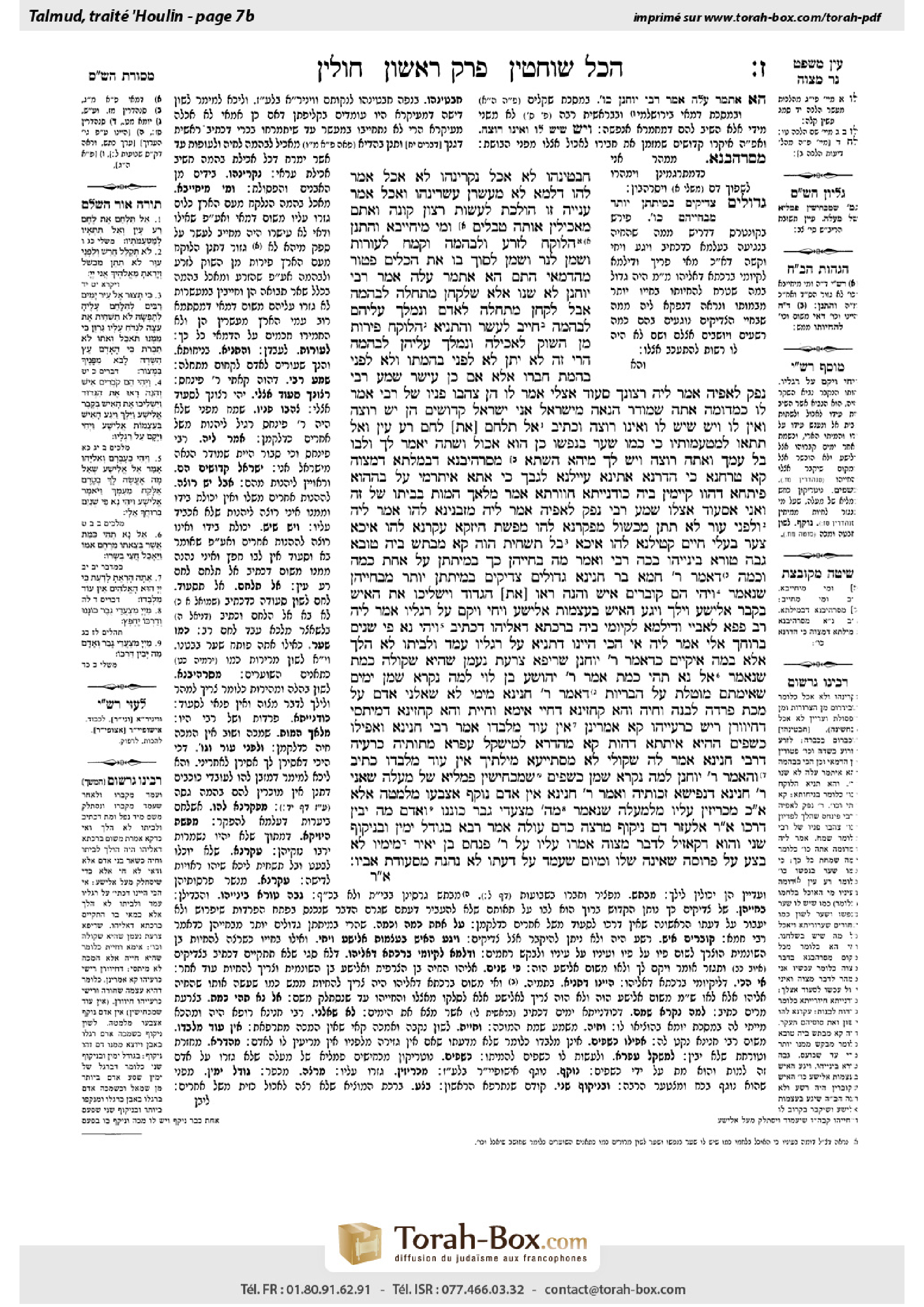
Chullin 7b: Talmud study for Daf Yomi
Study the Talmud for Daf Yomi with scanned pages, Hebrew text, English translations from Sefaria and AI-generated French translations.
Passage selection and English or AI-generated French translation are available where the scan has annotations. Daf Study is independent of Torah-Box and Sefaria.
Browse Chullin · חולין · All tractatesChullin 7b text and translations
This page of Chullin includes the Aramaic text, an English translation and an AI-generated French translation, alongside the scan above.
חולין ז׳ ב · Aramaic and Hebrew text
חַבְטִינְהוּ, לָא אֲכַל. נַקְּרִינְהוּ, לָא אֲכַל. אֲמַר לְהוּ: דִּלְמָא לָא מְעַשְּׂרָן? עַשְּׂרִינְהוּ, וַאֲכַל. אָמַר: עֲנִיָּיה זוֹ הוֹלֶכֶת לַעֲשׂוֹת רְצוֹן קוֹנָהּ, וְאַתֶּם מַאֲכִילִין אוֹתָהּ טְבָלִים!
וּמִי מִיחַיְּיבָא? וְהָתְנַן: הַלּוֹקֵחַ לְזֶרַע, וְלִבְהֵמָה, וְקֶמַח לְעוֹרוֹת, וְשֶׁמֶן לַנֵּר, וְשֶׁמֶן לָסוּךְ בּוֹ אֶת הַכֵּלִים – פָּטוּר מֵהַדְּמַאי.
הָתָם הָא אִתְּמַר עֲלַהּ, אָמַר רַבִּי יוֹחָנָן: לֹא שָׁנוּ אֶלָּא שֶׁלְּקָחָן מִתְּחִלָּה לִבְהֵמָה, אֲבָל לְקָחָן מִתְּחִלָּה לְאָדָם וְנִמְלַךְ עֲלֵיהֶם לִבְהֵמָה – חַיָּיב לְעַשֵּׂר. וְהָתַנְיָא: הַלּוֹקֵחַ פֵּירוֹת מִן הַשּׁוּק לַאֲכִילָה וְנִמְלַךְ עֲלֵיהֶן לִבְהֵמָה – הֲרֵי זֶה לֹא יִתֵּן לֹא לִפְנֵי בְּהֶמְתּוֹ וְלֹא לִפְנֵי בֶּהֱמַת חֲבֵרוֹ אֶלָּא אִם כֵּן עִישֵּׂר.
שְׁמַע רַבִּי, נְפַק לְאַפֵּיהּ, אֲמַר לֵיהּ: רְצוֹנְךָ סְעוֹד אֶצְלִי? אָמַר לוֹ: הֵן. צָהֲבוּ פָּנָיו שֶׁל רַבִּי.
אָמַר לוֹ: כִּמְדוּמֶּה אַתָּה שֶׁמּוּדָּר הֲנָאָה מִיִּשְׂרָאֵל אֲנִי? יִשְׂרָאֵל קְדוֹשִׁים הֵן, יֵשׁ רוֹצֶה וְאֵין לוֹ, וְיֵשׁ שֶׁיֵּשׁ לוֹ וְאֵינוֹ רוֹצֶה, וּכְתִיב: ״אַל תִּלְחַם אֶת לֶחֶם רַע עָיִן וְאַל תִּתְאָיו לְמַטְעַמֹּתָיו כִּי כְּמוֹ שָׁעַר בְּנַפְשׁוֹ כֶּן הוּא אֱכוֹל וּשְׁתֵה יֹאמַר לָךְ וְלִבּוֹ בַּל עִמָּךְ״, וְאַתָּה רוֹצֶה וְיֵשׁ לְךָ.
מִיהָא הַשְׁתָּא מְסַרְהֵיבְנָא, דִּבְמִלְּתָא דְּמִצְוָה קָא טָרַחְנָא, כִּי הָדַרְנָא אָתֵינָא עָיֵילְנָא לְגַבָּךְ.
כִּי אֲתָא, אִיתְרְמִי עָל בְּהָהוּא פִּיתְחָא דַּהֲווֹ קָיְימִין בֵּיהּ כּוּדַנְיָיתָא חִוָּורָתָא, אָמַר: מַלְאַךְ הַמָּוֶת בְּבֵיתוֹ שֶׁל זֶה וַאֲנִי אֶסְעוֹד אֶצְלוֹ?
שְׁמַע רַבִּי נְפַק לְאַפֵּיהּ, אֲמַר לֵיהּ: מְזַבֵּנְינָא לְהוּ, אֲמַר לֵיהּ: ״וְלִפְנֵי עִוֵּר לֹא תִתֵּן מִכְשֹׁל״.
מַפְקַרְנָא לְהוּ, מַפְּשַׁתְּ הֶיזֵּקָא. עָקַרְנָא לְהוּ, אִיכָּא צַעַר בַּעֲלֵי חַיִּים. קָטֵילְנָא לְהוּ, אִיכָּא ״בַּל תַּשְׁחִית״.
הֲוָה קָא מְבַתֵּשׁ בֵּיהּ טוּבָא, גְּבַהּ טוּרָא בֵּינַיְיהוּ, בָּכָה רַבִּי וְאָמַר: מָה בְּחַיֵּיהֶן כָּךְ, בְּמִיתָתָן עַל אַחַת כַּמָּה וְכַמָּה! דְּאָמַר רַבִּי חָמָא בַּר חֲנִינָא: גְּדוֹלִים צַדִּיקִים בְּמִיתָתָן יוֹתֵר מִבְּחַיֵּיהֶן, שֶׁנֶּאֱמַר: ״וַיְהִי הֵם קוֹבְרִים אִישׁ וְהִנֵּה רָאוּ הַגְּדוּד וַיַּשְׁלִיכוּ אֶת הָאִישׁ בְּקֶבֶר אֱלִישָׁע וַיֵּלֶךְ וַיִּגַּע הָאִישׁ בְּעַצְמוֹת אֱלִישָׁע וַיְחִי וַיָּקׇם עַל רַגְלָיו״.
אֲמַר לֵיהּ רַב פָּפָּא לְאַבָּיֵי: וְדִילְמָא לְקַיּוֹמֵי בֵּיהּ בִּרְכְּתָא דְּאֵלִיָּהוּ, דִּכְתִיב: ״וִיהִי נָא פִּי שְׁנַיִם בְּרוּחֲךָ אֵלָי״? אֲמַר לֵיהּ: אִי הָכִי, הַיְינוּ דְּתַנְיָא: עַל רַגְלָיו עָמַד, וּלְבֵיתוֹ לֹא הָלַךְ!
אֶלָּא בְּמָה אִיקַּיַּים? כִּדְאָמַר רַבִּי יוֹחָנָן: שֶׁרִיפֵּא צָרַעַת נַעֲמָן, שֶׁהִיא שְׁקוּלָה כְּמֵת, שֶׁנֶּאֱמַר: ״אַל נָא תְהִי כַּמֵּת״.
אָמַר רַבִּי יְהוֹשֻׁעַ בֶּן לֵוִי: לָמָּה נִקְרָא שְׁמָן ״יֵמִים״ – שֶׁאֵימָתָם מוּטֶּלֶת עַל הַבְּרִיּוֹת, דְּאָמַר רַבִּי חֲנִינָא: מִיָּמַי לֹא שְׁאָלַנִי אָדָם עַל מַכַּת פִּרְדָּה לְבָנָה וְחָיָה. וְהָא קָחָזֵינָא דְּחָיֵי! אֵימָא: ״וְחָיָית״, וְהָא קָחָזֵינָא דְּמִיתַּסֵּי! דְּחִיוָּורָן רֵישׁ כַּרְעַיְיהוּ קָא אָמְרִינַן.
״אֵין עוֹד מִלְּבַדּוֹ״ – אָמַר רַבִּי חֲנִינָא: וַאֲפִילּוּ כְּשָׁפִים. הָהִיא אִיתְּתָא דַּהֲוָת קָא מְהַדְּרָא לְמִישְׁקַל עַפְרָא מִתּוּתֵי כַּרְעֵיהּ דְּרַבִּי חֲנִינָא, אֲמַר לַהּ: שְׁקוּלִי, לָא מִסְתַּיְּיעָא מִילְּתִיךְ, ״אֵין עוֹד מִלְבַדּוֹ״ כְּתִיב. וְהָאָמַר רַבִּי יוֹחָנָן: לָמָּה נִקְרָא שְׁמָן כְּשָׁפִים – שֶׁמַּכְחִישִׁין פָּמַלְיָא שֶׁל מַעְלָה! שָׁאנֵי רַבִּי חֲנִינָא דִּנְפִישָׁא זְכוּתֵיהּ.
וְאָמַר רַבִּי חֲנִינָא: אֵין אָדָם נוֹקֵף אֶצְבָּעוֹ מִלְּמַטָּה, אֶלָּא אִם כֵּן מַכְרִיזִין עָלָיו מִלְּמַעְלָה, שֶׁנֶּאֱמַר: ״מֵה׳ מִצְעֲדֵי גֶבֶר כּוֹנָנוּ וְאָדָם מַה יָּבִין דַּרְכּוֹ״. אָמַר רַבִּי אֶלְעָזָר: דַּם נִיקּוּף מְרַצֶּה כְּדַם עוֹלָה. אָמַר רָבָא: בְּגוּדָל יָמִין, וּבְנִיקּוּף שֵׁנִי, וְהוּא דְּקָאָזֵיל לִדְבַר מִצְוָה.
אָמְרוּ עָלָיו עַל רַבִּי פִּנְחָס בֶּן יָאִיר: מִיָּמָיו לֹא בָּצַע עַל פְּרוּסָה שֶׁאֵינָהּ שֶׁלּוֹ, וּמִיּוֹם שֶׁעָמַד עַל דַּעְתּוֹ לֹא נֶהֱנָה מִסְּעוּדַת אָבִיו.
Chullin 7b · English translation
The hosts sifted the barley with a utensil, but the donkey did not eat it. They separated the chaff from the barley by hand, but the donkey did not eat it. They wondered why the donkey would not eat the barley. Rabbi Pineḥas ben Ya’ir said to his hosts: Perhaps the barley is not tithed. They tithed it and the donkey ate it. Rabbi Pineḥas ben Ya’ir said: This poor animal is going to perform the will of its Maker, and you are feeding it untithed produce? Rabbi Zeira was referring to this donkey when it spoke of God preventing mishaps from occurring through animals of the righteous.
The Gemara asks: And is one who purchases grain that is demai in order to feed his animal obligated to tithe it? But didn’t we learn in a mishna (Demai 1:3): One who purchases grain in the market for sowing or for feeding an animal, or flour to process animal hides, or oil to kindle a lamp, or oil to smear on vessels is exempt from the obligation of tithing demai?
The Gemara answers: There, it was stated with regard to that mishna that Rabbi Yoḥanan says: They taught this only in a case where one purchased those items initially for the animal or for the other purposes enumerated in the mishna, but if he purchased them initially for a person and reconsidered his plans for them and decided to use them for an animal, he is obligated to tithe the demai. And it is taught in a baraita in support of that understanding: In the case of one who purchases produce from the market for human consumption, and he reconsidered his plans for it and decided to use it for an animal, that person may neither place it before his animal nor before the animal of another unless he tithed the produce.
Rabbi Yehuda HaNasi heard that Rabbi Pineḥas ben Ya’ir arrived, and he emerged to greet him. Rabbi Yehuda HaNasi said to him: Is it your desire to dine with me? Rabbi Pineḥas ben Ya’ir said to him: Yes. Rabbi Yehuda HaNasi’s face beamed [tzahavu], as it was well known that Rabbi Pineḥas ben Ya’ir did not accept invitations to dine with others.
Rabbi Pineḥas ben Ya’ir said to Rabbi Yehuda HaNasi: Are you under the impression that deriving benefit from the Jewish people is forbidden to me by vow? On the contrary, the Jewish people are holy. I avoid accepting invitations, as there is one who wants to invite guests to dine with him but he does not have the means, and I do not want to enjoy a meal that my host cannot afford. And there is one who has the means but does not want to host guests, and with regard to those people it is written: “Eat not the bread of him that has an evil eye, neither desire his delicacies. For as one that has reckoned within himself, so is he: Eat and drink, says he to you; but his heart is not with you” (Proverbs 23:6–7). But you want to invite guests to dine with you, and you have the means.
But now I am rushing [mesarheivna], as I am engaged in the performance of a matter involving a mitzva. When I come back I will enter to dine with you.
When Rabbi Pineḥas ben Ya’ir came back, he happened to enter through that entrance in which white mules were standing. He said: The Angel of Death is in this person’s house, and I will eat with him? White mules were known to be dangerous animals.
Rabbi Yehuda HaNasi heard the comment of Rabbi Pineḥas ben Ya’ir and emerged to greet him. He said to him: I will sell the mules. Rabbi Pineḥas ben Ya’ir said to him: You will thereby violate the prohibition: “Nor place a stumbling block before the blind” (Leviticus 19:14), as it is prohibited for any Jew to keep a destructive animal in his possession.
Rabbi Yehuda HaNasi said to him: I will declare the mules ownerless. Rabbi Pineḥas ben Ya’ir said to him: You will thereby increase the damage, as there will be no owner to restrain it. Rabbi Yehuda HaNasi said to him: I will remove their hooves so that they will be unable to kick and cause damage. Rabbi Pineḥas ben Ya’ir said to him: There is the requirement to prevent suffering to animals, and you will be violating it. Rabbi Yehuda HaNasi said to him: I will kill them. Rabbi Pineḥas ben Ya’ir said to him: There is the prohibition: Do not destroy items of value.
Rabbi Yehuda HaNasi was greatly imploring him to enter his home until a mountain rose between them and Rabbi Yehuda HaNasi could no longer speak with him. Rabbi Yehuda HaNasi wept and said: If during their lifetimes it is so that the righteous are great, after their death it is all the more so true. The Gemara comments: This is as Rabbi Ḥama bar Ḥanina says: The righteous are greater after their death, more so than during their lifetimes, as it is stated: “And it came to pass, as they were burying a man, that they spied a raiding party; and they cast the man into the tomb of Elisha; and as soon as the man touched the bones of Elisha, he revived, and stood up on his feet” (II Kings 13:21).
Rav Pappa said to Abaye: This proof from the case of Elisha that the righteous are greater after death is not valid. And perhaps this transpired to fulfill with regard to Elisha the blessing of Elijah, as it is written: “Please, let a double portion of your spirit be upon me” (II Kings 2:9). Elijah revived one dead person and this one is the second revived by Elisha. Abaye said to Rav Pappa: If so, is this consistent with that which is taught in a baraita: The dead person arose on his feet but he did not go to his home, indicating that he had not truly been revived?
The Gemara asks: But if that is the case, in what manner was Elijah’s blessing fulfilled? It is as Rabbi Yoḥanan says: The blessing was fulfilled when he cured the leprosy of Naaman, since a leper is equivalent to a dead person, as it is stated with regard to Miriam when she was afflicted with leprosy: “Please, let her not be as one dead” (Numbers 12:12).
Apropos white mules, which were likened to the Angel of Death, Rabbi Yehoshua ben Levi says: Why are the mules called yemim (see Genesis 36:24)? It is because their terror [eimatam] is cast over all creatures, as Rabbi Ḥanina says: In all my days, no man has asked me about a wound caused him by a white mule and survived, indicating that they are extremely dangerous. The Gemara asks: But haven’t we seen that some people survive after being wounded by a white mule? The Gemara answers: Say instead, no man has asked me about a wound caused him by a mule and the wound healed. The Gemara asks: But haven’t we seen that such wounds heal? The Gemara answers: The wound that we say does not heal is one caused by a mule the top of whose legs are white.
The Gemara relates other statements of Rabbi Ḥanina: With regard to the verse: “There is none else beside Him” (Deuteronomy 4:35), Rabbi Ḥanina says: And even sorcery is ineffective against the will of God. The Gemara relates: There was a certain woman who would try to take dust from beneath the feet of Rabbi Ḥanina in order to perform sorcery on him and harm him. Rabbi Ḥanina said to her: Take the dust, but the matter will be ineffective for you, as it is written: “There is none other beside Him.” The Gemara asks: But doesn’t Rabbi Yoḥanan say: Why is sorcery called keshafim? It is an acronym for makhḥishin pamalya shel mala, meaning: That they diminish the heavenly entourage [pamalya], indicating that they function contrary to the will of God. The Gemara answers: Rabbi Ḥanina is different, as, because his merit is great, sorcery has no effect on him.
And Rabbi Ḥanina says: A person injures his finger below, on earth, only if they declare about him on high that he should be injured, as it is stated: It is of the Lord that a man’s goings are established; and a man, what does he understand of his way (see Psalms 37:23 and Proverbs 20:24). Rabbi Elazar says: The blood of a wound effects atonement like the blood of a burnt offering. Rava said: This is stated with regard to a wound on his right thumb, as one applies force with that thumb and the wound is consequently more severe; and it is also stated with regard to a second wound in the same place before the first has healed, and it is provided that he is wounded while going to perform a matter involving a mitzva.
Apropos Rabbi Pineḥas ben Ya’ir, the Gemara notes that they said about Rabbi Pineḥas ben Ya’ir: In all his days he never broke bread and recited a blessing on a piece of bread that was not his, and from the day that he achieved cognition he did not benefit even from the meal of his father, because he eschewed benefit from everyone.
Chullin 7b · Traduction française (IA)
Les troupes tamisèrent l'orge avec un ustensile, mais l'âne ne l'avala pas. Ils séparèrent la paille de l'orge à la main, mais l'âne ne l'avala pas. Ils se demandèrent pourquoi l'âne ne voulait pas manger l'orge. Rabbi Pinḥas ben Ya’ir dit à ses hôtes : Peut-être que l'orge n'est pas titré. Ils le titrèrent et l'âne l'avala. Rabbi Pinḥas ben Ya’ir dit : Cet animal pauvre va exécuter la volonté de son Créateur, et vous lui donnez des produits non titrés ? Rabbi Zeira faisait référence à cet âne lorsqu'il parlait de Dieu empêchant les malheurs par les bêtes des justes.
Le Guemara demande : Et est-ce que celui qui achète du grain demai pour nourrir son animal est tenu de le titrer ? Mais n'avons-nous pas appris dans une mitsva (Demai 1:3) : Celui qui achète du grain au marché pour semer ou pour nourrir un animal, ou de la farine pour traiter des peaux, ou de l'huile pour allumer une lampe, ou de l'huile pour enduire des vases est exempt de l'obligation de titrer le demai ?
Le Guemara répond : Là, il a été dit concernant cette mitsva que Rabbi Yoḥanan dit : Ils ont enseigné cela uniquement dans le cas où l'on achète ces choses initialement pour l'animal ou pour les autres usages énumérés dans la mitsva, mais si l'on achète ces choses initialement pour une personne et qu'il change ses projets et décide d'utiliser ces choses pour un animal, il est tenu de titrer le demai. Et cela est enseigné dans une baraïta en soutien de cette compréhension : Dans le cas où l'on achète des produits du marché pour la consommation humaine, et qu'il change ses projets et décide d'utiliser ces produits pour un animal, cette personne ne peut ni placer ces produits devant son animal ni devant l'animal d'un autre, à moins qu'il n'ait titré les produits.
Rabbi Yehuda HaNasi apprit que Rabbi Pineḥas ben Ya’ir était arrivé, et il sortit pour le saluer. Rabbi Yehuda HaNasi dit à lui : Est-ce que c'est votre désir de dîner avec moi ? Rabbi Pineḥas ben Ya’ir dit à lui : Oui. Le visage de Rabbi Yehuda HaNasi s'éclaira [tzahavu], car il était bien connu que Rabbi Pineḥas ben Ya’ir ne recevait pas d'invitations pour dîner avec d'autres.
Rabbi Pineḥas ben Ya’ir dit à Rabbi Yehuda HaNasi : Est-ce que vous pensez que tirer profit du peuple juif est interdit pour moi par serment ? Au contraire, le peuple juif est saint. J'évite d'accepter des invitations, car il y a celui qui veut inviter des convives à dîner mais n'a pas les moyens, et je ne veux pas profiter d'un repas que mon hôte ne peut pas se permettre. Et il y a celui qui a les moyens mais ne veut pas recevoir des convives, et concernant ces personnes il est écrit : « Ne mangez pas le pain de celui qui a un œil mauvais, ni désirez ses délices. Car celui qui a calculé en lui-même, ainsi est-il : mangez et buvez, dit-il à vous ; mais son cœur n'est pas avec vous » (Proverbes 23:6–7). Mais vous voulez inviter des convives à dîner avec vous, et vous avez les moyens.
Mais maintenant je suis pressé [mesarheivna], car je suis engagé dans la performance d'une affaire concernant une mitsva. Lorsque je reviendrai, je entrerai pour dîner avec vous.
Lorsque Rabbi Pineḥas ben Ya’ir revint, il entra par hasard par cette entrée où des mules blanches étaient stationnées. Il dit : L'Ange de la Mort est dans cette maison, et je vais dîner avec lui ? Les mules blanches étaient connues pour être des animaux dangereux.
Rabbi Yehuda HaNasi entendit le commentaire de Rabbi Pineḥas ben Ya’ir et sortit pour le saluer. Il lui dit : Je vendrai les mules. Rabbi Pineḥas ben Ya’ir lui dit : Vous enfreindrez ainsi la prohibition : « Ni ne placez un obstacle devant le aveugle » (Lévitique 19:14), car il est interdit à tout Juif de posséder un animal destructeur.
Rabbi Yehuda HaNasi lui dit : Je déclarerai les mules sans propriétaire. Rabbi Pineḥas ben Ya’ir lui dit : Vous augmenterez ainsi les dommages, car il n'y aura plus de propriétaire pour les contenir. Rabbi Yehuda HaNasi lui dit : Je retirerai leurs sabots afin qu'ils ne puissent plus frapper et causer des dommages. Rabbi Pineḥas ben Ya’ir lui dit : Il y a la nécessité de prévenir les souffrances des animaux, et vous enfreindrez cela. Rabbi Yehuda HaNasi lui dit : Je les tuerai. Rabbi Pineḥas ben Ya’ir lui dit : Il y a la prohibition : Ne détruisiez pas les objets de valeur.
Rabbi Yehuda HaNasi implorait beaucoup qu'il entre dans sa maison jusqu'à ce qu'une montagne se lève entre eux et Rabbi Yehuda HaNasi ne puisse plus parler avec lui. Rabbi Yehuda HaNasi pleura et dit : Si pendant leur vie c'est ainsi que les justes sont grands, après leur mort c'est encore plus vrai. Le Guemara commente : C'est comme Rabbi Ḥama bar Ḥanina dit : Les justes sont plus grands après leur mort que pendant leur vie, car il est dit : « Et il advint, lorsqu'ils enterraient un homme, qu'ils virent une bande de pillards ; et ils jetèrent l'homme dans la tombe d'Elisha ; et aussitôt que l'homme toucha les os d'Elisha, il revint à la vie, et se leva sur ses pieds » (II Rois 13:21).
Rav Pappa dit à Abaye : Cette preuve tirée du cas d'Elisha selon lequel les justes sont plus grands après leur mort n'est pas valable. Et peut-être cela s'est produit pour accomplir avec regard à Elisha la bénédiction d'Elie, car il est écrit : « S'il te plaît, que une double portion de ton esprit soit sur moi » (II Rois 2:9). Elie a ressuscité une personne morte et celle-ci est la seconde ressuscitée par Elisha. Abaye dit à Rav Pappa : Si c'est ainsi, est-ce cohérent avec ce qui est enseigné dans une baraïta : La personne morte se leva sur ses pieds mais ne rentra pas chez lui, indiquant qu'elle n'avait pas véritablement été ressuscitée ?
Le Guemara demande : Mais si c'est ainsi, dans quelle mesure la bénédiction d'Elie a-t-elle été accomplie ? C'est comme Rabbi Yoḥanan dit : La bénédiction a été accomplie lorsqu'il a guéri la lèpre de Naaman, car un lépreux est équivalent à un mort, car il est dit concernant Miriam lorsqu'elle était atteinte de lèpre : « S'il te plaît, qu'elle ne soit pas comme un mort » (Nombres 12:12).
Concernant les mules blanches, qui étaient comparées à l'Ange de la Mort, le Rabbi Yéhoshua ben Lévi dit : Pourquoi les mules sont-elles appelées yemim (cf. Genèse 36:24) ? C'est parce que leur terreur [eimatam] est étendue sur toutes les créatures, comme le Rabbi Ḥanina dit : Durant toute ma vie, personne n'a jamais demandé à ce que je parle d'une plaie causée par une mule blanche et ait survécu, ce qui montre qu'elles sont extrêmement dangereuses. La Guemara demande : Mais n'avons-nous pas vu que certaines personnes survivent après avoir été blessés par une mule blanche ? La Guemara répond : Dites plutôt, personne n'a jamais demandé à ce que je parle d'une plaie causée par une mule et la plaie ait guéri. La Guemara demande : Mais n'avons-nous pas vu que de telles plaies guérissent ? La Guemara répond : La plaie que nous disons ne guérir pas est celle causée par une mule dont les cuisses sont blanches.
La Guemara rapporte d'autres paroles du Rabbi Ḥanina : Concernant la parole : « Il n'y a point d'autre outre Lui » (Deutéronome 4:35), le Rabbi Ḥanina dit : Même la sorcellerie est inefficace contre la volonté de Dieu. La Guemara rapporte : Il y avait une certaine femme qui tentait de prendre de la poussière sous les pieds du Rabbi Ḥanina afin de lui faire de la sorcellerie et de le nuire. Le Rabbi Ḥanina dit à cette femme : Prends la poussière, mais l'affaire sera inefficace pour toi, car il est écrit : « Il n'y a point d'autre outre Lui ». La Guemara demande : Mais n'est-ce pas que le Rabbi Yoḥanan dit : Pourquoi la sorcellerie est-elle appelée keshafim ? C'est une acronyme pour makhḥishin pamalya shel mala, ce qui signifie : Qu'ils diminuent l'entourage céleste [pamalya], ce qui indique qu'ils fonctionnent contrairement à la volonté de Dieu. La Guemara répond : Le Rabbi Ḥanina est différent, car, grâce à sa mérite, la sorcellerie n'a aucun effet sur lui.
Et le Rabbi Ḥanina dit : Une personne se blesse au doigt en bas, sur la terre, seulement si on déclare à son sujet en haut qu'il doit être blessé, comme il est dit : « C'est à l'Éternel que les allées d'un homme sont établies ; et l'homme, qu'est-ce qu'il comprend de sa voie » (cf. Psaumes 37:23 et Proverbes 20:24). Le Rabbi Eléazar dit : Le sang d'une plaie procure un atonement comme le sang d'un holocauste. Rava dit : Cela est dit concernant une plaie sur son pouce droit, car on applique une force avec ce pouce et la plaie est donc plus grave ; et cela est aussi dit concernant une deuxième plaie au même endroit avant que la première ne se soit guérie, et il est donné qu'il est blessé alors qu'il va accomplir une affaire liée à une mitsva.
Concernant le Rabbi Pineḥas ben Ya’ir, la Guemara note que l'on disait à propos du Rabbi Pineḥas ben Ya’ir : Durant toute sa vie, il n'a jamais cassé du pain et n'a jamais récité une bénédiction sur un morceau de pain qui n'était pas le sien, et depuis le jour où il a atteint la connaissance, il n'a pas bénéficié même du repas de son père, car il évitait de profiter de tout le monde.
Traduction française générée par IA à partir de l’édition anglaise de Sefaria. Vérifie toujours un passage avec le texte source.
Text from Sefaria: William Davidson Edition - Vocalized Aramaic (unknown); William Davidson Edition - English (CC BY NC).