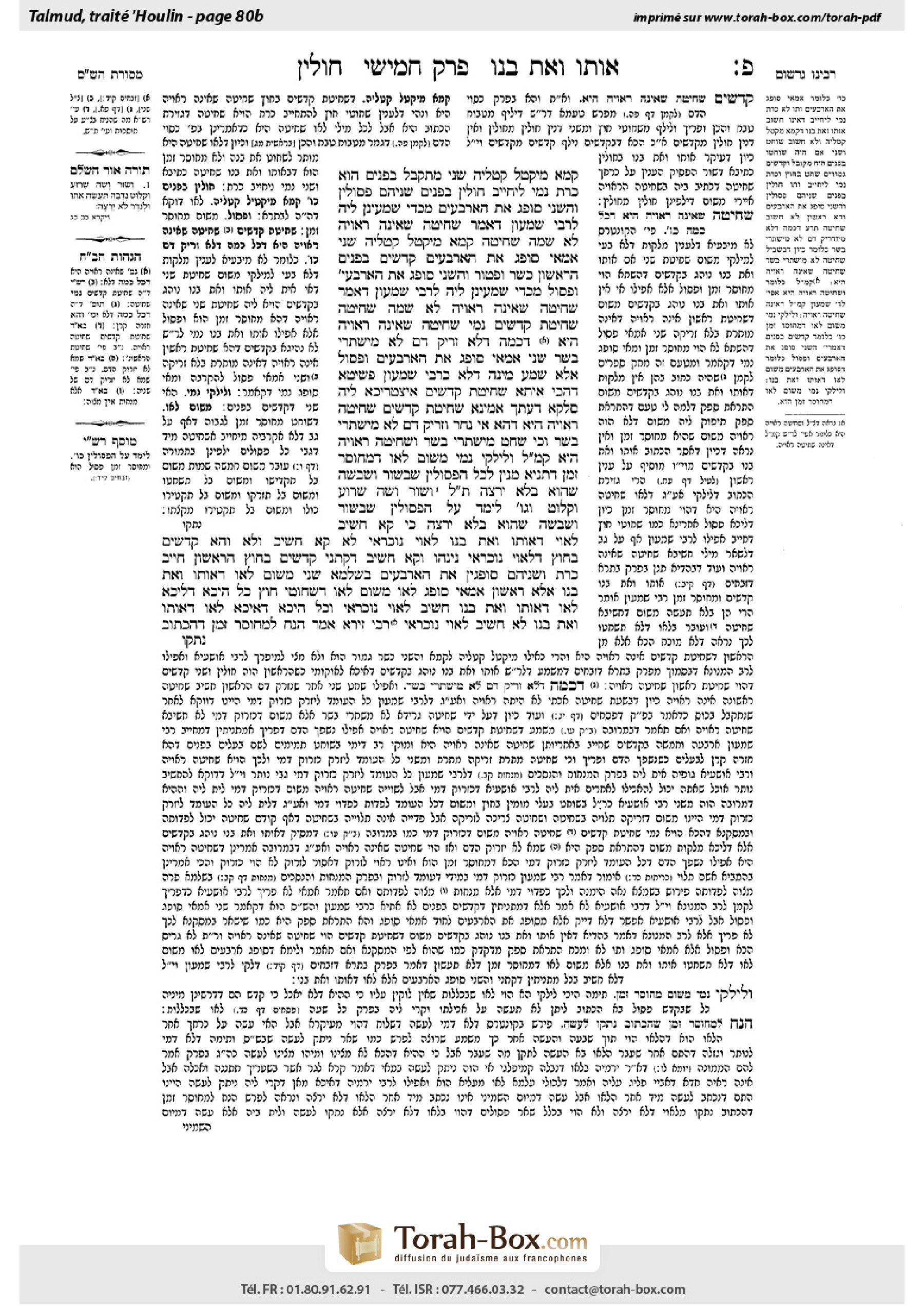
Chullin 80b: Talmud study for Daf Yomi
Study the Talmud for Daf Yomi with scanned pages, Hebrew text, English translations from Sefaria and AI-generated French translations.
Passage selection and English or AI-generated French translation are available where the scan has annotations. Daf Study is independent of Torah-Box and Sefaria.
Browse Chullin · חולין · All tractatesChullin 80b text and translations
This page of Chullin includes the Aramaic text, an English translation and an AI-generated French translation, alongside the scan above.
חולין פ׳ ב · Aramaic and Hebrew text
קַמָּא מִיקְטָל קַטְלֵיהּ, שֵׁנִי מִתְקַבֵּל בִּפְנִים הוּא, כָּרֵת נָמֵי לִיחַיַּיב.
חוּלִּין בִּפְנִים – שְׁנֵיהֶם פְּסוּלִין, וְהַשֵּׁנִי סוֹפֵג אֶת הָאַרְבָּעִים. מִכְּדֵי שָׁמְעִינַן לֵיהּ לְרַבִּי שִׁמְעוֹן דְּאָמַר: שְׁחִיטָה שֶׁאֵינָהּ רְאוּיָה – לֹא שְׁמָהּ שְׁחִיטָה, קַמָּא מִיקְטָל קַטְלֵיהּ, שֵׁנִי אַמַּאי סוֹפֵג אֶת הָאַרְבָּעִים?
קָדָשִׁים בִּפְנִים – הָרִאשׁוֹן כָּשֵׁר וּפָטוּר, וְהַשֵּׁנִי סוֹפֵג אֶת הָאַרְבָּעִים, וּפָסוּל.
מִכְּדֵי שָׁמְעִינַן לֵיהּ לְרַבִּי שִׁמְעוֹן דְּאָמַר: שְׁחִיטָה שֶׁאֵינָהּ רְאוּיָה לֹא שְׁמָהּ שְׁחִיטָה, שְׁחִיטַת קֳדָשִׁים נָמֵי שְׁחִיטָה שֶׁאֵינָהּ רְאוּיָה הִיא, דְּכַמָּה דְּלָא זָרֵיק דָּם – לָא מִישְׁתְּרֵי בָּשָׂר. שֵׁנִי אַמַּאי סוֹפֵג אֶת הָאַרְבָּעִים, וּפָסוּל? אֶלָּא שְׁמַע מִינַּהּ דְּלָא כְּרַבִּי שִׁמְעוֹן.
פְּשִׁיטָא דְּהָכִי אִיתַהּ? שְׁחִיטַת קָדָשִׁים אִיצְטְרִיכָא לֵיהּ, סָלְקָא דַּעְתָּךְ אָמֵינָא: שְׁחִיטַת קָדָשִׁים שְׁחִיטָה רְאוּיָה הִיא, דְּהָא אִי נָחַר וְזָרֵיק דָּם – לָא מִישְׁתְּרֵי בָּשָׂר, וְכִי שָׁחַט – מִישְׁתְּרֵי בָּשָׂר, וּשְׁחִיטָה רְאוּיָה הִיא; קָא מַשְׁמַע לַן.
וְלִילְקֵי נָמֵי מִשּׁוּם לָאו דִּמְחוּסַּר זְמַן, דְּתַנְיָא: מִנַּיִן לְכׇל הַפְּסוּלִין שֶׁבַּשּׁוֹר וְשֶׁבַּשֶּׂה שֶׁהוּא בְּ״לֹא יֵרָצֶה״?
תַּלְמוּד לוֹמַר: ״וְשׁוֹר וָשֶׂה שָׂרוּעַ וְקָלוּט וְגוֹ׳״, לִימֵּד עַל הַפְּסוּלִין שֶׁבַּשּׁוֹר וְשֶׁבַּשֶּׂה, שֶׁהוּא בְּ״לֹא יֵרָצֶה״!
כִּי קָא חָשֵׁיב לָאוֵי דְּ״אוֹתוֹ וְאֶת בְּנוֹ״ – לָאוֵי נוּכְרָאֵי לָא קָא חָשֵׁיב.
וְלָא? וְהָא קָדָשִׁים בַּחוּץ, דְּלָאוֵי נוּכְרָאֵי נִינְהוּ, וְקָא חָשֵׁיב, דְּקָתָנֵי: קָדָשִׁים בַּחוּץ – הָרִאשׁוֹן חַיָּיב כָּרֵת, וּשְׁנֵיהֶם סוֹפְגִין אֶת הָאַרְבָּעִים.
בִּשְׁלָמָא שֵׁנִי, מִשּׁוּם לָאו דְּ״אוֹתוֹ וְאֶת בְּנוֹ״, אֶלָּא רִאשׁוֹן אַמַּאי סוֹפֵג? לָאו מִשּׁוּם לָאו דִּשְׁחוּטֵי חוּץ?
כֹּל הֵיכָא דְּלֵיכָּא לָאו דְּ״אוֹתוֹ וְאֶת בְּנוֹ״ – חָשֵׁיב לָאוֵי נוּכְרָאֵי, וְכֹל הֵיכָא דְּאִיכָּא לָאו דְּ״אוֹתוֹ וְאֶת בְּנוֹ״ – לָא חָשֵׁיב לָאוֵי נוּכְרָאֵי.
רַבִּי זֵירָא אָמַר: הַנַּח לִמְחוּסַּר זְמַן, דְּהַכָּתוּב
Chullin 80b · English translation
Therefore, when one slaughters a mother and its offspring that are both sacrificial animals outside the Temple courtyard, with regard to the first, it is as if he has simply killed it without ritual slaughter, since being slaughtered outside the Temple courtyard renders it unfit. Accordingly, the second would have been fit to be accepted within the Temple, and there would have been no prohibition against slaughtering it on that day. If so, when he slaughtered it outside the courtyard, why is he liable only to receive lashes? Let him also be liable to receive karet.
Likewise, the same question may be asked with regard to what is taught in the mishna: If both animals were non-sacred and they were slaughtered inside the Temple courtyard, both of them are unfit for sacrifice. And for the slaughter of the second animal, one incurs the forty lashes. Since we have heard that Rabbi Shimon says: An act of slaughter that is unfit is not considered to have the halakhic status of an act of slaughter, with regard to the first animal, it is as if he has simply killed it without ritual slaughter, since a non-sacred animal slaughtered in the Temple courtyard is rendered unfit, as deriving benefit from it is prohibited. If so, why, for the slaughter of the second animal, does one incur the forty lashes?
Similarly, the mishna teaches: If both animals were sacrificial animals slaughtered inside the Temple courtyard, the first is fit for sacrifice, and one who slaughters it is exempt from any punishment. But for the slaughter of the second animal, one incurs the forty lashes for the slaughter of an animal and its offspring on a single day, and it is unfit for sacrifice.
Since we have heard that Rabbi Shimon says: An act of slaughter that is unfit to permit consumption of the animal is not considered to have the halakhic status of an act of slaughter. One can then raise the question: An act of slaughter of sacrificial animals is also considered an act of slaughter that is unfit, because as long as one has not sprinkled the blood, the meat is not permitted to be burned on the altar or eaten. Since slaughtering the first animal is not considered slaughtering, why, for slaughtering the second animal, does one incur the forty lashes for slaughtering an animal and its offspring on a single day, and why is it unfit? Rather, conclude from this analysis that the mishna is not in accordance with the opinion of Rabbi Shimon.
The Gemara asks: Isn’t it obvious that this is so? There is no need for this long analysis. The Gemara answers: It was necessary for Rabbi Oshaya to mention that the mishna is not in accordance with the opinion of Rabbi Shimon due to the case of slaughtering an animal and its offspring that are sacrificial animals inside the Temple courtyard. This is because it may enter your mind to say that slaughtering sacrificial animals is considered an act of slaughtering that is fit, because if he stabbed the animal to death and sprinkled its blood, the meat is not permitted, but if he slaughtered it, the meat is permitted and it is considered slaughtering that is fit according to Rabbi Shimon. Therefore, he teaches us that it is not fit.
§ With regard to the ruling that one who slaughters an animal and its offspring that are sacrificial animals inside the Temple courtyard receives lashes for violating the prohibition of: Itself and its offspring, when slaughtering the second animal, the Gemara suggests: And let him be flogged also for violating the prohibition against sacrificing an animal whose time has not yet arrived, since it is forbidden to sacrifice it until the next day. As it is taught in a baraita: From where is it derived with regard to all of the disqualifications of the bull, i.e., any feature that disqualifies cattle brought as offerings, and of the lamb, i.e., sheep brought as offerings, that if one consecrates, slaughters, or burns on the altar an animal so disqualified, he violates the prohibition of: It shall not be accepted, and is flogged?
It is derived from the fact that, in the middle of the passage prohibiting blemished animals from being sacrificed upon the altar, the verse states: “Either a bull or a lamb that has anything too long or too short…but for a vow it shall not be accepted” (Leviticus 22:23). Since this passage is already discussing a bull and lamb, it is unnecessary to mention them. Rather, this verse taught about all of the disqualifications of the bull and of the lamb, including that of an animal whose time has not yet arrived, that if one offers an animal with one of those disqualifications, he violates the prohibition of: It shall not be accepted.
The Gemara answers: He receives lashes for violating that prohibition as well, but when the mishna lists the prohibitions violated by the actions described, it lists only prohibitions related to the prohibition of: Itself and its offspring, but it does not list unrelated prohibitions.
The Gemara asks: And does the mishna not list unrelated prohibitions? But there are prohibitions with regard to sacrificial animals slaughtered outside the Temple courtyard, which are unrelated prohibitions, and it lists them. As it teaches: If both animals were sacrificial animals slaughtered outside the Temple courtyard, then for slaughtering the first animal, one is liable to receive karet. And both animals are disqualified for use as offerings, and for the slaughter of both of them one incurs forty lashes apiece.
Granted, with regard to the second animal one is flogged due to the prohibition of: Itself and its offspring. But with regard to the first animal, why does he incur the forty lashes? Isn’t it due to the prohibition of consecrated animals slaughtered outside the Temple courtyard? Therefore, with regard to the case of sacrificial animals slaughtered inside the Temple courtyard, the mishna should also have mentioned the unrelated prohibition of: It shall not be accepted.
The Gemara answers: Wherever there is no violation of the prohibition of: Itself and its offspring, for slaughtering an animal, the mishna lists unrelated prohibitions, but wherever there is a violation of the prohibition of: Itself and its offspring, the mishna does not list unrelated prohibitions, but only the prohibition of: Itself and its offspring.
Rabbi Zeira said: Leave the prohibition against sacrificing an animal whose time has not yet arrived, as the verse
Chullin 80b · Traduction française (IA)
Ainsi, lorsqu'on immole une mère et ses petits, qui sont tous des animaux sacrés, en dehors du cour de l'Autel, concernant le premier, cela équivaut à simplement le tuer sans immolation rituelle, car être tué en dehors du cour de l'Autel le rend inacceptable. Par conséquent, le second aurait été acceptable dans l'Autel, et il n'y aurait pas eu de prohibition contre son immolation ce jour-là. Si c'est ainsi, pourquoi est-il seulement puni par des fessures ? Il devrait aussi être puni par la karet.
De même, la même question peut être posée concernant ce qui est enseigné dans la mitsva : Si les deux animaux étaient non sacrés et qu'ils ont été immolés en dehors du cour de l'Autel, les deux sont inacceptables. Et pour l'immolation du second animal, on incure quarante fessures. Puisque nous avons entendu que Rabbi Shimon dit : Un acte d'immolation inacceptable n'est pas considéré comme un acte d'immolation halakhique, concernant le premier animal, cela équivaut à simplement le tuer sans immolation rituelle, car un animal non sacré immolé en dehors du cour de l'Autel est rendu inacceptable, car il est interdit d'en tirer profit. Si c'est ainsi, pourquoi, pour l'immolation du second animal, incure-t-on quarante fessures ?
De même, la mitsva enseigne : Si les deux animaux étaient des animaux sacrés immolés en dehors du cour de l'Autel, le premier est acceptable, et celui qui l'immole est exempt de toute punition. Mais pour l'immolation du second animal, on incure quarante fessures pour l'immolation d'un animal et de ses petits le même jour, et il est inacceptable.
Puisque nous avons entendu que Rabbi Shimon dit : Un acte d'immolation inacceptable pour permettre la consommation de l'animal n'est pas considéré comme un acte d'immolation halakhique. On peut alors poser la question : Un acte d'immolation d'animaux sacrifiés est également considéré comme un acte d'immolation inacceptable, car tant que l'on n'a pas versé le sang, la viande n'est pas permise à brûler sur l'autel ou à être mangée. Puisque l'immolation du premier animal n'est pas considérée comme une immolation, pourquoi, pour l'immolation du second animal, est-on puni de quarante fessures pour l'immolation d'un animal et de ses petits le même jour, et pourquoi est-il inacceptable ? Plutôt, concluez de cette analyse que la mitsva ne suit pas l'opinion de Rabbi Shimon.
Le Guemara demande : N'est-ce pas évident ? Il n'y a pas besoin d'une telle analyse longue. Le Guemara répond : Il était nécessaire que Rabbi Oshaya mentionne que la mitsva ne suit pas l'opinion de Rabbi Shimon en raison du cas d'immolation d'un animal et de ses petits qui sont des animaux sacrés dans le cour de l'Autel. Cela est dû au fait qu'il pourrait entrer en vous-même de dire que l'immolation d'animaux sacrés est considérée comme un acte d'immolation acceptable, car si l'on a tué l'animal et versé son sang, la viande n'est pas permise, mais si l'on l'a immolé, la viande est permise et est considérée comme une immolation acceptable selon Rabbi Shimon. Par conséquent, il nous enseigne qu'il n'est pas acceptable.
§ Concernant la décision que celui qui immole un animal et ses petits qui sont des animaux sacrés dans le cour du Temple est puni par des fessures pour avoir violé la prohibition de : Lui-même et ses petits, lorsque l'immolation du second animal a lieu, le Guemara suggère : Et qu'il soit également foudroyé pour avoir violé la prohibition contre l'immolation d'un animal dont le temps n'est pas encore arrivé, car il est interdit d'immoler jusqu'au lendemain. Comme il est enseigné dans une baraïta : D'où est-il dérivé concernant toutes les inacceptabilités du taureau, c'est-à-dire toute caractéristique qui rend les bœufs offerts inacceptables, et de l'agneau, c'est-à-dire les agneaux offerts, que si l'on consacre, immole ou brûle sur l'autel un animal ainsi inacceptable, il viole la prohibition de : Il ne sera pas accepté, et est puni par des fessures ?
C'est dérivé du fait que, au milieu du passage interdisant les animaux blemis d'être immolés sur l'autel, le verset dit : « Quel que soit un taureau ou un agneau qui a quelque chose trop long ou trop court… mais pour une promesse il ne sera pas accepté » (Lévitique 22:23). Puisque ce passage est déjà parlant d'un taureau et d'un agneau, il n'est pas nécessaire de les mentionner. Plutôt, ce verset a enseigné sur toutes les inacceptabilités du taureau et de l'agneau, y compris celle d'un animal dont le temps n'est pas encore arrivé, que si l'on offre un animal avec l'une de ces inacceptabilités, il viole la prohibition de : Il ne sera pas accepté.
Le Guemara répond : Il est puni par des fessures pour avoir violé cette interdiction également, mais lorsque la Michna liste les prohibitions violées par les actions décrites, elle liste seulement les prohibitions liées à l'interdiction de : Lui-même et ses petits, mais elle ne liste pas les prohibitions non liées.
Le Guemara demande : Et la mitsna ne liste-t-elle pas des prohibitions non liées ? Mais il y a des prohibitions concernant les animaux sacrifiés en dehors du cour de l'Autel, qui sont des prohibitions non liées, et elle les liste. Comme elle enseigne : Si les deux animaux étaient des animaux sacrifiés en dehors du cour de l'Autel, alors pour l'immolation du premier animal, l'on est puni par la karet. Et les deux animaux sont inacceptables pour l'offrande, et pour l'immolation des deux, l'on incure quarante fessures chacun.
D'accord, concernant le second animal, l'on est puni par des fessures en raison de la prohibition de : Lui-même et ses petits. Mais concernant le premier animal, pourquoi est-il puni par des fessures ? N'est-ce pas en raison de la prohibition des animaux consacrés immolés en dehors du cour de l'Autel ? Par conséquent, concernant le cas d'animaux sacrifiés en dehors du cour de l'Autel, la mitsna devrait aussi avoir mentionné la prohibition non liée de : Il ne sera pas accepté.
La Guemara répond : Lorsque la prohibition de : Lui-même et ses descendants, pour l'immolation d'un animal, n'est pas violée, la Misha liste des prohibitions non liées, mais lorsque la prohibition de : Lui-même et ses descendants est violée, la Misha ne liste pas des prohibitions non liées, mais uniquement la prohibition de : Lui-même et ses descendants.
Rabbi Zéira dit : Laissez la prohibition contre l'immolation d'un animal dont l'époque n'est pas encore arrivée, car la parole du Seigneur
Traduction française générée par IA à partir de l’édition anglaise de Sefaria. Vérifie toujours un passage avec le texte source.
Text from Sefaria: William Davidson Edition - Vocalized Aramaic (unknown); William Davidson Edition - English (CC BY NC).