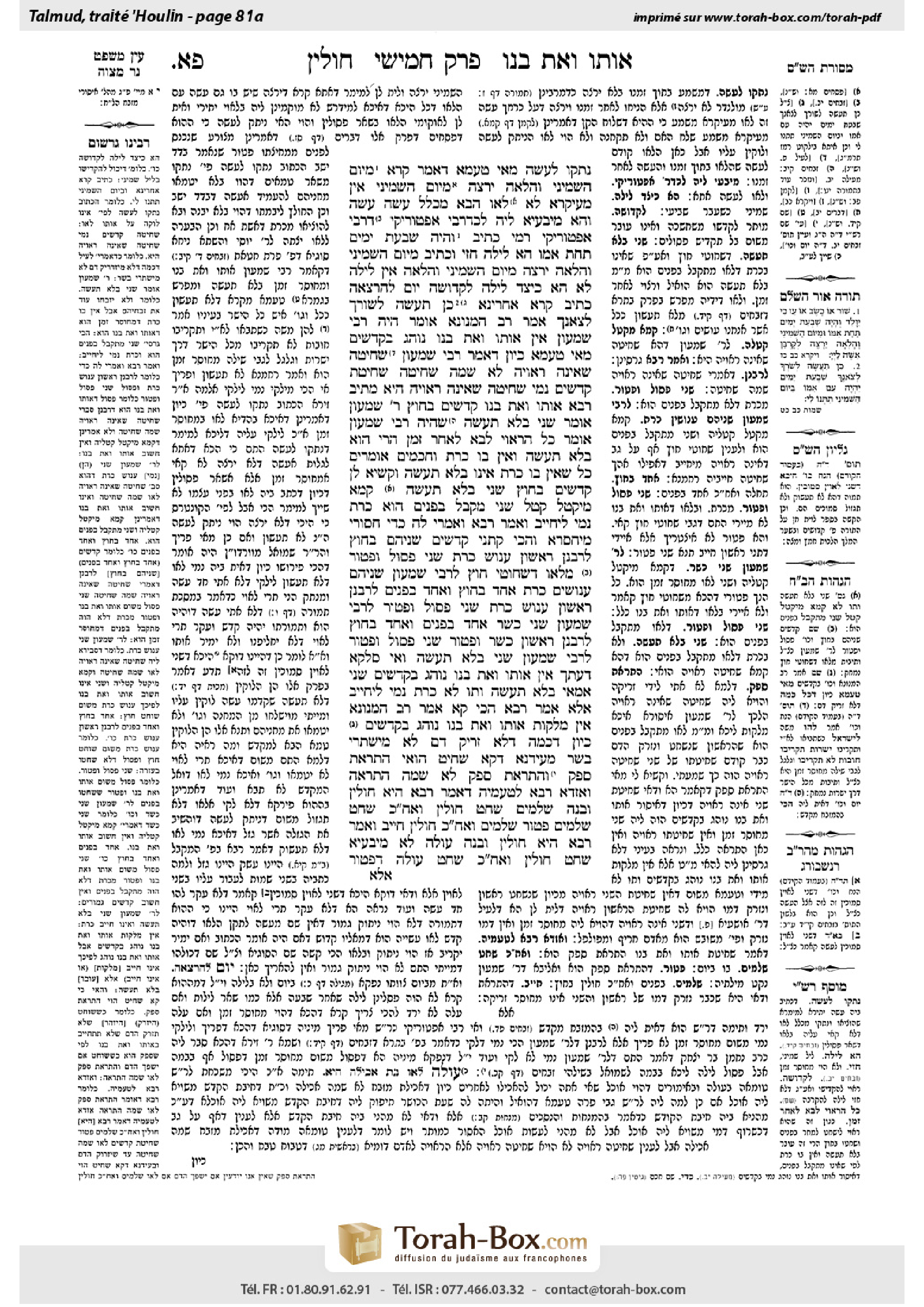
Chullin 81a: Talmud study for Daf Yomi
Study the Talmud for Daf Yomi with scanned pages, Hebrew text, English translations from Sefaria and AI-generated French translations.
Passage selection and English or AI-generated French translation are available where the scan has annotations. Daf Study is independent of Torah-Box and Sefaria.
Browse Chullin · חולין · All tractatesChullin 81a text and translations
This page of Chullin includes the Aramaic text, an English translation and an AI-generated French translation, alongside the scan above.
חולין פ״א א · Aramaic and Hebrew text
נִתְּקוֹ לַעֲשֵׂה. מַאי טַעְמָא? דְּאָמַר קְרָא: ״מִיּוֹם הַשְּׁמִינִי וָהָלְאָה יֵרָצֶה״ – מִיּוֹם הַשְׁמִינִי אִין, מֵעִיקָּרָא לָא. לָאו הַבָּא מִכְּלַל עֲשֵׂה – עֲשֵׂה.
וְהָא מִיבַּעְיָא לֵיהּ לְכִדְרַבִּי אַפְטוֹרִיקִי, דְּרַבִּי אַפְטוֹרִיקִי רָמֵי: כְּתִיב ״וְהָיָה שִׁבְעַת יָמִים תַּחַת אִמּוֹ״, הָא לַיְלָה חֲזֵי, וּכְתִיב ״מִיּוֹם הַשְּׁמִינִי וָהָלְאָה יֵרָצֶה״ – מִיּוֹם הַשְּׁמִינִי וָהָלְאָה אִין, לַיְלָה לָא!
הָא כֵּיצַד? לַיְלָה לִקְדוּשָּׁה, יוֹם לְהַרְצָאָה. כְּתִיב קְרָא אַחֲרִינָא: ״כֵּן תַּעֲשֶׂה לְשֹׁרְךָ לְצֹאנֶךָ״.
אָמַר רַב הַמְנוּנָא: אוֹמֵר הָיָה רַבִּי שִׁמְעוֹן: אֵין אוֹתוֹ וְאֶת בְּנוֹ נוֹהֵג בְּקׇדָשִׁים, מַאי טַעְמָא? כֵּיוָן דְּאָמַר רַבִּי שִׁמְעוֹן: שְׁחִיטָה שֶׁאֵינָהּ רְאוּיָה לֹא שְׁמָהּ שְׁחִיטָה, שְׁחִיטַת קֳדָשִׁים נָמֵי שְׁחִיטָה שֶׁאֵינָהּ רְאוּיָה הִיא.
מֵתִיב רָבָא: אוֹתוֹ וְאֶת בְּנוֹ קָדָשִׁים בַּחוּץ, רַבִּי שִׁמְעוֹן אוֹמֵר: שֵׁנִי בְּלֹא תַעֲשֶׂה, שֶׁהָיָה רַבִּי שִׁמְעוֹן אוֹמֵר: כׇּל הָרָאוּי לָבֹא לְאַחַר זְמַן – הֲרֵי הוּא בְּלֹא תַעֲשֶׂה וְאֵין בּוֹ כָּרֵת, וַחֲכָמִים אוֹמְרִים: כֹּל שֶׁאֵין בּוֹ כָּרֵת – אֵינוֹ בְּלֹא תַעֲשֶׂה.
וְקַשְׁיָא לַן: קָדָשִׁים בַּחוּץ, שֵׁנִי בְּלֹא תַעֲשֶׂה? קַמָּא מִיקְטָל קְטַל, שֵׁנִי מִתְקַבֵּל בִּפְנִים הוּא, כָּרֵת נָמֵי לִיחַיַּיב!
וְאָמַר רָבָא, וְאָמְרִי לַהּ כְּדִי: חַסּוֹרֵי מִיחַסְּרָא וְהָכִי קָתָנֵי: קָדָשִׁים שְׁנֵיהֶם בַּחוּץ, לְרַבָּנַן – רִאשׁוֹן עָנוּשׁ כָּרֵת, שֵׁנִי פָּסוּל וּפָטוּר מִלָּאו דִּשְׁחוּטֵי חוּץ.
לְרַבִּי שִׁמְעוֹן – שְׁנֵיהֶם עֲנוּשִׁים כָּרֵת.
אֶחָד בַּחוּץ וְאֶחָד בִּפְנִים: לְרַבָּנַן – רִאשׁוֹן עָנוּשׁ כָּרֵת, שֵׁנִי פָּסוּל וּפָטוּר; לְרַבִּי שִׁמְעוֹן – שֵׁנִי כָּשֵׁר.
אֶחָד בִּפְנִים וְאֶחָד בַּחוּץ: לְרַבָּנַן – רִאשׁוֹן כָּשֵׁר וּפָטוּר, שֵׁנִי פָּסוּל וּפָטוּר, לְרַבִּי שִׁמְעוֹן – שֵׁנִי בְּלֹא תַעֲשֶׂה.
וְאִי סָלְקָא דַעְתָּךְ אֵין ״אוֹתוֹ וְאֶת בְּנוֹ״ נוֹהֵג בְּקָדָשִׁים, שֵׁנִי אַמַּאי בְּלֹא תַעֲשֶׂה וְתוּ לָא? כָּרֵת נָמֵי לִיחַיַּיב!
אֶלָּא אָמַר רָבָא, הָכִי קָא אָמַר רַב הַמְנוּנָא: אֵין מַלְקוֹת ״אוֹתוֹ וְאֶת בְּנוֹ״ נוֹהֵג בְּקָדָשִׁים,
כֵּיוָן דְּכַמָּה דְּלָא זָרֵיק דָּם – לָא מִישְׁתְּרֵי בָּשָׂר, מֵעִידָּנָא דְּקָא שָׁחֵיט הָוֵאי הַתְרָאַת סָפֵק, וְהַתְרָאַת סָפֵק – לֹא שְׁמָהּ הַתְרָאָה.
וְאַזְדָּא רָבָא לְטַעְמֵיהּ, דְּאָמַר רָבָא: הִיא חוּלִּין וּבְנָהּ שְׁלָמִים, שָׁחַט חוּלִּין וְאַחַר כָּךְ שָׁחַט שְׁלָמִים – פָּטוּר.
שְׁלָמִים וְאַחַר כָּךְ חוּלִּין – חַיָּיב, וְאָמַר רָבָא: הִיא חוּלִּין וּבְנָהּ עוֹלָה, לָא מִיבַּעְיָא שָׁחַט חוּלִּין וְאַחַר כָּךְ שָׁחַט עוֹלָה דְּפָטוּר,
Chullin 81a · English translation
transmuted it from the standard prohibition of: It shall not be accepted, which is violated in the case of the other disqualifications, into a prohibition that stems from a positive mitzva. What is the reasoning by which this is derived? It is derived from that which the verse states: “From the eighth day and forward it may be accepted for an offering” (Leviticus 22:27), which teaches that from the eighth day after its birth, yes, it may be sacrificed as an offering, but initially, before the eighth day, no, it may not be sacrificed. Therefore, this is a prohibition that stems from a positive mitzva, which is not considered a negative prohibition for which one is flogged, but rather a positive mitzva.
The Gemara asks: But this verse is required for the statement of Rabbi Aptoriki, as Rabbi Aptoriki raises a contradiction: It is written: “Then it shall be seven days with its mother” (Leviticus 22:27), indicating that on the night after the seventh day it is already fit to be sacrificed. But it is also written in that verse: “From the eighth day and forward it may be accepted,” indicating that from the eighth day forward, yes, it is fit, but on the night before it is not.
How can these texts be reconciled? The night after the seventh day is fit for consecration, which is permitted at that time, while the eighth day is fit for effecting acceptance, and only then may it be sacrificed on the altar. The Gemara answers that another verse is also written that specifies this positive mitzva: “So shall you do with your ox and with your sheep; seven days shall it be with its mother; on the eighth day you shall give it to Me” (Exodus 22:29).
§ The Gemara returns to discussing Rabbi Shimon’s opinion with regard to slaughtering an animal and its offspring on the same day. Rav Hamnuna says that Rabbi Shimon would say: The prohibition against slaughtering an animal itself and its offspring does not apply to sacrificial animals. What is the reason? The reason is that since Rabbi Shimon says that an act of slaughter that is unfit to permit consumption is not considered to have the halakhic status of an act of slaughter, the prohibition will not apply here. This case of slaughtering sacrificial animals is also considered slaughter that is unfit, in that the flesh may not be burned upon the altar or eaten until the blood has been presented.
Rava raises an objection from a baraita: If one slaughtered an animal itself and its offspring and both animals were sacrificial animals slaughtered outside the Temple courtyard, Rabbi Shimon says: For slaughtering the second animal he transgresses a prohibition in slaughtering it outside the Temple, as Rabbi Shimon would say: With regard to any offering that is fit to come to the altar after a certain amount of time and is offered outside the Temple before that time, he who slaughters it transgresses a prohibition, but there is no liability to receive karet. And the Rabbis say: With regard to any offering slaughtered outside of the Temple for which there is no liability to receive karet because it is unfit to be an offering at that time, he who sacrifices it also does not transgress a prohibition.
And this statement in the baraita is difficult for us: If both animals were sacrificial animals slaughtered outside the Temple courtyard, Rabbi Shimon says: For slaughtering the second animal he transgresses a prohibition for slaughtering outside the Temple. According to Rabbi Shimon, slaughter that is unfit for consumption is not considered slaughter. Therefore, with regard to the first animal, it is as if he has killed it without ritual slaughter, since its slaughter was unfit, and the second animal would be accepted inside the Temple upon the altar. Therefore, let one who slaughters it outside of the Temple be liable to receive karet as well.
And Rava said, and some say it unattributed: The baraita is incomplete and this is what it is teaching: If one slaughters an animal and its offspring that are both sacrificial animals, and both of them are slaughtered outside the Temple courtyard, according to the opinion of the Rabbis, the slaughter of the first animal is punishable by karet, while the second animal is disqualified as its time has not yet arrived, and therefore, for its slaughter one is exempt from punishment for violating the prohibition of offerings slaughtered outside the Temple.
According to the opinion of Rabbi Shimon, the slaughter of both of them, including the second one alone, is punishable by karet. This is because the slaughter of the first is not considered slaughter, and therefore it does not disqualify the second through the prohibition of: Itself and its offspring.
If an animal and its offspring that are sacrificial animals are slaughtered, the first one outside the Temple courtyard, and the second one inside the Temple courtyard, according to the opinion of the Rabbis, the slaughter of the first is punishable by karet, while the second animal is disqualified as its time has not yet arrived, and its slaughterer is exempt from punishment for its slaughter outside the Temple, because he slaughtered it inside the Temple. According to the opinion of Rabbi Shimon, the second animal is fit for the altar, and it is sacrificed, as the slaughter of the first animal is not considered slaughter, and therefore the slaughter of the second does not violate the prohibition of a mother and its offspring.
If an animal and its offspring that are sacrificial animals are slaughtered, the first one inside the Temple courtyard and the second one outside the Temple courtyard, according to the opinion of the Rabbis, the first animal is fit for the altar, and one who slaughters it is exempt from any punishment, as its slaughter is perfectly legitimate. The second is unfit for the altar, as it was slaughtered outside the Temple, but its slaughterer is exempt from punishment for its slaughter outside the Temple because it is unfit for the altar, as its time has not yet arrived. According to the opinion of Rabbi Shimon, for slaughtering the second animal outside the Temple one transgresses a prohibition, as he holds that an offering whose time has not yet arrived that was slaughtered outside the Temple violates a prohibition.
Rava now explains his objection: And if it enters your mind that the prohibition of: Itself and its offspring, does not apply to sacrificial animals, then with regard to slaughtering the second animal outside the Temple, why does one transgress only a prohibition and nothing more? Let him be liable to receive karet as well, as since its slaughter does not violate the prohibition of: Itself and its offspring, it would be fit to be sacrificed inside the Temple. Therefore, it is clear that the prohibition of: Itself and its offspring, does apply to sacrificial animals.
Rather, Rava said: This is what Rav Hamnuna is saying: Though the prohibition of: Itself and its offspring, does apply to sacrificial animals, the administering of lashes for violating the prohibition of: Itself and its offspring, does not apply to sacrificial animals.
The reason is that since as long as one has not sprinkled the blood, the flesh is not permitted to be burned on the altar or eaten, at the time that one slaughters the second animal, when he receives a forewarning that his action violates the prohibition of: Itself and its offspring, it is an uncertain forewarning, because if the blood will not be sprinkled, the flesh will not be permitted, sparing him from violating the prohibition of: Itself and its offspring. And an uncertain forewarning is not considered a valid forewarning that renders one liable to receive lashes.
And Rava follows his line of reasoning, as Rava says: According to Rabbi Shimon, who holds that one does not incur punishment for the prohibition of: Itself and its offspring, for a slaughtering that is unfit, if she, the mother, is non-sacred, and her offspring is a peace offering, and one slaughtered the non-sacred mother, and afterward one slaughtered her offspring that is a peace offering on the same day, he is exempt for slaughtering the offspring. This is because the forewarning for slaughtering the offspring is uncertain as its blood might not be sprinkled, rendering the slaughter unfit.
But if one slaughtered the offspring that is a peace offering first and sprinkled its blood, and afterward he slaughtered the non-sacred mother, he is liable to receive lashes for slaughtering the mother. Once the non-sacred mother is slaughtered, the meat is fit; therefore, the forewarning is definite. And Rava says: If she, the mother, is non-sacred, and her offspring is sacrificed as a burnt offering, and both are slaughtered on the same day, it is not necessary to state that if one slaughtered the non-sacred mother, and afterward he slaughtered her offspring as a burnt offering, that he is exempt.
Chullin 81a · Traduction française (IA)
Il a transformé la prohibition standard de : « Il ne sera pas accepté », qui est violée dans le cas des autres incompatibilités, en une prohibition qui découle d'une mitsva positive. Quel est le raisonnement par lequel cela est déduit ? Il est déduit de ce que le texte dit : « À partir du huitième jour, il peut être accepté comme offrande » (Lévitique 22:27), ce qui enseigne que à partir du huitième jour après sa naissance, oui, il peut être sacrifié comme offrande, mais avant le huitième jour, non, il ne peut pas être sacrifié. Ainsi, c'est une prohibition qui découle d'une mitsva positive, qui n'est pas considérée comme une prohibition négative pour laquelle on est fouetté, mais plutôt une mitsva positive.
Le Guemara pose la question : Mais ce texte est nécessaire pour la déclaration de Rabbi Aptoriki, car Rabbi Aptoriki soulève une contradiction : Il est écrit : « Il restera sept jours avec sa mère » (Lévitique 22:27), indiquant que la nuit après le septième jour, il est déjà propre à être sacrifié. Mais il est aussi écrit dans ce même texte : « À partir du huitième jour, il peut être accepté », indiquant que à partir du huitième jour, oui, il est propre, mais la nuit avant, non, il ne l'est pas.
Comment ces textes peuvent-ils être conciliés ? La nuit après le septième jour est propre à la consécration, ce qui est permis à ce moment-là, tandis que le huitième jour est propre à l'acceptation, et seul à ce moment-là peut-il être sacrifié sur l'autel. Le Guemara répond que d'autre texte est également écrit qui spécifie cette mitsva positive : « Ainsi tu feras avec ton bœuf et avec ton mouton ; sept jours il restera avec sa mère ; le huitième jour tu le donneras à Moi » (Ex 22:29).
§ Le Guemara reprend la discussion de l'opinion de Rabbi Shimon concernant la mise à mort d'un animal et de son petit le même jour. Rav Hamnuna dit que Rabbi Shimon affirmerait : La prohibition de mettre à mort un animal et son petit ne s'applique pas aux animaux sacrés. Quel est le raisonnement ? Le raisonnement est que puisque Rabbi Shimon considère qu'une mise à mort inadaptée à la consommation n'a pas le statut halakhique de mise à mort, la prohibition ne s'applique pas dans ce cas. Ce cas de mise à mort d'animaux sacrés est également considéré comme une mise à mort inadaptée, car la viande ne peut être brûlée sur l'autel ni consommée avant que le sang n'ait été présenté sur l'autel.
Rava soulève un objet à partir d'une baraïta : Si l'on a mis à mort un animal et son petit et que les deux animaux étaient des animaux sacrés sacrifiés en dehors du cour de l'Autel, Rabbi Shimon dit : Pour la mise à mort du second animal, il transgresse une prohibition en le sacrifiant en dehors du cour de l'Autel, car Rabbi Shimon affirmerait : Concernant toute offrande propre à venir à l'autel après un certain délai et sacrifiée en dehors du cour de l'Autel avant ce délai, celui qui le sacrifie transgresse une prohibition, mais il n'y a pas de responsabilité de karet. Et les Rabbins disent : Concernant toute offrande sacrifiée en dehors de l'Autel pour laquelle il n'y a pas de responsabilité de karet car elle n'est pas propre à être une offrande à ce moment-là, celui qui la sacrifie ne transgresse pas non plus une prohibition.
Et cette déclaration dans la baraïta est difficile pour nous : Si les deux animaux étaient des animaux sacrifiés tués en dehors du cour du Temple, Rabbi Shimon dit : Pour la mise à mort du second animal, il transgresse une prohibition pour avoir tué en dehors du cour du Temple. Selon Rabbi Shimon, la mise à mort inadaptée à la consommation n'est pas considérée comme une mise à mort. Ainsi, concernant le premier animal, c'est comme s'il l'avait tué sans mise à mort rituelle, car sa mise à mort était inadaptée, et le second animal serait accepté sur l'autel du Temple. Ainsi, celui qui le tue en dehors du cour du Temple serait également responsable de karet.
Et Rava a dit, et certains disent sans attribution : La baraïta est incomplète et voici ce qu'elle enseigne : Si l'on tue un animal et son petit qui sont tous deux des animaux sacrés, et les deux sont tués en dehors du cour du Temple, selon l'opinion des Rabbins, la mise à mort du premier animal est punie de karet, tandis que la mise à mort du second animal est disqualifiée car son moment n'est pas encore arrivé, et donc, pour sa mise à mort, on est exempt de punition pour avoir tué en dehors de l'autel du Temple.
Selon l'opinion de Rabbi Shimon, la mise à mort des deux d'entre eux, y compris le second seul, est punie de karet. Cela est dû au fait que la mise à mort du premier n'est pas considérée comme une mise à mort, et donc, la mise à mort du second ne viole pas la prohibition de : lui-même et son petit.
Si un animal et son petit qui sont des animaux sacrés sont sacrifiés, le premier en dehors du cour de l'Autel et le second à l'intérieur du cour de l'Autel, selon l'opinion des Rabbins, la mise à mort du premier est punie de karet, tandis que la mise à mort du second est disqualifiée car son moment n'est pas encore arrivé, et la mise à mort du second est exemptée de punition pour avoir été sacrifié en dehors de l'Autel, car il a été sacrifié à l'intérieur. Selon l'opinion de Rabbi Shimon, le second animal est propre à l'autel et est sacrifié, car la mise à mort du premier n'est pas considérée comme une mise à mort, et donc la mise à mort du second ne viole pas la prohibition de la mère et son petit.
Si un animal et son petit qui sont des animaux sacrés sont tués, le premier à l'intérieur du courtyard du Temple et le second à l'extérieur du courtyard du Temple, selon l'opinion des Rabbins, le premier animal est propre à l'autel, et celui qui le tue est exempt de toute punition, car sa mise à mort est parfaitement légitime. Le second n'est pas propre à l'autel, car il a été tué à l'extérieur du Temple, mais celui qui le tue est exempt de punition pour sa mise à mort à l'extérieur du Temple, car il n'est pas propre à l'autel, car son temps n'est pas encore arrivé. Selon l'opinion de Rabbi Shimon, pour tuer le second animal à l'extérieur du Temple, on transgresse une interdiction, car il considère qu'un sacrifice dont le temps n'est pas encore arrivé, tué à l'extérieur du Temple, viole une interdiction.
Rava explique maintenant son objection : Et si cela entre dans votre tête que l'interdiction de : Lui-même et son petit, ne s'applique pas aux animaux sacrés, alors, concernant la mise à mort du second animal à l'extérieur du Temple, pourquoi transgresse-t-on uniquement une interdiction et rien de plus ? Que l'individu soit puni de karet également, car puisque sa mise à mort ne viole pas l'interdiction de : Lui-même et son petit, il serait propre à être sacrifié à l'intérieur du Temple. Ainsi, il est clair que l'interdiction de : Lui-même et son petit, s'applique aux animaux sacrés.
Plutôt, Rava a dit : C'est ce que Rav Hamnuna dit : Bien que l'interdiction de : Lui-même et son petit, s'applique aux animaux sacrés, l'administration de coups de fouet pour la violation de l'interdiction de : Lui-même et son petit, ne s'applique pas aux animaux sacrés.
La raison est que, tant que l'on n'a pas aspergé le sang, la chair n'est pas permise à être brûlée sur l'autel ou à être mangée. Lorsqu'on tue le second animal, et qu'on reçoit un avertissement que son action viole l'interdiction de : Lui-même et son petit, c'est un avertissement incertain, car si le sang n'est pas aspergé, la chair ne sera pas permise, ce qui épargne à l'individu de violer l'interdiction de : Lui-même et son petit. Et un avertissement incertain n'est pas considéré comme un avertissement valide qui rend l'individu coupable de coups de fouet.
Et Rava suit cette ligne de raisonnement, car Rava dit : Selon Rabbi Shimon, qui considère qu'on ne subit pas de punition pour l'interdiction de : Lui-même et son petit, pour une mise à mort inadaptée, si elle, la mère, est non sacrée, et son petit est un sacrifice de paix, et qu'on a tué la mère non sacrée, et ensuite on a tué son petit qui est un sacrifice de paix le même jour, il est exempt de la mise à mort du petit. Cela est dû au fait que l'avertissement pour la mise à mort du petit est incertain, car son sang pourrait ne pas être aspergé, ce qui rend la mise à mort inadaptée.
Mais si on a tué d'abord le petit qui est un sacrifice de paix et on a aspergé son sang, et ensuite on a tué la mère non sacrée, il est coupable de coups de fouet pour la mise à mort de la mère. Une fois que la mère non sacrée est tuée, la viande est propre ; donc, l'avertissement est certain. Et Rava dit : Si elle, la mère, est non sacrée, et son petit est un holocauste, et que les deux sont tués le même jour, il n'est pas nécessaire de préciser que si on a tué la mère non sacrée, et ensuite on a tué son petit comme un holocauste, il est exempt.
Traduction française générée par IA à partir de l’édition anglaise de Sefaria. Vérifie toujours un passage avec le texte source.
Text from Sefaria: William Davidson Edition - Vocalized Aramaic (unknown); William Davidson Edition - English (CC BY NC).