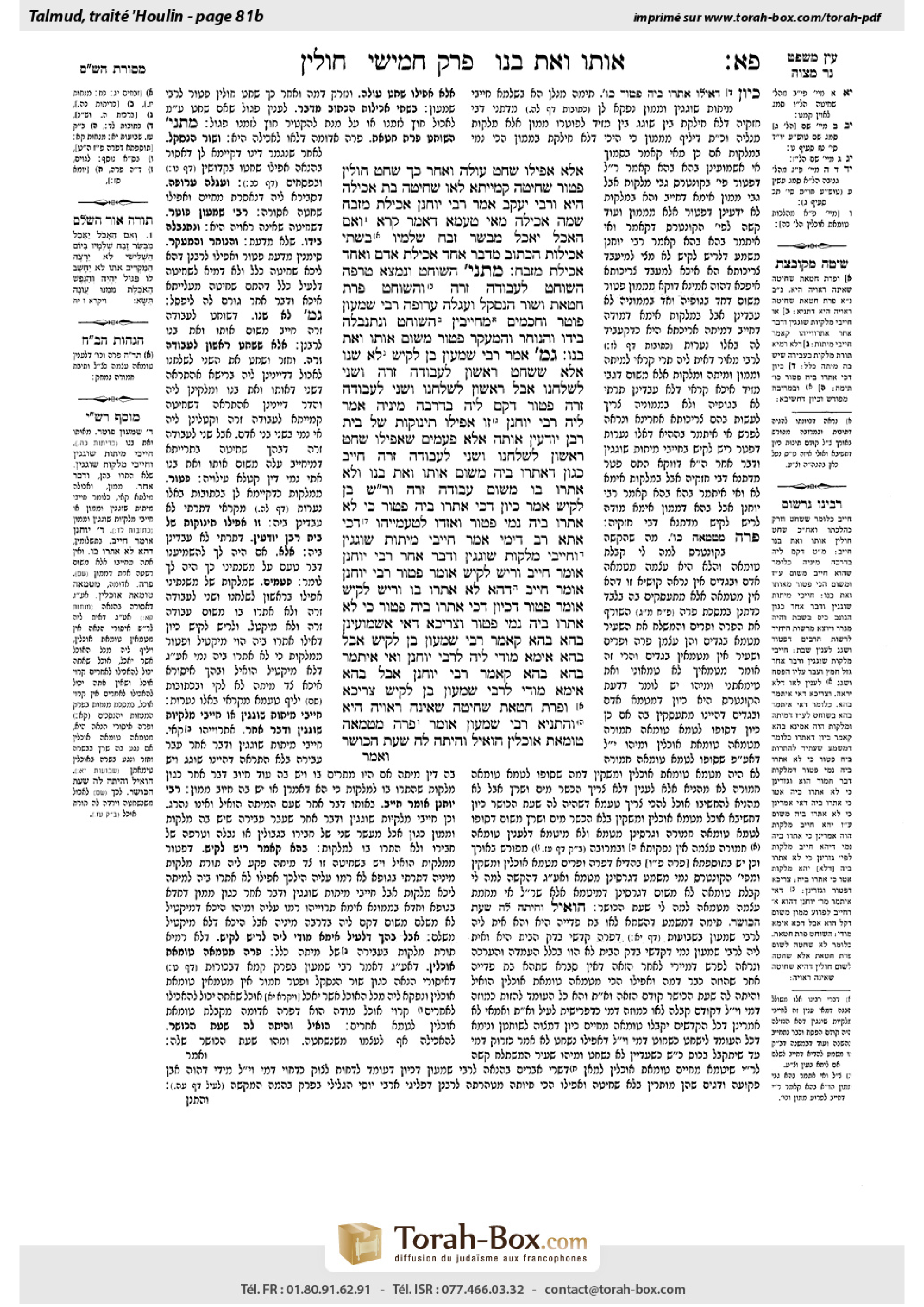
Chullin 81b: Talmud study for Daf Yomi
Study the Talmud for Daf Yomi with scanned pages, Hebrew text, English translations from Sefaria and AI-generated French translations.
Passage selection and English or AI-generated French translation are available where the scan has annotations. Daf Study is independent of Torah-Box and Sefaria.
Browse Chullin · חולין · All tractatesChullin 81b text and translations
This page of Chullin includes the Aramaic text, an English translation and an AI-generated French translation, alongside the scan above.
חולין פ״א ב · Aramaic and Hebrew text
אֶלָּא אֲפִילּוּ שָׁחַט עוֹלָה וְאַחַר כָּךְ שָׁחַט חוּלִּין – פָּטוּר, שְׁחִיטָה קַמַּיְיתָא לָאו שְׁחִיטָה בַּת אֲכִילָה הִיא.
וְרַבִּי יַעֲקֹב אָמַר רַבִּי יוֹחָנָן: אֲכִילַת מִזְבֵּחַ שְׁמָהּ אֲכִילָה. מַאי טַעְמָא? דְּאָמַר קְרָא: ״וְאִם הֵאָכֹל יֵאָכֵל מִבְּשַׂר זֶבַח שְׁלָמָיו״.
בִּשְׁתֵּי אֲכִילוֹת הַכָּתוּב מְדַבֵּר, אֶחָד אֲכִילַת אָדָם וְאֶחָד אֲכִילַת מִזְבֵּחַ.
מַתְנִי׳ הַשּׁוֹחֵט וְנִמְצָא טְרֵפָה, הַשּׁוֹחֵט לַעֲבוֹדָה זָרָה, וְהַשּׁוֹחֵט פָּרַת חַטָּאת, וְשׁוֹר הַנִּסְקָל, וְעֶגְלָה עֲרוּפָה – רַבִּי שִׁמְעוֹן פּוֹטֵר, וַחֲכָמִים מְחַיְּיבִין.
הַשּׁוֹחֵט וְנִתְנַבְּלָה בְּיָדוֹ, וְהַנּוֹחֵר, וְהַמְעַקֵּר – פָּטוּר מִשּׁוּם ״אוֹתוֹ וְאֶת בְּנוֹ״.
גְּמָ׳ אָמַר רַבִּי שִׁמְעוֹן בֶּן לָקִישׁ: לֹא שָׁנוּ אֶלָּא שֶׁשָּׁחַט רִאשׁוֹן לַעֲבוֹדָה זָרָה וְשֵׁנִי לְשֻׁלְחָנוֹ, אֲבָל רִאשׁוֹן לְשֻׁלְחָנוֹ וְשֵׁנִי לַעֲבוֹדָה זָרָה – פָּטוּר, דְּקָם לֵיהּ בִּדְרַבָּה מִינֵּיהּ.
אֲמַר לֵיהּ רַבִּי יוֹחָנָן: זוֹ, אֲפִילּוּ תִּינוֹקוֹת שֶׁל בֵּית רַבָּן יוֹדְעִין אוֹתָהּ! אֶלָּא, פְּעָמִים שֶׁאֲפִילּוּ שָׁחַט רִאשׁוֹן לְשֻׁלְחָנוֹ וְשֵׁנִי לַעֲבוֹדָה זָרָה – חַיָּיב.
כְּגוֹן דְּאַתְרוֹ בֵּיהּ מִשּׁוּם ״אוֹתוֹ וְאֶת בְּנוֹ״, וְלֹא אַתְרוֹ בֵּיהּ מִשּׁוּם עֲבוֹדָה זָרָה. וְרַבִּי שִׁמְעוֹן בֶּן לָקִישׁ אָמַר: כֵּיוָן דְּכִי אַתְרוֹ בֵּיהּ – פָּטוּר, כִּי לָא אַתְרוֹ בֵּיהּ נָמֵי – פָּטוּר.
וְאָזְדוּ לְטַעְמַיְיהוּ, דְּכִי אֲתָא רַב דִּימִי אָמַר: חַיָּיבֵי מִיתוֹת שׁוֹגְגִין, וְחַיָּיבֵי מַלְקוֹת שׁוֹגְגִין, וְדָבָר אַחֵר – רַבִּי יוֹחָנָן אוֹמֵר: חַיָּיב, וְרֵישׁ לָקִישׁ אוֹמֵר: פָּטוּר.
רַבִּי יוֹחָנָן אוֹמֵר: חַיָּיב, דְּהָא לָא אַתְרוֹ בֵּיהּ; וְרֵישׁ לָקִישׁ אוֹמֵר: פָּטוּר, דְּכֵיוָן דְּכִי אַתְרוֹ בֵּיהּ פָּטוּר – כִּי לָא אַתְרוֹ בֵּיהּ נָמֵי פָּטוּר.
וּצְרִיכָא, דְּאִי אַשְׁמוֹעִינַן בְּהָא – בְּהָא קָאָמַר רַבִּי שִׁמְעוֹן בֶּן לָקִישׁ, אֲבָל בְּהָא – אֵימָא מוֹדֵי לֵיהּ לְרַבִּי יוֹחָנָן.
וְאִי אִיתְּמַר בְּהָא, בְּהָא קָאָמַר רַבִּי יוֹחָנָן, אֲבָל בְּהָא אֵימָא מוֹדֵי לְרַבִּי שִׁמְעוֹן בֶּן לָקִישׁ, צְרִיכָא.
וּפָרַת חַטָּאת שְׁחִיטָה שֶׁאֵינָהּ רְאוּיָה הִיא? וְהָתַנְיָא: רַבִּי שִׁמְעוֹן אוֹמֵר: פָּרָה מְטַמְּאָה טוּמְאַת אֳכָלִין, הוֹאִיל וְהָיְתָה לָהּ שְׁעַת הַכּוֹשֶׁר.
Chullin 81b · English translation
But even if one slaughtered the offspring as a burnt offering and sprinkled its blood, and afterward slaughtered the non-sacred mother, he is exempt. The reason is that the slaughter of the first animal is not an act of slaughter subject to consumption, as a burnt offering is entirely burned upon the altar, and according to Rabbi Shimon, it is an act of slaughter that is improper, in that it does not render the meat fit to be eaten, is not considered slaughter.
And Rabbi Ya’akov says that Rabbi Yoḥanan says: Consumption by the altar is considered consumption. What is the reason? The reason is that the verse states with regard to an offering that was sacrificed with the intent to consume it after its designated time [piggul]: “And if any of the flesh of the sacrifice of his peace offerings be at all eaten [he’akhol ye’akhel] on the third day, it shall not be accepted” (Leviticus 7:18).
The repetitive expression “he’akhol ye’akhel” teaches that the verse is speaking of two types of consumption: One is human consumption, and the other one is consumption by the altar, and both are considered consumption with regard to piggul and other matters. Therefore, the slaughter of a burnt offering is considered slaughter that is fit for consumption, and the slaughter of a mother animal and its offspring, one of which is sacrificed as a burnt offering on the same day as the slaughter of the other, renders one liable to receive lashes even according to the opinion of Rabbi Shimon.
MISHNA: With regard to one who slaughters an animal and its offspring and one of them is discovered to be an animal with a wound that would have caused it to die within twelve months [tereifa] and may not be eaten, or one who slaughters one of the animals for the sake of idol worship, from which deriving benefit is prohibited, or one who slaughters the red heifer of purification, or an ox that was to have been stoned, or a heifer whose neck was to have been broken, all of which are animals from which deriving benefit is prohibited, Rabbi Shimon deems one who slaughters them exempt from lashes for the slaughter of a mother and its offspring, as in his opinion, slaughter that does not render the animal fit for consumption is not considered slaughter and does not violate the prohibition. And the Rabbis deem him liable, as the slaughter need not render the animal fit for consumption in order to violate the prohibition.
All agree that one who slaughters an animal and it becomes a carcass by his hand because the slaughter was invalid, or one who stabs an animal, or one who uproots the windpipe and the gullet, is exempt with regard to the prohibition against slaughtering a mother and its offspring, as it is written: “You shall not slaughter it and its offspring both in one day” (Leviticus 22:28), and in these cases, no ritual slaughter was performed.
GEMARA: Rabbi Shimon ben Lakish says: The Rabbis in the mishna taught that one is liable when one of the animals is slaughtered for the sake of idol worship only when he slaughtered the first animal for the sake of idol worship and the second animal for his own table. But if he slaughtered the first animal for his own table and the second animal for the sake of idol worship, he is exempt from lashes for the second act of slaughter, as he receives only the greater punishment, that for idol worship, which is death.
Rabbi Yoḥanan said to him: Even schoolchildren know this halakha, that one who is liable to receive two punishments receives only the greater punishment. Rather, sometimes, even if he slaughtered the first for his own table and the second for the sake of idol worship, he is liable to receive lashes for the second act of slaughter.
This occurs, for example, where the witnesses forewarned him before the second act of slaughter with regard to the prohibition of: Itself and its offspring, but they did not forewarn him with regard to idol worship. Since he is not punished for performing idol worship, he receives lashes for the less severe transgression. And Rabbi Shimon ben Lakish says: Since, had they forewarned him with regard to idol worship he would have been exempt from lashes; therefore, even if they did not forewarn him with regard to idol worship, he is also exempt from lashes.
The Gemara notes: And they each follow their known lines of reasoning in this matter. As when Rav Dimi came to Babylonia from Eretz Yisrael he said: With regard to those who unwittingly performed a transgression for which one is liable to receive the death penalty if one performed it intentionally, or those who unwittingly performed a transgression for which one is liable to receive lashes, and that transgression also involved another matter, monetary payment, and they were forewarned with regard to the monetary penalty but not with regard to the lashes or the death penalty, Rabbi Yoḥanan says: He is liable to pay; and Reish Lakish says: He is exempt.
The Gemara clarifies the rationales for their statements. Rabbi Yoḥanan says that he is liable; since they did not forewarn him with regard to the severe transgression, he sinned unwittingly, and he remains liable only to pay the monetary payment. And Reish Lakish says that he is exempt; since had they forewarned him with regard to the severe transgression, he would have been exempt from the monetary payment, when they did not forewarn him, he is also exempt.
The Gemara notes: And it is necessary to state their disagreement with regard to both of these cases. As, if it were taught to us only about this case where one slaughters the mother for his private use and afterward slaughters its offspring for idol worship, perhaps only in this case involving the death penalty and lashes does Rabbi Shimon ben Lakish say that even if they did not forewarn the transgressor with regard to idol worship, he is still exempt from lashes for the prohibition of: Itself and its offspring, because the death penalty and lashes are similar in that they are both corporal punishments, and so the obligation of lashes does not take effect at all when the death penalty is potentially applicable. But in that case, involving the death penalty or lashes together with a monetary payment, say that he agrees with Rabbi Yoḥanan that the transgressor is liable to pay the monetary payment.
And if the disagreement was stated only with regard to that case, where one unwittingly performed a transgression involving the death penalty or lashes together with a transgression bearing a monetary payment, perhaps only in that case does Rabbi Yoḥanan say that he is liable to pay the monetary payment. But in this case, where one slaughtered an animal and its offspring, and the second animal was slaughtered for the sake of idol worship, which involves the death penalty and lashes, but without a forewarning with regard to the death penalty, say that he agrees with Rabbi Shimon ben Lakish that one is exempt from lashes. Therefore, it is necessary to state their disagreement with regard to both cases.
§ The mishna teaches that Rabbi Shimon deems one who slaughters the red heifer of purification exempt from punishment for the prohibition of: Itself and its offspring, as that act of slaughter does not render the animal fit for consumption. The Gemara asks: And is the slaughter of the red heifer of purification considered an act of slaughter that is unfit for consumption? But isn’t it taught in a baraita: Rabbi Shimon says: A red heifer, even if it has been slaughtered and it is therefore prohibited to derive benefit from it, is susceptible to the ritual impurity of food, since it had a time in which it was fit for consumption?
Chullin 81b · Traduction française (IA)
Mais même si l'on immolait l'animal jeune comme holocauste et l'on versait son sang, et ensuite l'on immolait la mère non sacrée, il est exempt. La raison est que l'immolation du premier animal n'est pas une action d'immolation soumise à la consommation, car un holocauste est entièrement brûlé sur l'autel, et selon Rabbi Shimon, c'est une action d'immolation inappropriée, car elle ne rend pas la viande comestible, et n'est pas considérée comme une immolation.
Et Rabbi Ya'akov dit que Rabbi Yoḥanan dit : La consommation par l'autel est considérée comme une consommation. Quelle est la raison ? La raison est que la parole stipule concernant une offrande sacrifiée avec l'intention de la consommer après son temps désigné [piggul] : « Et si une partie de la chair de l'offrande de paix de son sacrifice est mangée [he'akhol ye'akhel] le troisième jour, elle ne sera pas acceptée » (Lévitique 7:18).
L'expression répétée « he'akhol ye'akhel » enseigne que la parole parle de deux types de consommation : l'un est la consommation humaine, l'autre est la consommation par l'autel, et les deux sont considérés comme des consommations concernant le piggul et d'autres choses. Ainsi, l'immolation d'un holocauste est considérée comme une immolation adaptée à la consommation, et l'immolation d'un animal et de son petit, l'un sacrifié comme holocauste le même jour que l'immolation de l'autre, rend l'individu coupable de recevoir des coups de fouet même selon l'opinion de Rabbi Shimon.
MICHNA : Concernant celui qui immole un animal et son petit, et l'un d'eux est découvert être un animal blessé qui aurait causé sa mort en douze mois [tereifa] et ne peut être mangé, ou celui qui immole l'un des animaux à l'usage de l'idolâtrie, d'où dériver un bénéfice est interdit, ou celui qui immole la vache rouge de purification, ou un bœuf qui devait être lapidé, ou une vache dont le cou devait être brisé, tous des animaux d'où dériver un bénéfice est interdit, Rabbi Shimon considère que celui qui immole ces animaux est exempt des coups de fouet pour l'immolation de la mère et de son petit, car selon son opinion, l'immolation qui ne rend pas l'animal comestible n'est pas considérée comme une immolation et ne viole pas la prohibition. Et les Sages considèrent qu'il est coupable, car l'immolation n'a pas besoin de rendre l'animal comestible pour violer la prohibition.
Tous s'accordent sur le fait que celui qui immole un animal et qu'il devient un cadavre par sa main à cause de l'immolation invalide, ou celui qui transperce un animal, ou celui qui arrache la trachée et le gosier, est exempt concernant la prohibition d'immoler la mère et son petit, car il est écrit : « Tu ne tueras pas lui et son petit le même jour » (Lévitique 22:28), et dans ces cas, aucun immolation rituelle n'a été effectuée.
GUEMARA : Rabbi Shimon ben Lakish dit : Les Sages dans la mishna ont enseigné que l'on est coupable lorsqu'un des animaux est immolé à l'usage de l'idolâtrie uniquement lorsque l'on a immolé le premier animal à l'usage de l'idolâtrie et le second animal à son propre festin. Mais si l'on a immolé le premier animal à son propre festin et le second animal à l'usage de l'idolâtrie, il est exempt des coups de fouet pour l'acte d'immolation secondaire, car il reçoit seulement la punition plus grave, celle de l'idolâtrie, qui est la mort.
Rabbi Yoḥanan dit à lui : Même les enfants savent cette halakha, que celui qui est tenu de recevoir deux punitions reçoit seulement la punition la plus grave. En réalité, parfois, même s'il a immolé le premier pour son propre festin et le second à l'intention de l'idolâtrie, il est tenu de recevoir des coups de fouet pour l'acte d'immolation secondaire.
Cela arrive, par exemple, dans le cas où les témoins l'avaient avertis avant l'acte d'immolation secondaire concernant la prohibition de : Lui-même et son petit, mais ils n'avaient pas avertis concernant l'idolâtrie. Puisqu'il n'est pas puni pour avoir accompli l'idolâtrie, il reçoit des coups de fouet pour la transgression moins grave. Et Rabbi Shimon ben Lakish dit : Puisqu', avait-on avertis concernant l'idolâtrie, il aurait été exempt des coups de fouet ; donc, même s'ils n'ont pas avertis concernant l'idolâtrie, il est également exempt des coups de fouet.
La Guemara note : Et ils suivent chacun leurs raisonnements connus dans cette affaire. Comme lorsque Rav Dimi est venu à Babylone d'Eretz Yisrael, il a dit : Concernant ceux qui ont commis une transgression involontaire pour laquelle l'on est tenu de la mort s'il l'avait commise intentionnellement, ou ceux qui ont commis une transgression involontaire pour laquelle l'on est tenu de coups de fouet, et que cette transgression impliquait également une autre affaire, le paiement, et qu'ils avaient été avertis concernant la sanction monétaire mais pas concernant les coups de fouet ou la mort, Rabbi Yoḥanan dit : Il est tenu de payer ; et Reish Lakish dit : Il est exempt.
La Guemara clarifie les raisonnements de leurs déclarations. Rabbi Yoḥanan dit qu'il est responsable ; puisqu'ils n'ont pas avertis sur la transgression grave, il a péché involontairement, et il reste responsable seulement de payer la sanction monétaire. Et Reish Lakish dit qu'il est exempt ; puisqu'ils auraient avertis sur la transgression grave, il aurait été exempt du paiement, et puisqu'ils n'ont pas avertis, il est également exempt.
La Guemara note : Il est nécessaire de préciser leur désaccord concernant ces deux cas. En effet, si on nous avait enseigné uniquement ce cas où l'on sacrifie la mère pour son usage personnel et ensuite sacrifie son petit pour l'idolâtrie, peut-être seulement dans ce cas impliquant la peine de mort et les fessées Rabbi Shimon ben Lakish affirme-t-il que même s'ils n'ont pas averti le transgresseur concernant l'idolâtrie, il est tout de même exempt des fessées pour la prohibition : « Lui-même et son petit », car la peine de mort et les fessées sont similaires dans le fait qu'elles sont toutes deux des peines corporelles, et ainsi l'obligation des fessées ne s'applique pas du tout lorsque la peine de mort est potentiellement applicable. Mais dans ce cas impliquant la peine de mort ou les fessées conjointement avec un paiement monétaire, disent-ils qu'ils s'accordent avec Rabbi Yoḥanan que le transgresseur est tenu de payer le paiement monétaire.
Et si le désaccord avait été précisé uniquement concernant ce cas, où l'on commet une transgression involontaire impliquant la peine de mort ou les fessées conjointement avec une transgression portant sur un paiement monétaire, peut-être seulement dans ce cas Rabbi Yoḥanan affirme-t-il qu'il est tenu de payer le paiement monétaire. Mais dans ce cas, où l'on sacrifie un animal et son petit, et le second animal est sacrifié à l'intention de l'idolâtrie, ce qui implique la peine de mort et les fessées, mais sans avertissement concernant la peine de mort, disent-ils qu'ils s'accordent avec Rabbi Shimon ben Lakish que l'on est exempt des fessées. Ainsi, il est nécessaire de préciser leur désaccord concernant ces deux cas.
§ La mitsva enseigne que Rabbi Shimon considère comme exempt de punition celui qui sacrifie la bête rouge de purification pour la prohibition : « Lui-même et son petit », car cette action de sacrifice ne rend pas l'animal propre à la consommation. La Guemara demande : Et le sacrifice de la bête rouge de purification est-il considéré comme une action de sacrifice non propre à la consommation ? Mais n'est-il pas enseigné dans une baraïta : Rabbi Shimon dit : Une bête rouge, même si elle a été sacrifiée et est donc interdite de bénéficier d'elle, est susceptible de la souillure rituelle de la nourriture, car elle avait un moment où elle était propre à la consommation ?
Traduction française générée par IA à partir de l’édition anglaise de Sefaria. Vérifie toujours un passage avec le texte source.
Text from Sefaria: William Davidson Edition - Vocalized Aramaic (unknown); William Davidson Edition - English (CC BY NC).