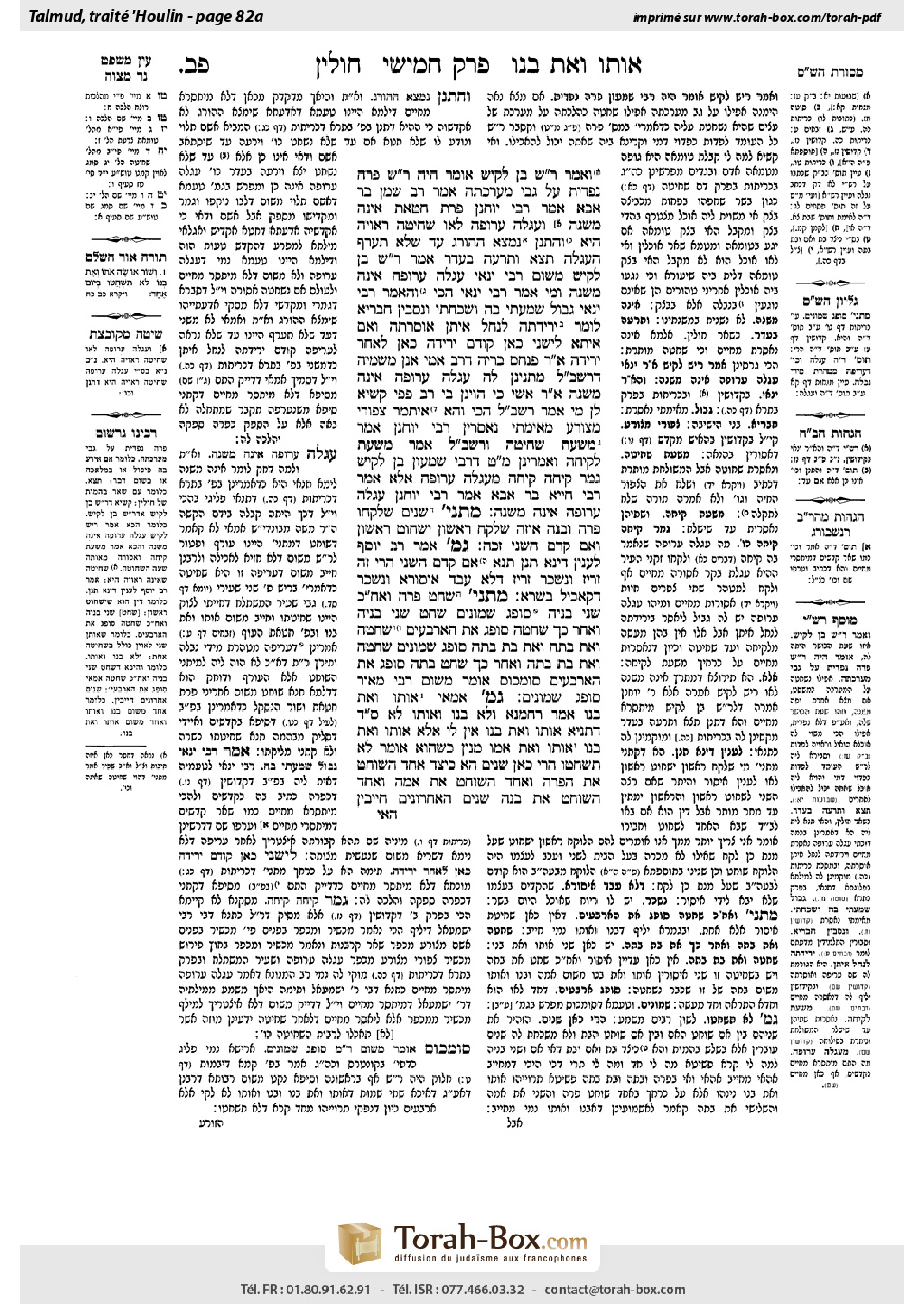
Chullin 82a: Talmud study for Daf Yomi
Study the Talmud for Daf Yomi with scanned pages, Hebrew text, English translations from Sefaria and AI-generated French translations.
Passage selection and English or AI-generated French translation are available where the scan has annotations. Daf Study is independent of Torah-Box and Sefaria.
Browse Chullin · חולין · All tractatesChullin 82a text and translations
This page of Chullin includes the Aramaic text, an English translation and an AI-generated French translation, alongside the scan above.
חולין פ״ב א · Aramaic and Hebrew text
וְאָמַר רַבִּי שִׁמְעוֹן בֶּן לָקִישׁ: אוֹמֵר הָיָה רַבִּי שִׁמְעוֹן, פָּרָה נִפְדֵּית עַל גַּבֵּי מַעֲרַכְתָּהּ. אָמַר רַב שֶׁמֶן בַּר אַבָּא אָמַר רַבִּי יוֹחָנָן: פָּרַת חַטָּאת אֵינָהּ מִשְׁנָה.
וְעֶגְלָה עֲרוּפָה, לָאו שְׁחִיטָה רְאוּיָה הִיא? וְהָתְנַן: נִמְצָא הַהוֹרֵג עַד שֶׁלֹּא תֵּעָרֵף הָעֲגָלָה – תֵּצֵא וְתִרְעֶה בָּעֵדֶר. אָמַר רַבִּי שִׁמְעוֹן בֶּן לָקִישׁ מִשּׁוּם רַבִּי יַנַּאי: עֶגְלָה עֲרוּפָה אֵינָהּ מִשְׁנָה.
וּמִי אָמַר רַבִּי יַנַּאי הָכִי? וְהָאָמַר רַבִּי יַנַּאי: גְּבוּל שָׁמַעְתִּי בָּהּ, וְשָׁכַחְתִּי, וְנָסְבִין חַבְרַיָּא לוֹמַר: יְרִידָתָהּ לְנַחַל אֵיתָן אוֹסַרְתָּהּ.
וְאִם אִיתָא, לִישַׁנֵּי: כָּאן קוֹדֶם יְרִידָה, כָּאן לְאַחַר יְרִידָה.
אָמַר רַב פִּנְחָס בְּרֵיהּ דְּרַב אַמֵּי: אֲנַן מִשְּׁמֵיהּ דְּרַבִּי שִׁמְעוֹן בֶּן לָקִישׁ מַתְנֵינַן לַהּ, עֶגְלָה עֲרוּפָה אֵינָהּ מִשְׁנָה. אָמַר רַב אָשֵׁי: כִּי הֲוֵינַן בֵּי רַב פַּפֵּי קַשְׁיָא לַן, מִי אָמַר רַבִּי שִׁמְעוֹן בֶּן לָקִישׁ הָכִי?
וְהָא אִיתְּמַר, צִפּוֹרֵי מְצוֹרָע מֵאֵימָתַי נֶאֱסָרִין? רַבִּי יוֹחָנָן אָמַר: מִשְּׁעַת שְׁחִיטָה, וְרַבִּי שִׁמְעוֹן בֶּן לָקִישׁ אָמַר: מִשְּׁעַת לְקִיחָה, וְאָמְרִינַן: מַאי טַעְמָא דְּרַבִּי שִׁמְעוֹן בֶּן לָקִישׁ?
גָּמַר ״קִיחָה״ ״קִיחָה״ מֵעֶגְלָה עֲרוּפָה.
אֶלָּא אָמַר רַבִּי חִיָּיא בַּר אַבָּא אָמַר רַבִּי יוֹחָנָן: עֶגְלָה עֲרוּפָה אֵינָהּ מִשְׁנָה.
מַתְנִי׳ שְׁנַיִם שֶׁלָּקְחוּ פָּרָה וּבְנָהּ, אֵיזֶה שֶׁלָּקַח רִאשׁוֹן יִשְׁחוֹט רִאשׁוֹן, וְאִם קָדַם הַשֵּׁנִי – זָכָה.
גְּמָ׳ אָמַר רַב יוֹסֵף: לְעִנְיַן דִּינָא תְּנַן, תְּנָא: אִם קָדַם הַשֵּׁנִי – הֲרֵי זֶה זָרִיז וְנִשְׂכָּר, זָרִיז – דְּלָא עֲבַד אִיסּוּרָא, וְנִשְׂכָּר – דְּקָאָכֵיל בִּשְׂרָא.
מַתְנִי׳ שָׁחַט פָּרָה וְאַחַר כָּךְ שְׁנֵי בָּנֶיהָ – סוֹפֵג שְׁמוֹנִים, שָׁחַט שְׁנֵי בָּנֶיהָ וְאַחַר כָּךְ שְׁחָטָהּ – סוֹפֵג אֶת הָאַרְבָּעִים, שְׁחָטָהּ וְאֶת בִּתָּהּ וְאֶת בַּת בִּתָּהּ – סוֹפֵג שְׁמוֹנִים.
שְׁחָטָהּ וְאֶת בַּת בִּתָּהּ, וְאַחַר כָּךְ שָׁחַט בִּתָּהּ – סוֹפֵג אֶת הָאַרְבָּעִים. סוֹמְכוֹס אוֹמֵר מִשּׁוּם רַבִּי מֵאִיר: סוֹפֵג שְׁמוֹנִים.
גְּמָ׳ אַמַּאי? ״אוֹתוֹ וְאֶת בְּנוֹ״ אָמַר רַחֲמָנָא, וְלֹא בְּנוֹ וְאוֹתוֹ! לָא סָלְקָא דַּעְתָּךְ, דְּתַנְיָא: ״אוֹתוֹ וְאֶת בְּנוֹ״ – אֵין לִי אֶלָּא אוֹתוֹ וְאֶת בְּנוֹ, אוֹתוֹ וְאֶת אִמּוֹ מִנַּיִן?
כְּשֶׁהוּא אוֹמֵר ״לֹא תִשְׁחֲטוּ״ – הֲרֵי כָּאן שְׁנַיִם, הָא כֵּיצַד? אֶחָד הַשּׁוֹחֵט אֶת הַפָּרָה, וְאֶחָד הַשּׁוֹחֵט אֶת אִמָּהּ, וְאֶחָד הַשּׁוֹחֵט אֶת בְּנָהּ – שְׁנַיִם הָאַחֲרוֹנִים חַיָּיבִין.
Chullin 82a · English translation
And Rabbi Shimon ben Lakish says in explanation of Rabbi Shimon’s statement: Rabbi Shimon would say that the red heifer can be redeemed with money even once it has been slaughtered and placed upon its pyre in preparation for being burned. Therefore, Rabbi Shimon states that there could be a time when the heifer was fit for consumption, i.e., if it was redeemed. Why, then, does he deem one who slaughters it exempt from liability for transgressing the prohibition of: Itself and its offspring? Rav Shemen bar Abba said that Rabbi Yoḥanan says: The statement with regard to the red heifer of purification is not considered part of the mishna, and Rabbi Shimon agrees that its slaughterer is liable for transgressing the prohibition of: Itself and its offspring.
The Gemara asks: And is the slaughter of the heifer whose neck was to have been broken not considered an act of slaughter that is fit? But didn’t we learn in a mishna (Sota 47a): If a heifer was set aside to have its neck broken to atone for the murder of an individual whose murderer was not known, and then the murderer was found before the heifer’s neck was broken, the heifer shall go out and graze among the flock, as it is not consecrated. Evidently, before its neck is broken, deriving benefit from it is not prohibited, and its slaughter would be one that is fit. Rabbi Shimon ben Lakish said in the name of Rabbi Yannai: The statement with regard to the heifer whose neck was to have been broken is not considered part of the mishna, and Rabbi Shimon agrees that its slaughterer is liable for violating the prohibition of: Itself and its offspring.
The Gemara asks: And does Rabbi Yannai actually say so? But doesn’t Rabbi Yannai say: I heard the boundary, i.e., stage, beyond which the heifer is forbidden, but I have forgotten what it is; but the group of scholars were inclined to say that the heifer’s descent to a hard valley, where its neck is broken, is the action that renders it forbidden?
And if it is so, let him resolve the contradiction by saying: Here, where deriving benefit from the heifer is permitted, and its slaughterer is liable for transgressing the prohibition of: Itself and its offspring, it is referring to an act of slaughtering that is fit and is performed before the heifer’s descent, while there, in the mishna, where Rabbi Shimon holds that there is no liability for transgressing: Itself and its offspring, it is referring to slaughtering performed after its descent. At that time, deriving benefit from the heifer is already prohibited, and the slaughter is therefore not considered fit.
Rav Pineḥas, son of Rav Ami, said: We taught the statement in the name of Rabbi Shimon ben Lakish himself, not as a quote from Rabbi Yannai: The statement with regard to the heifer whose neck is broken is not considered part of the mishna. Rav Ashi said: When we were studying in the study hall of Rav Pappi, that statement was difficult for us: Did Rabbi Shimon ben Lakish actually say that it is not considered part of the mishna?
But it was stated that amora’im engaged in a dispute concerning the following issue: From when is one prohibited from deriving benefit from the leper’s birds? Rabbi Yoḥanan says: One is prohibited from the moment of their slaughter; and Reish Lakish says: One is prohibited from the moment they are taken and designated to be a leper’s birds. And we say: What is the reasoning of Rabbi Shimon ben Lakish?
His reasoning is that he derives it via verbal analogy from the terms: “Taking [kiḥa]” (Leviticus 14:4), with regard to the birds, and: “Taking [kiḥa]” (Deuteronomy 21:3), with regard to the heifer whose neck is broken. Consequently, just as deriving benefit from the heifer whose neck is broken is prohibited from the time of its selection, so too must deriving benefit from these birds be prohibited from the time of their selection. Clearly, then, Rabbi Shimon ben Lakish holds that deriving benefit from the heifer whose neck is broken is prohibited while it is still alive. Therefore, its slaughter is one that does not render the animal fit for consumption. Accordingly, Rabbi Shimon would exempt its slaughterer from the prohibition of: Itself and its offspring, as is taught in the mishna.
Rather, Rabbi Ḥiyya bar Abba said that Rabbi Yoḥanan said: The statement with regard to the heifer whose neck is broken is not considered part of the mishna, and this resolution of the difficulty was articulated by Rabbi Yoḥanan rather than Reish Lakish.
MISHNA: With regard to two people who purchased a cow and its offspring, where each purchased one of the animals, whoever purchased his animal first shall slaughter it first, and the second one must wait until the next day to slaughter his animal, so as not to violate the prohibition of: It and its offspring. But if the second one preceded him and slaughtered his animal first, he benefitted, and the one who purchased the animal first may not slaughter it until the next day.
GEMARA: Rav Yosef said: We learn in the mishna that the first purchaser is granted precedence only with regard to the matter of a court judgment, in case the two purchasers go to court each demanding to slaughter his animal first. But there is no prohibition against the second one slaughtering his animal first if no claim is brought to court. Likewise, a Sage taught in a baraita: If the second one preceded him and slaughtered his animal first, he is diligent and rewarded; he is diligent because he did not violate a prohibition, and he is rewarded because he eats meat already that day.
MISHNA: If one slaughtered a cow and thereafter slaughtered its two offspring on the same day, he incurs eighty lashes for two separate actions violating the prohibition against slaughtering the mother and the offspring on the same day. If one slaughtered its two offspring and thereafter slaughtered the mother cow, he incurs the forty lashes, as he performed a single prohibited act. If one slaughtered the mother and its daughter, and, later that day, slaughtered its daughter’s daughter, he incurs eighty lashes, as he has performed the act of slaughtering a mother and its offspring twice.
But if one slaughtered the mother and its daughter’s daughter and thereafter slaughtered its daughter, he incurs the forty lashes, as he performed a single prohibited act. Sumakhos says in the name of Rabbi Meir: He incurs eighty lashes for slaughtering the daughter on the same day as its calf and its mother, as that act comprises two separate violations of the prohibition.
GEMARA: With regard to the statement in the mishna that if one slaughters two calves and thereafter slaughters their mother he incurs the forty lashes, the Gemara asks: Why does he receive lashes? After all, the phrase: “It and its offspring” (Leviticus 22:28), is what the Merciful One states in the Torah, and not: Its offspring and it. The Gemara answers: That thought should not enter your mind, as it is taught in a baraita: From the phrase “it and its offspring” I have derived only that the prohibition includes slaughtering the animal itself first and its offspring afterward. From where do I derive that the prohibition also includes the case of slaughtering the offspring itself first and its mother afterward?
It is derived in the following manner: When the verse states: “You shall not slaughter [tishḥatu] both in one day” (Leviticus 22:28), this is referring to two people who are prohibited from slaughtering on the same day, as the word “slaughter” is phrased in the plural. How so? If, during the course of a single day, there is one person who slaughters the cow and then another who slaughters that cow’s mother, and then there is another person who slaughters that cow’s offspring, the two latter people are liable, the first of them for slaughtering the mother after its offspring was slaughtered, and the second person for slaughtering the offspring after its mother was slaughtered.
Chullin 82a · Traduction française (IA)
Et Rabbi Šimon ben Lakish dit, en expliquant la déclaration de Rabbi Šimon : Rabbi Šimon disait que la vache rouge peut être rachetée avec de l'argent même après qu'elle ait été sacrifiée et placée sur son bûcher en préparation pour être brûlée. Ainsi, Rabbi Šimon affirme qu'il peut y avoir un moment où la vache était propre à la consommation, c'est-à-dire si elle avait été rachetée. Pourquoi, alors, considère-t-il qu'une personne qui sacrifie cette vache est exemptée de responsabilité pour avoir transgressé la prohibition de : « Elle et ses petits » ? Rav Šemen bar Abba a dit que Rabbi Yoḥanan dit : La déclaration concernant la vache rouge de purification n'est pas considérée comme faisant partie de la mitsva, et Rabbi Šimon est d'accord pour dire que son sacrificateur est responsable de transgresser la prohibition de : « Elle et ses petits ».
Le Guemara demande : Et le sacrifice de la vache dont le cou devait être brisé n'est-il pas considéré comme un acte de sacrifice propre ? Mais n'avons-nous pas appris dans une mitsva (Sota 47a) : Si une vache avait été désignée pour avoir son cou brisé afin d'expier le meurtre d'un individu dont l'assassin n'était pas connu, et que l'assassin avait été trouvé avant que la vache ne fasse brisé son cou, la vache sortira et paîtra avec le troupeau, car elle n'était pas consacrée. Évidemment, avant que son cou ne soit brisé, il n'était pas interdit d'en tirer un bénéfice, et son sacrifice serait un acte propre. Rabbi Šimon ben Lakish a dit en nom de Rabbi Yannai : La déclaration concernant la vache dont le cou devait être brisé n'est pas considérée comme faisant partie de la mitsva, et Rabbi Šimon est d'accord pour dire que son sacrificateur est responsable de transgresser la prohibition de : « Elle et ses petits ».
Le Guemara demande : Et Rabbi Yannai dit réellement cela ? Mais ne dit-on pas que Rabbi Yannai dit : J'ai entendu la limite, c'est-à-dire la phase, au-delà de laquelle la vache est interdite, mais j'ai oublié ce que c'est ; mais le groupe de sages penchait pour dire que la descente de la vache dans un vallon dur, où son cou est brisé, est l'action qui la rend interdite ?
Et si c'est ainsi, qu'il résolve le paradoxe en disant : Ici, où il est permis de tirer un bénéfice de la vache, et où son sacrificateur est responsable de transgresser la prohibition de : « Elle et ses petits », il s'agit d'un acte de sacrifice propre effectué avant la descente de la vache, tandis que là, dans la mitsna, où Rabbi Šimon considère qu'il n'y a pas de responsabilité pour transgresser : « Elle et ses petits », il s'agit d'un sacrifice effectué après sa descente. À ce moment-là, tirer un bénéfice de la vache est déjà interdit, et le sacrifice n'est donc pas considéré comme propre.
Rav Pineḥas, fils de Rav Ami, a dit : Nous avons appris la déclaration en nom de Rabbi Šimon ben Lakish lui-même, et non comme une citation de Rabbi Yannai : La déclaration concernant la vache dont le cou est brisé n'est pas considérée comme faisant partie de la mitsna. Rav Ashi a dit : Lorsque nous étudionsions dans la salle de récitation de Rav Pappi, cette déclaration nous posait problème : Rabbi Šimon ben Lakish a-t-il vraiment dit que cela n'appartient pas à la mitsna ?
Mais il a été dit que les amora’im étaient en désaccord sur la question suivante : À partir de quel moment est-on interdit de tirer un bénéfice des oiseaux du lépreux ? Rabbi Yoḥanan dit : On est interdit dès le moment de leur sacrifice ; et Reish Lakish dit : On est interdit dès qu'ils sont pris et désignés comme des oiseaux du lépreux. Et nous disons : Quel est le raisonnement de Rabbi Šimon ben Lakish ?
Son raisonnement est qu'il l'infère par analogie verbale à partir des termes : « Prendre [kiḥa] » (Lévitique 14:4), concernant les oiseaux, et : « Prendre [kiḥa] » (Deutéronome 21:3), concernant la vache dont le cou est brisé. Ainsi, comme tirer un bénéfice de la vache dont le cou est brisé est interdit dès le moment de sa sélection, de même doit être interdit de tirer un bénéfice de ces oiseaux dès leur sélection. Évidemment, Rabbi Šimon ben Lakish considère que tirer un bénéfice de la vache dont le cou est brisé est interdit alors qu'elle est encore vivante. Ainsi, son sacrifice ne rend pas l'animal propre à la consommation. Par conséquent, Rabbi Šimon exempterait son sacrificateur de la prohibition de : « Elle et ses petits », comme il est enseigné dans la mitsva.
Plutôt, Rabbi Ḥiyya bar Abba a dit que Rabbi Yoḥanan a dit : La déclaration concernant la vache dont le cou est brisé n'est pas considérée comme faisant partie de la mitsva, et cette résolution de la difficulté a été articulée par Rabbi Yoḥanan plutôt que par Reish Lakish.
MITSVA : Concernant deux personnes ayant acheté une vache et ses petits, où chacun a acheté un des animaux, celui qui a acheté son animal en premier doit sacrifier celui-ci en premier, et celui qui a acheté le second doit attendre jusqu'au lendemain pour sacrifier son animal, afin de ne pas violer la prohibition de : « Elle et ses petits ». Mais si le second a précédé et a sacrifié son animal en premier, il a bénéficié, et celui qui a acheté l'animal en premier ne peut sacrifier le sien qu'au lendemain.
GUEMARA : Rav Yosef a dit : Nous apprenons dans la Michna que le premier acheteur est accordé la priorité uniquement concernant la question d'un jugement de tribunal, en cas que les deux acheteurs portent une action devant le tribunal chacun exigeant de sacrifier son animal en premier. Mais il n'y a pas de prohibition contre le second d'abord sacrifier son animal en premier si aucun recours n'est porté devant le tribunal. De même, un Sage a enseigné dans une baraïta : Si le second a précédé et a sacrifié son animal en premier, il est diligent et récompensé ; il est diligent parce qu'il n'a pas violé une prohibition, et il est récompensé parce qu'il mange de la viande ce jour-là.
MICHNA : Si l'on a sacrifié une vache et ensuite sacrifié ses deux petits le même jour, on subit soixante-dix coups de fouet pour deux actions distinctes de violation de la prohibition de sacrifier la mère et ses petits le même jour. Si l'on a sacrifié ses deux petits et ensuite la vache mère, on subit quarante coups de fouet, car on a commis une seule action interdite. Si l'on a sacrifié la mère et sa fille, et, plus tard ce jour-là, sacrifié la fille de la fille, on subit soixante-dix coups de fouet, car on a commis l'acte de sacrifier une mère et ses petits deux fois.
Mais si l'on a immolé la mère et la fille de sa fille, puis l'on a immolé sa fille, on subit quarante coups de fouet, car on a accompli une seule action interdite. Sumakhos cite Rabbi Meir : On subit soixante-dix coups de fouet pour avoir immolé la fille le même jour que son veau et sa mère, car cette action constitue deux violations distinctes de l'interdiction.
GUEMARA : En ce qui concerne l'affirmation de la michna selon laquelle si l'on immole deux veaux et ensuite leur mère, on subit quarante coups de fouet, la Guemara pose la question : Pourquoi subit-on des coups de fouet ? Après tout, la phrase « Il et son descendant » (Lévitique 22:28) est ce que l'Éternel a dit dans la Torah, et non pas « Son descendant et il ». La Guemara répond : Cette pensée ne doit pas entrer en votre esprit, car il est enseigné dans une baraïta : À partir de la phrase « Il et son descendant », on a déduit seulement que l'interdiction inclut l'immolation de l'animal lui-même d'abord et de son descendant ensuite. D'où déduit-on que l'interdiction inclut aussi le cas où l'on immole le descendant lui-même d'abord et sa mère ensuite ?
On en déduit ainsi : Lorsque la parole dit : « Vous ne devez pas immoler [tishḥatu] les deux en un seul jour » (Lévitique 22:28), cela fait référence à deux personnes interdites d'immoler le même jour, car le mot « immoler » est utilisé au pluriel. Comment cela se passe-t-il ? Si, durant la durée d'un seul jour, il y a une personne qui immole la vache, puis une autre qui immole la mère de cette vache, et ensuite une autre personne qui immole l'animal de cette vache, les deux dernières personnes sont redevables, la première pour avoir immolé la mère après que son descendant ait été immolé, et la seconde pour avoir immolé le descendant après que sa mère ait été immolé.
Traduction française générée par IA à partir de l’édition anglaise de Sefaria. Vérifie toujours un passage avec le texte source.
Text from Sefaria: William Davidson Edition - Vocalized Aramaic (unknown); William Davidson Edition - English (CC BY NC).