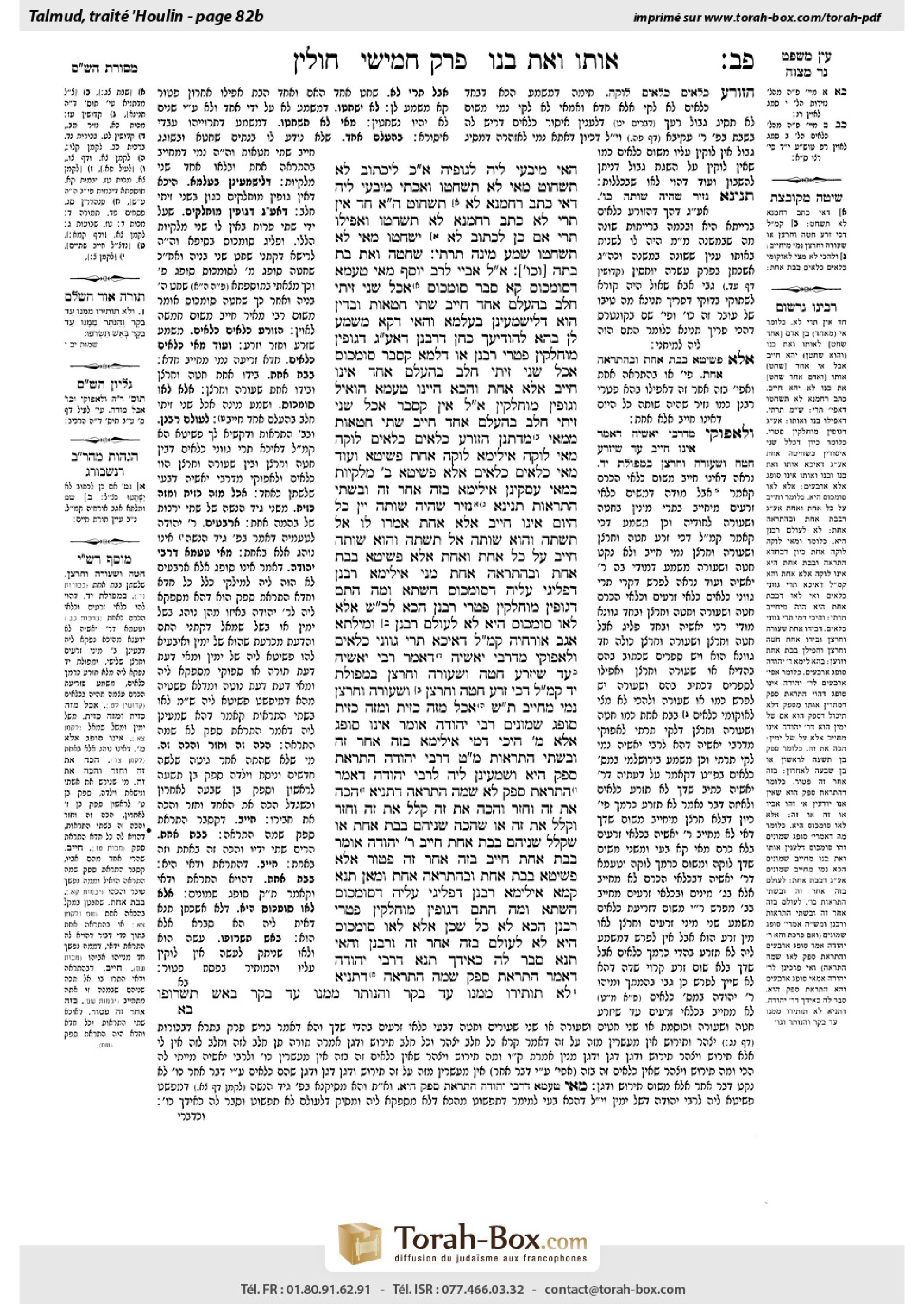
Chullin 82b: Talmud study for Daf Yomi
Study the Talmud for Daf Yomi with scanned pages, Hebrew text, English translations from Sefaria and AI-generated French translations.
Passage selection and English or AI-generated French translation are available where the scan has annotations. Daf Study is independent of Torah-Box and Sefaria.
Browse Chullin · חולין · All tractatesChullin 82b text and translations
This page of Chullin includes the Aramaic text, an English translation and an AI-generated French translation, alongside the scan above.
חולין פ״ב ב · Aramaic and Hebrew text
הַאי מִיבְּעֵי לֵיהּ לְגוּפֵיהּ? אִם כֵּן, לִיכְתּוֹב ״לֹא תִשְׁחוֹט״, מַאי ״לֹא תִשְׁחֲטוּ״?
וְאַכַּתִּי מִיבְּעֵי לֵיהּ, דְּאִי כְּתַב רַחֲמָנָא ״לֹא תִשְׁחוֹט״ הֲוָה אָמֵינָא: חַד – אִין, תְּרֵי – לָא.
כְּתַב רַחֲמָנָא ״לֹא תִשְׁחֲטוּ״, וַאֲפִילּוּ תְּרֵי! אִם כֵּן, לִכְתּוֹב ״לֹא יִשְׁחֲטוּ״!
מַאי ״לֹא תִשְׁחֲטוּ״? שְׁמַע מִינַּהּ תַּרְתֵּי.
שְׁחָטָהּ וְאֶת בַּת בִּתָּהּ, אֲמַר לֵיהּ אַבָּיֵי לְרַב יוֹסֵף: מַאי טַעְמָא דְּסוֹמְכוֹס?
קָא סָבַר סוֹמְכוֹס: אָכַל שְׁנֵי זֵיתֵי חֵלֶב בְּהֶעְלֵם אֶחָד – חַיָּיב שְׁתֵּי חַטָּאוֹת.
וּבְדִין הוּא דְּלַישְׁמְעִינַן בְּעָלְמָא, וְהַאי דְּקָא מַשְׁמַע לַן בְּהָא, לְהוֹדִיעֲךָ כֹּחָן דְּרַבָּנַן, דְּאַף עַל גַּב דְּגוּפִין מוּחְלָקִין – פָּטְרִי רַבָּנַן.
אוֹ דִלְמָא קָסָבַר סוֹמְכוֹס: אָכַל שְׁנֵי זֵיתֵי חֵלֶב בְּהֶעְלֵם אֶחָד אֵינוֹ חַיָּיב אֶלָּא אַחַת, וְהָכָא הַיְינוּ טַעְמָא – הוֹאִיל וְגוּפִין מוּחְלָקִין? אֲמַר לֵיהּ: אִין, קָסָבַר אָכַל שְׁנֵי זֵיתֵי חֵלֶב בְּהֶעְלֵם אֶחָד חַיָּיב שְׁתֵּי חַטָּאוֹת.
מִמַּאי? מִדִּתְנַן: הַזּוֹרֵעַ כִּלְאַיִם כִּלְאַיִם לוֹקֶה. מַאי לוֹקֶה? אִילֵּימָא לוֹקֶה אַחַת – פְּשִׁיטָא! וְעוֹד, מַאי כִּלְאַיִם כִּלְאַיִם? אֶלָּא פְּשִׁיטָא שְׁתֵּי מַלְקִיּוֹת.
בְּמַאי עָסְקִינַן? אִילֵימָא בְּזֶה אַחַר זֶה וּבִשְׁתֵּי הַתְרָאוֹת – תְּנֵינָא: נָזִיר שֶׁהָיָה שׁוֹתֶה יַיִן כׇּל הַיּוֹם אֵינוֹ חַיָּיב אֶלָּא אַחַת, אָמְרוּ לוֹ: ׳אַל תִּשְׁתֶּה!׳ וְהוּא שׁוֹתֶה, ׳אַל תִּשְׁתֶּה!׳ וְהוּא שׁוֹתֶה – חַיָּיב עַל כׇּל אַחַת וְאַחַת. אֶלָּא פְּשִׁיטָא בְּבַת אַחַת וּבְהַתְרָאָה אַחַת.
מַנִּי? אִילֵּימָא רַבָּנַן דִּפְלִיגִי עֲלֵיהּ דְּסוֹמְכוֹס – הַשְׁתָּא, וּמָה הָתָם דְּגוּפִין מוּחְלָקִין פָּטְרִי רַבָּנַן, הָכָא לֹא כׇּל שֶׁכֵּן?
אֶלָּא לָאו סוֹמְכוֹס הִיא? לָא, לְעוֹלָם רַבָּנַן, וּמִילְּתָא אַגַּב אוֹרְחֵיהּ קָא מַשְׁמַע לַן דְּאִיכָּא תְּרֵי גַּוְונֵי כִּלְאַיִם.
וּלְאַפּוֹקֵי מִדְּרַבִּי יֹאשִׁיָּה, דְּאָמַר רַבִּי יֹאשִׁיָּה: עַד שֶׁיִּזְרַע חִטָּה וּשְׂעוֹרָה וְחַרְצָן בְּמַפּוֹלֶת יָד, קָא מַשְׁמַע לַן דְּכִי זָרַע חִטָּה וְחַרְצָן וּשְׂעוֹרָה וְחַרְצָן נָמֵי מִחַיַּיב.
תָּא שְׁמַע: אָכַל מִזֶּה כְּזַיִת וּמִזֶּה כְּזַיִת – סוֹפֵג שְׁמוֹנִים. רַבִּי יְהוּדָה אוֹמֵר: אֵינוֹ סוֹפֵג אֶלָּא אַרְבָּעִים. הֵיכִי דָמֵי? אִילֵּימָא בְּזֶה אַחַר זֶה וּבִשְׁתֵּי הַתְרָאוֹת – מַאי טַעְמָא דְּרַבִּי יְהוּדָה? הַתְרָאַת סָפֵק הִיא, וְשָׁמְעִינַן לֵיהּ לְרַבִּי יְהוּדָה דְּאָמַר: הַתְרָאַת סָפֵק לֹא שְׁמָהּ הַתְרָאָה.
דְּתַנְיָא: הִכָּה אֶת זֶה וְחָזַר וְהִכָּה אֶת זֶה, קִלֵּל אֶת זֶה וְחָזַר וְקִלֵּל אֶת זֶה, אוֹ שֶׁהִכָּה שְׁנֵיהֶם בְּבַת אַחַת, אוֹ שֶׁקִּלֵּל שְׁנֵיהֶם בְּבַת אַחַת – חַיָּיב.
רַבִּי יְהוּדָה אוֹמֵר: בְּבַת אַחַת – חַיָּיב, בְּזֶה אַחַר זֶה – פָּטוּר. אֶלָּא פְּשִׁיטָא בְּבַת אַחַת וּבְהַתְרָאָה אַחַת.
וּמַאן תַּנָּא קַמָּא? אִילֵימָא רַבָּנַן דִּפְלִיגִי עֲלֵיהּ דְּסוֹמְכוֹס – הַשְׁתָּא, וּמָה הָתָם דְּגוּפִין מוּחְלָקִין פָּטְרִי רַבָּנַן, הָכָא לֹא כׇּל שֶׁכֵּן? אֶלָּא לָאו סוֹמְכוֹס הִיא!
לָא, לְעוֹלָם בְּזֶה אַחַר זֶה, וְרַבָּנַן, וְהַאי תַּנָּא סָבַר לַהּ כְּאִידַּךְ תַּנָּא דְּרַבִּי יְהוּדָה.
דְּאָמַר: הַתְרָאַת סָפֵק שְׁמָהּ הַתְרָאָה, דְּתַנְיָא: ״לֹא תוֹתִירוּ מִמֶּנּוּ עַד בֹּקֶר וְהַנֹּתָר מִמֶּנּוּ עַד בֹּקֶר בָּאֵשׁ תִּשְׂרֹפוּ״ –
Chullin 82b · English translation
The Gemara challenges: That verse is necessary for the prohibition itself, and it cannot be used to teach this additional halakha. The Gemara explains: If so, that the verse teaches only the prohibition against slaughtering an animal and its offspring in one day, let the Torah write: You shall not slaughter [tishḥot], in the singular. For what reason did the Torah write: “You shall not slaughter [tishḥatu]” (Leviticus 22:28), in the plural? It is to teach that two different people are prohibited from slaughtering, as explained earlier.
The Gemara challenges: But, nevertheless, the plural is necessary, as had the Merciful One written in the Torah: You shall not slaughter [tishḥot] in the singular, I would say: With regard to one person, yes, it is prohibited to slaughter an animal and its offspring in a single day, but with regard to two, it is not prohibited for one of them to slaughter the mother and the other to then slaughter the offspring on the same day.
Therefore, the Merciful One writes in the Torah: “You shall not slaughter [tishḥatu],” in the plural, indicating that even two individuals may not slaughter an animal and its offspring in a single day. The Gemara answers: If so, that only this is derived from the verse, let the Torah write: They shall not be slaughtered, indicating that whether by one individual or two, the slaughter of an animal and its offspring in a single day is prohibited, but only the one who slaughters the offspring has violated the prohibition.
What is meant by: “You shall not slaughter,” which indicates that two different people are prohibited from slaughtering? Conclude two conclusions from it: Conclude that the prohibition applies even if two people perform the two acts of slaughter, and that two cases are prohibited: Slaughtering the offspring after the mother, and slaughtering the mother after the offspring.
§ The mishna teaches: If one slaughtered the mother and its daughter’s daughter and thereafter slaughtered its daughter, he incurs the forty lashes. Sumakhos says in the name of Rabbi Meir: He incurs eighty lashes, because by slaughtering the daughter, he transgresses twice the prohibition of: Itself and its offspring. Abaye said to Rav Yosef: What is the reasoning for the opinion of Sumakhos that the transgressor incurs eighty lashes?
Does Sumakhos hold, in general, that if one unwittingly ate two olive-bulks of forbidden fat during one lapse of awareness he is liable to bring two sin offerings, since he transgressed the prohibition twice? If so, then in a case where one is forewarned that if he transgresses intentionally he will receive lashes and he then violates the same prohibition twice, as is the case in the mishna, he receives two sets of lashes.
And by right the mishna should have informed us of Sumakhos’s opinion in a general case, such as that of eating two olive-bulks of forbidden fat during a single lapse of awareness, but the reason that it teaches us this dispute in this situation, where one slaughters an animal and its daughter’s offspring and, later that day, slaughters its daughter, is to convey to you the far-reaching nature of the opinion of the Rabbis, that even though the two animals that caused the daughter to be forbidden are separate entities, the Rabbis still exempt the transgressor from a second set of lashes.
Or perhaps, Sumakhos holds in general that if one ate two olive-bulks of forbidden fat during one lapse of awareness, he is liable to bring only one sin offering. If so, one who transgresses intentionally after being forewarned receives only one set of lashes even if he transgresses the same prohibition twice. But here, in the mishna, this is the reason that the transgressor receives two sets of lashes: It is that the two animals that caused the daughter to be prohibited are separate entities. Rav Yosef said to Abaye: Yes, Sumakhos holds in general that if one ate two olive-bulks of forbidden fat during one lapse of awareness he is liable to bring two sin offerings.
The Gemara asks: From where does Rav Yosef derive this? He derives it from that which we learn in a baraita: One who sows diverse kinds, diverse kinds, i.e., he twice sows grain together with grape seeds, is flogged for violating the prohibition of diverse kinds. The Gemara asks: What is meant by: Is flogged? If we say it means that he is flogged one set of lashes, this is obvious. And additionally, if he receives only one set of lashes, what is the reason that the case of: Sowing diverse kinds twice, is mentioned, where he transgressed twice? Even if he transgressed only once, he receives lashes. Rather, it is obvious that he receives two sets of lashes.
The Gemara asks: What are we dealing with? If we say that we are dealing with a case where one violates the prohibition twice, one time after the other and with two separate forewarnings, it is unnecessary for the baraita to teach this, as we already learn it in a mishna (Nazir 42a): A nazirite who was drinking wine all day is liable to receive only one set of lashes. If onlookers said to him: Do not drink, do not drink, forewarning him several times, and he drinks after each forewarning, he is liable to receive lashes for each and every drink. Rather, it is obvious that he violated the prohibition twice at the same time and with a single forewarning, i.e., after he was forewarned he sowed wheat together with a grape seed with one hand, and barley together with a grape seed with the other hand, and he receives two sets of lashes.
The Gemara asks: In accordance with whose opinion is this baraita? If we say it is in accordance with the opinion of the Rabbis who disagree with Sumakhos in the mishna, who hold that one who slaughters an animal and its daughter’s offspring and, later that day, slaughters its daughter receives only one set of lashes, that would not be reasonable: Now, if there, in the mishna, where there are animals that are separate entities, the Rabbis exempt him from a second set of lashes, since he violated a single prohibition with a single forewarning; here, in the baraita with regard to diverse kinds, where, unlike animals, seeds are not considered separate entities (see 83a), if one sows diverse kinds twice at the same time, should they not all the more so exempt him from a second set of lashes?
Rather, is it not that the ruling of the baraita with regard to diverse kinds is in accordance with the opinion of Sumakhos and teaches that, even with a single entity, one who violates the same prohibition twice receives two sets of lashes? The Gemara responds: No, actually the baraita with regard to diverse kinds is in accordance with the opinion of the Rabbis, and he was forewarned before each act of sowing, which is why he receives two sets of lashes. And although this statement is redundant, by repeating the phrase: Diverse kinds, it teaches us a matter in passing: That there are two categories of the prohibition of diverse kinds: Sowing wheat together with grape seed and sowing barley together with grape seed.
And the baraita serves to exclude the opinion of Rabbi Yoshiya, as Rabbi Yoshiya says: One who sows diverse kinds is not liable by Torah law until he sows wheat, and barley, and grape seed with a single hand motion, i.e., by sowing in the vineyard he violates the prohibition of diverse kinds that applies to seeds and to the vineyard simultaneously. Therefore, it teaches us that when one sows only wheat and grape seed, or only barley and grape seed, he is liable as well. Consequently, a source clarifying Sumakhos’s opinion in a case where one violates the same prohibition twice during a single lapse of awareness, or with only a single forewarning when one violated the prohibition intentionally, has not been found.
The Gemara suggests: Come and hear a resolution from a mishna with regard to the prohibition against eating from the sciatic nerve (96a): If one ate an olive-bulk from this sciatic nerve in the right leg of an animal, and an olive-bulk from that sciatic nerve in the left leg of the same animal, he incurs eighty lashes. Rabbi Yehuda says: He incurs only forty lashes. The Gemara analyzes the mishna: What are the circumstances? If we say that he ate them one after the other and with two separate forewarnings, what is the reason for the opinion of Rabbi Yehuda? According to Rabbi Yehuda, it is an uncertain forewarning, as Rabbi Yehuda is uncertain whether the prohibition against eating from the sciatic nerve applies to the sciatic nerve of the right thigh or that of the left thigh (see 90b). And we have heard that Rabbi Yehuda says: An uncertain forewarning is not considered a forewarning.
As it is taught in a baraita: If one is uncertain which of two men is his father, and he struck this man and then struck that man, or cursed this man and then cursed that man, or struck both of them simultaneously, or cursed both of them simultaneously, in all these cases he is liable for violating the prohibition of: “And he that strikes his father, or his mother, shall be put to death” (Exodus 21:15), or that of: “And he that curses his father, or his mother, shall be put to death” (Exodus 21:17), as one of them is certainly his father.
Rabbi Yehuda says: Although if he struck or cursed both of them simultaneously he is liable, if he struck or cursed them one after the other, he is exempt, as each time he strikes or curses one of them he receives an uncertain forewarning, as perhaps this man is not his father, and one is liable only after receiving a definite forewarning. Consequently, if one was forewarned before eating from the sciatic nerve from the right leg, and afterward he was forewarned before eating from the sciatic nerve from the left leg, he would similarly be exempt as each of the forewarnings was uncertain. Rather, it is obvious that the case in the mishna is one where he partook of the two sciatic nerves simultaneously and with a single forewarning, and therefore, he incurs only forty lashes according to Rabbi Yehuda.
And who is the first tanna who holds that in such a case one receives eighty lashes? If we say that it is the Rabbis who disagree with Sumakhos in the mishna about the prohibition of: Itself and its offspring, that would conflict with their opinion: Now, if there, in the case of the mishna that discusses various animals that are separate entities, the Rabbis deem him exempt from a second set of lashes, here, in the mishna that discusses the sciatic nerve, where there are no separate animals, should they not all the more so exempt him from a second set of lashes? Rather, is the mishna not in accordance with the opinion of Sumakhos? Consequently, in his opinion one who eats the same prohibited item, such as an olive-bulk of forbidden fat, twice after a single forewarning receives two sets of lashes.
The Gemara responds: No, actually the case is one where he ate from the two sciatic nerves one after the other and received separate forewarnings, and the first opinion in that mishna is that of the Rabbis who disagree with Sumakhos with regard to: Itself and its offspring. And as for the difficulty that Rabbi Yehuda does not render one liable if the forewarning is an uncertain one, this tanna holds in accordance with the opinion of another tanna with regard to the opinion of Rabbi Yehuda.
As that other tanna says that Rabbi Yehuda holds: An uncertain forewarning is considered a forewarning, as it is taught in a baraita: The verse states with regard to the Paschal offering: “And you shall not leave any of it until morning; but that which remains of it until morning you shall burn with fire” (Exodus 12:10).
Chullin 82b · Traduction française (IA)
La Guemara conteste : Ce verset est nécessaire pour l'interdiction elle-même, et il ne peut être utilisé pour enseigner cette halakha supplémentaire. La Guemara explique : Si tel est le cas, c'est-à-dire que le verset enseigne seulement l'interdiction de sacrifier un animal et son descendant en un seul jour, la Torah aurait dû écrire : Tu ne sacrifieras pas [tishḥot], au singulier. Pour quelle raison la Torah a-t-elle écrit : « Tu ne sacrifieras pas [tishḥatu] » (Lévitique 22:28), au pluriel ? C'est pour enseigner que deux personnes différentes sont interdites de sacrifier, comme expliqué plus tôt.
La Guemara conteste : Cependant, malgré cela, le pluriel est nécessaire, car si le Très Miséricordieux avait écrit dans la Torah : Tu ne sacrifieras pas [tishḥot], au singulier, je dirais : En ce qui concerne une seule personne, oui, il est interdit de sacrifier un animal et son descendant en un seul jour, mais en ce qui concerne deux personnes, il n'est pas interdit pour l'une d'entre elles de sacrifier la mère et pour l'autre de sacrifier le descendant le même jour.
Par conséquent, le Très Miséricordieux écrit dans la Torah : « Tu ne sacrifieras pas [tishḥatu] », au pluriel, indiquant que même deux individus ne peuvent pas sacrifier un animal et son descendant en un seul jour. La Guemara répond : Si tel est le cas, c'est-à-dire que seul cela est déduit du verset, la Torah aurait dû écrire : Ils ne seront pas sacrifiés, indiquant que qu'importe que ce soit une seule personne ou deux, le sacrifice d'un animal et de son descendant en un seul jour est interdit, mais seulement celui qui sacrifie le descendant a violé l'interdiction.
Qu'entend-on par : « Tu ne tueras pas », qui indique que deux personnes différentes sont interdites de tuer ? Concluez deux conclusions à partir de cela : Concluez que l'interdiction s'applique même si deux personnes effectuent les deux actes de tuer, et que deux cas sont interdits : Tuer l'enfant après la mère, et tuer la mère après l'enfant.
§ La mitsva enseigne : Si l'on tue la mère et sa fille et, ensuite, tue sa fille, il encourt quarante coups de fouet. Sumakhos dit en nom de Rabbi Meir : Il encourt soixante-dix coups de fouet, car en tuant la fille, il transgresse deux fois l'interdiction de : Lui-même et son descendant. Abaye dit à Rav Yosef : Quel est le raisonnement de l'opinion de Sumakhos selon lequel le transgresseur encourt soixante-dix coups de fouet ?
Sumakhos tient-il, en général, que si l'on mange deux olives de graisse interdite pendant une seule perte de vigilance, il est tenu de présenter deux offrandes de péché, car il a transgressé l'interdiction deux fois ? Si tel est le cas, alors dans un cas où l'on est averti que s'il transgresse intentionnellement il recevra des coups de fouet, et qu'il transgresse ensuite la même interdiction deux fois, comme dans la mitsva, il recevra deux séries de coups de fouet.
Et par droit, la mitsna aurait dû nous informer de l'opinion de Sumakhos dans un cas général, tel que celui de la consommation de deux olives de graisse interdite pendant une seule perte de vigilance, mais la raison pour laquelle elle nous enseigne ce débat dans ce cas précis, où l'on sacrifie un animal et le descendant de sa fille et, plus tard la même journée, sacrifie sa fille, est pour vous faire comprendre la portée de l'opinion des Rabbins, que même si les deux animaux qui ont rendu la fille interdite sont des entités distinctes, les Rabbins exemptent le transgresseur d'une deuxième série de coups de fouet.
Ou peut-être Sumakhos tient-il, en général, que si l'on mange deux olives de graisse interdite pendant une seule perte de vigilance, il est tenu de présenter deux offrandes de péché. Si tel est le cas, celui qui transgresse intentionnellement après avoir été averti recevra seulement une série de coups de fouet même s'il transgresse la même interdiction deux fois. Mais ici, dans la mitsna, c'est la raison pour laquelle le transgresseur recevra deux séries de coups de fouet : C'est que les deux animaux qui ont rendu la fille interdite sont des entités distinctes. Rav Yosef dit à Abaye : Oui, Sumakhos tient en général que si l'on mange deux olives de graisse interdite pendant une seule perte de vigilance, il est tenu de présenter deux offrandes de péché.
La Guemara demande : D'où Rav Yosef dérive-t-il cela ? Il le dérive de ce que nous apprenons dans une baraïta : Celui qui sème des espèces différentes, c'est-à-dire qu'il sème deux fois du blé avec des graines de raisin, est fouetté pour avoir violé l'interdiction des espèces différentes. La Guemara demande : Qu'entend-on par : Est-il fouetté ? Si nous disons qu'il signifie qu'il est fouetté une seule série de coups de fouet, cela est évident. Et en outre, si il reçoit seulement une série de coups de fouet, quelle est la raison que le cas de : Sème des espèces différentes deux fois, est mentionné, où il a transgressé deux fois ? Même s'il a transgressé une seule fois, il reçoit des coups de fouet. Plutôt, cela est évident qu'il reçoit deux séries de coups de fouet.
La Guemara demande : De quoi sommes-nous en train de parler ? Si nous disons que nous sommes en train de parler d'un cas où l'on viole l'interdiction deux fois, l'une après l'autre et avec deux avertissements distincts, il n'est pas nécessaire que la baraïta enseigne cela, car nous l'avons déjà appris dans une mitsva (Nazir 42a) : Un nazir qui boit du vin toute la journée est tenu de recevoir seulement une série de coups de fouet. Si les spectateurs lui disent : Ne bois pas, ne bois pas, l'avertissant plusieurs fois, et qu'il boit après chaque avertissement, il est tenu de recevoir des coups de fouet pour chaque verre. Plutôt, cela est évident qu'il a violé l'interdiction deux fois en même temps et avec un seul avertissement, c'est-à-dire qu'après avoir été averti, il a semé du blé avec une graine de raisin avec une main, et du froment avec une graine de raisin avec l'autre main, et il reçoit deux séries de coups de fouet.
La Guemara pose la question : Selon l'opinion de qui est ce baraïta ? Si nous disons qu'il s'agit de l'opinion des Rabbins qui s'opposent à Sumakhos dans la mitsna, qui considèrent que celui qui sacrifie un animal et l'offspring de sa fille, et plus tard dans la même journée sacrifie sa fille, reçoit seulement une seule série de coups de fouet, cela ne serait pas raisonnable : Maintenant, si, dans la mitsna, où les animaux sont des entités distinctes, les Rabbins l'exemptent d'une deuxième série de coups de fouet, car il a violé une seule interdiction avec une seule avertissement ; ici, dans le baraïta concernant des espèces différentes, où, contrairement aux animaux, les semences ne sont pas considérées comme des entités distinctes (voir 83a), si l'on sème des espèces différentes deux fois en même temps, ne devrait-il pas être encore plus exempté d'une deuxième série de coups de fouet ?
Plutôt, n'est-ce pas que le jugement du baraïta concernant les espèces différentes s'inscrit dans l'opinion de Sumakhos et enseigne que, même avec une seule entité, celui qui viole la même interdiction deux fois reçoit deux séries de coups de fouet ? La Guemara répond : Non, en réalité, le baraïta concernant les espèces différentes s'inscrit dans l'opinion des Rabbins, et il a été averti avant chaque acte de semis, ce qui est la raison pour laquelle il reçoit deux séries de coups de fouet. Et bien que cette déclaration soit redondante, en répétant la phrase : Espèces différentes, il nous apprend une chose en passant : qu'il y a deux catégories de l'interdiction des espèces différentes : semer du blé avec des graines de raisin et semer du froment avec des graines de raisin.
Et le baraïta sert à exclure l'opinion de Rabbi Yoshiya, car Rabbi Yoshiya dit : Celui qui sème des espèces différentes n'est pas puni par la Loi divine jusqu'à ce qu'il sème du blé, du froment et des graines de raisin avec un seul geste, c'est-à-dire, en semant dans un vignoble, il viole l'interdiction des espèces différentes qui s'applique aux graines et au vignoble simultanément. Par conséquent, il nous apprend que lorsqu'on sème seulement du blé et des graines de raisin, ou seulement du froment et des graines de raisin, il est puni également. Ainsi, une source clarifiant l'opinion de Sumakhos dans un cas où l'on viole la même interdiction deux fois pendant une seule perte de vigilance, ou avec seulement un seul avertissement lorsqu'on a violé l'interdiction intentionnellement, n'a pas été trouvée.
La Guemara suggère : Viens écouter une résolution d'une mitsva concernant l'interdiction de manger de la moelle de la cuisse (96a) : Si l'on a mangé une olivette de cette moelle de la cuisse dans la cuisse de l'animal de droite, et une olivette de cette moelle de la cuisse dans la cuisse de l'animal de gauche, il subit soixante-dix coups de fouet. Rabbi Yehuda dit : Il subit seulement quarante coups de fouet. La Guemara analyse la mitsva : Quelles sont les circonstances ? Si nous disons qu'il a mangé l'un après l'autre et avec deux avertissements séparés, quelle est la raison de l'opinion de Rabbi Yehuda ? Selon Rabbi Yehuda, c'est un avertissement incertain, car Rabbi Yehuda est incertain quant à l'application de l'interdiction de manger de la moelle de la cuisse à la cuisse de la cuisse de droite ou à celle de gauche (voir 90b). Et nous avons entendu que Rabbi Yehuda dit : Un avertissement incertain n'est pas considéré comme un avertissement.
Comme il est enseigné dans un baraïta : Si l'on est incertain de savoir quel est le père de deux hommes, et qu'on a frappé l'un d'eux puis l'autre, ou qu'on a maudit l'un d'eux puis l'autre, ou qu'on a frappé les deux en même temps, ou qu'on a maudit les deux en même temps, dans tous ces cas, on est puni pour avoir violé l'interdiction : « Et celui qui frappe son père, ou sa mère, sera mis à mort » (Exode 21:15), ou celle de : « Et celui qui maudit son père, ou sa mère, sera mis à mort » (Exode 21:17), car l'un d'eux est certainement son père.
Rabbi Yehuda dit : Bien que s'il a frappé ou maudit les deux en même temps il soit puni, s'il les a frappés ou maudits l'un après l'autre, il est exempt, car chaque fois qu'il frappe ou maudit l'un d'eux, il reçoit un avertissement incertain, car peut-être cet homme n'est pas son père, et l'on est puni seulement après un avertissement certain. Par conséquent, si l'on avait été averti avant de manger de la moelle de la cuisse de la jambe de droite, et après cela averti avant de manger de la moelle de la cuisse de la jambe de gauche, il serait également exempt, car chaque avertissement était incertain. Plutôt, il est évident que le cas de la mitsva est celui où il a mangé les deux moelles de la cuisse simultanément et avec un seul avertissement, et par conséquent, il subit seulement quarante coups de fouet selon Rabbi Yehuda.
Et qui est le premier tanna qui considère que dans un tel cas on reçoit soixante-dix coups de fouet ? Si nous disons que c'est l'opinion des Rabbins qui s'opposent à Sumakhos dans la mitsva concernant l'interdiction : Lui-même et son enfant, cela entrerait en conflit avec leur opinion : Maintenant, si, dans le cas de la mitsva qui discute d'animaux distincts, les Rabbins l'exemptent d'une deuxième série de coups de fouet, ici, dans la mitsva concernant la moelle de la cuisse, où il n'y a pas d'animaux distincts, ne devrait-il pas être encore plus exempté d'une deuxième série de coups de fouet ? Plutôt, n'est-ce pas que la mitsva ne s'inscrit pas dans l'opinion de Sumakhos ? Par conséquent, selon son opinion, celui qui mange le même objet interdit, comme une olivette de graisse interdite, deux fois après un seul avertissement reçoit deux séries de coups de fouet.
La Guemara répond : Non, en réalité, le cas est celui où il a mangé les deux moelles de la cuisse l'une après l'autre et a reçu des avertissements séparés, et l'opinion première de cette mitsva est celle des Rabbins qui s'opposent à Sumakhos concernant : Lui-même et son enfant. Et quant à la difficulté que Rabbi Yehuda ne rend pas l'individu coupable si l'avertissement est incertain, ce tanna tient compte de l'opinion d'un autre tanna concernant l'opinion de Rabbi Yehuda.
Comme ce tanna dit que Rabbi Yehuda considère que l'avertissement incertain est considéré comme un avertissement, car il est enseigné dans un baraïta : La parabole mentionne concernant l'offrande pascal : « Et vous ne laisserez pas rester de cela jusqu'au matin ; mais ce qui reste de cela jusqu'au matin, vous le brûlerez avec le feu » (Exode 12:10).
Traduction française générée par IA à partir de l’édition anglaise de Sefaria. Vérifie toujours un passage avec le texte source.
Text from Sefaria: William Davidson Edition - Vocalized Aramaic (unknown); William Davidson Edition - English (CC BY NC).