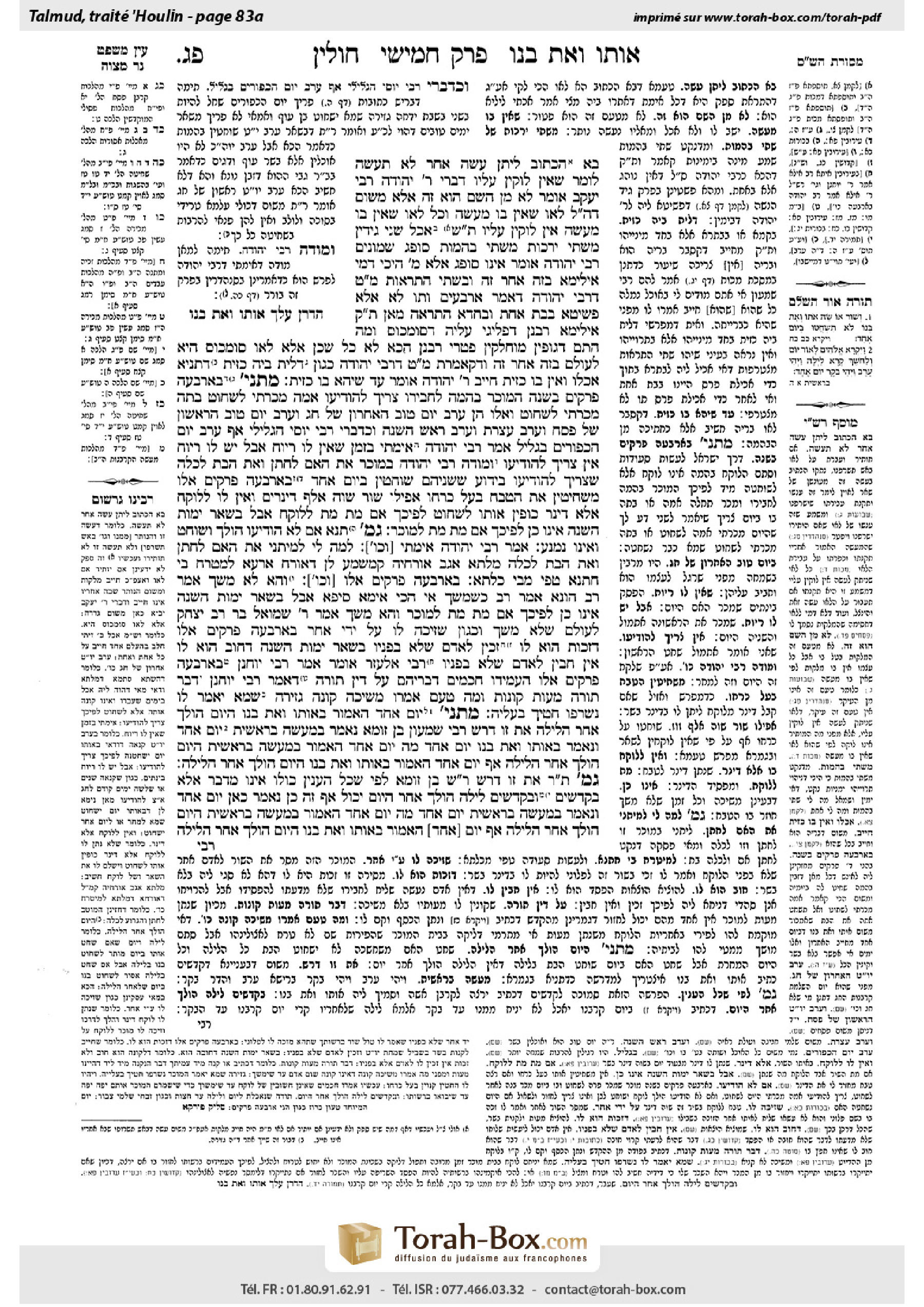
Chullin 83a: Talmud study for Daf Yomi
Study the Talmud for Daf Yomi with scanned pages, Hebrew text, English translations from Sefaria and AI-generated French translations.
Passage selection and English or AI-generated French translation are available where the scan has annotations. Daf Study is independent of Torah-Box and Sefaria.
Browse Chullin · חולין · All tractatesChullin 83a text and translations
This page of Chullin includes the Aramaic text, an English translation and an AI-generated French translation, alongside the scan above.
חולין פ״ג א · Aramaic and Hebrew text
בָּא הַכָּתוּב לִיתֵּן עֲשֵׂה אַחַר לֹא תַּעֲשֶׂה, לוֹמַר שֶׁאֵין לוֹקִין עָלָיו, דִּבְרֵי רַבִּי יְהוּדָה.
רַבִּי יַעֲקֹב אוֹמֵר: לֹא מִן הַשֵּׁם הוּא זֶה, אֶלָּא מִשּׁוּם דְּהָוֵה לֵיהּ לָאו שֶׁאֵין בּוֹ מַעֲשֶׂה, וְכׇל לָאו שֶׁאֵין בּוֹ מַעֲשֶׂה – אֵין לוֹקִין עָלָיו.
תָּא שְׁמַע: אָכַל שְׁנֵי גִידִין מִשְּׁתֵּי יְרֵכוֹת מִשְּׁתֵּי בְהֵמוֹת – סוֹפֵג שְׁמוֹנִים; רַבִּי יְהוּדָה אוֹמֵר: אֵינוֹ סוֹפֵג אֶלָּא אַרְבָּעִים. הֵיכִי דָמֵי? אִילֵּימָא בְּזֶה אַחַר זֶה וּבִשְׁתֵּי הַתְרָאוֹת – מַאי טַעְמָא דְּרַבִּי יְהוּדָה דְּאָמַר: אַרְבָּעִים וְתוּ לָא? אֶלָּא פְּשִׁיטָא בְּבַת אַחַת וּבַחֲדָא הַתְרָאָה.
מַאן תַּנָּא קַמָּא? אִילֵימָא רַבָּנַן דִּפְלִיגִי עֲלֵיהּ דְּסוֹמְכוֹס – וּמָה הָתָם, דְּגוּפִין מוּחְלָקִין, פָּטְרִי רַבָּנַן, הָכָא לֹא כׇּל שֶׁכֵּן? אֶלָּא לָאו סוֹמְכוֹס הִיא!
לְעוֹלָם בְּזֶה אַחַר זֶה, וּדְקָאָמְרַתְּ: מַאי טַעְמָא דְּרַבִּי יְהוּדָה? כְּגוֹן דְּלֵית בֵּיהּ כְּזַיִת, דְּתַנְיָא: אֲכָלוֹ וְאֵין בּוֹ כְּזַיִת – חַיָּיב, רַבִּי יְהוּדָה אוֹמֵר: עַד שֶׁיְּהֵא בּוֹ כְּזַיִת.
מַתְנִי׳ בְּאַרְבָּעָה פְּרָקִים בַּשָּׁנָה, הַמּוֹכֵר בְּהֵמָה לַחֲבֵירוֹ צָרִיךְ לְהוֹדִיעוֹ: ״אִמָּהּ מָכַרְתִּי לִשְׁחוֹט״, ״בִּתָּהּ מָכַרְתִּי לִשְׁחוֹט״. וְאֵלּוּ הֵן: עֶרֶב יוֹם טוֹב הָאַחֲרוֹן שֶׁל חַג, וְעֶרֶב יוֹם טוֹב הָרִאשׁוֹן שֶׁל פֶּסַח, וְעֶרֶב עֲצֶרֶת, וְעֶרֶב רֹאשׁ הַשָּׁנָה. וּכְדִבְרֵי רַבִּי יוֹסֵי הַגְּלִילִי, אַף עֶרֶב יוֹם הַכִּפּוּרִים בַּגָּלִיל.
אָמַר רַבִּי יְהוּדָה: אֵימָתַי – בִּזְמַן שֶׁאֵין לוֹ רֶיוַח, אֲבָל יֵשׁ לוֹ רֶיוַח – אֵין צָרִיךְ לְהוֹדִיעוֹ. וּמוֹדֶה רַבִּי יְהוּדָה בְּמוֹכֵר אֶת הָאֵם לֶחָתָן וְאֶת הַבַּת לַכַּלָּה – שֶׁצָּרִיךְ לְהוֹדִיעוֹ, בְּיָדוּעַ שֶׁשְּׁנֵיהֶם שׁוֹחֲטִין בְּיוֹם אֶחָד.
בְּאַרְבָּעָה פְּרָקִים אֵלּוּ מַשְׁחִיטִין אֶת הַטַּבָּח בְּעַל כׇּרְחוֹ, אֲפִילּוּ שׁוֹר שָׁוֶה אֶלֶף דִּינָרִים וְאֵין לוֹ לְלוֹקֵחַ אֶלָּא דִּינָר – כּוֹפִין אוֹתוֹ לִשְׁחוֹט. לְפִיכָךְ, אִם מֵת – מֵת לַלּוֹקֵחַ. אֲבָל בִּשְׁאָר יְמוֹת הַשָּׁנָה אֵינוֹ כֵּן, לְפִיכָךְ אִם מֵת – מֵת לַמּוֹכֵר.
גְּמָ׳ תָּנָא, אִם לֹא הוֹדִיעוֹ – הוֹלֵךְ וְשׁוֹחֵט וְאֵינוֹ נִמְנָע.
אָמַר רַבִּי יְהוּדָה אֵימָתַי. לְמָה לִי לְמִיתְנֵי אֶת הָאֵם לֶחָתָן וְאֶת הַבַּת לַכַּלָּה? מִלְּתָא אַגַּב אוֹרְחֵיהּ קָמַשְׁמַע לַן, דְּאוֹרַח אַרְעָא לְמִטְרַח בֵּי חַתְנָא טְפֵי מִבֵּי כַלְּתָא.
בְּאַרְבָּעָה פְּרָקִים אֵלּוּ, וְהָא לֹא מָשַׁךְ! אָמַר רַב הוּנָא אָמַר רַב: כְּשֶׁמָּשַׁךְ. אִי הָכִי, אֵימָא סֵיפָא: אֲבָל בִּשְׁאָר יְמוֹת הַשָּׁנָה אֵינוֹ כֵּן, לְפִיכָךְ אִם מֵת – מֵת לַמּוֹכֵר, וְהָא מָשַׁךְ!
אָמַר רַבִּי שְׁמוּאֵל בַּר רַב יִצְחָק: לְעוֹלָם שֶׁלֹּא מָשַׁךְ, וּכְגוֹן שֶׁזִּיכָּה לוֹ עַל יְדֵי אַחֵר, בְּאַרְבָּעָה פְּרָקִים אֵלּוּ דִּזְכוּת הוּא לוֹ – זָכִין לְאָדָם שֶׁלֹּא בְּפָנָיו, בִּשְׁאָר יְמוֹת הַשָּׁנָה דְּחוֹב הוּא לוֹ – אֵין חָבִין לָאָדָם שֶׁלֹּא בְּפָנָיו.
רַבִּי אֶלְעָזָר אוֹמֵר, אָמַר רַבִּי יוֹחָנָן: בְּאַרְבָּעָה פְּרָקִים אֵלּוּ הֶעֱמִידוּ חֲכָמִים דִּבְרֵיהֶם עַל דִּין תּוֹרָה.
דְּאָמַר רַבִּי יוֹחָנָן: דְּבַר תּוֹרָה – מָעוֹת קוֹנוֹת, וּמָה טַעַם אָמְרוּ מְשִׁיכָה קוֹנָה – גְּזֵירָה שֶׁמָּא יֹאמַר לוֹ ״נִשְׂרְפוּ חִטֶּיךָ בַּעֲלִיָּה״.
מַתְנִי׳ ״יוֹם אֶחָד״ הָאָמוּר בְּאוֹתוֹ וְאֶת בְּנוֹ – הַיּוֹם הוֹלֵךְ אַחַר הַלַּיְלָה. אֶת זוֹ דָּרַשׁ רַבִּי שִׁמְעוֹן בֶּן זוֹמָא: נֶאֱמַר בְּמַעֲשֵׂה בְרֵאשִׁית ״יוֹם אֶחָד״, וְנֶאֱמַר בְּאוֹתוֹ וְאֶת בְּנוֹ ״יוֹם אֶחָד״ – מָה ״יוֹם אֶחָד״ הָאָמוּר בְּמַעֲשֵׂה בְרֵאשִׁית הַיּוֹם הוֹלֵךְ אַחַר הַלַּיְלָה, אַף ״יוֹם אֶחָד״ הָאָמוּר בְּאוֹתוֹ וְאֶת בְּנוֹ הַיּוֹם הוֹלֵךְ אַחַר הַלַּיְלָה.
גְּמָ׳ תָּנוּ רַבָּנַן: אֶת זוֹ דָּרַשׁ רַבִּי שִׁמְעוֹן בֶּן זוֹמָא, לְפִי שֶׁכׇּל הָעִנְיָן כּוּלּוֹ אֵינוֹ מְדַבֵּר אֶלָּא בְּקָדָשִׁים, וּבְקָדָשִׁים לַיְלָה הוֹלֵךְ אַחַר הַיּוֹם, יָכוֹל אַף זֶה כֵּן? נֶאֱמַר כָּאן ״יוֹם אֶחָד״, וְנֶאֱמַר בְּמַעֲשֵׂה בְרֵאשִׁית ״יוֹם אֶחָד״, מָה ״יוֹם אֶחָד״ הָאָמוּר בְּמַעֲשֵׂה בְרֵאשִׁית – הַיּוֹם הוֹלֵךְ אַחַר הַלַּיְלָה, אַף יוֹם הָאָמוּר בְּאוֹתוֹ וְאֶת בְּנוֹ – הַיּוֹם הוֹלֵךְ אַחַר הַלַּיְלָה.
Chullin 83a · English translation
The verse comes to provide a positive mitzva to burn the leftovers, in the second part of the verse that states: “But that which remains of it until morning you shall burn with fire.” This positive mitzva is stated after the prohibition against leaving it over was stated in the first part of the verse, to say that one is not flogged for transgressing the prohibition. This is because any prohibition that can be rectified by the performance of a positive mitzva does not carry a punishment of lashes. This is the statement of Rabbi Yehuda. If not for this reason, Rabbi Yehuda evidently would hold that he receives lashes. The forewarning given in this case is uncertain, as he must be forewarned before morning, and at that time he might still consume it.
Rabbi Ya’akov says: This is not for that reason [hashem]. Rather, it is because it is a prohibition that does not involve an action. The transgression is simply the failure to consume all the meat during the allotted time rather than the performance of an action. And one is not flogged for the violation of any prohibition that does not involve an action.
The Gemara suggests: Come and hear a resolution with regard to the opinion of Sumakhos from a baraita discussing the sciatic nerve: If one ate two sciatic nerves from two thighs of two different animals, he incurs the penalty of eighty lashes; Rabbi Yehuda says: He incurs only forty lashes. The Gemara asks: What are the circumstances in this case? If we say that he ate them one after the other and with two separate forewarnings, what is the reasoning of the opinion of Rabbi Yehuda, who says: The violator receives forty lashes and nothing more? After all, he violates two separate prohibitions with two separate forewarnings. Rather, it is obvious that he ate them at the same time and with a single forewarning.
Who is the first tanna, who holds that in such a case one receives eighty lashes? If we say that it is the Rabbis who disagree with Sumakhos in the mishna about: Itself and its offspring, that would contradict their opinion: Now, if there, in that mishna in a case where there are various animals that are separate entities, the Rabbis deem him exempt from a second set of lashes, here, in the baraita about two sciatic nerves, which are not separate entities, should they not all the more so deem him exempt from a second set of lashes? Rather, is it not Sumakhos who is the first tanna? Consequently, in his opinion one who eats the same prohibited item, such as an olive-bulk of forbidden fat, twice after a single forewarning receives two sets of lashes.
The Gemara responds: Actually, he ate the two sciatic nerves one after the other with separate forewarnings, incurring two sets of lashes even according to the Rabbis who disagree with Sumakhos in the mishna about: Itself and its offspring. And as for that which you say: What is the reason of Rabbi Yehuda who holds that the transgressor incurs only a single set of lashes? This is a case where the volume of one of the sciatic nerves is not even an olive-bulk, and Rabbi Yehuda follows his line of reasoning, as it is taught in a baraita: If one ate the entire sciatic nerve, and its volume is not even an olive-bulk, he is liable to incur forty lashes; Rabbi Yehuda says: He is not liable unless it has a volume of at least an olive-bulk.
MISHNA: On four occasions during the year one who sells an animal to another is required to inform him: I sold the mother of this animal today for the buyer to slaughter it,or: I sold the daughter of this animal today for the buyer to slaughter it. And those four occasions are: The eve of the last day of the festival of Sukkot, the eve of the first day of the festival of Passover, and the eve of Shavuot, and the eve of Rosh HaShana. And according to the statement of Rabbi Yosei HaGelili, the eve of Yom Kippur in the Galilee is included as well.
Rabbi Yehuda said: When must he inform the buyer on those days? He must do so at a time when the seller has no interval between the sale of the mother and the offspring, as they were both sold on that day. But if the seller has an interval between the sales, he does not need to inform the buyer, as presumably each buyer purchased the animal to slaughter it on the day he purchased it. And Rabbi Yehuda concedes that in a case where one sells the mother animal to the groom and the offspring to the bride, that even if he did not sell them on the same day, he must inform the buyer, as it is obvious that they are both planning to slaughter their animal on one day, for their wedding feast.
On those four occasions, one compels the butcher to slaughter animals even against his will; even if there is a bull worth one thousand dinars and the buyer has only one dinar worth of meat, i.e., he already paid the butcher for one dinar’s worth of meat, one compels him to slaughter the animal and give him a dinar’s worth of meat. Therefore, if the bull dies before slaughter, although no act of acquisition was performed, it dies at the expense of the buyer, and he loses his dinar. But during the rest of the days of the year it is not so. On other days, until the buyer performs the act of pulling to assume ownership of the portion of the bull that he is purchasing, the bull remains in the butcher’s possession. Therefore, if the bull dies before the transaction is complete, it dies at the expense of the seller, who returns the buyer’s money.
GEMARA: The mishna teaches that on the four occasions mentioned it is the seller’s responsibility to inform the purchaser that the mother or offspring of the animal he is purchasing was sold that day. With regard to this it is taught: Consequently, the purchaser has no obligation to clarify the situation, and if the seller did not inform him, the purchaser may go and slaughter the animal he has purchased and need not refrain from doing so.
The mishna teaches that Rabbi Yehuda says: When must he inform the buyer on those days? It then teaches: And Rabbi Yehuda concedes that in a case where one sold the mother animal to the groom and the offspring to the bride, even if he did not sell them on the same day, he must inform the buyer. The Gemara asks: Why do I need to teach that the butcher sold specifically the mother animal to the groom and the offspring to the bride? It could have taught: He sold one to the groom and the other to the bride. The Gemara answers: It teaches us a related matter in passing, that it is proper conduct for the groom’s household to exert more effort than the bride’s household in the marriage preparations. Therefore, the groom purchases the mother, the larger animal, while the bride purchases the smaller animal, the offspring.
§ The mishna teaches: On those four occasions, one compels the butcher to slaughter animals even against his will, and even if there is a bull worth one thousand dinars and the buyer has paid for only one dinar’s worth of meat, one compels him to slaughter the animal. Therefore, if the bull dies before slaughter, it dies at the expense of the buyer. The Gemara challenges: But the buyer did not yet pull the animal to effect acquisition; consequently, although he paid the seller, the animal is not his. Rav Huna said that Rav said: The case is where he pulled it, and thereby acquired it. The Gemara asks: If so, say the latter clause: But during the rest of the days of the year it is not so. Therefore, if the bull dies, it dies at the expense of the seller, who returns the buyer’s money. But according to Rav, didn’t the buyer pull the animal? If so, why is its death at the expense of the seller?
Rabbi Shmuel bar Rav Yitzḥak said: Actually, the case in the mishna is one where the buyer did not pull the animal, and it is a case where the seller transfers ownership to the customer by means of another person, i.e., by instructing another to acquire a dinar’s worth of the ox’s meat on the customer’s behalf, without having obtained the customer’s consent. Therefore, on those four occasions, where it is for the customer’s benefit, as he wants meat for the Festival, the principle: One can act in a person’s interest in his absence, applies. By contrast, during the rest of the days of the year, where it is to the customer’s disadvantage to acquire the meat before the bull is slaughtered, as he does not want to incur avoidable expenses, one cannot act to the disadvantage of another person in his absence. Therefore, if the bull dies, it is at the expense of the seller.
Rabbi Elazar says that Rabbi Yoḥanan says that there is a different explanation: On those four occasions the Sages based their statement on the Torah law that giving money effects acquisition, and therefore, the payment of the buyer acquires the meat for him with no need for pulling.
As Rabbi Yoḥanan says: By Torah law, giving money effects the acquisition of movable property with no need for pulling. And what is the reason that the Sages said that pulling effects acquisition? It is a rabbinic decree lest the seller, once he receives the money, be unconcerned about the welfare of the movable property that he has sold, and, for example, not protect it from fire, so that he will say to the buyer: Your wheat was burned in the upper story of my house and I have no responsibility for it. For the benefit of rejoicing on the Festival, the Sages ordained that Torah law remains in effect on those four occasions and the buyer’s money effects acquisition, and one compels the butcher to slaughter animals even against his will.
MISHNA: With regard to the phrase “one day” that is stated with regard to the prohibition against slaughtering an animal itself and its offspring, the day follows the night. Therefore, one may slaughter an animal during the day and slaughter its offspring that night, but one may not slaughter an animal at night and slaughter its offspring the following day. Rabbi Shimon ben Zoma derived this by means of a verbal analogy. It is stated in the act of Creation: “One day” (Genesis 1:5), and it is stated with regard to the slaughter of an animal itself and its offspring: “One day” (Leviticus 22:28). Just as concerning the phrase “one day” that is stated in the act of Creation, the day follows the night, so too concerning the phrase “one day” that is stated with regard to the slaughter of an animal itself and its offspring, the day follows the night.
GEMARA: The Sages taught in a baraita: Rabbi Shimon ben Zoma taught this explanation: Because the entire section of the Torah where the prohibition: Itself and its offspring, appears speaks only about sacrificial animals, and with regard to sacrificial animals the night follows the day, one might have thought that even with regard to this prohibition it is so. Therefore, the following derivation is required: It is stated here, with regard to the slaughter of an animal and its offspring: “One day,” and it is stated in the act of Creation: “One day.” Just as concerning the phrase “one day” that is stated in the act of Creation, the day follows the night, so too concerning the phrase “one day” that is stated with regard to the slaughter of an animal itself and its offspring, the day follows the night.
Chullin 83a · Traduction française (IA)
La citation vient préciser une positive mitsva de brûler les restes, dans la deuxième partie de la citation qui stipule : « Mais ce qui reste jusqu'au matin, tu le brûleras avec le feu. » Cette positive mitsva est mentionnée après la prohibition de laisser les restes, afin de dire qu'on ne fouette pas celui qui transgresse cette prohibition. Cela est dû au fait que toute prohibition pouvant être rectifiée par la performance d'une positive mitsva ne subit pas de punition de fouet. C'est la déclaration du Rabbi Yéhuda. Si ce n'était pas pour cela, le Rabbi Yéhuda aurait vraisemblablement considéré qu'il recevait des fouets. La prévenance dans ce cas est incertaine, car il doit être prévenu avant le matin, et à ce moment-là il pourrait encore en consommer.
Le Rabbi Yaakov dit : Ce n'est pas pour cette raison [hashem]. Plutôt, c'est parce que c'est une prohibition qui ne concerne pas une action. La transgression est simplement le fait de ne pas consommer toute la viande durant la période assignée, et non la performance d'une action. Et on ne fouette pas pour la violation d'une prohibition qui ne concerne pas une action.
La Guemara suggère : Viens écouter une résolution concernant l'opinion du Sumakhos, à partir d'une baraïta discutant du nerf sciatique : Si l'on a mangé deux nerfs sciatiques provenant de deux cuisses de deux animaux différents, il subit la peine de soixante-dix coups de fouet ; le Rabbi Yéhuda dit : Il subit seulement quarante coups de fouet. La Guemara demande : Quelles sont les circonstances dans ce cas ? Si nous disons qu'il les a mangés l'un après l'autre et avec deux prévenances séparées, quelle est la raison de l'opinion du Rabbi Yéhuda, qui dit qu'il subit quarante coups de fouet et rien de plus ? Après tout, il viole deux prohibitions séparées avec deux prévenances séparées. Plutôt, il est évident qu'il les a mangés en même temps et avec une seule prévenance.
Qui est le premier tanna, celui qui considère qu'on subit soixante-dix coups de fouet dans ce cas ? Si nous disons que c'est les Rabbins qui s'opposent à Sumakhos dans la mitsva concernant : Lui-même et ses descendants, cela contredirait leur opinion : Maintenant, si là, dans cette mitsva, dans un cas où il y a divers animaux qui sont des entités séparées, les Rabbins considèrent qu'il est exempt d'un second ensemble de coups de fouet, ici, dans la baraïta concernant deux nerfs sciatiques, qui ne sont pas des entités séparées, ne devraient-ils pas encore plus considérer qu'il est exempt d'un second ensemble de coups de fouet ? Plutôt, n'est-ce pas Sumakhos qui est le premier tanna ? Ainsi, selon son opinion, celui qui mange le même objet interdit, comme une quantité d'huile prohibée, deux fois après une seule prévenance subit deux ensembles de coups de fouet.
La Guemara répond : En réalité, il a mangé les deux nerfs sciatiques l'un après l'autre avec des prévenances séparées, subissant deux ensembles de coups de fouet même selon les Rabbins qui s'opposent à Sumakhos dans la mitsva concernant : Lui-même et ses descendants. Et concernant ce que vous dites : Quelle est la raison du Rabbi Yéhuda qui considère que le transgresseur subit un seul ensemble de coups de fouet ? C'est un cas où le volume d'un des nerfs sciatiques n'est même pas une quantité d'huile, et le Rabbi Yéhuda suit sa ligne de raisonnement, comme il est enseigné dans une baraïta : Si l'on a mangé tout le nerf sciatique, et que son volume n'est même pas une quantité d'huile, il est tenu responsable de quarante coups de fouet ; le Rabbi Yéhuda dit : Il n'est pas tenu responsable à moins qu'il ait un volume d'au moins une quantité d'huile.
MICHNA : Quatre fois par an, celui qui vend un animal à un autre doit informer celui-ci : J'ai vendu la mère de cet animal aujourd'hui pour que l'acheteur le sacrifie, ou : J'ai vendu la fille de cet animal aujourd'hui pour que l'acheteur le sacrifie. Et ces quatre occasions sont : La veille de la dernière journée du festival de la Tabernacle, la veille de la première journée du festival de la Pâque, et la veille de Shavuot, et la veille de Rosh HaShana. Selon l'opinion du Rabbi Yosei HaGelili, la veille de Yom Kippur dans la Galilée est également incluse.
Le Rabbi Yéhuda dit : Quand doit-il informer l'acheteur ces jours-là ? Il doit le faire à un moment où le vendeur n'a pas d'intervalle entre la vente de la mère et de l'offspring, car ils ont tous les deux été vendus ce jour-là. Mais si le vendeur a un intervalle entre les ventes, il n'a pas besoin d'informer l'acheteur, car on suppose que chaque acheteur a acheté l'animal pour le sacrifier le jour où il l'a acheté. Et le Rabbi Yéhuda reconnaît que dans un cas où l'on vend l'animal mère au mari et l'offspring à la mariée, même s'ils n'ont pas été vendus le même jour, il doit informer l'acheteur, car il est évident qu'ils prévoient tous deux de sacrifier leur animal le même jour, pour leur festin de mariage.
Sur ces quatre occasions, on force le boucher à sacrifier les animaux même contre sa volonté ; même si c'est un taureau d'une valeur de mille dinars et que l'acheteur n'a qu'un dinar de viande, c'est-à-dire qu'il a déjà payé au boucher une viande d'un dinar, on force le boucher à sacrifier l'animal et à lui donner une viande d'un dinar. Ainsi, si le taureau meurt avant le sacrifice, bien qu'aucune acquisition n'ait été effectuée, il meurt à charge de l'acheteur, et il perd son dinar. Mais pendant les autres jours de l'année, ce n'est pas ainsi. Sur d'autres jours, jusqu'à ce que l'acheteur effectue l'acte de tirage pour prendre possession de la part du taureau qu'il achète, le taureau reste en possession du boucher. Ainsi, si le taureau meurt avant que la transaction ne soit terminée, il meurt à charge du vendeur, qui rend l'argent à l'acheteur.
GUEMARA : La mitsva enseigne que sur les quatre occasions mentionnées, c'est la responsabilité du vendeur d'informer l'acheteur que la mère ou l'offspring de l'animal qu'il achète a été vendu ce jour-là. À ce sujet, il est enseigné : Ainsi, l'acheteur n'a pas d'obligation de clarifier la situation, et si le vendeur ne l'a pas informé, l'acheteur peut aller sacrifier l'animal qu'il a acheté et n'a pas besoin de s'en abstenir.
La Michna enseigne que Rabbi Yéhuda dit : Quand doit-on informer l'acheteur sur ces jours ? Elle enseigne ensuite : Et Rabbi Yéhuda reconnaît que dans le cas où l'on vend l'animal mère au mari et les petits à la mariée, même si l'on n'a pas vendu les deux le même jour, il faut informer l'acheteur. La Guemara demande : Pourquoi faut-il enseigner spécifiquement que le boucher a vendu l'animal mère au mari et les petits à la mariée ? Il aurait pu enseigner : Il a vendu l'un au mari et l'autre à la mariée. La Guemara répond : Cela nous apprend une chose connexe, à savoir que c'est la conduite appropriée que la maison du mari exerce plus d'efforts que la maison de la mariée dans les préparatifs du mariage. Ainsi, le mari achète l'animal mère, l'animal plus grand, tandis que la mariée achète l'animal plus petit, les petits.
§ La Michna enseigne : Sur ces quatre occasions, on force le boucher à sacrifier les animaux même contre sa volonté, et même si il y a un taureau valant mille dinars et que l'acheteur a payé seulement un dinar de viande, on force le boucher à sacrifier l'animal. Ainsi, si le taureau meurt avant la sacrifice, il meurt à charge de l'acheteur. La Guemara conteste : Mais l'acheteur n'a pas encore tiré l'animal pour effectuer l'acquisition ; par conséquent, bien qu'il ait payé au vendeur, l'animal n'est pas à lui. Rav Huna dit que Rav a dit : Le cas est celui où il l'a tiré et donc acquis. La Guemara demande : Si c'est ainsi, disons la clause suivante : Mais durant les autres jours de l'année, ce n'est pas ainsi. Ainsi, si le taureau meurt, il meurt à charge du vendeur, qui rend l'argent à l'acheteur. Mais selon Rav, n'a-t-il pas tiré l'animal ? Si c'est ainsi, pourquoi la mort du taureau est-elle à charge du vendeur ?
Rabbi Shmuel bar Rav Yitzḥak dit : En réalité, le cas de la Michna est celui où l'acheteur n'a pas tiré l'animal, et c'est un cas où le vendeur transfère la propriété à l'acheteur par l'intermédiaire d'une autre personne, c'est-à-dire en instruisant une autre personne d'acquérir un dinar de viande du taureau à la place de l'acheteur, sans avoir obtenu l'accord de l'acheteur. Ainsi, sur ces quatre occasions, où c'est à l'avantage de l'acheteur, car il veut de la viande pour la fête, le principe : On peut agir dans l'intérêt d'une personne en son absence, s'applique. À l'inverse, durant les autres jours de l'année, où il est à l'avantage de l'acheteur d'acquérir la viande avant que le taureau ne soit sacrifié, car il ne veut pas encourir des dépenses inutiles, on ne peut pas agir à l'avantage d'une autre personne en son absence. Ainsi, si le taureau meurt, c'est à charge du vendeur.
Rabbi Eléazar dit que Rabbi Yoḥanan dit que l'explication est différente : Sur ces quatre occasions, les Sages ont fondé leur déclaration sur la loi talmudique selon laquelle le paiement efface l'acquisition, et donc, le paiement de l'acheteur acquiert la viande pour lui sans nécessiter de tirer.
Comme Rabbi Yoḥanan dit : Selon la loi talmudique, le paiement efface l'acquisition des biens mobiles sans nécessiter de tirer. Et pourquoi les Sages ont-ils dit que le tirage efface l'acquisition ? C'est un décret rabbinique afin que le vendeur, une fois qu'il reçoit l'argent, ne néglige pas le bien mobile qu'il a vendu, et, par exemple, ne le protège pas contre l'incendie, de sorte qu'il dira à l'acheteur : Votre blé a brûlé dans l'étage supérieur de ma maison et je n'ai pas de responsabilité à avoir à son égard. Pour le bénéfice de la joie de la fête, les Sages ont ordonné que la loi talmudique reste en vigueur sur ces quatre occasions et que l'argent de l'acheteur efface l'acquisition, et qu'on force le boucher à sacrifier les animaux même contre sa volonté.
MICHNA : Concernant la phrase « un jour » qui est mentionnée concernant l'interdiction de sacrifier un animal et son petit, le jour suit la nuit. Ainsi, on peut sacrifier un animal pendant la journée et sacrifier son petit la nuit, mais on ne peut pas sacrifier un animal la nuit et sacrifier son petit le lendemain. Rabbi Shimon ben Zoma a tiré cette conclusion par analogie verbale. Il est dit dans l'acte de Création : « Un jour » (Genèse 1:5), et il est dit concernant la sacrifice d'un animal et de son petit : « Un jour » (Lévitique 22:28). Comme concernant la phrase « un jour » qui est mentionnée dans l'acte de Création, le jour suit la nuit, ainsi aussi concernant la phrase « un jour » qui est mentionnée concernant la sacrifice d'un animal et de son petit, le jour suit la nuit.
GUEMARA : Les Sages ont enseigné dans une baraïta : Rabbi Shimon ben Zoma a enseigné cette explication : Parce que toute la section de la Torah où l'interdiction : Lui-même et son petit, apparaît, parle uniquement des animaux sacrés, et concernant les animaux sacrés la nuit suit la journée, on aurait pu penser que même concernant cette interdiction, c'est ainsi. Ainsi, la dérivation suivante est nécessaire : Il est dit ici, concernant la sacrifice d'un animal et de son petit : « Un jour », et il est dit dans l'acte de Création : « Un jour ». Comme concernant la phrase « un jour » qui est mentionnée dans l'acte de Création, le jour suit la nuit, ainsi aussi concernant la phrase « un jour » qui est mentionnée concernant la sacrifice d'un animal et de son petit, le jour suit la nuit.
Traduction française générée par IA à partir de l’édition anglaise de Sefaria. Vérifie toujours un passage avec le texte source.
Text from Sefaria: William Davidson Edition - Vocalized Aramaic (unknown); William Davidson Edition - English (CC BY NC).