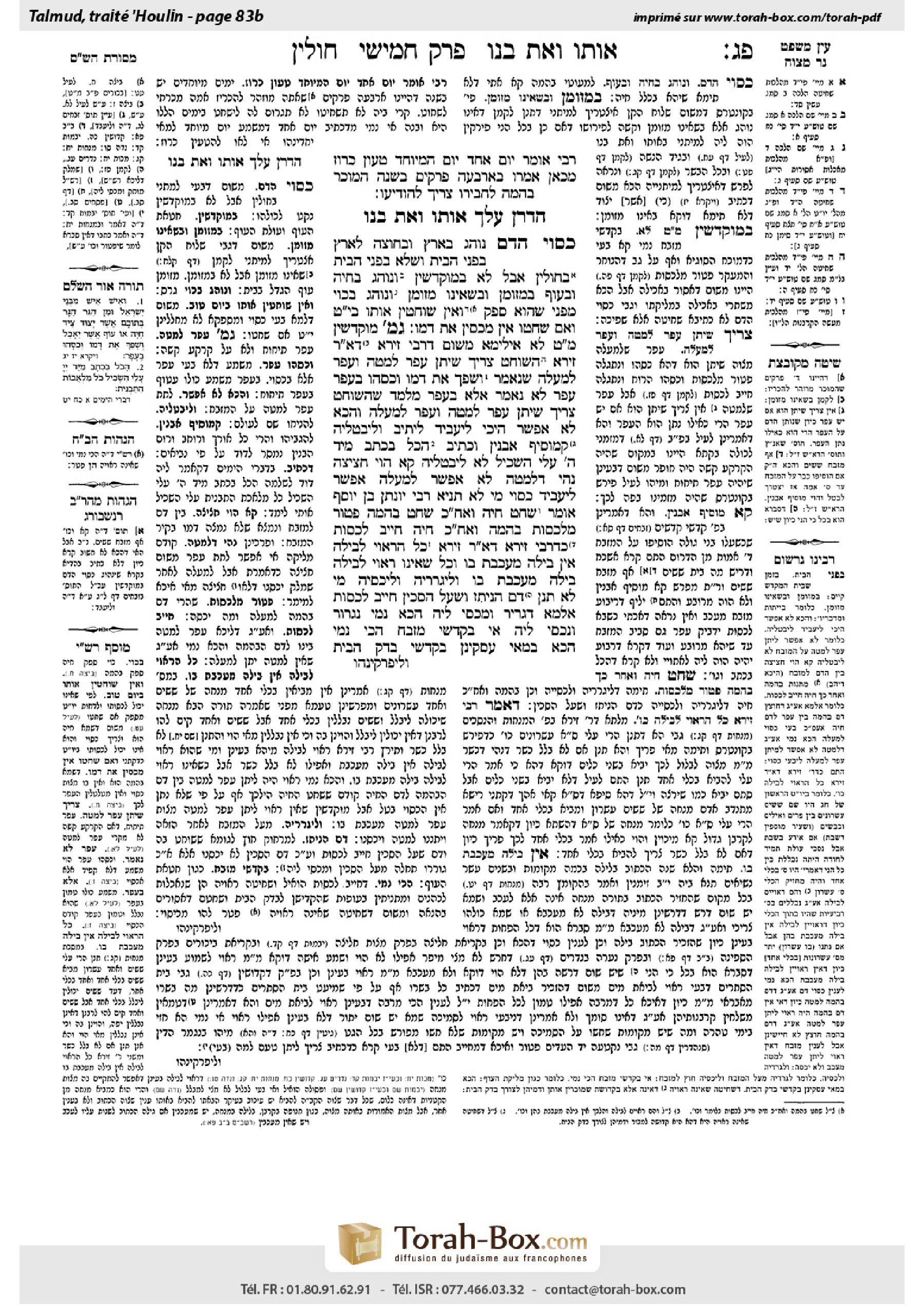
Chullin 83b: Talmud study for Daf Yomi
Study the Talmud for Daf Yomi with scanned pages, Hebrew text, English translations from Sefaria and AI-generated French translations.
Passage selection and English or AI-generated French translation are available where the scan has annotations. Daf Study is independent of Torah-Box and Sefaria.
Browse Chullin · חולין · All tractatesChullin 83b text and translations
This page of Chullin includes the Aramaic text, an English translation and an AI-generated French translation, alongside the scan above.
חולין פ״ג ב · Aramaic and Hebrew text
רַבִּי אוֹמֵר: ״יוֹם אֶחָד״ – יוֹם הַמְיוּחָד טָעוּן כָּרוֹז, מִכָּאן אָמְרוּ: בְּאַרְבָּעָה פְּרָקִים בַּשָּׁנָה הַמּוֹכֵר בְּהֵמָה לַחֲבֵירוֹ צָרִיךְ לְהוֹדִיעוֹ.
הֲדַרַן עֲלָךְ אוֹתוֹ וְאֶת בְּנוֹ.
מַתְנִי׳ כִּסּוּי הַדָּם נוֹהֵג בָּאָרֶץ וּבְחוּצָה לָאָרֶץ, בִּפְנֵי הַבַּיִת וְשֶׁלֹּא בִּפְנֵי הַבַּיִת, בְּחוּלִּין אֲבָל לֹא בְּמוּקְדָּשִׁין, וְנוֹהֵג בַּחַיָּה וּבָעוֹף, בִּמְזוּמָּן וּבְשֶׁאֵינוֹ מְזוּמָּן, וְנוֹהֵג בְּכוֹי מִפְּנֵי שֶׁהוּא סָפֵק.
וְאֵין שׁוֹחֲטִין אוֹתוֹ בְּיוֹם טוֹב, וְאִם שְׁחָטוֹ – אֵין מְכַסִּין אֶת דָּמוֹ.
גְּמָ׳ מוּקְדָּשִׁין מַאי טַעְמָא לָא? אִילֵּימָא מִשּׁוּם דְּרַבִּי זֵירָא, דְּאָמַר רַבִּי זֵירָא: הַשּׁוֹחֵט צָרִיךְ שֶׁיִּתֵּן עָפָר לְמַטָּה וְעָפָר לְמַעְלָה, שֶׁנֶּאֱמַר: ״וְשָׁפַךְ אֶת דָּמוֹ וְכִסָּהוּ בֶּעָפָר״ – ״עָפָר״ לֹא נֶאֱמַר, אֶלָּא ״בְּעָפָר״, מְלַמֵּד שֶׁהַשּׁוֹחֵט צָרִיךְ שֶׁיִּתֵּן עָפָר לְמַטָּה וְעָפָר לְמַעְלָה.
וְהָכָא לָא אֶפְשָׁר, הֵיכִי לֶיעְבֵּיד? לִיתֵּיב וְלִיבַטְּלֵיהּ – קָמוֹסֵיף אַבִּנְיָן, וּכְתִיב: ״הַכֹּל בִּכְתָב מִיַּד ה׳ עָלַי הִשְׂכִּיל״.
לָא לִיבַטְּלֵיהּ – קָא הָוֵי חֲצִיצָה.
נְהִי דִּלְמַטָּה לָא אֶפְשָׁר, לְמַעְלָה אֶפְשָׁר, לֶיעְבֵּיד כִּסּוּי!
מִי לָא תַּנְיָא, רַבִּי יוֹנָתָן בֶּן יוֹסֵף אוֹמֵר: שָׁחַט חַיָּה וְאַחַר כָּךְ שָׁחַט בְּהֵמָה – פָּטוּר מִלְּכַסּוֹת, בְּהֵמָה וְאַחַר כָּךְ חַיָּה – חַיָּיב לְכַסּוֹת.
כִּדְרַבִּי זֵירָא, דְּאָמַר רַבִּי זֵירָא: כׇּל הָרָאוּי לְבִילָּה – אֵין בִּילָּה מְעַכֶּבֶת בּוֹ, וְכֹל שֶׁאֵינוֹ רָאוּי לְבִילָּה – בִּילָּה מְעַכֶּבֶת בּוֹ.
וְלִיגְרְרֵיהּ וְלִיכַסְּיֵהּ? מִי לָא תְּנַן: דָּם הַנִּיתָּז וְשֶׁעַל הַסַּכִּין חַיָּיב לְכַסּוֹת? אַלְמָא דְּגָרֵיר וּמְכַסֵּי לֵיהּ, הָכָא נָמֵי נִגְרוֹר וּנְכַסֵּי לֵיהּ!
אִי בְּקׇדְשֵׁי מִזְבֵּחַ – הָכִי נָמֵי, הָכָא בְּמַאי עָסְקִינַן? בְּקׇדְשֵׁי בֶּדֶק הַבַּיִת.
Chullin 83b · English translation
§ Rabbi Yehuda HaNasi says: The verse: “You shall not slaughter it and its offspring both in one day” (Leviticus 22:28), is referring to a special day, and it indicates that a special day requires a proclamation to prevent buyers from slaughtering an animal together with its offspring on that day. From here is derived that which is stated in the mishna: On four occasions during the year, which are special days, one who sells an animal to another must inform him: I sold its mother for slaughter, or: I sold its offspring for slaughter.
MISHNA: The mitzva of covering the blood after slaughter is in effect both in Eretz Yisrael and outside of Eretz Yisrael, both in the presence, i.e., the time, of the Temple and not in the presence of the Temple. And it is in effect with regard to non-sacred animals, but it is not in effect with regard to sacrificial ones. And it is in effect with regard to the slaughter of an undomesticated animal and a bird, with regard to animals and birds that are readily available in his home, and with regard to those that are not readily available and are hunted in the wild. And it is in effect with regard to a koy, because it is uncertain whether a koy is a domesticated animal and one is exempt from the covering of its blood or whether it is an undomesticated animal and one is obligated to cover it.
And one may not slaughter a koy on a Festival, because covering its blood entails the performance of prohibited labor that is permitted only if there is a definite obligation to cover the blood. And if one slaughtered a koy on a Festival after the fact, one does not cover its blood until after the Festival.
GEMARA: The Gemara asks: What is the reason one is not obligated to cover the blood of sacrificial birds? If we say it is because of the statement of Rabbi Zeira, that is difficult. As Rabbi Zeira says: One who slaughters a bird or an undomesticated animal must place earth beneath the blood and earth above it, as it is stated: “And he shall pour out its blood and cover it with earth” (Leviticus 17:13). It is not stated: Cover it with earth, but rather, “in earth,” indicating that the blood must be concealed inside the earth. The verse teaches that one who slaughters a bird or undomesticated animal must place earth beneath the blood and earth above the blood.
The Gemara continues: And here, with regard to a bird offering, whose blood is presented on the altar, it is not possible for one to cover the blood with earth from beneath it. As how should one perform the covering of the blood? If one suggests that he should place earth on the altar and nullify that earth to the altar such that it will never be removed from there, this is unfeasible, since by nullifying the earth to the altar, he is adding to the structure of the altar. And it is written with regard to the construction of the Temple: “All was in writing, from the hand of the Lord, which He gave me to understand” (I Chronicles 28:19), indicating that the dimensions of the Temple and all the vessels within were given prophetically and are therefore not subject to change.
And if one suggests that he should not nullify the earth to the altar, this too is problematic, as the earth constitutes an interposition between the blood of the bird and the altar.
The Gemara explains why this statement of Rabbi Zeira does not sufficiently explain why one is not required to cover the blood of sacrificial birds. Granted that it is impossible to place earth beneath the blood of the bird, but it is possible to place earth above the blood of the bird. If so, let him perform a covering of the blood from above.
The Gemara explains this suggestion: Isn’t it taught in a baraita that Rabbi Yonatan ben Yosef says: If one slaughtered an undomesticated animal, whose blood requires covering, and thereafter slaughtered a domesticated animal, whose blood does not require covering, in the same location as the undomesticated animal, he is exempt from the obligation to cover the blood of the undomesticated animal, as it is covered with the blood of the domesticated animal. But if one slaughtered a domesticated animal and thereafter slaughtered an undomesticated animal he is obligated to cover the latter’s blood despite the fact that there is no earth, but rather blood of the domesticated animal, beneath it. It is evident from this baraita that the mitzva of covering the blood applies even when earth cannot be placed beneath the blood.
The Gemara responds: The exclusion of sacrificial birds from the mitzva of covering the blood, even from above, is in accordance with another statement of Rabbi Zeira, as Rabbi Zeira says with regard to meal offerings: For any measure of flour that is suitable for mixing with oil in a meal offering, the lack of mixing does not invalidate the meal offering. Even though there is a mitzva to mix the oil with the flour ab initio, the meal offering is fit for sacrifice even if the oil and the flour are not mixed together. And for any measure of flour that is not suitable for mixing with oil in a meal offering, the lack of mixing invalidates the meal offering. Similarly, if one slaughtered a domesticated animal and thereafter an undomesticated animal, since it was possible to cover the blood of the former before slaughtering the latter, which would allow the proper fulfillment of the mitzva of covering the blood, one is still obligated to cover the blood from above. By contrast, it is always impossible to properly perform the mitzva in the case of sacrificial birds.
The Gemara asks: Still, why is the mitzva of covering the blood not applicable to sacrificial birds? Let one scrape the blood off the altar and cover it elsewhere. Didn’t we learn in a mishna (87b): With regard to blood that spurts outside the pit in which the animal was slaughtered, and blood that remained on the slaughtering knife, one is obligated to cover it? Evidently, the halakha is that one may scrape off the blood and cover it in a location other than where it spilled out. Here too, let us scrape the blood of a sacrificial bird off the altar and cover it elsewhere.
The Gemara answers: If the ruling of the mishna was dealing with items consecrated for the altar, indeed, the blood must be scraped off and covered elsewhere. But here we are dealing with items consecrated for Temple maintenance, i.e., birds donated to the Temple in order to be sold, the profits of which would be used for repairs. Such birds may not be slaughtered, and if one transgressed and slaughtered them it is prohibited to derive any benefit from them. The tanna of the mishna holds that the mitzva of covering the blood does not apply to a slaughtered animal that is forbidden for consumption.
Chullin 83b · Traduction française (IA)
§ Rabbi Yehuda HaNasi dit : La parole : « Tu ne tueras pas l'animal et son petit le même jour » (Lévitique 22:28), fait référence à un jour spécial, et elle indique qu'un jour spécial nécessite une proclamation afin d'empêcher les acheteurs de tuer un animal avec son petit le même jour. De là découle ce qui est dit dans la mitsna : Pendant quatre occasions de l'année, qui sont des jours spéciaux, celui qui vend un animal à un autre doit l'informer : « J'ai vendu sa mère pour la bête à abattre », ou : « J'ai vendu son petit pour la bête à abattre ».
MICHNA : La mitsva de recouvrir le sang après l'abattage est en vigueur en Terre d'Israël et en dehors de Terre d'Israël, à l'époque du Temple et non pas lorsqu'il n'y a pas de Temple. Elle est en vigueur concernant les animaux non sacrés, mais pas concernant les animaux sacrés. Elle est en vigueur concernant l'abattage d'un animal sauvage et d'un oiseau, concernant les animaux et les oiseaux disponibles à la maison, ainsi que ceux qui ne sont pas disponibles et qui sont chassés en plein air. Elle est en vigueur concernant le koy, car on ne sait pas s'il s'agit d'un animal domestique et qu'on est exempt de recouvrir son sang ou s'il s'agit d'un animal sauvage et qu'on est tenu de recouvrir son sang.
Et on ne peut pas abattre un koy pendant un festival, car le recouvrement de son sang implique l'accomplissement d'un travail interdit, autorisé uniquement si l'obligation de recouvrir le sang est certaine. Et si l'on a abattu un koy pendant un festival après coup, on ne recouvre pas son sang avant la fin du festival.
GUEMARA : La Guemara pose la question : Quelle est la raison pour laquelle on n'est pas tenu de recouvrir le sang des oiseaux sacrés ? Si on dit que c'est en raison de la déclaration de Rabbi Zeira, cela est difficile. Car Rabbi Zeira dit : Celui qui abat un oiseau ou un animal sauvage doit placer de la terre sous le sang et de la terre au-dessus, comme il est dit : « Et il versera son sang et le recouvrera de terre » (Lévitique 17:13). Il n'est pas dit : « Recouvre-le de terre », mais plutôt : « dans la terre », ce qui indique que le sang doit être caché à l'intérieur de la terre. La parole enseigne que celui qui abat un oiseau ou un animal sauvage doit placer de la terre sous le sang et de la terre au-dessus du sang.
La Guemara continue : Et ici, concernant l'offrande d'oiseau, dont le sang est présenté sur l'autel, il n'est pas possible de recouvrir le sang avec de la terre sous lui. Comment devrait-on accomplir le recouvrement du sang ? Si l'on suggère qu'il devrait placer de la terre sur l'autel et l'annuler avec l'autel de sorte qu'elle ne soit jamais retirée d'où elle est, cela est impossible, car en annulant la terre avec l'autel, on ajoute à la structure de l'autel. Et il est écrit concernant la construction du Temple : « Tout était écrit, de la main du Seigneur, qui m'a donné à comprendre » (I Chron 28:19), ce qui indique que les dimensions du Temple et tous les ustensiles à l'intérieur étaient donnés prophétiquement et ne sont donc pas sujets à modification.
Et si l'on suggère qu'il ne devrait pas annuler la terre avec l'autel, cela est également problématique, car la terre constitue un interposition entre le sang de l'oiseau et l'autel.
La Guemara explique pourquoi cette déclaration de Rabbi Zeira ne suffit pas à expliquer pourquoi on n'est pas tenu de recouvrir le sang des oiseaux sacrés. Bien que ce soit impossible de placer de la terre sous le sang de l'oiseau, il est possible de placer de la terre au-dessus du sang de l'oiseau. Si tel est le cas, qu'on recouvre le sang d'en haut.
La Guemara explique cette suggestion : N'est-ce pas enseigné dans une baraïta que Rabbi Yonatan ben Yosef dit : Si l'on a abattu un animal sauvage, dont le sang exige un recouvrement, et ensuite un animal domestique, dont le sang ne nécessite pas de recouvrement, dans le même lieu que l'animal sauvage, on est exempt de l'obligation de recouvrir le sang de l'animal sauvage, car il est recouvert par le sang de l'animal domestique. Mais si l'on a abattu un animal domestique et ensuite un animal sauvage, on est tenu de recouvrir le sang de ce dernier, même s'il n'y a pas de terre, mais plutôt le sang de l'animal domestique, sous lui. Il est évident de cette baraïta que la mitsva de recouvrir le sang s'applique même lorsque la terre ne peut pas être placée sous le sang.
La Guemara répond : L'exclusion des oiseaux sacrifiés de la mitsva de recouvrement du sang, même d'en haut, s'inscrit en conformité avec une autre déclaration de Rabbi Zeira, car Rabbi Zeira dit concernant les offrandes de farine : Pour toute mesure de farine adaptée à la mélange avec l'huile dans une offrande de farine, l'absence de mélange ne rend pas l'offrande invalide. Même si l'on a une mitsva de mélanger l'huile avec la farine dès le début, l'offrande est propre à l'offrande même si l'huile et la farine ne sont pas mélangées ensemble. Et pour toute mesure de farine non adaptée à la mélange avec l'huile dans une offrande de farine, l'absence de mélange rend l'offrande invalide. De même, si l'on a abattu un animal domestique et ensuite un animal sauvage, puisque l'on pouvait recouvrir le sang de l'animal domestique avant l'abattage de l'animal sauvage, ce qui permettrait d'accomplir correctement la mitsva de recouvrement du sang, on est encore tenu de recouvrir le sang d'en haut. En revanche, il est toujours impossible d'accomplir correctement la mitsva dans le cas des oiseaux sacrifiés.
La Guemara pose la question : Toutefois, pourquoi la mitsva de recouvrement du sang ne s'applique-t-elle pas aux oiseaux sacrifiés ? Qu'on gratte le sang de l'autel et qu'on le recouvre ailleurs. N'avons-nous pas appris dans une mitsna (87b) : Concernant le sang qui jaillit en dehors du trou où l'animal a été abattu et le sang restant sur le couteau d'abattage, on est tenu de le recouvrir ? Il est évident que la halakha est que l'on peut gratter le sang et le recouvrir dans un lieu autre que celui où il est tombé. Ici aussi, qu'on gratte le sang d'un oiseau sacrifié de l'autel et qu'on le recouvre ailleurs.
La Guemara répond : Si la décision de la Michna concernait des objets consacrés pour l'autel, en effet, le sang doit être graté et recouvert ailleurs. Mais ici, nous traitons d'objets consacrés pour l'entretien du Temple, c'est-à-dire des oiseaux offerts au Temple afin d'être vendus, les profits de la vente étant utilisés pour les réparations. Ces oiseaux ne peuvent pas être sacrifiés, et si l'on transgresse en les sacrifiant, il est interdit d'en tirer quelque bénéfice que ce soit. Le tanna de la Michna affirme que la mitsva de recouvrir le sang ne s'applique pas à un animal sacrifié qui est interdit à la consommation.
Traduction française générée par IA à partir de l’édition anglaise de Sefaria. Vérifie toujours un passage avec le texte source.
Text from Sefaria: William Davidson Edition - Vocalized Aramaic (unknown); William Davidson Edition - English (CC BY NC).