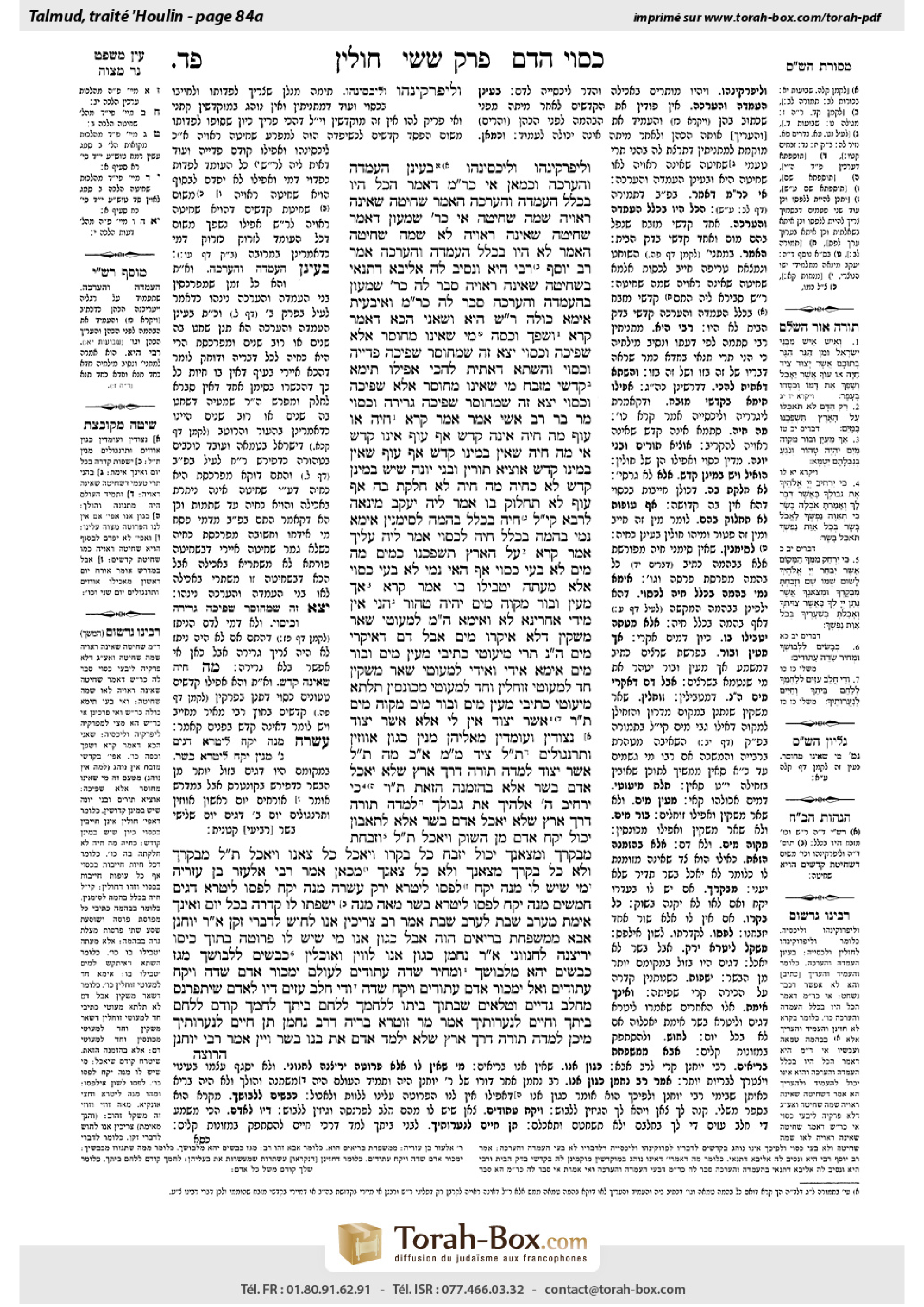
Chullin 84a: Talmud study for Daf Yomi
Study the Talmud for Daf Yomi with scanned pages, Hebrew text, English translations from Sefaria and AI-generated French translations.
Passage selection and English or AI-generated French translation are available where the scan has annotations. Daf Study is independent of Torah-Box and Sefaria.
Browse Chullin · חולין · All tractatesChullin 84a text and translations
This page of Chullin includes the Aramaic text, an English translation and an AI-generated French translation, alongside the scan above.
חולין פ״ד א · Aramaic and Hebrew text
וְלִיפְרְקִינְהוּ וְלִיכַסִּינְהוּ? בָּעֵינַן הַעֲמָדָה וְהַעֲרָכָה.
וּכְמַאן? אִי כְּרַבִּי מֵאִיר, דְּאָמַר: הַכֹּל הָיוּ בִּכְלַל הַעֲמָדָה וְהַעֲרָכָה – הָאָמַר: שְׁחִיטָה שֶׁאֵינָהּ רְאוּיָה שְׁמָהּ שְׁחִיטָה!
אִי כְּרַבִּי שִׁמְעוֹן, דְּאָמַר: שְׁחִיטָה שֶׁאֵינָהּ רְאוּיָה לֹא שְׁמָהּ שְׁחִיטָה – הָאָמַר: לֹא הָיוּ בִּכְלַל הַעֲמָדָה וְהַעֲרָכָה?
אָמַר רַב יוֹסֵף: רַבִּי הִיא, וְנָסֵיב לַהּ אַלִּיבָּא דְתַנָּאֵי; בִּשְׁחִיטָה שֶׁאֵינָהּ רְאוּיָה – סָבַר לַהּ כְּרַבִּי שִׁמְעוֹן, בְּהַעֲמָדָה וְהַעֲרָכָה – סָבַר לַהּ כְּרַבִּי מֵאִיר.
וְאִיבָּעֵית אֵימָא: כּוּלַּהּ רַבִּי שִׁמְעוֹן הִיא, וְשָׁאנֵי הָכָא דְּאָמַר קְרָא ״וְשָׁפַךְ וְכִסָּה״, מִי שֶׁאֵינוֹ מְחוּסָּר אֶלָּא שְׁפִיכָה וְכִסּוּי, יָצָא זֶה שֶׁמְחוּסָּר שְׁפִיכָה פְּדִיָּיה וְכִסּוּי.
וְהַשְׁתָּא דְּאָתֵית לְהָכִי, אֲפִילּוּ תֵּימָא קׇדְשֵׁי מִזְבֵּחַ, מִי שֶׁאֵינוֹ מְחוּסָּר אֶלָּא שְׁפִיכָה וְכִסּוּי – יָצָא זֶה, שֶׁמְחוּסָּר שְׁפִיכָה, גְּרִירָה, וְכִסּוּי.
מָר בַּר רַב אָשֵׁי אָמַר: אָמַר קְרָא ״חַיָּה אוֹ עוֹף״, מָה חַיָּה אֵינָהּ קֹדֶשׁ, אַף עוֹף אֵינוֹ קֹדֶשׁ.
אִי מָה חַיָּה שֶׁאֵין בְּמִינוֹ קֹדֶשׁ, אַף עוֹף שֶׁאֵין בְּמִינוֹ קֹדֶשׁ, אוֹצִיא תּוֹרִין וּבְנֵי יוֹנָה, שֶׁיֵּשׁ בְּמִינָן קֹדֶשׁ!
לָא, כְּחַיָּה – מָה חַיָּה לֹא חִלַּקְתָּ בָּהּ, אַף עוֹף לֹא תַּחְלוֹק בּוֹ.
אֲמַר לֵיהּ יַעֲקֹב מִינָאָה לְרָבָא: קַיְימָא לַן חַיָּה בִּכְלַל בְּהֵמָה לְסִימָנִין, אֵימָא נָמֵי בְּהֵמָה בִּכְלַל חַיָּה לְכִסּוּי.
אֲמַר לֵיהּ: עָלֶיךָ אָמַר קְרָא ״עַל הָאָרֶץ תִּשְׁפְּכֶנּוּ כַּמָּיִם״, מָה מַיִם לָא בָּעֵי כִּסּוּי, אַף הַאי נָמֵי לָא בָּעֵי כִּסּוּי.
אֶלָּא מֵעַתָּה, יַטְבִּילוּ בּוֹ? אָמַר קְרָא: ״אַךְ מַעְיָן וּבוֹר מִקְוֵה מַיִם יִהְיֶה טָהוֹר״, הָנֵי אִין, מִידֵּי אַחֲרִינָא לָא.
וְאֵימָא: הָנֵי מִילֵּי לְמַעוֹטֵי שְׁאָר מַשְׁקִין, דְּלָא אִיקְּרוֹ מַיִם, אֲבָל דָּם דְּאִיקְּרִי מַיִם – הָכִי נָמֵי?
תְּרֵי מִיעוּטֵי כְּתִיבִי: ״מַעְיָן מַיִם״ ״וּבוֹר מַיִם״.
אֵימָא: אִידֵּי וְאִידֵּי לְמַעוֹטֵי שְׁאָר מַשְׁקִין, חַד לְמַעוֹטֵי זוֹחֲלִין, וְחַד לְמַעוֹטֵי מְכוּנָּסִין!
תְּלָתָא מִיעוּטֵי כְּתִיבִי: ״מַעְיָן מַיִם״, ״וּבוֹר מַיִם״, ״מִקְוֵה מַיִם״.
תָּנוּ רַבָּנַן: ״אֲשֶׁר יָצוּד״, אֵין לִי אֶלָּא אֲשֶׁר יָצוּד, נִצּוֹדִין וְעוֹמְדִין מֵאֲלֵיהֶן מִנַּיִן, כְּגוֹן אֲוָוזִין וְתַרְנְגוֹלִים?
תַּלְמוּד לוֹמַר ״צֵיד״, מִכׇּל מָקוֹם. אִם כֵּן, מָה תַּלְמוּד לוֹמַר ״אֲשֶׁר יָצוּד״? לִמְּדָה תּוֹרָה דֶּרֶךְ אֶרֶץ, שֶׁלֹּא יֹאכַל אָדָם בָּשָׂר אֶלָּא בַּהַזְמָנָה הַזֹּאת.
תָּנוּ רַבָּנַן: ״כִּי יַרְחִיב ה׳ אֱלֹהֶיךָ אֶת גְּבֻלְךָ״ – לִמְּדָה תּוֹרָה דֶּרֶךְ אֶרֶץ, שֶׁלֹּא יֹאכַל אָדָם בָּשָׂר אֶלָּא לְתֵאָבוֹן.
יָכוֹל יִקַּח אָדָם מִן הַשּׁוּק וְיֹאכַל? תַּלְמוּד לוֹמַר: ״וְזָבַחְתָּ מִבְּקָרְךָ וּמִצֹּאנְךָ״. יָכוֹל יִזְבַּח כׇּל בְּקָרוֹ וְיֹאכַל, כָּל צֹאנוֹ וְיֹאכַל? תַּלְמוּד לוֹמַר: ״מִבְּקָרְךָ״ – וְלֹא כׇּל בְּקָרְךָ, ״מִצֹּאנְךָ״ – וְלֹא כׇּל צֹאנְךָ.
מִכָּאן אָמַר רַבִּי אֶלְעָזָר בֶּן עֲזַרְיָה: מִי שֶׁיֵּשׁ לוֹ מָנֶה – יִקַּח לְפָסוֹ לִיטְרָא יָרָק, עֲשָׂרָה מָנֶה – יִקַּח לְפָסוֹ לִיטְרָא דָּגִים, חֲמִשִּׁים מָנֶה – יִקַּח לְפָסוֹ לִיטְרָא בָּשָׂר, מֵאָה מָנֶה – יִשְׁפְּתוּ לוֹ קְדֵרָה בְּכׇל יוֹם. וְאִינָךְ אֵימַת? מֵעֶרֶב שַׁבָּת לְעֶרֶב שַׁבָּת.
אָמַר רַב: צְרִיכִין אָנוּ לָחוֹשׁ לְדִבְרֵי זָקֵן. אָמַר רַבִּי יוֹחָנָן: אַבָּא מִמִּשְׁפַּחַת בְּרִיאִים הֲוָה, אֲבָל כְּגוֹן אָנוּ, מִי שֶׁיֵּשׁ לוֹ פְּרוּטָה בְּתוֹךְ כִּיסוֹ – יְרִיצֶנָּה לַחֶנְוָונִי. אָמַר רַב נַחְמָן: כְּגוֹן אָנוּ לוֹוִין וְאוֹכְלִין.
״כְּבָשִׂים לִלְבוּשֶׁךָ״ – מִגֵּז כְּבָשִׂים יְהֵא מַלְבּוּשֶׁךָ, ״וּמְחִיר שָׂדֶה עַתּוּדִים״ – לְעוֹלָם יִמְכּוֹר אָדָם שָׂדֶה וְיִקַּח עַתּוּדִים, וְאַל יִמְכּוֹר אָדָם עַתּוּדִים וְיִקַּח שָׂדֶה. ״וְדֵי חֲלֵב עִזִּים״ – דַּיּוֹ לְאָדָם שֶׁיִּתְפַּרְנֵס מֵחֲלֵב גְּדָיִים וּטְלָאִים שֶׁבְּתוֹךְ בֵּיתוֹ.
״לְלַחְמְךָ לְלֶחֶם בֵּיתֶךָ״ – לַחְמְךָ קוֹדֶם לְלֶחֶם בֵּיתֶךָ. ״וְחַיִּים לְנַעֲרוֹתֶיךָ״ – אָמַר מָר זוּטְרָא בְּרֵיהּ דְּרַב נַחְמָן: תֵּן חַיִּים לְנַעֲרוֹתֶיךָ, מִיכָּן לִמְּדָה תּוֹרָה דֶּרֶךְ אֶרֶץ שֶׁלֹּא יְלַמֵּד אָדָם אֶת בְּנוֹ בָּשָׂר וְיַיִן.
אָמַר רַבִּי יוֹחָנָן:
Chullin 84a · English translation
The Gemara challenges: But even if the mishna is dealing with birds consecrated for Temple maintenance, let one redeem them after they were slaughtered and then cover their blood. The Gemara responds: This is not feasible, because in order to redeem a consecrated animal we require setting and valuating, i.e., the animal must be stood before a priest in order to evaluate it and only then is it redeemed (see Leviticus 27:11–12). A slaughtered bird cannot be stood before the priest; consequently, it cannot be redeemed.
The Gemara asks: But if the mishna is dealing with birds consecrated for Temple maintenance, in accordance with whose opinion is the mishna? If one suggests the mishna is in accordance with the opinion of Rabbi Meir, who says: Everything, i.e., animals consecrated both for the altar and for Temple maintenance, was included in the requirement of setting and valuating, and therefore the slaughtered birds may not be redeemed, this cannot be so. Doesn’t he also say that slaughter that is not fit to render the meat permitted is nevertheless considered a halakhic act of slaughter that requires the covering of the blood? If so, one should be obligated to cover the blood of the bird even if it is not redeemed.
The Gemara continues: And if one suggests the mishna is in accordance with the opinion of Rabbi Shimon, who says: Slaughter that is not fit to render the meat permitted is not considered a halakhic act of slaughter and therefore the bird would require redemption in order to cover its blood, this cannot be so. Doesn’t he also say that animals consecrated for Temple maintenance were not included in the requirement of setting and valuating? If so, let one redeem the slaughtered birds and cover their blood.
Rav Yosef said in reconciliation of this dilemma: The mishna’s ruling is in accordance with the opinion of Rabbi Yehuda HaNasi, and he formulates the mishna in accordance with the opinions of different tanna’im: With regard to the status of an act of slaughter that is not fit to render the meat permitted he holds in accordance with the opinion of Rabbi Shimon, while with regard to the requirement of setting and valuating he holds in accordance with the opinion of Rabbi Meir. Therefore, since one cannot redeem a bird that was consecrated for Temple maintenance once it has been slaughtered, there is no obligation to cover its blood, as the slaughter was not fit to render the meat permitted.
And if you wish, say instead that the entire mishna is in accordance with the opinion of Rabbi Shimon, who holds that birds consecrated for Temple maintenance may be redeemed even after their slaughter. And although it would seem that their slaughter is fit to render the meat permitted and that one should therefore be obligated in the mitzva of covering the blood, it is different here, as the verse states: “And he shall pour out its blood and cover it” (Leviticus 17:13). By juxtaposing “pour out” to “cover,” the verse indicates that the obligation to cover the blood applies only to blood that is lacking only pouring and covering, without any intervening step. Excluded is this blood of birds consecrated for Temple maintenance, which is lacking pouring, redeeming, and covering.
The Gemara notes: And now that you have arrived at this explanation, you may even say that the mishna is referring to birds consecrated for the altar. As for the question asked earlier: Why not let one scrape the blood from the altar and then cover it? The verse states: “And he shall pour out its blood and cover it,” indicating that the obligation to cover the blood applies only to blood that is lacking only pouring and covering, without any intervening step. Excluded is this blood of bird offerings, which is lacking pouring, scraping, and covering.
The Gemara cites another source for the exclusion of consecrated animals from the requirement of covering their blood: Mar bar Rav Ashi said that the verse states with regard to the mitzva of covering the blood: “An undomesticated animal or bird” (Leviticus 17:13). The juxtaposition of these two species intimates an analogy between them: Just as the undomesticated animal referred to in the verse is not consecrated, as undomesticated animals are never fit for sacrifice, so too, the bird referred to in the verse is not consecrated.
The Gemara asks: If it is so that the halakhot of slaughtering a bird are derived from those of an undomesticated animal, then say: Just as the verse is referring to an undomesticated animal, whose species cannot be consecrated as an offering, so too, the verse is referring only to a bird whose species cannot be consecrated as an offering. Therefore, I will exclude even non-sacred doves and pigeons, whose species can be consecrated.
The Gemara rejects this possibility: No, the juxtaposition indicates that the halakha with regard to the slaughter of birds is entirely like that of an undomesticated animal. Therefore, just as in the case of an undomesticated animal, you did not differentiate between its various species and all non-sacred animals are included in the mitzva, so too, with regard to the bird mentioned in the verse, you should not differentiate between its various species.
§ Concerning the halakha that covering the blood does not apply to a domesticated animal, the Gemara says that Ya’akov the heretic said to Rava: We maintain that an undomesticated animal, e.g., a deer, is included in the category of a domesticated animal with regard to the characteristics necessary to determine whether the animal is kosher, i.e., it chews its cud and has split hooves (see Deuteronomy 14:4–6). If so, I will also say that a domesticated animal is included in the category of an undomesticated animal with regard to the mitzva of covering the blood.
Rava said to him: With regard to your claim, the verse states in reference to the blood of a domesticated animal: “You may slaughter of your cattle and of your sheep…but be strong not to eat the blood…you shall pour it out on the ground, like water” (Deuteronomy 12:21–24). Accordingly, just as water does not require covering, so too, this blood of a domesticated animal does not require covering.
The Gemara asks: If that is so, that the verse equates the blood of a domesticated animal with water, then let one immerse ritually impure items in it to purify them, just as he can immerse them in water. The Gemara responds: The verse states: “But a spring or a cistern, or a gathering of water shall be pure” (Leviticus 11:36). The exclusionary term: “But,” indicates that only concerning these bodies of water, yes, they render pure an impure item, while something else, e.g., blood, does not.
The Gemara challenges: But perhaps one can say that this matter, i.e., the exclusionary term in the verse, serves only to exclude other liquids that are not called water. But with regard to blood, which is called water, as the verse states: “You shall pour it out on the ground, like water,” one may indeed immerse ritually impure items in it.
The Gemara responds: Two exclusions are written in the verse discussing ritually purifying waters: A spring of water, and: A cistern of water. The term “water” is understood as being attached to each of the bodies mentioned in the verse. The additional exclusion serves to exclude blood.
The Gemara challenges: Say that both this phrase, a spring of water, and that phrase, a cistern of water, serve to exclude other liquids, and not blood, whereby one phrase is to exclude flowing liquids that are not water from having the status of a spring, which renders an item ritually pure even when it is flowing; and one phrase serves to exclude gathered liquids that are not water from having the status of a ritual bath, which renders an item pure only when the water in the ritual bath is gathered.
The Gemara responds: Three exclusions are written in the verse: A spring of water, to exclude flowing liquids; and: A cistern of water, to exclude gathered liquids; and: A gathering of water, to exclude blood.
§ The Sages taught in a baraita: The verse states with regard to covering the blood: “And any man of the children of Israel, or of the strangers that sojourn among them, who traps a trapping of an undomesticated animal or bird that may be eaten, he shall pour out its blood and cover it with earth” (Leviticus 17:13). I have derived only that one is obligated to cover the blood of an undomesticated animal or bird that one traps. From where is it derived that undomesticated animals or birds that are already considered trapped on their own, such as geese and chickens that do not roam freely, are also included in the mitzva of covering the blood?
The verse states “a trapping” to indicate that in any case, one is obligated to cover the blood of an undomesticated animal. If so, what is the meaning when the verse states: “Who traps,” if it is not to be understood literally? The baraita explains: The Torah taught that it is a desired mode of behavior that a person should consume meat only with this mode of preparation. That is, just as the meat that one traps is not readily available, so too, one should not become accustomed to consuming meat.
In a similar vein, the Sages taught in a baraita that the verse states: “When the Lord, your God, expands your boundary…according to every craving of your soul you may eat meat” (Deuteronomy 12:20). The Torah taught that it is a desired mode of behavior that a person should consume meat due only to appetite. That is, one should consume meat only when he feels a need to eat it.
The baraita continues: One might have thought that a person may purchase meat from the marketplace and consume it. Therefore, the next verse states: “And you may slaughter of your cattle and of your flock,” indicating that one should consume the meat of animals of his own flock, not those purchased in the marketplace. One might have thought that a person may slaughter all of his cattle, i.e., his only cow, and consume the meat, or slaughter all of his flock, i.e., his only sheep, and consume the meat. Therefore, the verse states: “Of your cattle,” indicating some, but not all of, your cattle; “of your flock,” but not all of your flock.
From here, Rabbi Elazar ben Azaria said: One who has one hundred dinars should purchase a litra of vegetables for his stewpot [lefaso]; one who has one thousand dinars should purchase a litra of fish for his stewpot; one who has five thousand dinars should purchase a litra of meat for his stewpot; and if one has ten thousand dinars, his servants should place a pot of meat on the stove for him every day. The Gemara asks: And with regard to these other individuals mentioned by Rabbi Elazar ben Azaria, when, i.e., how often, should they consume meat? The Gemara responds: Every Shabbat eve.
Rav says: We must be concerned for the statement of the elder, i.e., Rabbi Elazar ben Azaria, and be thrifty with our expenditure on food items. Rabbi Yoḥanan says: Abba, i.e., Rav, was from a family of particularly healthy individuals, and was able to subsist on the modest diet suggested by Rabbi Elazar ben Azaria. But with regard to people such as us, who are not as healthy, one who has even one peruta in his pocket should hasten with it to the storekeeper and purchase food. Two generations later, Rav Naḥman said: With regard to people such as us, who are physically weaker than those in previous generations, not only do we not delay the purchase of food items, we even borrow money to purchase food and eat.
The Gemara continues its discussion with regard to one’s livelihood: The verse states: “The lambs will be for your clothing, and goats the worth of a field. And there will be goats’ milk enough for your food, for the food of your household; and sustenance for your maidens” (Proverbs 27:26–27). “The lambs will be for your clothing” indicates that your clothing should be produced from the shearings of lambs, i.e., purchase lambs from whose wool you can produce clothing. “And goats the worth of a field” indicates that a person should always seek to sell a field and purchase goats in order to benefit from their milk, wool, and offspring, and a person should not sell goats and purchase a field instead. “And there will be goats’ milk enough” indicates that it is sufficient for a person that he be sustained from the milk of kids and lambs that are in his house.
“For your food, for the food of your household” indicates that your food comes before the food of your household, i.e., one must first ensure that he has food for himself before providing for others. With regard to the phrase: “And sustenance for your maidens,” Mar Zutra, son of Rav Naḥman, said: The verse indicates that you must give sustenance to your youth, i.e., to your children. From here, the Torah taught that it is a desired mode of behavior that a person should not accustom his son to eat meat and drink wine; rather, he should teach his children to eat less expensive foods.
Rabbi Yoḥanan says:
Chullin 84a · Traduction française (IA)
La Guemara soulève un défi : Mais même si la Michna traite d'oiseaux consacrés à l'entretien du Temple, on pourrait les racheter après leur sacrifice et ensuite couvrir leur sang. La Guemara répond : Cela n'est pas possible, car pour racheter un animal consacré, on a besoin d'une évaluation, c'est-à-dire que l'animal doit être présenté devant un prêtre afin qu'il soit évalué et seulement alors peut-il être racheté (cf. Lévitique 27:11–12). Un oiseau sacrifié ne peut être présenté devant le prêtre ; par conséquent, il ne peut pas être racheté.
La Guemara pose une question : Mais si la Michna traite d'oiseaux consacrés à l'entretien du Temple, selon quel avis est-elle formulée ? Si l'on suggère que la Michna suit l'avis de Rabbi Meïr, qui dit : Tout, c'est-à-dire les animaux consacrés à l'autel et à l'entretien du Temple, étaient inclus dans la nécessité d'évaluation, et par conséquent les oiseaux sacrifiés ne peuvent pas être rachetés, cela ne peut pas être vrai. N'a-t-il pas aussi dit que le sacrifice qui n'est pas adapté à rendre la viande permise est toutefois considéré comme un acte halakhique de sacrifice qui exige la couverture du sang ? Si tel est le cas, on devrait être tenu de couvrir le sang de l'oiseau même s'il n'est pas racheté.
La Guemara continue : Et si l'on suggère que la Michna suit l'avis de Rabbi Shimon, qui dit : Le sacrifice qui n'est pas adapté à rendre la viande permise n'est pas considéré comme un acte halakhique de sacrifice et par conséquent l'oiseau devrait être racheté afin de couvrir son sang, cela ne peut pas être vrai. N'a-t-il pas aussi dit que les animaux consacrés à l'entretien du Temple n'étaient pas inclus dans la nécessité d'évaluation ? Si tel est le cas, on pourrait racheter les oiseaux sacrifiés et couvrir leur sang.
Rav Yosef a dit pour résoudre ce dilemme : La décision de la Michna suit l'avis de Rabbi Yéhuda HaNasi, et il formule la Michna selon les opinions de différents tannaïm : En ce qui concerne le statut d'un acte de sacrifice qui n'est pas adapté à rendre la viande permise, il suit l'avis de Rabbi Shimon, tandis qu'en ce qui concerne la nécessité de fixer et d'évaluer, il suit l'avis de Rabbi Meïr. Par conséquent, puisque l'on ne peut racheter un oiseau consacré à l'entretien du Temple une fois qu'il a été sacrifié, il n'y a pas d'obligation de couvrir son sang, car le sacrifice n'était pas adapté à rendre la viande permise.
Et si l'on veut, on peut dire plutôt que toute la Michna suit l'avis de Rabbi Shimon, qui affirme que les oiseaux consacrés à l'entretien du Temple peuvent être rachetés même après leur sacrifice. Et bien qu'il puisse sembler que leur sacrifice est adapté à rendre la viande permise et qu'on devrait donc être tenu de remplir la mitsva de couvrir leur sang, c'est différent ici, car la Parashia dit : « Et il versera son sang et le couvrira » (Lévitique 17:13). En juxtaposant « verser » à « couvrir », la Parashia indique que l'obligation de couvrir le sang s'applique uniquement au sang qui manque seulement le versement et la couverture, sans étape intermédiaire. Exclu est ce sang d'oiseaux consacrés à l'entretien du Temple, qui manque le versement, le rachat et la couverture.
La Guemara note : Et maintenant que vous avez atteint cette explication, vous pouvez même dire que la Michna fait référence à des oiseaux consacrés à l'autel. En ce qui concerne la question posée plus tôt : pourquoi ne pas permettre de retirer le sang de l'autel et ensuite de le couvrir ? La Parashia dit : « Et il versera son sang et le couvrira », indiquant que l'obligation de couvrir le sang s'applique uniquement au sang qui manque seulement le versement et la couverture, sans étape intermédiaire. Exclu est ce sang des offrandes d'oiseaux, qui manque le versement, le retrait et la couverture.
La Guemara cite une autre source pour l'exclusion des animaux consacrés de la nécessité de couvrir leur sang : Mar bar Rav Ashi a dit que la Parashia concernant la mitsva de couvrir le sang dit : « Un animal sauvage ou un oiseau » (Lévitique 17:13). La juxtaposition de ces deux espèces suggère une analogie entre eux : Tout comme l'animal sauvage mentionné dans la Parashia n'est pas consacré, car les animaux sauvages ne sont jamais adaptés à l'offrande, de même l'oiseau mentionné dans la Parashia n'est pas consacré.
La Guemara pose une question : Si c'est ainsi que les halakhot de la mise à mort d'un oiseau sont dérivées de celles d'un animal sauvage, alors disons : Tout comme la Parashia fait référence à un animal sauvage, dont l'espèce ne peut pas être consacrée en offrande, de même la Parashia fait référence uniquement à un oiseau dont l'espèce ne peut pas être consacrée en offrande. Par conséquent, je pourrais exclure même les pigeons et les moineaux non sacrés, dont l'espèce peut être consacrée.
La Guemara rejette cette possibilité : Non, la juxtaposition indique que la halakha concernant la mise à mort des oiseaux est entièrement semblable à celle d'un animal sauvage. Par conséquent, tout comme dans le cas d'un animal sauvage, on n'a pas distingué entre ses différentes espèces et tous les animaux non sacrés sont inclus dans la mitsva, de même, concernant l'oiseau mentionné dans la Torah écrite, on ne devrait pas distinguer entre ses différentes espèces.
§ Concernant la halakha selon laquelle la couverture du sang ne s'applique pas à un animal domestique, la Guemara dit que Ya'akov le mécréant a dit à Rava : Nous maintenons qu'un animal sauvage, par exemple un cerf, est inclus dans la catégorie d'un animal domestique concernant les caractéristiques nécessaires pour déterminer si l'animal est kasher, c'est-à-dire qu'il rumine et a des sabots fendus (cf. Lévitique 14:4–6). Si tel est le cas, je dirai aussi qu'un animal domestique est inclus dans la catégorie d'un animal sauvage concernant la mitsva de couvrir le sang.
Rava dit à lui : En ce qui concerne votre affirmation, la Parashah stipule à propos du sang d'un animal domestique : « Vous pourrez tuer vos bœufs et vos brebis, mais soyez forts pour ne pas manger le sang... vous le verserez sur la terre, comme de l'eau » (Deutéronome 12:21–24). Ainsi, tout comme l'eau n'exige pas d'être recouvert, de même le sang d'un animal domestique n'exige pas non plus d'être recouvert.
Le Guemara pose la question : Si c'est ainsi, c'est-à-dire que la Parashah compare le sang d'un animal domestique à l'eau, alors pourquoi ne pas immerger les objets impurs dans ce sang pour les rendre purs, tout comme on peut les immerger dans l'eau. Le Guemara répond : La Parashah stipule : « Mais une source ou un puits, ou une accumulation d'eau sera pure » (Lévitique 11:36). Le terme d'exclusion « mais » indique que seul concernant ces corps d'eau, oui, ils rendent pur un objet impur, tandis que quelque chose d'autre, par exemple le sang, ne le fait pas.
Le Guemara conteste : Mais peut-être qu'on peut dire que cette question, c'est-à-dire le terme d'exclusion dans la Parashah, sert uniquement à exclure d'autres liquides qui ne sont pas appelés de l'eau. Mais concernant le sang, qui est appelé de l'eau, comme la Parashah stipule : « Vous le verserez sur la terre, comme de l'eau », on pourrait effectivement immerger les objets impurs dans ce sang.
Le Guemara répond : Deux exclusions sont écrites dans la versette concernant les eaux de purification : une source d'eau, et : un puits d'eau. Le terme « eau » est compris comme étant attaché à chaque corps mentionné dans la versette. L'exclusion supplémentaire sert à exclure le sang.
Le Guemara conteste : Dites que ces deux expressions, une source d'eau et un puits d'eau, servent à exclure d'autres liquides, et non le sang, de sorte que l'une des expressions sert à exclure les liquides en mouvement qui ne sont pas de l'eau de ne pas avoir le statut d'une source, qui rend un objet pur même lorsqu'il est en mouvement ; et l'autre expression sert à exclure les liquides accumulés qui ne sont pas de l'eau de ne pas avoir le statut d'un bain rituel, qui rend un objet pur uniquement lorsque l'eau du bain rituel est accumulée.
Le Guemara répond : Trois exclusions sont écrites dans la versette : une source d'eau, pour exclure les liquides en mouvement ; et : un puits d'eau, pour exclure les liquides accumulés ; et : une accumulation d'eau, pour exclure le sang.
§ Les Sages enseignèrent dans une baraïta : La Parashah stipule à propos du recouvrement du sang : « Et tout homme des enfants d'Israël, ou des étrangers qui habitent parmi eux, qui piège un animal sauvage ou un oiseau qui peut être mangé, il versera son sang et le recouvrera avec de la terre » (Lévitique 17:13). J'ai déduit seulement que l'on est tenu de recouvrir le sang d'un animal sauvage ou d'un oiseau que l'on piège. D'où est déduit que les animaux sauvages ou les oiseaux qui sont déjà considérés comme piégés d'eux-mêmes, tels que les canards et les poules qui ne se promènent pas librement, sont également inclus dans la Mitsva du recouvrement du sang ?
La Parashah stipule « un piège » pour indiquer que dans tous les cas, l'on est tenu de recouvrir le sang d'un animal sauvage. Si c'est ainsi, quelle est la signification lorsque la Parashah stipule : « Qui piège », si ce n'est pas à prendre littéralement ? La baraïta explique : La Torah a enseigné que c'est un mode de comportement souhaitable que l'homme consomme de la viande uniquement avec ce mode de préparation. C'est-à-dire, tout comme la viande que l'on piège n'est pas facilement disponible, de même l'homme ne devrait pas s'habituer à consommer de la viande.
Dans un sens similaire, les Sages enseignèrent dans une baraïta que la Parashah stipule : « Quand l'Éternel, votre Dieu, étendra votre territoire... selon toute la convoitise de votre âme, vous pourrez manger de la viande » (Deutéronome 12:20). La Torah a enseigné que c'est un mode de comportement souhaitable que l'homme consomme de la viande uniquement en raison de la faim. C'est-à-dire, l'homme devrait consommer de la viande uniquement lorsqu'il a besoin de manger.
La baraïta continue : On aurait pu penser qu'une personne peut acheter de la viande au marché et la consommer. Ainsi, la Parashah stipule : « Et vous pourrez tuer vos bœufs et vos brebis », indiquant que l'on devrait consommer la viande des animaux de sa propre basse-cour, et non celle achetée au marché. On aurait pu penser qu'une personne peut tuer tous ses bœufs, c'est-à-dire sa seule vache, et les consommer, ou tuer tous ses brebis, c'est-à-dire sa seule brebis, et les consommer. Ainsi, la Parashah stipule : « De vos bœufs », indiquant certains, mais pas tous, de vos bœufs ; « de vos brebis », mais pas tous de vos brebis.
D'où, Rabbi Elazar ben Azaria a dit : Celui qui a cent dinars devrait acheter un litra de légumes pour sa marmite [lefaso] ; celui qui a mille dinars devrait acheter un litra de poisson pour sa marmite ; celui qui a cinq mille dinars devrait acheter un litra de viande pour sa marmite ; et si l'on a dix mille dinars, ses serviteurs devraient mettre une marmite de viande sur le feu pour lui chaque jour. Le Guemara pose la question : Et concernant ces autres individus mentionnés par Rabbi Elazar ben Azaria, quand, c'est-à-dire combien de fois, devraient-ils manger de la viande ? Le Guemara répond : Chaque soir de Shabbat.
Rav dit : Nous devons nous préoccuper de l'affirmation du vieil homme, c'est-à-dire de Rabbi Elazar ben Azaria, et être frugal dans nos dépenses alimentaires. Rabbi Yoḥanan dit : Abba, c'est-à-dire Rav, venait d'une famille d'individus particulièrement en bonne santé, et pouvait subsister sur le modeste régime suggéré par Rabbi Elazar ben Azaria. Mais concernant les gens comme nous, qui ne sont pas aussi en bonne santé, celui qui a même un peruta dans sa poche devrait hâter de s'y rendre au marchand et acheter de la nourriture. Deux générations plus tard, Rav Naḥman dit : Concernant les gens comme nous, qui sont physiquement plus faibles que ceux des générations précédentes, non seulement ne devons-nous pas retarder l'achat de nourriture, nous empruntons même de l'argent pour acheter de la nourriture et manger.
La Guemara continue sa discussion concernant la subsistance d'une personne : La Parole dit : « Les agneaux seront pour votre vêtement, et les chèvres valent la valeur d'un champ. Et il y aura assez de lait de chèvre pour votre nourriture, pour la nourriture de votre maison ; et un aliment pour vos servantes » (Proverbes 27:26–27). « Les agneaux seront pour votre vêtement » indique que votre vêtement doit être produit à partir de la laine des agneaux, c'est-à-dire acheter des agneaux dont la laine peut être transformée en vêtements. « Et les chèvres valent la valeur d'un champ » indique qu'une personne doit toujours chercher à vendre un champ et à acheter des chèvres afin de bénéficier de leur lait, leur laine et leurs petits, et une personne ne doit pas vendre des chèvres et acheter un champ à la place. « Et il y aura assez de lait de chèvre » indique que ce sera suffisant pour une personne qu'il soit nourri par le lait des agneaux et des chèvres qui sont chez lui.
« Pour votre nourriture, pour la nourriture de votre maison » indique que votre nourriture doit venir avant la nourriture de votre maison, c'est-à-dire qu'on doit d'abord s'assurer qu'on a de la nourriture pour soi-même avant de s'occuper des autres. En ce qui concerne la phrase : « Et un aliment pour vos servantes », Mar Zutra, fils de Rav Naḥman, a dit : La Parole indique qu'on doit nourrir ses jeunes, c'est-à-dire ses enfants. D'où la Torah a enseigné que c'est un mode de comportement souhaitable qu'une personne ne doive pas accoutumer son fils à manger de la viande et à boire du vin ; plutôt, il doit enseigner à ses enfants à manger des aliments moins coûteux.
Rabbi Yoḥanan dit :
Traduction française générée par IA à partir de l’édition anglaise de Sefaria. Vérifie toujours un passage avec le texte source.
Text from Sefaria: William Davidson Edition - Vocalized Aramaic (unknown); William Davidson Edition - English (CC BY NC).