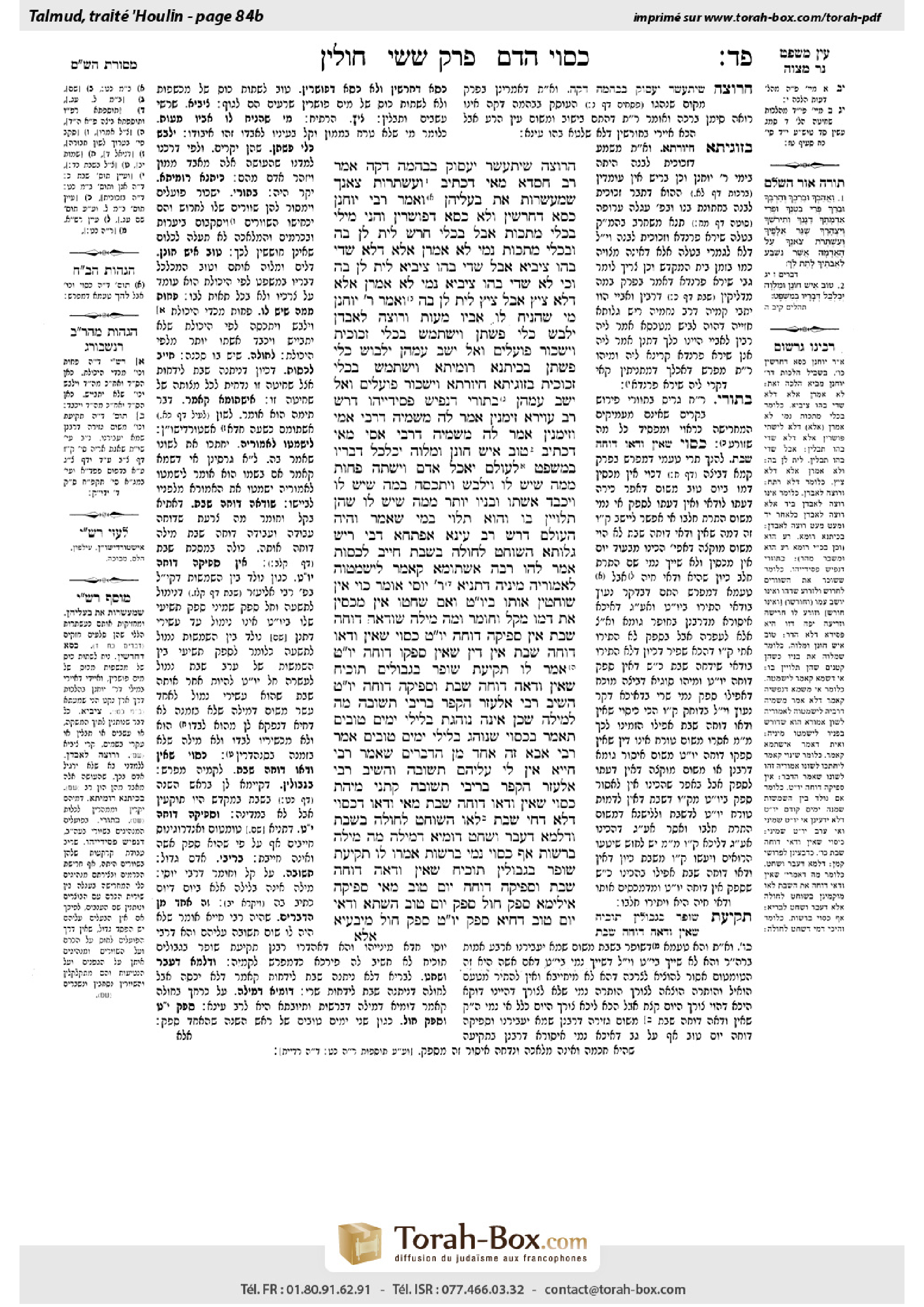
Chullin 84b: Talmud study for Daf Yomi
Study the Talmud for Daf Yomi with scanned pages, Hebrew text, English translations from Sefaria and AI-generated French translations.
Passage selection and English or AI-generated French translation are available where the scan has annotations. Daf Study is independent of Torah-Box and Sefaria.
Browse Chullin · חולין · All tractatesChullin 84b text and translations
This page of Chullin includes the Aramaic text, an English translation and an AI-generated French translation, alongside the scan above.
חולין פ״ד ב · Aramaic and Hebrew text
הָרוֹצֶה שֶׁיִּתְעַשֵּׁר יַעֲסוֹק בִּבְהֵמָה דַּקָּה. אָמַר רַב חִסְדָּא, מַאי דִּכְתִיב: ״וְעַשְׁתְּרֹת צֹאנְךָ״ – שֶׁמְּעַשְּׁרוֹת אֶת בַּעֲלֵיהֶן.
וְאָמַר רַבִּי יוֹחָנָן: כָּסָא דְּחָרָשִׁין, וְלָא כָּסָא דְּפוֹשְׁרִין. וְהָנֵי מִילֵּי בִּכְלִי מַתָּכוֹת, אֲבָל בִּכְלִי חֶרֶשׂ לֵית לַן בַּהּ. וּבִכְלֵי מַתָּכוֹת נָמֵי לָא אֲמַרַן, אֶלָּא דְּלָא שָׁדֵי בְּהוּ צִיבַיָּא, אֲבָל שָׁדֵי בְּהוּ צִיבַיָּא לֵית לַן בַּהּ. וְכִי לָא שָׁדֵי בְּהוּ צִיבַיָּא נָמֵי לָא אֲמַרַן, אֶלָּא דְּלָא צִיץ, אֲבָל צִיץ לֵית לַן בַּהּ.
וְאָמַר רַבִּי יוֹחָנָן: מִי שֶׁהִנִּיחַ לוֹ אָבִיו מָעוֹת וְרוֹצֶה לְאַבְּדָן – יִלְבַּשׁ כְּלֵי פִשְׁתָּן, וְיִשְׁתַּמֵּשׁ בִּכְלֵי זְכוּכִית, וְיִשְׂכּוֹר פּוֹעֲלִים וְאַל יֵשֵׁב עִמָּהֶן. יִלְבּוֹשׁ כְּלֵי פִשְׁתָּן – בְּכִיתָּנָא רוֹמִיתָא. וְיִשְׁתַּמֵּשׁ בִּכְלֵי זְכוּכִית – בְּזוּגִּיתָא חִיוָּרְתָּא. וְיִשְׂכּוֹר פּוֹעֲלִים וְאַל יָשַׁב עִמָּהֶן – בְּתוֹרֵי דִּנְפִישׁ פְּסֵידַיְיהוּ.
דָּרֵשׁ רַב עַוִּירָא, זִימְנִין אָמַר לַהּ מִשְּׁמֵיהּ דְּרַבִּי אַמֵּי, וְזִימְנִין אָמַר לַהּ מִשְּׁמֵיהּ דְּרַבִּי אַסִּי: מַאי דִּכְתִיב ״טוֹב אִישׁ חוֹנֵן וּמַלְוֶה יְכַלְכֵּל דְּבָרָיו בְּמִשְׁפָּט״? לְעוֹלָם יֹאכַל אָדָם וְיִשְׁתֶּה פָּחוֹת מִמַּה שֶּׁיֵּשׁ לוֹ, וְיִלְבַּשׁ וְיִתְכַּסֶּה בְּמַה שֶּׁיֵּשׁ לוֹ, וִיכַבֵּד אִשְׁתּוֹ וּבָנָיו יוֹתֵר מִמַּה שֶּׁיֵּשׁ לוֹ, שֶׁהֵן תְּלוּיִין בּוֹ וְהוּא תָּלוּי בְּמִי שֶׁאָמַר וְהָיָה הָעוֹלָם.
דָּרֵשׁ רַב עֵינָא אַפִּתְחָא דְּבֵי רֵישׁ גָּלוּתָא: הַשּׁוֹחֵט לַחוֹלֶה בְּשַׁבָּת חַיָּיב לְכַסּוֹת. אֲמַר לְהוּ רַבָּה: אֶשְׁתּוֹמָא קָאָמַר, לִישְׁמְטוּהּ לְאָמוֹרֵיהּ מִינֵּיהּ, דְּתַנְיָא: רַבִּי יוֹסֵי אוֹמֵר: כּוֹי אֵין שׁוֹחֲטִין אוֹתוֹ בְּיוֹם טוֹב, וְאִם שְׁחָטוֹ אֵין מְכַסִּין אֶת דָּמוֹ.
מִקַּל וָחוֹמֶר: וּמָה מִילָה שֶׁוַּדָּאָהּ דּוֹחֶה שַׁבָּת, אֵין סְפֵיקָהּ דּוֹחֶה יוֹם טוֹב, כִּסּוּי שֶׁאֵין וַדָּאוֹ דּוֹחֶה שַׁבָּת, אֵין דִּין שֶׁאֵין סְפֵקוֹ דּוֹחֶה יוֹם טוֹב?
אָמַר לוֹ: תְּקִיעַת שׁוֹפָר בִּגְבוּלִים תּוֹכִיחַ, שֶׁאֵין וַדָּאָהּ דּוֹחֶה שַׁבָּת, וּסְפֵיקָהּ דּוֹחֶה יוֹם טוֹב!
הֵשִׁיב רַבִּי אֶלְעָזָר הַקַּפָּר בְּרִיבִּי תְּשׁוּבָה: מָה לְמִילָה שֶׁכֵּן אֵינָהּ נוֹהֶגֶת בְּלֵילֵי יָמִים טוֹבִים, תֹּאמַר בְּכִסּוּי שֶׁנּוֹהֵג בְּלֵילֵי יָמִים טוֹבִים!
אָמַר רַבִּי אַבָּא: זֶה אֶחָד מִן הַדְּבָרִים שֶׁאָמַר רַבִּי חִיָּיא ״אֵין לִי עֲלֵיהֶם תְּשׁוּבָה״, וְהֵשִׁיב רַבִּי אֶלְעָזָר הַקַּפָּר בְּרִיבִּי תְּשׁוּבָה.
קָתָנֵי מִיהַת, כִּסּוּי שֶׁאֵין וַדָּאוֹ דּוֹחֶה שַׁבָּת. מַאי וַדָּאוֹ דְּכִסּוּי דְּלָא דָּחֵי שַׁבָּת? לָאו הַשּׁוֹחֵט לְחוֹלֶה בְּשַׁבָּת?
וְדִלְמָא דְּעָבַר וְשָׁחַט?
דּוּמְיָא דְּמִילָה: מָה מִילָה בִּרְשׁוּת, אַף כִּסּוּי נָמֵי בִּרְשׁוּת.
אָמְרוּ לוֹ: תְּקִיעַת שׁוֹפָר בַּגְּבוּלִין תּוֹכִיחַ, שֶׁאֵין וַדָּאָהּ דּוֹחֶה שַׁבָּת, וּסְפֵיקָהּ דּוֹחֶה יוֹם טוֹב.
מַאי סְפֵיקָהּ? אִילֵּימָא סָפֵק חוֹל סָפֵק יוֹם טוֹב – הַשְׁתָּא וַדַּאי יוֹם טוֹב דָּחֲיָא, סָפֵק יוֹם טוֹב סָפֵק חוֹל מִיבַּעְיָא?
Chullin 84b · English translation
One who wishes to become wealthy should engage in raising small domesticated animals. Rav Ḥisda said: What is the meaning of that which is written: “And the flocks [ve’ashterot] of your sheep” (Deuteronomy 7:13)? It means that sheep enrich [me’ashrot] their owners.
The Gemara cites additional statements by Rabbi Yoḥanan providing practical advice. Rabbi Yoḥanan says: It is preferable to drink from a cup of witches and not to drink from a cup of lukewarm water, which is extremely unhealthy. Rabbi Yoḥanan qualifies his statement: We said this only with regard to lukewarm water in metal vessels, but in earthenware vessels we have no problem with it. And even in metal vessels, we said that lukewarm water is unhealthy only in a case where one did not cast flavorings into the water, but if he cast flavorings into the water we have no problem with it. And even if one cast flavorings into the water, we said this only in a case where the water had not been boiled [tzeyatz], but if the water had been boiled we have no problem with it.
And Rabbi Yoḥanan says: In the case of one whose father bequeathed him a great deal of money and he seeks to lose it, he should wear linen garments, and should use glass vessels, and should hire laborers and not sit with them to supervise. The Gemara elaborates: He should wear linen garments; this is stated with regard to Roman linen, which becomes tattered quickly. He should use glass vessels; this is stated with regard to expensive white glass. And he should hire laborers and not sit with them; this applies to laborers who work with oxen, whose potential for causing damage is great if they are not supervised, as they will trample the crops.
Rav Avira interpreted the following verse homiletically, but sometimes he said the interpretation in the name of Rabbi Ami and sometimes he said it in the name of Rabbi Asi: What is the meaning of that which is written: “Good is the man who is gracious and lends, who orders his affairs with justice” (Psalms 112:5)? It means to teach that a person should always eat and drink less than what is within his means, and he should dress and cover himself in accordance with his means, and he should honor his wife and children more than what is within his means; as they are dependent on him and he is dependent on the One Who spoke and the world was created.
§ The mishna teaches that one may not slaughter a koy on a Festival since he may not cover its blood, as it is unclear whether there is an obligation by Torah law to do so. But if one transgressed and slaughtered a koy, one does not cover its blood. With regard to this, Rav Eina taught at the entrance to the house of the Exilarch: One who slaughters an undomesticated animal or a bird for a critically ill person on Shabbat, for whom it is permitted to slaughter, is obligated to cover its blood. Rabba said to those present: Rav Eina is saying an astonishing statement; remove his interpreter from before him. As it is taught in a baraita that Rabbi Yosei says: One may not slaughter a koy on a Festival, but if he slaughtered it, one does not cover its blood until after the Festival.
Rabbi Yosei elaborates: This can be derived from an a fortiori inference: And if with regard to the mitzva of circumcision, concerning which a definite obligation overrides Shabbat, nevertheless its uncertain obligation does not override a Festival; then with regard to the mitzva of covering the blood, concerning which even a definite obligation does not override Shabbat, is it not logical that its uncertain obligation, e.g., covering the blood of a koy, would not override a Festival? Although circumcision involves an act of prohibited labor, one performs it on Shabbat for a male infant whose eighth day from birth occurs on Shabbat. But in a case where it is uncertain when the eighth day from birth occurs, it is forbidden to circumcise the child on a Festival. By contrast, covering the blood is never performed on Shabbat.
The Sages said to him in rebuttal: The sounding of the shofar in the provinces, i.e., outside the Temple, will prove that this a fortiori inference is incorrect. This is because its definite obligation does not override Shabbat and it is prohibited to sound the shofar on Rosh HaShana that falls on Shabbat; and yet its uncertain obligation overrides the Festival.
Rabbi Elazar HaKappar the Distinguished responded with another refutation of the a fortiori inference: It cannot be inferred from circumcision that an uncertain obligation of the mitzva of covering the blood does not override a Festival. What is notable about circumcision? It is notable in that it is not in effect on Festival nights, but is performed only during the daytime. Will you then say with regard to the mitzva of covering the blood, which is in effect on Festival nights, that it does not override a Festival? Perhaps, since the mitzva of covering the blood is in effect during both day and night, its uncertain obligation overrides a Festival as well.
In reference to Rabbi Elazar HaKappar’s refutation, Rabbi Abba says: This a fortiori inference drawn by Rabbi Yosei is one of the matters with regard to which Rabbi Ḥiyya says: I do not have any refutation for them, and Rabbi Elazar HaKappar the Distinguished successfully responded with a refutation.
Rabba concludes his refutation of the statement of Rav Eina: In any event, the baraita teaches that definite obligations with regard to the mitzva of covering the blood do not override Shabbat. Now, what is a case of a definite obligation of covering the blood that does not override Shabbat? Is it not a case where one slaughters an undomesticated animal or a bird for a critically ill person on Shabbat? The baraita nevertheless teaches that one does not cover the blood, in contradiction to the ruling of Rav Eina.
The Gemara asks: But perhaps the baraita is referring to an instance where one transgressed Shabbat and slaughtered an animal for a healthy person. But in a case where one slaughtered an animal for an ill person, since it was permitted for him to slaughter the animal, perhaps he must cover the blood as well.
The Gemara responds: The baraita cannot be referring to such a case, since Rabbi Yosei compares it with circumcision. Therefore, it must be similar to the case of circumcision, in that just as the circumcision was performed with permission, as it is a mitzva to perform circumcision even if the eighth day falls on Shabbat, so too, the covering of the blood must be referring to a case where the slaughter was done with permission, i.e., for an ill person. Accordingly, the baraita poses a difficulty to the statement of Rav Eina.
§ The baraita states that the Sages said to Rabbi Yosei in refutation of his a fortiori inference: The sounding of the shofar in the provinces will prove that the inference is incorrect, since its definite obligation does not override Shabbat and its uncertain obligation overrides a Festival.
The Gemara asks: What is its uncertain obligation that overrides a Festival? If we say that it is referring to uncertainty with regard to whether one of the two days of Rosh HaShana is a weekday or a Festival, this is unfeasible: Now that the sounding of the shofar overrides the definite Festival of Rosh HaShana, is it necessary to teach that it overrides a day with regard to which it is uncertain whether it is a Festival or a weekday? That is, if the uncertainty is with regard to the Festival itself, then this case should have no bearing on the halakha concerning the obligation to cover the blood of a koy on a Festival, since the latter occurs on a definite Festival.
Chullin 84b · Traduction française (IA)
Celui qui désire devenir riche devrait s'occuper d'élever des petits animaux domestiques. Rav Ḥisda a dit : Quelle est la signification de ce qui est écrit : « Et les troupeaux [ve’ashterot] de tes brebis » (Deutéronome 7:13) ? Cela signifie que les brebis enrichissent [me’ashrot] leurs propriétaires.
La Guemara cite d'autres déclarations du Rabbi Yoḥanan donnant des conseils pratiques. Le Rabbi Yoḥanan dit : Il est préférable de boire d'une coupe de sorcières plutôt que d'une coupe d'eau tiède, qui est extrêmement nuisible à la santé. Le Rabbi Yoḥanan précise sa déclaration : Nous avons dit cela uniquement concernant l'eau tiède dans des récipients métalliques, mais dans des récipients en terre nous n'avons pas de problème avec cela. Et même dans des récipients métalliques, nous avons dit que l'eau tiède est nuisible uniquement dans le cas où l'on n'avait pas ajouté des épices à l'eau, mais si l'on avait ajouté des épices à l'eau nous n'avons pas de problème avec cela. Et même si l'on avait ajouté des épices à l'eau, nous avons dit cela uniquement dans le cas où l'eau n'avait pas été bouillie [tzeyatz], mais si l'eau avait été bouillie nous n'avons pas de problème avec cela.
Et le Rabbi Yoḥanan dit : Dans le cas d'une personne dont le père lui a légué une grande somme d'argent et qui cherche à perdre cet argent, il devrait porter des vêtements de lin et utiliser des récipients en verre, et embaucher des ouvriers sans les surveiller. La Guemara précise : Il devrait porter des vêtements de lin ; cela concerne spécifiquement le lin romain, qui s'effrite rapidement. Il devrait utiliser des récipients en verre ; cela concerne spécifiquement le verre blanc coûteux. Et il devrait embaucher des ouvriers sans les surveiller ; cela s'applique aux ouvriers qui travaillent avec des bœufs, dont le potentiel de causer des dommages est grand s'ils ne sont pas surveillés, car ils écrasent les récoltes.
Rav Avira a interprété le verset suivant de manière allégorique, mais parfois il l'a dit au nom du Rabbi Ami et parfois au nom du Rabbi Asi : Quelle est la signification de ce qui est écrit : « Bien est l'homme qui est généreux et prête, qui ordonne ses affaires avec justice » (Psaumes 112:5) ? Cela signifie enseigner qu'une personne devrait toujours manger et boire moins que ce qui est dans ses moyens, et s'habiller et se couvrir selon ses moyens, et honorer sa femme et ses enfants plus que ce qui est dans ses moyens ; car ils dépendent de lui et il dépend de Celui qui a parlé et le monde a été créé.
§ La michna enseigne que l'on ne peut pas sacrifier un koy pendant un festival, car on ne peut pas couvrir son sang, car il est incertain s'il y a une obligation selon la Torah de le faire. Mais si l'on a transgressé et sacrifié un koy, on ne couvre pas son sang. À ce sujet, Rav Eina a enseigné à l'entrée de la maison de l'Exilarch : Celui qui sacrifie un animal sauvage ou un oiseau pour une personne gravement malade le sabbat, pour qui il est permis de sacrifier, est tenu de couvrir son sang. Rabba a dit à ceux qui étaient présents : Rav Eina dit une déclaration étonnante ; retirez son interprète devant lui. Car il est enseigné dans une baraïta que Rabbi Yosei dit : On ne peut pas sacrifier un koy pendant un festival, mais si l'on a sacrifié un koy, on ne couvre pas son sang jusqu'après le festival.
Rabbi Yosei développe : Cela peut être déduit par une inférence a fortiori : Et si, concernant la mitsva de la circoncision, concernant laquelle une obligation définie domine le sabbat, néanmoins une obligation incertaine ne domine pas un festival ; alors concernant la mitsva de couvrir le sang, concernant laquelle même une obligation définie ne domine pas le sabbat, n'est-ce pas logique que son obligation incertaine, par exemple couvrir le sang d'un koy, ne domine pas un festival ? Bien que la circoncision implique une action de travail interdit, on la fait le sabbat pour un bébé dont le huitième jour de vie tombe le sabbat. Mais dans le cas où il est incertain quand le huitième jour de vie arrive, il est interdit de circoncire l'enfant un festival. À l'inverse, couvrir le sang n'est jamais fait le sabbat.
Les Sages ont répondu à lui en contredisant : Le son du cor dans les provinces, c'est-à-dire en dehors du Temple, prouvera que cette inférence a fortiori est incorrecte. Cela est dû au fait que son obligation définie ne domine pas le sabbat et qu'il est interdit de sonner le cor le Rosh HaShana qui tombe le sabbat ; et pourtant son obligation incertaine domine le festival.
Rabbi Elazar HaKappar le Distingué a répondu avec une autre réfutation de l'inférence a fortiori : On ne peut pas déduire de la circoncision que l'obligation incertaine de la mitsva de couvrir le sang ne domine pas un festival. Qu'est-ce qui est notable à la circoncision ? C'est notable en ce qu'elle n'est pas en effet les nuits de festival, mais est effectuée seulement pendant la journée. Direz-vous alors concernant la mitsva de couvrir le sang, qui est en effet les nuits de festival, qu'elle ne domine pas un festival ? Peut-être, puisque la mitsva de couvrir le sang est en effet à la fois la journée et la nuit, son obligation incertaine domine un festival également.
En référence à la réfutation de Rabbi Elazar HaKappar, Rabbi Abba dit : Cette inférence a fortiori tirée par Rabbi Yosei est l'une des matières concernant lesquelles Rabbi Ḥiyya dit : Je n'ai aucune réfutation contre elles, et Rabbi Elazar HaKappar le Distingué a répondu avec succès à la réfutation.
Rabba conclut sa réfutation de l'affirmation de Rav Eina : En tout cas, la baraïta enseigne que les obligations définies concernant la mitsva de couvrir le sang ne dominent pas le sabbat. Maintenant, qu'est-ce qu'un cas d'obligation définie de couvrir le sang qui ne domine pas le sabbat ? N'est-ce pas un cas où l'on sacrifie un animal sauvage ou un oiseau pour une personne gravement malade le sabbat ? La baraïta enseigne néanmoins que l'on ne couvre pas le sang, en contradiction avec la décision de Rav Eina.
La Guemara pose la question : Mais peut-être la baraïta fait référence à un cas où l'on a transgressé le sabbat et sacrifié un animal pour une personne saine. Mais dans le cas où l'on sacrifie un animal pour une personne malade, puisque c'était permis de sacrifier l'animal, peut-être doit-on couvrir le sang également.
La Guemara répond : La baraïta ne peut pas parler d’un cas tel que celui-ci, car le maître Yosei le compare à la circoncision. Par conséquent, il doit être semblable au cas de la circoncision, dans la mesure où la circoncision est effectuée avec l’autorisation, car il s’agit d’une mitsva de la circoncision même si le huitième jour tombe le sabbat, de même la couverture du sang doit parler d’un cas où la bête a été sacrifiée avec l’autorisation, c’est-à-dire pour une personne malade. Ainsi, la baraïta pose un problème à la déclaration de Rav Eina.
§ La baraïta affirme que les Sages dirent à Rabbi Yosei pour réfuter son raisonnement par l’exemple : Le son du cor dans les provinces prouvera que ce raisonnement est faux, car son obligation certaine ne remplace pas le sabbat, tandis que son obligation incertaine remplace un festival.
La Guemara demande : Quelle est cette obligation incertaine qui remplace un festival ? Si nous disons qu’il s’agit d’une incertitude concernant le fait que l’un des deux jours de Rosh HaShana soit un jour ordinaire ou un festival, cela est impossible : Maintenant que le son du cor remplace le festival certain de Rosh HaShana, pourquoi enseigner qu’il remplace un jour concernant lequel on est incertain s’il est un festival ou un jour ordinaire ? C’est-à-dire, si l’incertitude concerne le festival lui-même, alors ce cas ne devrait pas avoir d’importance pour la halakha concernant l’obligation de couvrir le sang d’un koy lors d’un festival, puisque ce dernier a lieu sur un festival certain.
Traduction française générée par IA à partir de l’édition anglaise de Sefaria. Vérifie toujours un passage avec le texte source.
Text from Sefaria: William Davidson Edition - Vocalized Aramaic (unknown); William Davidson Edition - English (CC BY NC).