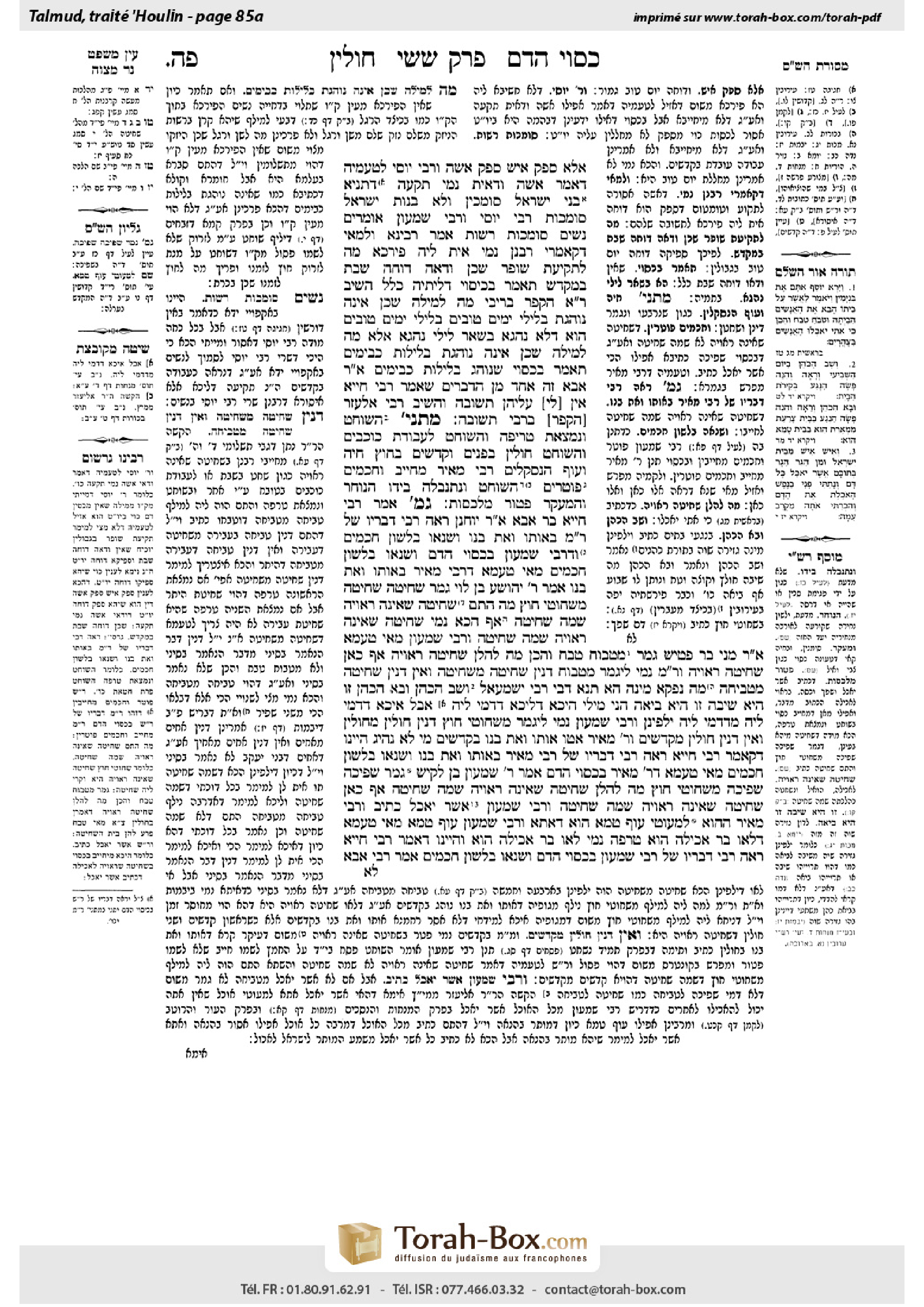
Chullin 85a: Talmud study for Daf Yomi
Study the Talmud for Daf Yomi with scanned pages, Hebrew text, English translations from Sefaria and AI-generated French translations.
Passage selection and English or AI-generated French translation are available where the scan has annotations. Daf Study is independent of Torah-Box and Sefaria.
Browse Chullin · חולין · All tractatesChullin 85a text and translations
This page of Chullin includes the Aramaic text, an English translation and an AI-generated French translation, alongside the scan above.
חולין פ״ה א · Aramaic and Hebrew text
אֶלָּא סְפֵק אִישׁ סְפֵק אִשָּׁה.
וְרַבִּי יוֹסֵי לְטַעְמֵיהּ, דְּאָמַר: אִשָּׁה וַדָּאִית נָמֵי תָּקְעָה. דְּתַנְיָא: בְּנֵי יִשְׂרָאֵל סוֹמְכִין, וְלֹא בְּנוֹת יִשְׂרָאֵל סוֹמְכוֹת.
רַבִּי יוֹסֵי וְרַבִּי שִׁמְעוֹן אוֹמְרִים: נָשִׁים סוֹמְכוֹת רְשׁוּת.
אָמַר רָבִינָא: וּלְמַאי דְּקָאָמְרִי רַבָּנַן נָמֵי אִית לֵיהּ פִּירְכָא, מָה לִתְקִיעַת שׁוֹפָר שֶׁכֵּן וַדָּאָהּ דּוֹחֶה שַׁבָּת בַּמִּקְדָּשׁ, תֹּאמַר בְּכִיסּוּי דְּלֵיתֵיהּ כְּלָל!
הֵשִׁיב רַבִּי אֶלְעָזָר הַקַּפָּר בְּרִיבִּי: מָה לְמִילָה שֶׁכֵּן אֵינָהּ נוֹהֶגֶת בְּלֵילֵי יָמִים טוֹבִים. בְּלֵילֵי יָמִים טוֹבִים הוּא דְּלָא נָהֲגָא, בִּשְׁאָר לֵילֵי נָהֲגָא?
אֶלָּא, מָה לְמִילָה – שֶׁכֵּן אֵינָהּ נוֹהֶגֶת בַּלֵּילוֹת כְּבַיָּמִים, תֹּאמַר בְּכִסּוּי – שֶׁנּוֹהֵג בַּלֵּילוֹת כְּבַיָּמִים! אָמַר רַבִּי אַבָּא: זֶה אֶחָד מִן הַדְּבָרִים שֶׁאָמַר רַבִּי חִיָּיא אֵין עֲלֵיהֶן תְּשׁוּבָה, וְהֵשִׁיב רַבִּי אֶלְעָזָר בְּרַבִּי תְּשׁוּבָה.
מַתְנִי׳ הַשּׁוֹחֵט וְנִמְצֵאת טְרֵיפָה, וְהַשּׁוֹחֵט לַעֲבוֹדָה זָרָה, וְהַשּׁוֹחֵט חוּלִּין בִּפְנִים וְקָדָשִׁים בַּחוּץ, חַיָּה וָעוֹף הַנִּסְקָלִים – רַבִּי מֵאִיר מְחַיֵּיב, וַחֲכָמִים פּוֹטְרִים.
הַשּׁוֹחֵט וְנִתְנַבְּלָה בְּיָדוֹ, הַנּוֹחֵר וְהַמְעַקֵּר – פָּטוּר מִלְּכַסּוֹת.
גְּמָ׳ אָמַר רַבִּי חִיָּיא בַּר אַבָּא אָמַר רַבִּי יוֹחָנָן: רָאָה רַבִּי דְּבָרָיו שֶׁל רַבִּי מֵאִיר בְּאוֹתוֹ וְאֶת בְּנוֹ, וּשְׁנָאוֹ בִּלְשׁוֹן חֲכָמִים, וּדְרַבִּי שִׁמְעוֹן בְּכִסּוּי הַדָּם, וּשְׁנָאוֹ בִּלְשׁוֹן חֲכָמִים.
מַאי טַעְמָא דְּרַבִּי מֵאִיר בְּאוֹתוֹ וְאֶת בְּנוֹ? אָמַר רַבִּי יְהוֹשֻׁעַ בֶּן לֵוִי: גָּמַר שְׁחִיטָה שְׁחִיטָה מִשְּׁחוּטֵי חוּץ.
מָה הָתָם – שְׁחִיטָה שֶׁאֵינָהּ רְאוּיָה שְׁמָהּ שְׁחִיטָה, אַף הָכָא נָמֵי – שְׁחִיטָה שֶׁאֵינָהּ רְאוּיָה שְׁמָהּ שְׁחִיטָה.
וְרַבִּי שִׁמְעוֹן, מַאי טַעְמָא? אָמַר רַבִּי מָנִי בַּר פַּטִּישׁ: גָּמַר מִ״טְּבוֹחַ טֶבַח וְהָכֵן״, מָה לְהַלָּן שְׁחִיטָה רְאוּיָה, אַף כָּאן שְׁחִיטָה רְאוּיָה.
וְרַבִּי מֵאִיר נָמֵי, לִיגְמַר מִ״טְּבוֹחַ״? דָּנִין שְׁחִיטָה מִשְּׁחִיטָה, וְאֵין דָּנִין שְׁחִיטָה מִטְּבִיחָה.
מָה נָפְקָא מִינַּהּ? הָא תָּנָא דְּבֵי רַבִּי יִשְׁמָעֵאל: ״וְשָׁב הַכֹּהֵן״ ״וּבָא הַכֹּהֵן״ – זוֹ הִיא שִׁיבָה זוֹ הִיא בִּיאָה.
הָנֵי מִילֵּי – הֵיכָא דְּלֵיכָּא דְּדָמֵי לֵיהּ, אֲבָל אִיכָּא דְּדָמֵי לֵיהּ – מִדְּדָמֵי לֵיהּ יָלְפִינַן.
וְרַבִּי שִׁמְעוֹן נָמֵי לִיגְמַר מִשְּׁחוּטֵי חוּץ? דָּנִין חוּלִּין מֵחוּלִּין, וְאֵין דָּנִין חוּלִּין מִקֳּדָשִׁים.
וְרַבִּי מֵאִיר: אַטּוּ אוֹתוֹ וְאֶת בְּנוֹ בְּקָדָשִׁים מִי לָא נָהֵיג? הַיְינוּ דְּקָאָמַר רַבִּי חִיָּיא: רָאָה רַבִּי דְּבָרָיו שֶׁל רַבִּי מֵאִיר בְּאוֹתוֹ וְאֶת בְּנוֹ, וּשְׁנָאוֹ בִּלְשׁוֹן חֲכָמִים.
מַאי טַעְמָא דְּרַבִּי מֵאִיר בְּכִסּוּי הַדָּם? אָמַר רַבִּי שִׁמְעוֹן בֶּן לָקִישׁ: גָּמַר שְׁפִיכָה שְׁפִיכָה מִשְּׁחוּטֵי חוּץ, מָה לְהַלָּן – שְׁחִיטָה שֶׁאֵינָהּ רְאוּיָה שְׁמָהּ שְׁחִיטָה, אַף כָּאן – שְׁחִיטָה שֶׁאֵינָהּ רְאוּיָה שְׁמָהּ שְׁחִיטָה.
וְרַבִּי שִׁמְעוֹן: ״אֲשֶׁר יֵאָכֵל״ כְּתִיב, וְרַבִּי מֵאִיר: הָהוּא לְמַעוֹטֵי עוֹף טָמֵא הוּא דַּאֲתָא, וְרַבִּי שִׁמְעוֹן: עוֹף טָמֵא מַאי טַעְמָא – דְּלָאו בַּר אֲכִילָה הוּא, טְרֵפָה נָמֵי – לָאו בַּר אֲכִילָה הוּא.
וְהַיְינוּ דְּאָמַר רַבִּי חִיָּיא: רָאָה רַבִּי דְּבָרָיו שֶׁל רַבִּי שִׁמְעוֹן בְּכִסּוּי הַדָּם, וּשְׁנָאוֹ בִּלְשׁוֹן חֲכָמִים.
אָמַר רַבִּי אַבָּא:
Chullin 85a · English translation
Rather, it must be that the uncertainty in the case of the sounding of the shofar concerns whether a particular individual is a man or a woman, e.g., a tumtum, whose sexual organs are indeterminate. Although a woman is not obligated in the mitzva of sounding the shofar, a tumtum is in fact obligated, despite the uncertainty of sex. It is therefore possible to derive from the sounding of the shofar that if one slaughters a koy, an animal whose status as a domesticated or undomesticated animal is uncertain, on a Festival, one covers its blood.
The Gemara notes: And Rabbi Yosei, who does not accept this refutation, conforms to his standard line of reasoning, as he says: One who is definitely a woman may also sound the shofar on Rosh HaShana. As it is taught in a baraita concerning the verse that discusses a burnt offering: “Speak to the sons of Israel…and he shall place his hands upon the head of the burnt offering” (Leviticus 1:2–4). The verse indicates that the sons of Israel place their hands upon the head of an offering, but the daughters of Israel do not place their hands.
Rabbi Yosei and Rabbi Shimon say: It is optional for women to place their hands on the head of an offering before it is slaughtered. Even though women are not obligated to place their hands, doing so is not considered to be performing labor with a sacrificial item, an act normally prohibited, despite the fact that one performs the placing of the hands by leaning with all of his weight on the animal. Similarly, Rabbi Yosei holds that although women are not obligated in the sounding of the shofar, it is optional for them to sound it, and it is not considered a desecration of the Festival.
Ravina said: And even according to what the Sages said, that a woman may not sound the shofar on Rosh HaShana but a tumtum is nevertheless obligated due to uncertainty, there is a refutation to their claim as well. One cannot derive from this that the obligation to cover the blood of a koy overrides a Festival. What is notable about the sounding of the shofar? It is notable in that its definite obligation overrides Shabbat in the Temple, as it was sounded in the Temple even when Rosh HaShana occurred on Shabbat, and it is therefore understandable that its uncertain obligation overrides a Festival as well. Can you say the same with regard to the mitzva of covering the blood, which does not override Shabbat in any instance?
The Gemara continues its analysis of the baraita: Rabbi Elazar HaKappar the Distinguished responded with another refutation to Rabbi Yosei’s a fortiori inference: One cannot infer from the mitzva of circumcision that an uncertain obligation to cover the blood of a koy does not override a Festival. What is notable about circumcision? It is notable in that it is not in effect on Festival nights. Can you say the same with regard to the mitzva of covering the blood, which is in effect on Festival nights? The Gemara asks: Does Rabbi Elazar HaKappar mean to say that the mitzva of circumcision is not in effect only on Festival nights, but it is in effect on other, non-Festival nights? Isn’t circumcision always performed during the day?
The Gemara responds: Rather, Rabbi Elazar HaKappar meant the following: What is notable about circumcision? It is notable in that it is not in effect at night as it is by day. Can you say a similar halakha with regard to the mitzva of covering the blood, which is in effect at night as it is by day? Rabbi Abba said: This a fortiori inference drawn by Rabbi Yosei is one of the matters with regard to which Rabbi Ḥiyya says that there is no refutation for them, and Rabbi Elazar HaKappar the Distinguished successfully responded with a refutation.
MISHNA: In the case of one who slaughters an undomesticated animal or a bird and it is discovered to be an animal with a wound that would have caused it to die within twelve months [tereifa]; and in the case of one who slaughters an undomesticated animal or a bird for the sake of idol worship; and in the case of one who slaughters a non-sacred animal or bird inside the Temple courtyard or a sacrificial bird outside the Temple courtyard; or in the case of one who slaughters an undomesticated animal or a bird that was sentenced to be stoned, e.g., for killing a person; in all these cases, even though it is prohibited to eat any of these animals or birds, Rabbi Meir deems one obligated to cover their blood, and the Rabbis deem one exempt from doing so because, in their opinion, slaughter that is not fit to render the meat permitted for consumption is not considered an act of slaughter.
One who slaughters an animal or bird and it became a carcass by his hand, i.e., the slaughter was performed incorrectly, and one who stabs the animal or bird, and one who tears loose the windpipe and the gullet, are exempt from covering the blood, as no act of slaughter took place, and one is obligated to cover blood only after a valid slaughter.
GEMARA: With regard to the dispute in the mishna about whether an act of slaughter that is not fit to render the meat permitted renders one obligated to cover the blood, Rabbi Ḥiyya bar Abba says that Rabbi Yoḥanan says: Rabbi Yehuda HaNasi, the redactor of the Mishna, saw as correct the statement of Rabbi Meir, that ineffective slaughter is considered an act of slaughter, with regard to the prohibition against slaughtering a mother and its offspring on the same day, and taught that halakha in the mishna (81b) using the term: The Rabbis, so that it would be accepted. And he saw as correct the statement of Rabbi Shimon, that ineffective slaughter is not considered an act of slaughter with regard to the mitzva of covering the blood, and taught that halakha in the mishna here using the term: The Rabbis.
The Gemara asks: What is the reason that Rabbi Meir holds that ineffective slaughter is considered an act of slaughter in the case of a mother and its offspring? Rabbi Yehoshua ben Levi said: He derives his opinion by means of a verbal analogy of the terms slaughter and slaughter, from the case of sacrificial animals slaughtered outside the Temple. The verse states with regard to a mother and its offspring: “It and its offspring you shall not slaughter [lo tishḥatu] in one day” (Leviticus 22:28), and the verse states with regard to sacrificial animals: “Or that is slaughtered [yishḥat] outside the camp” (Leviticus 17:3).
Accordingly, just as there, with regard to one who slaughters an offering outside the Temple it is a case of slaughter that is not fit to render the meat permitted, as one is prohibited from deriving any benefit from such meat, and it is nevertheless considered an act of slaughter to render one liable for slaughtering it outside the Temple, so too here, in the case of a mother and its offspring, an act of slaughter that is not fit to render the meat permitted is considered an act of slaughter, and one is liable.
The Gemara asks: And as for Rabbi Shimon, what is the reason he holds that an ineffective slaughter is not considered an act of slaughter? Rabbi Mani bar Pattish said: Rabbi Shimon derives his opinion from the verse: “Slaughter [tevo’aḥ] and prepare; for the men shall dine with me at noon” (Genesis 43:16). Just as there, the verse is referring to an act of slaughter that is fit to render the meat permitted, so too here, in the case of a mother and its offspring, only an act of slaughter that is fit to render the meat permitted is considered an act of slaughter.
The Gemara suggests: And as for Rabbi Meir as well, let him derive from “tevo’aḥ” that only an effective slaughter is considered an act of slaughter. The Gemara responds: According to Rabbi Meir, one derives the halakha with regard to a term of sheḥita from another instance of a term of sheḥita, and one does not derive the halakha with regard to the term of sheḥita from the term of teviḥa.
The Gemara asks: Being that both terms refer to slaughter, what is the difference which one is used; didn’t the school of Rabbi Yishmael teach a verbal analogy with regard to leprosy of houses: The verse states: “And the priest shall return [veshav] on the seventh day” (Leviticus 14:39), and another verse with regard to the priest’s visit seven days later states: “And the priest shall come [uva] and look” (Leviticus 14:44). This returning and this coming have the same meaning and one can therefore derive by verbal analogy that the halakha that applies if the leprosy had spread at the conclusion of the first week applies if it had spread again by the end of the following week.
The Gemara responds: This statement of the school of Rabbi Yishmael applies only where there are no other terms that are identical to it from which one could derive a verbal analogy. But if there is another term that is identical to it, we derive the verbal analogy from the term that is identical to it. Accordingly, Rabbi Meir derives a verbal analogy from the instance of sheḥita that appears with regard to sacrificial animals that are slaughtered outside the Temple.
The Gemara suggests: And as for Rabbi Shimon as well, let him derive from the case of sacrificial animals that were slaughtered outside the Temple that ineffective slaughter is considered an act of slaughter. The Gemara responds: Rabbi Shimon holds that one derives the halakha with regard to the slaughter of non-sacred animals from another instance of the slaughter of non-sacred animals, and one does not derive the halakha with regard to the slaughter of non-sacred animals from an instance of the slaughter of sacrificial animals. The prohibition against slaughtering a mother and its offspring on the same day is stated primarily with regard to non-sacred animals (see 78a).
The Gemara continues: And Rabbi Meir would respond: Is this to say that the prohibition against slaughtering a mother and its offspring on the same day does not apply to sacrificial animals? Rather, since the prohibition also applies to sacrificial animals, one can derive its halakha from the case of sacrificial animals that were slaughtered outside the Temple. The Gemara comments: This is what Rabbi Ḥiyya was referring to when he said that Rabbi Yehuda HaNasi saw as correct the statement of Rabbi Meir with regard to the halakha of a mother and its offspring, and taught it in the mishna using the term: The Rabbis.
§ The Gemara resumes its discussion of the dispute in the mishna: What is the reason that Rabbi Meir holds one is obligated in the mitzva of covering the blood in a case of ineffective slaughter? Rabbi Shimon ben Lakish said: Rabbi Meir derives this from a verbal analogy between the terms pouring and pouring, from the case of a sacrificial animal that was slaughtered outside the Temple courtyard. One verse states with regard to covering the blood: “And he shall pour out its blood” (Leviticus 17:13), and one verse states with regard to sacrificial animals slaughtered outside the Temple courtyard: “He has poured blood” (Leviticus 17:4). Accordingly, just as there, with regard to offerings slaughtered outside the Temple courtyard, it is a case of slaughter that is not fit to render the meat permitted but is nevertheless considered an act of slaughter, so too here, with regard to covering the blood, an act of slaughter that is not fit to render the meat permitted is considered an act of slaughter.
The Gemara continues: And Rabbi Shimon would respond: It is written with regard to covering the blood: “An undomesticated animal or bird that may be eaten” (Leviticus 17:13), indicating that the verse is referring specifically to slaughter fit to render the meat permitted for consumption. And Rabbi Meir holds: That phrase comes to exclude a ritually impure bird from the mitzva of covering the blood. And Rabbi Shimon would respond: What is the reason an impure bird is not included in the mitzva of covering the blood? It is because it is not fit for consumption. If so, a tereifa should also not be included in the mitzva of covering the blood, since it is also not fit for consumption.
The Gemara comments: And this is what Rabbi Ḥiyya is saying when he said that Rabbi Yehuda HaNasi saw as correct the statement of Rabbi Shimon with regard to the halakha of covering the blood, and taught it in the mishna using the term: The Rabbis.
§ Rabbi Abba says:
Chullin 85a · Traduction française (IA)
En réalité, il faut que l'incertitude dans le cas du son du cor concerne la question de savoir si une personne particulière est un homme ou une femme, par exemple un tumtum, dont les organes sexuels sont indéterminés. Bien qu'une femme ne soit pas tenue de remplir la mitsva du son du cor, un tumtum est en fait tenu, malgré l'incertitude sur son sexe. Il est donc possible d'extraire de la son du cor que si l'on sacrifie un koy, un animal dont le statut d'animal domestique ou non est indéterminé, lors d'une fête, l'on recouvre son sang.
La Guemara note : Et Rabbi Yosei, qui ne valide pas cette réfutation, suit sa ligne de raisonnement habituelle, car il dit : Une femme certaine peut également sonner le cor à la fête de Rosh HaShana. Comme il est enseigné dans une baraïta concernant la parabole qui parle d'un holocauste : « Parle aux fils d'Israël… et il posera ses mains sur la tête du holocauste » (Lévitique 1:2–4). La parabole indique que les fils d'Israël posent leurs mains sur la tête d'un holocauste, mais les filles d'Israël ne le font pas.
Rabbi Yosei et Rabbi Shimon disent : Il est facultatif pour les femmes de poser leurs mains sur la tête d'un holocauste avant qu'il ne soit sacrifié. Bien que les femmes ne soient pas tenues de poser leurs mains, faire cela n'est pas considéré comme un travail avec un objet sacré, une action normalement interdite, malgré le fait que l'on pose les mains en s'appuyant tout son poids sur l'animal. De même, Rabbi Yosei considère que bien que les femmes ne soient pas tenues de sonner le cor, il est facultatif pour elles de le faire, et cela n'est pas considéré comme une profanation de la fête.
Ravina dit : Et même selon ce que disent les Sages, que la femme ne peut pas sonner le cor à Rosh HaShana mais que le tumtum est toutefois tenu en raison d'incertitude, il y a une réfutation à leur affirmation également. On ne peut pas en déduire que l'obligation de recouvrir le sang du koy l'emporte sur la fête. Qu'est-ce qui rend le son du cor remarquable ? C'est qu'il l'emporte sur le sabbat dans le Temple, car il a été sonné dans le Temple même lorsque Rosh HaShana tombait un sabbat, et il est donc compréhensible qu'une obligation incertaine l'emporte également sur une fête. Pourriez-vous dire la même chose concernant la mitsva de recouvrir le sang, qui n'emporte pas sur le sabbat en aucun cas ?
La Guemara continue son analyse de la baraïta : Rabbi Elazar HaKappar le Distingué répond avec une autre réfutation à l'inférence a fortiori de Rabbi Yosei : On ne peut pas inférer de la mitsva de la circoncision que l'obligation incertaine de recouvrir le sang du koy ne l'emporte pas sur la fête. Qu'est-ce qui rend la circoncision remarquable ? C'est qu'elle n'est pas en vigueur les nuits de fête. Pourriez-vous dire la même chose concernant la mitsva de recouvrir le sang, qui est en vigueur les nuits de fête ? La Guemara demande : Rabbi Elazar HaKappar veut-il dire que la mitsva de la circoncision n'est pas en vigueur uniquement les nuits de fête, mais qu'elle l'est sur d'autres nuits non festives ? N'est-ce pas que la circoncision est toujours effectuée de jour ?
La Guemara répond : Plutôt, Rabbi Elazar HaKappar voulait dire ceci : Qu'est-ce qui rend la circoncision remarquable ? C'est qu'elle n'est pas en vigueur la nuit comme le jour. Pourriez-vous dire une même halakha concernant la mitsva de recouvrir le sang, qui est en vigueur la nuit comme le jour ? Rabbi Abba dit : Cette inférence a fortiori tirée par Rabbi Yosei est l'une des matières concernant lesquelles Rabbi Ḥiyya dit qu'il n'y a pas de réfutation, et Rabbi Elazar HaKappar le Distingué a réussi à répondre avec une réfutation.
MICHNA : Dans le cas d'une personne qui sacrifie un animal non domestique ou un oiseau et il est découvert qu'il s'agit d'un animal blessé qui aurait causé sa mort en douze mois [tereifa] ; et dans le cas d'une personne qui sacrifie un animal non domestique ou un oiseau pour l'idolâtrie ; et dans le cas d'une personne qui sacrifie un animal non sacré ou un oiseau dans le courtyard du Temple ou un oiseau sacré en dehors du courtyard du Temple ; ou dans le cas d'une personne qui sacrifie un animal non domestique ou un oiseau qui a été condamné à être lapidé, par exemple pour avoir tué une personne ; dans tous ces cas, même si il est interdit de manger ces animaux ou oiseaux, Rabbi Meir considère que l'on est tenu de recouvrir leur sang, et les Rabbins considèrent qu'on est exempt de le faire car, selon leur avis, un sacrifice qui n'est pas adapté à rendre la viande permise n'est pas considéré comme un acte de sacrifice.
Celui qui sacrifie un animal ou un oiseau et il devient un cadavre par sa main, c'est-à-dire que le sacrifice a été effectué incorrectement, et celui qui transperce l'animal ou l'oiseau, et celui qui déchire la trachée et le gosier, est exempt de recouvrir le sang, car aucun acte de sacrifice n'a eu lieu, et l'on est tenu de recouvrir le sang uniquement après un sacrifice valide.
GUEMARA : Concernant le débat dans la mitsna concernant si un acte de sacrifice non adapté à rendre la viande permise rend l'obligation de recouvrir le sang, Rabbi Ḥiyya bar Abba dit que Rabbi Yoḥanan dit : Rabbi Yehuda HaNasi, le rédacteur de la mitsna, a considéré comme correct la déclaration de Rabbi Meir, que le sacrifice inefficace est considéré comme un acte de sacrifice, concernant l'interdiction de sacrifier une mère et ses enfants le même jour, et a enseigné la halakha dans la mitsna (81b) en utilisant le terme : Les Rabbins, afin qu'elle soit acceptée. Et il a considéré comme correct la déclaration de Rabbi Shimon, que le sacrifice inefficace n'est pas considéré comme un acte de sacrifice concernant la mitsva de recouvrir le sang, et a enseigné la halakha dans la mitsna ici en utilisant le terme : Les Rabbins.
La Guemara pose la question : Quel est le fondement de la position de Rabbi Meïr selon laquelle un abattage inefficace est considéré comme un acte d'abattage dans le cas d'une mère et de son petit ? Rabbi Yéhoshua ben Lévi dit : Il tire sa conclusion par analogie verbale entre les termes d'abattage et d'abattage, à partir du cas des animaux sacrés abattus en dehors du Temple. La Parole stipule à propos d'une mère et de son petit : « Tu ne tueras pas [lo tishḥatu] l'un et l'autre en un même jour » (Lévitique 22:28), et la Parole stipule à propos des animaux sacrés : « Celui qui a été tué [yishḥat] en dehors du camp » (Lévitique 17:3).
Ainsi, tout comme là, concernant celui qui abat un sacrifice en dehors du Temple, c'est un cas d'abattage non adapté à rendre la viande permise, car on est interdit de tirer quelque bénéfice de cette viande, et pourtant il est considéré comme un acte d'abattage rendant responsable de l'avoir abattu en dehors du Temple, de même ici, dans le cas d'une mère et de son petit, un acte d'abattage non adapté à rendre la viande permise est considéré comme un acte d'abattage, et l'on est responsable.
La Guemara pose la question : Et concernant Rabbi Šimon, quelle est la raison selon laquelle il considère qu'un abattage inefficace n'est pas considéré comme un acte d'abattage ? Rabbi Mani bar Patti dit : Rabbi Šimon tire sa conclusion de la Parole : « Abatte [tevo’aḥ] et prépare ; car les hommes dîneront avec moi à midi » (Gen 43:16). Tout comme là, la Parole fait référence à un acte d'abattage adapté à rendre la viande permise, de même ici, dans le cas d'une mère et de son petit, seul un acte d'abattage adapté à rendre la viande permise est considéré comme un acte d'abattage.
La Guemara suggère : Et concernant Rabbi Meïr également, laissons-le tirer sa conclusion de « tevo’aḥ » selon lequel seul un abattage efficace est considéré comme un acte d'abattage. La Guemara répond : Selon Rabbi Meïr, on tire la halakha concernant un terme de sheḥita d'un autre cas de terme de sheḥita, et on ne tire pas la halakha concernant le terme de sheḥita d'un terme de teviḥa.
La Guemara pose la question : Puisque les deux termes font référence à l'abattage, quelle est la différence qui justifie l'usage de l'un ou de l'autre ? N'a-t-on pas appris de la maison de Rabbi Yishmael une analogie verbale concernant la lèpre des maisons : La Parole stipule : « Et le prêtre reviendra [veshav] le septième jour » (Lévitique 14:39), et une autre Parole concernant la visite du prêtre sept jours plus tard stipule : « Et le prêtre viendra [uva] et regardera » (Lévitique 14:44). Ce retour et ce venir ont le même sens et l'on peut donc tirer par analogie verbale que la halakha qui s'applique si la lèpre s'est étendue à la fin de la première semaine s'applique si elle s'est étendue à nouveau à la fin de la semaine suivante.
La Guemara répond : Cette déclaration de la maison de Rabbi Yishmael s'applique uniquement là où il n'y a pas d'autres termes identiques à partir desquels on pourrait tirer une analogie verbale. Mais si un autre terme identique existe, on tire l'analogie verbale à partir de ce terme identique. Ainsi, Rabbi Meïr tire une analogie verbale à partir du cas de sheḥita qui apparaît concernant les animaux sacrés abattus en dehors du Temple.
La Guemara suggère : Et concernant Rabbi Šimon également, laissons-le tirer sa conclusion du cas d'animaux sacrés abattus en dehors du Temple selon lequel un abattage inefficace est considéré comme un acte d'abattage. La Guemara répond : Rabbi Šimon considère que l'on tire la halakha concernant l'abattage d'animaux non sacrés d'un autre cas d'abattage d'animaux non sacrés, et l'on ne tire pas la halakha concernant l'abattage d'animaux non sacrés d'un cas d'abattage d'animaux sacrés. L'interdiction d'abattre une mère et son petit le même jour est principalement énoncée concernant les animaux non sacrés (voir 78a).
La Guemara continue : Et Rabbi Meïr répondrait : Est-ce que cela signifie que l'interdiction d'abattre une mère et son petit le même jour ne s'applique pas aux animaux sacrés ? Plutôt, puisque l'interdiction s'applique également aux animaux sacrés, l'on peut tirer sa halakha du cas d'animaux sacrés abattus en dehors du Temple. La Guemara commente : C'est ce que Rabbi Ḥiyya faisait référence lorsqu'il disait que Rabbi Yéhuda HaNasi considérait comme correct la déclaration de Rabbi Meïr concernant la halakha d'une mère et de son petit, et l'a enseigné dans la mitsna en utilisant le terme : Les Rabbins.
§ La Guemara reprend la discussion de la dispute dans la mitsna : Quel est le fondement selon lequel Rabbi Meïr considère qu'on est tenu de la mitsva de recouvrir le sang dans le cas d'un abattage inefficace ? Rabbi Šimon ben Lakish dit : Rabbi Meïr tire cette conclusion d'une analogie verbale entre les termes de versement et de versement, à partir du cas d'un animal sacré abattu en dehors du cour du Temple. Une Parole stipule concernant le recouvrement du sang : « Et il versera son sang » (Lévitique 17:13), et une autre Parole concernant les animaux sacrés abattus en dehors du Temple : « Il a versé du sang » (Lévitique 17:4). Ainsi, tout comme là, concernant les offrandes abattues en dehors du cour du Temple, c'est un cas d'abattage non adapté à rendre la viande permise mais considéré comme un acte d'abattage, de même ici, concernant le recouvrement du sang, un acte d'abattage non adapté à rendre la viande permise est considéré comme un acte d'abattage.
La Guemara continue : Et Rabbi Šimon répondait : Il est écrit concernant le recouvrement du sang : « Un animal ou oiseau non domestique qui peut être mangé » (Lévitique 17:13), indiquant que la parole se réfère spécifiquement à un animal sacré propre à rendre la viande permise à la consommation. Et Rabbi Meïr dit : Cette expression vise à exclure un oiseau impur du mitsva du recouvrement du sang. Et Rabbi Šimon répondait : Pourquoi un oiseau impur n’est-il pas inclus dans la mitsva du recouvrement du sang ? C’est parce qu’il n’est pas propre à la consommation. Si c’est ainsi, un tereifa devrait également être exclu de la mitsva du recouvrement du sang, car il n’est également pas propre à la consommation.
La Guemara commente : Et c’est ce que Rabbi Ḥiyya dit lorsqu’il disait que Rabbi Yéhouda HaNasi considérait comme correct la déclaration de Rabbi Šimon concernant la halakha du recouvrement du sang, et l’a transmise dans la mitsna en utilisant le terme : Les Sages.
§ Rabbi Abba dit :
Traduction française générée par IA à partir de l’édition anglaise de Sefaria. Vérifie toujours un passage avec le texte source.
Text from Sefaria: William Davidson Edition - Vocalized Aramaic (unknown); William Davidson Edition - English (CC BY NC).