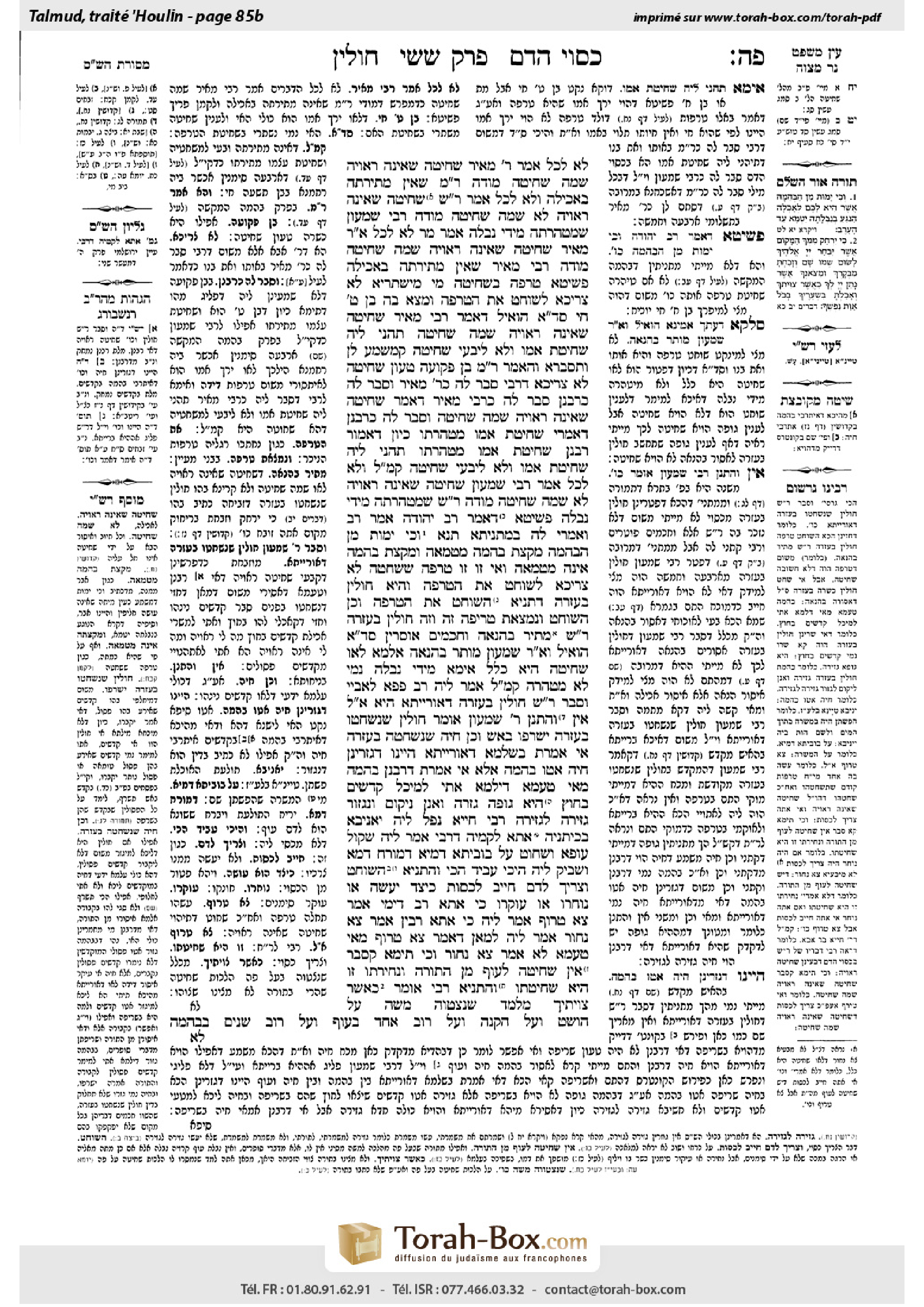
Chullin 85b: Talmud study for Daf Yomi
Study the Talmud for Daf Yomi with scanned pages, Hebrew text, English translations from Sefaria and AI-generated French translations.
Passage selection and English or AI-generated French translation are available where the scan has annotations. Daf Study is independent of Torah-Box and Sefaria.
Browse Chullin · חולין · All tractatesChullin 85b text and translations
This page of Chullin includes the Aramaic text, an English translation and an AI-generated French translation, alongside the scan above.
חולין פ״ה ב · Aramaic and Hebrew text
לֹא לַכֹּל אָמַר רַבִּי מֵאִיר שְׁחִיטָה שֶׁאֵינָהּ רְאוּיָה שְׁמָהּ שְׁחִיטָה: מוֹדֶה רַבִּי מֵאִיר שֶׁאֵין מַתִּירָתָהּ בַּאֲכִילָה; וְלֹא לַכֹּל אָמַר רַבִּי שִׁמְעוֹן שְׁחִיטָה שֶׁאֵינָהּ רְאוּיָה לֹא שְׁמָהּ שְׁחִיטָה: מוֹדֶה רַבִּי שִׁמְעוֹן שֶׁמְּטַהַרְתָּהּ מִידֵי נְבֵלָה.
אָמַר מָר: לֹא לַכֹּל אָמַר רַבִּי מֵאִיר שְׁחִיטָה שֶׁאֵינָהּ רְאוּיָה שְׁמָהּ שְׁחִיטָה, מוֹדֶה רַבִּי מֵאִיר שֶׁאֵין מַתִּירָתָהּ בַּאֲכִילָה. פְּשִׁיטָא! טְרֵפָה בִּשְׁחִיטָה מִי מִישְׁתַּרְיָא?
לָא צְרִיכָא, לְשׁוֹחֵט אֶת הַטְּרֵפָה וּמָצָא בָּהּ בֶּן תִּשְׁעָה חַי; סָלְקָא דַּעְתָּךְ אָמֵינָא: הוֹאִיל דְּאָמַר רַבִּי מֵאִיר: שְׁחִיטָה שֶׁאֵינָהּ רְאוּיָה שְׁמָהּ שְׁחִיטָה, תַּהֲנֵי לֵיהּ שְׁחִיטַת אִמּוֹ וְלָא לִיבְעֵי שְׁחִיטָה, קָמַשְׁמַע לַן.
וְתִסְבְּרָא? וְהָאָמַר רַבִּי מֵאִיר: בֶּן פְּקוּעָה טָעוּן שְׁחִיטָה!
לָא צְרִיכָא, דְּרַבִּי סָבַר לַהּ כְּרַבִּי מֵאִיר וְסָבַר לַהּ כְּרַבָּנַן. סָבַר לַהּ כְּרַבִּי מֵאִיר, דְּאָמַר: שְׁחִיטָה שֶׁאֵינָהּ רְאוּיָה שְׁמָהּ שְׁחִיטָה, וְסָבַר לַהּ כְּרַבָּנַן, דְּאָמְרִי: שְׁחִיטַת אִמּוֹ מְטַהַרְתּוֹ.
כֵּיוָן דַּאֲמוּר רַבָּנַן שְׁחִיטַת אִמּוֹ מְטַהַרְתּוֹ, תַּהֲנֵי לֵיהּ שְׁחִיטַת אִמּוֹ וְלָא לִיבְעֵי שְׁחִיטָה, קָא מַשְׁמַע לַן.
וְלֹא לַכֹּל אָמַר רַבִּי שִׁמְעוֹן שְׁחִיטָה שֶׁאֵינָהּ רְאוּיָה לֹא שְׁמָהּ שְׁחִיטָה, מוֹדֶה רַבִּי שִׁמְעוֹן שֶׁמְּטַהַרְתָּהּ מִידֵי נְבֵלָה. פְּשִׁיטָא! דְּאָמַר רַב יְהוּדָה אָמַר רַב, וְאָמְרִי לַהּ בְּמַתְנִיתָא תָּנָא: ״וְכִי יָמוּת מִן הַבְּהֵמָה״, מִקְצָת בְּהֵמָה מְטַמְּאָה וּמִקְצָת בְּהֵמָה אֵינָהּ מְטַמְּאָה, וְאֵי זוֹ זוֹ – טְרֵפָה שֶׁשְּׁחָטָהּ.
לָא צְרִיכָא, לְשׁוֹחֵט אֶת הַטְּרֵפָה וְהִיא חוּלִּין בַּעֲזָרָה. דְּתַנְיָא: הַשּׁוֹחֵט אֶת הַטְּרֵפָה, וְכֵן הַשּׁוֹחֵט וְנִמְצֵאת טְרֵיפָה, זֶה וָזֶה חוּלִּין בַּעֲזָרָה – רַבִּי שִׁמְעוֹן מַתִּיר בַּהֲנָאָה, וַחֲכָמִים אוֹסְרִין.
סָלְקָא דַּעְתָּךְ אָמֵינָא, הוֹאִיל וְאָמַר רַבִּי שִׁמְעוֹן: מוּתָּר בַּהֲנָאָה, אַלְמָא לָאו שְׁחִיטָה הִיא כְּלָל, אֵימָא: מִידֵי נְבֵלָה נָמֵי לָא מְטַהֲרָה, קָא מַשְׁמַע לַן.
אֲמַר לֵיהּ רַב פָּפָּא לְאַבָּיֵי: וְסָבַר רַבִּי שִׁמְעוֹן חוּלִּין בַּעֲזָרָה דְּאוֹרָיְיתָא הִיא? אֲמַר לֵיהּ: אִין, וְהָתְנַן רַבִּי שִׁמְעוֹן אוֹמֵר: חוּלִּין שֶׁנִּשְׁחֲטוּ בַּעֲזָרָה יִשָּׂרְפוּ בָּאֵשׁ, וְכֵן חַיָּה שֶׁנִּשְׁחֲטָה בָּעֲזָרָה. אִי אָמְרַתְּ בִּשְׁלָמָא דְּאוֹרָיְיתָא – הַיְינוּ דְּגָזְרִינַן חַיָּה אַטּוּ בְּהֵמָה.
אֶלָּא אִי אָמְרַתְּ דְּרַבָּנַן, בְּהֵמָה מַאי טַעְמָא? דִּילְמָא אָתֵי לְמֵיכַל קָדָשִׁים בַּחוּץ, הִיא גּוּפַהּ גְּזֵרָה, וַאֲנַן נֵיקוּם וְנִגְזוֹר גְּזֵירָה לִגְזֵירָה?
רַבִּי חִיָּיא נְפַל לֵיהּ יָאנִיבָא בְּכִיתָּנֵיהּ, אֲתָא לְקַמֵּיהּ דְּרַבִּי, אֲמַר לֵיהּ: שְׁקוֹל עוֹפָא וּשְׁחוֹט עַל בּוּבִיתָא דְּמַיָּא, דְּמוֹרַח דְּמָא וְשָׁבֵיק לֵיהּ.
הֵיכִי עָבֵיד הָכִי? וְהָתַנְיָא: הַשּׁוֹחֵט וְצָרִיךְ לַדָּם – חַיָּיב לְכַסּוֹת. כֵּיצַד יַעֲשֶׂה? אוֹ נוֹחֲרוֹ, אוֹ עוֹקְרוֹ.
כִּי אֲתָא רַב דִּימִי אָמַר: ״צֵא טְרוֹף״ אֲמַר לֵיהּ, כִּי אֲתָא רָבִין אָמַר: ״צֵא נְחוֹר״ אֲמַר לֵיהּ.
לְמַאן דְּאָמַר ״צֵא טְרוֹף״, מַאי טַעְמָא לָא אָמַר ״צֵא נְחוֹר״?
וְכִי תֵּימָא, קָסָבַר אֵין שְׁחִיטָה לָעוֹף מִן הַתּוֹרָה, וּנְחִירָתוֹ זוֹ הִיא שְׁחִיטָתוֹ, וְהָתַנְיָא: רַבִּי אוֹמֵר: ״כַּאֲשֶׁר צִוִּיתִךָ״ – מְלַמֵּד שֶׁנִּצְטַוָּה מֹשֶׁה עַל הַוֶּשֶׁט וְעַל הַקָּנֶה, וְעַל רוֹב אֶחָד בָּעוֹף, וְעַל רוֹב שְׁנַיִם בַּבְּהֵמָה.
Chullin 85b · English translation
Not with regard to all halakhot did Rabbi Meir say an act of slaughter that is not fit, e.g., where one slaughters a tereifa, is considered an act of slaughter, as Rabbi Meir does concede that such an act of slaughter does not render the meat of the animal permitted for consumption. And not with regard to all halakhot did Rabbi Shimon say an act of slaughter that is not fit is not considered an act of slaughter, as Rabbi Shimon does concede that such an act of slaughter renders the animal pure from having the impure status of an unslaughtered animal carcass.
The Gemara analyzes this statement: The Master said that not with regard to all halakhot did Rabbi Meir say an act of slaughter that is not fit is considered an act of slaughter, as Rabbi Meir concedes that such an act of slaughter does not render the meat of the animal permitted for consumption. The Gemara asks: Isn’t this obvious? Can a tereifa become permitted for consumption through slaughter?
The Gemara answers: No, this statement of Rabbi Abba is necessary in a case where one slaughtered a tereifa and found a living nine-month-old fetus inside it. It might enter your mind to say: Since Rabbi Meir said an act of slaughter that is not fit to render the meat permitted is considered an act of slaughter, the slaughter of its mother should be effective to render the meat of the fetus permitted for consumption, as it normally does when the mother is not a tereifa; and the fetus, after it is born, should not require its own slaughter. Rabbi Abba therefore teaches us that according to Rabbi Meir, slaughter that does not render the meat of the mother permitted for consumption does not render the fetus permitted either.
The Gemara asks: And how can you understand that without Rabbi Abba’s statement, one would have thought that according to Rabbi Meir, the fetus does not require its own slaughter? But doesn’t Rabbi Meir say that a fetus removed from its mother’s womb after the mother was properly slaughtered [ben pekua], requires slaughter, as the slaughter of the mother does not permit the fetus?
The Gemara responds: The statement of Rabbi Abba is not necessary for the opinion of Rabbi Meir, but it is for the opinion of Rabbi Yehuda HaNasi. This is because Rabbi Yehuda HaNasi holds in accordance with the opinion of Rabbi Meir in one instance, and holds in accordance with the opinion of the Rabbis in another. In a case where one slaughtered a mother and its offspring on the same day he holds in accordance with the opinion of Rabbi Meir, who says an act of slaughter that is not fit to render the meat permitted is considered an act of slaughter. And with regard to a ben pekua, Rabbi Yehuda HaNasi holds in accordance with the opinion of the Rabbis, who say the proper slaughter of the mother renders the fetus kosher, i.e., the fetus does not require its own ritual slaughter.
Therefore, since the Rabbis say the proper slaughter of the mother renders the fetus kosher, one might conclude that with regard to a tereifa as well, Rabbi Yehuda HaNasi holds the slaughter of the mother should be effective to render the meat of the fetus permitted for consumption, and it should not require its own slaughter. In light of this, Rabbi Abba teaches us that although Rabbi Yehuda HaNasi agrees with Rabbi Meir that an ineffective slaughter is considered an act of slaughter, Rabbi Yehuda HaNasi holds that in the case of a tereifa the slaughter of the mother is not effective for the fetus.
The Gemara addresses the second statement of Rabbi Abba: And not with regard to all halakhot did Rabbi Shimon say an act of slaughter that is not fit is not considered an act of slaughter, as Rabbi Shimon concedes that such an act of slaughter renders the animal pure from having the impure status of an unslaughtered animal carcass. The Gemara asks: Isn’t this obvious? As Rav Yehuda says that Rav says, and some say it was taught in a baraita: The verse states with regard to an animal carcass: “And if there dies of the animals…he that touches its carcass shall be unclean” (Leviticus 11:39). The word “of” indicates that some animals transmit impurity as a carcass and some animals do not transmit impurity. And which animal does not? That is a tereifa that one slaughtered.
The Gemara responds: No, Rabbi Abba’s statement is necessary in the case of one who slaughters a tereifa, and it is a non-sacred animal in the Temple courtyard. As it is taught in a baraita: In the case of one who slaughters a known tereifa, and likewise one who slaughters an animal and it was found to be a tereifa, and this and that were non-sacred animals slaughtered in the Temple courtyard, Rabbi Shimon permits one to derive benefit from them, as one is not considered to have transgressed the prohibition against slaughtering a non-sacred animal in the Temple courtyard. And the Rabbis prohibit one to derive benefit from them.
Accordingly, it might enter your mind to say: Since Rabbi Shimon says it is permitted to derive benefit from such an animal, evidently slaughtering a tereifa is not considered slaughter at all. Therefore, say that slaughter does not have the ability to purify the tereifa from having the status of a ritually impure animal carcass either. Rabbi Abba therefore teaches us that even according to Rabbi Shimon, the slaughter is effective to remove it from the status of a carcass.
Rav Pappa said to Abaye: And does Rabbi Shimon hold that the prohibition against deriving benefit from non-sacred animals slaughtered in the Temple courtyard is by Torah law? Abaye said to Rav Pappa: Yes he does. And we learned in a mishna (Temura 33b) that Rabbi Shimon says: Non-sacred animals that were slaughtered in the Temple courtyard shall be burned in the fire. And likewise, an undomesticated animal that was slaughtered in the Temple courtyard shall be burned in the fire. Abaye continues: Granted, if you say the meat of a non-sacred domesticated animal slaughtered in the Temple courtyard is forbidden by Torah law, this is the reason why we decree that the meat of an undomesticated animal is prohibited as well, due to the Torah prohibition against deriving benefit from the meat of a domesticated animal.
But if you say the meat of domesticated animals is forbidden by rabbinic law then the mishna is difficult: What is the reason the meat of a non-sacred domesticated animal is forbidden? It is forbidden lest one see someone consuming this meat outside the Temple courtyard and arrive at the erroneous conclusion that it is permitted to partake of sacrificial meat outside the Temple courtyard. If so, the prohibition against deriving benefit from the meat of a non-sacred domesticated animal is itself a rabbinic decree, and will we then proceed to issue a decree prohibiting one to derive benefit from a non-sacred undomesticated animal in order to prevent the violation of a decree?
§ The mishna teaches that one who stabs an undomesticated animal or bird, or who tears loose its windpipe and gullet, is exempt from covering the blood. With regard to this the Gemara relates: Moths infested the flax of Rabbi Ḥiyya. He came before Rabbi Yehuda HaNasi to ask how to get rid of the moths. Rabbi Yehuda HaNasi said to him: Take a bird and slaughter it over the tub of water in which the flax was soaked, as the moths will smell the blood and leave the flax.
The Gemara asks: How could Rabbi Ḥiyya do this? But isn’t it taught in a baraita: One who slaughters a bird or an undomesticated animal, and does so only because he needs the blood, is nevertheless obligated to cover the blood and may not use it for any other purpose? Rather, how should one who needs the blood act? He either stabs it or tears loose its windpipe and its gullet, so that it is not killed with an act of slaughter. How, then, could Rabbi Ḥiyya use the blood of the bird that he slaughtered to rid his flax of the moths?
The Gemara responds: When Rav Dimi came from Eretz Yisrael, he said that Rabbi Yehuda HaNasi said to Rabbi Ḥiyya: Go out and render the bird a tereifa, and then slaughter it, as the mishna teaches that one who slaughters a tereifa is not required to cover its blood. When Ravin came from Eretz Yisrael, he said that Rabbi Yehuda HaNasi said to Rabbi Ḥiyya: Go out and tear loose the bird’s windpipe and gullet.
The Gemara asks: According to the one who says that Rabbi Yehuda HaNasi said to Rabbi Ḥiyya: Go out and render the bird a tereifa, what is the reason that Rabbi Yehuda HaNasi did not say: Go out and tear loose its windpipe and gullet?
And if you would say the reason is because Rabbi Yehuda HaNasi holds that slaughter of a bird is not obligatory by Torah law, and consequently the tearing loose of its windpipe and gullet is considered its slaughter such that he would be required to cover the blood, this is untenable. As isn’t it taught in a baraita that Rabbi Yehuda HaNasi says: The verse states: “And you shall slaughter…as I have commanded you” (Deuteronomy 12:21). This teaches that Moses was previously commanded concerning the mitzvot of slaughter, i.e., he was taught about the gullet and the windpipe, that the cutting of these simanim constitutes slaughter, and about the requirement to cut the majority of one siman of a bird, and about the requirement to cut the majority of two simanim of an animal. If so, Rabbi Yehuda HaNasi holds that the slaughter of a bird is obligatory by Torah law.
Chullin 85b · Traduction française (IA)
Ne concernant toutes les halakhot, le maître Rabbi Meir n’a pas affirmé qu’un acte de sacrifice inapproprié, par exemple, celui où l’on sacrifie un tereifa, est considéré comme un acte de sacrifice, car Rabbi Meir reconnaît que cet acte de sacrifice ne rend pas la viande de l’animal permise à la consommation. De même, ne concernant toutes les halakhot, Rabbi Shimon n’a pas affirmé qu’un acte de sacrifice inapproprié n’est pas considéré comme un acte de sacrifice, car Rabbi Shimon reconnaît que cet acte de sacrifice rend l’animal pur de l’état impur d’un cadavre non sacrifié.
La Guemara analyse cette déclaration : Le maître a dit que ne concernant toutes les halakhot, Rabbi Meir n’a pas affirmé qu’un acte de sacrifice inapproprié est considéré comme un acte de sacrifice, car Rabbi Meir reconnaît que cet acte de sacrifice ne rend pas la viande de l’animal permise à la consommation. La Guemara demande : Ce n’est pas évident ? Un tereifa peut-il devenir permis à la consommation par le sacrifice ?
La Guemara répond : Non, cette déclaration de Rabbi Abba est nécessaire dans le cas où l’on sacrifie un tereifa et l’on découvre un fœtus vivant de neuf mois à l’intérieur. Il pourrait vous venir à l’esprit de dire : Puisque Rabbi Meir a affirmé qu’un acte de sacrifice inapproprié qui rend la viande permise est considéré comme un acte de sacrifice, le sacrifice de sa mère devrait être efficace pour rendre la viande du fœtus permise à la consommation, comme c’est le cas normalement lorsque la mère n’est pas un tereifa ; et le fœtus, après sa naissance, ne devrait pas nécessiter son propre sacrifice. Rabbi Abba enseigne donc que selon Rabbi Meir, un sacrifice qui ne rend pas la viande de la mère permise à la consommation ne rend pas non plus le fœtus permis.
La Guemara demande : Et comment pouvez-vous comprendre que sans la déclaration de Rabbi Abba, on aurait pu penser que selon Rabbi Meir, le fœtus ne nécessite pas son propre sacrifice ? Mais ne dit-on pas que Rabbi Meir affirme qu’un fœtus retiré du ventre de sa mère après que la mère ait été proprement sacrifiée [ben pekua] nécessite un sacrifice, car le sacrifice de la mère ne permet pas le fœtus ?
La Guemara répond : La déclaration de Rabbi Abba n’est pas nécessaire pour l’opinion de Rabbi Meir, mais elle l’est pour l’opinion de Rabbi Yehuda HaNasi. Cela est dû au fait que Rabbi Yehuda HaNasi adopte l’opinion de Rabbi Meir dans un cas et celle des Rabbins dans un autre. Dans un cas où l’on sacrifie une mère et son descendant le même jour, il adopte l’opinion de Rabbi Meir, qui affirme qu’un acte de sacrifice inapproprié à rendre la viande permise est considéré comme un acte de sacrifice. Et concernant un ben pekua, Rabbi Yehuda HaNasi adopte l’opinion des Rabbins, qui affirment que le sacrifice propre de la mère rend le fœtus kasher, c’est-à-dire que le fœtus ne nécessite pas son propre sacrifice rituel.
Par conséquent, puisque les Rabbins affirment que le sacrifice propre de la mère rend le fœtus kasher, on pourrait conclure que concernant un tereifa également, Rabbi Yehuda HaNasi considère que le sacrifice de la mère est efficace pour rendre la viande du fœtus permise à la consommation, et qu’il ne nécessite pas son propre sacrifice. En lumière de cela, Rabbi Abba enseigne que bien que Rabbi Yehuda HaNasi s’accorde avec Rabbi Meir sur le fait qu’un sacrifice inefficace est considéré comme un acte de sacrifice, Rabbi Yehuda HaNasi considère que dans le cas d’un tereifa, le sacrifice de la mère n’est pas efficace pour le fœtus.
La Guemara aborde la deuxième déclaration de Rabbi Abba : Et non concernant toutes les halakhot, Rabbi Shimon n’a pas dit qu’un acte de sacrifice inapproprié n’est pas considéré comme un acte de sacrifice, car Rabbi Shimon reconnaît que cet acte de sacrifice rend l’animal pur de l’état impur d’un cadavre non sacrifié. La Guemara demande : Ce n’est pas évident ? Comme Rav Yehuda dit que Rav a dit, et certains disent qu’il a été enseigné dans une baraïta : La Paracha mentionne un cadavre d’animaux : « Et si meurt un animal… celui qui touche son cadavre sera impur » (Lévitique 11:39). Le mot « de » indique que certains animaux transmettent l’impureté comme un cadavre et d’autres ne transmettent pas l’impureté. Et quels animaux ne le font pas ? C’est un tereifa que l’on a sacrifié.
La Guemara répond : Non, la déclaration de Rabbi Abba est nécessaire dans le cas où l’on sacrifie un tereifa, et c’est un animal non sacré dans le cour de l’Templ. Comme il est enseigné dans une baraïta : Dans le cas où l’on sacrifie un tereifa connu, et de même l’on sacrifie un animal et on découvre qu’il est un tereifa, et ce et cela sont des animaux non sacrés sacrifiés dans le cour de l’Templ, Rabbi Shimon permet de tirer un bénéfice d’eux, car l’on n’est pas considéré comme ayant transgressé la prohibition contre sacrifier un animal non sacré dans le cour de l’Templ. Et les Rabbins interdisent de tirer un bénéfice d’eux.
Ainsi, il pourrait vous venir à l’esprit de dire : Puisque Rabbi Shimon affirme que l’on peut tirer un bénéfice de tel animal, il est évident que sacrifier un tereifa n’est pas considéré comme un sacrifice. Par conséquent, dites que le sacrifice ne possède pas la capacité de purifier le tereifa de l’état d’un cadavre impur. Rabbi Abba enseigne donc que même selon Rabbi Shimon, le sacrifice est efficace pour enlever l’état de cadavre.
Rav Pappa a dit à Abaye : Et Rabbi Shimon considère-t-il que la prohibition contre tirer un bénéfice d’animaux non sacrés sacrifiés dans le cour du Temple est une prohibition de la Torah ? Abaye a répondu à Rav Pappa : Oui, il en est ainsi. Et nous avons appris dans une mitsna (Temura 33b) que Rabbi Shimon dit : Les animaux non sacrés sacrifiés dans le cour du Temple doivent être brûlés dans le feu. De même, un animal sauvage sacrifié dans le cour du Temple doit être brûlé dans le feu. Abaye continue : C’est évident, si vous dites que la viande d’un animal non sacré domestique sacrifié dans le cour du Temple est interdite par la Torah, c’est la raison pour laquelle nous décrétons que la viande d’un animal sauvage est également interdite, en raison de la prohibition de la Torah contre tirer un bénéfice de la viande d’un animal domestique.
Mais si vous dites que la viande des animaux domestiques est interdite par la loi rabbinique, alors la mitsna est difficile : Quel est le motif pour lequel la viande d'un animal domestique non sacré est interdite ? Elle est interdite afin que l'on ne voie pas quelqu'un consommant cette viande en dehors du cour de l'Autel et ne conclue pas à tort que la consommation de viande sacrée est permise en dehors du cour de l'Autel. Si c'est ainsi, l'interdiction de tirer profit de la viande d'un animal domestique non sacré est elle-même une décision rabbinique, et alors, allons-nous aller plus loin en émettant une décision interdisant de tirer profit d'un animal non sacré et non domestique afin d'empêcher la violation d'une décision ?
§ La mitsna enseigne que celui qui transperce un animal non domestique ou un oiseau, ou qui arrache le cou et l'œsophage, est exempt de recouvrir le sang. À ce sujet, la Guemara rapporte : Des mouscauts infestaient la lin de Rabbi Ḥiyya. Il alla devant Rabbi Yehuda HaNasi pour demander comment s'en débarrasser. Rabbi Yehuda HaNasi lui dit : Prends un oiseau et le sacrifie sur le bac de l'eau dans lequel la lin avait été trempé, car les mouscauts sentiront le sang et quitteront la lin.
La Guemara demande : Comment Rabbi Ḥiyya a-t-il pu faire cela ? Mais n'est-il pas enseigné dans une baraïta : Celui qui sacrifie un oiseau ou un animal non domestique, et le fait uniquement parce qu'il a besoin du sang, est toutefois tenu de recouvrir le sang et ne peut pas l'utiliser à d'autres fins ? Plutôt, comment doit agir celui qui a besoin du sang ? Il transperce ou arrache le cou et l'œsophage, de sorte qu'il ne meurt pas par un acte de sacrifice. Comment, alors, Rabbi Ḥiyya a-t-il pu utiliser le sang de l'oiseau qu'il avait sacrifié pour éloigner les mouscauts de sa lin ?
La Guemara répond : Quand Rav Dimi est venu d'Eretz Yisrael, il a dit que Rabbi Yehuda HaNasi avait dit à Rabbi Ḥiyya : Sortez et faites de l'oiseau un tereifa, puis sacrifiez-le, car la mitsva enseigne que celui qui sacrifie un tereifa n'est pas tenu de recouvrir son sang. Quand Rabin est venu d'Eretz Yisrael, il a dit que Rabbi Yehuda HaNasi avait dit à Rabbi Ḥiyya : Sortez et arrachez le cou et l'œsophage de l'oiseau.
La Guemara demande : Selon celui qui dit que Rabbi Yehuda HaNasi avait dit à Rabbi Ḥiyya : Sortez et faites de l'oiseau un tereifa, quel est le motif pour lequel Rabbi Yehuda HaNasi n'a pas dit : Sortez et arrachez le cou et l'œsophage ?
Et si vous dites que le motif est que Rabbi Yehuda HaNasi considère que le sacrifice d'un oiseau n'est pas obligatoire par la loi de la Torah, et par conséquent l'arrachage du cou et de l'œsophage est considéré comme son sacrifice tel que l'on serait tenu de recouvrir le sang, cela est inacceptable. Car n'est-il pas enseigné dans une baraïta que Rabbi Yehuda HaNasi dit : La Parashah dit : « Et vous sacrifierez… comme je vous l'ai commandé » (Deutéronome 12:21). Cela enseigne que Moïse avait été précédemment commandé concernant les mitsvot du sacrifice, c'est-à-dire qu'il avait été appris sur le cou et l'œsophage, que la coupure de ces simanim constitue le sacrifice, et sur la nécessité de couper la majorité d'un siman d'un oiseau, et sur la nécessité de couper la majorité de deux simanim d'un animal. Si c'est ainsi, Rabbi Yehuda HaNasi considère que le sacrifice d'un oiseau est obligatoire par la loi de la Torah.
Traduction française générée par IA à partir de l’édition anglaise de Sefaria. Vérifie toujours un passage avec le texte source.
Text from Sefaria: William Davidson Edition - Vocalized Aramaic (unknown); William Davidson Edition - English (CC BY NC).