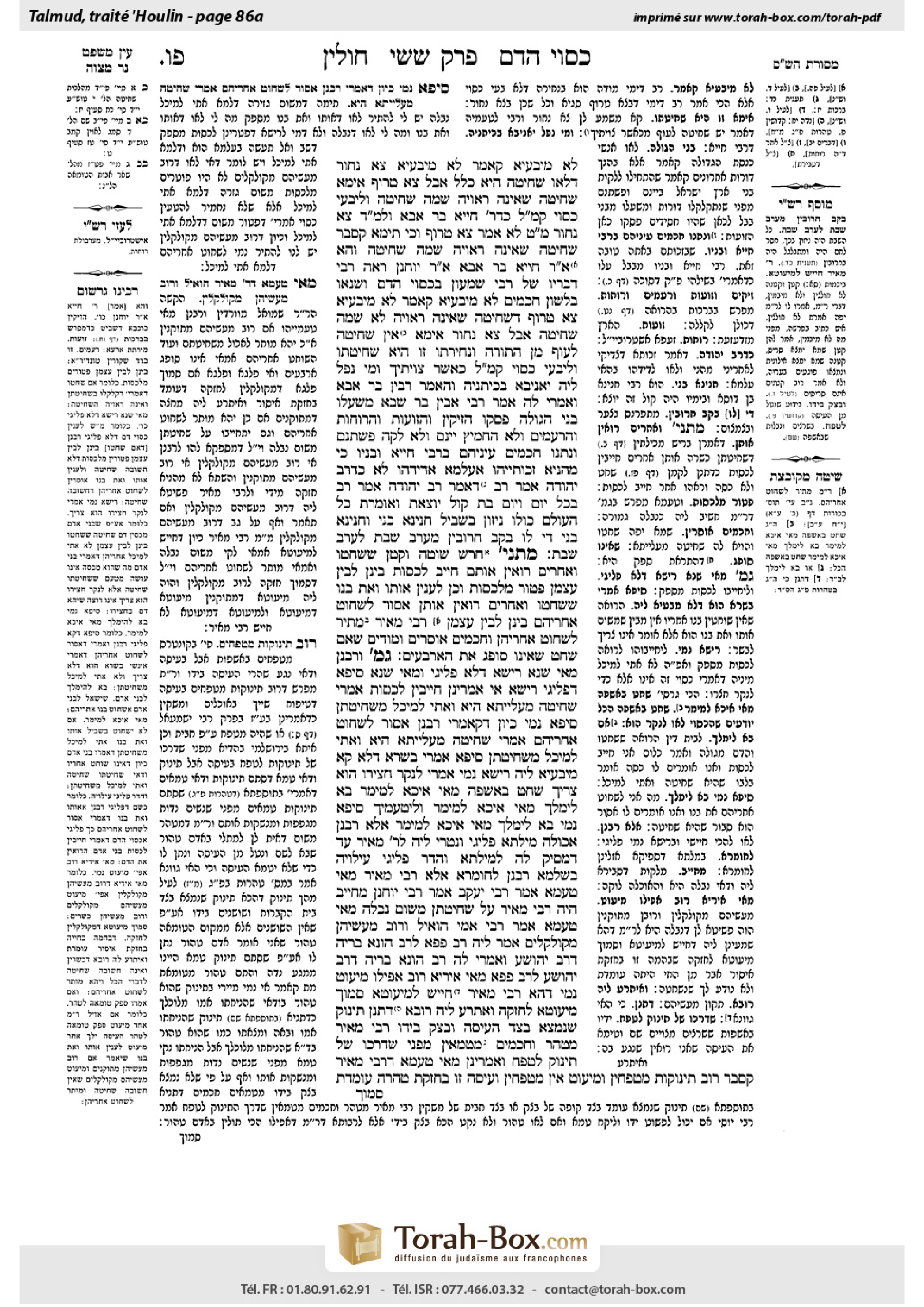
Chullin 86a: Talmud study for Daf Yomi
Study the Talmud for Daf Yomi with scanned pages, Hebrew text, English translations from Sefaria and AI-generated French translations.
Passage selection and English or AI-generated French translation are available where the scan has annotations. Daf Study is independent of Torah-Box and Sefaria.
Browse Chullin · חולין · All tractatesChullin 86a text and translations
This page of Chullin includes the Aramaic text, an English translation and an AI-generated French translation, alongside the scan above.
חולין פ״ו א · Aramaic and Hebrew text
לָא מִיבַּעְיָא קָאָמַר: לָא מִיבַּעְיָא ״צֵא נְחוֹר״ דְּלָאו שְׁחִיטָה הִיא כְּלָל, אֲבָל ״צֵא טְרוֹף״ אֵימָא שְׁחִיטָה שֶׁאֵינָהּ רְאוּיָה שְׁמָהּ שְׁחִיטָה וְלִיבְעֵי כִּסּוּי, קָא מַשְׁמַע לַן כִּדְרַבִּי חִיָּיא בַּר אַבָּא.
וּלְמַאן דְּאָמַר ״צֵא נְחוֹר״, מַאי טַעְמָא לָא אָמַר ״צֵא טְרוֹף״? וְכִי תֵּימָא קָסָבַר שְׁחִיטָה שֶׁאֵינָהּ רְאוּיָה שְׁמָהּ שְׁחִיטָה, וְהָא אָמַר רַבִּי חִיָּיא בַּר אַבָּא אָמַר רַבִּי יוֹחָנָן: רָאָה רַבִּי דְּבָרָיו שֶׁל רַבִּי שִׁמְעוֹן בְּכִסּוּי הַדָּם, וּשְׁנָאוֹ בִּלְשׁוֹן חֲכָמִים!
לָא מִיבַּעְיָא קָאָמַר: לָא מִיבַּעְיָא ״צֵא טְרוֹף״, דִּשְׁחִיטָה שֶׁאֵינָהּ רְאוּיָה לֹא שְׁמָהּ שְׁחִיטָה, אֲבָל ״צֵא נְחוֹר״ – אֵימָא: אֵין שְׁחִיטָה לָעוֹף מִן הַתּוֹרָה, וּנְחִירָתוֹ זוֹ הִיא שְׁחִיטָתוֹ, וְלִיבְעֵי כִּסּוּי, קָא מַשְׁמַע לַן ״כַּאֲשֶׁר צִוִּיתִיךְ״.
וּמִי נְפַל לֵיהּ יָאנִיבָא בְּכִיתָּנֵיהּ? וְהָאָמַר רָבִין בַּר אַבָּא, וְאָמְרִי לַהּ אָמַר רַבִּי אָבִין בַּר שְׁבָא: מִשֶּׁעָלוּ בְּנֵי הַגּוֹלָה פָּסְקוּ הַזִּיקִין וְהַזְּוָעוֹת וְהָרוּחוֹת וְהָרְעָמִים, וְלֹא הֶחְמִיץ יֵינָם, וְלֹא לָקָה פִּשְׁתָּנָם, וְנָתְנוּ חֲכָמִים עֵינֵיהֶם בְּרַבִּי חִיָּיא וּבָנָיו.
כִּי מַהְנְיָא זְכוּתַיְיהוּ – אַעָלְמָא, אַדִּידְהוּ – לָא, כִּדְרַב יְהוּדָה אָמַר רַב, דְּאָמַר רַב יְהוּדָה אָמַר רַב: בְּכׇל יוֹם וָיוֹם בַּת קוֹל יוֹצֵאת וְאוֹמֶרֶת: כָּל הָעוֹלָם כּוּלּוֹ נִיזּוֹן בִּשְׁבִיל חֲנִינָא בְּנִי, וַחֲנִינָא בְּנִי דַּי לוֹ בְּקַב חָרוּבִין מֵעֶרֶב שַׁבָּת לְעֶרֶב שַׁבָּת.
מַתְנִי׳ חֵרֵשׁ שׁוֹטֶה וְקָטָן שֶׁשָּׁחֲטוּ, וַאֲחֵרִים רוֹאִין אוֹתָם – חַיָּיב לְכַסּוֹת. בֵּינָן לְבֵין עַצְמָן – פָּטוּר מִלְּכַסּוֹת.
וְכֵן לְעִנְיַן אוֹתוֹ וְאֶת בְּנוֹ, שֶׁשָּׁחֲטוּ וַאֲחֵרִים רוֹאִין אוֹתָן – אָסוּר לִשְׁחוֹט אַחֲרֵיהֶם, בֵּינָן לְבֵין עַצְמָן – רַבִּי מֵאִיר מַתִּיר לִשְׁחוֹט אַחֲרֵיהֶן, וַחֲכָמִים אוֹסְרִים, וּמוֹדִים שֶׁאִם שָׁחַט – שֶׁאֵינוֹ סוֹפֵג אֶת הָאַרְבָּעִים.
גְּמָ׳ וְרַבָּנַן, מַאי שְׁנָא רֵישָׁא דְּלָא פְּלִיגִי, וּמַאי שְׁנָא סֵיפָא דִּפְלִיגִי?
רֵישָׁא, אִי אָמְרִינַן חַיָּיבִין לְכַסּוֹת, אָמְרִי: שְׁחִיטָה מְעַלַּיְיתָא הִיא, וְאָתֵי לְמֵיכַל מִשְּׁחִיטָתָן.
סֵיפָא נָמֵי, כֵּיוָן דְּקָאָמְרִי רַבָּנַן אָסוּר לִשְׁחוֹט אַחֲרֵיהֶם, אָמְרִי: שְׁחִיטָה מְעַלַּיְיתָא הִיא, וְאָתֵי לְמֵיכַל מִשְּׁחִיטָתָן!
סֵיפָא, אָמְרִי: בִּשְׂרָא דְּלָא קָא מִיבַּעְיָא לֵיהּ. רֵישָׁא נָמֵי, אָמְרִי: לְנַקֵּר חֲצֵירוֹ הוּא צָרִיךְ!
שָׁחַט בְּאַשְׁפָּה, מַאי אִיכָּא לְמֵימַר? בָּא לִימָּלֵךְ, מַאי אִיכָּא לְמֵימַר?
וְלִיטַעְמָיךְ, סֵיפָא נָמֵי, בָּא לִימָּלֵךְ – מַאי אִיכָּא לְמֵימַר?
אֶלָּא, רַבָּנַן אַכּוּלַּהּ מִילְּתָא פְּלִיגִי, וְנָטְרִי לֵיהּ לְרַבִּי מֵאִיר עַד דְּמַסֵּיק לַהּ לְמִילְּתָא, וַהֲדַר פְּלִיגִי עִילָּוֵיהּ.
בִּשְׁלָמָא רַבָּנַן לְחוּמְרָא, אֶלָּא רַבִּי מֵאִיר – מַאי טַעְמָא?
אָמַר רַבִּי יַעֲקֹב אָמַר רַבִּי יוֹחָנָן: מְחַיֵּיב הָיָה רַבִּי מֵאִיר עַל שְׁחִיטָתָן מִשּׁוּם נְבֵלָה. מַאי טַעְמָא? אָמַר רַבִּי אַמֵּי: הוֹאִיל וְרוֹב מַעֲשֵׂיהֶן מְקוּלְקָלִים.
אֲמַר לֵיהּ רַב פָּפָּא לְרַב הוּנָא בְּרֵיהּ דְּרַב יְהוֹשֻׁעַ, וְאָמְרִי לַהּ רַב הוּנָא בְּרֵיהּ דְּרַב יְהוֹשֻׁעַ לְרַב פָּפָּא: מַאי אִירְיָא רוֹב? אֲפִילּוּ מִיעוּט נָמֵי, דְּהָא רַבִּי מֵאִיר חָיֵישׁ לְמִיעוּטָא, סְמוֹךְ מִיעוּטָא לַחֲזָקָה, וְאִתְּרַע לֵיהּ רוּבָּא?
דִּתְנַן: תִּינוֹק שֶׁנִּמְצָא בְּצַד הָעִיסָּה וּבָצֵק בְּיָדוֹ, רַבִּי מֵאִיר מְטַהֵר, וַחֲכָמִים מְטַמְּאִין, מִפְּנֵי שֶׁדַּרְכּוֹ שֶׁל תִּינוֹק לְטַפֵּחַ. וְאָמְרִינַן: מַאי טַעְמָא דְּרַבִּי מֵאִיר? קָסָבַר: רוֹב תִּינוֹקוֹת מְטַפְּחִין, וּמִיעוּט אֵין מְטַפְּחִין, וְעִיסָּה זוֹ בְּחֶזְקַת טׇהֳרָה עוֹמֶדֶת,
Chullin 86a · English translation
The Gemara responds: Rav Dimi is speaking utilizing the style of: It is not necessary. That is, it is not necessary to teach: Go out and tear loose, since it is obvious that this is not considered slaughter at all and one is not required to cover the blood. But with regard to the instruction: Go out and render the bird a tereifa, I would say that an act of slaughter that is not fit to render the meat permitted is nevertheless considered an act of slaughter, and the blood of this bird should require covering. Therefore, Rav Dimi teaches us in accordance with the statement of Rabbi Ḥiyya bar Abba (85a), that Rabbi Yehuda HaNasi holds with regard to the mitzva of covering the blood that an act of slaughter that is not fit to render the meat permitted is not considered an act of slaughter, and one is therefore not required to cover the blood of this bird.
The Gemara asks: And according to the one who says that Rabbi Yehuda HaNasi said to Rabbi Ḥiyya: Go out and tear loose the windpipe and gullet, what is the reason Rabbi Yehuda HaNasi did not say: Go out and render the bird a tereifa? And if you would say the reason is because Rabbi Yehuda HaNasi holds that an act of slaughter that is not fit to render the meat permitted is considered an act of slaughter, and one would be required to cover the blood, this is untenable. As doesn’t Rabbi Ḥiyya bar Abba say that Rabbi Yoḥanan says: Rabbi Yehuda HaNasi saw as correct the statement of Rabbi Shimon, that an ineffective slaughter is not considered an act of slaughter with regard to the mitzva of covering the blood, and taught it in the mishna here using the term: The Rabbis?
The Gemara responds: Ravin is speaking utilizing the style of: It is not necessary. That is, it is not necessary to teach: Go out and render the bird a tereifa, since an act of slaughter that is not fit to render the meat permitted is not considered slaughter and one would not be required to cover the blood of the bird. But with regard to the instruction: Go out and tear loose the windpipe and gullet, I would say that the slaughter of a bird is not obligatory by Torah law to render it permitted for consumption, and consequently, the tearing loose of its windpipe and gullet is considered its slaughter and the blood of this bird should require covering. Therefore, Ravin teaches us that Rabbi Yehuda HaNasi holds that the slaughter of a bird is obligatory by Torah law, as he himself derives from the verse: “As I have commanded you” (Deuteronomy 12:21).
§ The Gemara questions the very occurrence of the incident involving Rabbi Ḥiyya: And could moths have infested his flax? But doesn’t Ravin bar Abba say, and some say Rabbi Avin bar Sheva says: From when the people of the Exile ascended from Babylonia to Eretz Yisrael there ceased to be meteors, earthquakes, storm winds, and thunder; and their wine did not sour, and their flax was not stricken with an infestation of moths; and the Sages placed their eyes, i.e., attributed these phenomena, to the merit of Rabbi Ḥiyya and his sons, who ascended from Babylonia? If so, how was Rabbi Ḥiyya’s flax affected?
The Gemara responds: When their merit is effective, it is effective for the rest of the world but not for themselves. And this is in accordance with the statement that Rav Yehuda says in the name of Rav, as Rav Yehuda says that Rav says: Each and every day a Divine Voice emerges and says: The entire world is sustained in the merit of Ḥanina ben Dosa, My son, and yet for Ḥanina, My son, a kav of carobs, i.e., a very small amount of inferior food, is sufficient to sustain him from one Shabbat eve to the next Shabbat eve. Similarly, the merit of Rabbi Ḥiyya and his sons was effective for others but not for themselves.
MISHNA: In the case of a deaf-mute, an imbecile, or a minor who slaughtered an undomesticated animal or a bird, and others saw them and ensured that the slaughter was properly performed, in which case the slaughter is valid (see 2a), one who oversaw the slaughter is obligated to cover the blood. If they slaughtered the animals among themselves without supervision, one is exempt from the obligation to cover the blood.
And likewise with regard to the matter of slaughtering a mother and its offspring on the same day, if a deaf-mute, an imbecile, or a minor slaughtered an undomesticated mother animal and others saw them, it is prohibited to slaughter its offspring after them. If they slaughtered the mother animal among themselves, Rabbi Meir deems it permitted to slaughter its offspring after them and the Rabbis deem it prohibited. And the Rabbis concede that if one slaughtered the offspring thereafter that he does not incur the forty lashes, as it is possible the mother was not properly slaughtered.
GEMARA: The Gemara asks: And as for the Rabbis, what is different about the first clause of the mishna that discusses the covering of the blood, where they do not disagree with the statement that if a deaf-mute, an imbecile, or a minor slaughtered an animal without supervision one is exempt from the obligation to cover the blood, which indicates the Rabbis hold that such an act of slaughter is not considered an act of slaughter; and what is different about the latter clause of the mishna that discusses the prohibition against slaughtering a mother and its offspring on the same day, where they disagree with Rabbi Meir and hold that if a deaf-mute, an imbecile, or a minor slaughtered a mother animal without supervision one is prohibited to subsequently slaughter its offspring, indicating they hold that such an act of slaughter is in fact considered an act of slaughter?
The Gemara responds: Actually, it is uncertain whether this slaughter is valid or not. With regard to the first clause, if we say one is obligated to cover the blood from an unsupervised slaughter, people might say this is because the slaughter performed by these people is proper, and they will come to eat meat from their slaughter, and it is in fact forbidden to eat from their slaughter. Therefore, the Rabbis did not require the covering of the blood.
The Gemara challenges: If so, then with regard to the latter clause of the mishna as well, since the Rabbis say it is prohibited to slaughter the offspring of the mother after them, people might say this is because the slaughter performed by these people is proper, and they will come to eat meat from their slaughter.
The Gemara rejects this: With regard to the latter clause, prohibiting the slaughter of the offspring will not cause people to conclude the unsupervised slaughter of the mother by disqualified people was valid. Rather, they will say: The reason the offspring is not slaughtered is because the owner does not need the meat. The Gemara asks: But with regard to the first clause as well, covering the blood will not lead one to conclude that the unsupervised slaughter was valid, as people will say: He is covering the blood because he needs to clean his courtyard of the blood. If so, let the Rabbis deem one obligated to cover the blood.
The Gemara rejects this: But if a disqualified person slaughtered the animal in a garbage dump, what can be said to allow the covering of the blood? Obviously, people will not assume one covers the blood in order to clean a garbage dump. Similarly, if one comes to consult the court, what can be said? That is, if one sees from a distance that a disqualified person slaughtered an animal and the blood is uncovered, and he comes to consult the court with regard to the obligation to cover the blood, if the court tells him to cover the blood he might conclude that this is because the unsupervised slaughter was valid. Accordingly, since there are scenarios in which one might mistakenly conclude that the unsupervised slaughter of inept people is valid, the Rabbis concede that one is exempt from covering the blood of such an act of slaughter in all cases.
The Gemara asks: But according to your reasoning that the Rabbis are concerned for the aforementioned scenarios, then with regard to the latter clause as well, if one comes to consult the court with regard to the slaughter of the offspring, what can be said? That is, if one sees a disqualified person slaughter the mother, and he comes to ask the court whether he may slaughter the offspring on the same day, if the court prohibits him from slaughtering it he might conclude that this is because the slaughter of the mother was valid. Why, then, do the Rabbis prohibit one from slaughtering the offspring?
The Gemara concludes: Rather, it must be that the Rabbis disagree concerning the entire matter, i.e., they disagree with regard to covering the blood as well, and hold that if a disqualified person slaughtered an animal while unsupervised, one must cover the blood; and the Rabbis waited for Rabbi Meir until he concluded his statement, and then they disagreed with him on both accounts.
The Gemara asks: If so, granted, the opinion of the Rabbis is understandable, as they consistently rule stringently. That is, although it is prohibited to consume the meat of an unsupervised slaughter performed by a deaf-mute, an imbecile, or a minor, the Rabbis require one to cover the blood and prohibit one to slaughter the offspring, due to concern that the person may have performed a valid slaughter. But with regard to the opinion of Rabbi Meir that one is exempt from covering the blood and that one may slaughter the offspring on the same day, what is the reason he does not rule stringently due to uncertainty?
Rabbi Ya’akov says that Rabbi Yoḥanan says: Rabbi Meir would deem one liable to receive lashes for eating from the slaughter of a deaf-mute, an imbecile, or a minor, due to violation of the prohibition against eating from an animal carcass. According to Rabbi Meir there is no uncertainty with regard to such slaughter, and it is not considered an act of slaughter at all. Consequently, one may become liable to receive lashes for its consumption. The Gemara asks: What is the reason? Rabbi Ami says: Since the majority of actions of a deaf-mute, imbecile, and a minor are bungled, i.e., they are performed incompetently, it can be assumed that their slaughter was performed improperly as well.
Rav Pappa said to Rav Huna, son of Rav Yehoshua, and some say that Rav Huna, son of Rav Yehoshua, said to Rav Pappa: Why did Rabbi Ami specifically state that the reasoning of Rabbi Meir is based on the assumption that the majority of their actions are bungled? Even if only a minority of their actions are bungled and the majority are performed competently, Rabbi Meir would also maintain that the animal is considered a carcass, as Rabbi Meir is concerned for a minority when it can be combined with a presumptive status. If so, append the minority to the presumptive status of an animal prior to its slaughter, i.e., that it is prohibited for consumption, and the majority of competent acts of slaughter is thereby weakened.
The Gemara proves that Rabbi Meir is concerned for the minority: As we learned in a mishna (Teharot 3:8): In the case of a ritually impure child who is found alongside ritually pure started dough, and he has risen dough in his hand that may have been removed from the larger portion of started dough, Rabbi Meir deems the started dough pure. This is because there is no proof the child touched it; he might have been given the piece by someone else. And the Rabbis deem it impure, as they assume he touched the started dough. The child is presumed to be impure because it is the manner of a child to handle items. And we say with regard to this mishna: What is the reasoning of Rabbi Meir? He holds that a majority of children handle items, in this case the dough, that are within reach, and a minority do not handle items within reach, and the dough itself retains a presumptive status of purity since its impurity has not been definitively determined.
Chullin 86a · Traduction française (IA)
La Guemara répond : Rav Dimi parle selon la formule : Il n’est pas nécessaire. C’est-à-dire, il n’est pas nécessaire d’enseigner : Sortez et déchirez, puisque c’est évident que cela ne constitue pas du tout un acte de sacrifice et qu’on n’est pas tenu de couvrir le sang. Mais concernant l’ordre : Sortez et faites de l’oiseau un tereifa, je dirais que tout acte de sacrifice qui n’est pas adapté à rendre la viande permise est toutefois considéré comme un acte de sacrifice, et le sang de cet oiseau devrait être couvert. Ainsi, Rav Dimi nous enseigne selon la déclaration de Rabbi Ḥiyya bar Abba (85a), que Rabbi Yehuda HaNasi considère, concernant la mitsva de couvrir le sang, que tout acte de sacrifice qui n’est pas adapté à rendre la viande permise n’est pas considéré comme un acte de sacrifice, et qu’on n’est donc pas tenu de couvrir le sang de cet oiseau.
La Guemara pose la question : Et selon celui qui dit que Rabbi Yehuda HaNasi a dit à Rabbi Ḥiyya : Sortez et déchirez le trachée et le gosier, quelle est la raison pour laquelle Rabbi Yehuda HaNasi n’a pas dit : Sortez et faites de l’oiseau un tereifa ? Et si vous dites que la raison est que Rabbi Yehuda HaNasi considère que tout acte de sacrifice qui n’est pas adapté à rendre la viande permise est considéré comme un acte de sacrifice, et qu’on serait tenu de couvrir le sang, cela est inacceptable. Car n’est-ce pas Rabbi Ḥiyya bar Abba qui dit que Rabbi Yoḥanan dit : Rabbi Yehuda HaNasi a adopté comme correct la déclaration de Rabbi Shimon, que tout sacrifice inefficace n’est pas considéré comme un acte de sacrifice concernant la mitsva de couvrir le sang, et a enseigné cela dans la mitsna ici en utilisant le terme : Les Sages ?
La Guemara répond : Ravin parle selon la formule : Il n’est pas nécessaire. C’est-à-dire, il n’est pas nécessaire d’enseigner : Sortez et faites de l’oiseau un tereifa, puisque tout acte de sacrifice qui n’est pas adapté à rendre la viande permise n’est pas considéré comme un sacrifice et qu’on ne serait pas tenu de couvrir le sang de l’oiseau. Mais concernant l’ordre : Sortez et déchirez le trachée et le gosier, je dirais que le sacrifice d’un oiseau n’est pas obligatoire selon la Loi pour le rendre permis à la consommation, et par conséquent, le déchirement de son trachée et de son gosier est considéré comme son sacrifice et le sang de cet oiseau devrait être couvert. Ainsi, Ravin nous enseigne que Rabbi Yehuda HaNasi considère que le sacrifice d’un oiseau est obligatoire selon la Loi, car il en dérive lui-même de la parole : « Comme je t’ai commandé » (Deutéronome 12:21).
§ La Guemara questionne l’occurrence de l’incident concernant Rabbi Ḥiyya : Et les chenilles auraient-elles infesté son lin ? Mais n’est-ce pas Ravin bar Abba qui dit, et certains disent Rabbi Avin bar Sheva qui dit : Depuis que le peuple de l’Exil est monté de Babylone en Eretz Yisrael, il n’y a plus de météores, de séismes, de vents tempétueux et de tonnerres ; et leur vin ne s’est pas corrompu, et leur lin n’a pas été attaqué par des chenilles ; et les Sages ont attribué ces phénomènes, c’est-à-dire placé leurs yeux, à la mérite de Rabbi Ḥiyya et de ses fils, qui sont montés de Babylone. Si c’est ainsi, comment le lin de Rabbi Ḥiyya a-t-il été affecté ?
La Guemara répond : Lorsque leur mérite est efficace, il est efficace pour le reste du monde mais pas pour eux-mêmes. Et cela correspond à la déclaration que Rav Yehuda fait au nom de Rav, comme Rav Yehuda dit que Rav dit : Chaque jour, une Voix divine émerge et dit : Le monde entier est soutenu par le mérite de Ḥanina ben Dosa, Mon fils, et pourtant pour Ḥanina, Mon fils, une kav de caroubes, c’est-à-dire une très petite quantité de nourriture inférieure, est suffisante pour le sustenter d’une veille de Shabbat à la suivante. De même, le mérite de Rabbi Ḥiyya et de ses fils était efficace pour les autres mais pas pour eux-mêmes.
MICHNA : Dans le cas d’un sourd-muet, d’un imbécile ou d’un mineur qui a tué un animal sauvage ou un oiseau, et que d’autres l’ont vu et ont assuré que la mise à mort était bien accomplie, dans ce cas la mise à mort est valide (voir 2a), celui qui a surveillé la mise à mort est tenu de couvrir le sang. Si ils ont tué les animaux entre eux sans surveillance, on est exempt de l’obligation de couvrir le sang.
Et de même concernant la question de la mise à mort d’une mère et de son petit, si un sourd-muet, un imbécile ou un mineur a tué un animal sauvage mère et que d’autres l’ont vu, il est interdit de tuer son petit après. Si ils ont tué la mère entre eux, Rabbi Meir considère qu’il est permis de tuer son petit après, et les Sages considèrent qu’il est interdit. Et les Sages reconnaissent que si l’on tue le petit après, on ne subit pas les quarante coups, car il est possible que la mère n’ait pas été bien tuée.
GUEMARA : La Guemara pose la question : Et concernant les Sages, qu’est-ce qui diffère dans la première clause de la mitsna qui discute de la couverture du sang, où ils ne contestent pas la déclaration que si un sourd-muet, un imbécile ou un mineur a sacrifié un animal sans surveillance, on est exempt de l’obligation de couvrir le sang, ce qui indique que les Sages considèrent que cet acte de sacrifice n’est pas considéré comme un acte de sacrifice ; et qu’est-ce qui diffère dans la seconde clause de la mitsna qui discute de l’interdiction de sacrifier une mère et son petit le même jour, où ils contestent Rabbi Meir et considèrent que si un sourd-muet, un imbécile ou un mineur a sacrifié une mère sans surveillance, il est interdit de sacrifier son petit après, ce qui indique qu’ils considèrent que cet acte de sacrifice est en fait considéré comme un acte de sacrifice ?
La Guemara répond : En réalité, il est incertain si ce sacrifice est valide ou non. Concernant la première clause, si nous disons qu’on est tenu de couvrir le sang d’un sacrifice non surveillé, les gens pourraient dire que c’est parce que le sacrifice effectué par ces personnes est correct, et qu’ils viendront à manger de leur sacrifice, et en réalité, il est interdit de manger de leur sacrifice. Ainsi, les Sages n’ont pas exigé la couverture du sang.
La Guemara conteste : Si c’est ainsi, alors concernant la seconde clause de la mitsna également, puisque les Sages disent qu’il est interdit de sacrifier les enfants de la mère après eux, les gens pourraient dire que c’est parce que le sacrifice effectué par ces personnes est correct, et ils viendront à manger de la viande provenant de leur sacrifice.
La Guemara rejette cela : Concernant la seconde clause, l’interdiction de sacrifier les enfants ne mènera pas les gens à conclure que le sacrifice non surveillé par des personnes inaptes était valide. Plutôt, ils diront : La raison pour laquelle les enfants ne sont pas sacrifiés est parce que l’propriétaire n’a pas besoin de la viande. La Guemara demande : Mais concernant la première clause également, le recouvrement du sang ne mènera pas à conclure que le sacrifice non surveillé était valide, car les gens diront : Il recouvre le sang parce qu’il a besoin de nettoyer son courtil du sang. Si c’est ainsi, que les Sages considèrent qu’on est tenu de recouvrir le sang.
La Guemara rejette cela : Mais si une personne inapte a sacrifié l’animal dans un lieu de déchet, que peut-on dire pour permettre le recouvrement du sang ? Évidemment, les gens ne supposeront pas que l’on recouvre le sang pour nettoyer un lieu de déchet. De même, si l’on vient consulter le tribunal, que peut-on dire ? C’est-à-dire, si l’on voit de loin qu’une personne inapte a sacrifié un animal et que le sang est découvert, et qu’on vient consulter le tribunal concernant l’obligation de recouvrir le sang, si le tribunal dit qu’il faut recouvrir le sang, on pourrait conclure que c’est parce que le sacrifice non surveillé était valide. Ainsi, puisque des scénarios existent où l’on pourrait conclure à tort que le sacrifice non surveillé d’individus inaptes est valide, les Sages acceptent qu’on soit exempt de recouvrir le sang de tels actes de sacrifice dans tous les cas.
La Guemara demande : Mais selon votre raisonnement que les Sages sont préoccupés par ces scénarios, alors concernant la seconde clause également, si l’on vient consulter le tribunal concernant la délivrance de l’animal, que peut-on dire ? C’est-à-dire, si l’on voit une personne inapte délivrer la mère, et qu’on vient demander au tribunal s’il est permis de délivrer l’animal le même jour, et si le tribunal interdit cela, on pourrait conclure que c’est parce que la délivrance de la mère était valide. Pourquoi, alors, les Sages interdisent-ils la délivrance de l’animal ?
La Guemara conclut : Plutôt, il faut que les Sages diffèrent sur l’ensemble de la question, c’est-à-dire qu’ils diffèrent concernant le recouvrement du sang également, et qu’ils considèrent que si une personne inapte a délivré un animal sans surveillance, il faut recouvrir le sang ; et les Sages ont attendu que Rabbi Meir termine son opinion, et ensuite ils ont différé avec lui sur les deux points.
La Guemara demande : Si c’est ainsi, d’accord, l’opinion des Sages est compréhensible, car ils règlent toujours strictement. C’est-à-dire, bien que ce soit interdit de consommer la viande d’une délivrance non surveillée effectuée par un sourd-muet, un imbécile ou un mineur, les Sages exigent que l’on recouvre le sang et qu’on interdise la délivrance de l’animal, par crainte que la personne ait effectué une délivrance valide. Mais concernant l’opinion de Rabbi Meir qui considère qu’on est exempt de recouvrir le sang et qu’on peut délivrer l’animal le même jour, quelle est la raison pour laquelle il ne règlement pas strictement en raison d’une incertitude ?
Rabbi Yaakov dit que Rabbi Yochanan dit : Rabbi Meir considérerait qu’on est tenu de recevoir des coups de fouet pour manger de la viande provenant de la boucherie d’un sourd-muet, d’un imbécile ou d’un mineur, en raison de la violation de l’interdiction de manger d’un animal mort. Selon Rabbi Meir, il n’y a pas d’incertitude concernant ce genre de boucherie, et elle n’est pas considérée comme un acte de boucherie. Ainsi, on peut être tenu de recevoir des coups de fouet pour sa consommation. La Guemara demande : Quelle est la raison ? Rabbi Ami dit : Puisque la majorité des actions d’un sourd-muet, d’un imbécile et d’un mineur sont mal exécutées, c’est-à-dire qu’elles sont exécutées de manière incompétente, on peut supposer que leur boucherie a été exécutée de manière incorrecte également.
Rav Pappa dit à Rav Huna, fils de Rav Yéhoshua, et certains disent que Rav Huna, fils de Rav Yéhoshua, dit à Rav Pappa : Pourquoi Rabbi Ami a-t-il spécifiquement dit que la raison de l’opinion de Rabbi Meir est basée sur l’hypothèse que la majorité de leurs actions sont mal exécutées ? Même si seulement une minorité de leurs actions sont mal exécutées et que la majorité sont exécutées correctement, Rabbi Meir aurait également maintenu que l’animal est considéré comme un cadavre, car Rabbi Meir est préoccupé par une minorité lorsqu’elle peut être combinée avec un statut présomptif. Si c’est ainsi, ajoutez la minorité au statut présomptif d’un animal avant sa boucherie, c’est-à-dire qu’il est interdit de le consommer, et la majorité des actions compétentes de boucherie est ainsi affaiblie.
La Guemara démontre que Rabbi Meir s'occupe de la minorité : Comme nous avons appris dans une mitsva (Téharot 3:8) : Dans le cas d'un enfant impur qui est trouvé auprès de farine pure, et qu'il tient une farine qui pourrait avoir été retirée de la portion principale de farine, Rabbi Meir considère la farine pure. C'est parce qu'il n'y a pas de preuve que l'enfant l'ait touchée ; il pourrait avoir été donné la pièce par quelqu'un d'autre. Et les Sages considèrent qu'elle est impure, car ils supposent qu'il a touché la farine. L'enfant est présomptivement impur car c'est la manière d'un enfant de manipuler des objets. Et nous disons concernant cette mitsva : Quelle est la raison de Rabbi Meir ? Il considère que la majorité des enfants manipulent des objets, dans ce cas la farine, qui sont accessibles, et une minorité ne manipulent pas des objets accessibles, et la farine elle-même conserve un statut présomptif de pureté car sa impureté n'a pas été définitivement déterminée.
Traduction française générée par IA à partir de l’édition anglaise de Sefaria. Vérifie toujours un passage avec le texte source.
Text from Sefaria: William Davidson Edition - Vocalized Aramaic (unknown); William Davidson Edition - English (CC BY NC).