Chullin 86b: Talmud study for Daf Yomi
Study the Talmud for Daf Yomi with scanned pages, Hebrew text, English translations from Sefaria and AI-generated French translations.
Passage selection and English or AI-generated French translation are available where the scan has annotations. Daf Study is independent of Torah-Box and Sefaria.
Browse Chullin · חולין · All tractatesChullin 86b text and translations
This page of Chullin includes the Aramaic text, an English translation and an AI-generated French translation, alongside the scan above.
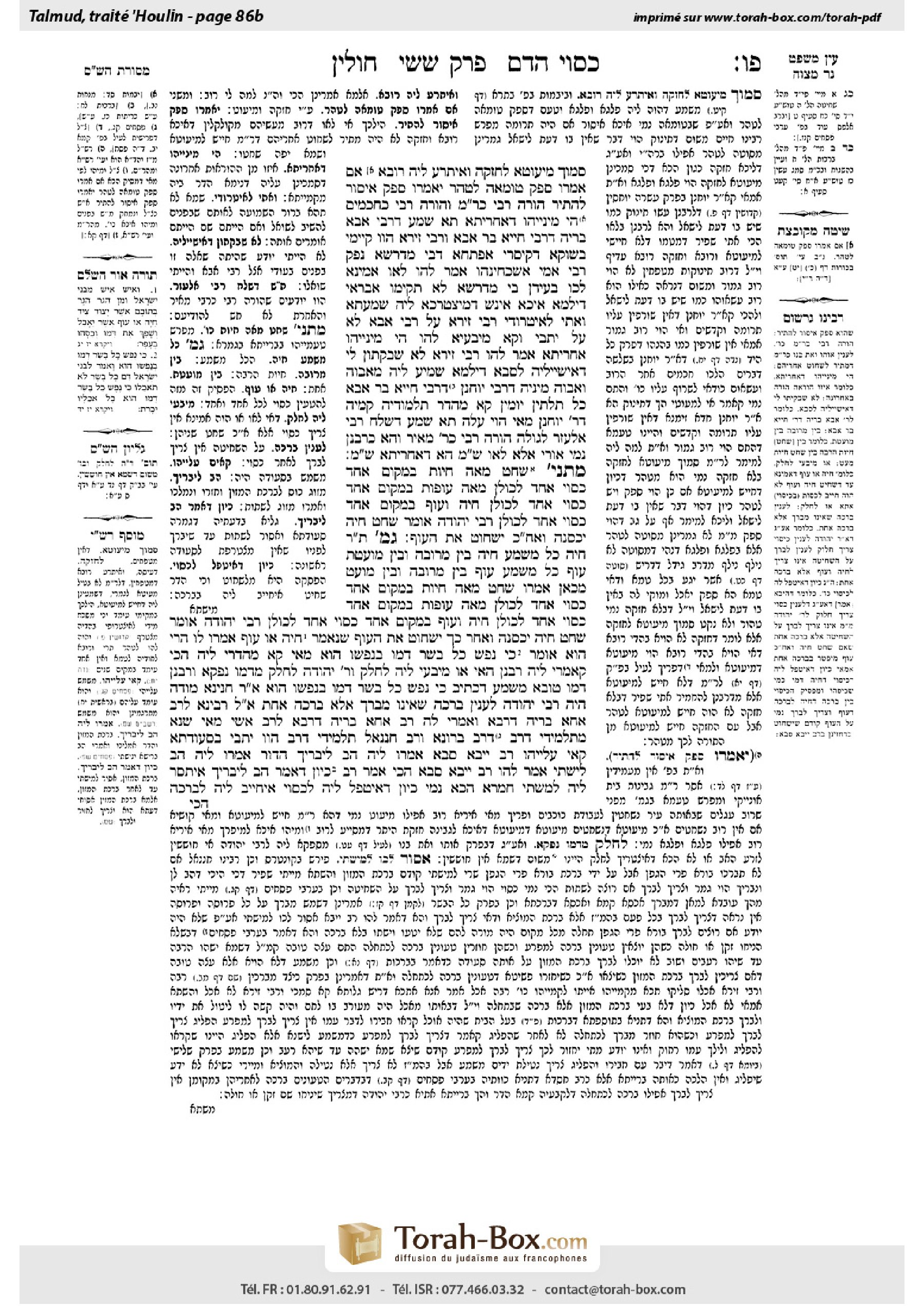
חולין פ״ו ב · Aramaic and Hebrew text
סְמוֹךְ מִיעוּטָא לַחֲזָקָה וְאִיתְּרַע לֵיהּ רוּבָּא.
אִם אָמְרוּ סְפֵק טוּמְאָה לְטַהֵר, יֹאמְרוּ סְפֵק אִיסּוּר לְהַתִּיר?
הוֹרָה רַבִּי כְּרַבִּי מֵאִיר, וְהוֹרָה רַבִּי כַּחֲכָמִים. הֵי מִינַּיְיהוּ דְּאַחֲרִיתָא?
תָּא שְׁמַע: דְּרַבִּי אַבָּא בְּרֵיהּ דְּרַבִּי חִיָּיא בַּר אַבָּא וְרַבִּי זֵירָא הֲווֹ קָיְימִי בְּשׁוּקָא דְּקֵיסָרִי, אַפִּתְחָא דְּבֵי מִדְרְשָׁא. נְפַק רַבִּי אַמֵּי אַשְׁכְּחִינְהוּ, אֲמַר לְהוּ: לָאו אָמֵינָא לְכוּ בְּעִידָּן בֵּי מִדְרְשָׁא לָא תְּקִימוּ אַבָּרַאי, דִּילְמָא אִיכָּא אִינָשׁ דְּמִיצְטַרְכָא לֵיהּ שְׁמַעְתָּא וְאָתֵי לְאִיטְּרוֹדֵי.
רַבִּי זֵירָא עָל, רַבִּי אַבָּא לָא עָל. יָתְבִי וְקָא מִיבַּעְיָא לְהוּ: הֵי מִינַּיְיהוּ אַחְרִיתָא? אֲמַר לְהוּ רַבִּי זֵירָא: לָא שְׁבַקְתּוּן לִי דֶּאֱישַׁיְּילֵיהּ לְסָבָא, דִּילְמָא שְׁמִיעַ לֵיהּ מֵאֲבוּהּ, וַאֲבוּהּ מִינֵּיהּ דְּרַבִּי יוֹחָנָן, דְּרַבִּי חִיָּיא בַּר אַבָּא כֹּל תְּלָתִין יוֹמִין קָא מַהְדַּר תַּלְמוּדֵיהּ קַמֵּיהּ דְּרַבִּי יוֹחָנָן.
מַאי הָוֵי עֲלַהּ? תָּא שְׁמַע, דְּשָׁלַח רַבִּי אֶלְעָזָר לַגּוֹלָה: הוֹרָה רַבִּי כְּרַבִּי מֵאִיר. וְהָא כְּרַבָּנַן נָמֵי אוֹרִי! אֶלָּא לָאו שְׁמַע מִינַּהּ הָא דְּאַחֲרִיתָא? שְׁמַע מִינַּהּ.
מַתְנִי׳ שָׁחַט מֵאָה חַיּוֹת בְּמָקוֹם אֶחָד – כִּסּוּי אֶחָד לְכוּלָּן, מֵאָה עוֹפוֹת בְּמָקוֹם אֶחָד – כִּסּוּי אֶחָד לְכוּלָּן, חַיָּה וָעוֹף בְּמָקוֹם אֶחָד – כִּסּוּי אֶחָד לְכוּלָּן. רַבִּי יְהוּדָה אוֹמֵר: שָׁחַט חַיָּה – יְכַסֶּנָּה, וְאַחַר כָּךְ יִשְׁחוֹט אֶת הָעוֹף.
גְּמָ׳ תָּנוּ רַבָּנַן: חַיָּה – כֹּל מַשְׁמַע חַיָּה, בֵּין מְרוּבָּה וּבֵין מוּעֶטֶת; עוֹף – כֹּל מַשְׁמַע עוֹף, בֵּין מְרוּבֶּה וּבֵין מוּעָט; מִכָּאן אָמְרוּ: שָׁחַט מֵאָה חַיּוֹת בְּמָקוֹם אֶחָד – כִּסּוּי אֶחָד לְכוּלָּן, מֵאָה עוֹפוֹת בְּמָקוֹם אֶחָד – כִּסּוּי אֶחָד לְכוּלָּן, חַיָּה וָעוֹף בְּמָקוֹם אֶחָד – כִּסּוּי אֶחָד לְכוּלָּן.
רַבִּי יְהוּדָה אוֹמֵר: שָׁחַט חַיָּה – יְכַסֶּנָּה, וְאַחַר כָּךְ יִשְׁחוֹט אֶת הָעוֹף, שֶׁנֶּאֱמַר: ״חַיָּה אוֹ עוֹף״.
אָמְרוּ לוֹ: הֲרֵי הוּא אוֹמֵר ״כִּי נֶפֶשׁ כׇּל בָּשָׂר דָּמוֹ בְנַפְשׁוֹ הוּא״, מַאי קָא מְהַדְּרִי לֵיהּ? הָכִי קָאָמְרִי לֵיהּ רַבָּנַן: הַאי ״אוֹ״ מִיבְּעֵי לֵיהּ לְחַלֵּק.
וְרַבִּי יְהוּדָה: לְחַלֵּק – מִ״דָּמוֹ״ נָפְקָא, וְרַבָּנַן: ״דָּמוֹ״ טוּבָא מַשְׁמַע, דִּכְתִיב: ״כִּי נֶפֶשׁ כׇּל בָּשָׂר דָּמוֹ בְנַפְשׁוֹ הוּא״.
אָמַר רַבִּי חֲנִינָא: מוֹדֶה הָיָה רַבִּי יְהוּדָה לְעִנְיַן בְּרָכָה, שֶׁאֵינוֹ מְבָרֵךְ אֶלָּא בְּרָכָה אַחַת. אֲמַר לֵיהּ רָבִינָא לְרַב אַחָא בְּרֵיהּ דְּרָבָא, וְאָמְרִי לַהּ רַב אַחָא בְּרֵיהּ דְּרָבָא לְרַב אָשֵׁי: מַאי שְׁנָא מִתַּלְמִידֵי דְּרַב?
דְּרַב בְּרוֹנָא וְרַב חֲנַנְאֵל תַּלְמִידֵי דְּרַב הֲווֹ יָתְבִי בִּסְעוֹדְתָּא, קָאֵי עֲלַיְיהוּ רַב יֵיבָא סָבָא, אֲמַרוּ לֵיהּ: הַב לִיבָרֵיךְ. הֲדוּר אֲמַרוּ לֵיהּ: הַב לִישְׁתֵּי. אֲמַר לְהוּ רַב יֵיבָא סָבָא: הָכִי אָמַר רַב, כֵּיוָן דַּאֲמַר ״הַב לִיבָרֵיךְ״ אִיתְּסַר לֵיהּ לְמִשְׁתֵּי חַמְרָא. הָכָא נָמֵי, כֵּיוָן דְּאִיטַּפַּל לֵיהּ לְכִסּוּי אִיחַיַּיב לֵיהּ לִבְרָכָה.
Chullin 86b · English translation
One appends the minority of children who do not handle items within reach to the presumptive status of purity of the dough, and consequently the force of the majority of children who handle items within reach is weakened. Therefore, the dough is considered pure. Similarly, with regard to slaughter performed by inept people, why does Rabbi Ami state that the reason behind Rabbi Meir’s opinion is due to a majority? Let even a minority of bungled acts of slaughter join with the presumptive prohibited status of the animal to render this animal a carcass.
The Gemara responds that the two cases are not comparable: If they said one may append the minority to the presumptive status with regard to a case of uncertain ritual impurity in order to render the dough pure, will they say that one may rely on a minority in the case of an uncertain prohibition in order to permit it? In other words, without the fact that a majority of the acts of slaughter of a deaf-mute, an imbecile, or a minor are bungled, Rabbi Meir could neither deem one exempt from covering the blood nor allow one to slaughter the offspring immediately. Consequently, it is due only to the majority that Rabbi Meir deems one liable for violation of the prohibition against consuming an animal carcass when consuming meat from their slaughter.
§ With regard to the dispute in the mishna, the Gemara notes: Rabbi Yehuda HaNasi ruled in accordance with the opinion of Rabbi Meir, who held that if a deaf-mute, an imbecile, or a minor slaughtered a mother animal, one may subsequently slaughter its offspring; and Rabbi Yehuda HaNasi also ruled in accordance with the opinion of the Rabbis, who held that it is prohibited to slaughter it. The Gemara asks: Which of these two rulings is the later, definitive ruling, and which ruling is the retracted one?
The Gemara suggests: Come and hear a proof from an incident: Rabbi Abba, son of Rabbi Ḥiyya bar Abba, and Rabbi Zeira were standing in the marketplace of Caesarea, at the entrance to the study hall. Rabbi Ami exited the study hall and found the two of them standing there. Rabbi Ami said to them: Have I not told you that at the time when the study hall is in session you should not stand outside, as perhaps there is a person inside the study hall who requires clarification of a halakha, and he will become bothered by it because you will not be inside to assist in offering the proper explanation?
Rabbi Zeira entered the study hall, whereas Rabbi Abba did not enter. The students were sitting and raising a dilemma: Which of Rabbi Yehuda HaNasi’s two rulings is the later one? Rabbi Zeira said to them: You did not let me know that this is your dilemma while I was outside, which would have allowed me to ask the elder one, i.e., Rabbi Abba, son of Rabbi Ḥiyya bar Abba, since perhaps he heard the answer from his father, Rabbi Ḥiyya bar Abba. And perhaps his father heard it from Rabbi Yoḥanan, as Rabbi Ḥiyya bar Abba would review his studies in front of Rabbi Yoḥanan every thirty days.
The Gemara asks: What conclusion was reached about it? The Gemara suggests: Come and hear a proof: Rabbi Elazar sent a message to the Jews in exile, i.e., Babylonia: Rabbi Yehuda HaNasi ruled in accordance with the opinion of Rabbi Meir. The Gemara challenges: But Rabbi Yehuda HaNasi also ruled in accordance with the opinion of the Rabbis. Why did Rabbi Elazar disregard that ruling? The Gemara concludes: Rather, isn’t it correct to conclude from Rabbi Elazar’s message that this ruling of Rabbi Yehuda HaNasi, which is in accordance with Rabbi Meir, is the later one? The Gemara affirms: One may in fact conclude from here that this is so.
MISHNA: If one slaughtered one hundred undomesticated animals in one place, one covering of the blood suffices for all the animals and there is no obligation to cover the blood of each animal separately. Likewise, if one slaughtered one hundred birds in one place, one covering of the blood suffices for all the birds. If one slaughtered an undomesticated animal and a bird in one place, one covering for all of the blood is sufficient. Rabbi Yehuda says: If one slaughtered an undomesticated animal, he should cover its blood immediately and only thereafter he should slaughter the bird.
GEMARA: The Sages taught in a baraita: The verse states with regard to the mitzva of covering the blood: “An undomesticated animal or bird” (Leviticus 17:13). “Undomesticated animal” is inclusive, i.e., any number of animals is included in the term undomesticated animal, whether many or few. Likewise, “bird” is inclusive, i.e., any amount is included in the term bird, whether many or few. From here the Rabbis stated: If one slaughtered one hundred undomesticated animals in one place, one covering of the blood suffices for all the animals. Likewise, if one slaughtered one hundred birds in one place, one covering of the blood suffices for all the birds. If one slaughtered an undomesticated animal and a bird in one place, one covering for all of the blood is sufficient.
The baraita continues: Rabbi Yehuda says: If one slaughtered an undomesticated animal, he should cover its blood immediately and only thereafter he should slaughter the bird, as it is stated: “An undomesticated animal or bird” (Leviticus 17:13). The term “or” indicates that each type must be attended to separately.
The Rabbis said to Rabbi Yehuda: But the next verse states: “For as to the life of all flesh, the blood thereof is all one with the life thereof.” The Gemara asks: What are the Rabbis responding to Rabbi Yehuda with this statement? The Gemara explains: This is what the Rabbis are saying to him: This term “or” that interposes between an undomesticated animal and a bird is needed to separate them, in order to indicate that the obligation to cover the blood applies after slaughtering either an undomesticated animal or a bird. If not for the term “or” one might have thought the obligation to cover the blood takes effect only after slaughtering both an undomesticated animal and a bird. Accordingly, one cannot derive from this term that the blood of an undomesticated animal and a bird must be covered separately.
And Rabbi Yehuda responds to this: The source for separating the obligations with regard to an undomesticated animal and a bird is derived from the verse: “And he shall pour out its blood” (Leviticus 17:13). The verse makes reference to the blood of only one animal, indicating that the obligation applies after slaughtering either a bird or an undomesticated animal. And the Rabbis respond that “its blood” also indicates many, as the term: Blood, can refer to any amount of blood. This is demonstrated by that which is written: “For as to the life of all flesh, the blood thereof is all one with the life thereof” (Leviticus 17:14).
§ Rabbi Ḥanina says: Although Rabbi Yehuda holds that one first covers the blood of an undomesticated animal before slaughtering the bird, Rabbi Yehuda would concede with regard to the matter of the blessing over their slaughter, i.e., that one recites only one blessing. The Gemara questions this assertion: Ravina said to Rav Aḥa, son of Rava, and some say that Rav Aḥa, son of Rava, said to Rav Ashi: In what way is this case different from the incident that occurred with the students of Rav?
As it occurred that Rav Beruna and Rav Ḥananel, the students of Rav, were sitting together at a meal, and Rav Yeiva the Elder stood over them to serve them. They said to him: Give us a cup of wine over which to recite the blessings of Grace after Meals. They then changed their mind and said to him: Give us a cup of wine to drink. Rav Yeiva the Elder said to them that this is what Rav said: Once someone at a meal says: Give me a cup over which to recite the blessings of Grace after Meals, it is prohibited for him to drink any more wine, since he has expressed his desire to conclude his meal. If he now wishes to drink more wine, he must recite a blessing before drinking it. Ravina asks: Here too, since he is required to cover the blood of the undomesticated animal before slaughtering the bird, there is an interruption between the acts of slaughter, and he has therefore become obligated to recite a new blessing before slaughtering the bird.
Chullin 86b · Traduction française (IA)
On attache les enfants mineurs qui ne manipulent pas les objets à portée de main au statut présomptif de pureté de la pâte, et par conséquent la force des enfants majoritaires qui manipulent les objets à portée de main est affaiblie. Ainsi, la pâte est considérée comme pure. De même, concernant la boucherie effectuée par des personnes incompétentes, pourquoi Rabbi Ami affirme-t-il que la raison de l'opinion de Rabbi Meir est due à la majorité ? Même une minorité d'actes mal exécutés de boucherie s'ajoute au statut présomptif de prohibition de l'animal pour rendre cet animal un cadavre.
La Guemara répond que les deux cas ne sont pas comparables : Si on disait qu'on peut attacher la minorité au statut présomptif concernant un cas d'impureté rituelle incertaine afin de rendre la pâte pure, pourrait-on dire qu'on peut se fier à la minorité dans le cas d'une interdiction incertaine afin de permettre cela ? Autrement dit, sans le fait que la majorité des actes de boucherie d'un sourd-muet, d'un imbécile ou d'un mineur sont mal exécutés, Rabbi Meir ne pourrait ni considérer qu'on est exempt de recouvrir le sang ni permettre de boucher la progéniture immédiatement. Ainsi, c'est uniquement grâce à la majorité que Rabbi Meir considère qu'on est tenu responsable de la violation de l'interdiction de consommer un cadavre lors de la consommation de viande provenant de leur boucherie.
§ Concernant le débat dans la mitsva, la Guemara note : Rabbi Yehuda HaNasi a décidé selon l'opinion de Rabbi Meir, qui affirmait que si un sourd-muet, un imbécile ou un mineur a bouché une bête mère, on peut ensuite boucher sa progéniture ; et Rabbi Yehuda HaNasi a également décidé selon l'opinion des Rabbins, qui affirmait qu'il est interdit de boucher celle-ci. La Guemara demande : Quelle de ces deux décisions est la décision ultérieure, définitive, et quelle est celle rejetée ?
La Guemara suggère : Viens écouter une preuve à partir d'un incident : Rabbi Abba, fils de Rabbi Ḥiyya bar Abba, et Rabbi Zeira étaient debout dans le marché de Caesarea, à l'entrée de la salle de étude. Rabbi Ami est sorti de la salle de étude et a trouvé les deux hommes debout là. Rabbi Ami a dit à eux : N'ai-je pas dit que lorsqu'il y a une session de étude, vous ne devriez pas être en dehors, car peut-être il y a une personne à l'intérieur de la salle de étude qui a besoin d'une clarification de halakha, et il sera dérangé par cela car vous ne serez pas à l'intérieur pour offrir l'explication appropriée ?
Rabbi Zeira est entré dans la salle de étude, tandis que Rabbi Abba n'a pas entré. Les étudiants étaient assis et soulevaient un dilemme : Quelle de ces deux décisions de Rabbi Yehuda HaNasi est la dernière ? Rabbi Zeira a dit à eux : Vous n'avez pas informé que c'était votre dilemme pendant que j'étais en dehors, ce qui m'aurait permis de demander à l'ancien, c'est-à-dire Rabbi Abba, fils de Rabbi Ḥiyya bar Abba, car peut-être il a entendu la réponse de son père, Rabbi Ḥiyya bar Abba. Et peut-être son père l'a entendu de Rabbi Yoḥanan, car Rabbi Ḥiyya bar Abba révisait ses études devant Rabbi Yoḥanan tous les trente jours.
La Guemara demande : Quelle conclusion a-t-on tirée à ce sujet ? La Guemara suggère : Viens écouter une preuve : Rabbi Elazar a envoyé un message aux Juifs en exil, c'est-à-dire en Babylone : Rabbi Yehuda HaNasi a rendu un jugement selon l'opinion de Rabbi Meir. La Guemara conteste : Mais Rabbi Yehuda HaNasi a également rendu un jugement selon l'opinion des Rabbins. Pourquoi Rabbi Elazar a-t-il ignoré cette décision ? La Guemara conclut : Plutôt, n'est-ce pas correct de conclure à partir du message de Rabbi Elazar que cette décision de Rabbi Yehuda HaNasi, qui est selon Rabbi Meir, est la dernière ? La Guemara affirme : On peut en effet conclure à partir de là que c'est ainsi.
MICHNA : Si l'on a immolé cent animaux sauvages dans un lieu, une couverture du sang suffit pour tous les animaux et il n'y a pas d'obligation de couvrir le sang de chaque animal séparément. De même, si l'on a immolé cent oiseaux dans un lieu, une couverture du sang suffit pour tous les oiseaux. Si l'on a immolé un animal sauvage et un oiseau dans un lieu, une couverture pour tout le sang suffit. Rabbi Yehuda dit : Si l'on a immolé un animal sauvage, il doit couvrir son sang immédiatement et seulement après cela il doit immoler l'oiseau.
GUEMARA : Les Sages ont enseigné dans une baraïta : La parabole dit concernant la mitsva de couvrir le sang : « Un animal sauvage ou un oiseau » (Lévitique 17:13). « Animal sauvage » est inclusif, c'est-à-dire que tout nombre d'animaux est inclus dans le terme « animal sauvage », qu'il soit nombreux ou peu. De même, « oiseau » est inclusif, c'est-à-dire que toute quantité est incluse dans le terme « oiseau », qu'il soit nombreux ou peu. D'où les Rabbins ont dit : Si l'on a immolé cent animaux sauvages dans un lieu, une couverture du sang suffit pour tous les animaux. De même, si l'on a immolé cent oiseaux dans un lieu, une couverture du sang suffit pour tous les oiseaux. Si l'on a immolé un animal sauvage et un oiseau dans un lieu, une couverture pour tout le sang suffit.
La baraïta continue : Rabbi Yehuda dit : Si l'on a immolé un animal sauvage, il doit couvrir son sang immédiatement et seulement après cela il doit immoler l'oiseau, car il est dit : « Un animal sauvage ou un oiseau » (Lévitique 17:13). Le terme « ou » indique que chaque type doit être traité séparément.
Les Rabbins ont dit à Rabbi Yehuda : Mais la parabole suivante dit : « Car concernant la vie de toute chair, le sang est un avec la vie » (Lévitique 17:11). La Guemara demande : À quoi les Rabbins répondent-ils à Rabbi Yehuda avec cette déclaration ? La Guemara explique : C'est ce que les Rabbins disent à lui : Ce terme « ou » qui sépare un animal sauvage et un oiseau est nécessaire pour les séparer, afin d'indiquer que l'obligation de couvrir le sang s'applique après avoir sacrifié soit un animal sauvage soit un oiseau. Sans ce terme « ou », on aurait pu penser que l'obligation de couvrir le sang s'applique seulement après avoir sacrifié à la fois un animal sauvage et un oiseau. Ainsi, on ne peut pas déduire de ce terme que le sang d'un animal sauvage et d'un oiseau doit être couvert séparément.
Et le maître Yéhuda répond à cela : La source de la séparation des obligations concernant un animal sauvage et un oiseau provient de la parole : « Et il versera son sang » (Lévitique 17:13). La parole fait référence au sang d'un seul animal, indiquant que l'obligation s'applique après avoir sacrifié soit un oiseau, soit un animal sauvage. Et les Sages répondent que « son sang » indique aussi plusieurs, car le terme « sang » peut désigner toute quantité de sang. Cela est démontré par ce qui est écrit : « Car la vie de toute chair, le sang de celle-ci est équivalente à la vie de celle-ci » (Lévitique 17:14).
§ Le maître Ḥanina dit : Bien que le maître Yéhuda considère qu'on doit d'abord couvrir le sang d'un animal sauvage avant de sacrifier l'oiseau, le maître Yéhuda reconnaîtrait, concernant la question de la bénédiction sur leur sacrifice, c'est-à-dire que l'on récite une seule bénédiction. La Guemara questionne cette affirmation : Ravina dit à Rav Aḥa, fils de Rava, et certains disent que Rav Aḥa, fils de Rava, dit à Rav Ashi : De quelle manière cette situation diffère-t-elle de l'incident qui s'est produit avec les élèves de Rav ?
Car il s'est produit que Rav Beruna et Rav Ḥananel, élèves de Rav, étaient assis ensemble à un repas, et Rav Yéiva le Vieux se tenait au-dessus d'eux pour les servir. Ils lui dirent : Donne-nous une coupe de vin sur laquelle nous réciterons les bénédictions de la Grâce après le repas. Ils changèrent ensuite d'avis et lui dirent : Donne-nous une coupe de vin à boire. Rav Yéiva le Vieux leur dit que c'est ce que Rav a dit : Lorsqu'une personne, lors d'un repas, dit : Donne-moi une coupe sur laquelle je réciterai les bénédictions de la Grâce après le repas, il est interdit à cette personne de boire du vin supplémentaire, car il a exprimé son désir de conclure son repas. Si maintenant il veut boire du vin supplémentaire, il doit réciter une bénédictions avant de boire. Ravina demande : Ici aussi, puisque l'on est tenu de couvrir le sang de l'animal sauvage avant de sacrifier l'oiseau, il y a une interruption entre les actes de sacrifice, et il est donc devenu tenu de réciter une nouvelle bénédictions avant de sacrifier l'oiseau.
Traduction française générée par IA à partir de l’édition anglaise de Sefaria. Vérifie toujours un passage avec le texte source.
Text from Sefaria: William Davidson Edition - Vocalized Aramaic (unknown); William Davidson Edition - English (CC BY NC).