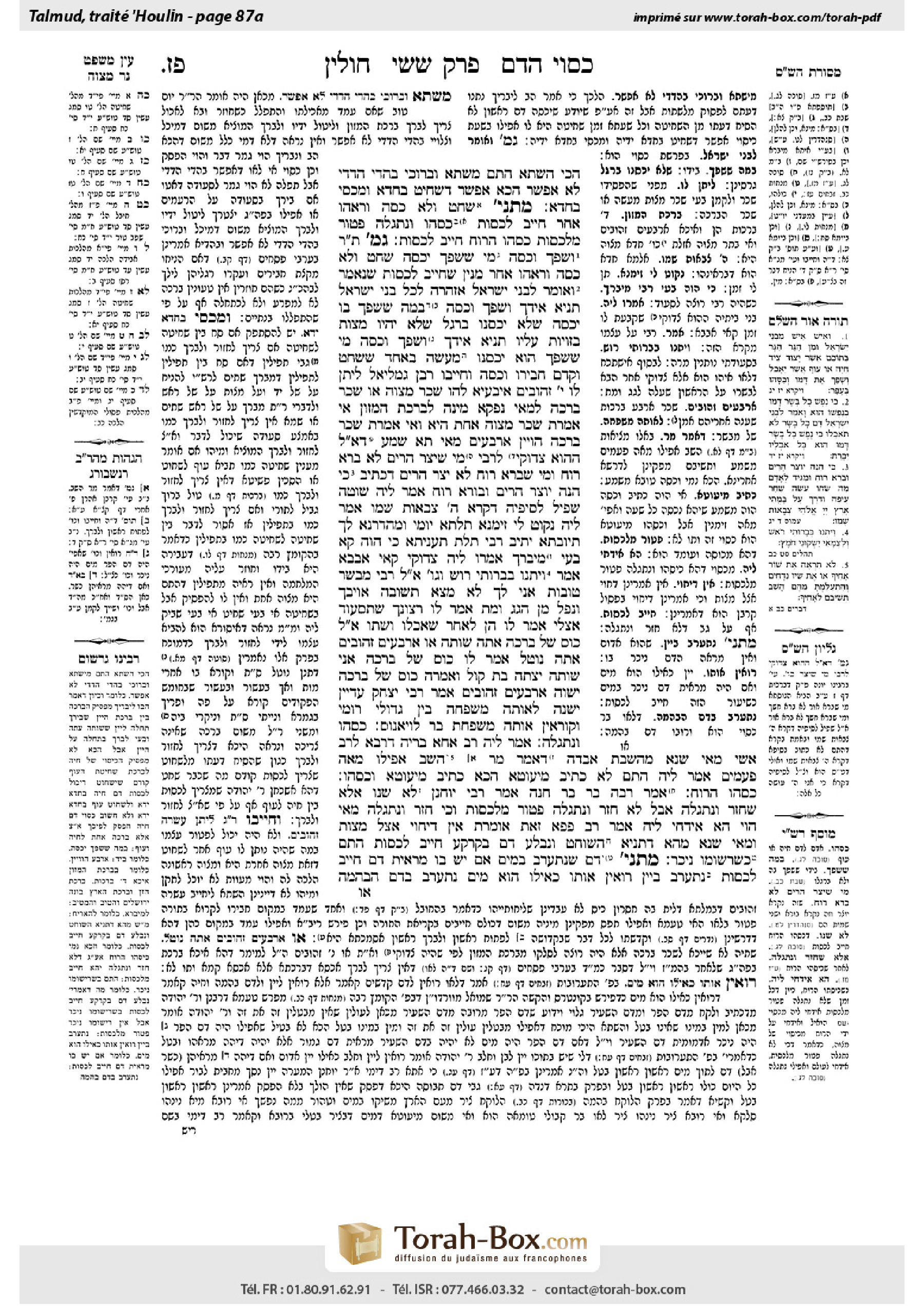
Chullin 87a: Talmud study for Daf Yomi
Study the Talmud for Daf Yomi with scanned pages, Hebrew text, English translations from Sefaria and AI-generated French translations.
Passage selection and English or AI-generated French translation are available where the scan has annotations. Daf Study is independent of Torah-Box and Sefaria.
Browse Chullin · חולין · All tractatesChullin 87a text and translations
This page of Chullin includes the Aramaic text, an English translation and an AI-generated French translation, alongside the scan above.
חולין פ״ז א · Aramaic and Hebrew text
הָכִי הַשְׁתָּא?! הָתָם מִשְׁתֵּא וּבָרוֹכֵי בַּהֲדֵי הֲדָדֵי לָא אֶפְשָׁר, הָכָא אֶפְשָׁר דְּשָׁחֵיט בַּחֲדָא וּמְכַסֵּי בַּחֲדָא.
מַתְנִי׳ שָׁחַט וְלֹא כִּסָּה, וְרָאָהוּ אַחֵר – חַיָּיב לְכַסּוֹת. כִּסָּהוּ וְנִתְגַּלָּה – פָּטוּר מִלְּכַסּוֹת. (כִּסָּהוּ) [כִּסַּתּוּ] הָרוּחַ – חַיָּיב לְכַסּוֹת.
גְּמָ׳ תָּנוּ רַבָּנַן: ״וְשָׁפַךְ וְכִסָּה״ – מִי שֶׁשָּׁפַךְ יְכַסֶּה. שָׁחַט וְלֹא כִּסָּה, וְרָאָהוּ אַחֵר, מִנַּיִן שֶׁחַיָּיב לְכַסּוֹת? שֶׁנֶּאֱמַר: ״וָאֹמַר לִבְנֵי יִשְׂרָאֵל״ – אַזְהָרָה לְכׇל בְּנֵי יִשְׂרָאֵל.
תַּנְיָא אִידַּךְ: ״וְשָׁפַךְ וְכִסָּה״, בַּמֶּה שֶׁשָּׁפַךְ – בּוֹ יְכַסֶּה, שֶׁלֹּא יְכַסֶּנּוּ בָּרֶגֶל, שֶׁלֹּא יִהְיוּ מִצְוֹת בְּזוּיוֹת עָלָיו. תַּנְיָא אִידַּךְ: ״וְשָׁפַךְ וְכִסָּה״, מִי שֶׁשָּׁפַךְ – הוּא יְכַסֶּנּוּ. מַעֲשֶׂה בְּאֶחָד שֶׁשָּׁחַט, וְקָדַם חֲבֵירוֹ וְכִסָּה, וְחִיְּיבוֹ רַבָּן גַּמְלִיאֵל לִיתֵּן לוֹ עֲשָׂרָה זְהוּבִים.
אִיבַּעְיָא לְהוּ: שְׂכַר מִצְוָה אוֹ שְׂכַר בְּרָכָה? לְמַאי נָפְקָא מִינַּהּ? לְבִרְכַּת הַמָּזוֹן. אִי אָמְרַתְּ שְׂכַר מִצְוָה – אַחַת הִיא, וְאִי אָמְרַתְּ שְׂכַר בְּרָכָה – הָוְיָין אַרְבָּעִים. מַאי?
תָּא שְׁמַע, דַּאֲמַר לֵיהּ הָהוּא מִינָא לְרַבִּי: מִי שֶׁיָּצַר הָרִים לֹא בָּרָא רוּחַ, וּמִי שֶׁבָּרָא רוּחַ לֹא יָצַר הָרִים, דִּכְתִיב: ״כִּי הִנֵּה יוֹצֵר הָרִים וּבֹרֵא רוּחַ״. אֲמַר לֵיהּ: שׁוֹטֶה, שְׁפֵיל לְסֵיפֵיהּ דִּקְרָא – ״ה׳ צְבָאוֹת שְׁמוֹ״.
אֲמַר לֵיהּ: נְקוֹט לִי זִימְנָא תְּלָתָא יוֹמֵי וּמַהְדַּרְנָא לָךְ תְּיוּבְתָּא. יְתֵיב רַבִּי תְּלָת תַּעֲנִיָּתָא. כִּי הֲוָה קָא בָּעֵי מִיבְרָא, אֲמַרוּ לֵיהּ: מִינָא קָאֵי אַבָּבָא. אֲמַר: ״וַיִּתְּנוּ בְּבָרוּתִי רוֹשׁ וְגוֹ׳״.
אֲמַר לֵיהּ: רַבִּי, מְבַשֵּׂר טוֹבוֹת אֲנִי לָךְ, לֹא מָצָא תְּשׁוּבָה אוֹיִבְךָ וְנָפַל מִן הַגָּג וָמֵת. אָמַר לוֹ: רְצוֹנְךָ שֶׁתִּסְעוֹד אֶצְלִי? אָמַר לוֹ: הֵן. לְאַחַר שֶׁאָכְלוּ וְשָׁתוּ, אָמַר לוֹ: כּוֹס שֶׁל בְּרָכָה אַתָּה שׁוֹתֶה אוֹ אַרְבָּעִים זְהוּבִים אַתָּה נוֹטֵל? אָמַר לוֹ: כּוֹס שֶׁל בְּרָכָה אֲנִי שׁוֹתֶה. יָצְתָה בַּת קוֹל וְאָמְרָה: כּוֹס שֶׁל בְּרָכָה שָׁוֶה אַרְבָּעִים זְהוּבִים.
אָמַר רַבִּי יִצְחָק: עֲדַיִין יֶשְׁנָהּ לְאוֹתָהּ מִשְׁפָּחָה בֵּין גְּדוֹלֵי רוֹמִי, וְקוֹרְאִין אוֹתָהּ מִשְׁפַּחַת בַּר לוּיָאנוּס.
כִּסָּהוּ וְנִתְגַּלָּה. אֲמַר לֵיהּ רַב אַחָא בְּרֵיהּ דְּרָבָא לְרַב אָשֵׁי: מַאי שְׁנָא מֵהֲשָׁבַת אֲבֵדָה, דְּאָמַר מָר: ״הָשֵׁב״ – אֲפִילּוּ מֵאָה פְּעָמִים.
אֲמַר לֵיהּ: הָתָם לָא כְּתִיב מִיעוּטָא, הָכָא כְּתִיב מִיעוּטָא ״וְכִסָּהוּ״.
כִּסָּהוּ הָרוּחַ. אָמַר רַבָּה בַּר בַּר חָנָה אָמַר רַבִּי יוֹחָנָן: לֹא שָׁנוּ אֶלָּא שֶׁחָזַר וְנִתְגַּלָּה, אֲבָל לֹא חָזַר וְנִתְגַּלָּה – פָּטוּר מִלְּכַסּוֹת. וְכִי חָזַר וְנִתְגַּלָּה מַאי הָוֵי? הָא אִידְּחִי לֵיהּ! אָמַר רַב פָּפָּא: זֹאת אוֹמֶרֶת אֵין דִּיחוּי אֵצֶל מִצְוֹת.
וּמַאי שְׁנָא מֵהָא דְּתַנְיָא: הַשּׁוֹחֵט וְנִבְלַע דָּם בַּקַּרְקַע – חַיָּיב לְכַסּוֹת. הָתָם כְּשֶׁרִשּׁוּמוֹ נִיכָּר.
מַתְנִי׳ דָּם שֶׁנִּתְעָרֵב בְּמַיִם, אִם יֵשׁ בּוֹ מַרְאִית דָּם – חַיָּיב לְכַסּוֹת. נִתְעָרֵב בְּיַיִן – רוֹאִין אוֹתוֹ כְּאִילּוּ הוּא מַיִם. נִתְעָרֵב בְּדַם הַבְּהֵמָה
Chullin 87a · English translation
The Gemara rejects this: How can these cases be compared? There, in the incident involving the students of Rav, it is impossible to drink and recite a blessing simultaneously. Accordingly, by requesting a cup over which to recite the blessing of Grace after Meals, they demonstrated their desire to cease drinking. Here, when one covers the blood of the undomesticated animal before slaughtering the bird, it is possible to slaughter the bird with the one hand and cover the blood of the undomesticated animal with the other one. Accordingly, the act of covering the blood of the undomesticated animal is not considered an interruption of the acts of slaughter, since they could have been performed simultaneously.
MISHNA: If one slaughtered an undomesticated animal or bird and did not cover the blood, and another person saw the uncovered blood, the second person is obligated to cover the blood. If one covered the blood and it was then uncovered, he is exempt from covering it again. If the wind blew earth on the blood and covered it, and it was consequently uncovered, he is obligated to cover the blood.
GEMARA: The Sages taught in a baraita: The verse states: “And he shall pour out its blood and cover it with earth” (Leviticus 17:13), indicating that the one who poured out its blood, i.e., slaughtered the animal, shall cover it. If one slaughtered the animal or bird and did not cover the blood, and another person saw the uncovered blood, from where is it derived that the person who saw the blood is obligated to cover it? It is derived from the following verse, as it is stated: “Therefore I said to the children of Israel” (Leviticus 17:12), which is a warning to all the children of Israel to fulfill the mitzva of covering the blood.
It is taught in another baraita: The verse states: “And he shall pour out its blood and cover it with earth,” indicating that with that which he poured out the blood he shall cover it, i.e., he must use his hand, and he may not cover it with his foot, so that mitzvot will not be contemptible to him. It is taught in another baraita: The verse states: “And he shall pour out its blood and cover it with earth,” indicating that the one who poured out the blood shall cover it. An incident occurred involving one who slaughtered an undomesticated animal or bird and another individual preempted him and covered the blood, and Rabban Gamliel deemed him obligated to give ten gold coins to the one who performed the act of slaughter.
A dilemma was raised before the Sages: Are these ten gold coins compensation for the stolen mitzva or are they compensation for the stolen blessing recited over the mitzva? The Gemara elaborates: What is the practical difference? The difference is with regard to a similar case involving Grace after Meals. If you say the coins are compensation for the mitzva, then with regard to Grace after Meals, since all its blessings constitute one mitzva, one would be obligated to give only ten gold coins. But if you say they are compensation for the lost blessing, then with regard to Grace after Meals the compensation is forty gold coins, since Grace after Meals comprises four blessings. What is the conclusion?
The Gemara suggests: Come and hear a proof from an incident in which a certain heretic said to Rabbi Yehuda HaNasi: He who created mountains did not create wind, and he who created wind did not create mountains; rather, each was created by a separate deity, as it is written: “For behold, He Who forms the mountains and He Who creates the wind” (Amos 4:13), indicating that there are two deities: One who forms the mountains and one who creates the wind. Rabbi Yehuda HaNasi said to him: Imbecile, go to the end of the verse, which states: “The Lord, the God of hosts, is His name.” The verse emphasizes that God is the One Who both forms and creates.
The heretic said to Rabbi Yehuda HaNasi: Give me three days’ time and I will respond to you with a rebuttal of your claim. Rabbi Yehuda HaNasi sat and fasted three days of fasting while awaiting the heretic, in order that he would not find a rebuttal. When Rabbi Yehuda HaNasi wanted to have a meal at the conclusion of those three days, they said to him: That heretic is standing at the doorway. Rabbi Yehuda HaNasi recited the following verse about himself: “They put gall into my food, and for my thirst they gave me vinegar to drink” (Psalms 69:22), i.e., my meal is embittered with the presence of this heretic.
When Rabbi Yehuda HaNasi came to the door he saw that it was in fact a different heretic, not the one who asked for three days to prepare a rebuttal. This heretic said to him: Rabbi, I am a bearer of good tidings for you: Your enemy did not find a response, and he threw himself from the roof and died. Rabbi Yehuda HaNasi said to the heretic: Since you have brought me good tidings, would you like to dine with me? The heretic said to him: Yes. After they ate and drank, Rabbi Yehuda HaNasi said to the heretic: Would you like to drink the cup of blessing, i.e., the cup of wine over which the Grace after Meals is recited, or would you like to take forty gold coins instead, and I will recite the Grace after Meals? The heretic said to him: I will drink the cup of blessing. A Divine Voice emerged and said: The cup of blessing is worth forty gold coins. Evidently, each one of the blessings in the Grace after Meals is worth ten gold coins.
The Gemara adds: Rabbi Yitzḥak says: That family of the heretic who dined with Rabbi Yehuda HaNasi still exists among the prominent families of Rome, and that family is called: The family of bar Luyyanus.
§ The mishna teaches that if one covered the blood and it was then uncovered he is not obligated to cover it again. Rav Aḥa, son of Rava, said to Rav Ashi: What is different about this case from the mitzva of returning a lost item, where the Master said: The verse states with regard to the obligation to return a lost item: “You shall return them to your brother” (Deuteronomy 22:1), even one hundred times?
Rav Ashi said to Rav Aḥa: There, in the verse discussing the obligation to return a lost item, a restriction is not written in the verse to limit the obligation. Here, in the verse discussing the obligation to cover the blood, a restriction is written, as the verse states: “And he shall cover it.” The usage of the term “it” indicates that one must cover the blood only one time.
§ The mishna teaches that if the wind blew earth on the blood and covered it one is obligated to cover the blood. Rabba bar bar Ḥana says that Rabbi Yoḥanan says: They taught this halakha only if the blood was again uncovered. But if the blood was not again uncovered one is exempt from the obligation to cover it. The Gemara asks: And when the blood was again uncovered, what of it? Isn’t it already rejected from the mitzva of covering since it was covered by the wind? Rav Pappa said: That is to say that there is no permanent rejection with regard to mitzvot. Although the wind covered the blood, the mitzva to cover it was not rendered null; rather, the mitzva simply could not be performed. Consequently, once the blood is again uncovered, the mitzva to cover the blood remains in place.
The Gemara asks: But even if the wind covered the blood and it remained covered, why is one exempt from performing the mitzva of covering the blood? What is different about this case from that which is taught in a baraita: In a case where one slaughters an undomesticated animal or a bird and its blood is absorbed by the ground, one is obligated to cover the blood? The Gemara responds: There, the baraita is referring to a case where the impression of the blood is still recognizable, i.e., it was not entirely absorbed in the ground.
MISHNA: In a case of the blood of an undomesticated animal or bird that was mixed with water, if there is in the mixture the appearance of blood one is obligated to cover it. If the blood was mixed with wine one views the wine as though it is water, and if a mixture with that amount of water would have the appearance of blood one is obligated to cover it. Likewise, if the blood of an undomesticated animal or a bird was mixed with the blood of a domesticated animal, which one does not have to cover,
Chullin 87a · Traduction française (IA)
La Guemara rejette cette interprétation : Comment peut-on comparer ces cas ? Là, dans l'incident concernant les élèves de Rav, il est impossible de boire et de réciter une berakha en même temps. Ainsi, en demandant un verre sur lequel réciter la berakha de la bénédiction de la table, ils ont montré leur désir de cesser de boire. Ici, lorsqu'on couvre le sang de l'animal sauvage avant d'abattre le volatile, on peut abattre le volatile avec une main et couvrir le sang de l'animal sauvage avec l'autre. Ainsi, l'acte de couvrir le sang de l'animal sauvage n'est pas considéré comme une interruption des actes d'abattage, puisqu'ils auraient pu être accomplis simultanément.
MICHNA : Si l'on a immolé un animal sauvage ou un oiseau sans recouvrir le sang, et qu'une autre personne a vu le sang découvert, la personne qui a vu le sang est tenue de le recouvrir. Si l'on a recouvert le sang et qu'il a été ensuite découvert, il est exempt de le recouvrir à nouveau. Si le vent a soufflé de la terre sur le sang et l'a couvert, et qu'il a ensuite été découvert, il est tenu de recouvrir le sang.
GUEMARA : Les Sages ont enseigné dans une baraïta : La Parashah dit : « Et il versera son sang et le recouvrira de terre » (Lévitique 17:13), indiquant que celui qui a versé son sang, c'est-à-dire qui a immolé l'animal, doit le recouvrir. Si l'on a immolé l'animal ou l'oiseau sans recouvrir le sang, et qu'une autre personne a vu le sang découvert, d'où tire-t-on que la personne qui a vu le sang est tenue de le recouvrir ? On tire cela d'une autre Parashah, comme il est dit : « Par conséquent, je dis aux enfants d'Israël » (Lévitique 17:12), ce qui est un avertissement à tous les enfants d'Israël pour accomplir la Mitsva de recouvrir le sang.
Il est enseigné dans une autre baraïta : La Parashah dit : « Et il versera son sang et le recouvrira de terre », indiquant que celui qui a versé son sang doit le recouvrir, c'est-à-dire qu'il doit utiliser sa main et non son pied, afin que la Mitsva ne soit pas méprisée. Il est enseigné dans une autre baraïta : La Parashah dit : « Et il versera son sang et le recouvrira de terre », indiquant que celui qui a versé son sang doit le recouvrir. Un incident s'est produit concernant celui qui a sacrifié un animal sauvage ou un oiseau, et une autre personne l'a anticipé et a recouvert le sang, et Rabban Gamliel a estimé qu'il était tenu de donner dix pièces d'or à celui qui a accompli l'acte de sacrifice.
Un dilemme a été soulevé devant les Sages : Ces dix pièces d'or sont-elles une compensation pour la Mitsva volée ou une compensation pour la berakha perdue ? La Guemara développe : Quelle est la différence pratique ? La différence est concernant un cas similaire concernant la bénédiction de la table. Si l'on dit que les pièces d'or sont une compensation pour la Mitsva, alors concernant la bénédiction de la table, puisque toutes ses berakhot constituent une seule Mitsva, on serait tenu de donner seulement dix pièces d'or. Mais si l'on dit qu'elles sont une compensation pour la berakha perdue, alors concernant la bénédiction de la table, la compensation est quarante pièces d'or, puisque la bénédiction de la table comprend quatre berakhot. Quelle est la conclusion ?
La Guemara suggère : Viens entendre une preuve tirée d’un incident où un certain hérétique dit à Rabbi Yehuda HaNasi : Celui qui a créé les montagnes n’a pas créé le vent, et celui qui a créé le vent n’a pas créé les montagnes ; plutôt, chacun a été créé par un dieu différent, comme il est écrit : « Car voici, celui qui façonne les montagnes et celui qui crée le vent » (Amos 4:13), indiquant qu’il y a deux dieux : celui qui façonne les montagnes et celui qui crée le vent. Rabbi Yehuda HaNasi répondit à lui : Crétin, va jusqu’à la fin de la parole, qui dit : « L’Éternel, l’Éternel des armées, est son nom. » La parole souligne que Dieu est celui qui façonne et crée à la fois.
L’hérétique dit à Rabbi Yehuda HaNasi : Donnez-moi trois jours et je vous répondrai avec une réfutation de votre affirmation. Rabbi Yehuda HaNasi s’assit et jeûna trois jours de jeûne en attendant l’hérétique, afin qu’il ne trouve pas de réfutation. Lorsque Rabbi Yehuda HaNasi voulait prendre un repas à la fin de ces trois jours, on lui dit : Cet hérétique est debout à la porte. Rabbi Yehuda HaNasi récita la suivante parole à son sujet : « Ils m’ont mis du gall en mon aliment, et pour ma soif ils m’ont donné du vinaigre à boire » (Psaumes 69:22), c’est-à-dire mon repas est amère à cause de la présence de cet hérétique.
Lorsque Rabbi Yehuda HaNasi est arrivé à la porte, il a vu qu'il s'agissait en fait d'un autre hérétique, pas celui qui avait demandé trois jours pour préparer une réfutation. Cet hérétique a dit à lui : Rabbi, je suis porteur de bonnes nouvelles pour vous : Votre ennemi n'a pas trouvé de réponse, et il s'est jeté du toit et est mort. Rabbi Yehuda HaNasi a dit à l'hérétique : Puisque vous m'avez apporté de bonnes nouvelles, voulez-vous dîner avec moi ? L'hérétique a dit à lui : Oui. Après qu'ils eurent mangé et bu, Rabbi Yehuda HaNasi a dit à l'hérétique : Voulez-vous boire le verre de bénédiction, c'est-à-dire le verre de vin sur lequel on récite la bénédiction de la table, ou voulez-vous prendre quarante pièces d'or plutôt, et je réciterai la bénédiction de la table ? L'hérétique a dit à lui : Je boirai le verre de bénédiction. Une Voix Divine est sortie et a dit : Le verre de bénédiction est d'une valeur de quarante pièces d'or. Évidemment, chaque une des bénédictions de la bénédiction de la table est d'une valeur de dix pièces d'or.
La Guemara ajoute : Rabbi Yitzḥak dit : Cette famille de l'hérétique qui a dîné avec Rabbi Yehuda HaNasi existe encore parmi les familles importantes de Rome, et cette famille s'appelle : la famille de bar Luyyanus.
§ La Michna enseigne que si l'on a recouvert le sang et qu'il a été ensuite découvert, on n'est pas tenu de le recouvrir à nouveau. Rav Aḥa, fils de Rava, a dit à Rav Ashi : Quelle est la différence dans ce cas par rapport à la Mitsva de rendre un objet perdu, où le Maître a dit : La Parashah dit concernant l'obligation de rendre un objet perdu : « Tu rendras à ton frère » (Lévitique 22:1), même cent fois ?
Rav Ashi a dit à Rav Aḥa : Là, dans la parole concernant l'obligation de rendre un objet perdu, il n'y a pas de restriction écrite dans la parole limitant l'obligation. Ici, dans la parole concernant l'obligation de couvrir le sang, une restriction est écrite, car la parole dit : « Et il couvrira [le sang]. » L'emploi du terme « il » indique qu'on doit couvrir le sang une seule fois.
§ La mitsna enseigne que si le vent a soufflé de la terre sur le sang et l'a recouvert, on est tenu de couvrir le sang. Rabba bar bar Ḥana dit que Rabbi Yoḥanan dit : Ils ont enseigné cette halakha uniquement si le sang était à nouveau découvert. Mais si le sang n'était pas à nouveau découvert, on est exempt de l'obligation de le couvrir. La Guemara demande : Et quand le sang était à nouveau découvert, qu'y a-t-il ? N'est-ce pas déjà rejeté de la Mitsva de couvrir puisqu'il avait été recouvert par le vent ? Rav Pappa a dit : Cela signifie qu'il n'y a pas de rejet permanent concernant les Mitsvot. Bien que le vent ait recouvert le sang, la Mitsva de le couvrir n'était pas annulée ; plutôt, la Mitsva ne pouvait pas être accomplie. Ainsi, une fois que le sang est à nouveau découvert, la Mitsva de le couvrir demeure en place.
La Guemara demande : Mais même si le vent a recouvert le sang et qu'il reste recouvert, pourquoi est-on exempt d'accomplir la Mitsva de couvrir le sang ? Qu'y a-t-il de différent dans ce cas par rapport à ce qui est enseigné dans une baraïta : Dans un cas où l'on sacrifie un animal sauvage ou un oiseau et son sang est absorbé par le sol, on est tenu de couvrir le sang ? La Guemara répond : Là, la baraïta fait référence à un cas où l'impression du sang est encore reconnaissable, c'est-à-dire qu'il n'était pas totalement absorbé dans le sol.
MICHNA : Dans le cas du sang d'un animal sauvage ou d'un oiseau qui est mélangé à de l'eau, si dans le mélange il y a l'apparence du sang, on est tenu de le couvrir. Si le sang est mélangé au vin, on considère le vin comme s'il était de l'eau, et si un mélange avec cette quantité d'eau aurait l'apparence du sang, on est tenu de le couvrir. De même, si le sang d'un animal sauvage ou d'un oiseau était mélangé au sang d'un animal domestique, dont on n'a pas à couvrir le sang,
Traduction française générée par IA à partir de l’édition anglaise de Sefaria. Vérifie toujours un passage avec le texte source.
Text from Sefaria: William Davidson Edition - Vocalized Aramaic (unknown); William Davidson Edition - English (CC BY NC).