Chullin 87b: Talmud study for Daf Yomi
Study the Talmud for Daf Yomi with scanned pages, Hebrew text, English translations from Sefaria and AI-generated French translations.
Passage selection and English or AI-generated French translation are available where the scan has annotations. Daf Study is independent of Torah-Box and Sefaria.
Browse Chullin · חולין · All tractatesChullin 87b text and translations
This page of Chullin includes the Aramaic text, an English translation and an AI-generated French translation, alongside the scan above.
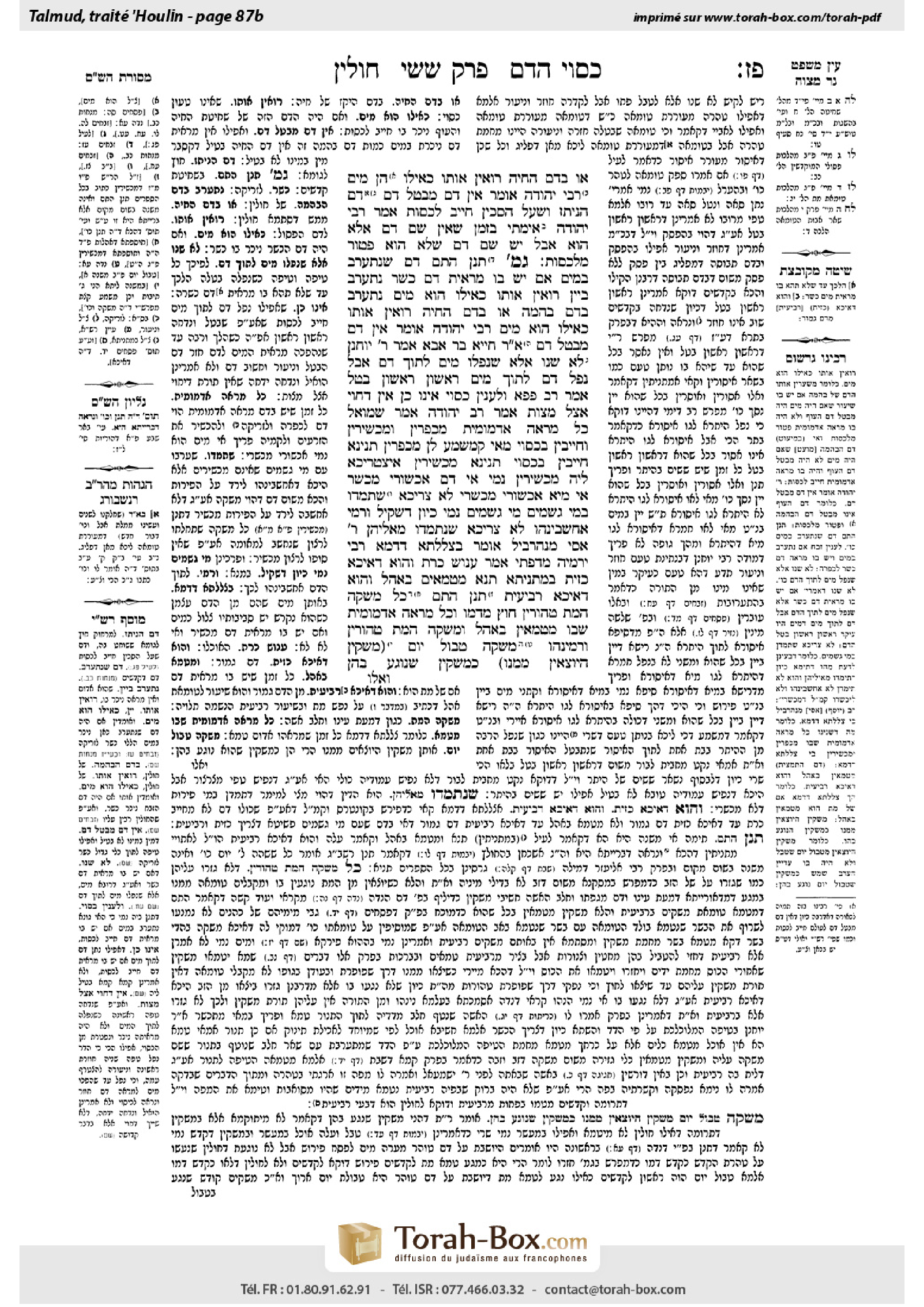
חולין פ״ז ב · Aramaic and Hebrew text
אוֹ בְּדַם הַחַיָּה – רוֹאִין אוֹתוֹ כְּאִילּוּ הֵן מַיִם. רַבִּי יְהוּדָה אוֹמֵר: אֵין דָּם מְבַטֵּל דָּם.
דָּם הַנִּיתָּז וְשֶׁעַל הַסַּכִּין – חַיָּיב לְכַסּוֹת. אָמַר רַבִּי יְהוּדָה: אֵימָתַי? בִּזְמַן שֶׁאֵין שָׁם דָּם אֶלָּא הוּא, אֲבָל יֵשׁ שָׁם דָּם שֶׁלֹּא הוּא – פָּטוּר מִלְּכַסּוֹת.
גְּמָ׳ תְּנַן הָתָם: דָּם שֶׁנִּתְעָרֵב בְּמַיִם, אִם יֵשׁ בּוֹ מַרְאִית דָּם – כָּשֵׁר. נִתְעָרֵב בְּיַיִן – רוֹאִין אוֹתוֹ כְּאִילּוּ הוּא מַיִם. נִתְעָרֵב בְּדַם בְּהֵמָה אוֹ בְּדַם הַחַיָּה – רוֹאִין אוֹתוֹ כְּאִילּוּ הוּא מַיִם. רַבִּי יְהוּדָה אוֹמֵר: אֵין דָּם מְבַטֵּל דָּם.
אָמַר רַבִּי חִיָּיא בַּר אַבָּא אָמַר רַבִּי יוֹחָנָן: לֹא שָׁנוּ אֶלָּא שֶׁנָּפְלוּ מַיִם לְתוֹךְ דָּם, אֲבָל נָפַל דָּם לְתוֹךְ מַיִם – רִאשׁוֹן רִאשׁוֹן בָּטֵל.
אָמַר רַב פָּפָּא: וּלְעִנְיַן כִּסּוּי אֵינוֹ כֵּן, אֵין דִּחוּי אֵצֶל מִצְוֹת.
אָמַר רַב יְהוּדָה אָמַר שְׁמוּאֵל: כׇּל מַרְאֵה אַדְּמוּמִית – מְכַפְּרִין, וּמַכְשִׁירִין, וְחַיָּיבִין בְּכִסּוּי. מַאי קָמַשְׁמַע לַן? מְכַפְּרִין – תְּנֵינָא, חַיָּיבִין בְּכִסּוּי – תְּנֵינָא!
מַכְשִׁירִין אִיצְטְרִיכָא לֵיהּ. מַכְשִׁירִין נָמֵי, אִי דָּם – אַכְשׁוֹרֵי מַכְשַׁר, אִי מַיָּא – אַכְשׁוֹרֵי מַכְשְׁרִי! לָא צְרִיכָא, שֶׁתִּמְּדוֹ בְּמֵי גְשָׁמִים.
מֵי גְשָׁמִים נָמֵי, כֵּיוָן דְּשָׁקֵיל וְרָמֵי, אַחְשְׁבִינְהוּ. לָא צְרִיכָא, שֶׁנִּתְמְדוּ מֵאֲלֵיהֶן.
רַבִּי אַסִּי מִנְּהַרְבִּיל אוֹמֵר: בִּצְלַלְתָּא דִּדְמָא. רַבִּי יִרְמְיָה מִדִּפְתִּי אָמַר: עָנוּשׁ כָּרֵת, וְהוּא דְּאִיכָּא כְּזַיִת. בְּמַתְנִיתָא תָּנָא: מְטַמְּאִים בְּאֹהֶל, וְהוּא דְּאִיכָּא רְבִיעִית.
תְּנַן הָתָם: כׇּל מַשְׁקֵה הַמֵּת טְהוֹרִין, חוּץ מִדָּמוֹ, וְכׇל מַרְאֵה אַדְּמוּמִית שֶׁבּוֹ מְטַמְּאִין בְּאֹהֶל. וּמַשְׁקֵה הַמֵּת טְהוֹרִין? וּרְמִינְהוּ: מַשְׁקֶה טְבוּל יוֹם, מַשְׁקִין הַיּוֹצְאִין מִמֶּנּוּ כְּמַשְׁקִין שֶׁנּוֹגֵעַ בָּהֶן,
Chullin 87b · English translation
or with blood of the undomesticated animal that did not flow from the neck and does not require covering, one views the blood as though it is water. Rabbi Yehuda says: Blood does not nullify blood. Therefore, even if the undomesticated animal’s blood, which one must cover, is not recognizable in this mixture, he is obligated to cover the mixture nevertheless.
With regard to blood that spurts outside the pit over which the animal was slaughtered, or onto a wall, and blood that remained on the slaughtering knife, one is obligated to cover it. Rabbi Yehuda said: When is this the halakha? When no blood remains there from the slaughter except that blood. But if blood remains there from the slaughter that is not that blood, he is exempt from covering it.
GEMARA: We learned in a mishna there (Zevaḥim 77b): In the case of blood of an offering fit for sacrifice that was mixed with water, if the mixture has the appearance of blood it is fit for sprinkling on the altar, even though the majority of the mixture is water. If the blood was mixed with red wine, one views the wine as though it is water. If that amount of water would leave the mixture with the appearance of blood it is fit for presentation. And likewise, if the blood was mixed with the blood of a non-sacred domesticated animal or the blood of a non-sacred undomesticated animal, one considers the non-sacred blood as though it is water. Rabbi Yehuda says: Blood does not nullify blood. Therefore, the priest presents the blood of the mixture on the altar.
The mishna teaches that in a case where water became mixed with the blood of an offering, if the mixture has the appearance of blood it is fit, despite the fact that there is more water than blood. Concerning this Rabbi Ḥiyya bar Abba says that Rabbi Yoḥanan says: They taught this halakha only in a case where the water fell into the blood. But in a case where the blood fell into the water, the first drop of blood, and then the next first drop of blood, are nullified in the water, i.e., each drop is nullified in turn. Consequently, the mixture is unfit for presentation, regardless of whether it has the appearance of blood.
Rav Pappa says: But with regard to the mitzva of covering the blood of birds or undomesticated animals that are slaughtered, it is not so. In this case, even if the blood fell into water the mitzva of covering applies to it, provided the mixture has the appearance of blood. The blood is not nullified by the water because there is no permanent rejection with regard to mitzvot other than those that relate to sacrificial rites. Therefore, its nullification was merely temporary, but once there is enough blood in the water it reassumes its status of blood.
§ With regard to mixtures of blood and water, Rav Yehuda says that Shmuel says: All mixtures of blood and water that maintain a reddish hue are considered blood and effect atonement by being presented on the altar, and render food susceptible to contracting ritual impurity, and are included in the obligation of covering the blood provided that the blood is from the slaughter of an undomesticated animal or bird. The Gemara asks: What is Rav Yehuda teaching us? If he is teaching us that such mixtures effect atonement, we already learn this from the mishna in tractate Zevaḥim. And if he is teaching us that such mixtures are included in the obligation of covering the blood, we already learn this in the mishna here.
Rather, it was necessary for Rav Yehuda to teach that such mixtures render food susceptible to contracting ritual impurity, as this was not taught in a mishna. The Gemara challenges: It is also unnecessary to teach that such mixtures render food susceptible to contracting ritual impurity. If the mixture has the status of blood it renders food susceptible, as does blood, and if the mixture has the status of water it renders food susceptible, as does water. The Gemara responds: No, this statement is necessary in a case where the blood was mixed with rainwater, which does not render food susceptible without the intent or desire of the owner of the food. If the mixture is considered blood it renders food susceptible.
The Gemara challenges: With regard to rainwater as well, since one took it and placed it into a vessel containing blood, he has ascribed significance to the rainwater and it should be capable of rendering food susceptible. The Gemara responds: No, this statement is necessary in a case where the rainwater was mixed with the blood by itself, i.e., it was not gathered and poured purposefully.
Rabbi Asi of Neharbil says: The statement of Rav Yehuda is referring to blood plasma, i.e., if the plasma has a reddish hue due to the blood, it has the status of blood and can render food susceptible to contracting ritual impurity. Rabbi Yirmeya of Difti said: Consumption of this plasma is punishable by karet, as is the halakha with regard to one who consumes blood (see Leviticus 17:14), provided that there is at least one olive-bulk of actual blood. It was taught in a baraita: Blood plasma that issues from a corpse that has a reddish hue imparts ritual impurity in a tent, provided that there is at least a quarter-log of actual blood, which is the amount of a corpse’s blood that imparts ritual impurity.
We learned in a baraita elsewhere (Tosefta, Oholot 4:5): All liquids that issue from a corpse, e.g., teardrops or breastmilk, are ritually pure, except for its blood. And all liquids that issue from a corpse that contain a reddish hue of blood impart ritual impurity in a tent. The Gemara asks: But are liquids that issue from a corpse ritually pure? And raise a contradiction from a mishna (Tevul Yom 2:1): With regard to liquids that issue from one who immersed that day, liquids that issue from him have the same status as liquids that he touches.
Chullin 87b · Traduction française (IA)
ou avec le sang d'un animal non domestique qui n'est pas coulé du cou et qui ne nécessite pas d'être recouvert, on considère le sang comme de l'eau. Rabbi Yéhuda dit : le sang ne neutralise pas le sang. Ainsi, même si le sang de l'animal non domestique, qui doit être recouvert, n'est pas identifiable dans ce mélange, il est tenu de recouvrir le mélange de toute façon.
En ce qui concerne le sang qui jaillit en dehors du trou dans lequel l'animal a été sacrifié, ou sur un mur, et le sang restant sur le couteau de boucher, on est tenu de le recouvrir. Rabbi Yéhuda dit : Dans quel cas cette halakha s'applique-t-elle ? Lorsqu'il ne reste plus de sang là où l'animal a été sacrifié, sauf ce sang. Mais si du sang reste là où l'animal a été sacrifié, qui n'est pas ce sang, on est exempt de le recouvrir.
GUEMARA : Nous avons appris dans une mitsva là (Zevaḥim 77b) : Dans le cas où le sang d'un sacrifice est mélangé à de l'eau, si le mélange a l'apparence du sang, il est propre à être versé sur l'autel, même si la majorité du mélange est de l'eau. Si le sang a été mélangé au vin rouge, on considère le vin comme de l'eau. Si la quantité d'eau rend le mélange à l'apparence du sang, il est propre à être présenté. De même, si le sang a été mélangé au sang d'un animal domestique non sacré ou au sang d'un animal non domestique non sacré, on considère le sang non sacré comme de l'eau. Rabbi Yéhuda dit : le sang ne neutralise pas le sang. Ainsi, le prêtre présente le sang du mélange sur l'autel.
La mitsna enseigne que dans le cas où de l'eau s'est mêlée au sang d'un sacrifice, si le mélange a l'apparence du sang, il est propre, malgré le fait qu'il y ait plus d'eau que de sang. Concernant cela, Rabbi Ḥiyya bar Abba dit que Rabbi Yoḥanan dit : Ils ont enseigné cette halakha uniquement dans le cas où l'eau est tombée dans le sang. Mais dans le cas où le sang est tombé dans l'eau, la première goutte de sang, et ensuite la deuxième goutte de sang, sont annulées dans l'eau, c'est-à-dire que chaque goutte est annulée à tour de rôle. Ainsi, le mélange n'est pas propre à être présenté, qu'il ait l'apparence du sang ou non.
Rav Pappa dit : Mais concernant la mitsva de recouvrir le sang des oiseaux ou des animaux non domestiques sacrifiés, ce n'est pas le cas. Dans ce cas, même si le sang est tombé dans l'eau, la mitsva de recouvrir s'applique à ce mélange, à condition que le mélange ait l'apparence du sang. Le sang n'est pas annulé par l'eau, car il n'y a pas de rejet permanent concernant les mitsvot autres que celles liées aux rites sacrificiels. Ainsi, sa nullification était temporaire, mais une fois qu'il y a suffisamment de sang dans l'eau, il reprend son statut de sang.
§ Concernant les mélanges de sang et d'eau, Rav Yéhuda dit que Shmuel dit : Tous les mélanges de sang et d'eau qui conservent une teinte rougeâtre sont considérés comme du sang et produisent un atonement en étant présentés sur l'autel, et rendent les aliments sujets à la contraction de l'impureté rituelle, et sont inclus dans l'obligation de recouvrir le sang, à condition que le sang provienne de la boucherie d'un animal non domestique ou d'un oiseau. La Guemara demande : Qu'est-ce que Rav Yéhuda nous enseigne ? Si il nous enseigne que ces mélanges produisent un atonement, nous avons déjà appris cela à partir de la mitsna dans le traité Zevaḥim. Et si il nous enseigne que ces mélanges sont inclus dans l'obligation de recouvrir le sang, nous avons déjà appris cela à partir de la mitsna ici.
Plutôt, il était nécessaire que Rav Yéhuda enseigne que ces mélanges rendent les aliments sujets à la contraction de l'impureté rituelle, car cela n'était pas enseigné dans une mitsna. La Guemara conteste : Il n'était pas non plus nécessaire d'enseigner que ces mélanges rendent les aliments sujets à la contraction de l'impureté rituelle. Si le mélange a le statut de sang, il rend les aliments sujets à l'impureté, comme le sang, et si le mélange a le statut d'eau, il rend les aliments sujets à l'impureté, comme l'eau. La Guemara répond : Non, cette déclaration est nécessaire dans le cas où le sang a été mélangé à l'eau de pluie, qui ne rend les aliments sujets à l'impureté sans l'intention ou le désir du propriétaire des aliments. Si le mélange est considéré comme du sang, il rend les aliments sujets à l'impureté.
La Guemara conteste : Concernant l'eau de pluie également, puisqu'on l'a prise et l'a mise dans un récipient contenant du sang, on a attribué de l'importance à l'eau de pluie et elle devrait être capable de rendre les aliments sujets à l'impureté. La Guemara répond : Non, cette déclaration est nécessaire dans le cas où l'eau de pluie a été mélangée au sang par elle-même, c'est-à-dire qu'elle n'a pas été recueillie et versée intentionnellement.
Rabbi Asi de Neharbil dit : La déclaration de Rav Yéhuda fait référence au plasma sanguin, c'est-à-dire si le plasma a une teinte rougeâtre en raison du sang, il a le statut de sang et peut rendre les aliments sujets à la contraction de l'impureté rituelle. Rabbi Yirmeya de Difti dit : La consommation de ce plasma est punie par la karet, comme c'est le cas pour celui qui consomme du sang (voir Lévitique 17:14), à condition qu'il y ait au moins une quantité d'olive de sang réel. Il a été enseigné dans une baraïta : Le plasma sanguin qui sort d'un cadavre qui a une teinte rougeâtre transmet l'impureté rituelle dans une tente, à condition qu'il y ait au moins un quart de log de sang réel, qui est la quantité de sang d'un cadavre qui transmet l'impureté rituelle.
Nous avons appris dans une baraïta ailleurs (Tosefta, Oholot 4:5) : Tous les liquides qui sortent d'un cadavre, par exemple des larmes ou du lait maternel, sont rituellement purs, sauf son sang. Et tous les liquides qui sortent d'un cadavre qui contiennent une teinte rougeâtre de sang transmettent l'impureté rituelle dans une tente. La Guemara demande : Mais les liquides qui sortent d'un cadavre sont-ils rituellement purs ? Et elle évoque une contradiction à partir d'une mitsva (Tevul Yom 2:1) : Concernant les liquides qui sortent de celui qui s'est immergé ce jour-là, les liquides qui sortent de lui ont le même statut que les liquides qu'il touche.
Traduction française générée par IA à partir de l’édition anglaise de Sefaria. Vérifie toujours un passage avec le texte source.
Text from Sefaria: William Davidson Edition - Vocalized Aramaic (unknown); William Davidson Edition - English (CC BY NC).