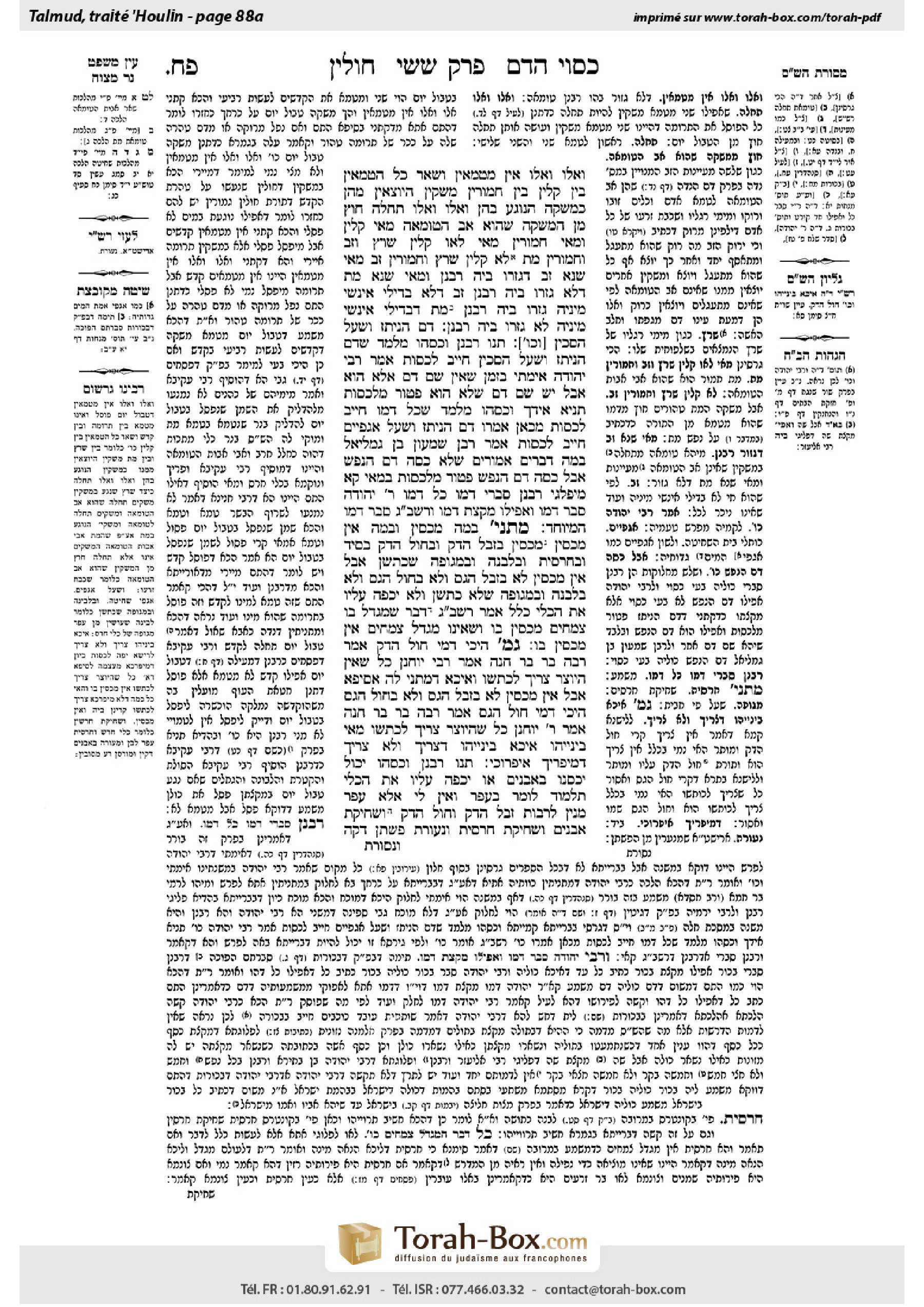
Chullin 88a: Talmud study for Daf Yomi
Study the Talmud for Daf Yomi with scanned pages, Hebrew text, English translations from Sefaria and AI-generated French translations.
Passage selection and English or AI-generated French translation are available where the scan has annotations. Daf Study is independent of Torah-Box and Sefaria.
Browse Chullin · חולין · All tractatesChullin 88a text and translations
This page of Chullin includes the Aramaic text, an English translation and an AI-generated French translation, alongside the scan above.
חולין פ״ח א · Aramaic and Hebrew text
וְאֵלּוּ וָאֵלּוּ אֵין מְטַמְּאִין, וּשְׁאָר כׇּל הַטְּמֵאִין, בֵּין קַלִּין בֵּין חֲמוּרִין – מַשְׁקִין הַיּוֹצְאִין מֵהֶן כְּמַשְׁקֶה הַנּוֹגֵעַ בָּהֶן, וְאֵלּוּ וָאֵלּוּ תְּחִלָּה, חוּץ מִן הַמַּשְׁקֶה שֶׁהוּא אַב הַטּוּמְאָה.
מַאי קַלִּין וּמַאי חֲמוּרִין? מַאי לָאו: קַלִּין – שֶׁרֶץ וְזָב, וַחֲמוּרִין – מֵת? לָא, קַלִּין – שֶׁרֶץ, וַחֲמוּרִין – זָב.
מַאי שְׁנָא זָב, דִּגְזַרוּ בֵּיהּ רַבָּנַן, וּמַאי שְׁנָא מֵת דְּלָא גְּזַרוּ בֵּיהּ רַבָּנַן? זָב דְּלָא בְּדִילִי אִינָשֵׁי מִינֵּיהּ – גְּזַרוּ בֵּיהּ רַבָּנַן, מֵת דִּבְדִילִי אִינָשֵׁי מִינֵּיהּ – לָא גְּזַרוּ בֵּיהּ רַבָּנַן.
דָּם הַנִּיתָּז וְשֶׁעַל הַסַּכִּין, תָּנוּ רַבָּנַן: ״וְכִסָּהוּ״ – מְלַמֵּד שֶׁדַּם הַנִּיתָּז וְשֶׁעַל הַסַּכִּין חַיָּיב לְכַסּוֹת. אָמַר רַבִּי יְהוּדָה: אֵימָתַי? בִּזְמַן שֶׁאֵין שָׁם דָּם אֶלָּא הוּא, אֲבָל יֵשׁ שָׁם דָּם שֶׁלֹּא הוּא – פָּטוּר מִלְּכַסּוֹת.
תַּנְיָא אִידַּךְ: ״וְכִסָּהוּ״ – מְלַמֵּד שֶׁכׇּל דָּמוֹ חַיָּיב לְכַסּוֹת, מִכָּאן אָמְרוּ: דָּם הַנִּיתָּז וְשֶׁעַל אֲגַפַּיִים חַיָּיב לְכַסּוֹת. אָמַר רַבָּן שִׁמְעוֹן בֶּן גַּמְלִיאֵל: בַּמֶּה דְּבָרִים אֲמוּרִים – שֶׁלֹּא כִּסָּה דַּם הַנֶּפֶשׁ, אֲבָל כִּסָּה דַּם הַנֶּפֶשׁ – פָּטוּר מִלְּכַסּוֹת.
בְּמַאי קָא מִיפַּלְגִי? רַבָּנַן סָבְרִי: ״דָּמוֹ״ – כׇּל דָּמוֹ, רַבִּי יְהוּדָה סָבַר: ״דָּמוֹ״ – וַאֲפִילּוּ מִקְצָת דָּמוֹ, וְרַבָּן שִׁמְעוֹן בֶּן גַּמְלִיאֵל סָבַר: ״דָּמוֹ״ – הַמְיוּחָד.
מַתְנִי׳ בַּמֶּה מְכַסִּין וּבַמֶּה אֵין מְכַסִּין? מְכַסִּין בְּזֶבֶל הַדַּק, וּבְחוֹל הַדַּק, בְּסִיד, וּבְחַרְסִית, וּבִלְבֵנָה וּבִמְגוּפָה שֶׁכְּתָשָׁן, אֲבָל אֵין מְכַסִּין לֹא בְּזֶבֶל הַגַּס, וְלֹא בְּחוֹל הַגַּס, וְלֹא בִּלְבֵנָה וּבִמְגוּפָה שֶׁלֹּא כְּתָשָׁן, וְלֹא יִכְפֶּה עָלָיו אֶת הַכְּלִי. כְּלָל אָמַר רַבָּן שִׁמְעוֹן בֶּן גַּמְלִיאֵל: דָּבָר שֶׁמְּגַדֵּל בּוֹ צְמָחִים – מְכַסִּין בּוֹ, וְשֶׁאֵינוֹ מְגַדֵּל צְמָחִים – אֵין מְכַסִּין בּוֹ.
גְּמָ׳ הֵיכִי דָמֵי חוֹל הַדַּק? אָמַר רַבָּה בַּר בַּר חָנָה אָמַר רַבִּי יוֹחָנָן: כֹּל שֶׁאֵין הַיּוֹצֵר צָרִיךְ לְכׇתְשׁוֹ. וְאִיכָּא דְּמַתְנֵי לַהּ אַסֵּיפָא: אֲבָל אֵין מְכַסִּין לֹא בְּזֶבֶל הַגַּס וְלֹא בְּחוֹל הַגַּס. הֵיכִי דָּמֵי חוֹל הַגַּס? אָמַר רַבָּה בַּר בַּר חָנָה אָמַר רַבִּי יוֹחָנָן: כֹּל שֶׁהַיּוֹצֵר צָרִיךְ לְכׇתְשׁוֹ.
מַאי בֵּינַיְיהוּ? אִיכָּא בֵּינַיְיהוּ דִּצְרִיךְ וְלָא צְרִיךְ, דְּמִיפְּרִיךְ אִיפְּרוֹכֵי.
תָּנוּ רַבָּנַן: ״וְכִסָּהוּ״, יָכוֹל יְכַסֶּנּוּ בַּאֲבָנִים אוֹ יִכְפֶּה עָלָיו אֶת הַכְּלִי? תַּלְמוּד לוֹמַר: ״בֶּעָפָר״. וְאֵין לִי אֶלָּא עָפָר, מִנַּיִן לְרַבּוֹת זֶבֶל הַדַּק, וְחוֹל הַדַּק, וּשְׁחִיקַת אֲבָנִים, וּשְׁחִיקַת חַרְסִית, וּנְעוֹרֶת פִּשְׁתָּן דַּקָּה,
Chullin 88a · English translation
And both these and those, i.e., both liquids that issue from one who immersed himself that day and liquids he touches, do not impart ritual impurity. And with regard to all other sources of impurity, whether minor sources or major sources, liquids that issue from them have the same status as liquids that touch them, and both these and those have first-degree ritual impurity, since they touched a primary source of ritual impurity upon exiting the source. This is the halakha except for a liquid that is itself a primary source of ritual impurity.
The Gemara analyzes the mishna: What is the meaning of minor sources and what is the meaning of major sources? What, is it not that the term: Minor sources, is referring to a creeping animal or a zav, and that the term: Major sources, is referring to a corpse? If so, the mishna teaches that all liquids that issue from a corpse are ritually impure, in contradiction to the baraita. The Gemara responds: No, the term: Minor sources, is referring to a creeping animal, e.g., urine found inside its body, which is not considered ritually impure, and the term: Major sources, is referring to a zav, concerning whom all liquids that issue from him are ritually impure. By contrast, liquids that issue from a corpse are ritually pure with the exception of blood.
The Gemara asks: What is different with regard to a zav, concerning whom the Sages decreed that liquids that issue from him are ritually impure, and what is different with regard to a corpse, concerning which the Sages did not decree that liquids that issue from it are ritually impure? The Gemara responds: In the case of a zav, since people do not naturally separate from him, the Sages decreed additional restrictions with regard to him in order to prevent others from contracting impurity from liquids that issue from a zav that are impure by Torah law. In the case of a corpse, since people naturally separate from it, the Sages did not decree additional restrictions with regard to it.
§ The mishna teaches that one is obligated to cover blood that spurts outside the pit over which the animal was slaughtered, or onto the wall, and blood that remained on the slaughtering knife. With regard to this halakha, the Sages taught in a baraita: The verse states: “And he shall cover it” (Leviticus 17:13), which teaches that one is obligated to cover blood that spurted and blood that remained on the slaughtering knife. Rabbi Yehuda said: When is this the halakha? When there is no blood except that blood. But if there is other blood that is not that blood, one is exempt from covering it.
It is taught in another baraita: The term: “And he shall cover it,” teaches that one is obligated to cover all of the blood. From here the Sages stated: With regard to blood that spurts out and blood that remains on the sides of the animal’s throat where it was slaughtered, one is obligated to cover it. Rabban Shimon ben Gamliel said: In what case is this statement said? It is said in a case where one did not already cover the blood of the soul, i.e., the blood that flows from the place of slaughter as the animal dies. But if one already covered the blood of the soul, he is exempt from the obligation to cover the blood that spurted out or the blood remaining on the sides of the animal’s neck in the area of slaughter.
The Gemara asks: With regard to what matter do they disagree? The Gemara responds: The Rabbis hold that the expression: “Its blood” (Leviticus 17:13), indicates an obligation to cover all of its blood, even the blood that spurts out. Rabbi Yehuda holds that “its blood” indicates that one may fulfill the mitzva with any part of the blood, even with a small amount of its blood. And Rabban Shimon ben Gamliel holds that “its blood” refers to the special blood, i.e., the blood of the soul.
MISHNA: With what substances may one cover the blood and with what substances may one not cover the blood? One may cover the blood with fine granulated manure, with fine sand, with lime, with crushed potsherd, and with a brick or the lid of an earthenware barrel that one crushed. But one may not cover the blood with thick manure, nor with thick, clumped sand, nor with a brick or the lid of an earthenware barrel that one did not crush. Neither may one merely turn a vessel over the blood. Rabban Shimon ben Gamliel stated a principle: With regard to a substance in which plants grow, one may cover blood with it; and with regard to a substance in which plants do not grow, one may not cover blood with it.
GEMARA: The mishna teaches that one may cover the blood with fine sand. The Gemara asks: What is considered fine sand? Rabba bar bar Ḥana says that Rabbi Yoḥanan says: It is any sand that the pottery producer does not need to crush in order to use it. The Gemara notes: And some teach this statement in reference to the latter clause of the mishna, which states: But one may not cover the blood with thick manure, nor with thick sand. The Gemara asks: What is considered thick sand? Rabba bar bar Ḥana says that Rabbi Yoḥanan says: It is any sand that the pottery producer must crush in order to use it.
The Gemara asks: What is the practical difference between these two versions? The Gemara responds: There is a difference between them with regard to sand that requires some crushing and sand that does not require full crushing, i.e., that crumbles in one’s hand and does not require a tool. According to the first version, as long as the sand does not require crushing it may be used to cover the blood. Therefore, sand that requires crumbling may be used since it is not considered sand that requires crushing. According to the second version, any sand that requires some crushing may not be used. Therefore, sand that requires crumbling may not be used to cover the blood.
§ The Sages taught in a baraita: The verse states with regard to the mitzva of covering the blood: “And cover it” (Leviticus 17:13). One might have thought that he may cover the blood with stones or merely turn a vessel over it. Therefore, the verse states: “With earth.” Based on this expression I have derived only that earth may be used. From where does one derive to include fine manure, fine sand, crushed stones, crushed potsherd, fine chaff of flax,
Chullin 88a · Traduction française (IA)
Et ces deux et ceux-là, c'est-à-dire ces liquides qui sortent d'une personne qui s'est immergée ce jour-là et ces liquides qu'elle touche, ne transmettent pas l'impureté rituelle. Et concernant toutes les autres sources d'impureté, qu'elles soient des sources mineures ou des sources principales, les liquides qui en sortent ont le même statut que les liquides qui les touchent, et ces deux et ceux-là ont une impureté rituelle de premier degré, puisqu'ils ont touché une source principale d'impureté rituelle lorsqu'ils sortaient de la source. C'est la halakha, sauf pour un liquide qui est lui-même une source principale d'impureté rituelle.
Le Guemara analyse la mitsna : Qu'entend-on par sources mineures et qu'entend-on par sources principales ? N'est-ce pas que le terme « sources mineures » fait référence à un animal rampant ou à un zav, et que le terme « sources principales » fait référence à un cadavre ? Si c'est ainsi, la mitsna enseigne que tous les liquides qui sortent d'un cadavre sont impurs rituellement, en contradiction avec la baraïta. Le Guemara répond : Non, le terme « sources mineures » fait référence à un animal rampant, par exemple, l'urine trouvée à l'intérieur de son corps, qui n'est pas considérée comme impure rituellement, et le terme « sources principales » fait référence à un zav, concernant lequel tous les liquides qui en sortent sont impurs rituellement. À l'inverse, les liquides qui sortent d'un cadavre sont purs rituellement, sauf le sang.
Le Guemara pose la question : Qu'est-ce qui diffère concernant un zav, concernant lequel les Sages ont décrété que les liquides qui en sortent sont impurs rituellement, et qu'est-ce qui diffère concernant un cadavre, concernant lequel les Sages n'ont pas décrété que les liquides qui en sortent sont impurs rituellement ? Le Guemara répond : Dans le cas d'un zav, puisque les gens ne s'éloignent naturellement pas de lui, les Sages ont décrété des restrictions supplémentaires concernant lui afin d'empêcher les autres de contracter l'impureté à partir des liquides qui en sortent et qui sont impurs selon la loi divine. Dans le cas d'un cadavre, puisque les gens s'éloignent naturellement de lui, les Sages n'ont pas décrété des restrictions supplémentaires concernant lui.
§ La mitsva enseigne que l'on est tenu de couvrir le sang qui jaillit en dehors du trou par lequel l'animal a été sacrifié, ou sur le mur, et le sang restant sur le couteau de boucherie. Concernant cette halakha, les Sages ont enseigné dans une baraïta : Le verset dit : « Et il couvrira cela » (Lévitique 17:13), ce qui enseigne que l'on est tenu de couvrir le sang qui a jailli et le sang restant sur le couteau de boucherie. Rabbi Yehuda dit : Dans quel cas cette halakha s'applique ? Lorsqu'il n'y a pas d'autre sang que celui-ci. Mais s'il y a d'autres sangs qui ne sont pas ce sang, l'on est exempt de couvrir celui-ci.
Il est enseigné dans une autre baraïta : Le terme « et il couvrira cela » enseigne que l'on est tenu de couvrir tout le sang. D'où les Sages ont déclaré : Concernant le sang qui jaillit et le sang restant sur les côtés de la gorge de l'animal où il a été tué, l'on est tenu de couvrir celui-ci. Rabban Shimon ben Gamliel dit : Dans quel cas cette déclaration s'applique ? C'est dit dans un cas où l'on n'a pas déjà couvert le sang de l'âme, c'est-à-dire le sang qui coule du lieu de la mise à mort lorsque l'animal meurt. Mais si l'on a déjà couvert le sang de l'âme, l'on est exempt de l'obligation de couvrir le sang qui a jailli ou le sang restant sur les côtés de la gorge de l'animal dans la zone de la mise à mort.
Le Guemara pose la question : À propos de quelle matière se déclarent-ils en désaccord ? Le Guemara répond : Les Rabbins pensent que l'expression « son sang » (Lévitique 17:13) indique une obligation de couvrir tout son sang, même le sang qui jaillit. Rabbi Yehuda pense que « son sang » indique que l'on peut accomplir la mitsva avec n'importe quelle partie du sang, même avec une quantité petite de son sang. Et Rabban Shimon ben Gamliel pense que « son sang » fait référence au sang spécial, c'est-à-dire au sang de l'âme.
MICHNA : Avec quels matériaux peut-on couvrir le sang et avec quels matériaux ne peut-on pas couvrir le sang ? On peut couvrir le sang avec de la cendre fine, avec du sable fin, avec de la chaux, avec des débris de poterie écrasés, et avec un briquet ou le couvercle d'un tonneau en terre cuite que l'on a écrasé. Mais on ne peut pas couvrir le sang avec de la cendre épaisse, ni avec du sable épais, ni avec un briquet ou le couvercle d'un tonneau en terre cuite que l'on n'a pas écrasé. On ne peut pas non plus simplement retourner un récipient sur le sang. Rabban Shimon ben Gamliel a énoncé un principe : Concernant une substance où les plantes poussent, on peut couvrir le sang avec elle ; et concernant une substance où les plantes ne poussent pas, on ne peut pas couvrir le sang avec elle.
GUEMARA : La mitsva enseigne que l'on peut couvrir le sang avec du sable fin. Le Guemara pose la question : Qu'est-ce qui est considéré comme du sable fin ? Rabba bar bar Ḥana dit que Rabbi Yoḥanan dit : C'est tout sable dont le fabricant de poteries n'a pas besoin de broyer pour l'utiliser. Le Guemara note : Et certains enseignent cette déclaration en référence à la dernière partie de la mitsva, qui dit : Mais on ne peut pas couvrir le sang avec de la cendre épaisse, ni avec du sable épais. Le Guemara pose la question : Qu'est-ce qui est considéré comme du sable épais ? Rabba bar bar bar Ḥana dit que Rabbi Yoḥanan dit : C'est tout sable dont le fabricant de poteries doit broyer pour l'utiliser.
Le Guemara pose la question : Quelle est la différence pratique entre ces deux versions ? Le Guemara répond : Il y a une différence entre eux concernant le sable qui nécessite un certain broyage et le sable qui ne nécessite pas un broyage complet, c'est-à-dire celui qui s'effrite dans la main et n'a pas besoin d'un outil. Selon la première version, tant que le sable ne nécessite pas de broyage, il peut être utilisé pour couvrir le sang. Par conséquent, le sable qui nécessite un certain broyage peut être utilisé, car il n'est pas considéré comme du sable nécessitant un broyage. Selon la deuxième version, tout sable qui nécessite un certain broyage ne peut pas être utilisé. Par conséquent, le sable qui nécessite un certain broyage ne peut pas être utilisé pour couvrir le sang.
§ Les Sages ont enseigné dans une baraïta : La parole du texte stipule concernant la mitsva de recouvrir le sang : « Et recouvre-le » (Lévitique 17:13). On aurait pu penser qu'on pouvait recouvrir le sang avec des pierres ou simplement poser un récipient sur lui. Par conséquent, le texte stipule : « Avec de la terre ». À partir de cette expression, j'ai déduit uniquement que la terre peut être utilisée. D'où tire-t-on qu'on inclut la bonne paille, le fin sable, les pierres écrasées, les fragments de poterie écrasés, la fine paille de lin,
Traduction française générée par IA à partir de l’édition anglaise de Sefaria. Vérifie toujours un passage avec le texte source.
Text from Sefaria: William Davidson Edition - Vocalized Aramaic (unknown); William Davidson Edition - English (CC BY NC).