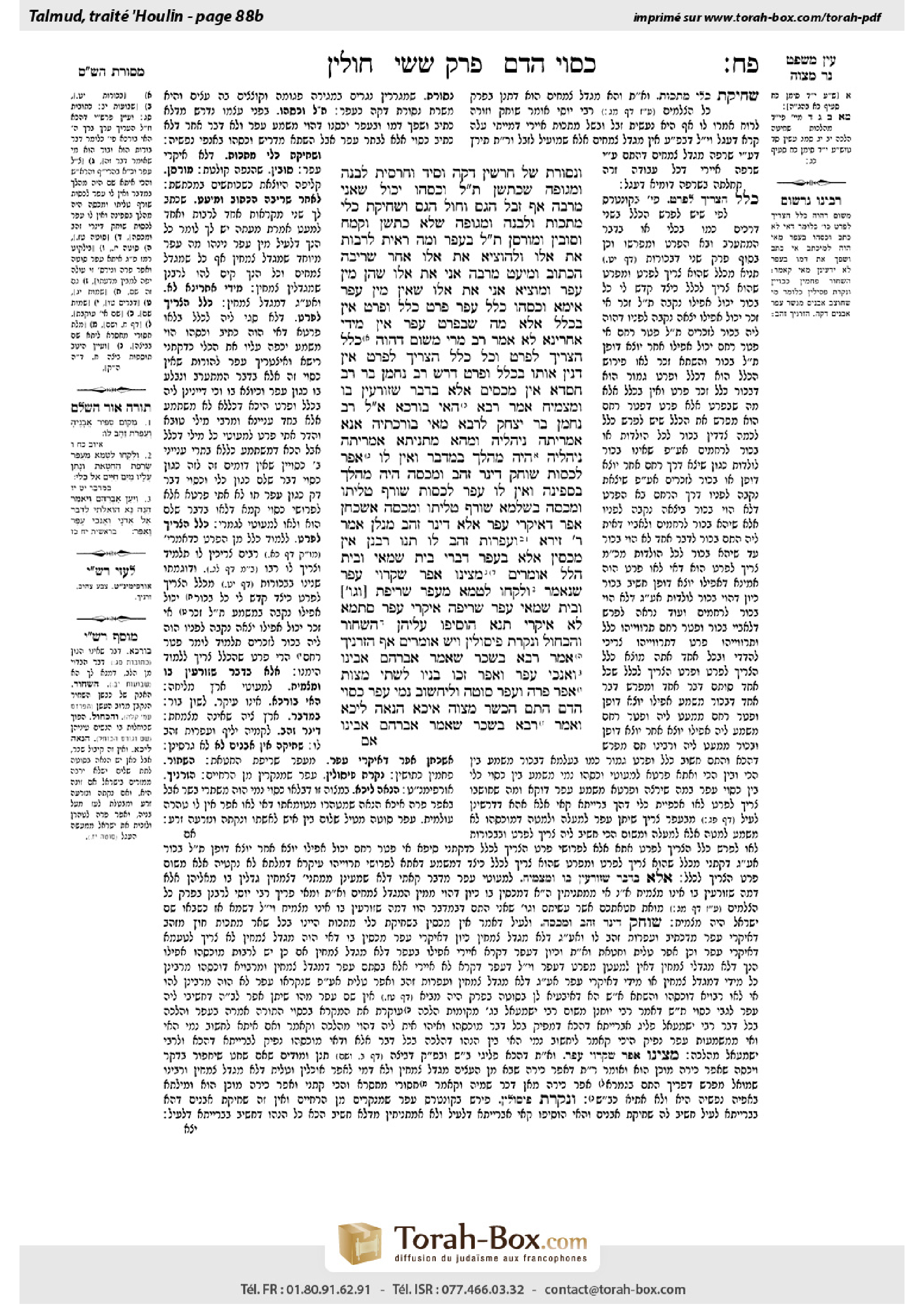
Chullin 88b: Talmud study for Daf Yomi
Study the Talmud for Daf Yomi with scanned pages, Hebrew text, English translations from Sefaria and AI-generated French translations.
Passage selection and English or AI-generated French translation are available where the scan has annotations. Daf Study is independent of Torah-Box and Sefaria.
Browse Chullin · חולין · All tractatesChullin 88b text and translations
This page of Chullin includes the Aramaic text, an English translation and an AI-generated French translation, alongside the scan above.
חולין פ״ח ב · Aramaic and Hebrew text
וּנְסוֹרֶת שֶׁל חָרָשִׁין דַּקָּה, וְסִיד, וְחַרְסִית לְבָנָה וּמְגוּפָה שֶׁכְּתָשָׁן? תַּלְמוּד לוֹמַר: ״וְכִסָּהוּ״. יָכוֹל שֶׁאֲנִי מְרַבֶּה אַף זֶבֶל הַגַּס, וְחוֹל הַגַּס, וּשְׁחִיקַת כְּלֵי מַתָּכוֹת, וּלְבֵנָה וּמְגוּפָה שֶׁלֹּא כְּתָשָׁן, וְקֶמַח, וְסוּבִּין, וּמוּרְסָן? תַּלְמוּד לוֹמַר: ״בֶּעָפָר״.
וּמָה רָאִיתָ לְרַבּוֹת אֶת אֵלּוּ וּלְהוֹצִיא אֶת אֵלּוּ? אַחַר שֶׁרִיבָּה הַכָּתוּב וּמִיעֵט, מְרַבֶּה אֲנִי אֶת אֵלּוּ שֶׁהֵן מִין עָפָר, וּמוֹצִיא אֲנִי אֶת אֵלּוּ שֶׁאֵינָן מִין עָפָר.
אֵימָא: ״וְכִסָּהוּ״ – כָּלַל, ״עָפָר״ – פָּרַט, כְּלָל וּפְרָט – אֵין בַּכְּלָל אֶלָּא מַה שֶּׁבַּפְּרָט, עָפָר – אִין, מִידֵּי אַחֲרִינָא – לָא!
אָמַר רַב מָרִי: מִשּׁוּם דְּהָוֵה כְּלָל הַצָּרִיךְ לִפְרָט, וְכׇל כְּלָל הַצָּרִיךְ לִפְרָט – אֵין דָּנִין אוֹתוֹ בִּכְלָל וּפְרָט.
דָּרַשׁ רַב נַחְמָן בַּר רַב חִסְדָּא: אֵין מְכַסִּים אֶלָּא בְּדָבָר שֶׁזּוֹרְעִין בּוֹ וּמַצְמִיחַ. אָמַר רָבָא: הַאי בּוּרְכָא!
אֲמַר לֵיהּ רַב נַחְמָן בַּר יִצְחָק לְרָבָא: מַאי בּוּרְכָתֵיהּ? אֲנָא אַמְרִיתַהּ נִיהֲלֵיהּ, וּמֵהָא מַתְנִיתָא אַמְרִיתַהּ נִיהֲלֵיהּ: הָיָה מְהַלֵּךְ בַּמִּדְבָּר, וְאֵין לוֹ אֵפֶר לְכַסּוֹת – שׁוֹחֵק דִּינַר זָהָב וּמְכַסֶּה. הָיָה מְהַלֵּךְ בִּסְפִינָה, וְאֵין לוֹ עָפָר לְכַסּוֹת – שׂוֹרֵף טַלִּיתוֹ וּמְכַסֶּה.
בִּשְׁלָמָא שׂוֹרֵף טַלִּיתוֹ וּמְכַסֶּה, אַשְׁכְּחַן אֵפֶר דְּאִיקְּרִי עָפָר, אֶלָּא דִּינַר זָהָב מְנָלַן? אָמַר רַבִּי זֵירָא: ״וְעַפְרוֹת זָהָב לוֹ״.
תָּנוּ רַבָּנַן: אֵין מְכַסִּין אֶלָּא בְּעָפָר, דִּבְרֵי בֵּית שַׁמַּאי. וּבֵית הִלֵּל אוֹמְרִים: מָצִינוּ אֵפֶר שֶׁקָּרוּי עָפָר, שֶׁנֶּאֱמַר ״וְלָקְחוּ לַטָּמֵא מֵעֲפַר שְׂרֵיפַת״. וּבֵית שַׁמַּאי: עֲפַר שְׂרֵיפָה אִיקְּרִי, עָפָר סְתָמָא לָא אִיקְּרִי.
תָּנָא: הוֹסִיפוּ עֲלֵיהֶן הַשְּׁחוֹר, וְהַכְּחוֹל, וְנִקְרַת פִּיסּוּלִין, וְיֵשׁ אוֹמְרִים: אַף הַזַּרְנִיךְ.
אָמַר רָבָא: בִּשְׂכַר שֶׁאָמַר אַבְרָהָם אָבִינוּ ״וְאָנֹכִי עָפָר וָאֵפֶר״, זָכוּ בָּנָיו לִשְׁתֵּי מִצְוֹת: אֵפֶר פָּרָה, וַעֲפַר סוֹטָה.
וְלִיחְשׁוֹב נָמֵי עֲפַר כִּסּוּי הַדָּם? הָתָם הֶכְשֵׁר מִצְוָה אִיכָּא, הֲנָאָה לֵיכָּא.
וְאָמַר רָבָא: בִּשְׂכַר שֶׁאָמַר אַבְרָהָם אָבִינוּ
Chullin 88b · English translation
fine sawdust of carpenters, lime, crushed potsherd, and a brick or the lid of an earthenware barrel that one crushed? The verse states: “And cover it,” i.e., with any substance. One might have thought that I will include even thick manure, and thick sand, filings of metal vessels, a brick or a lid that one did not crush, flour, bran, and coarse bran. Therefore, the verse states: “And cover it with earth,” indicating that not all substances may be used to cover the blood.
The Gemara asks: And what did you see that led you to include these substances and to exclude those? The Gemara responds: After noting that the verse included certain substances with the term: “And cover it,” and excluded others with the term: “With earth,” I include these substances, e.g., fine sand, which are a type of earth in which plants grow, and I exclude those substances, e.g., thick sand, which are not a type of earth, as plants do not grow in them.
The Gemara asks: Why must the verse be interpreted in this manner? Say that the term: “And cover it,” is a generalization, and the term: “With earth,” is a detail. Consequently, the verse constitutes a generalization and a detail, and according to the corresponding hermeneutical principle, the generalization includes only what is mentioned explicitly in the detail. Therefore, only earth may be used to cover the blood, while any other substance, even substances in which plants grow, may not be used.
Rav Mari said in response: One should not suggest such an interpretation because the term “and cover it” is a generalization that requires a detail to clarify its nature, and any generalization that requires a detail to clarify its nature is not interpreted by the hermeneutical principle of a generalization and a detail. It is necessary for the verse to state that the blood must be covered with earth in order to clarify that the mitzva of covering the blood is such that the blood must be covered with a substance that will absorb the blood, and that it does not suffice to place a vessel over it.
§ Rav Naḥman bar Rav Ḥisda taught: One may not cover the blood of an undomesticated animal or a bird except with a substance in which seed is sown and sprouts. Rava said: This is an absurdity [burkha], as the mishna and baraita both teach that one may use substances in which seeds do not sprout.
Rav Naḥman bar Yitzḥak said to Rava: What is the absurdity of his statement? I said this statement to Rav Naḥman bar Rav Ḥisda and I said it to him from this baraita: If one is traveling in the desert, where the earth is not arable, and wishes to slaughter an undomesticated animal or a bird, but he does not have ashes with which to cover the blood, he may grind a gold dinar into powder and cover the blood with it. If one is traveling on a ship and wants to slaughter an undomesticated animal or a bird but he does not have earth with which to cover the blood, he may burn his garment and cover the blood with the ashes. It is evident from the first clause of the baraita that desert sand, which does not allow for the sprouting of seeds, may not be used to cover the blood of an undomesticated animal or a bird.
The Gemara analyzes the baraita: Granted, it is understood that one may burn his garment and cover the blood with the ashes, since we found a source for the fact that ashes are called earth [afar], as the Gemara will soon prove; accordingly, the use of ashes is in accordance with the verse: “And cover it with earth.” But with regard to a gold dinar, from where do we derive that one may grind it into powder and use it to cover the blood? Rabbi Zeira said: The verse states: “And it has dust of [afrot] gold” (Job 28:6), indicating that gold is referred to as dust.
The Gemara cites a related baraita in which the Sages taught: One may not cover the blood of an undomesticated animal or a bird except with earth; this is the statement of Beit Shammai. And Beit Hillel say: We find that ashes are called dust [afar], as it is stated with regard to the red heifer: “And for the impure they shall take from the ashes [me’afar] of the burning of the purification from sin” (Numbers 19:17). And Beit Shammai respond: Ashes are called dust of the burning [afar sereifa], but they are not called ordinary dust [afar].
The Gemara notes: It is taught that the Sages added the following to the list of substances in the mishna with which one may cover the blood: Coal dust, stibium [keḥol], and shavings from chiseling. And some say they included even arsenic [zarnikh].
§ The Gemara cites aggadic accounts relating to the mitzva of covering the blood: Rava says: As reward for that which our Patriarch Abraham said: “And I am but dust [afar] and ashes” (Genesis 18:27), his children merited two mitzvot: The ashes of the red heifer (see Numbers, chapter 19) and the dust of the sota, i.e., dirt taken from the ground of the Tabernacle that is mixed into the water that examines whether or not a woman committed adultery (see Numbers 5:17).
The Gemara challenges: But let Rava also consider the earth used in the mitzva of covering the blood. The Gemara responds: There, the earth does serve as an accessory to the mitzva of covering the blood, but there is no benefit imparted by it. It occurs after the animal has been slaughtered and does not itself render the meat fit for consumption. By contrast, the ashes of the red heifer and the dust of the sota provide benefit, as the former purifies one who became ritually impure and the latter leads to peace between husband and wife when drinking the water proves that she did not commit adultery.
And Rava says: As reward for that which our Patriarch Abraham said to the king of Sodom:
Chullin 88b · Traduction française (IA)
du fin du bois de charpentier, de la chaux, des débris de poterie écrasés, d’un briquet ou du couvercle d’un tonneau en terre que l’on a écrasé ? La Sainte Écriture dit : « Et couvre-le », c’est-à-dire avec n’importe quelle substance. On aurait pu penser que je dois inclure même l’engrais épais, le sable épais, les copeaux de vases métalliques, un briquet ou un couvercle que l’on n’a pas écrasé, la farine, les épluchures de blé, et les épluchures grossières. C’est pourquoi la Sainte Écriture dit : « Et couvre-le avec la terre », indiquant que toutes les substances ne peuvent pas être utilisées pour couvrir le sang.
Le Guemara demande : Et qu’est-ce que tu as vu qui t’a conduit à inclure ces substances et à exclure celles-là ? Le Guemara répond : Après avoir noté que la Sainte Écriture inclut certaines substances avec le terme : « Et couvre-le », et exclut d’autres avec le terme : « Avec la terre », je inclure ces substances, par exemple le sable fin, qui sont un type de terre dans laquelle les plantes poussent, et je exclure celles-ci, par exemple le sable épais, qui ne sont pas un type de terre, car les plantes n’y poussent pas.
Le Guemara demande : Pourquoi doit-on interpréter la Sainte Écriture ainsi ? Dis que le terme : « Et couvre-le », est une généralisation, et le terme : « Avec la terre », est un détail. Ainsi, la Sainte Écriture constitue une généralisation et un détail, et selon le principe herméneutique correspondant, la généralisation inclut uniquement ce qui est mentionné explicitement dans le détail. Ainsi, seule la terre peut être utilisée pour couvrir le sang, tandis que toute autre substance, même celles dans lesquelles les plantes poussent, ne peut pas être utilisée.
Rav Mari dit en réponse : On ne devrait pas suggérer une telle interprétation, car le terme « et couvre-le » est une généralisation qui nécessite un détail pour clarifier sa nature, et toute généralisation qui nécessite un détail pour clarifier sa nature n’est pas interprétée par le principe herméneutique de la généralisation et du détail. Il est nécessaire que la Sainte Écriture stipule que le sang doit être couvert avec la terre afin de clarifier que la mitsva de couvrir le sang est telle que le sang doit être couvert avec une substance qui absorbe le sang, et qu’il ne suffit pas de placer un récipient dessus.
§ Rav Naḥman bar Rav Ḥisda enseigna : On ne peut pas couvrir le sang d’un animal sauvage ou d’un oiseau à moins d’utiliser une substance dans laquelle les graines sont semées et poussent. Rava dit : C’est une absurdité [burkha], car la mishna et la baraïta enseignent tous deux que l’on peut utiliser des substances dans lesquelles les graines ne poussent pas.
Rav Naḥman bar Yitzḥak dit à Rava : Quelle est l’absurdité de son affirmation ? J’ai dit cette affirmation à Rav Naḥman bar Rav Ḥisda et je l’ai dite à lui à partir de cette baraïta : Si l’on voyage dans le désert, où la terre n’est pas cultivable, et qu’on veut sacrifier un animal sauvage ou un oiseau, mais qu’on n’a pas de cendres avec lesquelles couvrir le sang, on peut broyer un dinar d’or en poudre et couvrir le sang avec cela. Si l’on voyage sur un bateau et qu’on veut sacrifier un animal sauvage ou un oiseau mais qu’on n’a pas de terre avec laquelle couvrir le sang, on peut brûler son vêtement et couvrir le sang avec les cendres. Il est évident de la première clause de la baraïta que le sable du désert, qui ne permet pas la germination des graines, ne peut pas être utilisé pour couvrir le sang d’un animal sauvage ou d’un oiseau.
Le Guemara examine la baraïta : C’est évident, on comprend que l’on peut brûler son vêtement et couvrir le sang avec les cendres, car nous avons trouvé une source selon laquelle les cendres sont appelées terre [afar], comme le Guemara le prouvera bientôt ; ainsi, l’utilisation des cendres est conforme à la Sainte Écriture : « Et couvre-le avec la terre ». Mais concernant le dinar d’or, d’où tirons-nous que l’on peut le broyer en poudre et l’utiliser pour couvrir le sang ? Rabbi Zeira dit : La Sainte Écriture dit : « Et il a la poussière d’or [afrot] » (Job 28:6), indiquant que l’or est appelé poussière.
Le Guemara cite une autre baraïta liée, dans laquelle les Sages enseignèrent : On ne peut pas couvrir le sang d’un animal sauvage ou d’un oiseau à moins d’utiliser la terre ; c’est l’affirmation de Beit Shammai. Et Beit Hillel disent : Nous trouvons que les cendres sont appelées poussière [afar], comme il est dit concernant la vache rouge : « Et pour les impurs, ils prendront de la poussière [me’afar] des cendres du brûlement de la purification du péché » (Nombres 19:17). Et Beit Shammai répondent : Les cendres sont appelées poussière du brûlement [afar sereifa], mais elles ne sont pas appelées poussière ordinaire [afar].
Le Guemara note : Il est enseigné que les Sages ont ajouté à la liste des substances de la mishna avec lesquelles l’on peut couvrir le sang : la poussière de charbon, le stibium [keḥol], et les copeaux de taille. Et certains disent qu’ils ont inclus même l’arsenic [zarnikh].
§ Le Guemara cite des récits aggadiques relatifs à la mitsva de couvrir le sang : Rava dit : En récompense de ce que notre patriarche Abraham a dit : « Et je suis seulement poussière et cendres » (Genèse 18:27), ses enfants ont mérité deux mitsvot : les cendres de la vache rouge (voir Nombres, chapitre 19) et la poussière de la sota, c’est-à-dire la terre prise du sol du Tabernacle mélangée à l’eau qui examine si une femme a commis l’adultère (voir Nombres 5:17).
Le Guemara conteste : Mais laisse Rava aussi considérer la terre utilisée dans la mitsva de couvrir le sang. Le Guemara répond : Là, la terre sert d’accessoire à la mitsva de couvrir le sang, mais elle ne procure pas de bénéfice. Elle se produit après que l’animal a été sacrifié et ne rend pas la viande comestible. En revanche, les cendres de la vache rouge et la poussière de la sota procurent un bénéfice, car la première purifie celui qui est devenu impur et la seconde mène à la paix entre mari et femme lorsqu’on boit l’eau et qu’on découvre qu’elle n’a pas commis l’adultère.
Et Rava dit : En récompense de ce que notre patriarche Abraham a dit au roi de Sodom :
Traduction française générée par IA à partir de l’édition anglaise de Sefaria. Vérifie toujours un passage avec le texte source.
Text from Sefaria: William Davidson Edition - Vocalized Aramaic (unknown); William Davidson Edition - English (CC BY NC).