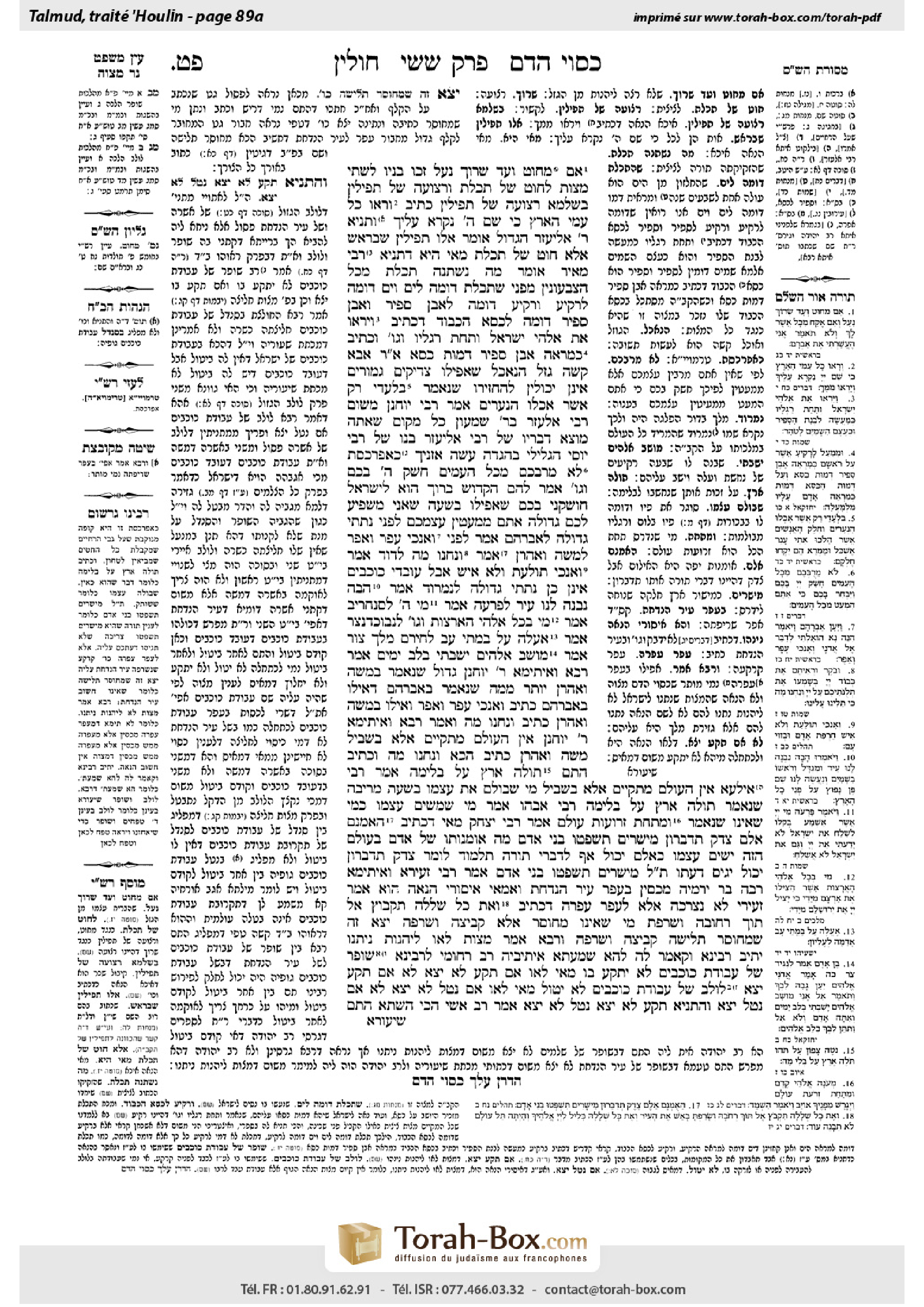
Chullin 89a: Talmud study for Daf Yomi
Study the Talmud for Daf Yomi with scanned pages, Hebrew text, English translations from Sefaria and AI-generated French translations.
Passage selection and English or AI-generated French translation are available where the scan has annotations. Daf Study is independent of Torah-Box and Sefaria.
Browse Chullin · חולין · All tractatesChullin 89a text and translations
This page of Chullin includes the Aramaic text, an English translation and an AI-generated French translation, alongside the scan above.
חולין פ״ט א · Aramaic and Hebrew text
״אִם מִחוּט וְעַד שְׂרוֹךְ נַעַל״, זָכוּ בָּנָיו לִשְׁתֵּי מִצְוֹת: לְחוּט שֶׁל תְּכֵלֶת, וּרְצוּעָה שֶׁל תְּפִילִּין.
בִּשְׁלָמָא רְצוּעָה שֶׁל תְּפִילִּין, כְּתִיב: ״וְרָאוּ כׇּל עַמֵּי הָאָרֶץ כִּי שֵׁם ה׳ נִקְרָא עָלֶיךָ״, וְתַנְיָא: רַבִּי אֱלִיעֶזֶר הַגָּדוֹל אוֹמֵר: אֵלּוּ תְּפִילִּין שֶׁבָּרֹאשׁ, אֶלָּא חוּט שֶׁל תְּכֵלֶת מַאי הִיא?
דְּתַנְיָא, רַבִּי מֵאִיר אוֹמֵר: מָה נִשְׁתַּנָּה תְּכֵלֶת מִכׇּל הַצִּבְעוֹנִין? מִפְּנֵי שֶׁתְּכֵלֶת דּוֹמֶה לַיָּם, וְיָם דּוֹמֶה לָרָקִיעַ, וְרָקִיעַ דּוֹמֶה לְאֶבֶן סַפִּיר, וְאֶבֶן סַפִּיר דּוֹמֶה לְכִסֵּא הַכָּבוֹד, דִּכְתִיב: ״וַיִּרְאוּ אֵת אֱלֹהֵי יִשְׂרָאֵל וְתַחַת רַגְלָיו וְגוֹ׳״, וּכְתִיב: ״כְּמַרְאֵה אֶבֶן סַפִּיר דְּמוּת כִּסֵּא״.
אָמַר רַבִּי אַבָּא: קָשֶׁה גָּזֵל הַנֶּאֱכָל, שֶׁאֲפִילּוּ צַדִּיקִים גְּמוּרִים אֵינָן יְכוֹלִין לְהַחְזִירוֹ, שֶׁנֶּאֱמַר: ״בִּלְעָדַי רַק אֲשֶׁר אָכְלוּ הַנְּעָרִים״.
אָמַר רַבִּי יוֹחָנָן מִשּׁוּם רַבִּי אֶלְעָזָר בְּרַבִּי שִׁמְעוֹן: כׇּל מָקוֹם שֶׁאַתָּה מוֹצֵא דְּבָרָיו שֶׁל רַבִּי אֱלִיעֶזֶר בְּנוֹ שֶׁל רַבִּי יוֹסֵי הַגְּלִילִי בַּהַגָּדָה – עֲשֵׂה אׇזְנֶיךָ כַּאֲפַרְכֶּסֶת. ״לֹא מֵרֻבְּכֶם מִכׇּל הָעַמִּים חָשַׁק ה׳ בָּכֶם וְגוֹ׳״ – אָמַר לָהֶם הַקָּדוֹשׁ בָּרוּךְ הוּא לְיִשְׂרָאֵל: חוֹשְׁקַנִי בָּכֶם, שֶׁאֲפִילּוּ בְּשָׁעָה שֶׁאֲנִי מַשְׁפִּיעַ לָכֶם גְּדוּלָּה – אַתֶּם מְמַעֲטִין עַצְמְכֶם לְפָנַי.
נָתַתִּי גְּדוּלָּה לְאַבְרָהָם – אָמַר לְפָנַי: ״וְאָנֹכִי עָפָר וָאֵפֶר״, לְמֹשֶׁה וְאַהֲרֹן – אָמַר: ״וְנַחְנוּ מָה״, לְדָוִד – אָמַר: ״וְאָנֹכִי תוֹלַעַת וְלֹא אִישׁ״.
אֲבָל אוּמּוֹת הָעוֹלָם אֵינָן כֵּן, נָתַתִּי גְּדוּלָּה לְנִמְרוֹד – אָמַר: ״הָבָה נִבְנֶה לָּנוּ עִיר״, לְפַרְעֹה – אָמַר: ״מִי ה׳״, לְסַנְחֵרִיב – אָמַר: ״מִי בְּכׇל אֱלֹהֵי הָאֲרָצוֹת וְגוֹ׳״, לִנְבוּכַדְנֶצַּר – אָמַר: ״אֶעֱלֶה עַל בָּמֳתֵי עָב״, לְחִירָם מֶלֶךְ צוֹר – אָמַר: ״מוֹשַׁב אֱלֹהִים יָשַׁבְתִּי בְּלֵב יַמִּים״.
אָמַר רָבָא, וְאִיתֵּימָא רַבִּי יוֹחָנָן: גָּדוֹל שֶׁנֶּאֱמַר בְּמֹשֶׁה וְאַהֲרֹן יוֹתֵר מִמַּה שֶּׁנֶּאֱמַר בְּאַבְרָהָם, דְּאִילּוּ בְּאַבְרָהָם כְּתִיב: ״וְאָנֹכִי עָפָר וָאֵפֶר״, וְאִילּוּ בְּמֹשֶׁה וְאַהֲרֹן כְּתִיב: ״וְנַחְנוּ מָה״. וְאָמַר רָבָא, וְאִיתֵּימָא רַבִּי יוֹחָנָן: אֵין הָעוֹלָם מִתְקַיֵּים אֶלָּא בִּשְׁבִיל מֹשֶׁה וְאַהֲרֹן, כְּתִיב הָכָא: ״וְנַחְנוּ מָה״, וּכְתִיב הָתָם: ״תּוֹלֶה אָרֶץ עַל בְּלִימָה״.
אָמַר רַבִּי אִילְעָא: אֵין הָעוֹלָם מִתְקַיֵּים אֶלָּא בִּשְׁבִיל מִי שֶׁבּוֹלֵם אֶת עַצְמוֹ בִּשְׁעַת מְרִיבָה, שֶׁנֶּאֱמַר: ״תּוֹלֶה אֶרֶץ עַל בְּלִימָה״. רַבִּי אֲבָהוּ אָמַר: מִי שֶׁמֵּשִׂים עַצְמוֹ כְּמִי שֶׁאֵינוֹ, שֶׁנֶּאֱמַר: ״וּמִתַּחַת זְרוֹעוֹת עוֹלָם״.
אָמַר רַבִּי יִצְחָק: מַאי דִּכְתִיב ״הַאֻמְנָם אֵלֶם צֶדֶק תְּדַבֵּרוּן מֵישָׁרִים תִּשְׁפְּטוּ בְּנֵי אָדָם״? מָה אוּמָּנוּתוֹ שֶׁל אָדָם בָּעוֹלָם הַזֶּה – יָשִׂים עַצְמוֹ כְּאִלֵּם. יָכוֹל אַף לְדִבְרֵי תוֹרָה? תַּלְמוּד לוֹמַר ״צֶדֶק תְּדַבֵּרוּן״. יָכוֹל יָגִיס דַּעְתּוֹ? תַּלְמוּד לוֹמַר ״מֵישָׁרִים תִּשְׁפְּטוּ בְּנֵי אָדָם״.
אָמַר רַבִּי זְעֵירָא, וְאִיתֵּימָא רַבָּה בַּר יִרְמְיָה: מְכַסִּין בַּעֲפַר עִיר הַנִּדַּחַת. וְאַמַּאי? אִיסּוּרֵי הֲנָאָה הוּא!
אָמַר זְעֵירִי: לֹא נִצְרְכָה אֶלָּא לַעֲפַר עֲפָרָהּ, דִּכְתִיב: ״וְאֶת כׇּל שְׁלָלָהּ תִּקְבֹּץ אֶל תּוֹךְ רְחֹבָהּ וְשָׂרַפְתָּ״, מִי שֶׁאֵינוֹ מְחוּסָּר אֶלָּא קְבִיצָה וּשְׂרֵפָה, יָצָא זֶה שֶׁמְחוּסָּר תְּלִישָׁה, קְבִיצָה וּשְׂרֵפָה.
וְרָבָא אָמַר: מִצְוֹת לָאו לֵיהָנוֹת נִיתְּנוּ.
יָתֵיב רָבִינָא וְקָאָמַר לַהּ לְהָא שְׁמַעְתָּא, אֵיתִיבֵיהּ רַב רְחוּמִי לְרָבִינָא: שׁוֹפָר שֶׁל עֲבוֹדָה זָרָה לֹא יִתְקַע בּוֹ. מַאי לָאו, אִם תָּקַע לֹא יָצָא? לָא, אִם תָּקַע יָצָא.
לוּלָב שֶׁל עֲבוֹדָה זָרָה לֹא יִטּוֹל. מַאי לָאו, אִם נָטַל לֹא יָצָא? לָא, אִם נָטַל יָצָא. וְהָתַנְיָא: תָּקַע לֹא יָצָא, נָטַל לֹא יָצָא!
אָמַר רַב אָשֵׁי: הָכִי הַשְׁתָּא? הָתָם
Chullin 89a · English translation
“That I will not take a thread nor a shoe strap nor anything that is yours” (Genesis 14:23), distancing himself from anything not rightfully his, his children merited two mitzvot: The thread of sky-blue wool worn on ritual fringes and the strap of phylacteries.
The Gemara asks: Granted, the strap of the phylacteries imparts benefit, as it is written: “And all the peoples of the earth shall see that the name of the Lord is called upon you; and they shall be afraid of you” (Deuteronomy 28:10). And it is taught in a baraita that Rabbi Eliezer the Great says: This is a reference to the phylacteries of the head, upon which the name of God is written. Phylacteries therefore impart the splendor and grandeur of God and are a fit reward. But what is the benefit imparted by the thread of sky-blue wool?
The Gemara answers: As it is taught in a baraita that Rabbi Meir would say: What is different about sky-blue from all other colors such that it was specified for the mitzva of ritual fringes? It is because sky-blue dye is similar in its color to the sea, and the sea is similar to the sky, and the sky is similar to the sapphire stone, and the sapphire stone is similar to the Throne of Glory, as it is stated: “And they saw the God of Israel; and there was under His feet the like of a paved work of sapphire stone, and the like of the very heaven for clearness” (Exodus 24:10). This verse shows that the heavens are similar to sapphire, and it is written: “And above the firmament that was over their heads was the likeness of a throne, as the appearance of a sapphire stone” (Ezekiel 1:26). Therefore, the throne is similar to the heavens. The color of sky blue dye acts as an indication of the bond between the Jewish people and the Divine Presence.
The Gemara above mentioned that Abraham refused to accept property that did not belong to him. With regard to this, Rabbi Abba says: Difficult is the return of theft that has been consumed, as even the perfectly righteous are unable to return it, as it is stated: “That I will not take a thread nor a shoe strap nor anything that is yours…except only that which the young men have eaten with me” (Genesis 14:23–24). Even the righteous Abraham was unable to return that which the young men had already consumed.
§ Rabbi Yoḥanan says in the name of Rabbi Elazar, son of Rabbi Shimon: Any place where you find the statements of Rabbi Eliezer, son of Rabbi Yosei HaGelili, in reference to aggada, make your ears like a funnel [ka’afarkeset], i.e., be receptive to his words. As Rabbi Eliezer interpreted the verse: “Not because you are more in number than any people did the Lord desire you and choose you, for you were the fewest of all peoples” (Deuteronomy 7:7), as follows: The Holy One, Blessed be He, said to the Jewish people: I desire you, since even at a time that I bestow greatness upon you, you diminish, i.e., humble, yourselves before Me.
I granted greatness to Abraham, yet he said before Me: “And I am but dust and ashes” (Genesis 18:27). I granted greatness to Moses and Aaron, yet Moses said of the two of them: “And what are we” (Exodus 16:7). I granted greatness to David, yet he said: “But I am a worm, and no man” (Psalms 22:7).
But the gentile nations of the world are not so. I granted greatness to Nimrod, yet he said: “Come, let us build a city and a tower, with its top in heaven, and let us make for ourselves a name” (Genesis 11:4). I granted greatness to Pharaoh, yet he said: “Who is the Lord” (Exodus 5:2). I granted greatness to Sennacherib, yet he said: “Who are they among all the gods of the countries that have delivered their country out of my hand, that the Lord should deliver Jerusalem out of my hand” (II Kings 18:35). I granted greatness to Nebuchadnezzar, yet he said: “I will ascend above the heights of the clouds” (Isaiah 14:14). I granted greatness to Ḥiram, king of Tyre, yet he said: “I sit in the seat of God, in the heart of the seas” (Ezekiel 28:2).
The Gemara relates: Rava says, and some say Rabbi Yoḥanan says: Greater is that which is stated with regard to Moses and Aaron than that which is stated with regard to Abraham. As with regard to Abraham it is written: “And I am but dust and ashes,” while with regard to Moses and Aaron it is written: “And what are we,” i.e., we are not even dust and ashes. And Rava says, and some say Rabbi Yoḥanan says: The world endures only in the merit of Moses and Aaron. It is written here: “And what are we,” and it written elsewhere: “He hangs the earth upon nothing” (Job 26:7). That is, the earth endures in the merit of those who said of themselves that they are nothing, i.e., Moses and Aaron.
With regard to that verse, Rabbi Ile’a says: The world endures only in the merit of one who restrains [shebolem] himself during a quarrel, as it is stated: “He hangs the earth upon nothing [belima]. Rabbi Abbahu says: The world endures only in the merit of one who renders himself as if he were non-existent, as it is stated: “And underneath are the everlasting arms” (Deuteronomy 33:27), i.e., one who considers himself to be underneath everything else is the everlasting arm that upholds the world.
Rabbi Yitzḥak says: What is the meaning of that which is written: “Do you indeed [ha’umnam] speak as a righteous company [elem]? Do you judge with equity [meisharim] the sons of men” (Psalms 58:2)? The verse is interpreted as follows: What should be a person’s occupation [umanut] in this world? He should render himself silent as a mute [ilem]. If so, one might have thought that he should render himself as a mute even with regard to words of Torah. Therefore, the verse states: “Speak as a righteous company,” indicating that one should speak the righteous words of Torah. If so, he might have thought that one who speaks words of Torah has the right to become arrogant. Therefore, the verse states: “Judge with equity [meisharim] the sons of men.” Even a learned judge must take extra care to judge with equity, and not assume that he will immediately arrive at the correct understanding.
§ The Gemara returns to discuss the mitzva of covering the blood: Rabbi Zeira says, and some say Rabba bar Yirmeya says: One may cover the blood of an undomesticated animal or a bird with the dust of an idolatrous city. The Torah states that the city and anything contained therein must be burned (see Deuteronomy 13:17). The Gemara, assuming the statement of Rabbi Zeira refers to the ashes of a burned idolatrous city, asks: But why may one use these ashes to cover the blood? These ashes are items from which deriving benefit is prohibited, as the verse states: “And there shall cleave none of the banned property to your hand” (Deuteronomy 13:18).
Ze’eiri said: Rabbi Zeira is not referring to the ashes of the burned city, which may not be used. Rather, his statement is necessary only concerning the dust of its dust, i.e., the dust of the ground of the idolatrous city, from which deriving benefit is not prohibited, as it is written: “And you shall gather all its spoil into the midst of the broad place thereof, and shall burn with fire the city” (Deuteronomy 13:17). Accordingly, items lacking only the acts of gathering and burning must be burned. This serves to exclude this dust of the ground, which lacks the acts of removal from the ground, gathering, and burning. The dust must also be removed from the ground before it can be gathered and burned.
And Rava says: One can even use the ashes from the idolatrous city to cover the blood, despite the fact that it is prohibited to derive any benefit from them. This is because mitzvot were not given for benefit, that is, the fulfillment of a mitzva is not considered deriving benefit, but the fulfillment of a divine decree.
The Gemara relates that Ravina was sitting and saying this halakha, that one may use the ashes of an idolatrous city to cover the blood. Rav Reḥumi raised an objection to Ravina from a baraita: With regard to a shofar of idol worship, from which it is prohibited to derive benefit, one may not blow with it. What, is it not that the baraita means to say that if one blew with it he has not fulfilled his obligation? The Gemara responds: No, the baraita means that one should not use such a shofar ab initio, but if one blew with it he has fulfilled his obligation.
Rav Reḥumi persists: It is taught in another baraita that with regard to a lulav of idol worship, one may not take it to perform the mitzva. What, is it not that the baraita means to say that if one took such a lulav he has not fulfilled his obligation? The Gemara responds: No, the baraita means that one should not use such a lulav ab initio, but if one took it he has fulfilled his obligation. The Gemara asks: But isn’t it taught in a baraita that if one blew a shofar of idolatry he has not fulfilled his obligation? And isn’t it taught in another baraita that if one took a lulav of idolatry to perform the mitzva he has not fulfilled his obligation?
Rav Ashi said in response: How can these cases be compared to the case of covering the blood? There, with regard to a shofar and lulav of idol worship, although the use of such items for a mitzva does not constitute benefit, one cannot fulfill his obligation with them, because
Chullin 89a · Traduction française (IA)
« Je ne prendrai ni un fil, ni un lacet de chaussure, ni quelque chose qui est à toi » (Genèse 14:23), se distançant de toute chose qui ne lui appartenait pas, ses enfants méritèrent deux mitsvot : le fil de laine bleue porté sur les franges rituelles et le lacet des phylactères.
La Guemara demande : Cela est évident, le lacet des phylactères procure un bénéfice, car il est écrit : « Et tous les peuples de la terre verront que le nom du Seigneur est invoqué sur toi ; et ils craindront toi » (Deutéronome 28:10). Et il est enseigné dans une baraïta que Rabbi Eléazar le Grand dit : cela fait référence aux phylactères de la tête, sur lesquels est écrit le nom de Dieu. Les phylactères procurent donc la splendeur et la grandeur de Dieu et constituent une récompense digne. Mais quels sont les bénéfices procurés par le fil de laine bleue ?
La Guemara répond : Comme il est enseigné dans une baraïta que Rabbi Méir disait : Qu'est-ce qui rend la couleur bleue différente de toutes les autres couleurs, de sorte qu'elle a été spécifiée pour la mitsva des franges rituelles ? C'est parce que la couleur du bleu de laine est semblable à celle de la mer, et la mer est semblable au ciel, et le ciel est semblable à la pierre saphir, et la pierre saphir est semblable au Trône de Gloire, comme il est dit : « Et ils virent Dieu d'Israël ; et sous Ses pieds, il y avait l'aspect d'une place pavée de pierre saphir, et l'aspect du ciel pour la clarté » (Exode 24:10). Cette verset montre que les cieux sont semblables à la pierre saphir, et il est écrit : « Et au-dessus du firmament qui était au-dessus de leurs têtes, il y avait l'aspect d'un trône, comme l'aspect d'une pierre saphir » (Ezéchiel 1:26). Ainsi, le trône est semblable aux cieux. La couleur du bleu de laine agit comme un signe de la relation entre le peuple juif et la Présence divine.
La Guemara mentionne ci-dessus que Abraham refusait de prendre une propriété qui ne lui appartenait pas. À ce sujet, Rabbi Abba dit : C'est difficile de rendre un vol qui a été consommé, car même les justes ne peuvent le rendre, comme il est dit : « Je ne prendrai ni un fil, ni un lacet de chaussure, ni quelque chose qui est à toi… sauf ce que les jeunes hommes ont mangé avec moi » (Genèse 14:23–24). Même le juste Abraham n'était pas capable de rendre ce que les jeunes hommes avaient déjà consommé.
§ Rabbi Yoḥanan dit au nom de Rabbi Eléazar, fils de Rabbi Shimon : Tout lieu où vous trouvez les paroles de Rabbi Eliezer, fils de Rabbi Yosei HaGelili, en ce qui concerne l'aggada, faites que vos oreilles soient comme un entonnoir [ka’afarkeset], c'est-à-dire soyez réceptifs à ses paroles. Comme Rabbi Eliezer interprète la verset : « Ce n'est pas parce que vous êtes plus nombreux que tout peuple que le Seigneur a désiré vous et choisi vous, car vous étiez les moins nombreux de tous les peuples » (Deutéronome 7:7), comme suit : Le Saint, le Très Haut, a dit au peuple juif : Je désire vous, car même à un moment où je vous confère une grandeur, vous vous diminuez, c'est-à-dire vous humiliez, devant Moi.
J'ai conféré une grandeur à Abraham, mais il dit devant Moi : « Et je suis seulement de la poussière et des cendres » (Genèse 18:27). J'ai conféré une grandeur à Moïse et à Aaron, mais Moïse dit des deux d'entre eux : « Et qu'est-ce que nous sommes » (Exode 16:7). J'ai conféré une grandeur à David, mais il dit : « Mais je suis un ver, et personne » (Psaumes 22:7).
Mais les nations païennes du monde ne sont pas ainsi. J'ai conféré une grandeur à Nimrod, mais il dit : « Viens, bâtisons une ville et une tour, dont le sommet touchera au ciel, et faisons-nous un nom » (Genèse 11:4). J'ai conféré une grandeur à Pharaon, mais il dit : « Qui est le Seigneur » (Exode 5:2). J'ai conféré une grandeur à Sennacherib, mais il dit : « Qui sont-ils parmi tous les dieux des pays qui ont sauvé leur pays hors de ma main, que le Seigneur devrait sauver Jérusalem hors de ma main » (II Rois 18:35). J'ai conféré une grandeur à Nebuchadnezzar, mais il dit : « Je monterai au-dessus des hauteurs des nuages » (Isaïe 14:14). J'ai conféré une grandeur à Ḥiram, roi de Tyr, mais il dit : « Je siège sur le trône de Dieu, au milieu des mers » (Ezéchiel 28:2).
La Guemara rapporte : Rava dit, et certains disent Rabbi Yoḥanan dit : Ce qui est dit concernant Moïse et Aaron est plus grand que ce qui est dit concernant Abraham. Comme concernant Abraham il est écrit : « Et je suis seulement de la poussière et des cendres », tandis que concernant Moïse et Aaron il est écrit : « Et qu'est-ce que nous sommes », c'est-à-dire nous ne sommes même pas de la poussière et des cendres. Et Rava dit, et certains disent Rabbi Yoḥanan dit : Le monde subsiste seulement grâce au mérite de Moïse et Aaron. Il est écrit ici : « Et qu'est-ce que nous sommes », et il est écrit ailleurs : « Il suspend la terre sur rien [belima] ». C'est-à-dire la terre subsiste grâce à ceux qui dirent d'eux-mêmes qu'ils étaient rien, c'est-à-dire Moïse et Aaron.
Concernant cette verset, Rabbi Ile’a dit : Le monde subsiste seulement grâce au mérite de celui qui se restreint [shebolem] pendant une querelle, comme il est dit : « Il suspend la terre sur rien [belima]. » Rabbi Abbahu dit : Le monde subsiste seulement grâce au mérite de celui qui se considère comme s'il n'existait pas, comme il est dit : « Et sous sont les bras éternels » (Deutéronome 33:27), c'est-à-dire celui qui considère lui-même comme étant sous tout autre est le bras éternel qui soutient le monde.
Rabbi Yitzḥak dit : Quelle est la signification de ce qui est écrit : « Est-ce que tu parles vraiment comme une compagnie de justes [elem] ? Est-ce que tu juges avec équité [meisharim] les fils des hommes » (Psaumes 58:2) ? La verset est interprétée comme suit : Quel doit être l'occupation [umanut] d'une personne dans ce monde ? Il doit se taire comme un muet [ilem]. Si tel est le cas, on pourrait penser qu'il doit se taire même concernant les paroles de la Torah. Ainsi, la verset dit : « Parle comme une compagnie de justes », indiquant que l'on doit parler les paroles justes de la Torah. Si tel est le cas, on pourrait penser qu'un juge qui parle des paroles de la Torah a le droit d'être arrogant. Ainsi, la verset dit : « Juge avec équité [meisharim] les fils des hommes ». Même un juge instruit doit prendre garde à juger avec équité, et ne pas supposer qu'il arrivera immédiatement à la bonne compréhension.
§ La Guemara reprend la discussion sur la mitsva de couvrir le sang : Rabbi Zeira dit, et certains disent que c'est Rabba bar Yirmeya qui le dit : On peut couvrir le sang d'un animal sauvage ou d'un oiseau avec la poussière d'une ville idolâtre. La Torah stipule que la ville et tout ce qu'elle contient doit être brûlé (cf. Deutéronome 13 : 17). La Guemara, supposant que la déclaration de Rabbi Zeira fait référence aux cendres d'une ville idolâtre brûlée, demande : Mais pourquoi peut-on utiliser ces cendres pour couvrir le sang ? Ces cendres sont des objets dont l'usage pour le bénéfice est interdit, car la Parashah dit : « Et aucun des objets interdits ne doit rester en votre main » (Deutéronome 13 : 18).
Ze’eiri dit : Rabbi Zeira ne fait pas référence aux cendres de la ville brûlée, qui ne peuvent pas être utilisées. Plutôt, sa déclaration est nécessaire uniquement concernant la poussière du sol de la ville idolâtre, dont l'usage pour le bénéfice n'est pas interdit, car il est écrit : « Et tu rassembleras toutes ses dépouilles au milieu de la place large, et tu brûleras la ville avec le feu » (Deutéronome 13 : 17). Ainsi, les objets manquant uniquement des actes de rassemblement et de brûlement doivent être brûlés. Cela sert à exclure cette poussière du sol, qui manque des actes de retrait du sol, de rassemblement et de brûlement. La poussière doit également être retirée du sol avant qu'elle ne puisse être rassemblée et brûlée.
Et Rava dit : On peut même utiliser les cendres de la ville idolâtre pour couvrir le sang, malgré le fait que l'usage de ces cendres est interdit. Cela est dû au fait que les mitsvot ne sont pas données pour le bénéfice, c'est-à-dire que l'accomplissement d'une mitsva n'est pas considéré comme un bénéfice, mais l'accomplissement d'un décret divin.
La Guemara rapporte que Ravina était assis et disait cette halakha, à savoir qu'on peut utiliser les cendres d'une ville idolâtre pour couvrir le sang. Rav Reḥumi a soulevé une objection contre Ravina à partir d'une baraïta : Concernant un cor d'idolâtrie, dont l'usage pour le bénéfice est interdit, on ne peut pas souffler avec. Qu'est-ce que cela ne signifie pas que la baraïta veut dire que si l'on a soufflé avec, on n'a pas accompli son obligation ? La Guemara répond : Non, la baraïta veut dire qu'on ne devrait pas utiliser de tel cor dès le début, mais si l'on a soufflé avec, on a accompli son obligation.
Rav Reḥumi persiste : Il est enseigné dans une autre baraïta que concernant un lulav d'idolâtrie, on ne peut pas le prendre pour accomplir la mitsva. Qu'est-ce que cela ne signifie pas que la baraïta veut dire que si l'on a pris un tel lulav, on n'a pas accompli son obligation ? La Guemara répond : Non, la baraïta veut dire qu'on ne devrait pas utiliser un tel lulav dès le début, mais si l'on l'a pris, on a accompli son obligation. La Guemara demande : Mais n'est-il pas enseigné dans une baraïta que si l'on a soufflé un cor d'idolâtrie, on n'a pas accompli son obligation ? Et n'est-il pas enseigné dans une autre baraïta que si l'on a pris un lulav d'idolâtrie pour accomplir la mitsva, on n'a pas accompli son obligation ?
Rav Ashi a répondu : Comment ces cas peuvent-ils être comparés au cas de couvrir le sang ? Là, concernant un cor et un lulav d'idolâtrie, bien que l'usage de tels objets pour une mitsva ne constitue pas un bénéfice, on ne peut pas accomplir son obligation avec eux, car
Traduction française générée par IA à partir de l’édition anglaise de Sefaria. Vérifie toujours un passage avec le texte source.
Text from Sefaria: William Davidson Edition - Vocalized Aramaic (unknown); William Davidson Edition - English (CC BY NC).