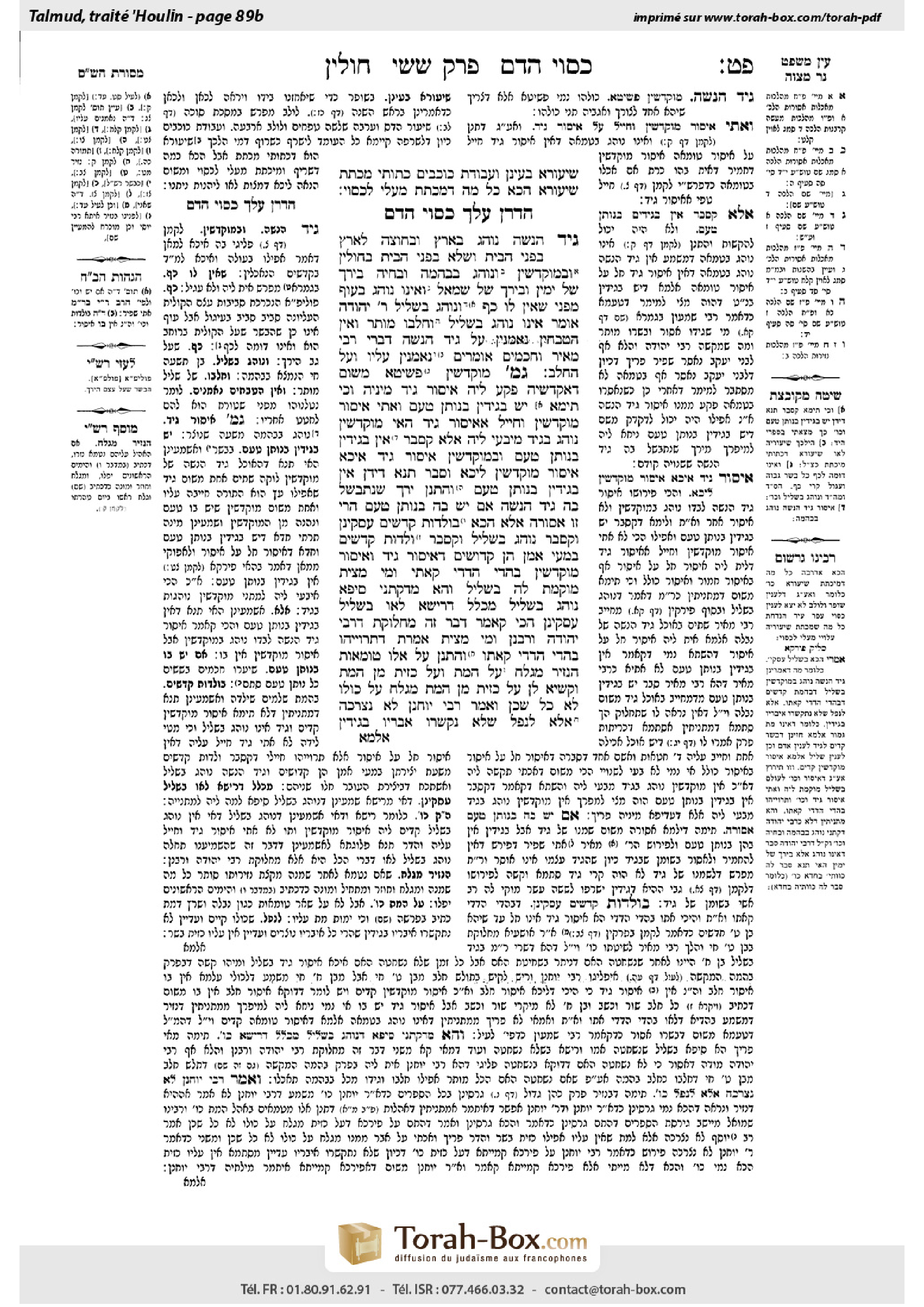
Chullin 89b: Talmud study for Daf Yomi
Study the Talmud for Daf Yomi with scanned pages, Hebrew text, English translations from Sefaria and AI-generated French translations.
Passage selection and English or AI-generated French translation are available where the scan has annotations. Daf Study is independent of Torah-Box and Sefaria.
Browse Chullin · חולין · All tractatesChullin 89b text and translations
This page of Chullin includes the Aramaic text, an English translation and an AI-generated French translation, alongside the scan above.
חולין פ״ט ב · Aramaic and Hebrew text
שִׁיעוּרָא בָּעֵינַן, וַעֲבוֹדָה זָרָה כַּתּוֹתֵי מְכַתַּת שִׁיעוּרַאּ. הָכָא, כֹּל מָה דִּמְכַתַּת מְעַלֵּי לְכִסּוּי.
הֲדַרַן עֲלָךְ כִּסּוּי הַדָּם.
מַתְנִי׳ גִּיד הַנָּשֶׁה נוֹהֵג בָּאָרֶץ וּבְחוּצָה לָאָרֶץ, בִּפְנֵי הַבַּיִת וְשֶׁלֹּא בִּפְנֵי הַבַּיִת, בַּחוּלִּין וּבַמּוּקְדָּשִׁין, וְנוֹהֵג בִּבְהֵמָה וּבְחַיָּה, בְּיָרֵךְ שֶׁל יָמִין וּבְיָרֵךְ שֶׁל שְׂמֹאל, וְאֵינוֹ נוֹהֵג בָּעוֹף – מִפְּנֵי שֶׁאֵין לוֹ כַּף.
וְנוֹהֵג בַּשְּׁלִיל. רַבִּי יְהוּדָה אוֹמֵר: אֵינוֹ נוֹהֵג בַּשְּׁלִיל, וְחֶלְבּוֹ מוּתָּר.
וְאֵין הַטַּבָּחִין נֶאֱמָנִין עַל גִּיד הַנָּשֶׁה, דִּבְרֵי רַבִּי מֵאִיר. וַחֲכָמִים אוֹמְרִים: נֶאֱמָנִין עָלָיו וְעַל הַחֵלֶב.
גְּמָ׳ מוּקְדָּשִׁין – פְּשִׁיטָא! מִשּׁוּם דְּאַקְדְּשֵׁיהּ פְּקַע לֵיהּ אִיסּוּר גִּיד מִינֵּיהּ?
וְכִי תֵּימָא יֵשׁ בְּגִידִין בְּנוֹתֵן טַעַם, וְאָתֵי אִיסּוּר מוּקְדָּשִׁין וְחָיֵיל אַאִיסּוּר גִּיד, הַאי ״מוּקְדָּשִׁין נוֹהֵג בְּגִיד״ מִיבְּעֵי לֵיהּ. אֶלָּא קָסָבַר אֵין בְּגִידִין בְּנוֹתֵן טַעַם, וּבְמוּקְדָּשִׁין אִיסּוּר גִּיד אִיכָּא, אִיסּוּר מוּקְדָּשִׁין לֵיכָּא.
וְסָבַר תַּנָּא דִּידַן אֵין בְּגִידִין בְּנוֹתֵן טַעַם? וְהָתְנַן: יָרֵךְ שֶׁנִּתְבַּשֵּׁל בָּהּ גִּיד הַנָּשֶׁה, אִם יֵשׁ בָּהּ בְּנוֹתֵן טַעַם – הֲרֵי זוֹ אֲסוּרָה!
אֶלָּא, הָכָא בְּוַלְדוֹת קָדָשִׁים עָסְקִינַן, וְקָסָבַר נוֹהֵג בַּשְּׁלִיל, וְקָסָבַר וַלְדוֹת קָדָשִׁים בִּמְעֵי אִמָּן הֵן קְדוֹשִׁים, דְּאִיסּוּר גִּיד וְאִיסּוּר מוּקְדָּשִׁין בַּהֲדֵי הֲדָדֵי קָאָתֵי.
וּמִי מָצֵית מוֹקְמַתְּ לַהּ בִּשְׁלִיל, וְהָא מִדְּקָתָנֵי סֵיפָא ״נוֹהֵג בַּשְּׁלִיל״, מִכְּלָל דְּרֵישָׁא לָאו בִּשְׁלִיל עָסְקִינַן! הָכִי קָאָמַר: דָּבָר זֶה מַחְלוֹקֶת דְּרַבִּי יְהוּדָה וְרַבָּנַן.
וּמִי מָצֵית אָמְרַתְּ דְּתַרְוַיְיהוּ בַּהֲדֵי הֲדָדֵי קָאָתוּ? וְהָתְנַן: עַל אֵלּוּ טוּמְאוֹת הַנָּזִיר מְגַלֵּחַ, עַל הַמֵּת וְעַל כְּזַיִת מִן הַמֵּת.
וְקַשְׁיָא לַן: עַל כְּזַיִת מִן הַמֵּת מְגַלֵּחַ, עַל כּוּלּוֹ לֹא כׇּל שֶׁכֵּן? וְאָמַר רַבִּי יוֹחָנָן: לֹא נִצְרְכָה אֶלָּא לְנֵפֶל שֶׁלֹּא (נקשרו) [נִתְקַשְּׁרוּ] אֵבָרָיו בְּגִידִין.
Chullin 89b · English translation
we require a minimum measure in order to fulfill these mitzvot. A shofar must be large enough that, when grasped, part of it protrudes from both sides of one’s hand, and a lulav must be at least four handbreadths long. And since an object of idol worship and its effects must be burned, its size as required for the mitzva is seen by halakha as crushed into powder. Since a shofar or lulav of idol worship is destined for burning, it is considered as if it is already burned, and it therefore lacks the requisite measurement for fulfilling the mitzva. By contrast, here, with regard to the ashes used to perform the mitzva of covering the blood, no minimum measure is required to fulfill the mitzva; in fact, the more the ash is crushed, the better it is for the mitzva of covering the blood.
MISHNA: The prohibition of eating the sciatic nerve applies both in Eretz Yisrael and outside of Eretz Yisrael, in the presence of, i.e., the time of, the Temple and not in the presence of the Temple, and with regard to non-sacred animals and with regard to sacrificial animals. And it applies to domesticated animals and to undomesticated animals, to the thigh of the right leg and to the thigh of the left leg. But it does not apply to a bird, due to the fact that the verse makes reference to the sciatic nerve as being “upon the spoon of the thigh” (Genesis 32:33), and a bird has no spoon of the thigh.
And the prohibition applies to a late-term animal fetus [shalil] in the womb. Rabbi Yehuda says: It does not apply to a fetus; and similarly, its fat is permitted.
And butchers are not deemed credible to say that the sciatic nerve was removed; this is the statement of Rabbi Meir. And the Rabbis say: They are deemed credible about the sciatic nerve and about the forbidden fat.
GEMARA: The mishna teaches that the prohibition of eating the sciatic nerve applies to both non-sacred animals and sacrificial animals. The Gemara asks: Is it not obvious that the prohibition applies to sacrificial animals? Would it be reasonable to suggest that because one consecrated it, he has abrogated the prohibition of eating the sciatic nerve from it?
And if you would say that sciatic nerves have the ability to impart flavor, i.e., they possess flavor, and the mishna is teaching that the prohibition of eating meat of sacrificial animals comes and takes effect upon the sciatic nerve despite the fact that it is already subject to the prohibition of eating the sciatic nerve, the mishna should have stated: The prohibition of eating meat of sacrificial animals applies to the sciatic nerve. The Gemara suggests: Rather, the tanna of the mishna holds that the sciatic nerve does not have the ability to impart flavor, and the mishna is teaching that with regard to sacrificial animals there is a prohibition of eating the sciatic nerve but there is no additional prohibition of eating the meat of a sacrificial animal.
The Gemara challenges this explanation: And does the tanna of our mishna hold that the sciatic nerve does not have the ability to impart flavor? But didn’t we learn in a mishna (96b): In the case of a thigh that was cooked with the sciatic nerve in it, if there is enough of the sciatic nerve in the thigh to impart its flavor to the meat, the entire thigh is forbidden? Consequently, it is clear that the tanna of the mishna holds that the sciatic nerve does possess flavor.
Rather, in the mishna here we are dealing with offspring of sacrificial animals. And the tanna holds that the prohibition of eating the sciatic nerve applies with regard to a fetus, and he also holds that the offspring of sacrificial animals are consecrated even while they are in the womb of their mother. Consequently, the prohibition of eating the sciatic nerve and the prohibition of eating sacrificial animals come into effect at the same time, and therefore both prohibitions apply and one does not say that a prohibition does not take effect where another prohibition already exists.
The Gemara challenges this explanation: Can you interpret this clause of the mishna as referring to a fetus? From the fact that the latter clause teaches: It applies to a late-term fetus, and Rabbi Yehuda holds that it does not apply to a late-term fetus, it may be inferred that in the first clause we are not dealing with a fetus. The Gemara explains: This is what the tanna of the mishna is saying: This matter that was taught in the first clause is a matter of dispute between Rabbi Yehuda and the Rabbis.
The Gemara again challenges the explanation that the first clause of the mishna is referring to a fetus: And how can you say that both prohibitions come into effect at the same time? But didn’t we learn in a mishna (Nazir 49b): A nazirite shaves for having become impure from these sources of ritual impurity: For impurity imparted by a corpse and for impurity imparted by an olive-bulk of a corpse.
And the clause: For impurity imparted by a corpse, is difficult for us, as it seems unnecessary; if a nazirite must shave for impurity imparted by an olive-bulk of a corpse, is it not all the more so true that he must shave for impurity imparted by an entire corpse? And Rabbi Yoḥanan says: It is necessary only for a miscarried human fetus whose limbs had not yet become joined to its sinews. Since the spine is complete the fetus is considered a full corpse, but as the limbs have not yet joined to the sinews it does not contain an olive-bulk of flesh.
Chullin 89b · Traduction française (IA)
nous exigeons une mesure minimale afin de remplir ces mitsvot. Un cor doit être suffisamment grand pour que, lorsqu'on le tient, une partie en dépasse des deux côtés de la main, et un lulav doit avoir au moins quatre paumes de longueur. Et puisque tout objet d'idolâtrie et ses effets doivent être brûlés, sa taille requise pour la mitsva est considérée par la halakha comme réduite en poudre. Puisque un cor ou un lulav d'idolâtrie est destiné à être brûlé, il est considéré comme s'il était déjà brûlé, et il manque donc la mesure requise pour remplir la mitsva. En revanche, ici, concernant les cendres utilisées pour accomplir la mitsva de recouvrir le sang, il n'y a pas de mesure minimale requise pour remplir la mitsva ; en fait, plus les cendres sont écrasées, mieux cela vaut pour la mitsva de recouvrir le sang.
MICHNA : L'interdiction de manger la moelle du fémur s'applique à la fois en Terre d'Israël et en dehors de Terre d'Israël, en présence, c'est-à-dire pendant, le Temple et non en présence du Temple, et concernant les animaux non sacrés et concernant les animaux sacrés. Elle s'applique aux animaux domestiques et aux animaux sauvages, au fémur du membre droit et au fémur du membre gauche. Mais elle ne s'applique pas à un oiseau, en raison du fait que la parabole fait référence à la moelle du fémur comme étant « sur la cuillère du fémur » (Genèse 32:33), et un oiseau n'a pas de cuillère du fémur.
Et l'interdiction s'applique à un fœtus avancé dans le ventre. Rabbi Yehuda dit : Elle ne s'applique pas à un fœtus ; de même, sa graisse est permise.
Et les bouchers ne sont pas considérés comme crédibles pour affirmer que le nerf sciatique a été retiré ; c'est la déclaration de Rabbi Meir. Et les Sages disent : Ils sont considérés comme crédibles concernant le nerf sciatique et concernant la graisse interdite.
GUEMARA : La mishna enseigne que l'interdiction de manger le nerf sciatique s'applique aux animaux non sacrés et aux animaux sacrés. La Guemara pose la question : N'est-ce pas évident que l'interdiction s'applique aux animaux sacrés ? Serait-il raisonnable de suggérer que, parce qu'on l'a consacré, on a abrogé l'interdiction de manger le nerf sciatique de celui-ci ?
Et si vous dites que les nerfs sciatiques ont la capacité de transmettre un goût, c'est-à-dire qu'ils possèdent un goût, et que la mishna enseigne que l'interdiction de manger la viande d'animaux sacrés s'applique au nerf sciatique malgré le fait qu'elle est déjà soumise à l'interdiction de manger le nerf sciatique, la mishna devrait avoir dit : L'interdiction de manger la viande d'animaux sacrés s'applique au nerf sciatique. La Guemara suggère : Plutôt, le tanna de la mishna considère que le nerf sciatique n'a pas la capacité de transmettre un goût, et la mishna enseigne que, concernant les animaux sacrés, il y a une interdiction de manger le nerf sciatique, mais il n'y a pas d'interdiction supplémentaire de manger la viande d'un animal sacré.
La Guemara conteste cette explication : Et est-ce que le tanna de notre mishna considère que le nerf sciatique n'a pas la capacité de transmettre un goût ? Mais n'avons-nous pas appris dans une mishna (96b) : Dans le cas d'un fémur cuisiné avec le nerf sciatique à l'intérieur, si la quantité de nerf sciatique dans le fémur est suffisante pour transmettre son goût à la viande, l'ensemble du fémur est interdit ? Ainsi, il est clair que le tanna de la mishna considère que le nerf sciatique possède un goût.
Plutôt, dans la mishna ici, nous parlons des descendants d'animaux sacrés. Et le tanna considère que l'interdiction de manger le nerf sciatique s'applique concernant un fœtus, et il considère également que les descendants d'animaux sacrés sont consacrés même pendant qu'ils sont dans le ventre de leur mère. Ainsi, l'interdiction de manger le nerf sciatique et l'interdiction de manger des animaux sacrés s'appliquent en même temps, et par conséquent, les deux interdictions s'appliquent et l'on ne dit pas qu'une interdiction ne s'applique pas là où une autre interdiction existe déjà.
La Guemara conteste à nouveau cette explication : Et comment pouvez-vous dire que la première clause de la mishna fait référence à un fœtus ? À partir du fait que la clause suivante enseigne : Elle s'applique à un fœtus avancé, et Rabbi Yehuda dit qu'elle ne s'applique pas à un fœtus avancé, on peut en déduire que dans la première clause nous ne traitons pas d'un fœtus. La Guemara explique : C'est ce que le tanna de la mishna dit : Cette matière enseignée dans la première clause est une matière de débat entre Rabbi Yehuda et les Sages.
La Guemara conteste à nouveau l'explication selon laquelle la première clause de la mishna fait référence à un fœtus : Et comment pouvez-vous dire que les deux interdictions s'appliquent en même temps ? Mais n'avons-nous pas appris dans une mishna (Nazir 49b) : Un nazirite rasait la tête en raison de l'impureté provenant de ces sources d'impureté rituelle : Pour l'impureté provenant d'un cadavre et pour l'impureté provenant d'une quantité d'olive de cadavre.
Et la clause : Pour l'impureté provenant d'un cadavre, est difficile pour nous, car elle semble inutile ; si un nazirite doit raser la tête en raison de l'impureté provenant d'une quantité d'olive de cadavre, n'est-ce pas encore plus vrai qu'il doit raser la tête en raison de l'impureté provenant d'un cadavre entier ? Et Rabbi Yoḥanan dit : C'est nécessaire uniquement pour un fœtus avorté dont les membres n'avaient pas encore été joints à ses nerfs. Puisque la colonne vertébrale est complète, le fœtus est considéré comme un cadavre complet, mais comme les membres n'ont pas encore été joints aux nerfs, il ne contient pas une quantité d'olive de chair.
Traduction française générée par IA à partir de l’édition anglaise de Sefaria. Vérifie toujours un passage avec le texte source.
Text from Sefaria: William Davidson Edition - Vocalized Aramaic (unknown); William Davidson Edition - English (CC BY NC).