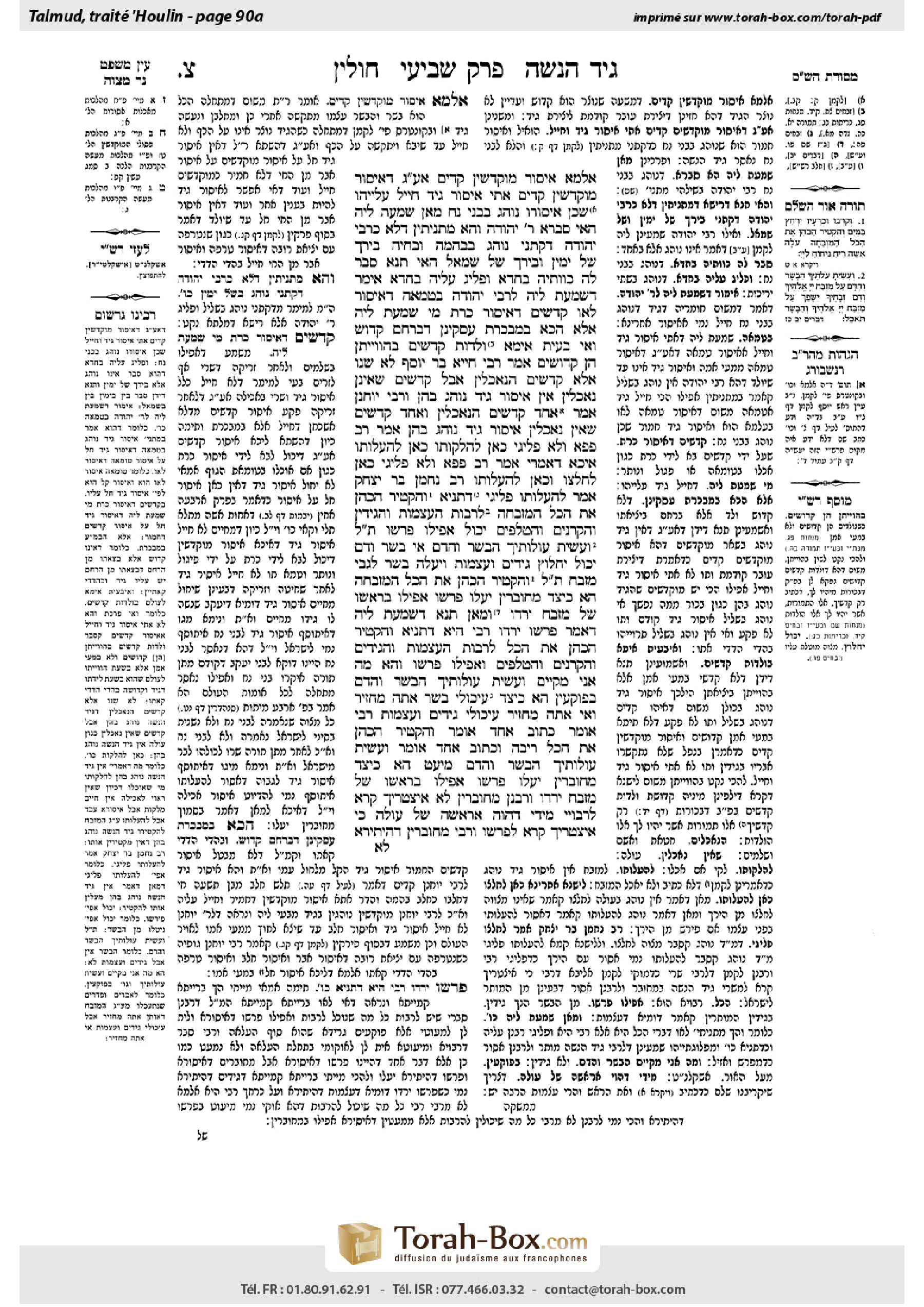
Chullin 90a: Talmud study for Daf Yomi
Study the Talmud for Daf Yomi with scanned pages, Hebrew text, English translations from Sefaria and AI-generated French translations.
Passage selection and English or AI-generated French translation are available where the scan has annotations. Daf Study is independent of Torah-Box and Sefaria.
Browse Chullin · חולין · All tractatesChullin 90a text and translations
This page of Chullin includes the Aramaic text, an English translation and an AI-generated French translation, alongside the scan above.
חולין צ׳ א · Aramaic and Hebrew text
אַלְמָא אִיסּוּר מוּקְדָּשִׁין קָדֵים!
אַף עַל גַּב דְּאִיסּוּר מוּקְדָּשִׁין קָדֵים, אָתֵי אִיסּוּר גִּיד חָיֵיל עֲלַיְיהוּ, שֶׁכֵּן אִיסּוּרוֹ נוֹהֵג בִּבְנֵי נֹחַ.
מַאן שָׁמְעַתְּ לֵיהּ הַאי סְבָרָא? רַבִּי יְהוּדָה, וְהָא מַתְנִיתִין דְּלָא כְּרַבִּי יְהוּדָה, דְּקָתָנֵי: נוֹהֵג בִּבְהֵמָה וּבְחַיָּה, בְּיָרֵךְ שֶׁל יָמִין וּבְיָרֵךְ שֶׁל שְׂמֹאל!
הַאי תַּנָּא סָבַר לַהּ כְּוָותֵיהּ בַּחֲדָא, וּפְלִיג עֲלֵיהּ בַּחֲדָא.
אֵימַר דְּשָׁמְעַתְּ לֵיהּ לְרַבִּי יְהוּדָה בִּטְמֵאָה, דְּאִיסּוּר לָאו, קָדָשִׁים דְּאִיסּוּר כָּרֵת – מִי שָׁמְעַתְּ לֵיהּ?
אֶלָּא, הָכָא בִּמְבַכֶּרֶת עָסְקִינַן, דְּבָרֶחֶם קָדוֹשׁ.
וְאִי בָּעֵית אֵימָא: וַלְדוֹת קָדָשִׁים בַּהֲוָויָיתָן הֵן קְדוֹשִׁים.
אָמַר רַבִּי חִיָּיא בַּר יוֹסֵף: לֹא שָׁנוּ אֶלָּא קֳדָשִׁים הַנֶּאֱכָלִין, אֲבָל קָדָשִׁים שֶׁאֵינָן נֶאֱכָלִין – אֵין אִיסּוּר גִּיד נוֹהֵג בָּהֶן. וְרַבִּי יוֹחָנָן אָמַר: אֶחָד קָדָשִׁים הַנֶּאֱכָלִין וְאֶחָד קָדָשִׁים שֶׁאֵין נֶאֱכָלִין – אִיסּוּר גִּיד נוֹהֵג בָּהֶן.
אָמַר רַב פָּפָּא: וְלָא פְּלִיגִי, כָּאן – לְהַלְקוֹתוֹ, כָּאן – לְהַעֲלוֹתוֹ.
אִיכָּא דְּאָמְרִי, אָמַר רַב פָּפָּא: וְלָא פְּלִיגִי – כָּאן לְחׇלְצוֹ, וְכָאן לְהַעֲלוֹתוֹ.
רַב נַחְמָן בַּר יִצְחָק אָמַר: לְהַעֲלוֹתוֹ פְּלִיגִי, דְּתַנְיָא: ״וְהִקְטִיר הַכֹּהֵן אֶת הַכֹּל הַמִּזְבֵּחָה״ – לְרַבּוֹת הַעֲצָמוֹת וְהַגִּידִין וְהַקְּרָנַיִם וְהַטְּלָפַיִם.
יָכוֹל אֲפִילּוּ פֵּרְשׁוּ, תַּלְמוּד לוֹמַר ״וְעָשִׂיתָ עֹלֹתֶיךָ הַבָּשָׂר וְהַדָּם״.
אִי בָּשָׂר וָדָם, יָכוֹל יַחְלוֹץ גִּידִים וַעֲצָמוֹת וְיַעֲלֶה בָּשָׂר לְגַבֵּי מִזְבֵּחַ? תַּלְמוּד לוֹמַר: ״וְהִקְטִיר הַכֹּהֵן אֶת הַכֹּל הַמִּזְבֵּחָה״. הָא כֵּיצַד? מְחוּבָּרִין – יַעֲלוּ, פֵּרְשׁוּ, אֲפִילּוּ בְּרֹאשׁוֹ שֶׁל מִזְבֵּחַ – יֵרְדוּ.
וּמַאן תַּנָּא דְּשָׁמְעַתְּ לֵיהּ דְּאָמַר פֵּרְשׁוּ יֵרְדוּ? רַבִּי הִיא, דְּתַנְיָא: ״וְהִקְטִיר הַכֹּהֵן אֶת הַכֹּל״ – לְרַבּוֹת הַעֲצָמוֹת וְהַגִּידִים וְהַקְּרָנַיִם וְהַטְּלָפַיִם, וַאֲפִילּוּ פֵּרְשׁוּ.
וְהָא, מָה אֲנִי מְקַיֵּים ״וְעָשִׂיתָ עֹלֹתֶיךָ הַבָּשָׂר וְהַדָּם״? בְּפוֹקְעִין. הָא כֵּיצַד? עִיכּוּלֵי בָשָׂר – אַתָּה מַחֲזִיר, וְאִי אַתָּה מַחֲזִיר עִיכּוּלֵי גִּידִים וַעֲצָמוֹת.
רַבִּי אוֹמֵר: כָּתוּב אֶחָד אוֹמֵר ״וְהִקְטִיר הַכֹּהֵן אֶת הַכֹּל״ – רִיבָּה, וְכָתוּב אֶחָד אוֹמֵר ״וְעָשִׂיתָ עֹלֹתֶיךָ הַבָּשָׂר וְהַדָּם״ – מִיעֵט, הָא כֵּיצַד? מְחוּבָּרִין – יַעֲלוּ, פֵּרְשׁוּ – אֲפִילּוּ בְּרֹאשׁוֹ שֶׁל מִזְבֵּחַ יֵרְדוּ.
וְרַבָּנַן, מְחוּבָּרִין לָא אִיצְטְרִיךְ קְרָא לְרַבּוֹיֵי, מִידֵי דְּהָוֵה אַרֹאשָׁהּ שֶׁל עוֹלָה, כִּי אִיצְטְרִיךְ קְרָא לְפֵרְשׁוּ.
וְרַבִּי, מְחוּבָּרִין דְּהֶיתֵּירָא
Chullin 90a · English translation
Evidently, the limbs of the body are formed before the nerves and sinews, and therefore the prohibition of eating sacrificial animals precedes the prohibition of eating the sciatic nerve.
The Gemara answers: Even though the prohibition of eating sacrificial animals precedes the prohibition of eating the sciatic nerve, the prohibition of eating the sciatic nerve comes and takes effect upon the offspring of consecrated animals, because the prohibition of eating the sciatic nerve adds an extra stringency in that it applies also to descendants of Noah. The prohibition of eating the sciatic nerve was in effect from the time Jacob wrestled with the angel (see Genesis 32:25–33), before the Torah was given. At that time, Jacob and his sons had the status of descendants of Noah, i.e., gentiles. Therefore, the prohibition of eating the sciatic nerve is broader than the prohibition of eating meat of sacrificial animals, which took effect only when the Torah was given.
The Gemara challenges this answer: Whom did you hear holds in accordance with this reasoning? It is Rabbi Yehuda, cited in a later mishna (100b). But the mishna here is not in accordance with the opinion of Rabbi Yehuda, as it teaches that the prohibition of eating the sciatic nerve applies to domesticated animals and to undomesticated animals, to the thigh of the right leg and to the thigh of the left leg. By contrast, Rabbi Yehuda holds that the prohibition applies only with regard to the sciatic nerve in the thigh of one leg (see 90b).
The Gemara explains: The tanna of this mishna holds in accordance with the opinion of Rabbi Yehuda with regard to one halakha, i.e., that the prohibition of eating the sciatic nerve applies to the descendants of Noah, and disagrees with his opinion with regard to one halakha and holds that the prohibition applies to the sciatic nerves of both legs.
The Gemara challenges: Say that you heard that Rabbi Yehuda rules that the prohibition of eating the sciatic nerve takes effect in addition to the prohibition with regard to a non-kosher animal, which is a prohibition punishable by lashes. Since the prohibition of the sciatic nerve is broader in that it applies to the descendants of Noah, it takes effect even though the animal is already prohibited as being not kosher. But in the case of sacrificial animals, whose consumption by an impure person is a prohibition punishable by karet, did you hear that Rabbi Yehuda considers the prohibition of eating the sciatic nerve more stringent, such that it takes effect even though the animal is already prohibited? Therefore, this answer is rejected.
The Gemara offers an alternative answer: Rather, here in the mishna we are dealing with a non-sacred animal giving birth to its firstborn, which becomes sanctified as it leaves the womb. The mishna teaches that although the prohibition of eating the sciatic nerve does not apply to the offspring of sacrificial animals, because their sacrificial status renders them prohibited for consumption before the prohibition of the sciatic nerve takes effect, that is not the case with regard to a firstborn. The sanctified status of a firstborn takes effect only as it leaves the womb, which is after the prohibition of the sciatic nerve takes effect.
And if you wish, say instead that the mishna is dealing with the offspring of all sacrificial animals, and this tanna holds that such animals are sanctified only when they come into being as independent creatures, i.e., at birth. Consequently, the prohibition of the sciatic nerve takes effect before the animal becomes prohibited at the time of its birth; or, according to the opinion that the sciatic nerve is permitted in a fetus, the two prohibitions take effect simultaneously.
§ Having addressed the need for the mishna to state that the prohibition of eating the sciatic nerve applies with regard to sacrificial animals, the Gemara discusses which types of sacrificial animals are included in this prohibition. Rabbi Ḥiyya bar Yosef says: The Sages taught that the prohibition of the sciatic nerve applies only with regard to sacrificial animals that are eaten, e.g., sin offerings, guilt offerings and peace offerings; but with regard to sacrificial animals that are not eaten, e.g., burnt offerings, the prohibition of the sciatic nerve does not apply. And Rabbi Yoḥanan says: The prohibition of the sciatic nerve applies both with regard to sacrificial animals that are eaten and with regard to sacrificial animals that are not eaten.
Rav Pappa said: Rabbi Ḥiyya bar Yosef and Rabbi Yoḥanan do not disagree; they are merely referring to different cases. Here, Rabbi Yoḥanan says that the prohibition of the sciatic nerve applies with regard to flogging one who eats it. There, Rabbi Ḥiyya bar Yosef says that the prohibition of the sciatic nerve does not apply with regard to bringing the meat of the animal up to the altar, i.e., offerings that are burned on the altar are brought up with the sciatic nerve. Burning the sciatic nerve on the altar is not comparable to eating it and is not prohibited.
There are those who say that Rav Pappa said as follows: Rabbi Ḥiyya bar Yosef and Rabbi Yoḥanan do not disagree; they are merely referring to different cases. Here, Rabbi Ḥiyya bar Yosef says that the prohibition of the sciatic nerve does not apply to burnt offerings, in that one is not required to remove it before burning the offering on the altar. There, Rabbi Yoḥanan says that the prohibition does apply, in that if one did remove the sciatic nerve, it is prohibited to bring it up onto the altar independently.
Rav Naḥman bar Yitzḥak disagreed with Rav Pappa and said: Rabbi Ḥiyya bar Yosef and Rabbi Yoḥanan disagree with regard to whether it is permitted to bring up the sciatic nerve to the altar even when it remains in the thigh. As it is taught in a baraita: In the verse: “And the priest shall make it all smoke on the altar” (Leviticus 1:9), the term “it all” serves to include the bones, and the sinews, and the horns, and the hooves among those items burned on the altar.
One might have thought that even if they became detached from the flesh of the burnt offering they are burned upon the altar. Therefore, the verse states: “And you shall offer your burnt offerings, the flesh and the blood, upon the altar of the Lord your God” (Deuteronomy 12:27), indicating that only the flesh and the blood are offered upon the altar.
The baraita continues: If it is only the flesh and the blood that are offered on the altar, one might have thought that a priest must first remove the sinews and bones from an offering and only then may he bring up the flesh to be burned upon the altar. Therefore, the verse states: “And the priest shall make it all smoke on the altar,” including the sinews and bones. How can these texts be reconciled? If the sinews and bones are attached to the flesh, they shall ascend. If they became detached from the flesh, then even if they are already at the top of the altar, they shall descend.
The Gemara comments: And who is the tanna that you heard, who said if they became detached from the flesh, they shall descend? It is Rabbi Yehuda HaNasi, as it is taught in a baraita: In the verse that states: “And the priest shall make it all smoke on the altar,” the term “it all” serves to include the bones, and the sinews, and the horns, and the hooves among those items burned on the altar, and that is the halakha even if they became detached from the flesh of the offering.
The baraita continues: But if so, how do I realize the meaning of the verse: “And you shall offer your burnt offerings, the flesh and the blood, upon the altar of the Lord your God” (Deuteronomy 12:27), which indicates that only the flesh and blood of an offering are offered on the altar? It is referring to parts of the offering that become dislodged from the fire. How so? If the partially consumed flesh of a burnt offering is dislodged from the altar, you return it to the fire, but you do not return the partially consumed sinews and bones that become dislodged.
The baraita continues: Rabbi Yehuda HaNasi says that one verse states: “And the priest shall make it all smoke on the altar,” which included sinews and bones. And one verse states: “And you shall offer your burnt offerings, the flesh and the blood,” which excluded any part other than the flesh and the blood. How can these texts be reconciled? If the sinews and bones were attached to the flesh, they shall ascend. If they became detached from the flesh, then even if they are already on top of the altar, they shall descend.
The Gemara explains their dispute: And the Rabbis hold that with regard to sinews and bones that are attached to the flesh it was not necessary for a verse to include the obligation to bring them up to the altar. It is clear that they must be brought up, just as it is the halakha that the head of a burnt offering, which contains many bones, is brought up, as stated explicitly in the verse: “And Aaron’s sons, the priests, shall lay the pieces, and the head, and the fat, in order upon the wood that is on the fire that is upon the altar” (Leviticus 1:8). When a verse was necessary it was for the case where the sinews and bones became detached from the flesh. Consequently, when the verse uses the inclusive phrase “it all,” it is to include sinews and bones that became detached.
But Rabbi Yehuda HaNasi holds that with regard to sinews and bones that are attached to the flesh and that are permitted to be eaten,
Chullin 90a · Traduction française (IA)
Apparemment, les membres du corps sont formés avant les nerfs et les tendons, et par conséquent, la prohibition de manger les animaux sacrifiés précède la prohibition de manger le nerf sciatique.
La Guemara répond : Même si la prohibition de manger les animaux sacrés précède la prohibition de manger le nerf sciatique, la prohibition de manger le nerf sciatique s'applique aux descendants des animaux sacrés, car la prohibition de manger le nerf sciatique est plus stricte dans la mesure où elle s'applique également aux descendants de Noé. La prohibition de manger le nerf sciatique était en vigueur depuis l'époque où Jacob lutta contre l'ange (voir Genèse 32:25–33), avant que la Torah ne soit donnée. À cette époque, Jacob et ses fils avaient le statut de descendants de Noé, c'est-à-dire des non-juifs. Par conséquent, la prohibition de manger le nerf sciatique est plus large que la prohibition de manger la viande des animaux sacrés, qui est entrée en vigueur seulement avec la donnation de la Torah.
La Guemara conteste cette réponse : Qui as-tu entendu qui suit ce raisonnement ? C'est Rabbi Yéhuda, cité dans un mishna ultérieur (100b). Mais le mishna ici ne suit pas l'opinion de Rabbi Yéhuda, car il enseigne que la prohibition de manger le nerf sciatique s'applique aux animaux domestiques et aux animaux sauvages, au mollet de la jambe droite et au mollet de la jambe gauche. À l'inverse, Rabbi Yéhuda considère que la prohibition s'applique uniquement au nerf sciatique du mollet d'une seule jambe (voir 90b).
La Guemara explique : Le tanna de ce mishna suit l'opinion de Rabbi Yéhuda concernant une halakha, c'est-à-dire que la prohibition de manger le nerf sciatique s'applique aux descendants de Noé, et s'oppose à son opinion concernant une autre halakha, en considérant que la prohibition s'applique aux nerfs sciatiques des deux jambes.
La Guemara conteste : Dis que tu as entendu que Rabbi Yéhuda considère que la prohibition de manger le nerf sciatique s'applique en plus de la prohibition concernant un animal non-kosher, qui est une prohibition punie de fessures. Puisque la prohibition du nerf sciatique est plus large dans la mesure où elle s'applique aux descendants de Noé, elle s'applique même si l'animal est déjà interdit comme non-kosher. Mais dans le cas des animaux sacrés, dont la consommation par une personne impure est une prohibition punie de karet, as-tu entendu que Rabbi Yéhuda considère la prohibition de manger le nerf sciatique comme plus stricte, de sorte qu'elle s'applique même si l'animal est déjà interdit ? Par conséquent, cette réponse est rejetée.
La Guemara propose une autre réponse : Plutôt, ici dans le mishna, nous parlons d'un animal non sacré qui donne naissance à son premier-né, qui devient sanctifié lorsqu'il sort du ventre. Le mishna enseigne que bien que la prohibition de manger le nerf sciatique ne s'applique pas aux descendants des animaux sacrés, car leur statut sacré les rend interdits à la consommation avant que la prohibition du nerf sciatique ne s'applique, cela n'est pas le cas concernant le premier-né. Le statut sanctifié du premier-né s'applique seulement lorsqu'il sort du ventre, ce qui est après que la prohibition du nerf sciatique ait pris effet.
Et si tu veux, dis plutôt que le mishna traite des descendants de tous les animaux sacrifiés, et ce tanna considère que ces animaux sont sanctifiés seulement lorsqu'ils deviennent des êtres indépendants, c'est-à-dire à la naissance. Par conséquent, la prohibition du nerf sciatique s'applique avant que l'animal ne devienne interdit à la naissance ; ou, selon l'opinion qui considère que le nerf sciatique est permis dans un fœtus, les deux prohibitions s'appliquent simultanément.
§ Ayant abordé le besoin que le mishna indique que la prohibition de manger le nerf sciatique s'applique aux animaux sacrifiés, la Guemara discute des types d'animaux sacrifiés inclus dans cette prohibition. Rabbi Ḥiyya bar Yosef dit : Les Sages ont enseigné que la prohibition du nerf sciatique s'applique uniquement aux animaux sacrifiés qui sont mangés, par exemple, les sacrifices expiatoires, les sacrifices de culpabilité et les sacrifices de paix ; mais concernant les animaux sacrifiés qui ne sont pas mangés, par exemple, les holocaustes, la prohibition du nerf sciatique ne s'applique pas. Et Rabbi Yoḥanan dit : La prohibition du nerf sciatique s'applique à la fois aux animaux sacrifiés qui sont mangés et aux animaux sacrifiés qui ne sont pas mangés.
Rav Pappa a dit : Rabbi Ḥiyya bar Yosef et Rabbi Yoḥanan ne sont pas en désaccord ; ils parlent simplement de cas différents. Ici, Rabbi Yoḥanan dit que la prohibition du nerf sciatique s'applique à l'infraction de frapper celui qui le mange. Là, Rabbi Ḥiyya bar Yosef dit que la prohibition du nerf sciatique ne s'applique pas à l'offrande de viande sur l'autel, c'est-à-dire les offrandes brûlées sur l'autel sont apportées avec le nerf sciatique. Brûler le nerf sciatique sur l'autel n'est pas comparable à le manger et n'est pas interdit.
Certains disent que Rav Pappa a dit comme suit : Rabbi Ḥiyya bar Yosef et Rabbi Yoḥanan ne sont pas en désaccord ; ils parlent simplement de cas différents. Ici, Rabbi Ḥiyya bar Yosef dit que la prohibition du nerf sciatique ne s'applique pas aux offrandes brûlées, car on n'est pas tenu de le retirer avant de brûler l'offrande sur l'autel. Là, Rabbi Yoḥanan dit que la prohibition s'applique, car si l'on a retiré le nerf sciatique, il est interdit d'apporter le nerf sciatique seul sur l'autel.
Rav Naḥman bar Yitzḥak a désaccordé Rav Pappa et a dit : Rabbi Ḥiyya bar Yosef et Rabbi Yoḥanan sont en désaccord concernant la permission d'apporter le nerf sciatique sur l'autel même s'il reste dans le mollet. Comme il est enseigné dans une baraïta : Dans la verset : « Et le prêtre fera brûler tout cela sur l'autel » (Lévitique 1:9), le terme « tout cela » sert à inclure les os, les nerfs, les cornes et les sabots parmi les choses brûlées sur l'autel.
On pouvait penser que même si elles sont détachées de la chair du holocauste, elles sont brûlées sur l'autel. Par conséquent, la Sainte Écriture dit : « Et tu offriras tes holocaustes, la chair et le sang, sur l'autel du Seigneur ton Dieu » (Lévitique 12:27), indiquant que seul la chair et le sang sont offerts sur l'autel.
La baraïta continue : Si c'est seulement la chair et le sang qui sont offerts sur l'autel, on pouvait penser qu'un prêtre doit d'abord retirer les nerfs et les os d'une offrande et seulement ensuite peut-il présenter la chair à être brûlée sur l'autel. Par conséquent, la Sainte Écriture dit : « Et le prêtre fera monter tout cela sur l'autel », y compris les nerfs et les os. Comment ces textes peuvent-ils être conciliés ? Si les nerfs et les os sont attachés à la chair, ils montent. Si ils sont devenus détachés de la chair, même s'ils sont déjà en haut de l'autel, ils descendent.
La Guemara commente : Et qui est le tanna que vous avez entendu, qui a dit que s'ils sont devenus détachés de la chair, ils descendent ? C'est Rabbi Yehuda HaNasi, comme il est enseigné dans une baraïta : Dans la Sainte Écriture qui dit : « Et le prêtre fera monter tout cela sur l'autel », le terme « tout cela » sert à inclure les os, les nerfs, les cornes et les sabots parmi les choses brûlées sur l'autel, et c'est la halakha même s'ils sont devenus détachés de la chair de l'offrande.
La baraïta continue : Mais si c'est ainsi, comment puis-je comprendre le sens de la Sainte Écriture : « Et tu offriras tes holocaustes, la chair et le sang, sur l'autel du Seigneur ton Dieu » (Deutéronome 12:27), qui indique que seul la chair et le sang d'une offrande sont offerts sur l'autel ? Il s'agit des parties de l'offrande qui se détachent du feu. Comment ? Si la chair partiellement consumée d'un holocauste se détache de l'autel, on la remet dans le feu, mais on ne remet pas les nerfs et les os partiellement consumés qui se détachent.
La baraïta continue : Rabbi Yehuda HaNasi dit que l'une des Saintes Écritures dit : « Et le prêtre fera monter tout cela sur l'autel », qui inclut les nerfs et les os. Et l'autre Sainte Écriture dit : « Et tu offriras tes holocaustes, la chair et le sang », qui exclut toute partie autre que la chair et le sang. Comment ces textes peuvent-ils être conciliés ? Si les nerfs et les os étaient attachés à la chair, ils montent. Si ils sont devenus détachés de la chair, même s'ils sont déjà en haut de l'autel, ils descendent.
La Guemara explique leur débat : Et les Rabbins pensent que concernant les nerfs et les os qui sont attachés à la chair, il n'était pas nécessaire qu'une Sainte Écriture inclue l'obligation de les présenter sur l'autel. Il est clair qu'ils doivent être présentés, tout comme c'est la halakha que la tête d'un holocauste, qui contient beaucoup d'os, est présentée, comme il est dit explicitement dans la Sainte Écriture : « Et les fils d'Aaron, les prêtres, placeront les morceaux, la tête et la graisse, dans l'ordre sur le bois qui est sur le feu qui est sur l'autel » (Lévitique 1:8). Quand une Sainte Écriture était nécessaire, c'était pour le cas où les nerfs et les os sont devenus détachés de la chair. Par conséquent, quand la Sainte Écriture utilise l'expression inclusive « tout cela », c'est pour inclure les nerfs et les os qui sont devenus détachés.
Mais Rabbi Yehuda HaNasi affirme que concernant les nerfs et les os qui sont attachés à la chair et qui sont permis à manger,
Traduction française générée par IA à partir de l’édition anglaise de Sefaria. Vérifie toujours un passage avec le texte source.
Text from Sefaria: William Davidson Edition - Vocalized Aramaic (unknown); William Davidson Edition - English (CC BY NC).