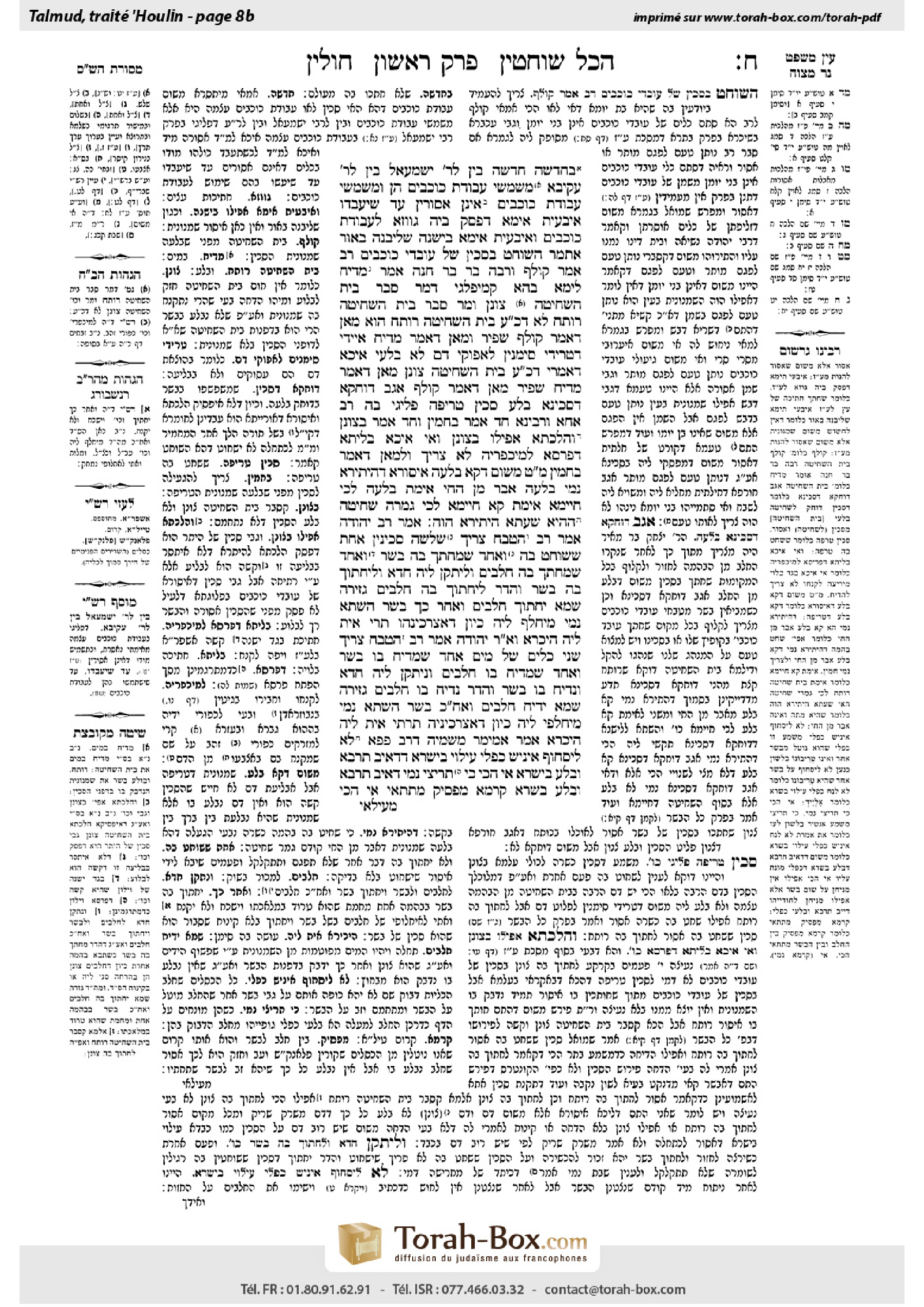
Chullin 8b: Talmud study for Daf Yomi
Study the Talmud for Daf Yomi with scanned pages, Hebrew text, English translations from Sefaria and AI-generated French translations.
Passage selection and English or AI-generated French translation are available where the scan has annotations. Daf Study is independent of Torah-Box and Sefaria.
Browse Chullin · חולין · All tractatesChullin 8b text and translations
This page of Chullin includes the Aramaic text, an English translation and an AI-generated French translation, alongside the scan above.
חולין ח׳ ב · Aramaic and Hebrew text
בַּחֲדָשָׁה.
חֲדָשָׁה, בֵּין לְרַבִּי יִשְׁמָעֵאל בֵּין לְרַבִּי עֲקִיבָא, מְשַׁמְּשֵׁי עֲבוֹדָה זָרָה הֵן, וּמְשַׁמְּשֵׁי עֲבוֹדָה זָרָה אֵינָן אֲסוּרִין עַד שֶׁיֵּעָבֵדוּ! אִיבָּעֵית אֵימָא, דִּפְסַק בֵּיהּ גְּוָוזָא לַעֲבוֹדָה זָרָה, וְאִיבָּעֵית אֵימָא, בִּישָׁנָה שֶׁלִּיבְּנָהּ בָּאוּר.
אִתְּמַר: הַשּׁוֹחֵט בְּסַכִּין שֶׁל גּוֹיִם, רַב אָמַר: קוֹלֵף, וְרַבָּה בַּר בַּר חָנָה אָמַר: מֵדִיחַ. לֵימָא בְּהָא קָמִיפַּלְגִי, דְּמָר סָבַר: בֵּית הַשְּׁחִיטָה צוֹנֵן, וּמָר סָבַר: בֵּית הַשְּׁחִיטָה רוֹתֵחַ.
לָא, דְּכוּלֵּי עָלְמָא בֵּית הַשְּׁחִיטָה רוֹתֵחַ הוּא; מַאן דְּאָמַר קוֹלֵף – שַׁפִּיר, וּמַאן דְּאָמַר מֵדִיחַ – אַיְּידֵי דִּטְרִידִי סִימָנִין לְאַפּוֹקֵי דָּם לָא בָּלְעִי.
אִיכָּא דְּאָמְרִי, דְּכוּלֵּי עָלְמָא בֵּית הַשְּׁחִיטָה צוֹנֵן. מַאן דְּאָמַר מֵדִיחַ – שַׁפִּיר, מַאן דְּאָמַר קוֹלֵף – אַגַּב דּוּחְקָא דְסַכִּינָא בָּלַע.
סַכִּין טְרֵיפָה, פְּלִיגִי בַּהּ רַב אַחָא וְרָבִינָא, חַד אָמַר: בְּחַמִּין, וְחַד אָמַר: בְּצוֹנֵן, וְהִלְכְתָא: אֲפִילּוּ בְּצוֹנֵן, וְאִי אִיכָּא בְּלִיתָא דִּפְרָסָא לְמִיכְפְּרֵיהּ, לָא צְרִיךְ.
וּלְמַאן דְּאָמַר בְּחַמִּין, מַאי טַעְמָא? מִשּׁוּם דְּקָא בָלְעָה אִיסּוּרָא? דְּהֶיתֵּירָא נָמֵי בָּלְעָה אֵבֶר מִן הַחַי! אֵימַת בָּלְעָה? לְכִי חָיְימָא. אֵימַת קָא חָיְימָא? לְכִי גָמְרָה שְׁחִיטָה, הָהִיא שַׁעְתָּא הֶיתֵּירָא הֲוָה.
אָמַר רַב יְהוּדָה אָמַר רַב: הַטַּבָּח צָרִיךְ שְׁלֹשָׁה סַכִּינִין, אַחַת שֶׁשּׁוֹחֵט בָּהּ, וְאֶחָד שֶׁמְּחַתֵּךְ בָּהּ בָּשָׂר, וְאֶחָד שֶׁמְּחַתֵּךְ בָּהּ חֲלָבִים.
וְלִיתַקֵּן לֵיהּ חֲדָא, וְלִיחְתּוֹךְ בָּהּ בָּשָׂר, וַהֲדַר לִיחְתּוֹךְ בַּהּ חֲלָבִים? גְּזֵירָה שֶׁמָּא יַחְתּוֹךְ חֲלָבִים וְאַחַר כָּךְ בָּשָׂר. הַשְׁתָּא נָמֵי מִיחַלַּף לֵיהּ! כֵּיוָן דְּאַצְרְכִינְהוּ תְּרֵי – אִית לֵיהּ הֶיכֵּרָא.
וְאָמַר רַב יְהוּדָה אָמַר רַב: הַטַּבָּח צָרִיךְ שְׁנֵי כֵּלִים שֶׁל מַיִם, אֶחָד שֶׁמֵּדִיחַ בּוֹ בָּשָׂר, וְאֶחָד שֶׁמֵּדִיחַ בּוֹ חֲלָבִים. וְנִיתַקֵּן לֵיהּ חֲדָא, וּנְדִיחַ בּוֹ בָּשָׂר וַהֲדַר נְדִיחַ בּוֹ חֲלָבִים? גְּזֵירָה שֶׁמָּא יָדִיחַ חֲלָבִים וְאַחַר כָּךְ בָּשָׂר. הַשְׁתָּא נָמֵי מִיחַלְּפִי לֵיהּ? כֵּיוָן דְּאַצְרְכִינֵּיהּ תַּרְתֵּי אִית לֵיהּ הֶיכֵּרָא.
אָמַר אַמֵּימָר מִשְּׁמֵיהּ דְּרַב פָּפָּא: לָא לִיסְחוֹף אִינִישׁ כַּפְלֵי עִילָּוֵי בִּישְׂרָא, דְּדָאֵיב תַּרְבָּא וּבָלַע בִּישְׂרָא.
אִי הָכִי, כִּי תְּרִיצִי נָמֵי דָּאֵיב תַּרְבָּא וּבָלַע בִּשְׂרָא? קְרָמָא מַפְסֵיק מִתַּתַּאי! אִי הָכִי
Chullin 8b · English translation
The Gemara rejects that possibility: Rav Naḥman is referring to the case of a new knife on which there is no residue.
The Gemara challenges: If it is a new knife, both according to Rabbi Yishmael and according to Rabbi Akiva, who disagreed about whether an idol is forbidden from the moment that one crafts it or from the moment that one worships it, a knife is merely in the category of accessories of idol worship, and accessories of idol worship are forbidden only after they are used for idol worship. The Gemara explains: If you wish, say that the reference is to a case where he cut a branch [gevaza] for idol worship with the knife, which leaves no residue. And if you wish, say instead that Rav Naḥman is referring to the case of an old knife that he burned until it became white hot in the fire, and therefore, there is no residue on the knife.
§ It was stated: With regard to one who slaughters an animal with the knife of gentiles, Rav says: He peels off a layer of the flesh from the place on the animal where the knife touched the flesh and the forbidden residue on the knife was absorbed. And Rabba bar bar Ḥana says: He rinses the place where the knife touched the flesh. The Gemara suggests: Let us say that they disagree about this, that one Sage, Rabba bar bar Ḥana, holds: The area of the slaughter on the throat is cold and does not absorb the forbidden residue, and therefore rinsing is sufficient. And one Sage, Rav, holds: The area of the slaughter on the throat is hot and therefore it absorbs the forbidden residue.
The Gemara rejects that suggestion: No, it is possible that everyone holds that the area of the slaughter on the throat is hot. For the one who says that he peels off a layer, it works out well, and the one who says that he rinses the place where the knife touched the flesh holds that since the two organs that must be severed in ritual slaughter [simanim], i.e., the windpipe and the gullet, are occupied with discharging blood, they do not absorb the residue.
There are those who say that everyone holds that the area of the slaughter on the throat is cold. For the one who says that he rinses the place where the knife touched the flesh, it works out well, and the one who says that he peels off a layer holds that although that area is cold, due to the pressure of the knife on the throat, the flesh absorbs the residue.
§ With regard to a knife with which an animal that is a tereifa was slaughtered, Rav Aḥa and Ravina disagree. One says: One purges it in hot water to remove the absorptions from the tereifa, and one says: One rinses it in cold water, and that is sufficient. And the halakha is: One may rinse it even in cold water. And if there is a tattered piece of a curtain with which to wipe the knife, one need not rinse it.
And according to the one who says that one purges it in hot water, what is the reason that he must do so; is it due to the premise that the knife absorbed forbidden residue? That reasoning should not be limited to a case where he slaughtered a tereifa. A knife with which he slaughtered an animal that is permitted should also require purging, because it absorbed residue from the limb from a living animal before the slaughter was completed. The Gemara answers: When is there concern that the knife absorbed the residue? It is when the throat grows warm. When does it grow warm? It is at the point when the slaughter is complete. At that moment, it is already permitted.
§ Rav Yehuda says that Rav says: The slaughterer requires three knives, one with which he slaughters the animal, and one with which he cuts meat, and one with which he cuts forbidden fats. One may not use the same knife for cutting the meat and the forbidden fats due to the residue on the knife after cutting the forbidden fats.
The Gemara suggests: And let him designate one knife for cutting both the meat and forbidden fats and cut meat with it and then cut forbidden fats with it. In this manner the forbidden residue on the knife will not affect the meat. The Gemara explains: The Sages issued a rabbinic decree prohibiting the use of one knife to cut meat and then forbidden fats lest he also cut forbidden fats and cut meat thereafter. The Gemara challenges: Now too, after the decree mandating separate knives there is a concern that they will be confused for him and he will use the knife that cut the forbidden fats to cut the meat. The Gemara explains: Since the Sages required him to have two knives, he has a conspicuous marker on one of the knives that will prevent confusion.
And Rav Yehuda says that Rav says: The slaughterer requires two vessels of water, one with which he rinses meat and one with which he rinses forbidden fats. The Gemara suggests: And let him designate one vessel and rinse meat with the water in the vessel and then rinse forbidden fats with the water in the same vessel. The Gemara explains: The Sages issued a rabbinic decree to prohibit doing so lest he rinse fats and rinse meat thereafter. The Gemara challenges: Now too, after the decree mandating separate vessels there is a concern that they will be confused for him and he will rinse meat in the vessel in which he rinsed fats. The Gemara answers: Since the Sages required him to have two vessels, he has a conspicuous marker on one of the vessels that will prevent confusion.
§ Ameimar says in the name of Rav Pappa: A person should not place [lisḥof] the flanks of an animal atop other meat so that the forbidden fats that are attached to the flanks are in contact with the other meat, due to the fact that the forbidden fat liquefies and flows and the meat absorbs it.
The Gemara raises an objection: If so, and that is a concern, when the flanks are placed in their typical manner [teritzi] as well, with the forbidden fat above the meat of the flanks, the forbidden fat flows and the meat of the flanks absorbs it. The Gemara explains: The membrane between the forbidden fat and the meat of the flanks interposes from below and prevents absorption of the forbidden fat. The Gemara challenges: If so,
Chullin 8b · Traduction française (IA)
La Guemara rejette cette possibilité : Rav Naḥman fait référence au cas d’un couteau neuf sur lequel il n’y a pas de résidu.
La Guemara soulève un défi : Si c’est un couteau neuf, selon les deux, Rabbi Yishmael et Rabbi Akiva, qui s’opposaient sur le moment où un idole devient interdite, à savoir le moment où on le fabrique ou le moment où on le cultive, un couteau est simplement dans la catégorie des accessoires du culte idolâtre, et les accessoires du culte idolâtre sont interdits uniquement après qu’ils aient été utilisés pour le culte idolâtre. La Guemara explique : Si vous le souhaitez, dites que la référence est au cas où il a coupé une branche [gevaza] pour le culte idolâtre avec le couteau, ce qui ne laisse pas de résidu. Et si vous le souhaitez, dites plutôt que Rav Naḥman fait référence au cas d’un couteau ancien qu’il a brûlé jusqu’à ce qu’il devienne blanc à la flamme, et donc, il n’y a pas de résidu sur le couteau.
§ On a dit : Concernant celui qui sacrifie un animal avec le couteau des non-Juifs, Rav dit : Il enlève une couche de la viande au lieu où le couteau a touché la viande et où le résidu interdit a été absorbé. Et Rabba bar bar Ḥana dit : Il rince la zone où le couteau a touché la viande. La Guemara suggère : Disons qu’ils s’opposent sur ce point, à savoir que l’un des Sages, Rabba bar bar Ḥana, considère que la zone de la sacrifice à la gorge est froide et ne n’absorbe pas le résidu interdit, et donc le rinçage suffit. Et l’autre Sage, Rav, considère que la zone de la sacrifice à la gorge est chaude et donc qu’elle absorbe le résidu interdit.
La Guemara rejette cette suggestion : Non, il est possible que tout le monde considère que la zone de la boucherie à la gorge est chaude. Pour celui qui dit qu’il enlève une couche, cela fonctionne bien, et celui qui dit qu’il rince la zone où le couteau a touché la viande considère que les deux organes qui doivent être séparés dans la boucherie [simanim], c’est-à-dire la trachée et le gosier, sont occupés à écouler le sang, et donc ils n’absorbent pas le résidu.
Certains disent que tout le monde considère que la zone de la boucherie à la gorge est froide. Pour celui qui dit qu’il rince la zone où le couteau a touché la viande, cela fonctionne bien, et celui qui dit qu’il enlève une couche considère que bien que cette zone soit froide, en raison de la pression du couteau sur la gorge, la viande absorbe le résidu.
§ Concernant un couteau avec lequel un animal téréifé a été sacrifié, Rav Aḥa et Ravina s’opposent. L’un dit : On le nettoie dans de l’eau chaude pour éliminer les absorptions provenant du téréifé, et l’autre dit : On le rince dans de l’eau froide, et cela suffit. Et la halakha est : On peut rincer même dans de l’eau froide. Et si il y a un morceau déchiré d’un rideau avec lequel on peut essuyer le couteau, on n’a pas besoin de le rincer.
Et selon celui qui dit qu’on le nettoie dans de l’eau chaude, quelle est la raison qu’il doit le faire ; est-ce en raison du principe que le couteau a absorbé un résidu interdit ? Cette raisonnance ne devrait pas être limitée au cas où il a sacrifié un téréifé. Un couteau avec lequel il a sacrifié un animal permis devrait aussi nécessiter un nettoyage, car il a absorbé un résidu provenant d’un membre d’un animal vivant avant que la bête ne soit achevée. La Guemara répond : Quand y a-t-il une crainte que le couteau ait absorbé le résidu ? C’est quand la gorge se réchauffe. Quand se réchauffe-t-elle ? C’est au moment où la bête est achevée. À ce moment, il est déjà permis.
§ Rav Yehuda dit que Rav dit : Le boucher a besoin de trois couteaux, un avec lequel il sacrifie l’animal, un avec lequel il découpe la viande, et un avec lequel il découpe les graisses interdites. On ne peut pas utiliser le même couteau pour découper la viande et les graisses interdites en raison du résidu restant après avoir coupé les graisses interdites.
La Guemara suggère : Et qu’il désigne un seul couteau pour couper à la fois la viande et les graisses interdites et qu’il coupe la viande avec ce couteau et ensuite les graisses interdites avec ce même couteau. Ainsi, le résidu interdit sur le couteau ne nuira pas à la viande. La Guemara explique : Les Sages ont émis un décret rabbinique interdisant l’utilisation d’un seul couteau pour couper la viande et ensuite les graisses interdites de peur qu’il ne coupe les graisses interdites et ensuite la viande. La Guemara soulève un défi : Maintenant aussi, après le décret exigeant des couteaux séparés, il y a une crainte qu’ils soient confondus et qu’il utilise le couteau qui a coupé les graisses interdites pour couper la viande. La Guemara explique : Puisque les Sages ont exigé qu’il ait deux couteaux, il a un marqueur évident sur l’un d’eux qui empêchera la confusion.
Et Rav Yehuda dit que Rav dit : Le boucher a besoin de deux récipients d’eau, un avec lequel il rince la viande et un avec lequel il rince les graisses interdites. La Guemara suggère : Et qu’il désigne un seul récipient et qu’il rince la viande avec l’eau du récipient et ensuite rince les graisses interdites avec l’eau du même récipient. La Guemara explique : Les Sages ont émis un décret rabbinique pour interdire cela de peur qu’il rince les graisses et ensuite rince la viande. La Guemara soulève un défi : Maintenant aussi, après le décret exigeant des récipients séparés, il y a une crainte qu’ils soient confondus et qu’il rince la viande dans le récipient où il a rincé les graisses. La Guemara répond : Puisque les Sages ont exigé qu’il ait deux récipients, il a un marqueur évident sur l’un d’eux qui empêchera la confusion.
§ Ameimar dit au nom de Rav Pappa : Une personne ne devrait pas placer [lisḥof] les flancs d’un animal sur d’autres viandes de sorte que les graisses interdites attachées aux flancs soient en contact avec les autres viandes, en raison du fait que la graisse interdite fond et coule et que la viande l’absorbe.
La Guemara soulève un objection : Si c’est le cas, et c’est une crainte, alors quand les flancs sont placés dans leur manière habituelle [teritzi], avec la graisse interdite au-dessus de la viande des flancs, la graisse interdite coule et la viande des flancs l’absorbe. La Guemara explique : La membrane entre la graisse interdite et la viande des flancs interpose d’en bas et empêche l’absorption de la graisse interdite. La Guemara soulève un défi : Si c’est le cas,
Traduction française générée par IA à partir de l’édition anglaise de Sefaria. Vérifie toujours un passage avec le texte source.
Text from Sefaria: William Davidson Edition - Vocalized Aramaic (unknown); William Davidson Edition - English (CC BY NC).